⏱ 20 min read
Most enterprise APIs fail long before they go down.
They fail when everyone still thinks they mean the same thing, but they no longer do. The endpoint is green, latency looks fine, the dashboard is smugly healthy—and yet sales cannot trust customer status, finance disputes order totals, and support sees three versions of “active subscription” depending on which screen they open. The outage is semantic, not technical. Those are the expensive ones.
This is why API design cannot be treated as a thin integration concern. In serious systems, an API contract is not just a transport schema or an OpenAPI document. It is a boundary of meaning. It decides what a thing is called, what is guaranteed, what can change, and what another team is allowed to assume. In other words, an API contract often behaves like a bounded context whether architects acknowledge it or not.
That is the central argument of this article: if you are doing domain-driven design in an enterprise landscape of microservices, event streams, partner integrations, and aging core systems, you should treat API contracts as bounded context boundaries. Not metaphorically. Operationally. Structurally. Politically. microservices architecture diagrams
Because once you do, a lot of persistent mess starts to make sense: why canonical models disappoint, why “simple” field reuse becomes organizational debt, why Kafka topics quietly become integration monoliths, and why migrations succeed only when semantics move before code does. event-driven architecture patterns
A boundary is not a wall. It is a treaty line. Good architecture is less about shared components and more about negotiated meaning.
Context
In classical domain-driven design, a bounded context is the explicit boundary within which a model applies consistently. “Customer,” “Order,” “Policy,” “Account,” “Claim”—these words are not globally stable across the enterprise. They are stable only within a context that defines their semantics.
That idea remains one of the most useful weapons against enterprise entropy.
But modern delivery teams often implement DDD while handling APIs as merely technical artifacts: versioned payloads, generated clients, endpoint catalogs, and governance checklists. The result is a split-brain architecture. Domain boundaries are discussed in workshops; contract boundaries are implemented somewhere else by integration teams, platform groups, or whichever squad owns the gateway. EA governance checklist
The split does not hold for long.
The API is where one model meets another. It is the point where internal truth becomes external promise. That promise is narrower than the internal model by design. It should be. But it still encodes domain language, lifecycle assumptions, identity rules, and invariants. If those semantics are muddled, the consumer does not merely receive bad data; it builds the wrong business behavior on top of it.
This is especially visible in enterprises running a mix of:
- legacy systems of record
- new microservices
- Kafka-based event backbones
- partner and channel APIs
- customer-facing digital products
- analytics platforms pulling “the same” business entities for different purposes
In that world, the API contract becomes the practical edge of the bounded context. It is where autonomy is defended or lost.
Problem
The common failure pattern looks innocent at first.
A company starts decomposing a monolith, perhaps around order management, customer servicing, billing, or claims. Teams are told to create APIs. To move faster, they reuse shared schemas. Soon they define a “canonical customer,” a “standard order,” or an “enterprise product model” that everyone should align to.
This sounds responsible. It feels efficient. It is usually the beginning of semantic sprawl.
The problem is not reuse itself. The problem is pretending that multiple domains share the same meaning just because they share a noun.
Take “customer.” In CRM, a customer may be a managed relationship. In billing, it is a liable party. In identity and access, it is a principal with credentials. In support, it is a case-bearing contact. In risk, it may be a legal counterparty. In consumer channels, it could be a household profile. These are not formatting differences. They are different business truths.
When one API contract tries to satisfy all of them, it stops representing a context and starts becoming a compromise artifact. Compromise artifacts age badly. They attract optional fields, unclear ownership, undocumented invariants, and hidden coupling.
Then the enterprise sees familiar symptoms:
- Breaking changes disguised as “minor schema updates”
- Integration teams maintaining translation logic nobody wants to own
- Kafka topics overloaded with mixed-use semantics
- Consumer services caching and reinterpreting source data
- Reconciliation jobs becoming permanent fixtures
- Duplicate “golden sources” emerging by stealth
- Governance boards arguing about definitions after implementation has started
At this point, architects often talk about versioning, backward compatibility, and event standards. Those matter. But they are not the root issue.
The root issue is that the enterprise has not aligned API contracts with bounded contexts. It has exposed nouns without exposing context.
Forces
Several forces make this problem stubborn.
1. Enterprises crave standardization
Large organizations are biased toward uniform models because uniformity feels controllable. Procurement likes standards. Governance likes standards. Platform teams like standards. Auditors definitely like standards. ArchiMate for governance
But semantic uniformity is not the same as technical consistency. You can standardize interface practices—naming, error handling, security, discoverability, observability—without forcing one business meaning across unrelated contexts.
That distinction is where many architecture programs go off the road.
2. Consumers always want “just one more field”
Every API provider has heard it: “Can you just add billing state, risk segment, service tier, and account manager to the customer response? It will save us another call.”
That is how context leakage starts. One field at a time.
An API that serves many use cases tends to drift toward a shared enterprise read model, except without explicit ownership or proper design. Eventually it is neither stable enough for domain integrity nor optimized enough for product delivery.
3. Event platforms magnify semantic mistakes
Kafka is brilliant at moving facts quickly and durably. It is also merciless at scaling confusion. A badly defined event contract, once adopted by many consumers, becomes architectural concrete.
Teams start publishing events named after broad entities—CustomerUpdated, OrderChanged, AccountSynced—without asking the crucial question: updated according to whose model? Which invariants hold? What exactly changed? Is this event domain-significant, integration-oriented, or merely system-state replication?
Event-driven architectures do not remove bounded contexts. They make them more necessary.
4. Legacy migration creates semantic overlap
In migration scenarios, old and new systems often coexist for years. During that period, multiple representations of the same business concept are active at once. APIs must mediate between them.
This is where teams are tempted to hide mismatch under a single contract. That usually defers pain rather than removing it. Mismatch needs translation, not denial.
5. Organizational boundaries shape technical boundaries
DDD is not a drawing exercise. A bounded context often corresponds to a team, a budget line, a regulatory obligation, a change cadence, and an operational support model. If an API contract cuts across all of these without acknowledging them, the result is friction dressed up as integration.
Solution
Treat API contracts as explicit bounded context interfaces.
That means an API contract should not be designed primarily as a reusable enterprise object model. It should be designed as the published language of a specific domain context. It should expose what that context means, guarantees, and is willing to commit to externally.
This has several consequences.
First, the contract is intentionally partial. It does not attempt to be the full truth of the enterprise entity. It expresses the truth relevant to the provider context.
Second, translation is normal. If another bounded context consumes the contract, it should translate it into its own model rather than letting the provider’s vocabulary colonize its internals.
Third, multiple APIs may describe adjacent aspects of the “same” real-world entity. That is not duplication in the bad sense. It is contextual modeling.
Fourth, versioning becomes less about field accretion and more about preserving semantic commitments. A field is not breaking only when the parser survives. It is breaking when the business meaning changes.
Fifth, event contracts deserve the same discipline as synchronous APIs. A Kafka topic is an interface. A schema registry does not solve semantic ambiguity. It only records it neatly.
Here is a simple conceptual view.

The important detail is not the arrows. It is the labels. “Customer” is not moving untouched through the system. Contracts are carrying context-specific meaning.
Domain semantics are the real payload
A useful API contract does more than define shape. It defines semantics:
- identity: what makes this thing the same thing over time?
- lifecycle: what states exist and what transitions are valid?
- invariants: what must always be true?
- temporal meaning: is the value current, effective-dated, pending, or historical?
- authority: is this system the source of truth, a projection, or a cache?
- completeness: what is omitted by design?
- obligations: what can consumers rely on contractually?
This is why good architects obsess over naming. Naming is compressed ontology.
If your API returns status, you have said almost nothing. If it returns billingStatus, you have started to tell the truth. If the contract also defines what Delinquent means, when it changes, and whether retries can reorder events, then you are finally designing architecture rather than serializing wishful thinking.
Architecture
A practical architecture built on this idea usually has four layers of concern.
1. Internal domain model
Inside the service or context, the team models aggregates, policies, workflows, and invariants however the domain demands. This model is free to evolve. It is not exposed directly.
2. Published API contract
This is the outward-facing expression of the bounded context. It may be REST, gRPC, GraphQL, async events, or a mix. The key is that it is curated. It is not a direct leak of persistence schema or internal aggregate shape.
3. Anti-corruption or translation layer
Consumers map the provider’s contract into their own model. Sometimes this translation is thin. Sometimes it is substantial. Either way, making it explicit protects autonomy.
4. Reconciliation and consistency mechanisms
Where contexts overlap in business process—especially in event-driven systems—you need mechanisms for idempotency, replay, correction, duplicate detection, and semantic reconciliation. Not because the model is wrong, but because distributed systems are honest about disagreement.
A common enterprise pattern looks like this:
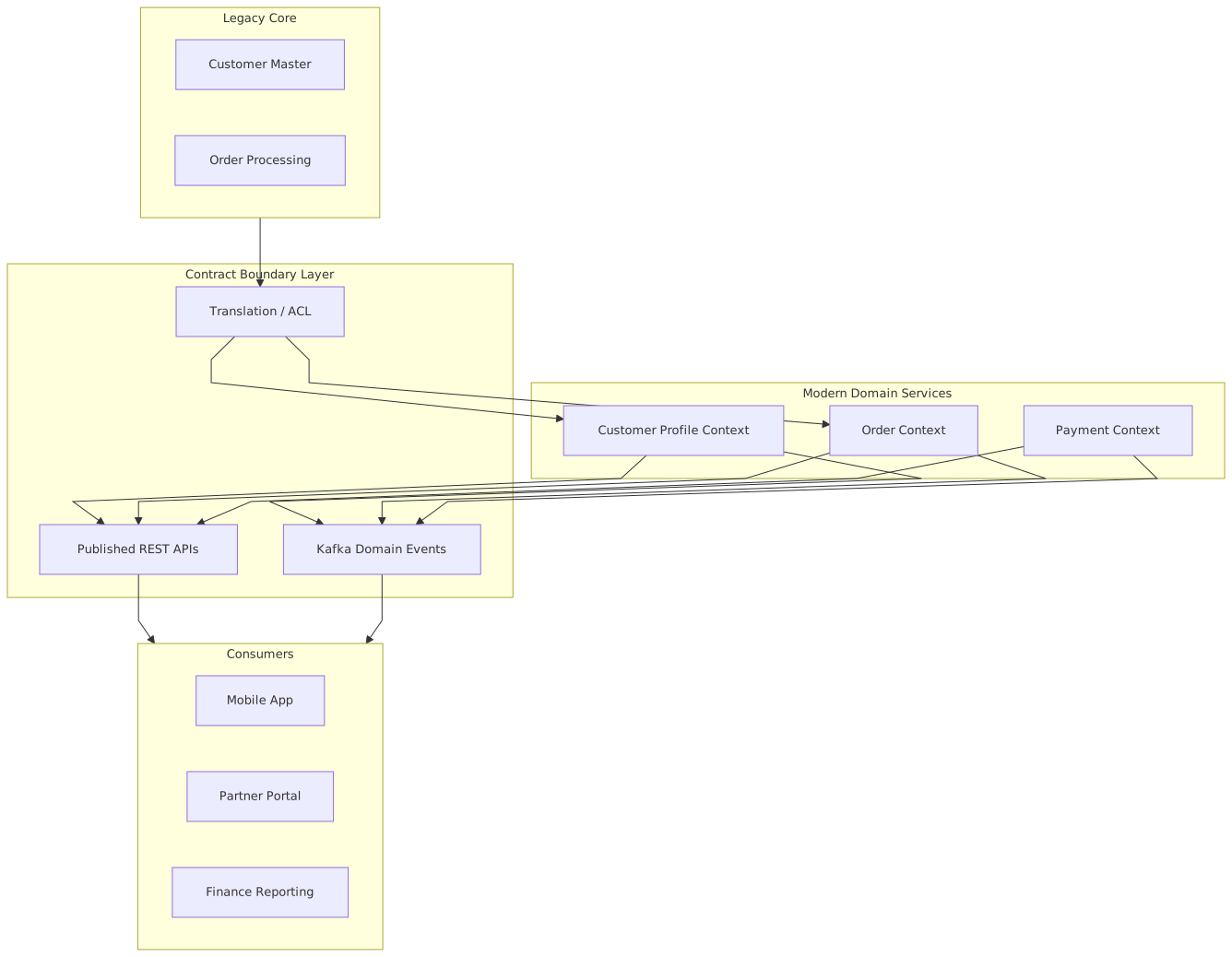
Notice what is absent: no global canonical model in the middle pretending to erase difference. There are contracts, translations, and clear responsibilities.
APIs and Kafka in the same ecosystem
REST APIs are usually better when a consumer needs current state, explicit request-response semantics, and operational clarity. Kafka is better for propagating domain facts, decoupling reaction flows, and enabling asynchronous composition.
But both need bounded context discipline.
A synchronous API should answer from the provider’s context, not as a stitched federation of enterprise truth unless it is explicitly a composed experience API.
A Kafka event should represent a meaningful fact from the producer’s context. Avoid vague entity churn events when what consumers actually need are domain-specific events like:
InvoiceIssuedPaymentFailedSubscriptionCancelledOrderAllocated
Those names are not decoration. They prevent consumers from reverse-engineering your state machine from generic updates.
Migration Strategy
The hardest part of this approach is not greenfield design. It is migration.
Most enterprises already have APIs that expose too much, too little, or the wrong thing entirely. They have shared schemas embedded in dozens of applications. They have Kafka topics carrying half-governed payloads. They have consumers that silently depend on accidental fields. You do not fix that by publishing a cleaner contract and sending a cheerful email.
You need a progressive strangler migration.
The right sequence is semantic first, traffic second, decommissioning last.
Step 1: Identify semantic seams
Find places where one API or event contract is serving multiple incompatible meanings. Typical hotspots are customer, account, product, policy, entitlement, and order.
Map consumers by use case, not by endpoint count. Who uses which fields for which business decisions? Which assumptions are implicit? Which contracts are treated as authoritative?
Step 2: Define target bounded-context contracts
Design new contracts around actual contexts. This may produce multiple narrower APIs where one broad API existed before. That is a feature, not a regression.
Write down:
- glossary and term definitions
- ownership and authority
- invariants
- temporal semantics
- compatibility policy
- translation rules from legacy payloads
Step 3: Introduce an anti-corruption layer
Stand up a translation layer that accepts the old contract and emits the new contextual contract, or vice versa where necessary. This allows internal modernization without forcing all consumers to move at once.
Step 4: Dual publish and reconcile
For event-driven migration, publish both legacy and new domain events for a period. For synchronous APIs, route traffic through a facade that can serve both old and new contracts. Compare outputs. Measure semantic drift. Capture mismatches.
This is where reconciliation matters.
Reconciliation is not just record matching. It is the explicit management of difference between contexts and between generations of the same contract. In practice it includes:
- correlation IDs
- idempotent consumers
- replay support
- compensating actions
- side-by-side reports
- exception workflows for human review
A mature migration acknowledges that old and new systems will disagree for a while. The job is to make disagreement visible, bounded, and recoverable.
Step 5: Shift consumers incrementally
Prioritize consumers with the clearest contextual fit and the lowest translation burden. Avoid trying to migrate every downstream consumer simultaneously. That is not modernization; that is synchronized panic.
Step 6: Tighten governance around old contracts
Freeze legacy contract expansion. The old interface should become stable but stale. Any new semantic needs must go to the new contextual contracts. Otherwise the old API keeps growing and the migration starves.
Step 7: Retire with evidence
Retirement should be based on observed traffic, consumer attestation, replay validation, and reconciliation closure—not hope.
A migration view often looks like this:
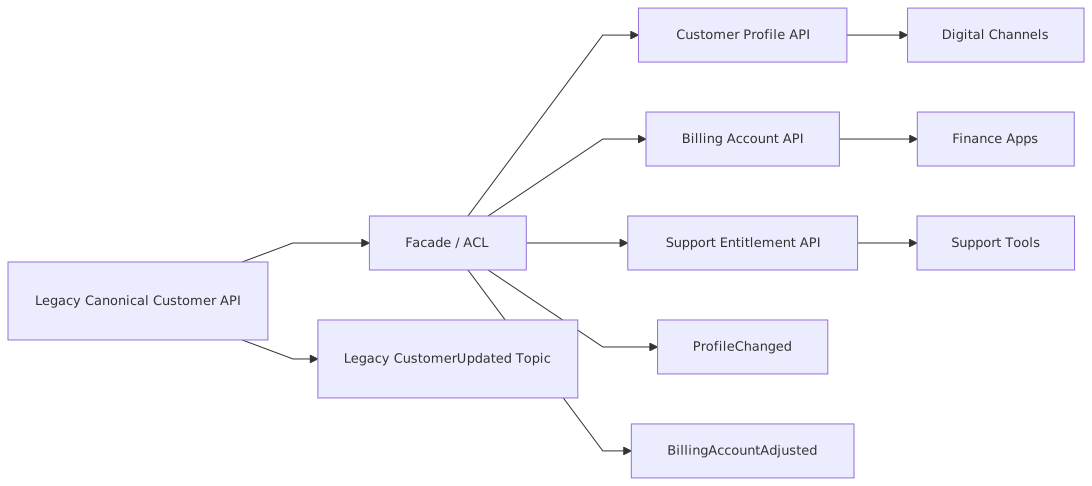
The facade is temporary. The contextual contracts are the destination.
Enterprise Example
Consider a large telecom modernizing customer and billing capabilities. This is a familiar enterprise shape: decades-old CRM, a billing platform older than several managers, a service assurance stack, new digital channels, Kafka introduced halfway through the transformation, and a board asking for “one view of customer.”
The original architecture exposed a single Customer API meant to serve mobile apps, call center tools, collections, field service, and partner channels. It returned identity, addresses, subscriptions, arrears, entitlements, and assorted profile flags. It looked convenient.
It was a trap.
Digital channels wanted profile and preference updates with low latency. Billing needed liable-party rules and delinquency states. Support needed active service entitlements and outage impact. Collections needed household debt exposure. Every change to the API turned into a negotiation among domains with different release cycles and compliance constraints.
Kafka made this worse. The organization published CustomerUpdated events whenever almost anything changed. Consumers built brittle logic to inspect changed fields and infer whether they should react. Some cached customer snapshots. Others stitched the event stream with direct API reads. Reporting built yet another customer mart. Nobody agreed on who owned “customer status.”
The turnaround came when the architecture team stopped asking for a universal customer and started modeling contexts explicitly:
- Customer Profile Context for identity, contactability, preferences
- Billing Account Context for liable party, account balance, payment state
- Service Entitlement Context for active products, service rights, eligibility
- Support Case Context for interactions and incidents
Each context published its own API and domain events. The old customer API was frozen and gradually fronted by a translation facade. Mobile apps moved first to the profile contract. Finance tools moved to billing. Support tooling adopted entitlement and case contracts.
This did not eliminate duplication. It made duplication honest.
For example, both profile and billing retained a notion of customer reference, but with different lifecycle rules and different authority. Rather than suppress this, the enterprise defined correlation and reconciliation processes. A customer merge in profile could trigger downstream review in billing if legal liability mappings were affected. Events carried contextual identifiers plus correlation keys, not fantasy global sameness.
Results were less glamorous than conference slides but more useful:
- fewer cross-team release dependencies
- smaller contract negotiations
- lower consumer breakage from unrelated changes
- cleaner Kafka topics with domain-specific intent
- explicit reconciliation for identity mismatches
- better auditability of source-of-truth decisions
The lesson is blunt: “single customer view” is usually a product experience, not a domain model. Build it as a composed read model if needed. Do not force it into every operational contract.
Operational Considerations
A contract boundary is only as good as its runtime behavior.
Observability by contract
Track not just technical metrics but contract-level signals:
- version usage
- field access frequency
- schema validation failures
- semantic error rates
- consumer-specific latency and retries
- dead-letter queue rates by event type
- reconciliation backlog and aging
If you do not measure who depends on which semantics, you are governing blindly.
Schema governance is necessary but insufficient
Schema registries, OpenAPI catalogs, and linting pipelines are useful. They catch syntax drift. They do not catch domain confusion.
Add human review focused on semantics:
- is this new field context-appropriate?
- does this name leak another domain’s vocabulary?
- is authority clear?
- does the event describe a business fact or just internal churn?
Consumer-driven contracts help, but carefully
Consumer-driven contract testing is useful for compatibility, especially in microservices. But consumers should not dictate provider semantics. Let them validate expectations, not redesign the domain by stealth.
Reconciliation is an operational capability
If contexts overlap and data moves asynchronously, reconciliation is not an exception path. It is part of the architecture.
Design for:
- late events
- duplicate events
- out-of-order delivery
- partial failures across services
- replay after bug fixes
- corrective events versus hard deletes
- human exception handling
In financial, healthcare, telecom, and supply chain domains, the quality of your reconciliation process often matters more than the elegance of your event diagram.
Tradeoffs
This approach is powerful, but not free.
You will have more models
Yes. That is the point.
A bounded-context approach creates multiple representations of related concepts. Teams must translate between them. That takes effort. But the alternative is hidden translation scattered through every consumer, which is worse and harder to govern.
There is less superficial reuse
Shared enterprise schemas appear efficient because they reduce immediate duplication. They also increase coupling and negotiation overhead. Contextual contracts trade some reuse for autonomy and clarity.
Discoverability gets harder before it gets better
Consumers can no longer assume there is one endpoint for “customer.” They must understand which context they actually need. This requires better API portals, glossaries, architecture decision records, and onboarding support.
Some executives will dislike the vocabulary
Leaders often ask for one source of truth. You need to respond carefully: one source of truth for what question? Truth is contextual. Authority can be precise without being universal.
A mature architecture uses multiple authoritative sources for different domain concerns, plus composed views where business experience demands it.
Failure Modes
There are several ways to get this wrong.
Mistaking bounded contexts for microservices
A bounded context may map to one service, several services, or part of a larger application. If you create one microservice per noun and call that DDD, you will produce distributed confusion quickly.
Treating every API as a separate context
Not every contract deserves its own bounded context. Some APIs are just channels or facades over the same model. Context is about semantic consistency, not interface count.
Rebranding canonical models as “enterprise contexts”
This is an old trick with a fresh label. If the model exists mainly to satisfy everyone equally, it probably serves no one well.
Ignoring translation costs
Anti-corruption layers are not free. They need ownership, tests, observability, and retirement plans. Temporary adapters have a way of becoming a career.
Publishing low-level state-change events
If your Kafka topics emit generic mutations with field diffs, consumers will infer domain meaning inconsistently. That is how event-driven systems become archaeology projects.
Skipping reconciliation because “events are reliable”
Reliable delivery is not semantic agreement. Even perfectly delivered events can represent disagreeing models, stale timing, or invalid assumptions.
When Not To Use
There are situations where this level of contextual rigor is overkill.
Do not force this approach if you have:
- a small system with one team and genuinely shared language
- a simple CRUD domain with little semantic variance
- short-lived integration code where long-term coupling risk is low
- a reporting or analytics pipeline consuming denormalized snapshots intentionally
- a startup product still discovering its domain and not yet suffering organizational scale
In those environments, a simpler contract model may be enough.
Also, if your organization lacks the discipline to maintain glossaries, ownership, and contract governance, declaring APIs as bounded contexts will become decorative architecture. Better a modest but honest design than a DDD theater production.
Related Patterns
Several patterns complement this approach well.
Anti-Corruption Layer
Essential when consuming contracts from another context, especially legacy systems. It protects your model from semantic contamination.
Strangler Fig Pattern
Ideal for progressive migration from broad legacy APIs toward contextual contracts. The semantic boundary usually needs to be established before the old endpoint can be retired.
Published Language
Directly aligned with the idea that an API contract is a formalized language of a bounded context.
Open Host Service
Useful when a context intentionally exposes a stable set of operations to others while preserving internal autonomy.
Event Collaboration
A good fit when contexts need to react to domain facts asynchronously. But again, event contracts must stay contextual.
CQRS and Composed Read Models
Helpful for building “single view” experiences without collapsing operational contexts into one canonical model.
Summary
The enterprise does not break because systems are distributed. It breaks because meaning is distributed carelessly.
Treating API contracts as bounded contexts is a practical way to bring domain-driven design out of the workshop and into the interfaces that actually shape coupling. It forces teams to be explicit about semantics, authority, lifecycle, and tradeoffs. It accepts that “customer,” “order,” and “account” are not universal objects drifting peacefully through the estate. They are contextual truths connected by contracts, translation, and reconciliation.
That changes how you design APIs. It changes how you publish Kafka events. It changes how you run migrations. And it changes what you mean by source of truth.
Use this approach when the cost of semantic ambiguity is higher than the cost of translation—which, in most real enterprises, is much earlier than people think.
A clean contract is not the one with the fewest fields. It is the one that knows which world it belongs to.
Frequently Asked Questions
What is API-first design?
API-first means designing the API contract before writing implementation code. The API becomes the source of truth for how services interact, enabling parallel development, better governance, and stable consumer contracts even as implementations evolve.
When should you use gRPC instead of REST?
Use gRPC for internal service-to-service communication where you need high throughput, strict typing, bidirectional streaming, or low latency. Use REST for public APIs, browser clients, or when broad tooling compatibility matters more than performance.
How do you govern APIs at enterprise scale?
Enterprise API governance requires a portal/catalogue, design standards (naming, versioning, error handling), runtime controls (gateway policies, rate limiting, observability), and ownership accountability. Automated linting and compliance checking is essential beyond ~20 APIs.