⏱ 21 min read
Distributed systems look tidy in slide decks and feral in production.
On the whiteboard, an order is placed, payment is captured, inventory is reserved, shipping is arranged, and everyone goes home happy. In the real enterprise, the payment gateway times out after authorizing the card, the warehouse reserves stock twice because a retry landed badly, the shipping provider accepts a label request and then loses the callback, and customer service opens a ticket because the customer has three contradictory emails. This is the point where many microservices programs discover an awkward truth: a workflow is not a sequence of API calls. It is a set of business state transitions unfolding across unreliable boundaries. microservices architecture diagrams
That is why state machines matter.
Not as a theoretical flourish. Not as another box in an architecture standards catalog. But as a practical way to make business process behavior explicit, testable, recoverable, and understandable. If you are running microservices with Kafka, asynchronous messaging, retries, compensations, and a few inherited systems that still believe nightly batch is modern, then your workflow already is a state machine. The only question is whether you have modeled it on purpose or allowed it to emerge as tribal folklore hidden in handlers, cron jobs, and “temporary” database flags.
A good architecture names the states that matter to the business. It makes legal transitions explicit. It separates domain semantics from transport mechanics. And it gives operations teams something better than crossed fingers when events arrive late, twice, or not at all.
This article takes the opinionated view that most enterprise microservices workflows should be designed around explicit state transition models, especially where the workflow spans bounded contexts, asynchronous messaging, and long-running business processes. But this is not a silver bullet. State machines can become overbuilt, bureaucratic, and actively harmful when the domain is simple or when you confuse orchestration technology with domain design. We will look at the forces, the architecture, migration strategy, enterprise use, operational concerns, tradeoffs, failure modes, and when not to use them.
Context
Microservices changed where workflow logic lives, but not the need for workflow logic itself.
In a monolith, business progression often sat inside one transactional boundary. A single service method updated rows, called some collaborators, and committed or rolled back. The model was imperfect, but the flow was often visible. When systems split into services, the old workflow did not disappear. It fractured. One part moved into event consumers. Another slipped into REST endpoints. A bit landed in Kafka stream processors. More leaked into “integration services” that nobody admits are miniature monoliths. event-driven architecture patterns
The result is common enough to be boring: each service owns its local state well enough, but nobody owns the end-to-end lifecycle clearly. Business people ask, “What exactly does ‘Order Pending’ mean?” and get six different answers from six teams. Developers ask, “Can we retry this message safely?” and the answer depends on whether some side effect already escaped. Operators ask, “Why is this order stuck?” and the only path to truth is grep, SQL, and luck.
This is not just a technical problem. It is a domain problem.
Domain-driven design gives us the right lens. A workflow that matters to the business belongs in the domain model, not buried in integration plumbing. If “Submitted,” “Approved,” “Rejected,” “Partially Fulfilled,” and “Cancelled” have real business semantics, then they deserve first-class treatment. They are not booleans. They are not incidental statuses. They are the language the business uses to reason about obligations, rights, timing, and failure recovery.
That leads naturally to an explicit state machine.
A state machine is simply a model that says: this business entity can be in one of these states; these events or commands can move it to those next states; these transitions may have guards, side effects, or compensations; and any illegal move should be rejected, ignored, or sent for investigation. In workflow-heavy microservices, that model becomes the backbone of resilience and comprehension.
Problem
The problem is not that distributed workflows are hard. The problem is that people keep pretending they are linear.
In a microservices architecture, every workflow runs into the same ugly realities:
- services fail independently
- networks partition
- messages arrive out of order
- retries create duplicates
- local transactions cannot span the whole process
- external systems acknowledge ambiguously
- human intervention interrupts automation
- business policies evolve faster than integration contracts
Without an explicit state transition model, teams typically manage this in one of three bad ways.
First, they create implicit workflow through chained synchronous calls. Service A calls B, B calls C, and C calls D. It feels direct. It also creates temporal coupling, fan-out fragility, and painful rollback semantics when step 3 fails after step 1 succeeded. This is workflow by hope.
Second, they move to event-driven choreography but keep the logic implicit. Every service reacts to events and updates its local store. This reduces coupling, which is good, but often scatters the workflow policy across multiple handlers. Nobody can answer basic questions such as “What states are terminal?” or “What event should reopen a failed fulfillment?” This is workflow by archaeology.
Third, they buy or build an orchestrator and declare victory. The workflow engine is then treated as the source of truth, while domain services become obedient step runners. This can work, but often degrades into an anemic domain model where business semantics live outside the bounded contexts that actually own them. This is workflow by externalization.
None of these are universally wrong. All of them fail when domain semantics are fuzzy.
Consider order processing. “Paid” may mean funds authorized but not captured. Or it may mean captured successfully. “Allocated” may mean inventory reserved logically in ERP but not physically picked in WMS. “Shipped” may mean label printed, handed to carrier, or carrier scanned departure. These distinctions are not implementation details. They determine customer promises, revenue recognition, cancellation rights, refund logic, and support scripts.
A workflow system that does not model such states precisely is not simplifying the business. It is lying about it.
Forces
Architecture lives in tradeoffs, and state machines in microservices sit at the intersection of several competing forces.
Business clarity versus implementation flexibility
The business wants a shared language: what state is this thing in, what can happen next, and who owns the transition. Engineering wants room to evolve services independently. A good state model stabilizes the semantics while allowing different technical implementations behind each transition.
Local autonomy versus end-to-end visibility
Microservices thrive on bounded contexts and decentralized ownership. Workflows demand a coherent lifecycle view. Push too hard on local autonomy and the process disappears into fragments. Push too hard on central visibility and you create an orchestrator that knows too much.
Asynchronous resilience versus determinism
Kafka and event-driven patterns improve decoupling and throughput. They also introduce eventual consistency, duplicate delivery, and out-of-order events. A state machine provides deterministic rules in a non-deterministic environment, but only if transitions are modeled idempotently and with explicit versioning.
Rich domain model versus operational complexity
The more faithfully you model real-world state, the more useful the system becomes. It also gets more complex to test, migrate, observe, and explain. Enterprises often overcorrect either way: simplistic status fields or Byzantine workflow taxonomies no one can maintain.
Central orchestration versus distributed choreography
This is the old argument wearing modern clothes. Orchestration offers control and visibility. Choreography preserves autonomy and scale. In practice, enterprises use both. The trick is deciding where the state machine lives and which transitions are driven centrally versus emitted by participating services.
Solution
My recommendation is straightforward: model long-running business workflows as explicit state machines owned by the domain that carries the business obligation, and use events to drive transitions across service boundaries.
That sentence matters. The owner of the state machine should be a domain concept, not a middleware product.
If the workflow is fundamentally about an Order, then the Order lifecycle should define the legal states and transitions, even if payment, inventory, fraud, and shipping each contribute events. If the workflow is about a Loan Application, then that aggregate or process manager should own progression from Draft to Submitted to Underwriting to Approved to Funded or Declined.
State machines in this style usually have:
- a clearly identified workflow owner entity or process aggregate
- explicit states with domain meaning
- a transition table or policy model
- commands and domain events that trigger transitions
- guards that enforce invariants
- side effects emitted as events or commands
- reconciliation paths for missing or conflicting external outcomes
- terminal and non-terminal failure states
This can be implemented in several ways:
- Inside a service as domain logic
The service stores state in its own database, processes commands/events, validates transitions, and emits resulting events. This is often the best default.
- As a process manager or saga coordinator
A dedicated component tracks cross-service workflow state and sends commands to participants. This is useful when no single domain aggregate naturally owns the workflow, or when compensations are complex.
- In a workflow engine
Useful for human tasks, long timeouts, visual operations tooling, or compliance-heavy process execution. But the engine must not replace domain semantics. It should execute them.
A useful mental model is this: the state machine is the railway signaling system of your workflow. Trains can be late, duplicated, or redirected. Signals decide what is safe and legal next. Without signals, every train is a surprise.
Architecture
At the core is an explicit transition model. Not a vague enum in a table. A model that says what is allowed.
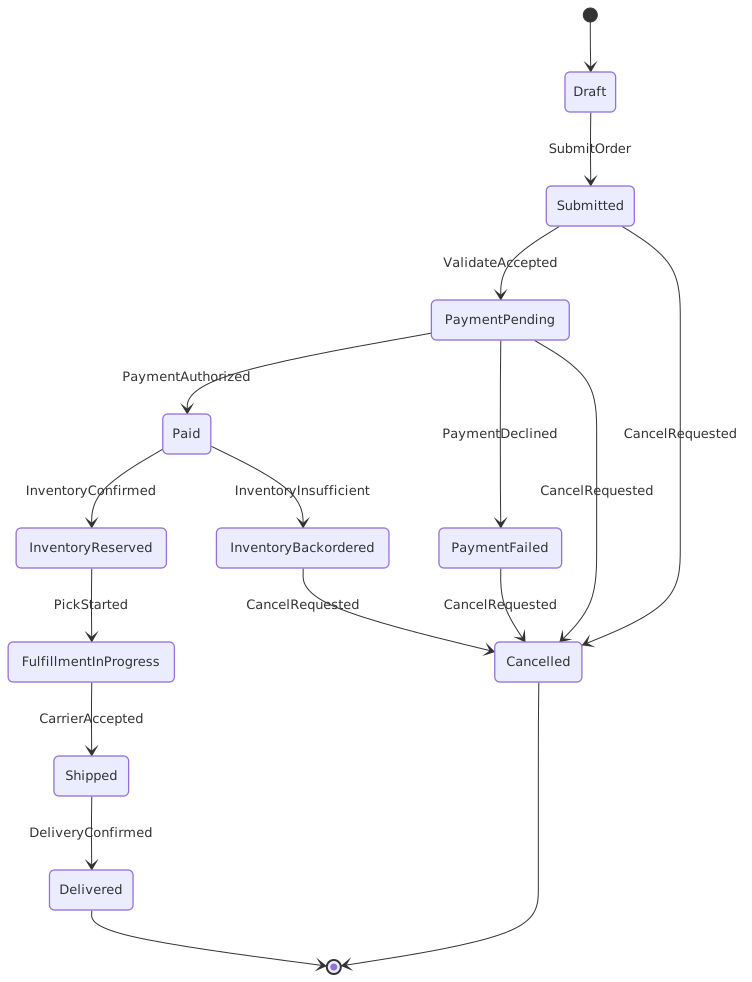
This kind of diagram is not decoration. It is the architecture.
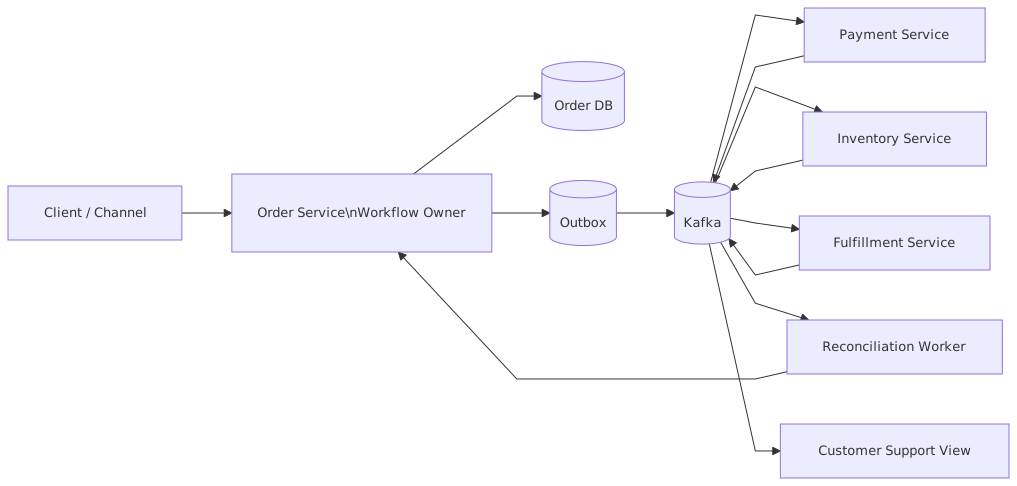
A typical implementation in a Kafka-based microservices environment looks like this:
- The workflow-owning service persists current state and transition history.
- It consumes commands or domain events from Kafka.
- For each incoming message, it checks idempotency and sequence expectations.
- It evaluates whether the transition is legal from the current state.
- If legal, it updates state atomically with an outbox record.
- The outbox publishes the new domain event to Kafka.
- Downstream services react and emit their own outcome events.
- Reconciliation jobs detect workflows stranded between expected transitions.
The outbox pattern matters because half of workflow bugs come from dual writes. If you update local state and publish to Kafka separately, you have built a lottery machine. Atomic state change plus reliable event publication is table stakes.
Here is a simplified architecture view.
Domain semantics and bounded contexts
This is where many teams go wrong. They assume every service should share the same workflow state names. That is a fast route to accidental coupling.
In domain-driven design terms, each bounded context should speak its own language. The Order context may have PaymentPending and Paid. The Payment context may have Authorized, Captured, Voided, ChargebackOpen. The Fulfillment context may care about WaveAssigned, Picked, Packed, Manifested.
Do not force one global state model across contexts.
Instead, the workflow owner translates external outcomes into its own state transitions. Payment emits PaymentAuthorized. Order interprets that as legal movement from PaymentPending to Paid. The contexts collaborate through events, but semantics remain locally owned.
That translation layer is not bureaucracy. It is protection.
Orchestration and choreography together
Pure choreography sounds elegant until the first post-incident review. Pure orchestration sounds safe until every team is waiting on the central workflow team. Real enterprises mix them.
A common pattern:
- Use choreography for fact publication: payment outcome, inventory result, shipping acceptance.
- Use orchestration where policy, timing, compensation, or escalation requires a coherent conductor.
For example, an Order service may orchestrate when to request payment, inventory reservation, and shipment. But Payment and Inventory services internally choreograph their own local sub-processes.
Reconciliation is part of the design
If your workflow depends on external systems, your architecture needs reconciliation from day one. Not as a support script. As a first-class pattern.
Why? Because some transitions are “Schrödinger transitions.” The remote side may have completed the action, but your system did not receive confirmation. Payment gateways do this. Carriers do this. Mainframes definitely do this.
A mature state machine includes intermediate uncertainty states such as PaymentUnknown, ShipmentPendingConfirmation, or AwaitingPartnerStatus. These are not embarrassing edge cases. They are honest representations of reality.
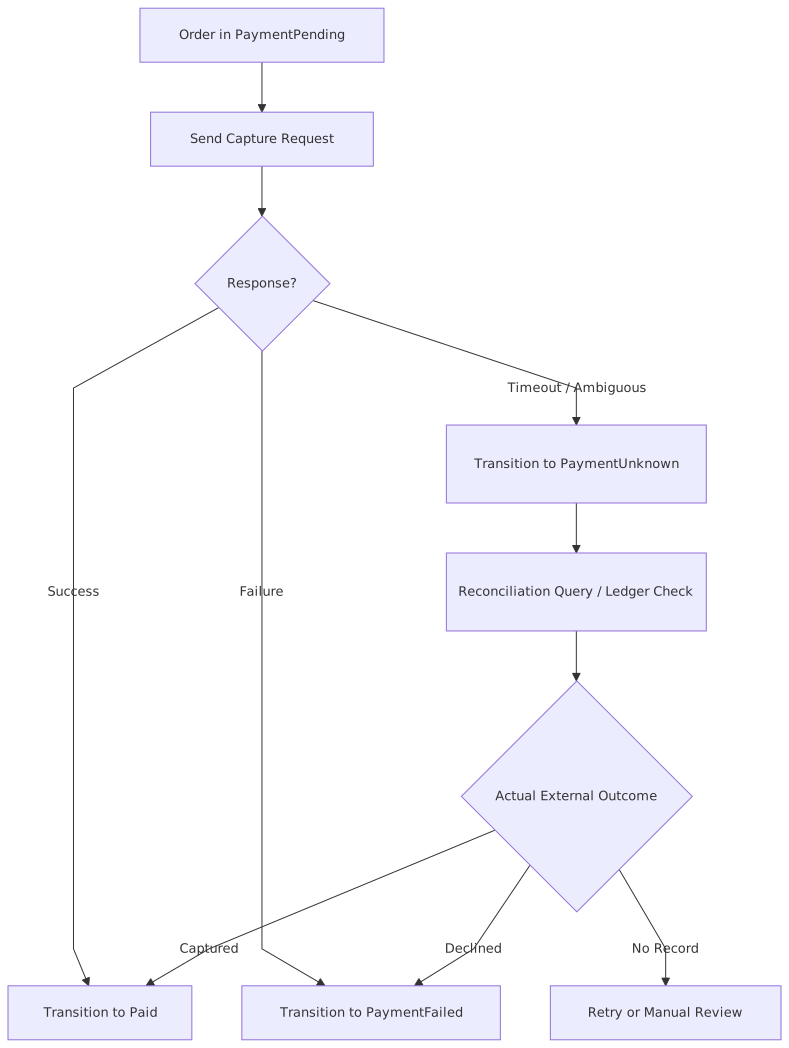
That is how grown-up systems behave. They admit ambiguity and recover deliberately.
Migration Strategy
Most enterprises do not get to start clean. They inherit a monolith, a BPM suite, a stack of integration jobs, and a forest of status columns that mean different things depending on who last touched them. You do not replace this with a pristine state machine in one go. You strangle it progressively.
The migration path I recommend has five stages.
1. Discover the real state model
Before writing code, map the actual lifecycle from production behavior, not design documents. Pull examples from logs, support tickets, compensating scripts, and operations runbooks. Find every status field and every event that changes it. Then answer:
- what states exist today, formally or informally
- which are business-significant versus technical
- what transitions are legal
- which transitions already occur illegally
- where ambiguity exists
- what manual interventions are common
This exercise often reveals that the organization already has a state machine. It is just undocumented and inconsistent.
2. Introduce a canonical workflow owner
Create one service or module that becomes the source of truth for the workflow state, even if legacy systems still perform some steps. Start by mirroring or deriving state from existing events and APIs. Do not yet seize control of every transition. Build visibility first.
This is classic strangler fig thinking: surround before you replace.
3. Publish domain events with outbox reliability
As you carve behavior out of the legacy estate, ensure the new owner emits durable, versioned domain events. Kafka is ideal here because it gives replay, decoupling, and an audit trail of progression. But remember: Kafka is transport. Your domain model still decides legal transitions.
4. Move transition authority incrementally
Pick one transition family at a time. Payment is often a good start, because the semantics are important and the outcomes are externally visible. Let the new workflow owner decide state changes for payment outcomes while the rest of the process still leans on legacy systems. Then move inventory. Then fulfillment. Do not migrate by service boundary alone; migrate by transition authority.
That is the key move. Ownership of state transitions is more important than ownership of code.
5. Add reconciliation and retire legacy status sources
Only once the new workflow owner can recover from ambiguous outcomes should you remove old status derivations and reports. Enterprises often skip this, cut over too early, and discover that the old batch job was silently reconciling edge cases for years.
A practical migration sequence looks like this:
- mirror legacy status into new state model
- validate with shadow reads and discrepancy dashboards
- enable new transitions for a small segment
- compare outcomes against legacy
- add compensations and reconciliation
- expand scope
- retire old write paths
- finally retire old read models
Migration is not just technical. It is semantic. You are teaching the organization to speak more precisely about workflow.
Enterprise Example
Consider a global retailer modernizing order fulfillment across e-commerce, store inventory, warehouse management, and third-party delivery providers.
The legacy setup looked familiar: a commerce platform wrote order rows, an ESB called payment and ERP, nightly jobs synchronized statuses, and customer support used a reporting database that was usually six hours behind. “Order Complete” could mean paid but not shipped, shipped but not invoiced, or cancelled after a failed allocation. Refunds frequently misfired because the workflow had no explicit representation of partial fulfillment and post-shipment cancellation constraints.
The retailer introduced an Order Lifecycle service as the workflow owner. Not a mega-service that swallowed all logic. A focused domain service that owned the order state machine and emitted events to Kafka.
The bounded contexts remained separate:
- Order owned customer-facing lifecycle semantics
- Payment owned authorization, capture, void, refund events
- Inventory owned reservation and release semantics
- Fulfillment owned picking, packing, and dispatch
- Delivery integrated carrier updates
- Customer Care consumed a materialized view of workflow history
The order state machine included states like:
DraftSubmittedFraudReviewPaymentPendingPaidPartiallyAllocatedAllocatedFulfillmentInProgressPartiallyShippedShippedDeliveredCancelledCompensationPending
Notice the language. These are not transport statuses. They describe business posture.
A customer might place an order for three items sourced from two warehouses and one store. Payment is authorized immediately, but inventory returns mixed results: two items reserved, one backordered. The order transitions to PartiallyAllocated. The business rule then decides whether to split shipment, substitute, hold, or ask customer consent. That rule belongs in the domain. It cannot be safely improvised by three downstream services independently.
Kafka carried all outcome events. The Order Lifecycle service consumed them, enforced legal transitions, and emitted consolidated order state changes. It used an outbox for reliable publication and maintained transition history for audit.
The interesting part came with carrier integrations. Carriers often accepted label creation synchronously but delayed definitive pickup confirmation. The system introduced ShipmentPendingConfirmation and a reconciliation worker that queried carrier APIs for orders stuck in that state beyond SLA. This cut support incidents sharply because “stuck” orders were no longer invisible ambiguities.
Migration followed a strangler approach. Initially, the new service only observed and reconstructed state from legacy events. Discrepancy dashboards compared old status reports to the new state machine. Once confidence grew, payment transitions moved to the new owner. Then inventory. Then shipping. Nightly batch jobs were retired last, after reconciliation logic proved it could handle the edge cases those jobs had quietly covered.
The result was not just cleaner code. It changed operations and business conversation. Customer support could see the exact last legal transition. Finance could distinguish authorization from capture consistently. Product teams could add new promises, like split shipment notifications, without spelunking through integration spaghetti.
That is what a useful architecture does. It improves the software and the organization’s ability to think.
Operational Considerations
State machines become truly valuable when they are observable.
Transition history
Store transition history, not just current status. For enterprise support, the question is rarely “what state is it in?” but “how did it get here?” A complete timeline of state changes, causation IDs, correlation IDs, and triggering events is operational gold.
Idempotency and deduplication
Kafka consumers must assume at-least-once delivery. Every transition handler should be idempotent. If PaymentAuthorized arrives twice, the second processing should either be a no-op or raise an explicit duplicate signal without harming the workflow.
Versioning
State models evolve. New states appear. Old transitions split. Event schemas change. Version your messages and transition logic deliberately. Backward compatibility matters because workflow messages live longer than sprint plans.
Timeouts and SLAs
Long-running workflows need timers. If inventory confirmation has not arrived in 15 minutes, what happens? If payment remains ambiguous after 5 minutes, when does reconciliation start? Time is a business actor in workflows. Model it.
Manual intervention
Some workflows need human override. But make it explicit. “Force state to shipped” is not a control mechanism; it is vandalism with permissions. Support tooling should trigger modeled transitions such as EscalateForReview, ApproveException, or CancelByAgent.
Read models
Do not force every consumer to reconstruct workflow from event logs. Build materialized views for customer support, operations dashboards, and business reporting. The event stream is a backbone, not a user interface.
Tradeoffs
State machines bring clarity, but they are not free.
The biggest gain is explicitness. You get a shared language, legal transition enforcement, better testing, and easier reasoning about failure. You gain operational visibility and a place to put reconciliation logic. You also improve domain boundaries because state ownership becomes a design decision rather than an accident.
The biggest cost is complexity. A well-modeled workflow exposes nuance that many teams would rather hand-wave away. It adds transition logic, persistence concerns, versioning, diagrams, and operational tooling. If the team is undisciplined, the model becomes a bureaucratic mess of dozens of states no one can explain.
There is also a cultural tradeoff. Explicit state machines force arguments early. What exactly is “fulfilled”? Can cancellation happen after picking? Does partial shipment count as a customer-visible milestone? These debates are uncomfortable. They are also precisely the debates architecture should surface.
Failure Modes
State machine architectures fail in recognizable ways.
The enum graveyard
Teams define many states but no real transition rules. The result is a decorative status field with arbitrary updates from anywhere. That is not a state machine. That is a cemetery of intentions.
Technical states masquerading as business states
KafkaPublished, WebhookSent, RetryingStep3 — these may matter operationally, but they should not pollute the business lifecycle unless they change business meaning. Keep domain semantics distinct from transport mechanics.
One global workflow to rule them all
Enterprises sometimes centralize every process in one giant orchestrator. It becomes a dependency magnet, a bottleneck, and a semantic dumping ground. Bounded contexts vanish under the weight of central control.
No reconciliation path
If ambiguous outcomes have no modeled recovery, workflows accumulate in zombie states. Support teams then invent spreadsheet-based truth. This is depressingly common.
Overfitting to the current process
If your state machine mirrors every current departmental step, including temporary policy quirks, it calcifies the organization. Model durable domain semantics, not every accidental detail of today’s operations.
When Not To Use
Not every process deserves a state machine.
If the interaction is short-lived, synchronous, and safely transactional inside one service, a simple command handler is often enough. You do not need a formal lifecycle model for every CRUD update. If the business has no meaningful distinction between intermediate statuses, adding a state machine may be ceremony without value.
Avoid heavyweight workflow modeling when:
- the domain object has trivial lifecycle semantics
- there are no long-running or cross-service transitions
- eventual consistency is not involved
- retries and ambiguity are irrelevant
- human explanation of state adds little business value
Also be cautious when the team lacks operational discipline. A state machine without observability, idempotency, and versioning is just more complicated failure.
Related Patterns
Several patterns naturally complement state machines in microservices.
- Saga / Process Manager: coordinates long-running transactions and compensations across services.
- Outbox Pattern: ensures reliable event publication with local state changes.
- Event Sourcing: useful when transition history is the primary source of truth, though not required for a state machine.
- CQRS: separates operational workflow state from read models for support and reporting.
- Strangler Fig Pattern: ideal for progressive migration from legacy workflow implementations.
- Domain Events: communicate state changes between bounded contexts without sharing internal models.
- Reconciliation Jobs: repair or complete workflows after ambiguous or missing external outcomes.
These patterns are not a shopping list. Use them where the forces justify them.
Summary
Microservices did not eliminate workflow. They made workflow impossible to ignore.
An explicit state machine gives distributed business processes a spine. It turns hidden assumptions into modeled semantics. It makes legal progression visible, failures recoverable, and conversations between teams less vague. In domain-driven design terms, it puts lifecycle behavior back where it belongs: inside the domain language of the bounded context that owns the obligation.
The practical recipe is clear enough:
- model business-significant states explicitly
- let one domain owner control legal transitions
- use Kafka or events to connect services, not to define semantics
- implement idempotency and outbox reliability
- treat reconciliation as a first-class concern
- migrate progressively with a strangler strategy
- resist both oversimplification and orchestration empire-building
A workflow without an explicit state model is like a city without traffic lights. Cars still move. People still arrive. But eventually the intersections fill with noise, blame, and avoidable damage.
Good architecture does not make distributed systems simple. It makes them legible.
And in enterprise systems, legibility is half the battle.
Frequently Asked Questions
What is a service mesh?
A service mesh is an infrastructure layer managing service-to-service communication. It provides mutual TLS, load balancing, circuit breaking, retries, and observability without each service implementing these capabilities. Istio and Linkerd are common implementations.
How do you document microservices architecture for governance?
Use ArchiMate Application Cooperation diagrams for the service landscape, UML Component diagrams for internal structure, UML Sequence diagrams for key flows, and UML Deployment diagrams for Kubernetes topology. All views can coexist in Sparx EA with full traceability.
What is the difference between choreography and orchestration in microservices?
Choreography has services react to events independently — no central coordinator. Orchestration uses a central workflow engine that calls services in sequence. Choreography scales better but is harder to debug; orchestration is easier to reason about but creates a central coupling point.