⏱ 21 min read
Most architecture writing obsesses over birth. How do we split the monolith, carve out services, publish events, choose Kafka topics, design APIs, and chase the tidy diagrams that make transformation look inevitable? But in large enterprises, systems do not merely get born. They linger. They duplicate. They decay. And eventually, if we have any discipline at all, they must be retired. event-driven architecture patterns
Retirement is where architecture stops being a drawing exercise and becomes operational truth.
A service that should have died but still processes 3% of production traffic is not “almost retired.” It is alive enough to hurt you. A database kept around “just for reference” becomes tomorrow’s shadow dependency. A Kafka topic no producer claims ownership of will still surprise you six months later when a batch job fails because someone finally deleted it. In other words: systems are easier to create than to remove, and most enterprises are better at expansion than subtraction.
That is why service retirement deserves to be treated as a first-class lifecycle concern in microservices architecture. Not as cleanup. Not as decommissioning paperwork. As architecture. microservices architecture diagrams
This article looks at service retirement patterns through a practical enterprise lens: domain-driven design, migration strategy, progressive strangler moves, reconciliation, Kafka-based event flows, operational controls, and the uncomfortable tradeoffs that make retirement hard. The interesting work is not switching traffic off. The interesting work is proving that nothing important still depends on what you want to kill.
Context
Microservices promised independent deployability, faster change, and cleaner alignment between business capabilities and software boundaries. In many places they delivered exactly that. But they also produced a new estate management problem: instead of one aging monolith, you now have dozens or hundreds of services at different stages of health and relevance.
Some are strategic. Some are transitional. Some are accidental artifacts from a reorg, a platform migration, or a hurried carve-out. Some still carry business value, but the domain has moved on and the original service no longer represents the language of the business. What was once CustomerProfileService has become a mash-up of identity, consent, preference, risk, and marketing eligibility. The code still runs. The model is dead.
This is where domain-driven design matters. Retirement is not merely technical replacement. It is often the final act of re-drawing a bounded context.
A bounded context should encapsulate a coherent domain model and language. When a service no longer maps cleanly to a business capability, retirement may be the healthiest option. Sometimes the domain has been split, sometimes absorbed into a larger platform capability, sometimes externalized to SaaS, and sometimes rendered obsolete by a process redesign. In all those cases, keeping the old service alive introduces semantic drift. And semantic drift is expensive. It creates translation layers, duplicate ownership, ambiguous events, and the sort of enterprise confusion that gets called “complexity” when it is really unowned meaning.
Retirement, then, is part of lifecycle architecture:
- introduction
- growth
- stabilization
- containment
- retirement
- removal
If you do not design for the last three, you accumulate software ghosts.
Problem
Retiring a microservice sounds simple in slides. Redirect traffic. Migrate data. Delete infrastructure. Celebrate.
Reality is messier.
A service is rarely just an API. It is a knot of dependencies:
- synchronous consumers
- asynchronous consumers on Kafka or other brokers
- databases and historical datasets
- scheduled jobs
- secrets and certificates
- dashboards and alerts
- batch exports
- downstream analytics feeds
- regulatory retention obligations
- tribal knowledge embedded in support teams
The direct dependencies are the easy ones. The dangerous dependencies are the unofficial ones: spreadsheets driven by CSV extracts, an overnight reconciliation script nobody has touched in two years, a fraud rules engine reading the old topic, a contact center desktop with a hidden fallback call path. Retirement fails in the margins.
Worse, many organizations retire services using purely technical criteria. They count API calls, move traffic, and assume the job is done. But services exist inside domains, not just networks. If you retire the wrong semantic source of truth, you do not merely break integration. You break the business’s ability to agree on what something means.
Consider customer status in a bank. One legacy service might expose “active customer,” but in practice that value combines legal status, account status, sanctions screening, and digital enrollment. A replacement service may only model account-level activity. If you route consumers from old to new without reconciling domain semantics, you have not retired a service. You have created institutional ambiguity at machine speed.
That is the real problem: retirement is not a shutdown exercise. It is a controlled transfer of responsibility across domain boundaries, technical interfaces, operational ownership, and historical truth.
Forces
Service retirement sits in the middle of competing forces. Good architecture acknowledges the tension instead of pretending it can be designed away.
1. Business continuity versus architectural cleanliness
Architects want a clean end state. Business leaders want no disruption. The enterprise will tolerate ugliness for continuity far longer than architects like.
2. Domain correctness versus migration speed
A fast migration often relies on compatibility shims, anti-corruption layers, and temporary semantic compromises. But the longer those temporary structures live, the more likely they become permanent.
3. Data retention versus platform simplification
You may want to remove the service and its data store. Regulation, audit, or legal hold may force you to preserve records for years.
4. Consumer autonomy versus provider-led retirement
In a microservices environment, consumers evolve at different rates. A provider can declare a retirement date, but consumers often carry the true schedule.
5. Event-driven decoupling versus hidden dependency spread
Kafka reduces tight runtime coupling, which is good. But it also allows consumers to multiply quietly. A topic with “just a few consumers” often has more listeners than anyone thinks.
6. Cost reduction versus risk concentration
Retiring duplicated systems lowers run cost and cognitive load. But moving too much responsibility into a replacement service can create a new concentration risk.
7. Perfect certainty versus forward movement
You will never know with absolute confidence that every dependency is found. Mature retirement patterns reduce uncertainty to a tolerable level. They do not eliminate it.
This is one reason I prefer talking about retirement patterns rather than retirement projects. Projects imply a one-off. Patterns imply repeatable controls for living systems.
Solution
The core solution is to treat service retirement as a progressive capability transfer with explicit lifecycle states, not a binary cutover.
A healthy retirement pattern usually includes five concerns:
- Semantic replacement
Prove what business capability is replacing the retired service and where the new source of truth lives.
- Progressive strangler migration
Shift read, write, and event responsibilities incrementally rather than through a single big-bang switch.
- Reconciliation
Compare old and new outputs over time, especially where data models, event contracts, or business rules differ.
- Operational quarantine
Move the old service through controlled states: active, read-only, shadow, dormant, retired.
- Evidence-based removal
Remove runtime, data, and integration assets only after proving dependency absence and retention compliance.
The retirement lifecycle can be modeled simply.

This sequence matters. Enterprises get into trouble when they jump straight from “replacement introduced” to “removed.” The middle states are where confidence is built.
A few opinionated rules help.
Rule 1: Retire capabilities, not just code
The question is not “can we shut this service down?” The question is “where does this capability now live, and is that ownership understood by both technology and business operations?”
Rule 2: Freeze scope before retirement
Once a service is marked for retirement, feature growth should stop unless required by law or critical business continuity. Otherwise you create the absurd situation of modernizing and decommissioning the same thing at once.
Rule 3: Separate interface migration from semantic migration
You can preserve an API path while changing semantics underneath. Or keep semantics stable while changing protocols and deployment. These are different risks. Handle them separately.
Rule 4: Reconciliation is not optional
If the old and new services produce materially different results, you need to know whether the difference is a bug, an intended domain correction, or an uncovered edge case. Many failures hide here.
Rule 5: Retirement has an afterlife
After runtime shutdown, there are still archives, compliance obligations, incident playbooks, topic cleanup, schema registry entries, IAM roles, and support runbooks. Removal is a chain of deletions, not one.
Architecture
A practical retirement architecture uses a replacement service, compatibility layer, event bridge, reconciliation pipeline, and observability around dependency discovery.
Here is a common target shape.
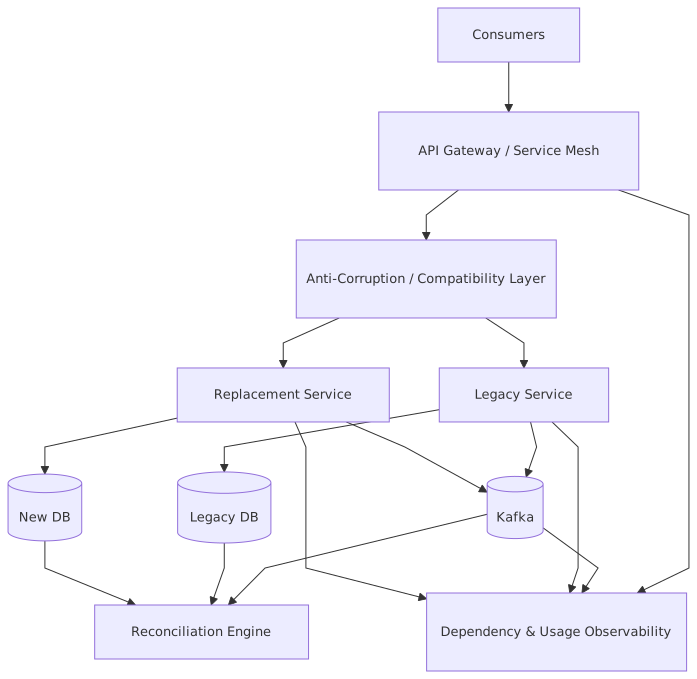
A few design points deserve emphasis.
Compatibility and anti-corruption
The compatibility layer is often underrated. It can do protocol translation, field mapping, defaulting, request routing, and deprecation signaling. In domain-driven design terms, it acts as an anti-corruption layer between the old model and the new bounded context.
That matters because retirement often coincides with domain correction. The replacement service may not simply be a rewritten version of the legacy service. It may embody a better domain model. The compatibility layer allows consumers to move gradually while protecting the new context from old conceptual pollution.
Still, this layer is a temporary structure. Temporary structures have a habit of getting permanent jobs. Put an end date on it.
Kafka and event retirement
Kafka changes the retirement game because events outlive service calls. You can move synchronous traffic fairly easily through gateways and service meshes. Event consumers are harder because producers often do not know who is consuming.
For Kafka-based retirement, I prefer a staged event migration:
- old service continues publishing canonical legacy events
- replacement service publishes new domain events
- bridge or translator publishes compatibility events where needed
- consumers are migrated in waves
- lagging consumers are identified through topic usage telemetry
- only then is the old topic deprecated and removed
This is not elegant. It is survivable.
Where possible, introduce explicit topic ownership, schema compatibility rules, and consumer registration. Enterprises that skip these disciplines discover during retirement that “decoupled architecture” was just hidden coupling with better marketing.
Read and write path separation
Many retirement efforts fail because they treat all traffic as one thing. In reality, reads and writes behave differently.
- Read migration can often happen first using routing, caching, or replicated data views.
- Write migration is riskier because it changes source-of-truth ownership and may trigger side effects.
- Event publication migration is separate again because downstream processes rely on event semantics and timing.
Architecturally, give each path its own plan and controls.
Data ownership and historical truth
One of the hardest questions in retirement is: where does history live after the service is gone?
There are several answers, each with tradeoffs:
- migrate historical data into the replacement bounded context
- archive immutable history into a reporting or records platform
- retain a read-only legacy store for legal retention
- publish normalized history into an enterprise data platform
The wrong answer is “leave the old database running forever because someone may need it.” That is not a strategy. That is fear wearing infrastructure.
Migration Strategy
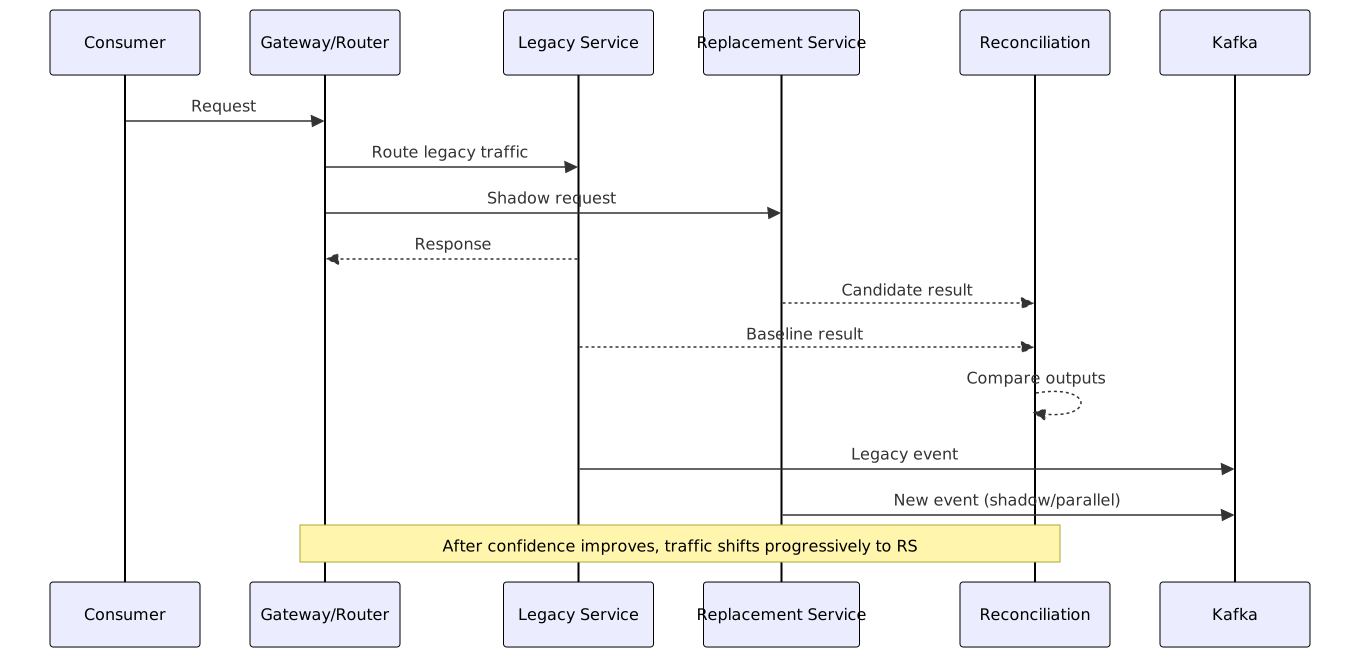
The right migration strategy is usually a progressive strangler, not a hard cutover. The strangler pattern is well understood for system modernization, but it is equally useful for retirement because retirement is modernization from the other end.
A practical sequence looks like this:
Phase 1: Discover and classify dependencies
Before moving anything, inventory dependencies:
- APIs and clients
- Kafka producers and consumers
- databases and data extracts
- scheduled jobs
- support procedures
- dashboards and alerts
- IAM roles and secrets
- batch and reporting consumers
Classify each dependency by criticality, business owner, and migration status. This sounds bureaucratic. It is not. It is how you avoid retiring a service that still feeds payroll or sanctions screening.
Phase 2: Freeze domain contracts
Decide what semantics are stable and what semantics are intentionally changing. Document the mapping between old and new concepts. This is straight domain-driven design work: establish ubiquitous language and context boundaries.
For example:
- old
CustomerStatus=ACTIVEmay map to several new concepts - old
AccountClosedDatemight now be event-derived instead of state-stored - old “consent” may split into marketing consent, channel consent, and legal basis
If you skip this, reconciliation becomes meaningless because you will be comparing outputs that represent different truths.
Phase 3: Introduce replacement in shadow mode
Deploy the replacement service and feed it equivalent requests or events without exposing it as the system of record. Let it process real production flows. Compare outputs. Measure drift.
This phase should expose:
- missing rules
- temporal inconsistencies
- data mapping errors
- performance differences
- event ordering issues
- idempotency defects
Shadow mode is where optimism goes to meet reality. Good.
Phase 4: Reconcile continuously
Reconciliation is the bridge between confidence and fantasy.
You need both technical reconciliation and business reconciliation.
- Technical reconciliation checks payload equality, event counts, IDs, timestamps, and side effects.
- Business reconciliation checks whether domain outcomes match expected business meaning.
This distinction matters. Two systems may differ technically but be business-equivalent. Or they may match structurally while meaningfully disagreeing on something important like eligibility, balance, or risk classification.
For Kafka-driven flows, reconciliation often includes:
- comparing event counts by key and time window
- checking missing or duplicate events
- validating schema-transformed payloads
- verifying consumer-visible outcomes downstream
Phase 5: Migrate reads, then writes, then events
Reads are usually the safest early move. Writes follow once you are confident in source-of-truth behavior. Events often lag because downstream consumers are scattered across the enterprise.
A common mistake is to switch writes before downstream reconciliation is mature. Then every anomaly becomes harder to reason about because the source of truth already moved.
Phase 6: Move legacy to read-only
Once writes are cut over, place the legacy service in read-only mode. This is a critical transition state. It reduces mutation risk while preserving access for straggler consumers and investigations.
Read-only mode should be enforced, not assumed.
Phase 7: Dormant monitoring window
After traffic reaches near zero, keep the service dormant but observable:
- monitor for incoming calls
- detect topic consumption or production
- track DB access
- alert on unauthorized or unexpected use
This quiet period catches hidden dependencies. Enterprises need it more than they admit.
Phase 8: Retire and remove
Only after the dormant window and compliance checks should you remove:
- runtime and infrastructure
- queues/topics and subscriptions
- schemas and contracts
- IAM permissions
- dashboards, alerts, and runbooks
- residual data beyond retention policy
Enterprise Example
Consider a global insurer retiring a legacy Policy Servicing Service built fifteen years ago and later wrapped as a microservice during a modernization program. On paper, it was a single service. In reality, it was three bounded contexts trapped in one runtime: policy state, customer correspondence preferences, and mid-term adjustment workflows.
The enterprise wanted to move policy state into a modern policy platform, correspondence into a customer communications domain, and adjustment workflow into a case management service. This is a classic sign that retirement is really domain decomposition in disguise.
The legacy service exposed REST APIs, produced Kafka events for policy updates, and fed a nightly reporting extract. It also had a deeply annoying habit common in enterprises: business rules lived partly in code, partly in reference tables, and partly in support procedures no architect had ever seen.
The migration began with what looked like a technical inventory but quickly became semantic archaeology. The team discovered that a “policy updated” event was consumed by:
- the claims system
- customer communications
- actuarial reporting
- fraud models
- a regional compliance archive
- two partner integration adapters
- one unofficial BI pipeline
This is the Kafka problem in miniature. Event-driven architecture made independent consumption possible. It also made retirement dependency discovery harder.
The team applied a progressive strangler approach:
- New policy platform introduced for policy state changes.
- Compatibility API preserved the old contract for upstream channels.
- Dual event publication emitted both old
PolicyUpdatedand new domain events. - Reconciliation pipeline compared policy snapshots, event counts, and downstream outcomes.
- Legacy service moved to read-only once writes fully cut over.
- Correspondence preferences and adjustment workflows were split and migrated separately, not forced into one retirement date.
The crucial architectural decision was not to create one giant replacement service. That would have preserved the original semantic confusion in new clothing. Instead, the retirement became an opportunity to restore bounded contexts.
There were tradeoffs. The dual-run period lasted nine months, longer than leadership expected. Costs temporarily increased because both stacks ran in parallel and the reconciliation tooling itself became a small product. But the outcome was sounder: clearer domain ownership, lower support complexity, and elimination of duplicate event semantics that had caused years of reporting disputes.
The most interesting defect found during reconciliation was not technical. The old system treated certain backdated endorsements as effective immediately for reporting, while the new platform treated them according to business-effective date. Both were internally consistent. Only one matched regulatory reporting expectations in a given region. Without reconciliation and business review, the insurer would have “successfully” migrated into non-compliance.
That is enterprise architecture in the real world. The danger is rarely just downtime. It is incorrect meaning.
Operational Considerations
Retirement work often dies from operational negligence, not architectural weakness.
Observability first
You need strong telemetry before you can retire safely:
- request logs by consumer identity
- topic producer/consumer metrics
- schema usage visibility
- DB query auditing
- scheduled job inventories
- trace-level routing data through gateway or mesh
If you cannot see usage, you are guessing. Enterprises guess more than they should.
Deprecation governance
Retirement needs a governance model with: EA governance checklist
- target dates
- named business owner
- named technical owner
- consumer communication plan
- exception handling process
- sunset milestones
Without this, every consumer assumes they are someone else’s problem.
Runbooks and support transition
Support teams often know more about hidden dependencies than architecture repositories do. Bring them in early. Update runbooks to reflect new routing, fallback procedures, and incident handling during dual-run.
Security and access cleanup
Forgotten service accounts, old Kafka ACLs, database users, and certificates are classic post-retirement residue. They are not harmless leftovers. They are control failures waiting for an audit.
Data archiving and retention
Be explicit about:
- what data is archived
- who can access it
- how long it is retained
- whether it is immutable
- how legal hold is applied
Retirement can reduce operational burden while increasing records management burden. Plan for both.
Tradeoffs
Good retirement architecture is full of compromise.
Dual-run increases confidence but raises cost
Running old and new systems together costs money and operational effort. Still, for critical domains, the confidence is usually worth it.
Compatibility layers reduce disruption but extend complexity
They buy time for consumers. They also become one more thing to own, secure, test, and eventually remove.
Event bridging helps migration but can distort semantics
A translated Kafka topic may preserve consumer continuity while quietly flattening richer new domain concepts into old shapes. That can delay proper domain adoption.
Strict retirement deadlines create urgency but can provoke unsafe shortcuts
Soft deadlines drift forever. Hard deadlines cause panic. The answer is staged gates with evidence, not theatrical cutoff dates.
Archiving preserves compliance but weakens discoverability
A retired system’s history may remain accessible only through records platforms or offline retrieval, which is right for compliance and annoying for operations. That is a valid tradeoff.
Failure Modes
Retirement projects fail in remarkably consistent ways.
1. Hidden consumers
The service appears unused because official consumers moved, but unofficial scripts, batch jobs, or local integrations still rely on it.
2. Semantic mismatch
The replacement service is technically functional but models the domain differently, causing subtle business errors.
3. Event contract drift
Kafka consumers continue receiving events, but field meaning, sequencing, or cardinality changes in ways downstream systems cannot tolerate.
4. Incomplete side-effect migration
A write path moves successfully, but one old side effect like audit logging, compliance notification, or cache invalidation is forgotten.
5. Read-only mode that still writes
This happens more often than teams admit. Hidden writes via maintenance jobs, retries, or framework behavior continue mutating the legacy store.
6. Data reconciliation treated as a one-time task
It needs to run long enough to expose edge cases, seasonal behaviors, and low-frequency scenarios.
7. Retirement without ownership transfer
The old service is shut down, but nobody clearly owns the capability, data semantics, or support path in the new world.
8. “Temporary” bridges never removed
Congratulations, you have retired the old service and created a permanent migration architecture.
When Not To Use
Not every service needs a sophisticated retirement pattern.
Do not use full dual-run, compatibility, and reconciliation machinery when:
- the service is low criticality and has well-known consumers
- the domain semantics are trivial or unchanged
- there is no significant historical data or regulatory retention concern
- the service is being removed with no replacement capability
- blast radius is genuinely small and reversible
In those cases, a simpler deprecation and shutdown process may be enough.
Also, do not force retirement if the real issue is poor service boundaries but the capability still belongs together operationally. Sometimes the better move is consolidation or refactoring, not retirement. Architects can become too enchanted by deletion. Deleting the wrong thing is just another kind of complexity.
And if you lack basic observability, consumer visibility, or ownership clarity, do not pretend you are doing controlled retirement. You are rolling dice with a CAB approval attached.
Related Patterns
Service retirement rarely stands alone. It usually sits beside several related patterns.
Strangler Fig Pattern
Useful for progressively shifting traffic and responsibility from old to new.
Anti-Corruption Layer
Essential when the replacement bounded context uses different domain semantics and should not inherit legacy concepts directly.
Change Data Capture
Helpful for synchronizing state during migration or building reconciliation views, especially where direct dual writes are risky.
Event Versioning and Topic Deprecation
Important in Kafka-heavy environments where event contracts must evolve without surprising downstream consumers.
Read-Only Legacy Pattern
A transitional state that preserves access while preventing mutation.
Archive and Attest Pattern
Move historical data to governed storage with explicit evidence of retention, lineage, and access controls.
Reconciliation Pipeline
A pattern in its own right for comparing outputs, side effects, and business outcomes across old and new systems.
Together these patterns create a retirement toolkit rather than a one-off playbook.
Summary
Service retirement is one of the most underdesigned parts of microservices architecture. We lavish attention on service creation and service extraction, then treat end-of-life as if it were infrastructure hygiene. It is not. It is where domain ownership, operational discipline, and migration strategy are tested in production reality.
The key ideas are straightforward, even if the work is not:
- retire business capabilities deliberately, not just code artifacts
- use domain-driven design to clarify semantic ownership
- prefer progressive strangler migration over big-bang cutover
- separate read, write, and event migration paths
- use Kafka carefully, because event decoupling hides dependency spread
- reconcile continuously, both technically and in business terms
- move through lifecycle states like shadow, read-only, and dormant
- remove only when evidence says nothing important still depends on the service
The old service is rarely the real problem. The real problem is uncertainty about what it still means, who still depends on it, and where that responsibility should live next.
Retirement is architecture with consequences. And in the enterprise, subtraction is often the hardest design skill of all.
Frequently Asked Questions
What is a service mesh?
A service mesh is an infrastructure layer managing service-to-service communication. It provides mutual TLS, load balancing, circuit breaking, retries, and observability without each service implementing these capabilities. Istio and Linkerd are common implementations.
How do you document microservices architecture for governance?
Use ArchiMate Application Cooperation diagrams for the service landscape, UML Component diagrams for internal structure, UML Sequence diagrams for key flows, and UML Deployment diagrams for Kubernetes topology. All views can coexist in Sparx EA with full traceability.
What is the difference between choreography and orchestration in microservices?
Choreography has services react to events independently — no central coordinator. Orchestration uses a central workflow engine that calls services in sequence. Choreography scales better but is harder to debug; orchestration is easier to reason about but creates a central coupling point.