⏱ 21 min read
There is a moment in every large enterprise when the architecture starts lying.
On paper, the landscape looks tidy: neat microservices, event streams, bounded contexts, a Kafka backbone, a nice presentation slide with arrows that suggest confidence. But then the business asks a painfully ordinary question: event-driven architecture patterns
“Where is this customer order right now?”
And nobody can answer cleanly.
The order is partly in Payments, partly in Fulfilment, partly waiting on Risk, and partly stranded in some workflow engine that was introduced three years ago to “orchestrate the estate.” The state exists, but it exists like fog. Everyone can feel it; nobody can hold it.
That is the real problem stateful workflow partitioning addresses. It is not an abstract scaling trick. It is a way of restoring honesty to distributed systems. It says: if a workflow has state, ownership, sequencing, and business meaning, then we must partition it deliberately, in line with the domain, and operate it as a first-class architectural concern.
This matters because distributed workflows are where microservice optimism goes to die. Stateless request-response services are easy to draw and easy to sell. Stateful, long-running, partially failing, business-critical workflows are where architecture earns its salary. microservices architecture diagrams
So let’s talk about partitioning them properly.
Context
Enterprises do not struggle with workflows because they lack technology. They struggle because workflow state crosses boundaries that were never meant to share ownership.
A customer onboarding process may span identity verification, fraud screening, product eligibility, account creation, welcome communications, and compliance checks. Each of those concerns belongs to a different domain area. In a well-designed microservices landscape, they should remain separate. But the business sees one thing: onboarding.
That gap between domain decomposition and business outcome is where stateful workflows emerge.
In a monolith, this was inconvenient but manageable. A few relational tables, some status columns, a scheduler, and a nightly batch job could hold the process together. Ugly, certainly. Effective, often enough.
In microservices, that same approach becomes dangerous. Now the workflow state is fragmented across services, databases, event topics, retries, dead-letter queues, compensating actions, and operator intuition. A simple status field becomes an accidental distributed transaction.
This is why stateful workflow partitioning matters. We are deciding where workflow state lives, how it is split, which partition owns progress, how ordering is preserved, and how the architecture aligns technical execution with business semantics.
And yes, Kafka enters the conversation quickly, because event streams are often the nervous system of these designs. But Kafka is not the architecture. It is the transport and persistence substrate for ordered event flow. The architecture is the set of choices about boundaries, ownership, and recovery.
That distinction is worth underlining: partitions are not just a throughput mechanism; they are a statement of domain ownership.
Problem
The core problem is simple to state and hard to solve:
How do you manage large volumes of long-running, stateful business workflows across microservices while preserving correctness, scalability, observability, and domain integrity?
The failure mode most teams hit first is the centralized orchestrator. Someone introduces a workflow engine or “process manager” that knows every step, every branch, and every timeout. Initially, this looks sensible. It gives visibility. It coordinates the sequence. It helps with retries. It becomes the place where business analysts can point and say, “that’s the process.”
Then entropy arrives.
The orchestrator starts embedding business rules that belong inside domains. Services become remote procedure endpoints behind a central brain. Every change to a workflow becomes a platform dependency. The engine accumulates state for millions of in-flight instances. Partitioning is bolted on late. Hot keys appear. Reprocessing becomes risky. The engine is now both operationally critical and conceptually overreaching.
The second failure mode is the opposite: no explicit workflow ownership at all. Teams rely on event choreography alone. Service A emits an event, Service B reacts, Service C eventually responds, and nobody owns the overall progression. This can work for simple event propagation, but it breaks down for workflows with deadlines, retries, compensations, SLAs, human intervention, or legally auditable lifecycle transitions.
What is needed is a middle path: workflow state that is explicit, partitioned, scalable, and aligned with bounded contexts rather than accidentally centralized or chaotically dispersed.
Forces
Several forces pull in different directions here. Good architecture is usually the art of disappointing each force just enough.
1. Business semantics want a coherent lifecycle
The business talks about claims, orders, loans, subscriptions, shipments, and incidents as cohesive things. Each has a lifecycle. “Pending”, “approved”, “funded”, “cancelled”, “dispatched”, “closed” — these are not implementation details. They are domain semantics.
If the architecture cannot represent that lifecycle clearly, operations suffer, audit suffers, and change becomes dangerous.
2. Domain-driven design wants boundaries respected
A claim is not underwriting. An order is not payment. A loan application is not KYC. Domain-driven design tells us to separate these concerns into bounded contexts. That advice remains sound.
But bounded contexts do not eliminate workflows. They make workflows explicit. The lifecycle often spans multiple contexts, and someone still needs to model the coordination without collapsing the domains into one giant service.
3. Scale wants partitioning and locality
Long-running workflows create a lot of state and message traffic. The architecture must scale horizontally. That usually means partitioning by a business key such as orderId, claimId, customerId, or caseId.
Partitioning preserves locality: all events for one workflow instance go to the same partition, in order, processed by a single consumer thread or actor at a time. This is how you avoid races without distributed locking everywhere.
4. Reliability wants deterministic recovery
Production systems fail in boring, repetitive ways: consumer crashes, poison messages, partial retries, duplicate events, service outages, schema evolution mistakes, and operator interventions at 2 a.m.
A stateful workflow architecture must make recovery boring too. Replaying an event log or state journal should reconstruct workflow state deterministically. If recovery depends on tribal knowledge, the design is already broken.
5. Change wants evolutionary migration
Most enterprises are not starting greenfield. They are dragging a monolith, a BPM suite, a pile of batch jobs, and several generations of integration middleware into a modern platform.
That means workflow partitioning has to support strangler migration. You do not stop the bank, insurer, retailer, or telecom while you redraw the boxes. You migrate workflow slices progressively, often with reconciliation bridges in the middle.
Solution
The practical solution is to partition stateful workflows by a stable business key, keep workflow state explicit, and place ownership at the right domain level.
This sounds obvious. It rarely is.
At a high level:
- A workflow instance is identified by a domain key.
- All events for that workflow route consistently to the same partition.
- A workflow coordinator, process manager, or aggregate-like state machine consumes these events serially for that partition key.
- The coordinator stores explicit workflow state and emits commands/events to participating services.
- Domain services retain their own business responsibilities and data ownership.
- The workflow layer manages progression, deadlines, compensations, and reconciliation, but does not become the owner of all domain logic.
The most important design choice is what exactly is being partitioned.
Not “messages.”
Not “consumer throughput.”
Not “Kafka topics.”
What is being partitioned is the unit of business progress.
For an e-commerce platform, that may be an order. For insurance, a claim. For lending, a loan application. For telecom, a service order. This is where domain semantics matter deeply. If you partition by a technical surrogate that does not reflect business lifecycle, you will create cross-partition coordination and lose the very locality you were trying to gain.
A good partition key has three properties:
- It is stable for the life of the workflow.
- It captures the business entity whose lifecycle matters.
- It concentrates the events that need ordered handling.
If your workflow spans multiple entities with different lifecycles, that is usually a clue that you have more than one workflow or that your bounded contexts are not yet clear enough.
Architecture
A common architecture uses Kafka as the event backbone, with workflow state managers consuming partitioned event streams and persisting workflow snapshots or event-sourced state.

This pattern is often described as orchestration, but that word hides too much. The critical design nuance is that the workflow component should not become a god-service. It is a stateful coordination boundary, not the place where every domain rule goes to retire.
Workflow state manager
The state manager owns:
- workflow instance state
- current stage and sub-status
- timers and deadlines
- retry metadata
- correlation IDs
- expected responses
- compensation intent
- reconciliation markers
- audit trail pointers
It does not own the internal business invariants of Payments, Risk, Inventory, or KYC. Those remain within their bounded contexts.
This is where domain-driven design helps. The workflow state manager sits above or between bounded contexts, but it must still speak in domain language. Its state transitions should mean something to the business. “Awaiting risk decision” is meaningful. “Step 14 complete” is a code smell.
Partition model
Kafka partitions are useful because they provide ordered append-only logs per key. If all workflow events for order-123 land on the same partition, then one consumer can process them sequentially and maintain a correct state machine without distributed concurrency control for that workflow.
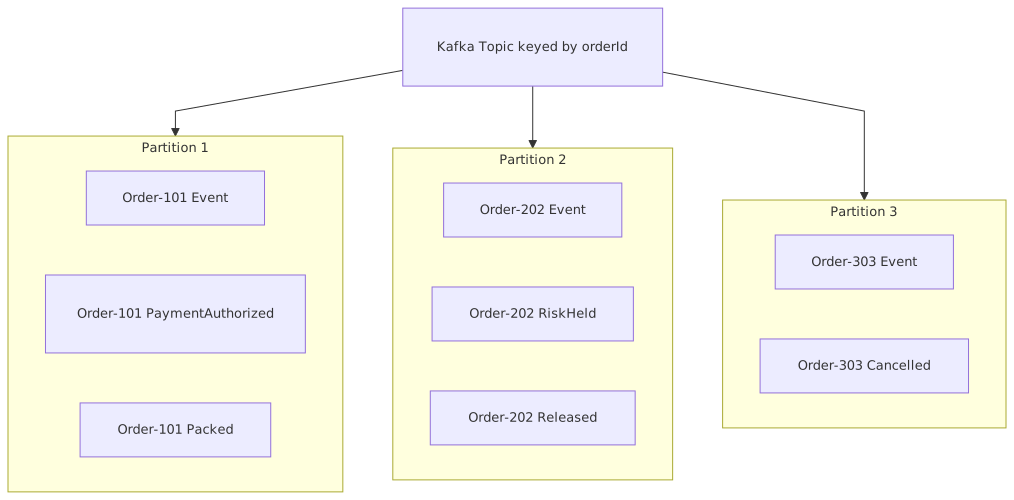
This is not just scalable; it is conceptually tidy. Ordering becomes a property of the partition key rather than an operational aspiration.
State persistence
You have a few options:
- Event-sourced workflow state: every transition is appended as an event, and state is rebuilt through replay.
- Snapshot plus journal: keep current state in a store, plus an event log for recovery and audit.
- Relational state table per workflow instance: often simpler, especially if full event sourcing is unnecessary.
I am opinionated here: many workflow systems do not need pure event sourcing. They need deterministic replay, auditability, and recovery, but not necessarily every ceremony that comes with event sourcing. A durable state store plus append-only transition log is often enough.
Domain semantics and state model
The temptation is to model workflow state as technical steps. Resist it.
Instead, define states that reflect domain intent:
SubmittedPendingIdentityVerificationPendingFraudReviewApprovedRejectedAwaitingCustomerActionProvisioningInProgressCompleted
The architecture becomes far easier to reason about when state names map to the language used by operations, customer support, and compliance.
That is classic domain-driven design thinking. The workflow state model is part of the ubiquitous language. If the business says “this claim is under assessment,” your systems should have a state that means exactly that.
Reconciliation path
Distributed workflows never run perfectly. Some responses are delayed, some events are duplicated, and some downstream actions succeed but the acknowledgment is lost. Reconciliation is not optional decoration. It is part of the architecture.
A sound design includes:
- idempotent command handling
- correlation identifiers on every interaction
- timeout-driven reconciliation checks
- compensating transitions when possible
- manual intervention queues when not
Think of reconciliation as the enterprise equivalent of admitting reality. There will always be a delta between what should have happened and what your distributed estate can currently prove happened.
Migration Strategy
Most firms do not adopt stateful workflow partitioning because they are designing a new platform from scratch. They adopt it because the current workflow model is collapsing under change.
The right migration approach is usually a progressive strangler.
Start by identifying a business workflow that is operationally visible, bounded enough to carve out, and painful enough that people care. Order fulfilment exceptions. New customer onboarding. Insurance FNOL to claim triage. Loan application intake.
Then migrate in slices.
Phase 1: Observe and mirror
Before moving control, capture the existing workflow events from the monolith, BPM suite, or integration layer. Build a partitioned read model first. This gives you visibility into lifecycle progression without changing production control.
This phase matters because it lets you test:
- partition key choice
- event ordering assumptions
- workflow state model
- reconciliation logic
- reporting and operational dashboards
Many teams skip this and go straight to command authority. That is how you end up discovering hidden business rules after the cutover.
Phase 2: Sidecar coordination
Introduce a workflow state manager that tracks a subset of cases, often in parallel with the legacy orchestrator. At first, it may only manage alerts, deadlines, and exception handling while the old system still drives the core process.
This is a useful compromise. It creates confidence in the partition model without forcing a big-bang change.
Phase 3: Strangle a workflow segment
Pick a segment with clear ownership and move command authority there. For example, customer onboarding might still begin in the old platform, but identity verification and account setup could be driven by the new partitioned workflow layer.
Use anti-corruption layers to map legacy statuses into the new domain semantics. Keep this translation explicit. Legacy systems often encode twenty years of accidental meaning into cryptic status values. Do not let that pollution leak directly into the new model.
Phase 4: Shift initiation and truth
Once enough of the lifecycle is owned by the new architecture, move workflow initiation there. This is the real tipping point. The new workflow layer becomes the source of truth for state progression, and legacy systems become participants or data providers.
Phase 5: Retire and reconcile
Even after cutover, retain reconciliation jobs between old and new estates for a while. That may feel inelegant, but it is often the difference between a survivable migration and a governance incident. EA governance checklist

Migration is not just a technical sequence. It is a confidence-building exercise. You are asking operations, risk, audit, and business teams to trust a new representation of workflow truth. They will only do that if the migration exposes discrepancies early and handles them visibly.
Enterprise Example
Consider a large insurer handling property claims after severe weather events.
On a normal day, claim volumes are manageable. During a major storm, volume spikes by a factor of ten. Claims go through intake, policy validation, fraud checks, triage, adjuster assignment, document collection, settlement calculation, payment, and closure. Some require human review, some auto-settle, some branch into legal or vendor repair processes.
The legacy estate typically looks like this:
- a claims monolith storing master status
- a BPM engine driving assignments
- a fraud platform integrated asynchronously
- a document service
- a payment service
- a CRM front end exposing partial status
- overnight reconciliation jobs to fix mismatches
When catastrophe hits, the pain surfaces fast. The BPM engine becomes a bottleneck. Operators cannot tell whether a payment delay is due to fraud hold, missing evidence, or queue lag. Duplicate submissions create split workflows. Support teams invent spreadsheets. Audit asks for lineage, and everyone goes quiet.
A partitioned workflow architecture improves this materially.
The insurer chooses claimId as the workflow partition key. All claim lifecycle events route by that key through Kafka. A claim workflow manager maintains explicit state for each claim:
SubmittedPolicyValidationPendingFraudScreenPendingAwaitingAssessmentAwaitingDocumentsSettlementCalculatedPaymentPendingClosedEscalatedForManualReview
Domain services remain separate:
- Policy service validates coverage.
- Fraud service scores the claim.
- Assessment service coordinates adjusters.
- Payment service executes settlement.
- Document service manages evidence.
The workflow manager coordinates but does not own claim valuation rules or payment execution logic.
This matters in practice. During a surge event, the insurer can scale partition consumers horizontally while preserving ordered handling per claim. Claims remain coherent. Operators can query one workflow state view instead of polling five systems. Reconciliation jobs detect claims where payment was executed but acknowledgment was not received. Manual review queues are generated from explicit timeout transitions rather than email folklore.
The big win is not merely throughput. It is operational truthfulness. The insurer can answer, with precision, why a claim is delayed and what state transition is expected next.
That is architecture earning its keep.
Operational Considerations
Stateful workflow partitioning is operational architecture, not just application design.
Partition sizing and hot keys
Choose too few partitions and you limit concurrency. Choose too many and you increase overhead, rebalance churn, and storage complexity. Real systems also suffer from hot partitions. A few customers, merchants, products, or brokers may generate disproportionate traffic.
If your business key distribution is highly uneven, pure key partitioning may not be enough. Sometimes you need composite keys, workflow sharding strategies, or domain redesign. Be careful though: adding randomness to distribute load can break ordering semantics. Scale is not worth much if it destroys correctness.
Consumer rebalancing
Kafka consumer group rebalances can stall partitions temporarily. For stateful workflows, that pause matters. You need cooperative rebalancing where possible, fast state recovery, and clear lag monitoring. The architecture should tolerate consumer movement without losing workflow progression guarantees.
Idempotency
You will get duplicates. Design for them early.
Every command and event should carry:
- workflow ID
- correlation ID
- causation ID
- version or sequence marker
- timestamp
- source identity
Downstream handlers should be idempotent. The workflow state manager should treat repeated events as harmless, not catastrophic.
Timeouts and timers
Long-running workflows live on timers: waiting for customer documents, underwriting response, stock confirmation, or human approval. Timer management is easy to hand-wave and hard to do well.
Avoid local in-memory timers as the sole mechanism. Persist timer intent. Recover timers after restart. Make timeout transitions visible as first-class workflow events.
Observability
Logs are not enough. You need workflow-centric telemetry:
- in-flight count by state
- age of workflow instances by state
- transition latency
- timeout rate
- compensation rate
- reconciliation backlog
- partition lag
- manual intervention volume
This is one area where a business-facing dashboard is worth more than a thousand platform graphs. Operations need to see “claims awaiting fraud decision longer than SLA,” not just “topic lag.”
Data retention and audit
Workflow histories often have legal and operational retention requirements. Decide early how long event logs, snapshots, and transition journals must be kept. Archiving strategy is not glamourous, but auditors have a way of making neglected details feel suddenly strategic.
Tradeoffs
There is no free architecture. Stateful workflow partitioning buys clarity and scale by imposing discipline.
Benefits
- ordered processing per business entity
- explicit lifecycle ownership
- improved recovery and replay
- better operational observability
- alignment with domain semantics
- easier scaling for high-volume workflows
- more reliable reconciliation
Costs
- more infrastructure complexity
- partition strategy becomes a major design decision
- consumer and state recovery logic must be robust
- cross-workflow coordination remains hard
- schema evolution requires care
- teams must understand asynchronous failure semantics
The biggest tradeoff is this: you are moving complexity from accidental runtime behavior into deliberate architecture.
That is usually the right trade. But it still means writing the complexity down, designing for it, and operating it consciously.
Failure Modes
The dangerous part of this pattern is that it can fail in ways that still look sophisticated.
1. Wrong partition key
Partition by a key that does not match workflow ownership, and you create endless cross-partition joins and race conditions. This is the most common design error.
2. Workflow god-service
The coordinator absorbs more and more domain logic until bounded contexts become shell services. You have recreated a distributed monolith with better branding.
3. Hidden dual writes
A workflow step updates local state and emits an event without proper atomicity or outbox handling. Under failure, state and event diverge. Reconciliation then becomes permanent rather than exceptional.
4. Unbounded state growth
Millions of long-lived workflows accumulate, snapshots bloat, timers pile up, and recovery slows. Lifecycle closure and archival need real design attention.
5. Human work ignored
Many enterprise workflows include manual review, override, or exception handling. If the architecture treats humans as out-of-band anomalies, operators will create side channels and your workflow truth will drift.
6. Reconciliation treated as an afterthought
This is a particularly expensive illusion. In distributed enterprise systems, reconciliation is not a backup plan. It is part of the main plan.
When Not To Use
Stateful workflow partitioning is not a universal answer.
Do not use it when:
- the process is short-lived and synchronous
- there is no meaningful long-running state
- ordering per business entity does not matter
- business volume is low enough that simpler designs suffice
- the workflow logic belongs entirely within one service boundary
- you do not have the operational maturity to manage event-driven stateful systems
A straightforward CRUD service with a few integration calls does not need partitioned workflow coordination. Neither does every saga. Teams often reach for elaborate workflow machinery because they are trying to future-proof against scale they do not have. That is not architecture; that is anxiety.
Also be careful in domains where a single business process truly requires strong cross-entity atomicity. If legal or financial correctness depends on ACID semantics across multiple aggregates, a partitioned asynchronous workflow may complicate matters more than it helps. Sometimes the old answer — keep it in one transactional boundary — is still the right answer.
Related Patterns
Stateful workflow partitioning does not stand alone. It typically sits among a family of patterns.
Saga
A saga coordinates long-running transactions through local commits and compensations. Partitioned workflow state managers often implement saga-like behavior, especially when coordinating multiple bounded contexts.
Process manager
This is a close cousin and often the most accurate term. A process manager reacts to events, maintains state, and issues commands. The distinction matters less than discipline around domain ownership.
Outbox pattern
Essential when services emit events after local state changes. It reduces dual-write inconsistency and makes replay more trustworthy.
Event sourcing
Useful when complete state reconstruction and auditability are priorities. Not mandatory, but often adjacent.
CQRS
Helpful for separating workflow state views from command handling, especially when operational dashboards need tailored lifecycle projections.
Strangler fig pattern
The natural migration strategy for replacing monolithic or BPM-centric workflow implementations incrementally.
Anti-corruption layer
Crucial during migration. It prevents legacy status models and message shapes from poisoning the new domain semantics.
Summary
Stateful workflows are where enterprise architecture stops being decorative and starts being accountable.
If a business process is long-running, high-volume, operationally important, and spread across microservices, then its state cannot remain an accidental side effect of message passing. It needs explicit ownership. It needs a partition strategy rooted in domain semantics. It needs deterministic recovery, visible reconciliation, and migration that respects the existing estate.
That is what stateful workflow partitioning provides.
Done well, it creates a system where each workflow instance has a home, an ordered history, a meaningful lifecycle, and a scalable execution model. Kafka can provide the ordered partitions. Microservices can keep domain ownership local. A workflow state manager can coordinate progress without becoming the emperor of the enterprise. Reconciliation can acknowledge the messiness of distributed reality without surrendering correctness.
Done badly, of course, it becomes a workflow god-service, a partitioning mistake wrapped in infrastructure, or a distributed monolith with a streaming platform attached.
So be opinionated.
Partition by business meaning.
Model state in domain language.
Keep coordination explicit.
Design reconciliation before production teaches it to you.
Migrate progressively, not heroically.
Because in the end, the business does not care how elegant your services look in a diagram. It cares whether you can answer the oldest question in distributed systems with confidence:
What is happening to this thing right now, and what happens next?
The key is not replacing everything at once, but progressively earning trust while moving meaning, ownership, and behavior into the new platform.
Frequently Asked Questions
What is a service mesh?
A service mesh is an infrastructure layer managing service-to-service communication. It provides mutual TLS, load balancing, circuit breaking, retries, and observability without each service implementing these capabilities. Istio and Linkerd are common implementations.
How do you document microservices architecture for governance?
Use ArchiMate Application Cooperation diagrams for the service landscape, UML Component diagrams for internal structure, UML Sequence diagrams for key flows, and UML Deployment diagrams for Kubernetes topology. All views can coexist in Sparx EA with full traceability.
What is the difference between choreography and orchestration in microservices?
Choreography has services react to events independently — no central coordinator. Orchestration uses a central workflow engine that calls services in sequence. Choreography scales better but is harder to debug; orchestration is easier to reason about but creates a central coupling point.