⏱ 20 min read
Time is the first thing distributed systems waste.
Not CPU. Not memory. Time.
A customer taps Pay Now, an underwriter requests a quote, a warehouse allocates stock, a claims system checks fraud signals. In each case, the business thinks in terms of a promise: answer within this window or the answer is no longer useful. Yet most microservice estates still behave like badly run meetings. Every service takes “just a few more seconds,” retries with optimism, waits on downstream calls that are already doomed, and emits events that arrive after the business moment has passed.
This is why deadline propagation matters. Not as a transport trick, not as another resilience checkbox, but as a way of making time a first-class domain concern. In a distributed architecture, a deadline is not merely a timeout. A timeout says, “I am tired of waiting.” A deadline says, “This answer stops having value at this exact point.” That distinction is where architecture begins.
And yes, the phrase sounds technical. But the consequences are deeply business-shaped. In lending, a credit offer must be assembled before a rate lock expires. In e-commerce, inventory reservation must complete before the cart checkout window closes. In logistics, route optimization must finish before the dispatch wave is released. If we don’t carry those temporal semantics across service boundaries, then every team invents its own local patience. That is how enterprise systems become a graveyard of partial work, zombie retries, and reconciliations nobody budgeted for.
So let’s be opinionated: if your microservices collaborate on work that decays in value over time, distributed deadline propagation should be part of the architecture. Not everywhere. Not blindly. But deliberately, modeled in the domain, enforced in the platform, and visible in operations. microservices architecture diagrams
Context
Microservices made one trade explicit: we break a large system into smaller bounded contexts so teams can move faster and evolve independently. Domain-driven design gave us the language for doing that without turning architecture into a pile of RPC endpoints. We identify capabilities, define aggregates, model invariants, and let each bounded context own its data and behavior.
That part is now well understood. The harder lesson comes later: business capabilities do not operate in isolation. They collaborate in sequences, sagas, and event flows. A single customer intent can cross five, ten, or twenty services. Every crossing introduces latency, queueing, retries, and the possibility that one part of the estate still works on work the business no longer cares about.
This is especially visible in hybrid enterprise landscapes:
- synchronous APIs at the edge
- Kafka for domain event distribution
- workflow or orchestration engines for long-running processes
- legacy systems behind ESBs or adapters
- analytics and fraud engines with variable response times
- cloud-native services with autoscaling, sidecars, and service meshes
In these landscapes, time has many local representations:
- HTTP timeouts
- gRPC deadlines
- Kafka retention and consumer lag
- workflow task TTLs
- database lock wait settings
- circuit breaker thresholds
- retry backoff policies
The problem is not that these exist. The problem is that they are usually configured independently. The estate has plenty of clocks and very little shared understanding of whose clock matters.
A business deadline often originates from outside the system: customer patience, regulatory SLA, market price validity, batch cutoff, dispatch window, or fraud review threshold. Architecture should preserve that meaning as work flows across bounded contexts. Otherwise the technical platform optimizes for activity, not value.
Problem
In most microservice systems, each service sets local timeouts and retry behavior based on technical convenience. That creates three predictable pathologies.
First, deadline amplification. An API gateway allows 8 seconds. Service A calls B with a 5-second timeout. B calls C with 5 seconds. C calls D with 5 seconds. Locally reasonable. Globally absurd. The original caller gave up long ago, but the estate continues burning compute and holding resources for a request that is already dead.
Second, semantic drift. The sales domain says a quote is valid for 3 seconds during interactive pricing. The fraud service interprets urgency as a priority flag. The fulfillment service queues inventory allocation normally because it sees no explicit expiration. Same business process, different assumptions about time.
Third, asynchronous afterlife. A request times out at the edge, but downstream Kafka consumers continue processing emitted events. Inventory gets reserved after the cart expired. A payment hold remains active after order cancellation. CRM receives a “successful offer generated” event for a session the customer abandoned two minutes earlier.
This is not just an engineering nuisance. It breaks domain integrity.
A system with no propagated deadline is like an airport with no departure boards. Everyone is busy, but no one knows which flight has already left.
The root issue
The root issue is that most systems treat time constraints as transport configuration rather than domain policy. A timeout is buried in code or mesh settings; a business deadline belongs in the model.
If “submit quote before lock expiry” is a core business rule, then the architecture should carry an explicit deadline or expiry across interactions. Every participating service should understand whether to continue, degrade, compensate, or reject work based on remaining time budget.
Forces
This problem lives at the intersection of several forces. Good architecture makes those tensions explicit.
1. Business semantics vs technical mechanics
The business talks about validity, freshness, cutoff, reservation window, and regulatory SLA. Infrastructure talks about timeouts and retries. They are related, but not the same thing.
DDD matters here. In one bounded context, “deadline” may mean quote valid until. In another, it may mean reservation must be confirmed by. In another, decision must complete within compliance SLA. A single technical header is not enough unless its meaning is anchored in ubiquitous language.
2. End-to-end latency vs local autonomy
Each service should own its behavior. But if every service optimizes independently, nobody owns end-to-end time. Distributed systems punish local selfishness.
3. Reliability vs waste
Retries improve success rates for transient failures. They also consume the very time budget you are trying to preserve. A retry on an expired request is not resilience. It is waste with metrics.
4. Synchronous and asynchronous coexistence
Deadlines are easy to imagine in request-response chains. They are harder in Kafka-driven flows where consumers may process long after publication. Yet that is exactly where domain expiration matters most. event-driven architecture patterns
5. Precision vs practicality
Clocks drift. Queues delay. Networks jitter. No enterprise system will enforce deadlines with mathematical purity. The goal is not perfect temporal determinism. The goal is useful, consistent behavior under uncertainty.
6. Migration reality
Most enterprises do not get to redesign the world. They have old services, packaged software, and message buses that were built before anyone talked about propagated deadlines. Any useful approach must support progressive adoption.
Solution
The architectural move is simple to describe and surprisingly hard to do well:
Represent deadlines explicitly, propagate them across service boundaries, enforce them consistently, and reconcile expired work.
That sentence contains four distinct ideas.
1. Represent deadlines explicitly
A deadline should be carried as data, not implied by local config. Typical forms include:
- absolute timestamp:
deadlineAt - remaining budget in milliseconds:
timeRemainingMs - domain-specific expiry:
quoteValidUntil,reservationExpiresAt - reason or class: interactive, regulatory, cutoff-bound
For inter-service propagation, absolute time is usually safer than relative timeout because each hop can calculate remaining budget independently. Relative time often accumulates rounding errors and interpretation mistakes.
My preference is this: keep a transport-level propagated deadline and, where needed, map it to domain-level temporal concepts inside each bounded context. Don’t force one to pretend to be the other.
2. Propagate across synchronous and asynchronous channels
For synchronous calls, include deadline metadata in HTTP headers or gRPC metadata. For Kafka, include it in message headers and, when business-relevant, also in the event payload.
Why both? Because transport headers are useful for middleware and interceptors. Payload fields are useful when expiry is part of the domain fact and must survive republishing, replay, audit, or cross-platform integration.
3. Enforce with policy, not scattered if-statements
Each service should evaluate the remaining budget at ingress and before expensive downstream work. The service can then choose among policies:
- reject immediately if expired
- degrade to a cheaper path
- skip optional enrichments
- avoid fan-out
- stop retries
- return partial results if business-safe
- emit expiry or timeout domain events for compensation
Do not leave this to every team’s interpretation. Define platform libraries, gateway behavior, consumer interceptors, and service templates.
4. Reconcile expired and partial work
This is the part many articles skip because it is messy. Real systems do not stop perfectly at the deadline. Some work completes late. Some side effects are already committed. Some events arrive out of order. Therefore deadline propagation must be paired with reconciliation.
You need explicit handling for:
- inventory reserved after checkout expiry
- payment authorized after order cancellation
- pricing response generated after quote window closed
- fraud review completed after manual fallback triggered
Expired work should not simply disappear. It should be marked, compensated, or reconciled according to domain rules.
Architecture
The architecture has three layers: domain semantics, propagation mechanics, and runtime enforcement.
Domain view
From a DDD perspective, deadlines belong in process boundaries, not everywhere. Aggregates enforce business invariants; sagas and process managers coordinate work across bounded contexts; domain events publish facts. Deadlines usually enter through commands and process coordination.
Examples:
SubmitLoanApplicationcarriesdecisionDeadlineAtCreateOrderestablishesreservationExpiresAtPriceQuoteRequestedcarriesquoteDeadlineAt
Within each bounded context, the domain model should decide what late means:
- reject command because decision window closed
- mark outcome as stale but still auditable
- compensate a side effect
- route to manual process
- preserve event for compliance but not customer response
This is important: late is a business state, not merely a transport error.
Technical propagation view
The platform should carry deadlines through all major communication paths:
- API gateway -> services
- service -> service calls
- service -> Kafka producer
- Kafka consumer -> downstream processing
- workflow engine -> task execution
- adapters -> legacy systems
Here is a simplified flow.
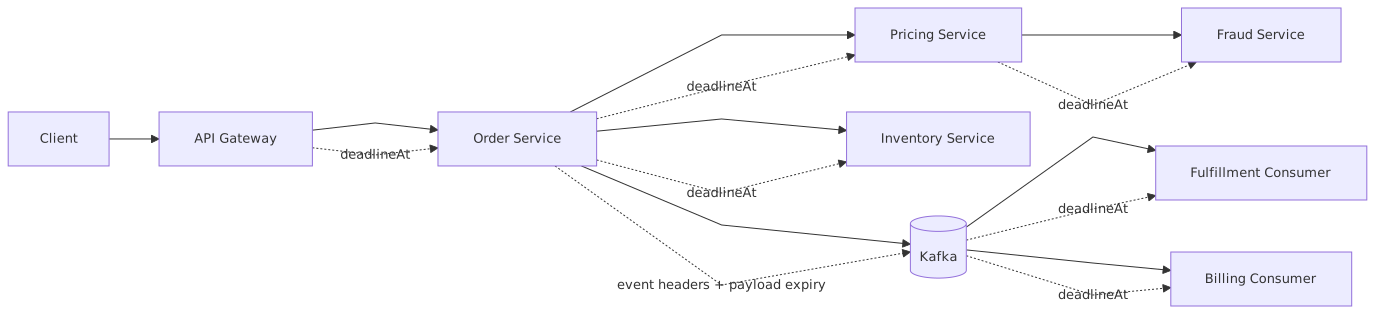
A few design choices matter.
Absolute deadline over hop timeout
Store something like deadlineAt=2026-03-27T12:00:02.250Z. Each service computes remaining time:
remaining = deadlineAt - now(clock)
That avoids compounding local timeout assumptions.
Budget partitioning
Sometimes a service should reserve part of the remaining budget for downstream steps. For example:
- 20% for response assembly
- 50% max for pricing
- 20% for fraud
- 10% buffer
This is not always necessary, but in fan-out paths it prevents one call from consuming all time budget.
Domain expiration in events
If an event causes work whose value expires, include expiry semantics in the event itself. For example:
This lets consumers act appropriately even when replayed or processed by a nonstandard client.
Enforcement pipeline
A clean implementation typically includes:
- gateway or edge service sets initial deadline from client SLA, product policy, or channel rule
- middleware/interceptors propagate deadline metadata automatically
- ingress filter checks expiration before allocating expensive resources
- downstream clients stop retries if remaining budget is insufficient
- Kafka consumers discard, compensate, or reroute expired messages based on domain policy
- observability emits deadline-related metrics and traces
Here is a policy sequence.
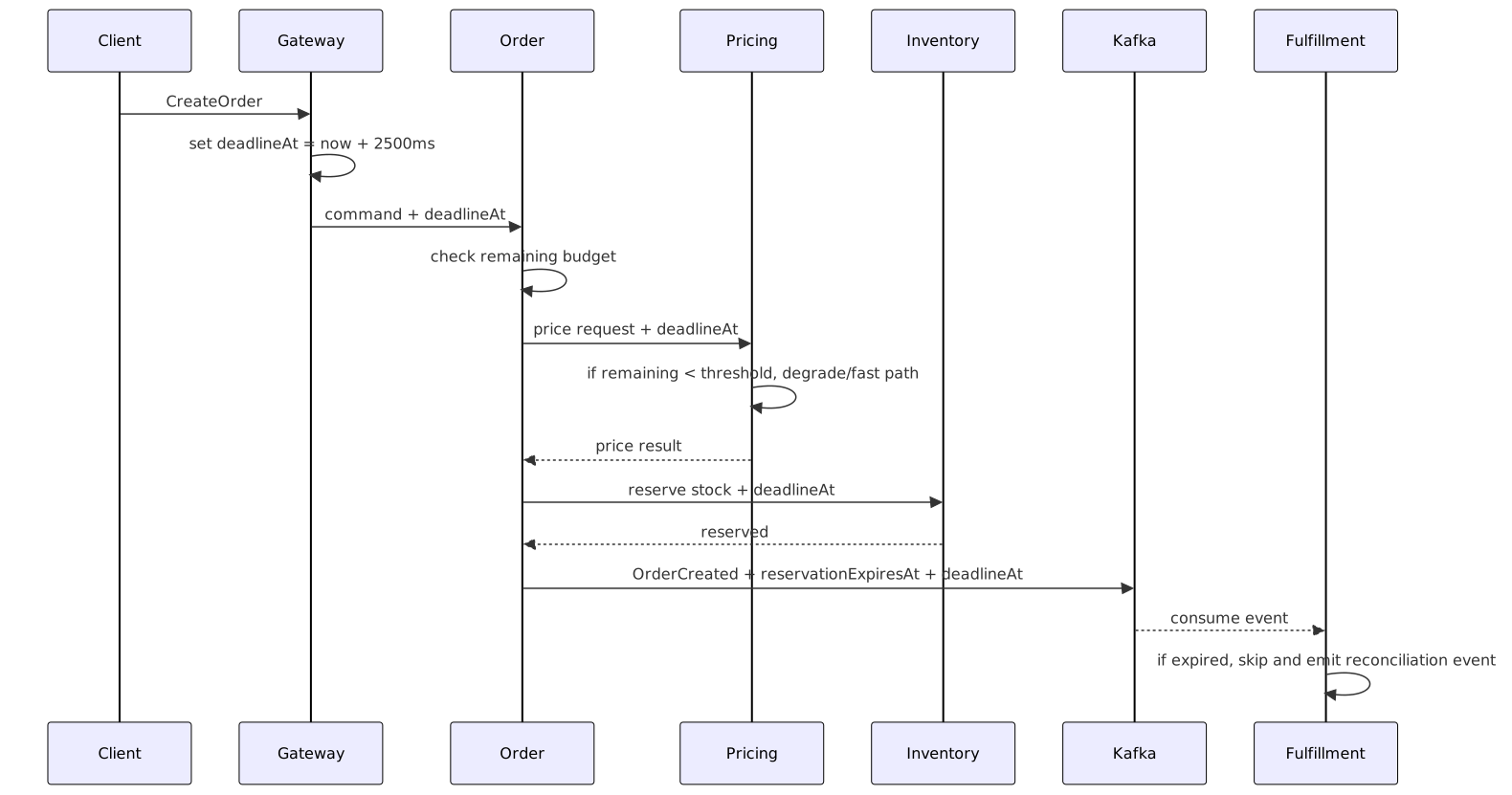
The threshold logic matters. A service should not start a 700ms operation with 80ms remaining unless the domain explicitly allows stale completion.
Migration Strategy
No enterprise starts here greenfield. Deadline propagation almost always arrives after latency incidents, cost spikes, or customer-visible inconsistency. So the migration strategy must be incremental. This is where the strangler pattern earns its keep.
Step 1: Discover time-sensitive journeys
Start with business journeys where lateness changes value:
- card authorization during checkout
- real-time pricing or offer generation
- fraud scoring in onboarding
- warehouse allocation before order promise
- dispatch planning before cutoff
Map the current path, actual latency distribution, retries, and downstream side effects. Don’t model the whole enterprise. Find the hotspots where deadlines already exist in business language but are not reflected in architecture.
Step 2: Introduce canonical deadline metadata at the edge
Pick a standard:
- HTTP header, e.g.
X-Deadline-At - gRPC deadline metadata
- Kafka header, e.g.
deadlineAt - optional correlation metadata like
requestClass
This is the first strangler seam. Existing services can ignore it. New or modified services can honor it.
Step 3: Instrument before enforcing
Measure:
- requests received with deadline
- expired on arrival
- remaining budget per service
- work started with insufficient budget
- late completions
- retries attempted after effective expiry
Without this, teams will debate policy using opinions and anecdotes.
Step 4: Add propagation libraries and platform guardrails
Do not ask every squad to reimplement deadline handling. Provide:
- ingress filters
- outbound client interceptors
- Kafka producer/consumer wrappers
- policy hooks for minimum remaining budget
- tracing attributes and logs
This is one of those boring platform investments that prevents a thousand inconsistent local decisions.
Step 5: Enforce on selected paths
Turn on behavior in narrow slices first:
- reject expired requests at ingress
- disable retries when remaining budget falls below threshold
- skip optional enrichments
- mark late events for reconciliation
This gives operational feedback without destabilizing the estate.
Step 6: Bridge legacy systems
Legacy systems rarely understand propagated deadlines. Wrap them.
An adapter can:
- translate deadline into legacy timeout where possible
- stop calling legacy if insufficient budget remains
- mark responses as stale if they arrive after deadline
- trigger compensation or manual review
Step 7: Add reconciliation flows
This is the stage people postpone and then regret. Once the estate starts becoming deadline-aware, late side effects become visible. Build the compensations and reconciliation logic before rolling adoption widely.
Here is a migration sketch.
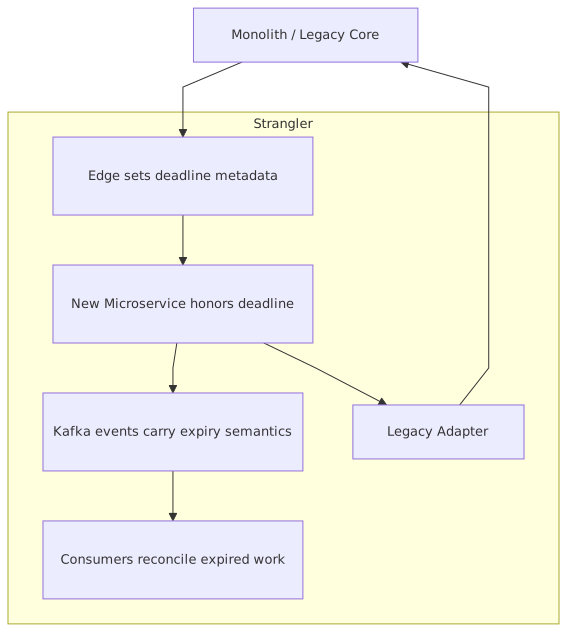
A practical migration rule
Start where the business already suffers from “late but completed” behavior. That pain creates sponsorship. Nobody funds deadline propagation because it is elegant. They fund it because they are tired of apologizing for work that completed after it stopped mattering.
Enterprise Example
Consider a large retailer with a modern digital storefront, Kafka event backbone, and a mixture of cloud-native services and legacy fulfillment systems. cloud architecture guide
The checkout flow looks simple from outside:
- customer submits order
- pricing confirms final amount
- fraud service scores transaction
- inventory reserves stock
- payment authorizes
- order confirmation returned
Behind the curtain, it is a tangle of APIs, Kafka topics, and old warehouse integrations.
The original symptoms
The retailer had a 3-second customer SLA for interactive checkout confirmation. Yet many requests timing out at the edge still triggered downstream work:
- inventory was reserved after the customer had already retried and placed a duplicate order
- payment holds remained for carts that had expired
- fraud scoring consumed expensive external API calls for abandoned sessions
- warehouse allocation messages were processed from Kafka long after the reservation window closed
The architecture had resilience components everywhere: retries, bulkheads, circuit breakers. But no shared temporal contract. Every service was reliable in isolation and collectively irresponsible.
Domain reframing
The key shift was not technical. It was semantic.
The team introduced three domain concepts:
checkoutDeadlineAt: the interactive response windowreservationExpiresAt: how long stock reservation remains validauthorizationValidityUntil: how long a payment authorization can be used
These were related, but not identical. That distinction mattered. The customer-facing checkout deadline was short. The reservation and authorization windows could legitimately extend beyond it for compensation and recovery scenarios.
This is classic DDD thinking: one word, “deadline,” hides multiple meanings across bounded contexts. The architecture must not flatten them carelessly.
The implementation
At the API gateway, each checkout request received checkoutDeadlineAt.
Order service propagated that timestamp to pricing, fraud, inventory, and payment. Kafka events also carried relevant expiry fields in payload and deadlineAt in headers.
Policies were introduced:
- if less than 150ms remained, skip nonessential recommendation enrichment
- if less than 300ms remained, use cached fraud score if available
- if request expired before inventory call, do not reserve stock
- if payment authorization completed after checkout deadline but before authorization validity expiry, emit
AuthorizationLateCompletedfor reconciliation - warehouse consumers checked
reservationExpiresAtbefore acting on reservation events
The outcome
The retailer saw three meaningful changes:
- fewer wasted downstream calls
- reduced duplicate reservations and payment holds
- clearer operational visibility into expired vs failed work
The most important result was not average latency. It was behavioral coherence. Late work became intentional rather than accidental.
That is what mature architecture looks like. Not the elimination of failure, but the alignment of system behavior with business meaning when failure and delay occur.
Operational Considerations
Deadline propagation only works if it becomes visible in operations.
Observability
At minimum, capture:
- deadline on ingress
- remaining budget at each hop
- expired-on-arrival count
- late completion count
- retries attempted with insufficient budget
- Kafka consumer lag relative to message expiry
- reconciliation backlog
Add deadline metadata to traces. A distributed trace that shows span durations without time budget context tells half the story.
Clock discipline
Absolute deadlines depend on clocks that are “good enough.” Use synchronized infrastructure time. This will not be perfect, and it does not need to be. But if clock skew is wild, deadline behavior becomes random.
Queue behavior
Kafka introduces an important operational reality: a consumer can receive a message long after its useful lifetime. That is not a bug. It is the nature of asynchronous systems.
You need explicit policy per topic or event type:
- discard expired work
- process anyway if required for audit
- process only to emit compensation
- route to manual review
Retry governance
Tie retries to remaining budget. A retry policy that ignores deadline budget is a denial-of-service attack you launch against yourself.
Backpressure and admission control
When latency rises, deadlines should influence admission. Better to reject low-value work early than drown the system in requests that cannot possibly finish in time.
Reconciliation operations
Provide support tooling for:
- inspecting expired flows
- replaying safe events
- triggering compensations
- resolving stuck reservations or holds
- reviewing SLA breaches by journey and bounded context
This is where enterprise architecture stops being a diagram and becomes a working system.
Tradeoffs
There is no free lunch here.
More semantic clarity, more design work
You gain correctness, but only if teams think carefully about what “deadline” means in their context. That is real modeling work.
Less waste, more visible rejection
Early expiry checks will increase explicit rejects. Some stakeholders will initially see that as worse than hidden timeouts. It isn’t. It is honesty.
Better coordination, reduced local freedom
Teams lose some freedom to define arbitrary timeouts and retry patterns. Good. End-to-end behavior matters more than local folklore.
Cleaner operations, more platform complexity
Propagation libraries, interceptors, Kafka header handling, tracing enrichment, and reconciliation workflows add moving parts. The complexity is justified only where time-sensitivity is genuinely business-critical.
Greater consistency, harder testing
Temporal behavior is notoriously hard to test. You will need deterministic clock abstractions, latency injection, and end-to-end scenario testing under degraded conditions.
Failure Modes
Deadline propagation does not eliminate failure. It changes its shape.
1. Deadline ignored by one service
One service in the chain keeps retrying or processing expired work. The whole value proposition weakens. This is why platform enforcement beats policy documents.
2. Confusion between timeout and deadline
A team maps a 2-second deadline to a 2-second socket timeout and thinks the job is done. It isn’t. Timeouts are a local waiting rule; deadlines are an end-to-end validity rule.
3. Event replay breaks semantics
A replayed Kafka event triggers processing months later because expiry was only in transport headers, not in payload or persisted state. Audit and replay requirements must be considered up front.
4. Over-aggressive expiration
A service drops work too eagerly based on a strict threshold and causes avoidable failures. Policies should reflect probability and cost, not zealotry.
5. Missing reconciliation
The system becomes good at abandoning expired work and terrible at cleaning up side effects already committed. This is the classic half-architecture: good ingress checks, bad business recovery.
6. Clock skew and inconsistent time sources
Different nodes disagree enough to create phantom expiry. Usually rare, always maddening.
7. Deadline laundering through adapters
Legacy adapters strip deadline metadata or replace it with local timeout defaults. The architecture looks consistent on paper and leaks in practice.
When Not To Use
Not every system needs this.
Do not invest heavily in distributed deadline propagation when:
- the workload is batch-oriented and value does not sharply decay with time
- services are loosely coupled and mostly independent
- asynchronous processing is intentionally eventual and lateness is acceptable
- the estate is small enough that simple gateway timeouts are sufficient
- the domain has no meaningful temporal semantics beyond technical responsiveness
A monthly financial consolidation process does not usually need end-to-end propagated deadlines. A customer checkout flow absolutely might.
Also, avoid turning this into a religion. If teams start adding deadline metadata to every internal call regardless of business significance, you will create complexity without clarity. Time should be explicit where it changes decisions.
Related Patterns
Deadline propagation sits among several adjacent patterns.
Timeout
A local mechanism for limiting wait time. Necessary, but not sufficient.
Circuit Breaker
Prevents repeated calls to a failing dependency. Should work with deadline budget, not independently of it.
Bulkhead
Contains resource exhaustion. Useful when expired requests would otherwise consume shared pools.
Saga
Coordinates distributed business transactions. Deadlines often define saga step validity and compensation triggers.
Strangler Fig
Ideal for introducing deadline-aware behavior incrementally around legacy systems.
Outbox Pattern
Ensures reliable publication of events. Important when expiry semantics must accompany durable event emission.
Idempotency
Critical for retries, late completions, and reconciliations. Without idempotency, temporal recovery gets ugly fast.
Process Manager / Workflow
Useful when deadline policies require explicit orchestration, escalation, and compensation over time.
These are complementary. Deadline propagation is not a substitute for them. It gives them a shared temporal frame.
Summary
Distributed deadline propagation is what happens when an architecture finally admits that time has business meaning.
In a microservice estate, that means more than setting timeouts. It means carrying an explicit deadline across calls and events, interpreting it through bounded-context semantics, using it to govern retries and fan-out, and reconciling work that completes after its useful life.
The important ideas are straightforward:
- model time-sensitive intent explicitly
- distinguish domain expiry from transport timeout
- propagate deadlines across synchronous and Kafka-based flows
- enforce with platform policy, not scattered custom code
- reconcile late side effects deliberately
- migrate progressively using strangler seams around legacy systems
The tradeoff is clear. You take on modeling effort, platform work, and operational discipline. In return, you get a system that stops pretending all work is equally valuable at all times.
That is a trade worth making in any enterprise where lateness changes the meaning of success.
Because in distributed systems, the hardest bug is not that something failed.
It is that it succeeded too late.
Frequently Asked Questions
What is a service mesh?
A service mesh is an infrastructure layer managing service-to-service communication. It provides mutual TLS, load balancing, circuit breaking, retries, and observability without each service implementing these capabilities. Istio and Linkerd are common implementations.
How do you document microservices architecture for governance?
Use ArchiMate Application Cooperation diagrams for the service landscape, UML Component diagrams for internal structure, UML Sequence diagrams for key flows, and UML Deployment diagrams for Kubernetes topology. All views can coexist in Sparx EA with full traceability.
What is the difference between choreography and orchestration in microservices?
Choreography has services react to events independently — no central coordinator. Orchestration uses a central workflow engine that calls services in sequence. Choreography scales better but is harder to debug; orchestration is easier to reason about but creates a central coupling point.