⏱ 20 min read
Large enterprises do not suffer from a lack of events. They suffer from too many meanings.
That is the real problem.
A customer is “active” in one system because billing has an open contract. The same customer is “inactive” in another because risk suspended trading. A third system says the customer was “reactivated,” but what it really means is that a call center agent removed a hold code. Put all three on Kafka and people will congratulate themselves on becoming event-driven. Then six months later, every downstream team is carrying a private dictionary, dashboards are lying, and integration code has quietly become the most business-critical software in the company. event-driven architecture patterns
This is where architecture earns its keep. Not by drawing prettier boxes, but by stopping semantic drift from becoming operational chaos.
Cross-domain event translation is one of those patterns that sounds mundane until you live without it. In a domain-driven design landscape, each bounded context has every right to speak its own language. In fact, it should. That is the point. But once those contexts start collaborating through asynchronous messaging, language stops being a local matter. Events leak meaning. And meaning, unlike payload shape, is hard to refactor.
A translation layer between domains is not a technical ornament. It is a semantic shock absorber. It lets domains stay honest internally while still participating in a broader enterprise conversation. It is the anti-corruption layer’s more operational cousin, built for streams, state transitions, reconciliation, and the grubby realities of long-running migration.
This article lays out when to use cross-domain event translation, how to design it, where it fails, and why naive “just publish domain events to Kafka” strategies so often age badly. I’ll lean into domain-driven design, migration strategy, and the tradeoffs that appear once systems meet real enterprise constraints: compliance, legacy models, partial outages, duplicated events, and organizations that cannot stop the world to redesign a taxonomy.
Context
Microservices promised autonomy. Domain-driven design gave that autonomy a vocabulary: bounded contexts, ubiquitous language, aggregates, invariants. In the best implementations, teams model their domain deeply and expose behavior without leaking internal structures.
The trouble begins when event-driven architecture enters the room.
Inside a bounded context, a domain event is wonderfully precise. OrderApproved, PolicyLapsed, MarginCallIssued, ShipmentDispatched. It captures something meaningful in that domain’s language at a point in time. The event is useful precisely because it is opinionated.
But enterprise landscapes are not single domains. They are federations. A retail bank has cards, fraud, KYC, collections, servicing, treasury, CRM, and regulatory reporting. An insurer has policy administration, claims, underwriting, billing, customer servicing, and partner distribution. A manufacturer has planning, procurement, plant execution, logistics, commerce, and finance. Every one of those bounded contexts needs to react to things happening elsewhere. Very few of them mean the same thing by the same words.
This is the first important idea: events are not facts floating in a vacuum; they are facts interpreted through a domain model.
That distinction matters because many integration failures come from treating event streams as if they were universal truth. They are not. They are domain truth. That is narrower, and more useful, but also more dangerous when forgotten.
Kafka makes this both easier and harder. Easier because durable event logs and consumer groups reduce coupling at the infrastructure layer. Harder because the low friction of publishing encourages indiscriminate distribution of semantically local events as if transport-level decoupling somehow solved business-level interpretation.
It doesn’t.
Problem
Teams often start with a simple instinct: “We already have domain events, so let other services consume them.” On a whiteboard, this looks elegant. In production, it creates three recurring pathologies.
First, semantic leakage. A downstream domain starts depending on the source domain’s private terminology and lifecycle quirks. Billing consumes customer events from CRM and learns far too much about lead conversion stages. Fraud consumes payment events and accidentally couples itself to internal authorization sub-states that were never meant to be external. The source context’s model begins to colonize others.
Second, schema compliance without semantic compliance. Teams obsess over Avro compatibility, Protobuf evolution, topic naming conventions, and schema registry policies. Good hygiene, certainly. But two teams can agree perfectly on JSON shape and still disagree completely on what “cancelled” means. Was the order cancelled by the customer, replaced by an amendment, rejected by policy, or voided before settlement? You can validate structure and still ship nonsense.
Third, consumer-side translation sprawl. Every consuming service writes its own mapper from upstream events to local concepts. Ten consumers, ten interpretations. Subtle differences accumulate: timing windows, duplicate suppression rules, code tables, precedence logic. Now your architecture depends on consistency across independently written ad hoc translation code. That is not a pattern. That is a distributed accident.
The root issue is simple. Bounded contexts need linguistic freedom, but integration needs controlled interpretation. If you ignore the tension, either the source domain becomes an enterprise canonical model by stealth, or every consumer becomes a mini integration platform.
Both outcomes are bad. One destroys autonomy. The other destroys coherence.
Forces
Several forces pull this design in opposite directions.
Domain purity versus enterprise interoperability
DDD tells us to keep models sharp inside bounded contexts. That is correct. Yet enterprises need shared flows: customer onboarding, order fulfillment, claims settlement, case handling, revenue recognition. These are cross-domain narratives. You cannot run them well if every team translates everything for itself.
Producer autonomy versus consumer simplicity
Letting producers publish raw domain events preserves source integrity. It also pushes complexity downstream. Providing translated events simplifies consumers but risks creating a central integration bottleneck. There is no free lunch here, only a choice about where complexity lives.
Real-time responsiveness versus semantic confidence
Streaming encourages immediate reaction. But some translations require context, state, or reconciliation. A “CustomerActivated” enterprise event may require signals from onboarding, KYC, billing, and entitlements. If you publish too soon, consumers act on half-truths. If you wait too long, the business loses responsiveness.
Event history versus current state
Some domains care about every transition. Others only care about effective state. Translation layers often need to derive one from the other. That means holding state, correlating events, and resolving ordering gaps. Once you do that, you are no longer simply routing messages. You are building a domain-aware projection engine.
Migration speed versus model correctness
In a greenfield world, one could carefully define context maps and event contracts from day one. Enterprises rarely have that luxury. They have mainframes, ESBs, operational data stores, nightly batches, and line-of-business systems with fifteen years of sediment. Translation layers often appear during migration because they let you move incrementally. But migration expediency can tempt teams into encoding legacy semantics forever.
That too is a trap.
Solution
The solution is to introduce a cross-domain event translation layer that sits between source domain event streams and target domain-consumable events. Its job is not to canonicalize the universe. Its job is narrower and more valuable: to transform domain-local event semantics into explicitly governed, audience-appropriate integration semantics.
That phrase matters: integration semantics.
A translation layer should produce events meant for a specific cross-domain purpose. Sometimes those are enterprise process events such as CustomerReadyForTrading, OrderFulfillmentStarted, or ClaimSettlementAuthorized. Sometimes they are partner-facing integration events. Sometimes they are target-domain-facing adaptation events. What they should not be is a hand-wavy “canonical customer event” intended to satisfy everyone forever. Canonical models become junk drawers. Translation layers should be purposeful.
In DDD terms, this is best understood as an event-oriented extension of the anti-corruption layer. The classic anti-corruption layer protects one domain from another’s model through translation at synchronous boundaries. In event-driven microservices, the same principle applies asynchronously. We translate not just shape, but intent, lifecycle, and business significance. microservices architecture diagrams
A good translation layer usually does five things:
- Consumes source domain events from one or more bounded contexts.
- Correlates and enriches them using reference data, local state, or additional streams.
- Maps semantics into target integration concepts, including status normalization and reason-code interpretation.
- Publishes translated events to topics designed around downstream use cases.
- Reconciles and audits outcomes so that eventual consistency does not quietly become permanent inconsistency.
This is not just ETL with better marketing. The difference is domain reasoning. The translator understands that AccountSuspended, CustomerRestricted, and TradingDisabled are not interchangeable, and that whether they lead to a downstream CustomerUnavailableForTrading event depends on policy, timing, and business rules.
A reference shape
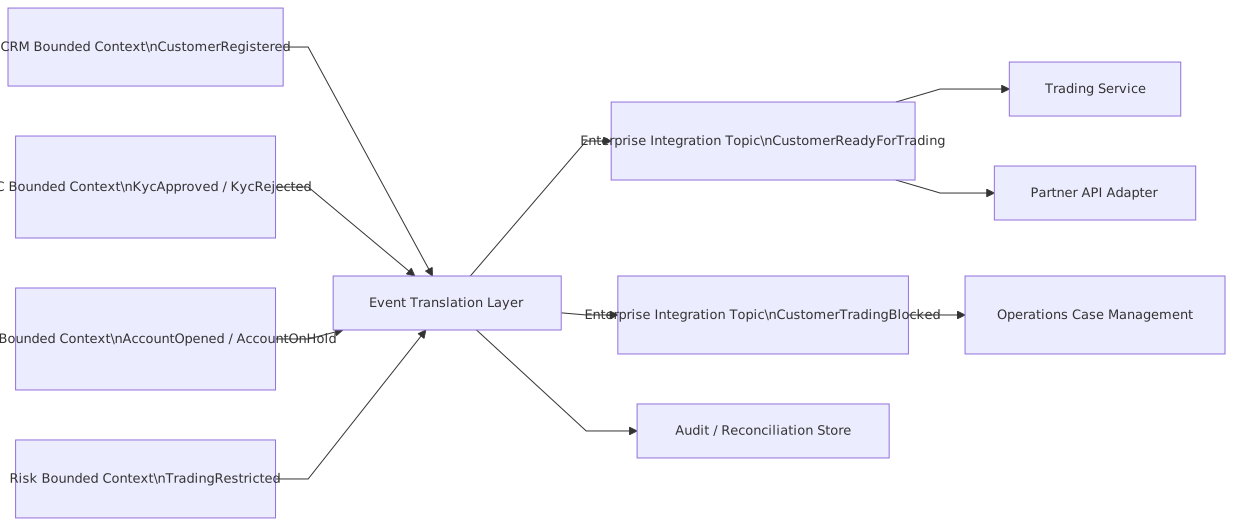
Notice what this is not doing. It is not forcing CRM, KYC, Billing, and Risk to agree on one internal customer model. They keep their own language. The translator composes a cross-domain interpretation for a specific business capability: trading readiness.
That is the pattern in one sentence: let domains remain distinct, and make integration semantics explicit in the middle.
Architecture
There are several ways to implement the translation layer, and the right choice depends on volume, latency, and semantic complexity.
Option 1: Stateless mapping
If the source event already contains sufficient meaning and only requires renaming or code conversion, a stateless translator may be enough. This can be implemented in Kafka Streams, a lightweight consumer-producer service, or even a managed stream processing platform.
Use this only when semantics truly align and you are merely adapting contracts. Many teams overestimate how often that is true.
Option 2: Stateful stream translation
This is the more common enterprise case. The translator maintains local state so it can correlate multiple upstream events, handle ordering, derive effective status, and suppress duplicates. Kafka Streams, Flink, or a bespoke service with a durable state store all work here.
The translator becomes a small domain in its own right: not a core business domain, but a semantic integration component with explicit rules.
Option 3: Process-aware translation
Sometimes translation is inseparable from a cross-domain workflow. For example, producing CustomerReadyForTrading may require an orchestration or saga-like view: registered, identity verified, account funded, no active trading block. Here the translator overlaps with process management. Be careful. If it starts making business decisions that belong to a domain, you have built a hidden domain service in the integration layer.
The line is subtle but crucial: translation should interpret and compose domain outcomes, not usurp domain authority.
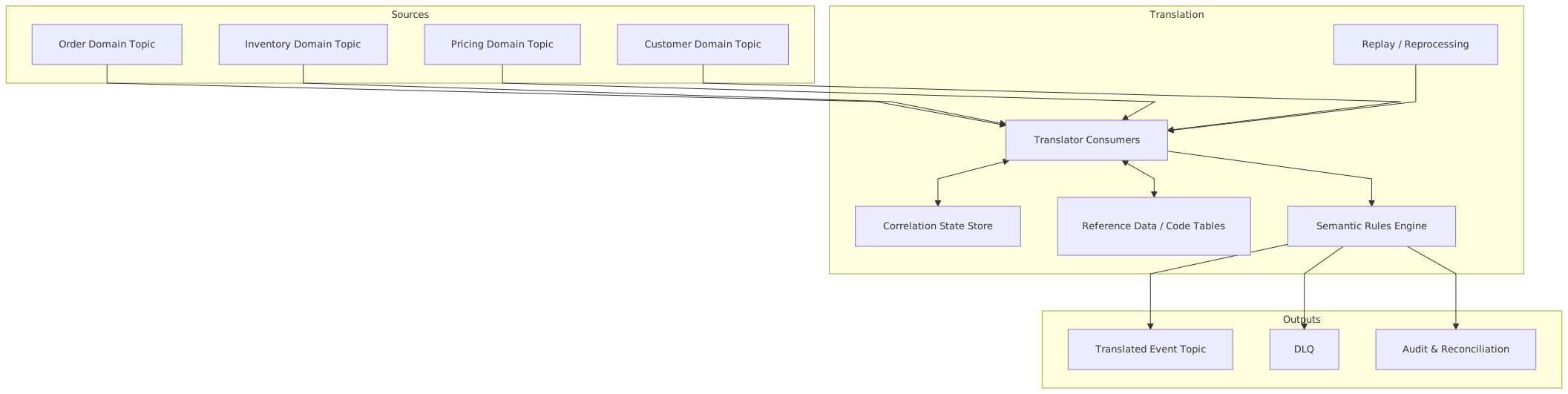
Core architectural elements
A robust translation architecture usually contains:
- Source event topics aligned to bounded contexts
- Schema registry and contract governance
- A translation service or stream processor
- Reference and correlation state
- Translated event topics aligned to downstream capabilities
- Audit and reconciliation store
- Dead-letter and replay mechanisms
- Observability around lag, mapping errors, and semantic drift
Here is a more detailed view.
Event design principles
A few hard-won rules help.
Publish source events and translated events separately. Do not overwrite or mutate source topics. Downstream consumers should choose which semantic level they want.
Name translated events for business meaning, not technical mechanics. CustomerTradingBlocked is better than CustomerStatusMappedV2.
Carry provenance. Every translated event should include source event references, translation version, correlation identifiers, and timestamps. If operations cannot answer “why did this event exist?” you are headed for painful reconciliations.
Make reasons first-class. State without reason is often semantically useless. “Blocked” means little without whether it came from KYC failure, unpaid debt, sanctions match, or temporary fraud review.
Version business meaning deliberately. Schema versioning is not enough. If translation rules change materially, treat that as a governed semantic version and communicate it.
Context mapping matters
DDD gives us useful lenses here. The translation layer is often needed where context relationships are customer-supplier, conformist, or partnership in awkward combinations. If a downstream domain should not conform directly to the upstream model, translation provides insulation. It allows one bounded context to remain a good citizen without becoming everyone’s shared language.
This is why I am skeptical of broad enterprise canonical event models. They often claim to promote reuse but end up flattening domain nuance. The result is a bland middle language no one truly owns and everyone resents. Better to have a small number of intentional translation products for specific cross-domain interactions.
Migration Strategy
This pattern shines during migration because it supports a progressive strangler approach.
Enterprises rarely replace systems in one move. More often, a monolith or legacy application remains system of record while new microservices peel off capabilities. During this period, semantics are unstable. Legacy systems emit crude events or only expose CDC, batch extracts, or ESB notifications. New services publish richer domain events. Consumers need continuity while the landscape changes underneath them.
A translation layer can become the seam that makes this survivable.
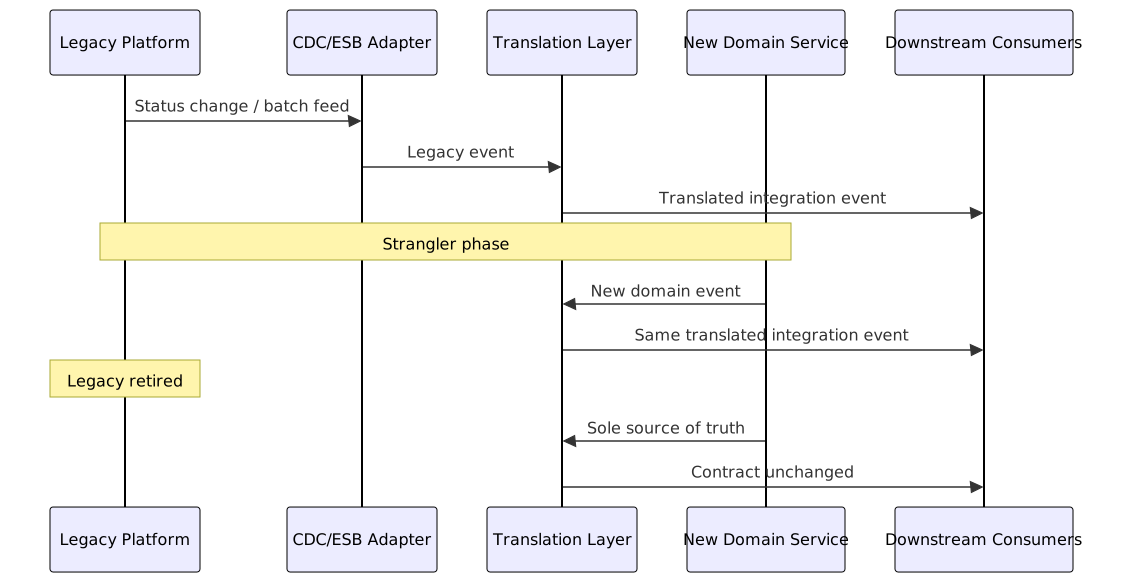
Progressive strangler path
- Tap legacy change signals: database CDC, mainframe feeds, ESB messages, scheduled extracts.
- Translate legacy signals into stable integration events used by new consumers.
- Introduce new microservices that publish proper domain events.
- Adjust translation rules so the same translated integration events can be produced from either legacy or new sources.
- Cut over consumers gradually without forcing them to understand migration internals.
- Retire legacy source mappings once the new domains fully own the semantics.
This lets you preserve downstream contracts while upstream implementation evolves.
Migration reasoning
This is the migration logic that matters: stabilize downstream meaning before stabilizing upstream implementation.
Teams often do the opposite. They rebuild upstream services first, then ask consumers to adapt repeatedly as new events mature. That creates avoidable churn. If you establish a translation boundary early, you can absorb source-side evolution while keeping downstream integration contracts coherent.
There is another benefit: side-by-side reconciliation. During migration, produce translated events from both legacy and new sources, compare outcomes, and investigate mismatches before consumer cutover. This is one of the few reliable ways to test semantics, not just syntax.
Reconciliation in migration
Reconciliation deserves explicit attention because event-driven migrations fail quietly when they fail semantically.
A proper reconciliation model should compare:
- expected translated events from legacy
- expected translated events from new services
- actual emitted translated events
- downstream materialized state after consumption
This catches hidden problems: missing prerequisite events, duplicate suppression gone wrong, changed reason-code mappings, timezone effects, out-of-order transitions, and stale reference data.
In other words, reconciliation is how you learn whether the enterprise still means the same thing after you modernize it.
Enterprise Example
Consider a global insurer modernizing its policy servicing platform.
The legacy policy admin system emits state changes through an ESB. Everything downstream consumes variants of policy status: billing starts invoicing, claims checks coverage eligibility, CRM updates customer notifications, and finance tracks earned premium. Over time, “policy active” drifted into at least four meanings:
- policy issued
- premium posted
- coverage effective
- no underwriting hold
As the insurer introduced microservices for billing, underwriting, and customer communications, each began publishing richer events to Kafka: PolicyIssued, PremiumCollected, CoverageActivated, UnderwritingHoldPlaced, UnderwritingHoldReleased, PolicyCancelled, PolicyReinstated.
The early temptation was obvious: let everyone consume these events directly. Claims wanted CoverageActivated, CRM wanted PolicyIssued, finance wanted all of them. Very quickly, teams built local logic to decide whether a policy was truly “in force.” Results diverged. Customer emails claimed coverage was live before billing confirmed payment. Claims accepted cases on policies still under underwriting hold. Operations lost trust.
The fix was not a bigger data lake or another governance committee. It was a translation layer producing two explicit integration events: EA governance checklist
PolicyInForcePolicyNotInForce
Those events were not naive mappings. The translator maintained state by policy identifier and applied business rules agreed by the relevant domains:
PolicyInForceonly when issued, effective date reached, no active underwriting hold, and payment conditions satisfied for product typePolicyNotInForcewhen cancelled, rescinded, expired, or blocked by unresolved conditions- reason codes preserved, such as
NON_PAYMENT,UNDERWRITING_HOLD,FUTURE_EFFECTIVE_DATE,CANCELLED
Claims consumed PolicyInForce for eligibility screening. CRM consumed both events for customer communication. Finance still consumed source-domain events because it needed a more detailed ledger-oriented view.
That last point is crucial. Not all consumers should use translated events. Some need raw domain detail. A translation layer does not replace domain events; it complements them.
During migration, the insurer ran legacy ESB-derived translations and new Kafka-derived translations side by side for three months. Reconciliation exposed edge cases nobody had modeled properly: policy reinstatements after same-day cancellation, retroactive effective dates, and product lines where billing tolerance windows delayed in-force status. Without the translation layer and audit trail, those inconsistencies would have emerged as claim disputes and regulatory incidents.
That is what “architecture decision” means in enterprise terms: fewer philosophical arguments, fewer customer-facing mistakes.
Operational Considerations
Translation layers are operational systems. Treat them as such.
Observability
You need more than CPU and memory charts. Track:
- consumer lag by topic and partition
- translation success/failure counts
- unmatched correlation rates
- duplicate detection counts
- stale reference data indicators
- reconciliation deltas
- semantic version distribution in output events
One good metric is “events awaiting completeness.” If many records are stuck waiting for missing upstream signals, you either have source quality problems or over-complicated translation rules.
Replay and determinism
Sooner or later you will need to replay history. Maybe a bug in reason-code mapping, maybe a corrupted state store, maybe a policy update from compliance. Replay is only safe if translation is deterministic for a given input history and reference-data version. If your translator depends on mutable external lookups without versioning, replay will produce different answers and operations will rightly lose faith.
Idempotency
Translated events must be safe under duplicate upstream delivery. Kafka gives you strong tools, but business idempotency still matters. A duplicate PremiumCollected should not generate two PolicyInForce transitions if state is unchanged.
Ordering
Ordering is often the silent killer. Per-aggregate partitioning helps, but cross-topic correlations still produce races. Design for late and out-of-order events. Sometimes that means buffering. Sometimes it means emitting a correction event. Pretending ordering is perfect is not architecture; it is wishful thinking.
Data retention and audit
In regulated industries, you need to show how a translated business event was derived. Keep source references, rule versions, and possibly snapshots of relevant reference data. “We think the mapper did this” is not an acceptable audit answer.
Team ownership
The translation layer should have clear ownership. Shared infrastructure teams can host the platform, but semantic rules require business-adjacent stewardship. If nobody owns the meaning, the layer will rot into generic middleware.
Tradeoffs
This pattern is powerful, but it is not free.
The biggest benefit is semantic decoupling. Domains keep their own language. Consumers get events aligned to their business needs. Migration becomes safer. Reconciliation has a home. Enterprise process events become explicit.
The biggest cost is another moving part with business logic in it. That logic can become a bottleneck if centralized badly. Teams may fight over whose interpretation belongs in the translator. Latency increases when stateful correlation is required. Operational burden goes up.
There is also a subtler risk: the translation layer can become a de facto canonical model hub. Once every team sees it as the place to put “shared meaning,” it grows tentacles. Soon simple mappings become policy adjudication, entitlement decisions, and cross-domain orchestration. At that point you have built a hidden monolith in the middle of your event mesh.
The remedy is discipline. Keep translation purpose-specific. Split translators by business capability when necessary. Push real business decisions back into owning domains.
Failure Modes
A few failure modes show up repeatedly.
1. The thin veneer failure
The translator merely renames fields and republishes everything. This adds operational complexity without solving semantic mismatch. If no real domain interpretation happens, don’t build the layer.
2. The accidental canonical failure
Every domain starts consuming only translated events, and the translation layer becomes the enterprise’s unofficial source of truth. This undermines bounded contexts and creates central coupling.
3. The hidden workflow failure
Translation logic starts deciding outcomes that should belong to domain services. For example, marking a customer as approved based on partial evidence rather than waiting for the approval domain’s authoritative decision. Integration code should not impersonate business authority.
4. The unreconcilable failure
No audit trail, no rule versions, no source provenance. When downstream state diverges, nobody can explain why. This is common and ugly.
5. The migration sediment failure
Temporary legacy mappings become permanent. The translator carries obsolete code tables and half-understood exceptions years after the migration ended. Technical debt in integration is still debt.
When Not To Use
You do not need a cross-domain event translation layer every time two services exchange events.
Do not use it when:
- producer and consumer are in the same bounded context and share language naturally
- the event is already intentionally designed as an external integration event
- semantics align closely enough that simple contract adaptation at the edge is sufficient
- there are very few consumers and no sign of semantic divergence
- a synchronous API with explicit request semantics would be clearer than asynchronous interpretation
- the latency budget cannot tolerate stateful correlation and business meaning depends on delayed completeness
Most importantly, do not use a translation layer to paper over poor domain boundaries. If two services constantly require semantic translation because the split was arbitrary, the problem may be the decomposition itself.
Related Patterns
This pattern sits near several others.
- Anti-Corruption Layer: the conceptual ancestor; translation at domain boundaries, usually synchronous.
- Published Language: when a bounded context exposes an intentionally shared language; often preferable when semantics truly are stable and shared.
- Outbox Pattern: reliable publication of source domain events; often the right upstream mechanism feeding translators.
- Saga / Process Manager: when cross-domain coordination becomes workflow, not just translation.
- CQRS Projections: translation layers often build projection-like state from multiple event streams.
- Strangler Fig Pattern: crucial during migration; translation stabilizes downstream contracts while legacy is replaced.
- Event Carried State Transfer versus Event Notification: translation may convert between fine-grained notifications and business-meaningful state transitions.
The important distinction is that cross-domain event translation is not a replacement for these patterns. It is a semantic integration mechanism that often composes with them.
Summary
Cross-domain event translation exists because enterprises are multilingual, and pretending otherwise is expensive.
In a domain-driven design microservice landscape, bounded contexts should keep their own semantics. That is strength, not disorder. But once events cross boundaries, someone must take responsibility for interpretation. If you leave that burden to every consumer, you get inconsistency. If you force one source model on everyone, you get semantic imperialism. A translation layer is the middle path: explicit, governed, operationally accountable.
Used well, it gives you cleaner context boundaries, safer Kafka-based integration, progressive strangler migration, and a place to do reconciliation when reality turns messy—as it always does. Used badly, it becomes a canonical swamp or a hidden workflow engine.
So be opinionated. Translate only where meaning genuinely changes. Preserve provenance. Reconcile relentlessly. Keep temporary migration logic temporary. And remember the line that matters most in event-driven architecture:
Transport is easy. Shared meaning is the hard part.
That is why this pattern matters.
Frequently Asked Questions
What is a service mesh?
A service mesh is an infrastructure layer managing service-to-service communication. It provides mutual TLS, load balancing, circuit breaking, retries, and observability without each service implementing these capabilities. Istio and Linkerd are common implementations.
How do you document microservices architecture for governance?
Use ArchiMate Application Cooperation diagrams for the service landscape, UML Component diagrams for internal structure, UML Sequence diagrams for key flows, and UML Deployment diagrams for Kubernetes topology. All views can coexist in Sparx EA with full traceability.
What is the difference between choreography and orchestration in microservices?
Choreography has services react to events independently — no central coordinator. Orchestration uses a central workflow engine that calls services in sequence. Choreography scales better but is harder to debug; orchestration is easier to reason about but creates a central coupling point.