⏱ 22 min read
Most enterprise data problems do not begin with bad technology. They begin with amnesia.
A customer balance is wrong in one screen but right in another. A shipment appears delivered in analytics but still in transit in operations. Finance closes the month using numbers that nobody can quite explain, only defend. Then the room fills with familiar words: “pipeline,” “sync issue,” “eventual consistency,” “Kafka lag,” “ETL bug.” These words sound technical, but the real problem is usually simpler and more dangerous: the organization has lost the story of its data. event-driven architecture patterns
That story is data lineage.
In a monolith, lineage is often hidden but survivable. The joins live in one database, the transaction boundaries are mostly local, and a determined engineer can still trace cause and effect with enough SQL and patience. In a microservices architecture, that safety net disappears. Data is copied, projected, enriched, cached, transformed, denormalized, published, re-published, and interpreted through different bounded contexts. The same business fact now travels through a landscape of APIs, events, stream processors, materialized views, data products, and analytics platforms. Without a lineage graph across services, the system becomes operationally fluent and semantically incoherent.
And that is the real risk. Not just “where did this field come from?” but “what does this data mean here, who changed its meaning, and what business decision now depends on that interpretation?”
That is why lineage in microservices should not be treated as a governance afterthought or a metadata side project. It is an architectural capability. It sits at the intersection of domain-driven design, event architecture, observability, data governance, and migration strategy. Done well, it helps teams move faster because they can change systems without losing trust. Done poorly, it becomes another catalog full of stale diagrams and aspirational metadata. EA governance checklist
This article lays out a practical architecture for data lineage across microservices: what problem it solves, the forces that shape it, how to model lineage with domain semantics, how Kafka and event-driven systems change the game, how to migrate toward it with a progressive strangler approach, what operational concerns matter, where it fails, and when you should not use it at all.
Context
Microservices changed the shape of enterprise data.
The old model assumed that applications owned behavior while the enterprise data warehouse owned historical truth. Transactions happened in operational systems; interpretation happened later in a central analytics stack. That division was never perfect, but it was stable enough. Then came service decomposition, domain ownership, event streams, customer-facing real-time decisions, and product teams accountable for both transactional and analytical outcomes.
Now every service is, in effect, a data producer. Many are also data consumers, data transformers, and data publishers.
Order Management emits OrderPlaced. Inventory reserves stock and emits StockReserved. Pricing enriches the order with discount context. Billing creates invoices. Customer 360 builds a read model. Fraud computes risk features. Data engineering lands the same events in a lakehouse. Finance derives revenue recognition records from several of these streams, often asynchronously and with its own interpretation rules. Each step is locally rational. Together, they form a chain of derivations that spans business domains and technical platforms.
The architecture challenge is not merely to collect metadata from all those systems. It is to preserve the meaning of data as it crosses bounded contexts.
Domain-driven design matters here. A field named status inside Fulfillment is not the same concept as status inside Billing, even if they happen to share values such as PENDING or COMPLETED. A customer in CRM may represent a legal account, while in e-commerce it may mean an authenticated user profile. If lineage only captures table-to-table or topic-to-topic movement, it produces an attractive lie. The graph looks complete, but the business semantics have already drifted.
Lineage across services must therefore operate at three levels at once:
- Technical lineage: topics, APIs, tables, jobs, services, schemas.
- Operational lineage: producers, consumers, versions, timestamps, correlation identifiers, replay provenance.
- Semantic lineage: business concepts, bounded contexts, transformations of meaning, derivation rules, policy interpretation.
Without all three, you have breadcrumbs but not a map.
Problem
Microservices encourage autonomy. Lineage needs coherence. Those two instincts collide.
Each service team optimizes for local speed. They choose storage models suited to their workload, publish events designed for their consumers, and evolve schemas independently. This is healthy. But lineage is inherently cross-cutting. It asks teams to expose origin, transformation, dependencies, and meaning beyond the boundary of their own service.
In practice, several problems emerge.
First, data duplication becomes invisible. Teams build read models, cache layers, reporting stores, and enrichment streams. The same business fact now exists in ten places. Nobody knows which are authoritative, which are snapshots, and which are derived approximations.
Second, semantics drift silently. A service republishes a field into a new topic, renames nothing, but changes the calculation basis. Downstream consumers continue happily until an executive dashboard goes sideways. Technical compatibility does not guarantee semantic compatibility.
Third, root-cause analysis becomes theater. During an incident, teams can trace infrastructure metrics and request IDs, but they cannot explain the life of a business datum. “Why did this customer get free shipping?” is not answered by CPU graphs.
Fourth, compliance and audit become painful. Regulations often ask for explainability: where personal data came from, where it flowed, who used it, how it was transformed, when it was deleted. In a service mesh of events, APIs, CDC streams, and analytics jobs, this is not inferable after the fact.
Fifth, migration amplifies the mess. During strangler migrations, both legacy and new services coexist. Data may be replicated in both directions. Reconciliation logic appears. Temporary translators become permanent. If lineage does not explicitly model the migration state, the enterprise ends up governing ghosts.
A lineage graph across services addresses these issues, but only if it is treated as part of the architecture, not as a passive metadata inventory.
Forces
Architecture is the art of balancing forces, not chasing ideals. Data lineage in microservices sits in the middle of several stubborn ones. microservices architecture diagrams
Autonomy vs standardization
Service teams need freedom to evolve. Lineage needs common contracts for metadata, identifiers, event naming, schema versioning, and relationship modeling. Too much standardization and teams rebel. Too little and the graph becomes a patchwork.
Real-time flow vs explainability
Kafka, stream processing, and asynchronous messaging are excellent for decoupling and scale. They are less forgiving when you need a clear audit trail of derivation. The faster data moves, the easier it is to lose narrative continuity.
Domain semantics vs platform abstraction
A centralized lineage platform wants generic entities: datasets, jobs, fields, columns, nodes, edges. Domain teams think in orders, policies, claims, reservations, and settlements. The platform must support both. Generic metadata alone is sterile. Pure domain modeling alone does not scale.
Evolution vs stability
Schemas change. Contexts split. Services die. Topics get compacted. Retention windows expire. A lineage architecture must tolerate change without making historical lineage unreadable.
Cost vs completeness
Full lineage capture is expensive. Every API call, every event, every transformation, every field-level mapping—this can become a surveillance state for data. Most enterprises do not need absolute completeness. They need trustworthy coverage of the flows that matter.
Governance vs usability
If lineage is built only for governance teams, engineers ignore it. If it is built only for engineers, compliance teams cannot use it. The system has to serve both: operational troubleshooting and enterprise accountability. ArchiMate for governance
These are not minor implementation details. They shape the design.
Solution
The practical answer is to build a federated lineage capability with a central graph model and domain-owned semantic contributions.
That sentence sounds neat. The work is not.
At the core, you maintain a lineage graph across services where nodes represent things such as domains, services, topics, APIs, tables, data products, and business concepts. Edges represent relationships such as produces, consumes, derives, enriches, copies, reconciles, exposes, and supersedes. Some edges are technical. Some are semantic. The graph is queryable, versioned, and time-aware.
The crucial design move is this: lineage is not just inferred from infrastructure; it is also declared by the domain.
Infrastructure can tell you that Service A publishes to Kafka topic X and Stream Job B reads X and writes table Y. Useful, but insufficient. It cannot tell you whether netAmount in Y still means “post-discount pre-tax customer charge” or has become “recognized revenue amount.” That semantic shift must be modeled explicitly, ideally close to the bounded context where it occurs.
So the solution has four layers:
- Capture layer
Collect technical metadata from Kafka, schema registry, APIs, CDC tools, ETL/ELT jobs, databases, orchestration platforms, and query engines.
- Semantic annotation layer
Let domain teams declare mappings from technical assets to business concepts, bounded contexts, transformation rules, and ownership.
- Lineage graph layer
Store all lineage as a graph with temporal versioning. This graph should support both runtime query and historical reconstruction.
- Consumption layer
Expose lineage to engineers, operators, auditors, and data consumers through search, impact analysis, incident analysis, and policy views.
This is where domain-driven design sharpens the architecture. The semantic unit is not “table” or “topic.” It is often a domain fact. For example:
- “Order was placed”
- “Payment was authorized”
- “Inventory was reserved”
- “Invoice was issued”
- “Revenue was recognized”
Each fact may have multiple technical representations across services. The lineage system should connect these representations without pretending they are identical. A derivation is not a copy. An enrichment is not an assertion of truth. A projection is not a source of record.
Those distinctions matter.
Architecture
A workable architecture usually combines passive observation with explicit declaration.
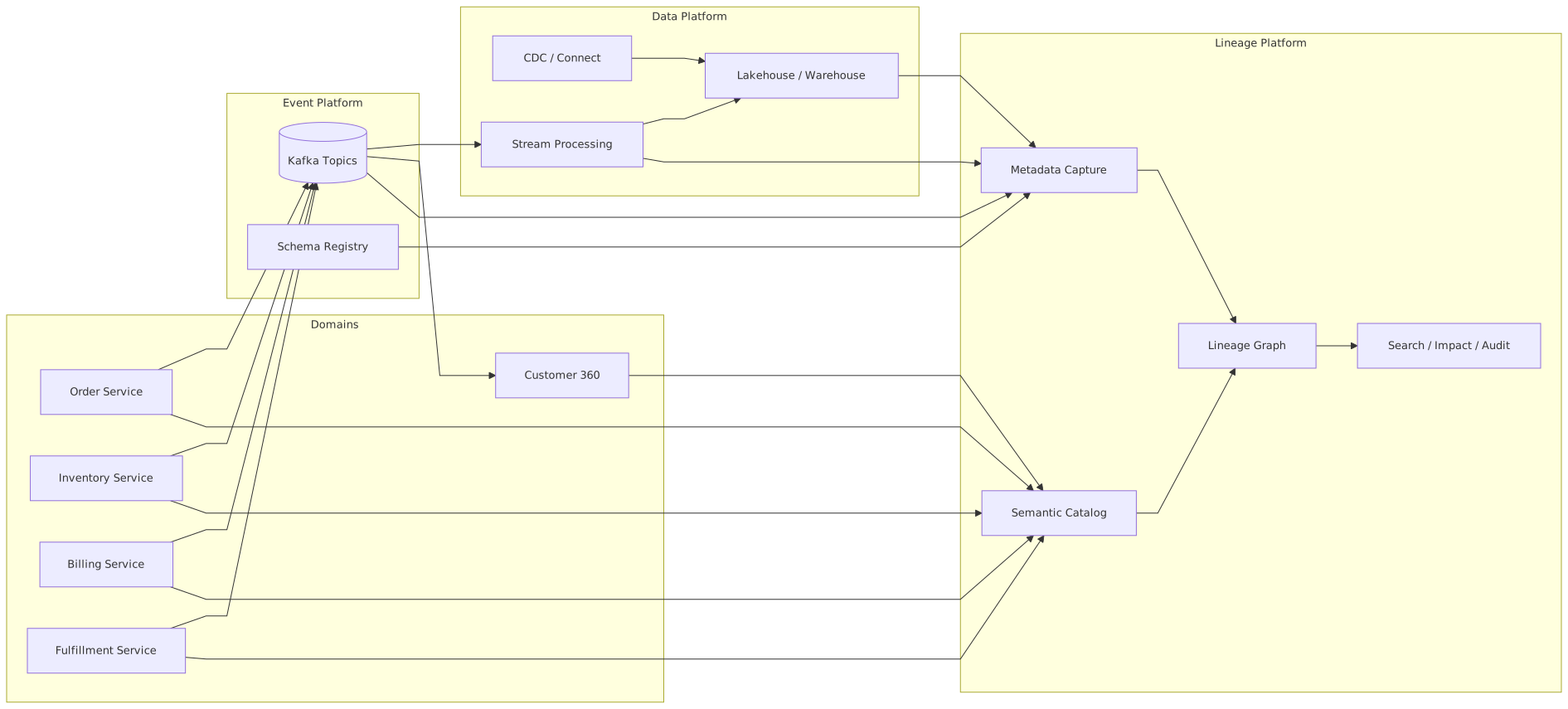
1. Capture technical lineage automatically
Start with what the platform can observe:
- Kafka producers and consumers
- topic schemas and versions
- stream processing topologies
- CDC source and sink mappings
- API gateway traffic metadata
- data pipeline task dependencies
- warehouse table and view lineage
- orchestration DAGs
- service ownership metadata from the internal developer platform
This gives you structural lineage: who talks to whom, what gets transformed, where data lands.
Kafka is especially important. In event-driven microservices, Kafka topics often become the hidden connective tissue of the enterprise. They are both integration surface and historical log. Capture should include:
- producer service
- topic name and retention
- key semantics
- event type and schema version
- downstream consumers
- replay and backfill jobs
- dead-letter topics
- stream jobs creating derived topics
Without replay provenance, lineage is incomplete. A backfill job that re-emits six months of corrected events is not just another producer. It is a semantic intervention.
2. Add semantic lineage from domains
Here is where most lineage initiatives either become useful or die.
Each domain should publish metadata that answers questions like:
- What business concept does this dataset or event represent?
- Is it a source-of-record, projection, cache, read model, or derived fact?
- Which bounded context defines its semantics?
- What transformations alter meaning rather than shape?
- What is the authoritative identity for correlation?
- What downstream uses are intended, tolerated, or forbidden?
This metadata should be versioned with the service or schema, ideally as code-adjacent declarations. If it lives in a wiki, it will rot.
A simple example:
orders.order_placed.v3
Domain concept: OrderPlaced
Context: Ordering
Classification: source domain event
Identity: orderId
Semantics note: represents customer commitment, not payment confirmation
billing.invoice_created.v1
Domain concept: InvoiceIssued
Context: Billing
Classification: derived accounting event
Derived from: OrderPlaced, PaymentAuthorized, tax policy service
Semantics note: legal invoice amount may differ from basket total
Now the graph can tell a much richer story.
3. Model lineage as time-aware graph
Lineage without time is nostalgia. Enterprises need to know not only current dependencies but also what was true at the time of an incident, audit, or financial close.
Graph entities often include:
- Domain
- Bounded Context
- Service
- API Endpoint
- Kafka Topic
- Event Type
- Schema Version
- Stream Job
- Database Table
- Data Product
- Business Concept
- Policy / Rule Set
- Reconciliation Process
Graph relationships include:
PRODUCESCONSUMESDERIVES_FROMENRICHESPROJECTSRECONCILES_WITHOWNED_BYDEFINED_IN_CONTEXTSUPERSEDESEXPOSESUSES_POLICY
Temporal attributes matter:
- effective from / to
- schema version window
- migration phase
- deprecation status
- replay interval
- retention horizon
4. Support reconciliation as first-class lineage
This deserves special emphasis.
In distributed systems, reconciliation is not an embarrassing exception. It is a normal operating mechanism. Systems disagree. Events arrive late. APIs fail. CDC duplicates records. Legacy and new services coexist. Finance and operations count the same reality differently for legitimate reasons.
Lineage should model reconciliation processes as explicit nodes and edges, not hide them behind scripts.
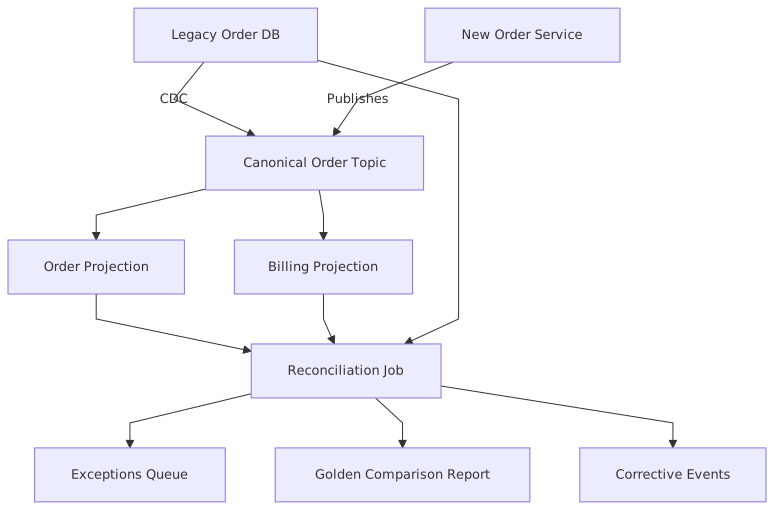
A reconciliation job should declare:
- compared sources
- comparison keys
- tolerance rules
- mismatch categories
- corrective action
- whether it is advisory or authoritative
This turns ugly operational reality into navigable architecture.
Migration Strategy
No sane enterprise gets lineage “done” in one move. The successful pattern is progressive strangler migration.
Do not begin by trying to catalog the whole enterprise. Begin where change and risk are highest: domains under active decomposition, customer-facing event flows, financial reporting paths, regulated data, and known reconciliation hotspots.
A practical migration path looks like this.
Step 1: Pick one value stream, not one platform
Choose a cross-service business journey such as order-to-cash, claim-to-settlement, or quote-to-bind. This keeps the effort anchored in business meaning rather than metadata plumbing.
Step 2: Capture current technical lineage
Instrument Kafka, data pipelines, APIs, and warehouse jobs for that value stream. Build the first graph from observable flow data.
Step 3: Add domain semantics manually
Work with domain teams to annotate the important events, projections, and tables. This is where bounded contexts become explicit. Expect disagreement. That is healthy. Misalignment discovered in metadata is cheaper than misalignment discovered in production.
Step 4: Introduce lineage contracts
Require new services and new event types in that value stream to include minimal lineage metadata:
- owner
- domain concept
- source-of-record classification
- upstream derivation
- identity key
- retention and privacy class
This is the strangler move: all new architecture comes through the new guardrails, while old systems are mapped gradually.
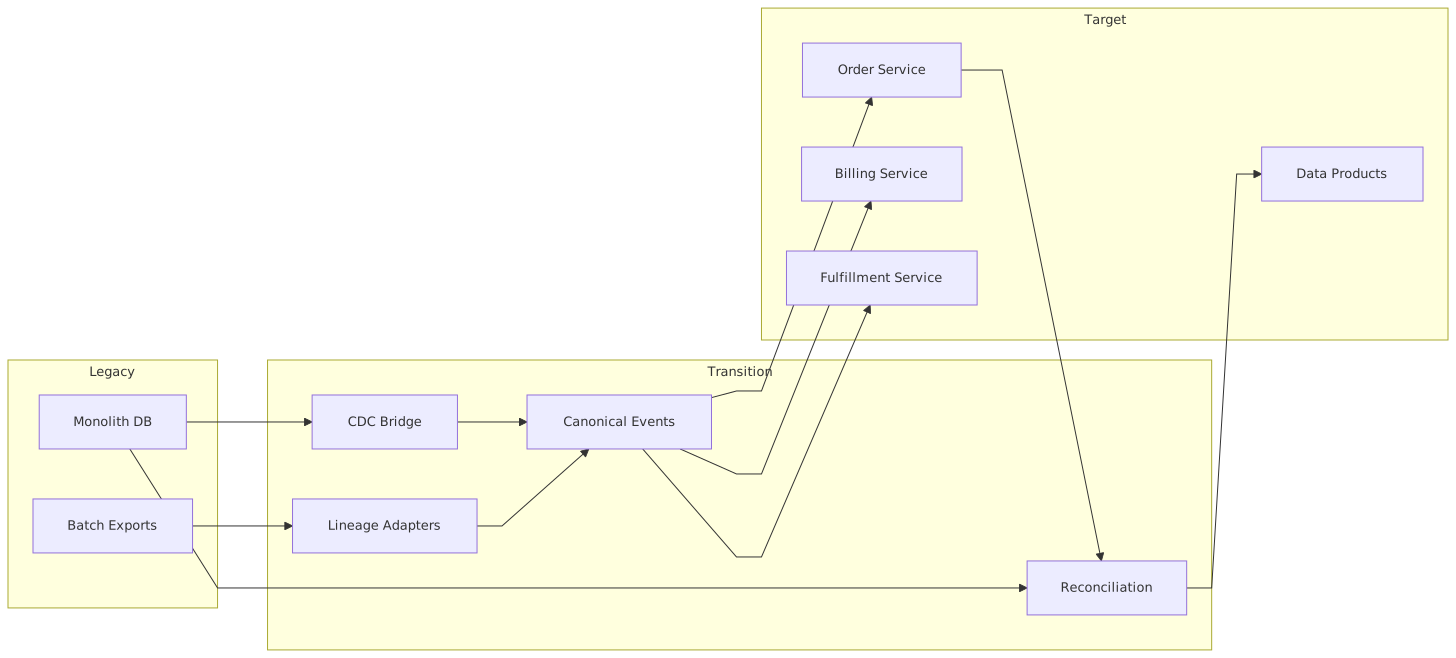
Step 5: Wrap legacy systems with lineage adapters
For monolith tables, batch interfaces, and undocumented feeds, create adapters that emit lineage metadata and, where useful, canonical domain events. You are not rewriting the old world first. You are making it legible.
Step 6: Add reconciliation and supersession paths
As services replace legacy functions, model coexistence explicitly:
- old source and new source
- dual-write or CDC bridge
- reconciliation jobs
- cutover milestones
- superseded assets and dates
Step 7: Expand by business priority
Repeat the pattern value stream by value stream. Over time, the graph becomes a map of actual enterprise data flow rather than a speculative inventory.
Here is the migration point many teams miss: lineage should help retire transitional architecture. If the graph cannot show you what temporary topics, bridge tables, and backfill jobs are still live, the strangler pattern becomes ivy. It wraps the old house and never stops growing.
Enterprise Example
Consider a large retailer modernizing its order-to-cash platform.
The company had a central commerce monolith, an ERP for billing, a warehouse management system, and a growing Kafka platform used by new microservices. Product teams had already built separate services for cart, order orchestration, inventory reservation, shipping, promotions, and customer notifications. Data engineering consumed events into a lakehouse for analytics. Finance built revenue reports from a mixture of ERP extracts and event-derived tables.
On paper, this looked modern. In practice, the same “order amount” existed in at least six forms:
- basket total before tax
- order committed amount
- captured payment amount
- invoice total
- shipped value
- recognized revenue
All were called some variation of amount.
When the company introduced split shipments and delayed payment capture for certain geographies, reporting drift became chronic. Operations blamed analytics. Analytics blamed event quality. Finance blamed both. They were all partly right.
The architecture team responded by building a lineage graph for the order-to-cash domain. They did not start with the whole enterprise. They started with the handful of business facts that actually mattered:
- OrderPlaced
- PaymentAuthorized
- InventoryReserved
- ShipmentDispatched
- InvoiceIssued
- RevenueRecognized
Then they mapped every technical representation of those facts across:
- monolith tables
- Kafka topics
- stream jobs
- billing extracts
- warehouse models
- executive dashboards
The key breakthrough was semantic, not technical. The team forced every dataset to declare whether it represented customer commitment, financial obligation, logistics movement, or accounting recognition. Suddenly the graph showed not one amount flowing through many systems, but several related amounts diverging by legitimate business rules.
They also modeled reconciliation explicitly. A daily reconciliation process compared:
- orders placed in commerce
- invoices issued in ERP
- shipments dispatched in WMS
- revenue entries in finance
Mismatch categories were codified:
- timing delay
- partial shipment
- payment failure
- tax recalculation
- duplicate event
- stale reference data
Once visible, these mismatches stopped being random “data quality” complaints and became managed business conditions.
The result was not perfect harmony. That is fantasy. The result was bounded disagreement with traceability. Incident triage time dropped sharply. Schema changes in order events were reviewed for downstream semantic impact. Finance stopped treating the event platform as a black box. And during the final strangler cutover from monolith order tables to the new Order Service, the team could prove which downstream consumers still depended on legacy extracts and which had been safely migrated.
That is what good lineage gives an enterprise: not beauty, but confidence.
Operational Considerations
Lineage systems fail when they are architected as static documentation. They need operational discipline.
Metadata freshness
A stale lineage graph is worse than none because it creates false confidence. Capture pipelines need SLAs. If Kafka consumers are discovered hourly but schema versions update daily and API metadata monthly, users must see that freshness clearly.
Identity and correlation
Cross-service lineage depends on identifiers. But enterprises usually have too many:
- customer ID
- account ID
- party ID
- session ID
- order ID
- invoice ID
- shipment ID
The graph should model identity relationships and correlation rules. Otherwise, lineage breaks at exactly the point where business users ask real questions.
Field-level lineage selectively
Column-level or field-level lineage sounds attractive. It is also expensive and brittle across semi-structured events and code-based transformations. Use it where value justifies the cost:
- regulated attributes
- financial measures
- ML features with decision impact
- sensitive personal data
For many domains, dataset-level or event-level lineage is enough.
Versioning and retention
Kafka retention, topic compaction, and warehouse snapshot policies shape what lineage can be proven later. If the enterprise expects six-year audit explainability but retains event payloads for seven days, architecture and compliance are living on different planets.
Access control
Lineage itself can be sensitive. It reveals where personal data flows, where critical finance logic runs, and what systems depend on what. Treat the graph as governed infrastructure, not public wallpaper.
Developer workflow integration
If lineage metadata is painful to produce, teams will bypass it. The best implementations integrate with:
- CI/CD checks
- schema registry validation
- service templates
- ADRs
- internal developer portals
The rule is simple: if you want federated accountability, make the right thing easy.
Tradeoffs
There is no free lunch here.
A rich lineage capability increases delivery friction at the edges. Teams must annotate events, classify data products, think about semantics, and maintain metadata. Architects love this. Delivery teams do not, at least not initially.
You also face a choice between central intelligence and local truth. A central platform can infer patterns and standardize models, but it will never fully understand domain nuance. Domain teams understand nuance, but they are inconsistent and busy. The answer is federation, but federation means governance by negotiation, and negotiation is slower than command.
Another tradeoff is between precision and usability. A highly detailed graph with every field mapping and transient processing job may satisfy auditors and overwhelm engineers. A simpler graph is easier to use but may hide important distinctions. Good architecture creates layers: start coarse, drill down only where needed.
Then there is the tradeoff between event-driven purity and reconciled reality. Many microservices enthusiasts like to believe that a well-formed event stream is the truth. Enterprises know better. Source systems are corrected, legal records differ from operational records, and timing matters. If your lineage architecture cannot model disagreement, it is not enterprise-ready.
Failure Modes
Most lineage programs fail in predictable ways.
1. The catalog trap
The organization buys or builds a metadata catalog, loads in tables and topics, and declares victory. Six months later it is a searchable graveyard of technical assets with no trustworthy semantic meaning.
2. Over-centralization
A governance team dictates a universal business glossary and lineage taxonomy detached from actual delivery teams. Domain teams comply cosmetically. The graph becomes formally correct and practically useless.
3. Under-modeled semantics
Lineage captures movement but not transformation of meaning. This is the most common failure. It produces diagrams that answer “where from?” but not “what changed?”
4. Transitional sprawl
During migration, bridge topics, dual writes, CDC feeds, and one-off reconciliation jobs proliferate. Nobody models supersession or decommissioning, so temporary lineage becomes permanent architecture.
5. Missing historical truth
The graph shows current dependencies only. During an audit or incident review, teams cannot reconstruct what lineage existed at the time because old edges and schema semantics were overwritten.
6. Ignoring failure paths
Dead-letter queues, retries, replay jobs, manual corrections, and exception workflows are omitted. But in real enterprises, some of the most consequential data journeys happen precisely in those unhappy paths.
A mature lineage architecture includes the mess. Architecture that only models the happy path is interior decoration.
When Not To Use
Not every system needs a full lineage graph across services.
If you have a small number of services, limited regulatory burden, and no significant data replication beyond operational needs, a lightweight approach may be enough:
- schema registry
- service ownership catalog
- a few hand-maintained dependency diagrams
- query lineage inside the warehouse
Likewise, if the business domain is simple and strongly transactional, and most consistency still lives inside one application boundary, do not rush to build an enterprise lineage platform just because microservices are fashionable.
And if the organization lacks basic service ownership, event governance, or domain boundaries, lineage will not save you. It will merely expose the disorder in sharper detail. That can still be useful, but let us be honest about what problem is being solved.
Do not use a rich lineage architecture as a substitute for fixing broken domain modeling. If every service publishes “customer-updated” events that mean different things to different people, the issue is not metadata. The issue is language.
Related Patterns
Several architecture patterns sit adjacent to lineage and often get confused with it.
Event sourcing
Event sourcing preserves the history of state changes within a bounded context. It helps with local provenance. It does not automatically provide cross-service lineage or semantic interpretation across contexts.
Change Data Capture
CDC is useful for extracting lineage from legacy databases and supporting strangler migration. But CDC reflects storage changes, not domain intent. Treat it as a bridge, not a semantic truth source.
Data mesh
Data mesh emphasizes domain-owned data products. Good. But domain ownership alone does not create traceability. Lineage is one of the operating mechanisms that makes mesh governable.
OpenTelemetry and observability
Tracing shows request flow and runtime behavior. Valuable, but not enough. Data lineage deals with business facts, transformations, and persistence over time. The two should complement each other.
Canonical data model
A canonical model can simplify integration, especially during migration. It can also become a semantic empire that flattens bounded contexts. Use canonical events sparingly, mainly for translation and migration seams, not as a universal language.
Master Data Management
MDM resolves identity and authoritative reference data. That supports lineage, especially around customer, product, and location entities, but it does not replace the need to model derivations and data flow.
Summary
In a microservices architecture, data does not merely move. It changes jurisdiction.
A business fact born in one bounded context is copied, enriched, reinterpreted, and operationalized across many others. The challenge is not just tracing pipelines. It is preserving the meaning of that fact as it travels. That is why data lineage across services must combine technical metadata, operational flow, and domain semantics.
The right architecture is federated: automatic capture from platforms like Kafka, APIs, CDC, and warehouses; explicit semantic annotation from domain teams; a time-aware lineage graph; and first-class modeling of reconciliation, migration, and supersession.
Do not boil the ocean. Start with a value stream. Use a progressive strangler migration. Wrap legacy systems with lineage adapters. Make reconciliation visible. Force semantic declarations where they matter. And never confuse compatibility with meaning.
Because in enterprise architecture, the hardest question is rarely “where is the data?” It is “what truth does this data now claim to represent?”
If your architecture cannot answer that, it is not really governing data. It is only moving it around.
Frequently Asked Questions
What is a service mesh?
A service mesh is an infrastructure layer managing service-to-service communication. It provides mutual TLS, load balancing, circuit breaking, retries, and observability without each service implementing these capabilities. Istio and Linkerd are common implementations.
How do you document microservices architecture for governance?
Use ArchiMate Application Cooperation diagrams for the service landscape, UML Component diagrams for internal structure, UML Sequence diagrams for key flows, and UML Deployment diagrams for Kubernetes topology. All views can coexist in Sparx EA with full traceability.
What is the difference between choreography and orchestration in microservices?
Choreography has services react to events independently — no central coordinator. Orchestration uses a central workflow engine that calls services in sequence. Choreography scales better but is harder to debug; orchestration is easier to reason about but creates a central coupling point.