⏱ 21 min read
Cloud scaling is often discussed as if it were a thermostat problem. CPU rises, add pods. Traffic drops, remove them. Simple. Mechanical. Comfortingly automatable.
That story is incomplete.
In real enterprise systems, scaling is less like adjusting room temperature and more like running an airport in a thunderstorm. Some signals arrive late. Some are noisy. Some matter only in the context of a particular domain. A queue spike in payment authorization means something very different from a queue spike in product recommendations. A CPU alert may be a genuine demand surge, or merely the symptom of a poisoned message retrying itself to death. And the worst scaling decisions are the ones that are technically correct yet economically absurd.
This is where the distinction between reactive and proactive scaling matters. Reactive scaling responds to what is already happening. Proactive scaling acts on what is likely to happen. Most cloud microservice estates need both. Very few implement both well.
The architectural mistake is to treat scaling as a purely platform concern. It isn’t. Scaling is a business capability expressed through infrastructure. If you separate the two too aggressively, you end up with a fleet of services that can elastically amplify the wrong behavior at great speed. The autoscaler becomes a machine for making bad design more expensive.
A better approach starts with domain-driven thinking. Before deciding how to scale, decide what business behavior you are scaling, which bounded context owns it, what signal truly predicts demand, and how failure should degrade. In other words: scaling policy is part of the architecture, not just a cluster setting.
This article walks through that distinction in practical terms. We will cover the forces involved, the architecture patterns that make each model work, migration strategies for estates already running Kafka-backed microservices, and the operational realities that separate conference-slide architectures from systems that survive Black Friday, payroll day, or insurance catastrophe events. event-driven architecture patterns
Context
Cloud-native systems promised elastic supply to meet elastic demand. To some extent, they delivered. Kubernetes Horizontal Pod Autoscaler, serverless concurrency models, cluster autoscaling, managed Kafka consumer groups, and cloud load balancers made it much easier to move from fixed-capacity estates to adaptive ones.
But scaling in microservices is not one problem. It is several. microservices architecture diagrams
There is request-path scaling, where latency-sensitive APIs must absorb interactive traffic. There is event-path scaling, where asynchronous processing pipelines consume a stream of work from Kafka or other brokers. There is data-path scaling, where the database, cache, and storage systems become the real bottleneck. And there is organizational scaling, where teams need enough autonomy that one domain’s traffic event does not trigger a platform-wide incident.
These dimensions collide. A retailer’s checkout service might scale on HTTP requests. Its fraud-check pipeline might scale on Kafka lag and message age. Its inventory reservation service might need to scale conservatively because the backing ERP integration cannot tolerate burst concurrency. The customer sees one “Buy Now” button. The architecture sees three different demand profiles and four different failure modes.
This is why a simplistic “autoscale on CPU” policy usually ages badly. CPU is often a lagging indicator of stress. In event-driven systems, it may barely move while customer commitments quietly pile up in a topic. In I/O-heavy services, throughput can collapse before CPU becomes interesting. In poorly instrumented systems, CPU becomes the metric of choice not because it is correct, but because it is available. Architects should be suspicious of that convenience.
Reactive and proactive scaling emerge from this reality.
- Reactive scaling uses observed current-state signals: CPU, memory, request rate, queue depth, Kafka lag, response time, concurrent sessions.
- Proactive scaling uses forecast or business-calendar signals: expected campaign traffic, batch windows, payroll cycles, market open, seasonality, learned trends, upstream booking data.
They are not rivals. They are complementary controls. One catches what is happening now. The other gets the runway clear before the planes arrive.
Problem
The core problem is this: cloud microservices experience demand in ways that infrastructure metrics alone do not explain.
A service does not “scale” in the abstract. A domain capability scales under a given workload shape, with a given consistency model, across a given set of dependencies. If those dependencies are slower, costlier, or less elastic than the service itself, your scaling policy can become a denial-of-service attack on your own estate.
Consider three common pathologies:
- Reactive scaling too late
Traffic rises quickly. By the time CPU or request latency breaches threshold, pods are already saturated. New instances take time to start, warm caches, join meshes, and pass readiness checks. User experience degrades before capacity catches up.
- Reactive scaling on the wrong signal
Kafka consumer lag rises, but the root cause is a downstream customer-master service returning 500s. Autoscaling adds consumers, which just create more failing calls and more retries. The system “scales” failure.
- Proactive scaling without domain context
Capacity is pre-provisioned for a marketing campaign based on website traffic forecasts, but the actual bottleneck is not front-end search. It is an order orchestration bounded context whose inventory reconciliation job collides with the campaign. Capacity is added in the wrong place.
The subtlety here is important. Scaling decisions are never just about volume. They are about where work accumulates, what work can wait, what work must remain serialized, and what business promise is at stake.
That last point matters more than technologists sometimes admit. There is a difference between delaying recommendation generation by 30 seconds and delaying payment settlement by 30 seconds. Both are “backlogs.” Only one can become a regulatory incident.
Forces
Several forces shape the decision between reactive and proactive scaling.
1. Demand volatility
Some domains have unpredictable spikes. News media, ticketing, flash sales, and emergency claims processing are notoriously spiky. Reactive scaling is necessary here, but often insufficient, because spikes can outrun startup time.
2. Forecastability
Some workloads are highly predictable. Payroll runs. End-of-month billing. batch settlement. Insurance renewal cycles. Airline check-in windows. These favor proactive scaling because demand is not a surprise; it is a calendar event pretending to be traffic.
3. Domain semantics
A DDD lens changes the design. Not every bounded context should scale in the same way.
- Catalog browsing may scale aggressively and degrade gracefully.
- Pricing may need cache-heavy proactive warming before a campaign.
- Payment authorization may scale cautiously due to external gateway rate limits.
- Inventory allocation may require partition-aware consumer scaling because overselling is worse than slowness.
Scaling should respect the invariants of the domain.
4. Stateful dependencies
The least elastic component often sets the real ceiling. Databases, mainframes, SaaS APIs, payment gateways, and legacy ERPs punish thoughtless scaling. If your stateless service multiplies requests against a stateful bottleneck, you have created fan-out amplification.
5. Cost shape
Reactive scaling optimizes for pay-as-you-go efficiency. Proactive scaling optimizes for readiness. Enterprises need both because cost minimization and business continuity are often in tension. An underutilized pod before a peak may be cheaper than a reputational failure during one.
6. Startup and warm-up time
Some services can scale almost instantly. Others require JIT warm-up, cache priming, model loading, or connection pool establishment. Reactive scaling is weaker where warm-up time is significant.
7. Consistency and reconciliation
In event-driven architecture, scaling consumer count changes processing order, partition ownership, and timing. If business correctness depends on reconciliation later, you can scale more aggressively. If correctness depends on strict sequencing, your options are narrower.
That is one of the quiet truths of enterprise architecture: reconciliation is often the hidden enabler of scale. If you can detect and repair divergence later, you can tolerate more aggressive runtime behavior now.
Solution
The solution is not to pick reactive or proactive scaling. It is to architect a layered scaling strategy in which platform automation, domain semantics, and operational forecasting work together.
A useful pattern is this:
- Use proactive scaling to establish baseline readiness ahead of forecast demand.
- Use reactive scaling to absorb real-time deviation from forecast.
- Use domain-level guardrails to prevent scaling from overwhelming fragile dependencies.
- Use reconciliation workflows to repair partial failure where asynchronous processing introduces temporary inconsistency.
This is easier to understand visually.

The architecture should distinguish at least four kinds of triggers:
- Resource triggers
CPU, memory, network saturation. Useful, but blunt.
- Workload triggers
Request rate, concurrency, queue depth, Kafka lag, event age. Better aligned to throughput.
- Business triggers
Promotion schedules, batch windows, trading sessions, customer geography wave patterns. These are where proactive scaling shines.
- Integrity triggers
Reconciliation backlog, dead-letter queue growth, retry storms, duplicate-event rates. These indicate the system is diverging from intended business state, even if infrastructure appears healthy.
In mature systems, the best scaling trigger is often a composite. For example, scale a consumer group when:
- Kafka lag exceeds threshold,
- oldest message age exceeds threshold,
- downstream error rate is below safe threshold,
- and partition count permits additional useful concurrency.
That last condition is often missed. In Kafka, consumer parallelism is constrained by partition count. Teams sometimes add more consumers and wonder why throughput does not improve. Architecture still matters, even in managed platforms.
Architecture
A practical architecture for mixed reactive and proactive scaling in cloud microservices has several layers.
Domain-aligned service boundaries
Start with bounded contexts, not deployment units. The scaling profile of a service should match the business capability it encapsulates. If a service mixes customer profile reads, promotion eligibility, and payment orchestration, it will have conflicting scaling characteristics. That is not merely untidy. It is operationally dangerous.
DDD helps here because it asks the right question: what belongs together because it changes together and shares invariants? Scaling policy follows that answer.
For example:
- Browse Context: highly cacheable, aggressively elastic.
- Order Context: durable, event-oriented, careful around idempotency.
- Payment Context: externally constrained, strict audit trails.
- Inventory Context: partition-sensitive, reconciliation-heavy.
Event-driven elasticity with Kafka
Kafka is a natural fit for asynchronous scale because it separates ingress from processing. Producers can continue writing events while consumers scale independently. But Kafka does not remove architectural responsibility. It relocates it.
Consumer group scaling should consider:
- partition count and skew,
- lag growth rate, not just lag absolute,
- event age,
- retry topics and dead-letter behavior,
- ordering requirements by aggregate key,
- idempotent processing and deduplication.
A service processing OrderPlaced events may scale horizontally across partitions keyed by order ID. But a service processing InventoryReserved and InventoryReleased events for the same SKU may need careful key strategy to avoid inconsistent stock views. Throughput without semantic safety is just a faster route to reconciliation debt.
Scaling trigger design
Use a hierarchy of triggers.
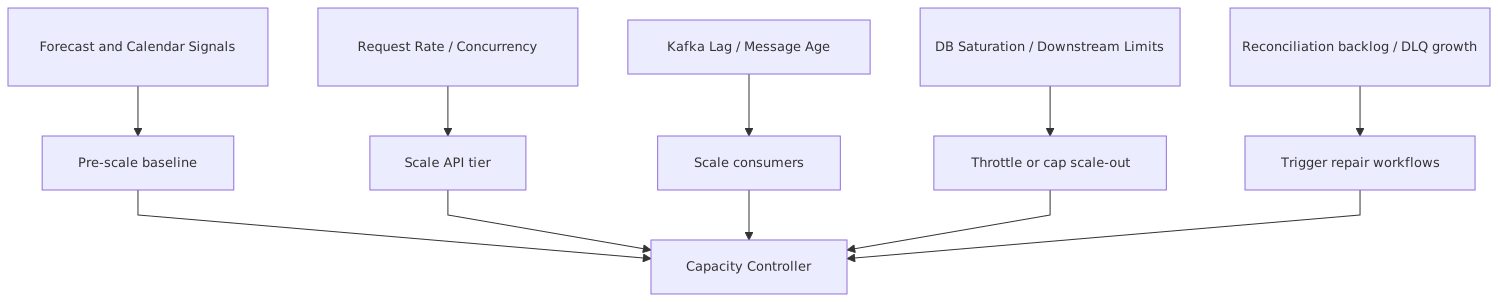
A good enterprise rule is: never scale one tier in isolation if another tier is known to be the true bottleneck. If the database is already at connection saturation, adding API pods just creates longer queues and louder incidents. Introduce dependency-aware caps.
Reconciliation as a first-class mechanism
In asynchronous microservice estates, some failure is unavoidable. Events arrive late. Consumers restart. duplicate delivery happens. External systems timeout and then succeed anyway. If you rely only on synchronous correctness, you will build a slow and brittle system.
Reconciliation gives you another option:
- process optimistically,
- record durable intent,
- detect divergence,
- repair with compensating action or replay.
This approach is especially valuable in proactive scaling scenarios where pre-scaling event consumers may increase throughput enough to expose rare race conditions. If your design includes audit logs, event sourcing patterns where appropriate, idempotent handlers, and scheduled reconciliation jobs, you can safely push more work through the system.
Reconciliation is not a license for sloppiness. It is an acknowledgment that distributed systems settle truth over time.
Guardrails
Guardrails turn scaling from reckless acceleration into controlled motion:
- circuit breakers,
- adaptive concurrency limits,
- bulkheads,
- token buckets,
- per-tenant quotas,
- backpressure,
- partition-aware processing caps,
- workload shedding for low-priority paths.
Without guardrails, autoscaling is often just auto-amplification.
Migration Strategy
Most enterprises do not get to redesign scaling cleanly. They inherit a mixture of monoliths, lift-and-shift services, shared databases, and well-meaning Kubernetes defaults. So migration matters.
The right approach is usually progressive strangler migration. Do not begin by “modernizing scaling.” Begin by isolating domain behavior and introducing observable triggers around it. Scaling becomes credible only when the workload is visible and the boundary is meaningful.
Step 1: Identify bounded contexts with distinct demand patterns
Find business capabilities whose traffic and criticality differ materially. Common first candidates:
- search and browse,
- customer notification,
- order orchestration,
- payment callbacks,
- document generation.
Do not split by technical layer. Split where demand semantics diverge.
Step 2: Introduce event capture and telemetry
Before changing scaling policy, instrument:
- request rate and latency percentiles,
- queue depth and Kafka lag,
- message age,
- downstream dependency saturation,
- business SLA indicators,
- reconciliation backlog.
Many migrations fail because teams can observe pod metrics but not business work-in-progress.
Step 3: Externalize asynchronous work
Use Kafka or similar messaging to decouple spikes from processing where domain semantics allow. Move from synchronous chains to event-driven handoffs in non-transactional areas first. Notifications are a classic early win. Fraud review is another. Payment authorization is usually not.
Step 4: Add reactive scaling on workload metrics
Scale APIs on concurrency or RPS where appropriate. Scale consumers on lag and event age rather than CPU alone. Introduce dependency-aware max replicas.
Step 5: Add proactive scaling around known peaks
Integrate campaign calendar, batch scheduler, or business event feed into capacity planning. This can be very simple at first:
- pre-scale 20 minutes before promotion,
- warm key caches,
- pre-create consumer instances,
- expand Kafka partitions only where rekeying semantics are understood.
Step 6: Introduce reconciliation and replay
As you scale asynchronous workloads more aggressively, add:
- replayable event history,
- DLQ triage patterns,
- reconciliation jobs against source-of-truth systems,
- compensation commands where needed.
Step 7: Strangle legacy bottlenecks carefully
Some services will still depend on monolith tables or ERP calls. Wrap them with anti-corruption layers and rate-aware adapters. Scaling must stop at the edge of the old world unless that world is redesigned.
This migration pattern looks like this:

Notice the order. First isolate. Then observe. Then decouple. Then scale. Teams that reverse this usually discover they have built a faster route into a shared database bottleneck.
Enterprise Example
Consider a large omnichannel retailer preparing for Black Friday.
The estate includes:
- a product catalog service,
- pricing service,
- promotion engine,
- order orchestration service,
- payment service,
- inventory reservation service,
- fulfillment allocation pipeline,
- customer notification service.
All run as microservices in Kubernetes. Kafka is used for order, inventory, and fulfillment events. The payment gateway and warehouse management system are external dependencies.
What went wrong initially
The platform team implemented reactive autoscaling mostly on CPU and memory. During prior peak events:
- API pods scaled late because startup and cache warm-up took several minutes.
- order consumers scaled aggressively on lag, overwhelming the inventory reservation database.
- payment retries multiplied during gateway slowness, causing duplicate authorization concerns.
- notification services consumed too much cluster capacity because they looked “busy” while more critical workloads starved.
Technically, the autoscaler worked. Business-wise, it was a mess.
What changed
The retailer re-architected scaling policies by bounded context.
Catalog and browse
- Proactive pre-scaling before campaign launch.
- CDN and cache warming using expected hot products.
- Reactive API scaling on request concurrency and p95 latency.
Promotion and pricing
- Proactive scaling tied to campaign calendar.
- Rule cache preload.
- Strict fallback behavior to cached offers rather than synchronous recalculation under pressure.
Order orchestration
- Reactive scaling on Kafka lag and event age.
- Max replica cap based on database write throughput.
- Idempotency keys for order commands.
- Reconciliation process for orders stuck in pending state.
Payment
- Conservative scaling.
- Concurrency guardrail tied to gateway contract limits.
- Retry budget and circuit breaker.
- Reconciliation against gateway settlement file.
Inventory
- Partitioning by SKU family.
- Consumer scale aligned to partition count.
- Reservation timeout and nightly reconciliation against warehouse source of truth.
Notifications
- Lowest priority workload class.
- Aggressive queue-based scaling, but with preemption allowed in favor of revenue-critical services.
Outcome
The retailer did not simply “scale better.” It scaled according to business meaning. During Black Friday:
- browse and promotion traffic surged 8x with low latency,
- order lag remained controlled,
- payment failures degraded safely rather than explosively,
- inventory mismatches were reconciled post-event without oversell becoming systemic.
That is the point. Enterprise architecture is not judged by whether every graph is flat. It is judged by whether the business promise survives stress.
Operational Considerations
Scaling policies are production controls. Treat them with the same seriousness as code.
Observability
You need telemetry at three levels:
- platform: CPU, memory, pod restarts, node pressure;
- service: RPS, latency, error rate, saturation;
- business flow: orders pending, messages older than SLA, failed payments awaiting reconciliation.
If you cannot observe backlog age, you do not know whether your event system is healthy. Lag count alone can mislead when message sizes and processing time vary.
Forecasting and capacity planning
Proactive scaling depends on credible forecasts. These need not be machine learning masterpieces. For many enterprises, a decent business calendar plus historical patterns is enough. The mistake is not imperfect forecasting. The mistake is pretending no forecast exists.
Warm-up behavior
Measure startup time honestly:
- container start,
- application boot,
- JIT optimization,
- cache fill,
- connection pool stabilization,
- service mesh registration.
Reactive scaling loses value fast if warm-up takes longer than the spike.
Policy testing
Test scaling triggers in non-production and controlled production canaries:
- synthetic traffic surges,
- Kafka backlog injection,
- downstream throttling simulation,
- node failure during scale-out,
- replay drills.
Autoscaling configurations deserve game days. They are executable architecture.
Multi-tenancy
If the platform serves multiple business units or tenants, tenant-aware quotas matter. Otherwise one tenant’s promotion can consume shared capacity and create a political incident disguised as a technical one.
Governance
Avoid central platform teams becoming the sole owners of scaling policy. Domain teams should own the semantics of triggers and safe degradation. Platform teams should provide primitives, standards, and guardrails.
Tradeoffs
Reactive and proactive scaling each have strengths and weaknesses.
Reactive scaling tradeoffs
Pros
- efficient for uncertain demand,
- lower baseline cost,
- simpler to automate with runtime metrics,
- good fit for elastic stateless services.
Cons
- inherently lagging,
- vulnerable to noisy or misleading signals,
- may scale failure instead of throughput,
- often blind to business criticality.
Proactive scaling tradeoffs
Pros
- ready before demand arrives,
- better for predictable peaks,
- reduces cold-start and cache-warm penalties,
- supports smoother customer experience during scheduled events.
Cons
- depends on forecast quality,
- may waste cost when demand does not materialize,
- can create false confidence if applied to wrong bottleneck,
- requires tighter collaboration between business and technology.
Combined model tradeoffs
A combined model is usually best, but not free:
- more moving parts,
- more policy interactions,
- more governance needed,
- stronger observability requirements,
- greater risk of hidden coupling between autoscaler and business scheduler.
Still, this complexity is often justified. Real systems are mixed economies. They need both just-in-time reaction and prepared capacity.
Failure Modes
Scaling architectures fail in recognizable ways. Learn these patterns early.
1. Scaling the symptom
Latency rises because a downstream API is timing out. Autoscaler adds pods, increasing call volume and making the timeout storm worse.
2. Partition illusion in Kafka
Consumer replicas increase beyond partition count. Cost rises, throughput does not.
3. Retry amplification
Failures trigger retries, retries trigger scaling, scaling triggers more retries. This is a classic positive feedback loop.
4. Shared dependency collapse
One domain scales successfully and saturates a shared database, cache cluster, or legacy integration used by unrelated services.
5. Forecasting the wrong thing
A proactive plan anticipates web traffic but ignores back-office event processing, settlement, or reconciliation loads that follow later.
6. Reconciliation debt
Teams rely on eventual consistency but do not build robust reconciliation. Errors accumulate quietly until financial or inventory discrepancies surface.
7. Domain-inappropriate elasticity
A service with strict sequencing or lock contention is scaled horizontally beyond the point where coordination cost dominates throughput.
8. Unbounded cost spikes
Lag-triggered scaling reacts to poison messages or pathological workloads and creates large bills without restoring service quality.
Architecturally, the antidote is the same: tie scaling to domain semantics, not just infrastructure heat.
When Not To Use
There are cases where one or both approaches should be constrained.
Do not lean heavily on reactive scaling when:
- startup time is long relative to spike onset,
- downstream systems are non-elastic and fragile,
- the workload has hard real-time requirements,
- the signal is too noisy to trust.
Do not lean heavily on proactive scaling when:
- demand is truly chaotic and not forecastable,
- cost sensitivity is extreme,
- the workload is low criticality and can tolerate queueing,
- there is no operational discipline to maintain forecasts.
Do not use aggressive autoscaling at all when:
- the real bottleneck is a shared relational database no one is willing to redesign,
- ordering guarantees are strict and tied to a small number of hot keys,
- the domain requires serialized processing for correctness,
- the team lacks idempotency, replay, and reconciliation capabilities.
That last one bears repeating. If you cannot safely replay or reconcile, be careful about scaling asynchronous throughput. Speed without recovery is bravado.
Related Patterns
Several patterns complement reactive and proactive scaling.
- Bulkhead isolation: prevent one workload from exhausting shared resources.
- Circuit breaker: stop calling dependencies that are already failing.
- Backpressure: signal producers or upstream tiers to slow down.
- Queue-based load leveling: absorb spikes asynchronously.
- SAGA / compensating transactions: coordinate long-running workflows across services.
- Strangler Fig pattern: progressively migrate domain slices from monolith to microservices.
- Anti-corruption layer: protect domain models from legacy semantics.
- Event sourcing and replay: useful where auditability and repair matter.
- Priority classes and workload preemption: reserve capacity for critical business flows.
- Adaptive concurrency control: tune throughput safely under changing conditions.
These are not decorations. They are the supporting cast that makes scaling architecture survivable.
Summary
Reactive versus proactive scaling is the wrong debate if framed as a choice. Enterprises need both. Reactive scaling responds to reality. Proactive scaling respects inevitability. The architecture challenge is deciding which business capabilities need which style, under which signals, and with which guardrails.
The deepest lesson is simple: scaling policies should follow domain semantics.
A browse service, a payment service, and an inventory reservation service may all run on the same cluster, but they do not inhabit the same world. Their triggers differ. Their bottlenecks differ. Their failure costs differ. Their recovery paths differ. Architecture that ignores this usually ends up scaling indiscriminately and recovering manually.
Use reactive scaling for real-time adaptation. Use proactive scaling for forecast demand and warm-up-sensitive workloads. Use Kafka and asynchronous patterns where decoupling helps, but couple scaling decisions to partitioning, lag age, and downstream safety. Introduce reconciliation as a first-class capability so the estate can heal after inevitable distributed failures. And migrate progressively, with strangler patterns and anti-corruption layers, rather than trying to autoscale a monolith-shaped problem out of existence.
In the end, scaling is not about adding pods. It is about preserving business intent under pressure.
That is a very different discipline. And a much more useful one.
Frequently Asked Questions
What is a service mesh?
A service mesh is an infrastructure layer managing service-to-service communication. It provides mutual TLS, load balancing, circuit breaking, retries, and observability without each service implementing these capabilities. Istio and Linkerd are common implementations.
How do you document microservices architecture for governance?
Use ArchiMate Application Cooperation diagrams for the service landscape, UML Component diagrams for internal structure, UML Sequence diagrams for key flows, and UML Deployment diagrams for Kubernetes topology. All views can coexist in Sparx EA with full traceability.
What is the difference between choreography and orchestration in microservices?
Choreography has services react to events independently — no central coordinator. Orchestration uses a central workflow engine that calls services in sequence. Choreography scales better but is harder to debug; orchestration is easier to reason about but creates a central coupling point.