⏱ 21 min read
There’s a particular smell to enterprise systems that have stayed in one database too long.
You can sense it before you open the schema. Product teams move carefully around “shared tables.” Reporting logic leaks into transactional models. Every new service proposal begins with a dangerous sentence: “We’ll just reuse the customer database.” Before long, the database is no longer a store of record for a business capability. It is the organization chart cast in SQL, with every compromise ever made preserved in DDL.
Polyglot persistence is the point where an architecture stops pretending all data has the same shape, the same access pattern, and the same business meaning.
That is the heart of the matter. This is not really a story about databases. It is a story about boundaries. About deciding that a pricing engine should not be forced into the same storage model as an event ledger, that a recommendation service should not inherit the transactional assumptions of order management, and that “one database to rule them all” is usually a governance convenience masquerading as architecture. EA governance checklist
In a microservices architecture, the datastore-per-service idea is one of the few patterns that actually changes team behavior. It gives a service real ownership. Not just of code, but of persistence, performance characteristics, scaling decisions, and the meaning of the data itself. That is why this pattern matters. And it is also why it is frequently done badly.
Done well, polyglot persistence lets each service choose a storage technology aligned to its domain model and operational reality: relational for orders, document for product catalogs, graph for network relationships, time-series for telemetry, log storage for immutable events, search indexes for retrieval. Done badly, it becomes a licensing festival with six databases, no consistency model, no observability, and a platform team quietly regretting every decision.
This article looks at polyglot persistence in microservices architecture from an enterprise perspective: why teams adopt it, how datastore-per-service changes the design of systems, how to migrate toward it using a strangler approach, where Kafka and event-driven integration fit, and where the whole thing goes wrong. event-driven architecture patterns
Context
Monoliths often centralize more than logic. They centralize data assumptions.
A typical enterprise starts with a single operational database because it is practical. Finance, customer management, inventory, order processing, product information, and fulfillment all grow around one relational core. The schema becomes the integration mechanism. Teams read each other’s tables because it is faster than negotiating APIs. Batch jobs appear. Then ETL pipelines. Then a reporting replica. Then a search index fed from trigger logic someone is afraid to touch.
For a while, this works. Relational databases are astonishingly forgiving. They absorb complexity that should have been designed away. But eventually the system reaches a point where a single persistence model starts to distort the business.
A product catalog wants flexible schema evolution for attributes by market and channel. Orders demand transactional integrity and strict invariants. Audit trails want append-only immutability. Customer behavior analytics wants denormalized event streams. Fraud detection wants fast graph traversal. Full-text search wants inverted indexes, not tortured SQL.
Yet the enterprise often insists on one tool because standardization feels safer.
This is where domain-driven design becomes useful, not as ceremony, but as a sanity check. If your bounded contexts are meaningfully different, their persistence concerns will usually be different too. The mistake is to treat all “data” as one horizontal concern and all “storage” as one platform choice. In reality, persistence is deeply entangled with domain semantics. How you store something influences what consistency guarantees you can make, what queries are cheap, what evolution paths are possible, and what business rules can be enforced naturally.
Microservices architecture makes this explicit. If services own business capabilities, they must own the persistence decisions that support those capabilities. Otherwise they are merely distributed modules bolted onto a shared data platform.
Problem
The core problem is not simply scale. It is coupling.
A shared database creates hidden integration. Service A can change Service B’s world accidentally with a schema change, a lock escalation, a slow query, or a supposedly harmless reporting join. Teams become unable to deploy independently because data is a common dependency. Governance shifts from product capability to schema negotiation. The database becomes the real monolith. ArchiMate for governance
Worse, a single persistence technology flattens domain distinctions. Teams start designing around the strengths and weaknesses of one database rather than around business meaning. If everything must fit relational tables, document-like aggregates are decomposed unnaturally. If everything is pushed into a document store, transactional invariants get reimplemented in application logic. If everything is event-sourced because one team liked it, simple CRUD domains become harder than they should be.
The enterprise pain usually appears in a few recognizable forms:
- shared schema ownership and endless coordination
- inability to scale services independently
- poor fit between data model and workload
- fragile cross-service joins
- slow migrations because every change breaks downstream consumers
- conflicting needs for consistency, query flexibility, retention, and compliance
- operational bottlenecks when one database becomes a point of contention
The answer is not “use many databases” as a slogan. The answer is to align persistence with service boundaries and domain responsibilities.
Forces
Architecture is the art of managing forces, not eliminating them. Polyglot persistence sits in the middle of several competing pressures.
Domain semantics
This is the big one. Different business capabilities speak different data languages.
An order is usually a transactional aggregate with strong consistency needs. A product listing is often a rich, evolving document assembled from many attributes and localized variants. A shipment scan is an event. A customer identity graph is relationship-centric. A recommendation model is derived state, not operational truth.
If you ignore these semantic differences, your data platform becomes a compromise machine.
Team autonomy
Microservices promise independent delivery. Shared persistence quietly destroys that promise. A team cannot move quickly if every schema change requires a committee. Datastore per service creates true ownership: one team, one service boundary, one persistence contract.
But autonomy has a cost. Teams can choose badly. Platform standards still matter.
Operational diversity
Different datastores optimize for different shapes of work: ACID transactions, key-value access, flexible documents, graph traversal, event ingestion, search, time-series analytics. Polyglot persistence exploits this. It also multiplies operational burden: backup strategies, patching, monitoring, security, failover, capacity planning, and skill needs.
Consistency vs availability vs decoupling
Once data is split by service, distributed transactions become a trap. Enterprises must accept more asynchronous workflows, eventual consistency, and reconciliation patterns. The upside is looser coupling and better resilience. The downside is that business processes become more explicit and harder to fake.
Compliance and governance
Data protection, retention, lineage, residency, encryption, auditability, and access control do not become easier because teams have separate datastores. In many firms they become harder. Polyglot persistence must live within enterprise governance, not outside it.
Cost and cognitive load
More technologies mean more vendor management, more runbooks, more production expertise, and more failure modes. A pattern that improves business fit can still be the wrong call if the organization cannot operate it well.
Solution
The solution is straightforward to describe and difficult to do with discipline:
Each microservice owns its data and chooses the datastore that best fits its domain and access patterns. Other services interact through APIs, events, or replicated read models—not by reading its tables.
That is datastore per service. Polyglot persistence is what happens when different services make different storage choices.
This pattern only works if you respect the service boundary. A service’s database is private. Not politically private. Architecturally private. If another service needs the data, it asks through a contract or subscribes to domain events. The moment teams query each other’s databases directly, the old monolith has returned wearing a Docker badge.
Domain-driven design gives the pattern its backbone. A bounded context should own its ubiquitous language, aggregates, invariants, and data lifecycle. Persistence follows that boundary. The storage model is then chosen not by fashion, but by fit.
A simple enterprise decomposition might look like this:
- Order Service: relational database for strong transactional consistency and referential rules
- Catalog Service: document database for flexible product structures and localized attributes
- Customer 360 Read Model: denormalized document or search index assembled from events
- Fraud Service: graph database for relationship analysis
- Audit/Event Ledger: append-only event store or Kafka-backed immutable history
- Search Service: Elasticsearch or OpenSearch for retrieval use cases
- Telemetry/Monitoring: time-series database for operational metrics
This is not a prize for variety. It is an expression of domain semantics.
A datastore-per-service view
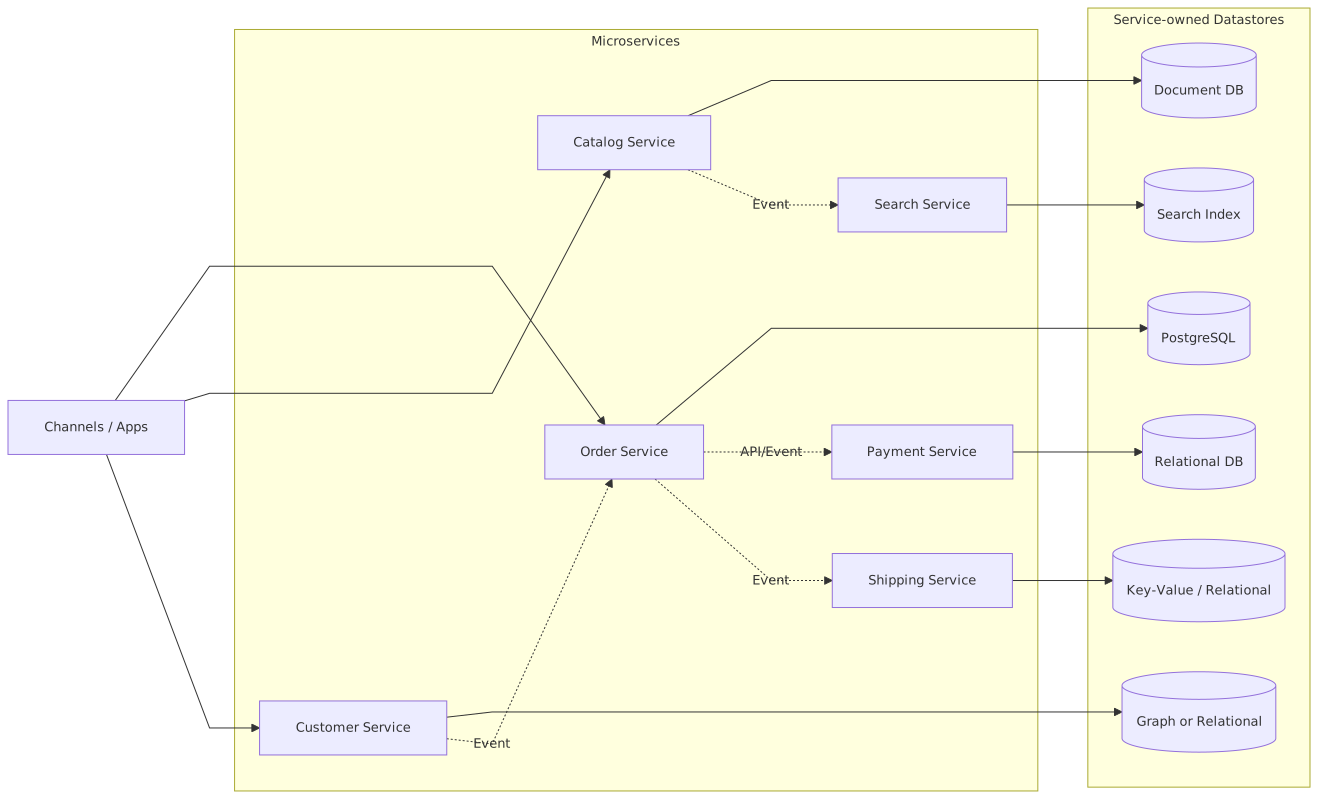
The key architectural decision is not the list of databases. It is the rule that service boundaries are integration boundaries. Data crossing them does so through contracts and events.
Architecture
There are three ideas that matter most in the architecture of polyglot persistence: ownership, propagation, and read optimization.
1. Ownership
Each service is the system of record for a specific domain capability. This sounds obvious, yet many enterprises evade it by allowing several services to update the same conceptual entity. That leads nowhere good.
For example, if the Customer Service owns customer identity and profile semantics, then other services do not maintain their own mutable “truth” for customer records. They may keep projections or local snapshots, but ownership remains clear. Domain events communicate changes; local models consume them.
Ownership also means local schemas can evolve independently. The Catalog Service can restructure product documents without forcing the Order Service to rebuild. This is precisely the freedom a monolith never gave you.
2. Propagation
Once data is owned by different services, you need a way to distribute change. This is where Kafka often becomes relevant.
Kafka is not mandatory, but it is frequently useful because it provides durable event streams, replayability, consumer decoupling, and a natural backbone for asynchronous integration. A service writes domain events such as OrderPlaced, ProductUpdated, CustomerAddressChanged, PaymentAuthorized. Other services subscribe and update their local state or trigger workflows.
This is the architecture’s honest moment: there is no free lunch. If Service B needs a local copy of Service A’s data for performance or resilience, then B must handle staleness, event ordering, idempotency, versioning, and reconciliation.
That is not a flaw in the pattern. That is the cost of autonomy made visible.
3. Read optimization
A common misconception is that splitting data by service means giving up rich queries. Not quite. It means you stop doing ad hoc cross-service joins against operational databases.
Instead, you build read models. Sometimes these are API compositions. Sometimes they are materialized views fed by events. Sometimes they live in a search index. Sometimes they become a reporting warehouse. Query requirements still matter, but they are handled deliberately.
For customer-facing search, a denormalized search index may subscribe to catalog and inventory events. For a Customer 360 screen, a read model may collect customer profile, orders, support cases, and loyalty status into a single document optimized for retrieval. The operational systems remain independent; the read experience is composed.
Event flow and projections
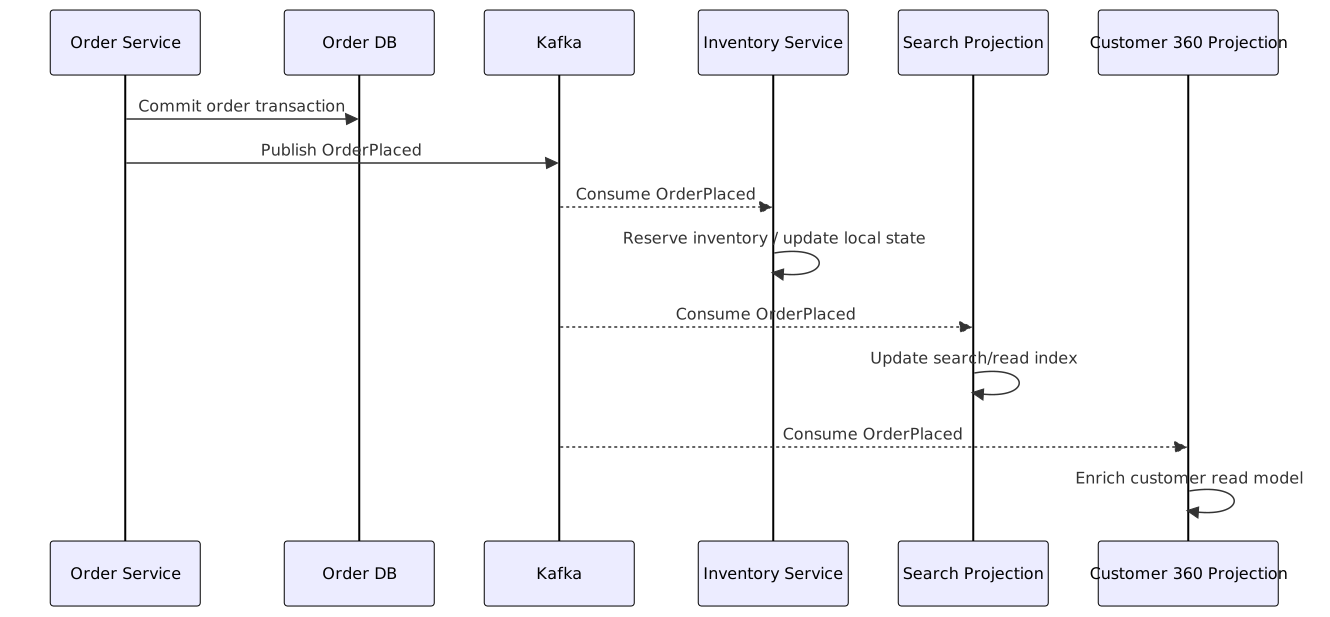
This is where reconciliation matters. Streams fail. Consumers lag. Messages are duplicated. Schemas evolve. A practical architecture always assumes that derived views and local copies can drift and need repair.
Migration Strategy
Most enterprises do not adopt polyglot persistence on a blank sheet. They inherit a large relational estate and a long trail of direct SQL integrations. So the migration strategy matters more than the target diagram.
The best approach is usually a progressive strangler migration. Not a heroic rewrite. Not a “big bang” database split. A careful extraction of bounded contexts, one capability at a time.
Start where the pain is highest and the boundary is clearest.
Step 1: Identify bounded contexts and ownership
Use domain-driven design properly here. Not every table cluster is a bounded context. Look for business capabilities with distinct language, lifecycle, invariants, and team ownership. Catalog, ordering, pricing, customer identity, fulfillment, payments, claims, policy servicing—these are often better anchors than technical modules.
Then define ownership. Which service becomes the system of record? What events will it publish? What consumers depend on the data today?
Step 2: Stop the bleeding
Before moving data, stop new direct database dependencies. Introduce APIs or event contracts so teams stop integrating through shared tables. This is often the most important governance move in the whole migration.
Step 3: Extract service logic around the legacy database
Initially, a new service may still read from the legacy database through an anti-corruption layer while owning only part of the workflow. This is acceptable as a transitional state. The point is to put a service contract in place and isolate knowledge of the old schema.
Step 4: Create the target datastore and dual-write carefully—or better, use change capture
Moving to a service-owned datastore requires data replication during transition. Dual writes are seductive and dangerous. They fail in awkward half-committed ways. A more reliable strategy is often:
- commit to the source system of record
- emit events or capture changes via CDC
- project into the target service datastore
- validate parity
- switch reads
- then switch writes
CDC tools can be useful in legacy migration because they let you reflect changes out of a monolith while you establish new service boundaries. But CDC should be treated as scaffolding, not permanent architecture, unless you are very deliberate about its role.
Step 5: Introduce local read models and reconciliation
Consumers that currently query shared tables directly will need either APIs or local projections. Build those projections with replayable events where possible. Add reconciliation jobs to compare source and projection counts, hashes, timestamps, or business totals.
Step 6: Cut over gradually
Move one consumer at a time. One read path, then one write path, then one business workflow. Keep rollback options explicit. Migration is not just data movement; it is dependency untangling.
Progressive strangler view
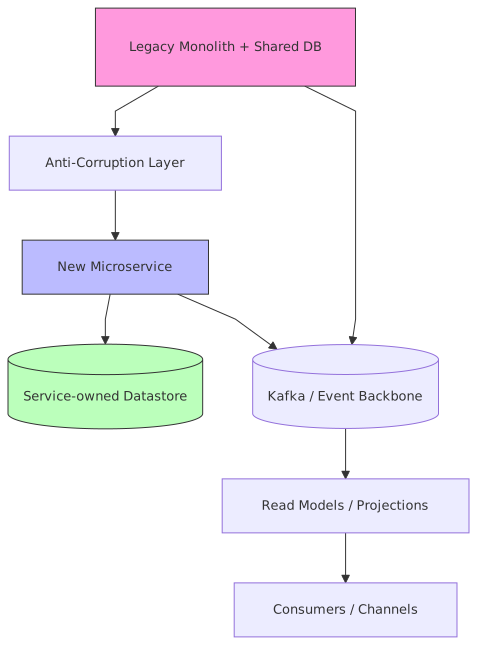
A note of experience: migrations fail less often because of bad technology than because of bad ambiguity. If ownership, event semantics, and cutover rules are fuzzy, no amount of tooling will save the program.
Enterprise Example
Consider a global retailer modernizing its commerce platform.
The legacy estate runs on a central Oracle database. Product data, pricing, inventory snapshots, customer accounts, orders, fulfillment, and promotions all coexist in one sprawling schema. Regional teams query it directly for websites, mobile apps, marketing campaigns, and call center operations. The database is powerful, expensive, and in constant pain.
The retailer wants faster product launches, local market flexibility, and better resilience during peak periods.
A sensible target architecture might look like this:
- Catalog Service uses a document database because product structures vary by category, geography, and channel. Apparel carries size and color matrices; electronics carries technical attributes; groceries carry regulatory metadata and perishability details.
- Order Service uses PostgreSQL because order placement, state transitions, line-level totals, and payment references need strong transactional guarantees.
- Pricing Service uses a relational store plus cache because pricing rules require consistency and quick lookup, but not arbitrary document flexibility.
- Inventory Service uses a key-value or relational model optimized for reservation and availability checks.
- Search Service uses OpenSearch for discovery, faceting, and relevance tuning.
- Customer 360 is not an operational master at all; it is a read model built from customer, order, and support events.
- Event backbone runs on Kafka to distribute product changes, price updates, order events, shipment milestones, and customer profile changes.
Here is what changes in practice.
When a merchant updates a product, the Catalog Service persists the canonical product document and publishes a ProductUpdated event. Search consumes it to refresh indexing. Pricing may consume it if product hierarchy affects price eligibility. Recommendation systems consume it for feature engineering. No one reads the catalog tables directly.
When an order is placed, the Order Service writes to its relational database, emits OrderPlaced, and other services react asynchronously. Inventory reserves stock. Fulfillment starts orchestration. Customer 360 updates the shopper timeline. Search does nothing because it should not care.
The result is not just technical neatness. Teams stop tripping over each other. The catalog team can evolve product schemas without negotiating changes with payments. The order team can optimize transaction paths for checkout peaks. Search can reindex independently. The database stops being the place where organizational conflict goes to hide.
But the tradeoffs are real. During a flash sale, search may show product availability that is a few seconds stale. Customer 360 may lag behind real-time checkout. Reconciliation jobs become operationally important, not optional. Event versioning becomes a serious discipline. This is the adult form of architecture: more explicit, more robust, less magical.
Operational Considerations
Polyglot persistence is easy to draw and hard to run.
Platform discipline
Without a platform strategy, polyglot persistence becomes entropy. Enterprises need approved datastore categories, security baselines, backup patterns, observability standards, patching policies, IaC modules, and support models. Team autonomy does not mean every squad invents its own production posture.
A useful principle is constrained choice. Allow different datastores where justified, but from a curated set:
- one or two relational standards
- one document store
- one event streaming platform
- one search platform
- perhaps one graph store where there is a compelling use case
Too much variety kills operability.
Data governance
Data classification, encryption, tokenization, retention, deletion rights, residency controls, and audit logging must be implemented across all stores. This is where many programs get surprised. It is one thing to delete a customer from one monolithic database. It is quite another to enforce privacy obligations across operational stores, event logs, caches, search indexes, and derived projections.
Observability
You need to observe both transactions and propagation:
- event lag
- consumer failures
- projection freshness
- reconciliation mismatch rates
- dead-letter queue volume
- datastore replication status
- query latency by service
- backup restore success, not just backup completion
A service may be “up” while its downstream projections are silently stale. That is a business outage wearing a green dashboard.
Reconciliation
In event-driven polyglot systems, reconciliation is a first-class architectural capability.
Projections drift. Messages get replayed. Consumers deploy bugs. Legacy migrations miss edge cases. Enterprises need repeatable mechanisms to detect and repair divergence:
- periodic full rebuilds from event history
- hash or count checks between source and projection
- business-level controls such as “orders booked vs payments authorized”
- compensating workflows when asynchronous steps partially fail
Architects who omit reconciliation from the design are not designing for reality.
Data lifecycle and archival
Different datastores have different retention economics. Event logs grow indefinitely unless managed. Search indexes are disposable but operationally expensive. Transaction stores need careful archival. A polyglot estate needs explicit retention tiers and historical access patterns.
Tradeoffs
Polyglot persistence is not free architecture. It is a bargain with clear terms.
Benefits
- better alignment between datastore and domain behavior
- clearer service ownership
- stronger team autonomy
- independent scaling
- more resilient architecture than a shared database core
- ability to optimize read models separately from operational writes
- easier evolution of domain models within bounded contexts
Costs
- more operational complexity
- eventual consistency and staleness
- more complicated reporting and cross-domain queries
- event contract governance
- harder debugging across asynchronous flows
- greater need for platform engineering maturity
- data duplication by design
The most important tradeoff is this: you exchange hidden coupling for visible complexity.
That is usually a good trade. Hidden coupling is poison. Visible complexity can be managed. But only if the organization is honest about the cost.
Failure Modes
Most failed polyglot persistence programs do not fail because “microservices are bad.” They fail because teams adopt the mechanics without the discipline. microservices architecture diagrams
1. Database per service, but still shared logically
Teams keep direct SQL access “for convenience.” Reporting jobs bypass APIs. Support tools join across databases. Integration is still through storage, only now it is more brittle. This is the most common failure.
2. Technology sprawl
Every team chooses a new datastore. Soon the enterprise is running PostgreSQL, MySQL, MongoDB, Cassandra, Neo4j, Redis, Elasticsearch, DynamoDB, and three managed cloud variants with no common operating model. Variety becomes fragility.
3. Event chaos
Events are published without clear semantics, versioning, ownership, or backward compatibility rules. Consumers interpret them differently. Topics become accidental public APIs with no governance. Kafka then amplifies confusion very efficiently.
4. No reconciliation path
Derived views drift and nobody knows. During an outage, teams realize they cannot rebuild a projection or validate correctness. This is a design failure, not an operational one.
5. Wrong datastore choice
A team picks a document database because “schema flexibility” sounds modern, then spends months rebuilding joins and transactional guarantees in code. Or they pick a graph database where a relational model would have been perfectly adequate. Not every domain wrinkle justifies a specialized store.
6. Distributed transaction nostalgia
Teams try to preserve monolithic consistency semantics across service boundaries with two-phase commit or elaborate synchronous chains. The result is a distributed monolith with worse latency.
7. Ignoring domain boundaries
If the service decomposition is poor, datastore-per-service simply hardens the wrong cuts. Bad boundaries multiplied are still bad boundaries.
When Not To Use
There is a fashion cycle in architecture, and polyglot persistence is attractive enough to be overused.
Do not use it when the domain is simple, the team is small, and a modular monolith with a single relational database will serve you better. If the business capabilities are tightly coupled, consistency requirements are strict, and independent scaling is not a real concern, splitting persistence may add more cost than value.
Do not use specialized datastores just because they are available in the cloud catalog. A general-purpose relational database remains the right answer for a remarkable number of enterprise problems.
Do not introduce multiple datastores if your organization lacks:
- clear service ownership
- event integration discipline
- operational maturity
- data governance capability
- ability to support distributed troubleshooting
And do not force datastore diversity onto every service. Polyglot persistence means appropriate diversity, not mandatory diversity. An entire microservices estate can still sensibly use mostly relational databases if the domains warrant it.
Architecture should follow business shape, not technical vanity.
Related Patterns
Polyglot persistence often appears alongside several related patterns.
Database per Service
The foundational pattern. A service owns its private persistence and does not share its schema directly.
Domain-Driven Design
Bounded contexts, ubiquitous language, and aggregate boundaries help determine where datastore ownership belongs and what invariants must remain local.
Event-Driven Architecture
Domain events propagate state changes between services. Kafka is often the practical backbone for this in large enterprises.
CQRS
Separating write models from read models is a natural fit when operational data is distributed across services and user-facing queries need composed views.
Saga Pattern
Long-running, multi-service business processes replace distributed transactions with orchestration or choreography plus compensating actions.
Strangler Fig Pattern
The safest migration path from a monolith: incrementally extract capabilities and redirect traffic over time.
Anti-Corruption Layer
Protects new services from legacy schema and legacy concepts during migration.
These patterns are not decorations. They solve the secondary problems created by splitting data ownership.
Summary
Polyglot persistence in microservices architecture is best understood as a boundary decision, not a database trend.
The real move is this: a service owns its domain, its invariants, its contracts, and therefore its data. Once you accept that, datastore-per-service follows naturally. And once datastore-per-service follows, storage diversity becomes a practical option where domain semantics justify it.
That shift changes everything. Teams gain autonomy. Schemas stop being shared governance battlegrounds. Read models become explicit. Kafka and event-driven integration become useful ways to propagate change. Reconciliation becomes a first-class concern. Migration becomes a strangler journey, not a rewrite fantasy.
The tradeoff is equally clear. You give up the comforting illusion of one centralized truth that everyone can join against in real time. In exchange, you get systems that can evolve, scale, and align with the business more honestly.
That is usually worth it.
But only when done with discipline. Polyglot persistence is not an excuse for technology sprawl. It is not a badge of modernity. It is not a reason to avoid thinking about bounded contexts, consistency, failure modes, or governance. In the enterprise, those concerns are the architecture.
If you remember one line, make it this:
Use many datastores only when you have the courage to have many clear boundaries.
That is the real pattern.
Frequently Asked Questions
What is a service mesh?
A service mesh is an infrastructure layer managing service-to-service communication. It provides mutual TLS, load balancing, circuit breaking, retries, and observability without each service implementing these capabilities. Istio and Linkerd are common implementations.
How do you document microservices architecture for governance?
Use ArchiMate Application Cooperation diagrams for the service landscape, UML Component diagrams for internal structure, UML Sequence diagrams for key flows, and UML Deployment diagrams for Kubernetes topology. All views can coexist in Sparx EA with full traceability.
What is the difference between choreography and orchestration in microservices?
Choreography has services react to events independently — no central coordinator. Orchestration uses a central workflow engine that calls services in sequence. Choreography scales better but is harder to debug; orchestration is easier to reason about but creates a central coupling point.