⏱ 20 min read
Distributed systems don’t fail like monoliths fail. A monolith tends to fall over with a loud bang. A microservice estate fails like a large organization misses a meeting: quietly, partially, and with just enough ambiguity to make everyone dangerous. microservices architecture diagrams
That is why compensation matters.
Once you split a business process across services, teams, databases, and queues, you have traded the comfort of a single ACID transaction for something much closer to real business life. Orders are placed before payment is fully settled. Inventory is reserved before shipping is confirmed. Loyalty points appear, then disappear, then reappear after reconciliation. The architecture stops being a neat machine and starts behaving like a company. Messages arrive late. Decisions are revised. Systems disagree for a while. And then, if the design is sound, they converge.
This is the practical world of eventual consistency compensation in microservices.
A lot of architecture writing makes this sound more elegant than it really is. People talk about sagas, orchestration, choreography, outbox patterns, Kafka, retries, and idempotency as if they are tidy Lego bricks. They are not. They are survival gear. Compensation is not an advanced embellishment for distributed systems. It is the mechanism by which a business process remains trustworthy when atomic consistency is no longer available. event-driven architecture patterns
The central idea is simple enough: if a distributed workflow cannot complete all steps successfully, the system performs semantic undo actions to bring the business to an acceptable state. But “undo” is the dangerous word here. In enterprise systems, we rarely reverse reality. We create new facts that offset earlier facts. We cancel, refund, release, reverse, expire, rebook, credit, and notify. Compensation is not technical rollback. It is business correction.
That distinction is where the architecture lives.
Context
Microservices almost always arise from a sensible impulse. Teams want autonomy. Delivery needs to speed up. Different parts of the business evolve at different rates. The customer pricing engine should not wait for the warehouse team to deploy. The claims adjudication service should not share a release train with policy administration. Domain-driven design gives this move its discipline: split systems along bounded contexts, align software with the business language of those contexts, and let each context own its model and data.
That last part changes everything.
Once each service owns its own database, there is no cheap way to wrap a business transaction across all of them. The old habit of “just put it in one transaction” dies the day Order, Payment, Inventory, Shipping, and Customer Credit become independent systems. Architects can mourn this, but they cannot legislate it away.
So the business process becomes asynchronous. An order service accepts a request and emits an event. Payment authorization happens elsewhere. Inventory reservation happens in another bounded context. Shipping receives a request later. Notifications fan out. Billing eventually settles. Read models catch up. Search indexes lag behind. A customer sees one truth in the portal while a call center agent sees another in the back office for a few seconds, perhaps longer.
This is not a bug in the architecture. It is the architecture.
The real question is whether the business semantics can tolerate temporary disagreement. If the answer is yes, eventual consistency is often the right choice. If the answer is no, stop romanticizing microservices and keep the transaction local.
Problem
The hard problem is not simply that data becomes eventually consistent. The hard problem is that business processes become partially complete.
Consider a purchase flow:
- Order is accepted.
- Payment is authorized.
- Inventory is reserved.
- Shipment is created.
- Customer is notified.
In a single transactional system, failure at step 4 could roll back all prior work. In a distributed landscape, that option is gone. Payment might already have been authorized by an external gateway. Inventory might be reserved in a warehouse management system. Notifications may already be in the wild. The system cannot pretend nothing happened.
So what should happen if shipment creation fails? Should payment be voided? Should inventory be released? Should the order move to a pending exception state? Should customer service be asked to intervene? Should the process retry for an hour before compensating? These are not plumbing questions. They are domain questions.
A weak architecture treats compensation as a generic rollback pattern. A strong architecture treats it as part of the domain model.
There is another wrinkle. Many failures are not final failures. Kafka consumers get rebalanced. A downstream service is unavailable for three minutes. A message arrives out of order. A payment provider times out but later confirms success. If you compensate too early, you create damage. If you compensate too late, you create customer pain and operational cost. Compensation timing is one of the most important and least discussed design decisions in distributed systems.
Forces
Several forces pull against each other here, and good architecture is mostly the art of making these tensions explicit.
Business autonomy versus transactional certainty
Microservices are attractive because teams can own bounded contexts independently. But independence eliminates easy cross-service transactions. You gain speed of change and lose immediate global consistency.
Technical failure versus business failure
A timeout is not always a failed business action. A payment gateway may authorize funds and fail to return the response. A shipping request may succeed while the acknowledgment message is lost. Compensation triggered by technical uncertainty can double the damage.
Domain semantics versus infrastructure abstraction
It is tempting to design a generic compensation engine with generic “undo” handlers. This usually produces nonsense. “Release reservation” means something different from “void payment,” and neither is the same as “cancel shipment.” Compensation is meaningful only within domain semantics.
Customer experience versus internal correctness
The business may prefer a delayed confirmation over an immediate cancellation. Or it may prefer hard failure over prolonged uncertainty. Airlines, banks, retailers, and healthcare providers make different tradeoffs because the customer and regulatory implications differ.
Throughput versus observability
Asynchronous event-driven systems scale well, especially with Kafka, but they also make causality harder to see. Compensation that cannot be traced end-to-end becomes operational folklore. People start saying things like “the system catches up eventually,” which is the distributed systems equivalent of whistling in the dark.
Automation versus human intervention
Some failures should trigger immediate automated compensation. Others should route to an exception queue for manual review. If every inconsistency needs a person, the architecture does not scale. If no inconsistency can involve a person, the architecture ignores reality.
Solution
The solution is to model long-running business transactions as explicit workflows with forward actions, semantic compensations, durable state transitions, and reconciliation.
That sentence carries a lot.
First, a long-running transaction should be visible in the model. Call it a saga if you like, but the name matters less than the discipline. There is a business process that spans bounded contexts and time. It needs state. It needs correlation IDs. It needs deadlines. It needs decisions about retries and compensation. Hiding that process inside ad hoc event handlers is one of the fastest ways to lose control of a system.
Second, every forward action should have a defined compensation where meaningful. Not every step can be undone, and not every step should be. Shipping a parcel cannot always be “unshipped.” Instead, the compensation may be “create return flow” or “issue credit and customer apology.” This is where domain-driven design earns its keep: compensation belongs in the ubiquitous language of each context.
Third, state transitions must be durable and replayable. This is where patterns like transactional outbox, idempotent consumers, event logs, and Kafka retention become practical necessities rather than architectural decoration. If the workflow state and emitted messages can drift apart, compensation logic will become unreliable under stress.
Fourth, there must be reconciliation. Eventual consistency without reconciliation is wishful thinking. Reconciliation means periodically comparing expected business state with actual state across systems and issuing corrective actions where drift is detected. In every large enterprise, some messages are delayed, some integrations break, some consumers are misconfigured, and some operators patch data. Reconciliation is the broom after the parade.
There are two main styles for driving compensation:
- Orchestrated compensation: a central workflow component decides which step to invoke next and which compensation to apply on failure.
- Choreographed compensation: services react to events and publish their own follow-up events, including compensation events.
My bias is simple: use orchestration for business-critical, high-value, multi-step workflows where visibility matters. Use choreography for simpler, decoupled flows where local reactions are sufficient. Pure choreography scales socially until the day nobody can explain why a refund happened.
Compensation flow

This diagram is deceptively neat. Real compensation logic usually includes retry windows, timeouts, alternative paths, and manual review states. But the essential point stands: once a downstream step fails irrecoverably, earlier successful steps are not rolled back by infrastructure. They are compensated by business actions.
Architecture
A practical architecture for eventual consistency compensation in microservices usually contains six building blocks.
1. Bounded contexts with explicit ownership
Order, Payment, Inventory, Shipping, and Customer Notification should not share tables or internal APIs casually. Each context owns its data and business rules. This is basic domain-driven design, but it matters more in compensation architecture because ambiguity over ownership leads directly to contradictory correction logic.
If Inventory owns reservations, only Inventory can truly release them. If Payment owns capture and refund policies, only Payment can determine whether a void is legal or a refund is required. Compensation cannot be centralized by stealing domain decisions away from the owning context.
2. Durable workflow state
Whether implemented in a dedicated saga store, workflow engine, or process manager table, the distributed transaction needs persisted state. Typical fields include:
- business key, such as order ID
- correlation and causation IDs
- current status
- completed steps
- pending retries
- timeout deadlines
- compensation state
- audit trail
This state is what allows the system to resume after restarts, process duplicate messages safely, and explain itself to operators.
3. Reliable message publication
The transactional outbox pattern is the old workhorse here. A service writes domain state changes and outbound events in the same local transaction. A relay then publishes the outbox to Kafka or another broker. This avoids the classic failure where the database commits but the event is never published, or the event is published but the database update fails.
4. Idempotent consumers and commands
In distributed systems, duplicates are not edge cases. They are a fact of life. Compensation commands must be idempotent:
- releasing an already released reservation should not corrupt stock
- voiding an already voided authorization should be safe
- refunding should not happen twice
- canceling an already canceled order should be a no-op
Without idempotency, retries become dangerous and reconciliation becomes impossible to trust.
5. Timeout and retry policies based on business semantics
A payment timeout may justify waiting ten minutes before compensation if the acquirer is known to respond late. A stock reservation may expire after fifteen minutes automatically. A shipment booking may have a cut-off after which same-day delivery is impossible. These are not generic middleware settings. They are domain policies.
6. Reconciliation services
A reconciliation component compares actual downstream facts with intended workflow state. It may consume Kafka compacted topics, query operational stores, or compare daily extracts. The point is simple: if the event-driven flow misses something, reconciliation finds the gap.
Reference architecture
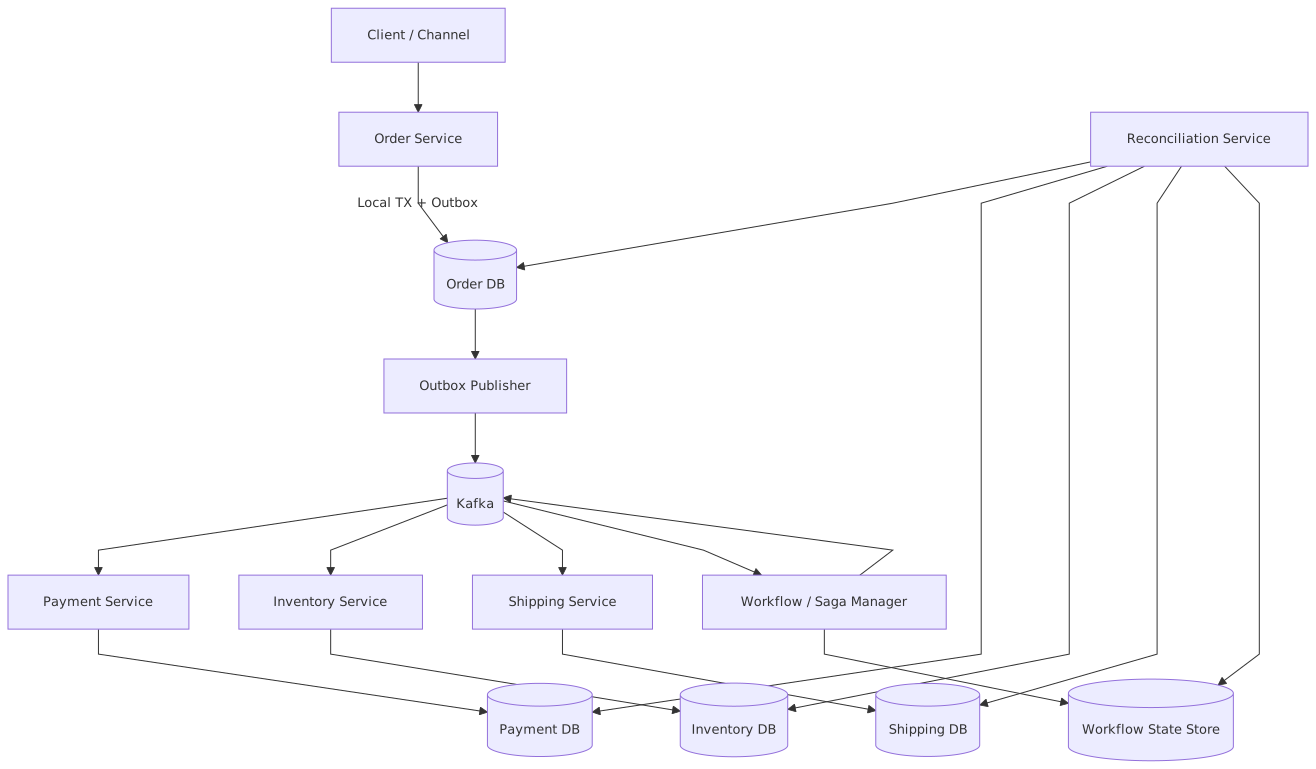
Kafka is not mandatory, but it is often a good fit because it gives durable event streams, replay capability, partitioned scalability, and consumer decoupling. It also introduces its own operational realities: ordering only within partitions, consumer lag, poison messages, schema evolution, and reprocessing side effects. Kafka will not save a bad compensation design. It will merely preserve it very efficiently.
Migration Strategy
Most enterprises do not get to design compensation cleanly from a blank sheet. They inherit a monolith, a package application, point-to-point integrations, and some APIs that look synchronous but are actually held together by operator intervention. The migration to eventual consistency has to be progressive.
This is where strangler thinking matters.
Do not begin by extracting every service and then hoping sagas will sort it out. Start by identifying one business capability with clear boundaries and tolerable consistency windows. Often this is order submission, claims intake, customer onboarding, or fulfillment routing. Keep the system of record stable while introducing a new event-driven edge.
A sensible migration path often looks like this:
- Expose domain events from the monolith
Add an outbox table or change data capture pipeline so the monolith publishes meaningful business events. Not table change noise. Real events like OrderPlaced, PaymentAuthorized, InventoryReserved.
- Build a read-side or peripheral service first
Let a new service consume events and provide a non-critical capability. This proves event reliability, schema discipline, and observability without threatening core transaction integrity.
- Extract one decisioning context
Move a bounded context with strong internal cohesion, such as fraud evaluation or shipping rate calculation, behind an API and event contract.
- Introduce explicit compensation for one multi-step flow
Choose a workflow where the business can define correction semantics clearly. Build orchestration, retries, and reconciliation around that single flow.
- Strangle write ownership gradually
Shift source-of-truth responsibility one aggregate at a time. Resist the temptation to dual-write indefinitely. Dual writes are where architecture goes to die.
- Add reconciliation before scale exposes drift
Teams usually postpone reconciliation because they hope the happy path will remain happy. It won’t.
Progressive strangler migration
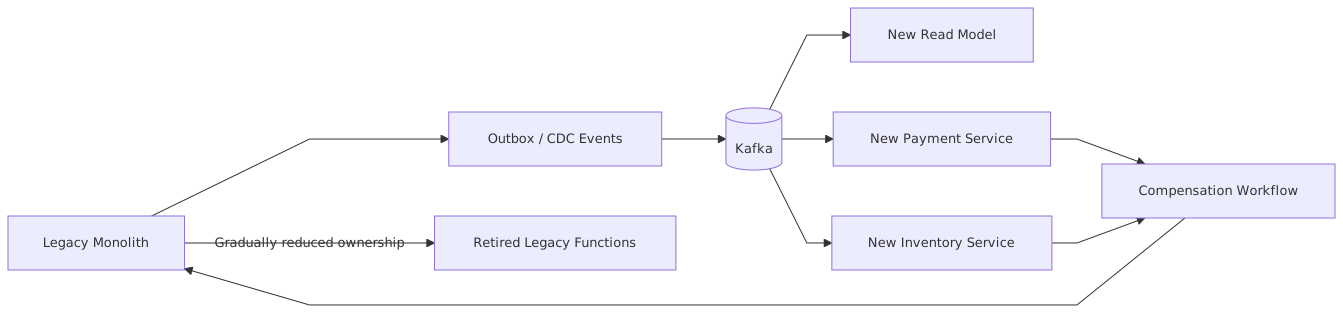
The trick in migration is not technical decomposition. It is preserving business meaning while shifting transaction boundaries. If the monolith had one reliable “place order” transaction, and the new architecture replaces it with five loosely coordinated services and no clear compensation semantics, you have not modernized anything. You have just moved the outage pattern.
Enterprise Example
Take a large omnichannel retailer. The sort with web orders, mobile app orders, click-and-collect, store fulfillment, warehouse fulfillment, gift cards, loyalty points, and three payment providers because history is undefeated.
Originally, their order management lived inside a large commerce platform. Checkout wrote orders, reserved stock, and captured payment in a tightly controlled transaction as long as everything stayed within that platform. But the business evolved. Store inventory came from a separate retail system. Warehouse reservations moved to a new fulfillment platform. Fraud checks were outsourced. Customer notifications moved to a cloud service. Loyalty points became a separate product team’s platform.
Suddenly the “order transaction” was fiction.
The first failure mode they saw was familiar: payment was authorized, but the inventory service timed out. The old system marked the order failed. Operations later discovered that inventory had actually been reserved asynchronously and remained stuck for hours. Customers saw canceled orders with temporary charges. Agents manually released stock. Finance reconciled payment holds. Nobody trusted the architecture.
The fix was not “more retries.” The fix was to model the business process explicitly.
They introduced:
- an Order service as the entry point
- Payment, Inventory, and Fulfillment as separate bounded contexts
- Kafka for domain events
- a workflow manager to track each order’s progress
- outbox publishing in each service
- compensation semantics agreed with business stakeholders
The compensation rules were business-specific:
- if payment authorization succeeded but inventory could not be reserved within 10 minutes, void the authorization
- if partial inventory existed across stores, hold order in
Awaiting Sourcingrather than cancel - if shipment creation failed after payment capture, issue a refund and generate customer care alert
- if loyalty points were granted before final fulfillment failure, issue a reversing points event rather than deleting the original grant
That last point matters. Loyalty did not “undo” points in place. It emitted a compensating ledger entry. This preserved auditability and respected the domain model. Finance liked it. Customer care could explain it. Auditors could trace it. That is good architecture: not elegant in a slide deck, but survivable in production.
They also added nightly reconciliation across orders, payment authorizations, stock reservations, and loyalty ledgers. It found more issues in the first week than the event-driven flow had surfaced in a month. This embarrassed the engineering team briefly and saved the business repeatedly afterward.
Operational Considerations
Compensation architecture succeeds or fails in operations.
Observability must show business state, not just technical metrics
Dashboards that show Kafka throughput and consumer lag are useful, but not sufficient. Operators need to know:
- orders stuck in
PaymentAuthorizedAwaitingInventory - compensations initiated in the last hour
- average age of pending workflows
- number of retries before compensation
- reconciliation discrepancies by type
- manual intervention queue volume
If you cannot answer “Which customers are currently affected?” your observability is still too technical.
Correlation IDs are non-negotiable
Every event, command, and log entry should carry correlation and causation metadata. Without it, root-cause analysis becomes archeology.
Dead-letter queues are not a strategy
A DLQ is a containment mechanism. It is not resolution. Every message routed there should have ownership, triage rules, and replay policy. Otherwise the DLQ becomes a graveyard where eventual consistency goes to become permanent inconsistency.
Schema evolution must be disciplined
Kafka-based systems live or die by contract management. Compensation often relies on event fields introduced later in the journey. Use schema registries, compatibility policies, and event versioning practices that fit the lifespan of the workflow.
Reconciliation should be routine, not exceptional
Run scheduled and on-demand reconciliation. Treat it like backups: tedious, essential, and only appreciated after disaster. Reconciliation can use event logs, snapshots, or direct queries, but it should be explicit, measurable, and owned.
Manual intervention needs first-class support
Some failures are business exceptions, not software defects. Build operator screens to inspect workflow state, retry steps, trigger compensations, and annotate decisions. Enterprises that skip this end up granting database access to support teams. That is never a proud architectural moment.
Tradeoffs
Compensation is not free. It shifts complexity rather than removing it.
Benefits
- supports autonomous microservices and bounded contexts
- enables scalable, asynchronous processing
- reflects real business semantics better than fake distributed transactions
- provides auditability through explicit correction events
- tolerates transient failures and partial outages
Costs
- more state to manage
- delayed consistency visible to users and operators
- complex testing, especially for timing and duplicates
- harder debugging across services
- significant design effort to define semantic compensations
- need for reconciliation and exception handling
The biggest tradeoff is emotional: teams must accept that correctness is achieved over time rather than in one instant. Some organizations are culturally ready for this. Others keep rebuilding synchronous coupling under a new name.
Failure Modes
Compensation designs fail in predictable ways.
Treating compensation as technical rollback
If the architecture assumes every action can be blindly undone, it will violate domain rules. A captured payment may require refund, not void. A shipped parcel may require return logistics, not cancellation.
Compensating too early
A timeout triggers compensation, then the original action succeeds later. Now you have a reservation and a release, or a capture and a refund, or worse, duplicate customer notifications. Distinguish uncertainty from failure.
Missing idempotency
Retries and replay cause duplicate compensations. Finance notices first.
Hidden dual writes
A service updates its database and publishes to Kafka outside one reliable boundary. Under failure, downstream state diverges and reconciliation becomes constant firefighting.
No ownership of exception states
The workflow reaches CompensationPendingManualReview and sits there because no team actually owns it. Many enterprise outages are just unowned states with fancy names.
Choreography beyond human comprehension
Each service reacts to events, emits more events, and eventually some combination produces a compensation. It works until a production incident requires explanation. Then every team points at another topic.
Reconciliation postponed forever
The system appears fine until financial close, inventory audit, or regulator inquiry. Then all the “rare edge cases” arrive as a single expensive meeting.
When Not To Use
Eventual consistency compensation is not a universal answer. Sometimes it is exactly the wrong move.
Do not use it when:
- the business operation requires immediate atomic correctness and cannot tolerate temporary divergence
- regulatory or legal constraints demand synchronous commit across all state changes
- the workflow is simple enough to remain inside one bounded context and one database
- the organization lacks operational maturity for observability, retries, reconciliation, and on-call ownership
- the domain semantics for compensation are unclear or disputed
- external systems do not support safe retries, correlation, or compensating actions
A classic example is high-value financial ledger posting. Ledgers should usually be designed as append-only accounting systems with tightly controlled consistency semantics, not sprayed across loosely coordinated microservices with “best effort” compensation. Another example is inventory decrement for a single warehouse application where one local transaction is perfectly adequate. Do not distribute what does not need to be distributed.
This is the harsh but useful rule: if you want microservices mainly for fashion, compensation will punish you.
Related Patterns
Several patterns sit close to compensation and are often used together.
Saga pattern
The standard framing for long-running distributed transactions. Useful, but often explained too generically. The key is still domain semantics.
Transactional outbox
Essential for reliable event publication from local transactions. One of the few patterns that consistently earns its reputation.
Idempotent consumer
Needed because duplicates happen. Without it, retries and replay are dangerous.
CQRS
Helpful where read models can lag and different views of workflow state are needed for customers, operators, and downstream systems.
Event sourcing
Sometimes useful for domains where full auditability of state transitions and compensations is valuable. But do not reach for it casually; event sourcing adds its own cognitive tax.
TCC: Try-Confirm-Cancel
Useful in some reservation-heavy domains, especially where provisional resource holds are natural. Less suitable when many actions are irreversible or externally mediated.
Reconciliation and repair jobs
Not glamorous, deeply necessary. The unsung partner of eventual consistency.
Summary
Compensation in microservices is what happens when architecture grows up.
Once a business process crosses bounded contexts, independent databases, and asynchronous messaging, there is no honest way to preserve the illusion of one big transaction. You either model the distributed nature of the process properly, or you let failure leak into the business in random ways.
The right approach is straightforward in principle and demanding in practice: model long-running workflows explicitly, define semantic compensations in the language of the domain, persist workflow state durably, publish events reliably, make consumers idempotent, delay compensation until failure is genuinely understood, and reconcile relentlessly.
Kafka can help. Sagas can help. Workflow engines can help. But none of them substitute for understanding the business meaning of “what should happen next if this step succeeds, fails, or remains uncertain.”
That is the essence of eventual consistency compensation. Not rollback. Not magic. Just disciplined business correction in a world where systems, like organizations, rarely move in perfect lockstep.
And that, in enterprise architecture, is often the difference between a distributed system that merely runs and one that can be trusted.
Frequently Asked Questions
What is a service mesh?
A service mesh is an infrastructure layer managing service-to-service communication. It provides mutual TLS, load balancing, circuit breaking, retries, and observability without each service implementing these capabilities. Istio and Linkerd are common implementations.
How do you document microservices architecture for governance?
Use ArchiMate Application Cooperation diagrams for the service landscape, UML Component diagrams for internal structure, UML Sequence diagrams for key flows, and UML Deployment diagrams for Kubernetes topology. All views can coexist in Sparx EA with full traceability.
What is the difference between choreography and orchestration in microservices?
Choreography has services react to events independently — no central coordinator. Orchestration uses a central workflow engine that calls services in sequence. Choreography scales better but is harder to debug; orchestration is easier to reason about but creates a central coupling point.