⏱ 22 min read
Caching is one of those decisions that looks clever in the architecture review and suspicious in the postmortem.
A team adds a cache because the database is hot, latency is wobbling, and every dashboard says the same thing: too many reads, too much repetition, too much waste. Then the system grows up. What started as one application becomes a set of microservices. Ownership gets split. Data moves behind service boundaries. Kafka appears. A search index joins the party. A mobile app expects instant consistency, finance expects exactness, and operations just wants the pager to stop screaming at 2 a.m. event-driven architecture patterns
That is when cache invalidation stops being a side concern and becomes a core architectural problem.
The old joke says there are only two hard things in computer science: cache invalidation and naming things. In distributed systems, these are often the same problem. If you do not understand the domain semantics of what changed, you cannot invalidate the right thing. And if you cannot name the business event correctly, you will publish technical noise instead of useful truth. A cache does not become correct because Redis is fast. It becomes correct because the invalidation model mirrors the business.
This is the uncomfortable truth many enterprise teams eventually learn: distributed cache invalidation is not really about caches. It is about ownership, time, and meaning.
So let us treat it that way.
Context
In a monolith, cache invalidation is irritating but usually local. The application updates a record, clears a key, and carries on. The transaction boundary is visible. The call stack is visible. The person changing the code often understands both the write path and the read path.
Microservices destroy that convenience for good reasons.
Each service owns data aligned to a bounded context. Catalog owns product descriptions. Pricing owns price calculation. Inventory owns available-to-sell stock. Customer owns preferences. Order owns lifecycle. Each of these services may have its own database, its own scaling profile, and its own read model. To hit performance targets, teams add local in-memory caches, shared distributed caches, gateway caches, query-side materialized views, and downstream consumer caches.
Now a single business change can ripple through many representations.
A product price changes. The Pricing service updates its source of truth. The Product Details API has a denormalized cache that embeds price. The mobile API gateway caches rendered responses. The search index contains the old price for sorting. Promotions has eligibility snapshots. Recommendation models have a feature cache. Analytics has near-real-time state built from Kafka. Nobody is wrong individually. But the system can be wrong collectively.
This is the environment where invalidation flow matters.
Not “did we delete a Redis key?”
But “how does semantic change propagate across distributed read models with acceptable staleness, observability, and recoverability?”
That is the architecture question.
Problem
The problem sounds deceptively simple: when data changes in one microservice, how do all dependent caches and read models stop serving stale information? microservices architecture diagrams
In practice there are several intertwined problems hiding inside that sentence:
- Detecting change reliably
- Expressing change in domain terms that other services can understand
- Mapping domain change to cache keys and query shapes
- Propagating invalidation across process and network boundaries
- Tolerating partial failure and reordering
- Reconciling systems that missed events
- Balancing latency, consistency, throughput, and cost
And because this is enterprise software, there is one more problem: different data has different truth requirements.
A product image can be stale for five minutes and nobody cares. Inventory count cannot be stale during checkout without real business damage. Customer entitlement data might be security-sensitive and should not outlive a revocation event. Financial rates may have legal implications. A cache invalidation strategy that treats all data as equal is already broken.
That is why the first architectural move is not technical. It is semantic. Identify what kind of truth each bounded context needs to expose, how fast changes must propagate, and what stale data costs the business.
If you skip that step, you end up with one of the classic enterprise anti-patterns: a generic caching platform imposed across the estate, proudly centralized, elegantly abstracted, and perfectly misaligned to the domain.
Forces
Distributed cache invalidation sits in the crossfire of competing forces. Good architecture names the tension rather than pretending it does not exist.
Performance vs correctness
Caches exist because round-tripping to systems of record is expensive. But every cache buys performance by borrowing against freshness. If you overcorrect for consistency, you may erase the value of the cache. If you overcorrect for speed, you may serve lies at scale.
Service autonomy vs shared semantics
Microservices should be autonomous, but invalidation depends on consumers understanding change. If every service emits low-level database deltas, consumers become tightly coupled to internal schemas. If the producer emits richer domain events, the contracts become more stable but require more design discipline.
Push vs pull
Push-based invalidation is fast. A service publishes events and downstream caches react. Pull-based refresh is simpler. Consumers use TTLs, version checks, or read-through loading. Push gives fresher systems but creates operational dependency on messaging. Pull reduces coupling but accepts staleness. Most real systems need both.
Fine-grained precision vs implementation complexity
Invalidating a single key is efficient. Invalidating every derived representation touched by a change is hard. Broad invalidation is easier but more expensive. Narrow invalidation preserves hit rates but requires richer dependency mapping.
Eventual consistency vs business expectation
Architects love saying “eventual consistency” as if it were a strategy. It is not. It is a confession that the system may be wrong for some period of time. The architecture still has to define how wrong, for whom, and for how long.
Independent deployability vs migration reality
Most enterprises do not start greenfield. They inherit monoliths, ETL jobs, shared databases, and undocumented report extracts. Cache invalidation has to work during migration, not after some imaginary clean break. That means dual-read, dual-publish, strangler routing, and ugly but necessary reconciliation.
Solution
The most reliable solution in microservices is to treat cache invalidation as an event-driven propagation problem rooted in domain events, not as a side effect of CRUD.
That sentence carries a lot of weight.
When something meaningful changes in a bounded context, the owning service emits a domain event that describes the business fact: PriceChanged, InventoryAdjusted, CustomerStatusRevoked, OrderCancelled. These are not table updates. They are statements in the language of the business. Downstream services subscribe and decide what to invalidate, recompute, or ignore based on their own models.
The invalidation flow typically has four layers:
- Source of truth update
- The owning service commits a state change in its own datastore.
- Reliable event publication
- The service publishes a domain event, usually via an outbox pattern to avoid dual-write inconsistency.
- Consumer-side invalidation or refresh
- Downstream services receive the event and invalidate cache entries, rebuild projections, or refresh read models.
- Reconciliation
- Periodic jobs or stream replays repair drift caused by missed events, poison messages, or partial outages.
This architecture works because it preserves bounded context ownership. The producer tells the world what changed in business terms. The consumers remain responsible for their own caches. Nobody reaches into another service’s Redis instance and starts deleting keys. That path leads to chaos dressed as convenience.
A good rule is this: a service may publish facts; it should not orchestrate another service’s cache internals.
Why Kafka often fits
Kafka is frequently a good backbone for invalidation flow because it provides durable event streams, consumer groups, replay capability, and ordering guarantees within partitions. Replay matters. Invalidation systems fail in subtle ways, and the ability to rebuild projections from a retained stream is not a luxury. It is your insurance policy.
But Kafka is not magic. It gives you durability and scalable fan-out. It does not give you domain modeling, idempotency, exactly-once business semantics, or a free pass on event design.
Use Kafka because you need durable, replayable propagation. Not because “all microservices use Kafka now.”
Architecture
A practical architecture usually combines several tactics:
- Domain events for semantic change propagation
- Outbox pattern for reliable publish after local commit
- Consumer-managed caches and projections
- TTL as a safety net, not the primary consistency model
- Versioning or sequence numbers for idempotency and ordering defense
- Reconciliation pipelines for drift correction
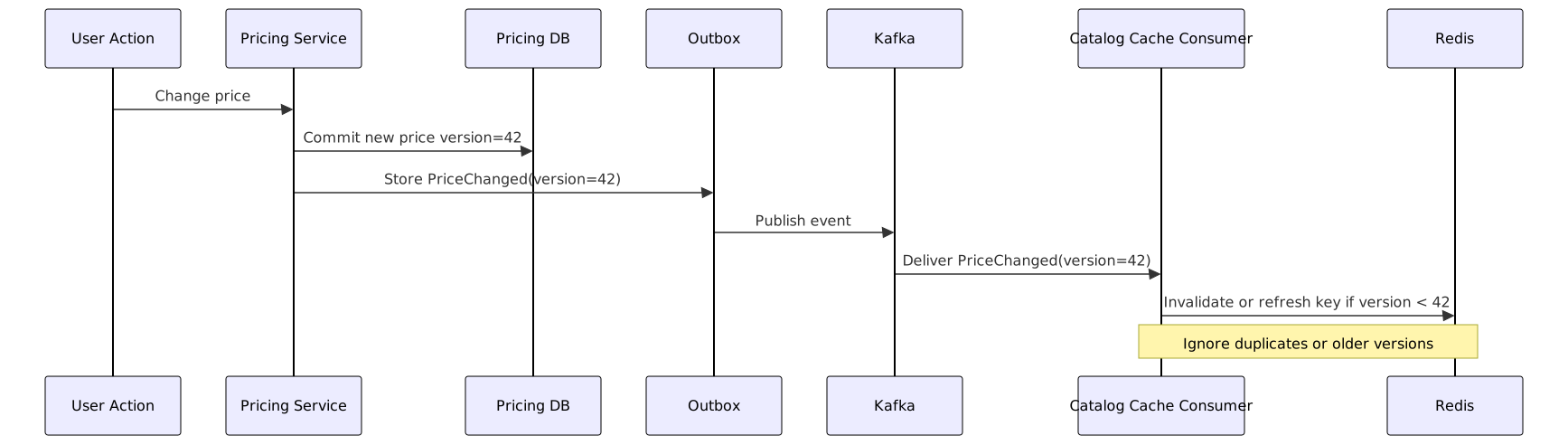
Here is the core invalidation flow.

This is the basic shape, but the devil is in the design choices.
Domain semantics first
Suppose Pricing emits price_row_updated with old and new table values. It may look flexible, but consumers now need knowledge of Pricing’s internal schema. Worse, they may infer business meaning incorrectly. Was this a temporary markdown? A tax-inclusive display price change? A currency correction? A backdated price effective next week?
A better event is something like:
BasePriceChangedPromotionalPriceActivatedPromotionalPriceExpiredPriceEffectiveFromScheduled
Now downstream services can make valid decisions. Search may reindex only active display prices. Checkout may invalidate quote caches only when the effective window is current. Analytics may maintain separate measures for base and promotional price evolution.
This is classic domain-driven design. Cache invalidation depends on ubiquitous language. The event is not a transport wrapper. It is a semantic contract.
Key design matters more than many teams admit
Invalidation is only as precise as the cache key strategy.
If a consumer caches by productId, invalidation is simple. If it caches a query like “top discounted products in region X for loyalty tier Y,” then a single price event may affect many result sets. Teams often discover too late that query-result caching creates invalidation fan-out they cannot compute efficiently.
There are several patterns here:
- Entity cache: key by aggregate identifier. Easy to invalidate.
- Composite view cache: key by common query dimensions. Harder, but manageable if dimensions are stable.
- Arbitrary query cache: almost impossible to invalidate precisely without dependency indexing.
For enterprise systems, I am opinionated: avoid arbitrary distributed query caching unless you can tolerate broad invalidation or periodic rebuilds. It produces elegant benchmarks and ugly operations.
Event-carried state transfer vs notification-only
Consumers may receive:
- a notification that something changed, then re-fetch source data
- or enough payload to update local projections directly
Each has tradeoffs.
Notification-only events reduce payload size and keep consumers close to source truth, but they can create read storms after hot changes.
Event-carried state supports local recomputation and resilience, but can couple consumers to producer data shape and increases event governance complexity.
In practice, use event-carried state for stable, high-value fields needed in many downstream read models. Use notification-only where source lookup is cheap or semantics are volatile.
Ordering and idempotency
Distributed invalidation breaks in boring ways. Events arrive twice. Events arrive late. Consumers restart. Partitions rebalance. A stale event overwrites a fresh cache entry.
Defend with versions.
Every invalidation-relevant event should carry one or more of:
- aggregate version
- event sequence number
- logical timestamp from the source
- effective date range for temporal semantics
Consumers should update or invalidate only if the incoming version is newer than what they have seen. This is not optional in serious systems.
Reconciliation is not a nice-to-have
Every event-driven invalidation architecture eventually experiences drift.
A consumer was down too long. A topic retention window was misconfigured. A poison message blocked a partition. A deployment introduced an incompatible deserializer. A cache node was restored from backup with old data. An operator flushed the wrong namespace. You can have excellent engineering and still get drift.
So build reconciliation in from day one.
Reconciliation can take several forms:
- periodic full rebuild of projections
- incremental compare between source and cached view
- CDC-based audit stream versus materialized state
- replay from Kafka from a known checkpoint
- version watermark checking
The right choice depends on scale and criticality. The wrong choice is believing your event path will never miss.
Migration Strategy
Most organizations are not redesigning a blank page. They are moving from a monolith or shared-database estate where cache invalidation is local, implicit, or frankly accidental.
This is where progressive strangler migration earns its keep.
Do not begin by announcing “we now have distributed cache invalidation.” Begin by identifying one bounded context where stale data is painful, the ownership is clear, and the event semantics can be made explicit. Build the flow there. Learn. Then expand.
A useful migration sequence looks like this:
1. Identify authoritative ownership
Find the current source of truth for the data item. Not the loudest team. The actual owner. In many enterprises this is harder than it should be. Shared databases blur ownership. Reporting jobs mutate tables. Legacy systems emit half-truths. Clear this up first.
2. Introduce semantic events at the source
If the monolith is still the system of record, it should publish domain events when relevant changes occur. Do this even before extracting the service. The event contract is often the first real boundary.
3. Use outbox or CDC to avoid dual-write pain
If the legacy application cannot publish events transactionally, use an outbox table or CDC pipeline to capture committed change. CDC alone is not enough if it emits only row-level deltas. You still need domain translation somewhere.
4. Build consumers that manage their own caches
Start with one consumer service or one API gateway cache. Let it subscribe, invalidate, and expose metrics on staleness and lag. Resist the temptation to centralize all invalidation logic in an infrastructure team. Shared plumbing is fine; shared semantics is not.
5. Run dual paths and reconcile
During migration, the old invalidation mechanism and the new event-driven flow will coexist. That is normal. Use shadow consumers, compare cache-hit correctness, and reconcile periodically. Measure drift rather than assuming success.
6. Strangle reads before writes where practical
A common pattern is to first move read models and cache consumers to the new event flow, while writes remain in the monolith. Once event semantics are stable and downstream consumers trust them, extract write ownership into a service.
7. Retire direct cache coupling
Legacy estates often contain hidden shortcuts: one application clears another application’s cache directly. Remove these slowly. Replace them with event contracts and let consumers own their invalidation.
Here is a simple strangler migration picture.
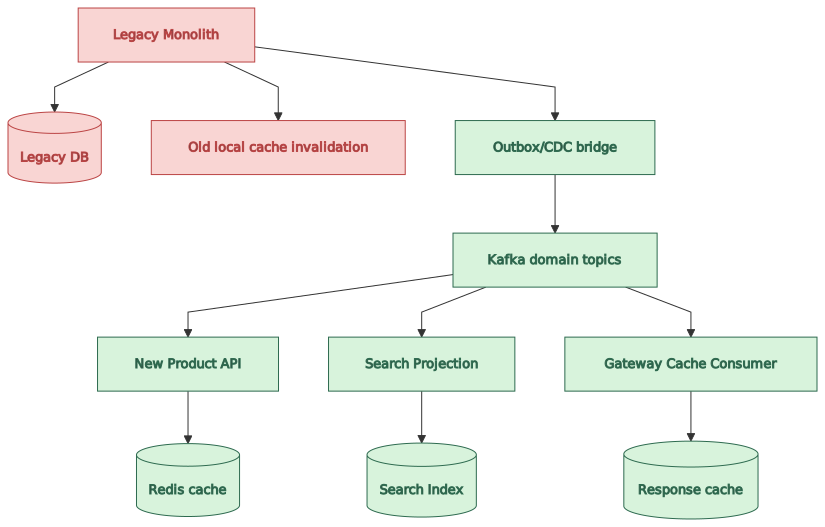
The migration lesson is simple: events are often the first product of decomposition, not the last.
Enterprise Example
Consider a global retail platform with these bounded contexts:
- Catalog manages product descriptions, category assignments, media
- Pricing manages list prices, promotions, regional price rules
- Inventory manages available-to-sell quantities by fulfillment node
- Search maintains denormalized documents for discovery
- Digital Experience API assembles product detail and listing responses
- Checkout validates final price and stock during purchase
The business complaint is familiar: product pages and category listings show stale prices and stock after updates. Search rankings lag. Promotions go live but caches keep serving old values. During seasonal events, the team manually flushes large cache regions, crushing hit rates and shifting load to backing stores.
The root cause is not that Redis is misconfigured. The root cause is architectural.
Pricing updates a relational database and invalidates only its own local cache. Inventory publishes technical stock table changes, but only one consumer understands them. The Experience API caches assembled product pages by SKU and region, but nobody can tell it exactly when a promotion window activates. Search refreshes on a batch schedule. Several teams directly clear shared cache prefixes in response to incidents.
Classic distributed ambiguity.
A better design
- Pricing becomes the authoritative publisher of
BasePriceChanged,PromotionActivated, andPromotionExpired. - Inventory publishes
AvailableToSellAdjustedwith SKU, region, node scope, and version. - Catalog publishes
ProductContentUpdatedfor changes that affect rendered product details. - All events flow through Kafka with retention sufficient for replay.
- Experience API subscribes to these topics and maintains a dependency map for page fragments:
- Search subscribes and reindexes impacted product documents.
- Checkout does not trust caches for final commitment; it uses direct validation against source services or strongly consistent reservation models where needed.
- A nightly reconciliation job compares current source versions for hot SKUs against cache metadata and projection versions.
- product detail by SKU-region
- category listing by category-region-sort profile
Now the important tradeoff: category listing caches are query-shaped and expensive to invalidate precisely. A single promotion activation may affect many listing result sets. Instead of trying to calculate every impacted key, the team chooses bounded broad invalidation:
- invalidate top listing caches for the affected category and region
- rely on short TTL for lower-traffic combinations
- asynchronously rebuild hot keys based on access patterns
That is not mathematically pure. It is enterprise architecture. Precision where it pays. Approximation where it does not.
This design also respects domain semantics. Pricing says when a promotion becomes active. It does not tell Search which documents to rewrite or Experience API which Redis keys to delete. Consumers own those decisions.
What improved
- Stale price incidents dropped because activation events were explicit and replayable.
- Search freshness improved from batch latency to event latency.
- Cache flush storms reduced because invalidation became targeted.
- Post-incident recovery improved because projections could replay from Kafka and reconcile against source versions.
What stayed hard
- Query-result cache invalidation for merchandising pages remained approximate.
- Cross-region clock issues affected scheduled price activation until the team standardized on source-effective timestamps rather than consumer wall clocks.
- Inventory updates were high volume, so some low-value caches used coarser TTL plus periodic refresh instead of event-driven invalidation.
That is the point: not all data deserves the same invalidation machinery.
Operational Considerations
Architects who stop at the box-and-arrow level are designing theatre. Invalidation lives or dies operationally.
Measure staleness explicitly
Do not just measure cache hit ratio. A cache can be highly efficient and consistently wrong.
Track:
- event lag from producer commit to consumer processing
- cache freshness age
- version drift between source and cached entry
- replay duration
- number of broad invalidations or namespace flushes
- reconciliation mismatch rate
Freshness is a product metric, not just an infrastructure metric.
TTL is a seatbelt, not the steering wheel
TTLs are useful because they bound worst-case staleness. They are not a replacement for invalidation where correctness matters. If your answer to distributed invalidation is “set TTL to 30 seconds,” what you are saying is “the business can be wrong for 30 seconds.” Sometimes that is acceptable. Often it is not.
Use TTL as:
- a safety net for missed invalidations
- a control on cache growth
- a fallback for low-value data
Do not use TTL as a substitute for understanding the domain.
Plan for replay
Keep event retention long enough for consumer recovery and projection rebuild. Test replay regularly. If a consumer cannot rebuild from the retained stream in operationally acceptable time, your recovery story is weaker than you think.
Backpressure and burst handling
Promotion launches, catalog imports, and inventory feeds can create bursts. Consumers must handle event spikes without causing cache stampedes or overwhelming source services on refresh.
Mitigations include:
- batch invalidation where semantics allow
- refresh coalescing
- jittered background reloads
- read-through request collapsing
- partitioning topics by stable keys
- prioritizing hot entities
Security and data minimization
Caches can outlive revocations. That matters for entitlements, permissions, and customer status.
For security-sensitive data:
- use short TTL plus immediate event-driven invalidation
- encrypt or avoid caching where practical
- track revocation SLAs
- prove invalidation in audit trails
Compliance teams care less that your architecture is elegant and more that revoked access actually stops.
Tradeoffs
There is no free lunch here. Distributed cache invalidation is a game of managed compromise.
Event-driven invalidation
Pros
- Freshness with low source read load
- Decoupled propagation
- Replay and rebuild capability
- Natural fit for microservices and bounded contexts
Cons
- Operational complexity
- Event contract governance
- Ordering and idempotency challenges
- Consumer drift still possible
TTL-based expiration
Pros
- Simple
- No eventing dependency
- Predictable bound on staleness
Cons
- Either too stale or too expensive
- Poor fit for high-correctness domains
- Causes synchronized expiry if done badly
Write-through / write-behind shared cache
Pros
- Centralized control
- Fast reads for certain patterns
Cons
- Dangerous across bounded contexts
- Coupling disguised as convenience
- Hard to model domain-specific invalidation semantics
Full cache flush / region flush
Pros
- Operationally easy
- Good emergency brake
Cons
- Kills hit rate
- Causes source load spikes
- A sign the invalidation model is underdesigned
My bias is clear: use domain-event-driven invalidation for high-value, shared, semantically rich data; use TTL and coarse invalidation for low-value or awkward query caches; reserve full flushes for incidents.
Failure Modes
This is where mature architecture earns its salary. Let us name the common ways this goes wrong.
Dual-write inconsistency
The service updates its database but fails to publish the invalidation event. Now source truth changed and caches remain stale indefinitely.
Mitigation: outbox pattern, CDC with durable delivery, reconciliation.
Consumer missed event
A consumer is down beyond retention, a topic is misconfigured, or a deserialization bug drops messages.
Mitigation: replay controls, dead-letter handling, reconciliation jobs, freshness alarms.
Out-of-order events
Version 43 arrives before 42, or an older replayed event lands after a fresh one.
Mitigation: monotonic version checks, idempotency stores, effective-time validation.
Cache stampede after invalidation
Thousands of requests miss simultaneously and hammer the source system.
Mitigation: request coalescing, background refresh, soft TTL, stale-while-revalidate, bulkhead isolation.
Over-invalidation
A single change clears huge regions, collapsing cache efficiency.
Mitigation: better key strategy, dependency maps, isolate hot entities, accept selective staleness where business allows.
Semantic mismatch
Producer emits technical changes, consumers infer business meaning inconsistently.
Mitigation: domain events, event review with domain experts, bounded context contracts.
Reconciliation that cannot finish
The system accumulates more drift than repair jobs can process in the available window.
Mitigation: incremental reconciliation, partitioned repair, replay-by-scope, prioritize critical entities.
The broad lesson: if you cannot recover from invalidation failure, you do not have an invalidation architecture. You have a hope-based design.
When Not To Use
Not every cache in a microservice landscape deserves distributed invalidation machinery.
Do not use an event-driven invalidation architecture when:
The data is cheap to fetch and low value
If the underlying read is already fast and the stale-data cost is trivial, adding Kafka consumers and reconciliation jobs is architecture cosplay.
The domain can tolerate bounded staleness
For static reference data, documentation content, or infrequently changing metadata, a sensible TTL may be enough.
The cache is entirely local and ephemeral
Per-instance in-memory caches for computation shortcuts often do not justify distributed invalidation. Let them expire naturally unless correctness says otherwise.
You do not have clear ownership
If no bounded context truly owns the data, event-driven invalidation will amplify confusion. Fix ownership first.
Your event maturity is low
If the organization cannot maintain stable event contracts, monitor consumers, or replay streams, start smaller. Use TTL plus targeted source reads until the platform and teams are ready.
Architecture should solve the problem you actually have, not the one that makes for an impressive slide.
Related Patterns
Several patterns sit close to distributed cache invalidation and are often used together.
Outbox Pattern
Ensures state change and event publication are reliably connected without unsafe dual writes.
Change Data Capture
Useful for migration and propagation, especially from legacy stores. Best paired with semantic translation when raw row changes are not meaningful enough.
CQRS
Separate read models often need independent invalidation or projection rebuild strategies. CQRS does not require event sourcing, but it frequently benefits from event-driven updates.
Materialized Views
A cache is sometimes just a temporary optimization. A materialized view is a durable read model. Treat them differently operationally, but both need refresh and reconciliation logic.
Saga
Useful when multi-service workflows trigger chains of state changes that produce multiple invalidations. Still, do not confuse workflow coordination with cache consistency.
Strangler Fig Pattern
Ideal for incrementally introducing event-driven invalidation from a monolith into microservices.
Stale-While-Revalidate
Helpful for balancing user experience and source protection on expensive read paths.
Summary
Distributed cache invalidation in microservices is not a Redis feature. It is a domain architecture problem wearing an infrastructure costume.
The winning approach is usually straightforward in principle and demanding in execution:
- let bounded contexts own truth
- publish domain events, not database gossip
- use reliable publication with outbox or equivalent
- let consumers own their own invalidation and projection logic
- defend against duplicates, delay, and reordering with versions
- reconcile regularly because drift is inevitable
- migrate progressively with a strangler approach
- use TTL as a backstop, not a worldview
The deepest mistake teams make is treating cache invalidation as generic plumbing. It is not generic. The semantics of PriceChanged are different from InventoryAdjusted, and both are different from CustomerAccessRevoked. The architecture should reflect that.
A cache is a promise with an expiry date. In a distributed enterprise system, the hard part is not making that promise fast. The hard part is knowing exactly when it stops being true.
Frequently Asked Questions
What is a service mesh?
A service mesh is an infrastructure layer managing service-to-service communication. It provides mutual TLS, load balancing, circuit breaking, retries, and observability without each service implementing these capabilities. Istio and Linkerd are common implementations.
How do you document microservices architecture for governance?
Use ArchiMate Application Cooperation diagrams for the service landscape, UML Component diagrams for internal structure, UML Sequence diagrams for key flows, and UML Deployment diagrams for Kubernetes topology. All views can coexist in Sparx EA with full traceability.
What is the difference between choreography and orchestration in microservices?
Choreography has services react to events independently — no central coordinator. Orchestration uses a central workflow engine that calls services in sequence. Choreography scales better but is harder to debug; orchestration is easier to reason about but creates a central coupling point.