⏱ 19 min read
Microservices migrations rarely fail because teams can’t write Dockerfiles. They fail because people pull the wrong seams.
That is the real game.
A monolith is not simply “old code.” It is a living map of business decisions, compromises, edge cases, tribal knowledge, emergency fixes, reporting obligations, and that one tax rule no one remembers until quarter close. When architects approach migration as a technical decomposition exercise, they tend to carve along code boundaries. But code boundaries are often historical accidents. The right cuts are usually hiding in business language, workflow ownership, data change patterns, operational urgency, and failure tolerance.
Service extraction is surgery, not demolition. If you cut in the wrong place, the patient may survive, but it will limp forever.
This is where heuristics matter. Not rigid rules. Heuristics. Practical signals that help us decide what to extract first, what to leave alone, where to place the new boundary, and how to migrate without putting the enterprise into a months-long reconciliation crisis. Good heuristics don’t promise certainty. They reduce the odds of creating distributed chaos with cleaner PowerPoint slides.
This article lays out those heuristics in the way enterprise migrations actually happen: unevenly, politically, and under pressure. We will look at domain-driven design, progressive strangler migration, event-driven integration with Kafka where it helps, reconciliation strategies, the awkward tradeoffs, and the conditions under which microservice extraction is exactly the wrong move. event-driven architecture patterns
Context
Most enterprises did not wake up one morning and choose a monolith out of laziness. They built one because it was the fastest way to capture a business model while requirements were moving under their feet. Over time, the monolith absorbed more capabilities: customer onboarding, order processing, billing, fulfillment, reporting, notifications, pricing, compliance checks, partner integration. It became the place where the business happened.
Then growth changed the economics.
Different teams wanted to release at different speeds. Some capabilities needed independent scaling. Compliance wanted sharper access boundaries. Operations wanted better fault isolation. Product wanted faster experimentation. Data teams wanted trustworthy event streams instead of nightly extracts. Suddenly the monolith’s strength—shared context and transactionality—became its tax.
That tax is often paid in four currencies:
- release coordination
- fragile coupling
- slow change approval
- operational blast radius
At this point, leadership starts saying “microservices” as though it were a destination. It is not. It is a distribution of responsibilities, data, failure, and governance. It can absolutely improve speed and resilience. It can also multiply inconsistency, complexity, and organizational confusion if boundaries are poorly chosen. microservices architecture diagrams
So the first architectural question is not “how do we move to microservices?” It is “which capabilities deserve extraction, in what order, with which boundary, and at what level of autonomy?”
That is a much harder question. It is also the only one that matters.
Problem
The practical problem of service extraction is this: enterprise systems entangle domain logic, process flow, shared data, and user experience in ways that are not obvious from the codebase alone.
A naive extraction usually follows one of three patterns:
- Layer extraction
Teams extract technical layers—say, notifications or authentication adapters—because they are easy to isolate. Sometimes that helps. Often it creates infrastructure services masquerading as business services, leaving the real domain knots untouched.
- Table-based extraction
Teams assign a service to a set of database tables. This looks clean in diagrams and turns ugly the moment a core business invariant spans multiple extracted tables and remaining monolith logic.
- Org-chart extraction
Teams create services that match team names. This can work if teams are aligned to domain ownership. It fails when the organization itself is a temporary compromise, which is common in enterprises.
The result is familiar: chatty services, duplicated validation rules, distributed transactions by stealth, endless reconciliation jobs, and a support team staring at Kafka topics trying to figure out why an invoice exists without a shipment.
The central problem is boundary selection under uncertainty.
And uncertainty is not a side effect here. It is the operating condition.
Forces
A useful architecture article should admit tension, not hide it. Service extraction is a tug-of-war among forces that do not naturally agree.
Domain cohesion vs integration simplicity
Domain-driven design teaches us to place boundaries around cohesive business capabilities and their language. That is sound advice. But highly cohesive domains often rely on data and processes spread throughout the monolith. Extracting them cleanly may require substantial anti-corruption logic, event publishing, and process redesign.
Team autonomy vs enterprise consistency
Independent teams want ownership and release freedom. Enterprises want standardized observability, security, identity, auditability, and data governance. If every extracted service is truly sovereign, the platform becomes a zoo. If governance is too heavy, “microservices” becomes a slower monolith with YAML. EA governance checklist
Transaction integrity vs service autonomy
In a monolith, a single database transaction can enforce a business invariant across modules. Once extracted, those invariants often become eventual consistency problems. Some businesses tolerate that well. Others absolutely do not.
Speed of extraction vs correctness of boundary
Quick wins matter. Leadership wants visible progress. But the fastest extraction candidate is not always the one with the best long-term boundary. An architect must distinguish a tactical extraction from a strategic one.
Event-driven elegance vs operational reality
Kafka can be a superb backbone for domain events, decoupling, replay, and downstream analytics. It can also become a giant asynchronous rumor mill if event semantics are vague, schemas drift, or consumers treat events as remote procedure calls with more latency.
These forces are why extraction heuristics are valuable. We are not searching for perfect decomposition. We are searching for a better shape under pressure.
Solution
My view is simple: extract services based on domain semantics first, operational asymmetry second, and data ownership third. In that order.
Not because data is unimportant. Quite the opposite. But data ownership makes sense only after we understand the business capability and the invariants it must protect.
Heuristic 1: Extract where the language is stable and distinct
If the business uses words differently in one area than in another, that is a signal. A customer in CRM may not mean the same thing as a customer in billing. An order in sales is often not the same conceptual thing as an order in fulfillment.
These semantic differences matter more than shared IDs.
Bounded contexts from domain-driven design are the best starting point for extraction. If a capability has its own terms, rules, metrics, lifecycle, and decision-makers, it is a candidate. Stable language usually predicts stable ownership.
Heuristic 2: Extract where change rate and release cadence differ materially
Some parts of the system change every sprint. Others are touched once a quarter. Mixing them in one release unit is organizational friction disguised as architecture.
If pricing rules change weekly while invoicing changes under stricter control, that asymmetry is useful. Extracting pricing may let a team move faster without dragging the financial core into constant regression cycles.
Heuristic 3: Extract where failure isolation is valuable
Capabilities with spiky load, fragile integrations, or noisy dependencies are prime candidates. Payment gateway integration, notification delivery, search indexing, and partner API orchestration often fit here. They can fail independently and recover independently.
This is especially true when failure should degrade, not halt, the core journey.
Heuristic 4: Extract where a clear system of record can be established
A service boundary without data ownership is theater. If no one can answer “which service is the authoritative source for this state?” the extraction is premature.
Authoritative ownership does not mean all data lives in one place. It means one service owns the truth and publishes changes outward.
Heuristic 5: Avoid extracting business invariants that still demand synchronous atomicity
This is where many migrations go wrong. If two operations must succeed or fail together because the business cannot tolerate intermediate states, do not split them early unless you are prepared to redesign the process itself.
Microservices do not repeal the laws of accounting.
Heuristic 6: Prefer extracting capability slices, not technical fragments
A service should own meaningful business behavior. “PDF service” and “validation service” are usually signs of decomposition by implementation concern. Better to extract “Statement Generation” if the PDFs are part of a business capability with its own rules, SLAs, and lifecycle.
Heuristic 7: Start where anti-corruption is feasible
The first few extractions teach the enterprise how to migrate. Pick places where an anti-corruption layer can shield the new service from monolith weirdness. This reduces accidental leakage of old abstractions into the new model.
Heuristic 8: Use events for facts, APIs for decisions
A domain event should communicate something that happened. A synchronous API should be used when one service needs another service to make a decision now. Teams get into trouble when they publish vague, command-like events or build request-response chains over Kafka in denial of reality.
These heuristics do not remove judgment. They sharpen it.
Architecture
A sound extraction architecture usually evolves through a progressive strangler pattern. The monolith remains the operational core while new capabilities are incrementally peeled out behind controlled interfaces. Routing, event publication, data replication, and reconciliation become first-class concerns.
Here is the shape at a high level:
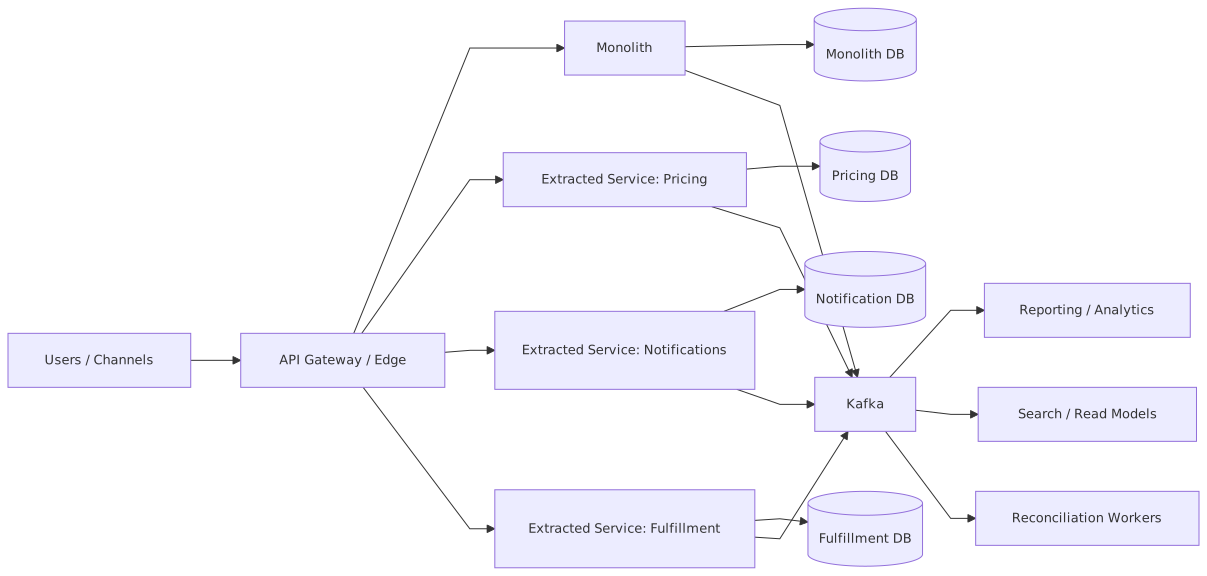
There are three important ideas here.
First, the monolith remains a participant, not a legacy embarrassment to be ignored. During migration it is often the largest bounded context in the estate, whether we like it or not.
Second, Kafka is not there to make the architecture look modern. It is there where event propagation, decoupled consumers, and replayable state changes have genuine value. Publishing order-created, invoice-issued, shipment-dispatched, or customer-updated events can support extracted services, analytics, and reconciliation. But eventing should follow domain semantics, not replace them.
Third, extracted services need their own persistence where they own state. Shared databases are a transitional concession, not an end state.
Domain semantics and service boundaries
A healthy service boundary has four characteristics:
- it speaks a distinct business language
- it owns decisions, not merely data storage
- it can explain its invariants
- it has a clear upstream/downstream relationship with neighbors
For example, in commerce:
- Pricing decides applicable price based on catalog, contracts, promotions, and regional policy
- Ordering captures customer intent and order lifecycle
- Fulfillment manages allocation, shipment, and delivery execution
- Billing determines what must be invoiced and when
- Customer Account governs profile, preferences, and account status
These contexts interact, but they do not have the same semantics. Treating them as one service because they all reference “customer” is how teams create distributed monoliths.
Data ownership and reconciliation
Once state is distributed, reconciliation becomes unavoidable. Not because the architecture is bad, but because reality is messy. Messages arrive late. Consumers are down. duplicates happen. Backfills occur. External systems lie.
Reconciliation should not be an afterthought. It should be designed as an explicit capability:
- compare source-of-truth records to downstream projections
- detect missing or duplicate events
- re-drive from durable logs such as Kafka
- expose operational dashboards for mismatch counts and aging
- define compensating actions where automatic repair is safe
A common mistake is to assume eventual consistency means “we’ll just wait.” It doesn’t. Eventual consistency without reconciliation is just eventual confusion.
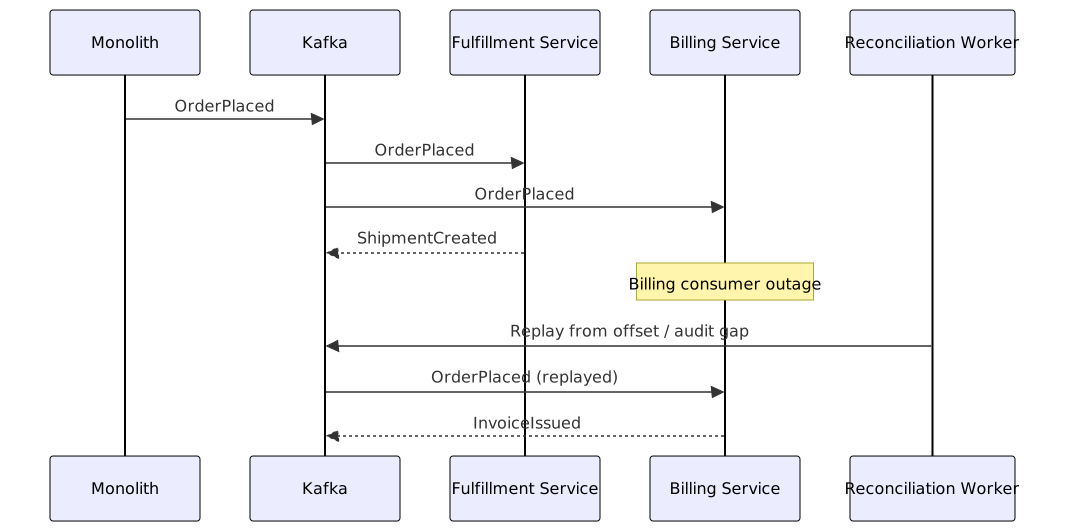
This pattern is not glamorous, but it is deeply practical. Enterprises live or die on their ability to detect and repair inconsistency before customers or auditors do.
Migration Strategy
The strangler fig metaphor survives because it is useful. You do not replace the monolith by declaration. You surround it with new behavior, reroute traffic gradually, and let old pathways go dormant.
A progressive migration usually follows these stages.
1. Identify bounded contexts and candidate seams
Run event storming, domain workshops, operational incident reviews, and release analytics. Look for semantic boundaries, high-change areas, scaling hot spots, and integration pain.
This is not just discovery. It is a way to separate business capabilities from implementation accidents.
2. Classify candidates by extraction style
Not every service should be extracted the same way. There are at least four migration styles:
- Facade extraction: route calls through an interface while behavior still lives mostly in the monolith
- Logic extraction: move domain decision logic first, leave some persistence behind temporarily
- Data extraction: move authoritative storage to the service once invariants are understood
- Event-carved extraction: use emitted domain events to build an autonomous downstream capability
These are stepping stones, not purity tests.
3. Introduce an anti-corruption layer
The new service should not be forced to inherit every oddity in the monolith’s internal model. Use a translation layer to map old concepts to the new bounded context language. This is one of the most valuable DDD patterns in migration.
Without it, the old model leaks everywhere and the new service becomes a smaller monolith module with HTTP.
4. Dual-run where the risk demands it
For critical capabilities, run the new service in shadow mode. It receives the same inputs, produces decisions, and compares outcomes with the monolith before taking production authority. This is especially powerful for pricing, fraud checks, eligibility, and routing decisions.
5. Shift authority, not just traffic
A service is not really extracted when it serves read-only copies while the monolith still makes decisions. The meaningful migration milestone is transfer of authority: this service is now the place where this decision lives.
6. Build reconciliation from day one
The first extraction should establish the pattern for mismatch detection, replay, dead-letter handling, idempotency, and operator workflows. If you skip this, every later service invents its own repair rituals.
7. Retire old paths aggressively
Nothing is as permanent as “temporary dual writes.” Once authority shifts, remove obsolete writes, hidden dependencies, and bypass integrations. Migration debt compounds fast.
Here is a simple migration flow:
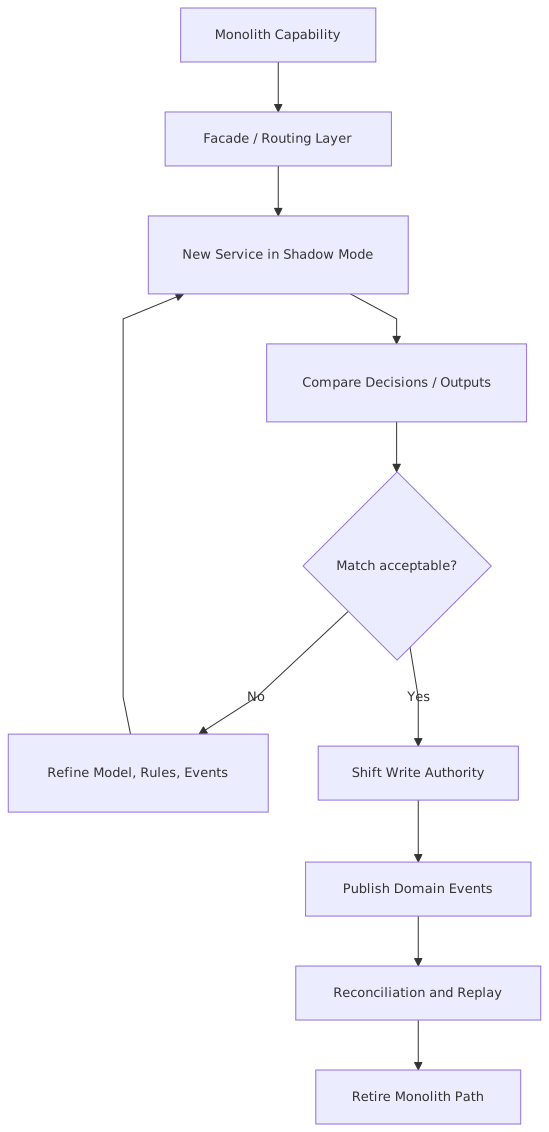
This progression matters because migrations fail when authority is ambiguous. During transition there must be one source of decision at each stage, even if there are many copies of data.
Enterprise Example
Consider a global manufacturer-distributor running a large order-to-cash platform. The monolith handled account management, quoting, pricing, order capture, inventory allocation, fulfillment, invoicing, and partner EDI integration. It supported multiple regions, each with special terms and tax logic. Releases were monthly, outages were expensive, and any change in pricing required regression testing half the estate.
Leadership wanted “microservices.” Fair enough. But the wrong first move would have been splitting by tables or by channel.
Instead, the team began with domain semantics.
Why Pricing was extracted first
Pricing had its own language: list price, customer contract, rebate, promotion, net price, regional override, effective date. It changed frequently. It had strong ownership from a commercial team. It was consulted by many channels but did not need to share every transaction boundary with downstream fulfillment and billing.
Most importantly, price calculation could be dual-run. The monolith and a new Pricing service could both compute prices for the same request and compare results safely before cutover.
That made Pricing an excellent first extraction.
The team built a Pricing service with its own data store for rules and contracts, introduced an anti-corruption layer to translate monolith product and customer references into pricing context concepts, and exposed a synchronous API for price determination. Kafka was used to publish price-rule-changed events and capture order-priced facts for downstream analytics, but not as a substitute for immediate price decisions.
What they did not extract early
They did not immediately extract invoicing. That was wise. Invoicing depended on legal entity rules, tax calculation, shipment events, credit status, returns, and accounting controls. The invariants were tighter, the failure tolerance lower, and the downstream audit burden much higher. Extracting it too early would have traded release pain for financial exposure.
The second extraction: Fulfillment orchestration
Fulfillment was selected next, not because it was simple, but because its operational profile differed sharply from the monolith. Warehouse integration spikes, carrier API flakiness, and asynchronous shipment updates were contaminating core order processing. Extracting fulfillment orchestration improved failure isolation.
Kafka became more valuable here. ShipmentCreated, AllocationFailed, DeliveryConfirmed, and ReturnReceived events fed downstream systems and read models. But the team also built reconciliation workers because warehouse systems missed callbacks and carriers occasionally sent duplicate notifications. That operational humility paid off.
Results
Within a year, pricing releases moved from monthly to several times a week. Fulfillment incidents no longer froze order capture. Support teams could replay missed shipment events and reconcile invoice holds. The monolith was still large, but now smaller in the places that mattered.
That is what successful migration looks like in enterprise life: not cinematic replacement, but increasing clarity of responsibility.
Operational Considerations
Distributed systems move complexity from code structure into runtime behavior. So extraction should always be paired with operational design.
Observability
Every service boundary is a potential blind spot. You need:
- correlation IDs across monolith and services
- structured events and logs with business keys
- distributed tracing for synchronous calls
- lag and consumer health metrics for Kafka
- business-level dashboards, not just CPU graphs
A good architecture lets operations answer “where is order 847291?” in minutes, not through a four-team email thread.
Idempotency
Replays, retries, and duplicates are normal. Consumers must handle repeated events safely. APIs handling externally retried requests need idempotency keys. If this is not designed upfront, reconciliation turns into data surgery.
Schema evolution
Events become contracts. Treat them with the same care as public APIs. Use schema compatibility rules, versioning discipline, and explicit deprecation. Nothing rots faster than a topic whose payload means different things to different consumers.
Security and governance
Extracted services change the access model. Fine-grained authorization, service identity, secret rotation, audit logging, and data classification become more important, not less. The monolith may have hidden some sins through centralization. Microservices expose them.
Platform consistency
A platform team should provide standard ways to do telemetry, deployment, policy enforcement, and event publishing. Not to impose fashion. To reduce accidental complexity. Teams should innovate in the domain, not in five competing ways to log JSON.
Tradeoffs
Microservices migration is a trade. Always.
You gain:
- team autonomy
- independent deployment
- localized scaling
- clearer ownership
- better fault isolation in the right places
You pay in:
- eventual consistency
- operational complexity
- more explicit integration design
- duplicate data projections
- governance overhead
- harder end-to-end debugging
A monolith centralizes complexity. Microservices distribute it. Distribution is not reduction.
The architectural choice is worthwhile when the enterprise benefits from independent evolution more than it suffers from consistency and coordination costs. That usually happens in large organizations with multiple teams, heterogeneous load profiles, and distinct domain capabilities. It does not happen merely because the codebase is old.
There is also a cultural tradeoff. Service ownership requires product thinking, operational accountability, and sharper domain understanding. If teams are not ready to own a capability end-to-end, extraction will just spread confusion across more repos.
Failure Modes
Patterns fail in predictable ways. We should say so plainly.
The distributed monolith
Services are split, but every request fans out synchronously across half the estate. One release still demands broad coordination. Nothing is really independent.
Boundary by database table
The service owns tables, not business decisions. Invariants leak. Logic duplicates. Reporting asks basic questions nobody can answer consistently.
Event soup
Kafka topics proliferate without clear domain meaning. Events become integration gossip. Consumers infer state from half-truths. Reprocessing is dangerous because semantics were never stable.
Permanent dual writes
The monolith writes to its DB and the new service DB “temporarily.” Months later, both are still authoritative depending on code path. This is one of the nastiest migration traps in enterprise systems.
No reconciliation strategy
Teams assume retries are enough. They are not. Missing, delayed, and malformed events accumulate until finance, customer service, or compliance discovers the mismatch first.
Team-topology mismatch
A service exists, but no stable team truly owns it. Shared ownership is often another phrase for deferred accountability.
When Not To Use
Not every system should be broken apart.
Do not pursue aggressive service extraction when:
- the domain is small and cohesive
- one team owns the whole system effectively
- release frequency is acceptable
- scaling characteristics are uniform
- cross-capability transactions are critical and hard to redesign
- operational maturity is weak
- the main problem is poor code structure, not deployment coupling
Sometimes a modular monolith is the better answer. That is not architectural cowardice. It is architectural honesty.
A well-structured modular monolith with bounded contexts, clear module interfaces, and disciplined ownership can deliver most of the design benefits people seek from microservices while avoiding much of the distributed systems tax. In fact, many failed microservices programs should have started there.
The right first move is often to refactor the monolith toward domain modules before extracting anything. If you cannot describe the boundaries in-process, you probably should not distribute them out-of-process.
Related Patterns
Several patterns complement service extraction heuristics.
Strangler Fig Pattern
Incrementally route behavior from old to new, preserving continuity.
Anti-Corruption Layer
Translate between monolith concepts and the new bounded context. Essential when legacy semantics are polluted or overloaded.
Event Sourcing and CQRS
Useful in selective domains with auditability and replay needs, but not a default migration prescription. Apply sparingly.
Saga / Process Manager
Helps coordinate long-running business processes across services where no single transaction exists. Valuable, but often overused by teams that split boundaries too early.
Outbox Pattern
Critical for reliable event publication when state changes and event emission must stay consistent without distributed transactions.
Modular Monolith
Often the best precursor to extraction, and sometimes the final destination.
Summary
Service extraction is not about shrinking a monolith one repo at a time. It is about discovering where business meaning, operational need, and ownership naturally belong.
The best extraction heuristics are grounded in domain-driven design. Look for stable language, distinct business decisions, different rates of change, meaningful failure isolation, and clear data authority. Migrate progressively with a strangler approach. Use Kafka where domain events and replay genuinely help. Design reconciliation as a first-class concern. Be ruthless about retiring temporary paths. And do not split invariants just because the org is impatient.
A good service boundary makes the business easier to understand. A bad one just makes it harder to debug.
That is the test I trust.
If the migration leaves the enterprise with clearer semantics, sharper accountability, safer change, and recoverable inconsistency, it is probably working. If it leaves you with more network hops and less certainty, you have not modernized. You have merely redistributed the mess.
Frequently Asked Questions
What is a service mesh?
A service mesh is an infrastructure layer managing service-to-service communication. It provides mutual TLS, load balancing, circuit breaking, retries, and observability without each service implementing these capabilities. Istio and Linkerd are common implementations.
How do you document microservices architecture for governance?
Use ArchiMate Application Cooperation diagrams for the service landscape, UML Component diagrams for internal structure, UML Sequence diagrams for key flows, and UML Deployment diagrams for Kubernetes topology. All views can coexist in Sparx EA with full traceability.
What is the difference between choreography and orchestration in microservices?
Choreography has services react to events independently — no central coordinator. Orchestration uses a central workflow engine that calls services in sequence. Choreography scales better but is harder to debug; orchestration is easier to reason about but creates a central coupling point.