⏱ 20 min read
Microservices are supposed to buy us independence. That is the sales pitch: smaller services, autonomous teams, faster change, safer deployments. Then reality arrives wearing a pager.
A team wants to release a pricing change, but they cannot because catalog must go first. Catalog cannot go first because inventory needs a schema update. Inventory cannot move because fulfillment still expects the old event contract. Fulfillment is waiting on identity because a new claims model affects authorization. By Thursday afternoon, what we have is not a fleet of independent services. We have a conga line.
This is the dirty secret of many microservice estates: they are distributed systems organizationally, but monoliths operationally. The coupling did not disappear. It merely spread itself across pipelines, event contracts, shared data expectations, and deployment approvals. A deployment dependency chain is architecture telling you the truth. microservices architecture diagrams
And truth matters. Because if you do not understand the chain, you will automate the wrong thing, blame the wrong team, and create fragile release practices wrapped in modern tooling. Kubernetes will not save you from a bad domain cut. Kafka will not save you from version chaos. CI/CD will simply make the chain fail faster. event-driven architecture patterns
So let us talk plainly. Deployment dependency chains are not merely a DevOps nuisance. They are a design smell. Sometimes they are justified. Often they are evidence that service boundaries are wrong, contracts are too brittle, domain semantics are leaking, or migration is being attempted as a big-bang rewrite in disguise.
This article looks at deployment dependency chains through the lens of enterprise architecture and domain-driven design. We will examine why they emerge, how to model them, what tradeoffs they imply, how to migrate away from them progressively, and when trying to eliminate them is actually a mistake.
Context
In a healthy microservice architecture, a service should be deployable with a high degree of autonomy. Not total autonomy—that is fantasy—but enough that most changes can be made and released without coordinating a parade of downstream and upstream teams.
Yet enterprises rarely begin healthy. They begin with a large system, years of accumulated business rules, a mix of synchronous integration and batch interfaces, duplicated reference data, and a very human set of teams optimized around reporting lines rather than bounded contexts.
Then comes the microservices program.
The first services are usually carved around obvious technical seams: customer, order, payment, product. These names sound domain-driven, but often they are nouns stolen from data models, not boundaries discovered from business capability. That distinction matters. If “Customer Service” owns every customer attribute used by every line of business, it is not a bounded context. It is a distributed shared table with an API in front of it.
Dependency chains emerge in exactly that kind of landscape. A service cannot deploy independently because its meaning is not independent. It is coupled to another service’s interpretation of state, timing, contracts, and invariants.
There are a few places where these chains become visible:
- release trains where several services must deploy in sequence
- API version upgrades that need synchronized cutovers
- event contract changes where producers and consumers evolve together
- database decomposition projects where old and new models coexist
- security model changes that touch every edge and internal policy check
- cross-domain workflows that still rely on synchronous orchestration
If you have ever seen a release checklist that reads like a military invasion plan, you have seen a deployment dependency chain.
Problem
The obvious problem is slower delivery. But that is only the first-order effect.
The deeper problem is that dependency chains make change risky in ways that are hard to reason about. They increase lead time, batch size, coordination overhead, rollback complexity, and incident blast radius. They turn ordinary releases into distributed negotiations.
Consider what happens when service A depends on B deploying first because A sends a new field. B depends on C because C validates that field. C depends on D because D republishes a transformed event to older consumers. This is not just sequencing. It is semantic lockstep. If any one team slips, everybody waits. If one deploy partially succeeds, the estate enters a mixed-version world that nobody fully modeled.
That mixed-version world is where most real failures live.
The anti-pattern is not simply “service dependencies exist.” Dependencies are normal. The anti-pattern is when deployment order becomes the hidden mechanism that preserves system correctness. Once correctness depends on release choreography, the architecture is brittle.
A good test is this: if teams ask “what order must we deploy these services in so the business process still works?” more often than they ask “how do we make this change backward-compatible?”, then the system has learned the wrong lesson.
Forces
Architects love purity. Enterprises pay for compromise. Dependency chains exist because several forces pull in opposite directions.
Domain consistency versus service autonomy
In domain-driven design, we split systems into bounded contexts so each context can own its language, rules, and model. But the business still needs end-to-end outcomes. An order must be accepted, paid for, allocated, shipped, invoiced, and recognized. Those steps cross contexts.
The temptation is to preserve a single transactional worldview across services. That leads to synchronous calls, shared schemas, and release coupling. The alternative is eventual consistency and reconciliation, which buys autonomy but demands more discipline.
Speed of delivery versus safety of change
Backward compatibility, parallel run, versioned contracts, and tolerant readers all make change safer. They also take time and create temporary complexity. Under deadline pressure, teams often choose the “just deploy these five services together” shortcut. It works today. It creates a release train tomorrow.
Local optimization versus estate-wide operability
One team can simplify its service by assuming all consumers move in lockstep. The estate then pays the price in coordination. Deployment dependency chains are often the result of local simplifications that externalize risk.
Data ownership versus reporting and reference needs
Shared understanding of core business entities—customer, product, account, policy, claim—creates pressure toward central models. But central models are often where semantic coupling begins. When every service depends on a canonical representation evolving in place, deployment chains follow naturally.
Migration urgency versus migration quality
Large enterprises do not refactor greenfield systems. They migrate old systems while the business keeps trading. This creates coexistence periods where legacy and target architectures overlap. Chains are often worst during migration, especially if strangler patterns are not paired with clear semantic ownership and reconciliation mechanisms.
Solution
The practical solution is not “remove all dependencies.” That is childish architecture. The real solution is to shift coupling away from deployment-time sequencing and into explicit, versioned, observable contracts.
That means a few opinionated principles.
First, use bounded contexts, not entity nouns, to define services. Service boundaries should reflect domain semantics and rates of change. If two teams must deploy together repeatedly, either the contract is wrong or the boundary is.
Second, design contracts for mixed-version operation. Assume producers and consumers will not upgrade together. Build for coexistence. Old and new contracts should overlap long enough to make deployment order irrelevant in the common case.
Third, prefer additive change. Add fields before requiring them. Publish both old and new events during migration. Read old and new formats. Delay removal until consumers are proven off the old path.
Fourth, separate command-side invariants from read-side convenience. Much deployment coupling comes from trying to keep every downstream read model perfectly synchronized with every upstream write model. That is a fool’s errand in a distributed system. Use events, materialized views, and reconciliation instead.
Fifth, treat reconciliation as a first-class architectural mechanism, not an embarrassing cleanup job. If eventual consistency matters, then drift will happen. You need replay, repair, idempotency, auditability, and compensating flows. The grown-up architecture is the one that plans for mismatch.
Sixth, use Kafka or similar event streaming judiciously. Kafka can reduce temporal coupling, but it does not remove semantic coupling. It is brilliant for durable event distribution, replay, and decoupled consumers. It is terrible when teams use it as a universal pipe for poorly governed schema changes.
Here is the essence: the system should tolerate partial rollout, delayed consumers, retried messages, duplicated events, and staggered migration stages. If it cannot, the deployment chain has simply been hidden under automation.
Architecture
A useful way to reason about deployment dependency chains is to model three kinds of coupling:
- Runtime coupling: one service must call another to complete work.
- Data coupling: one service depends on another’s schema or state shape.
- Deployment coupling: one service’s release depends on another’s release sequence.
The architecture goal is not to eliminate runtime or data interaction. It is to stop those interactions from hardening into deployment coupling.
A typical dependency chain
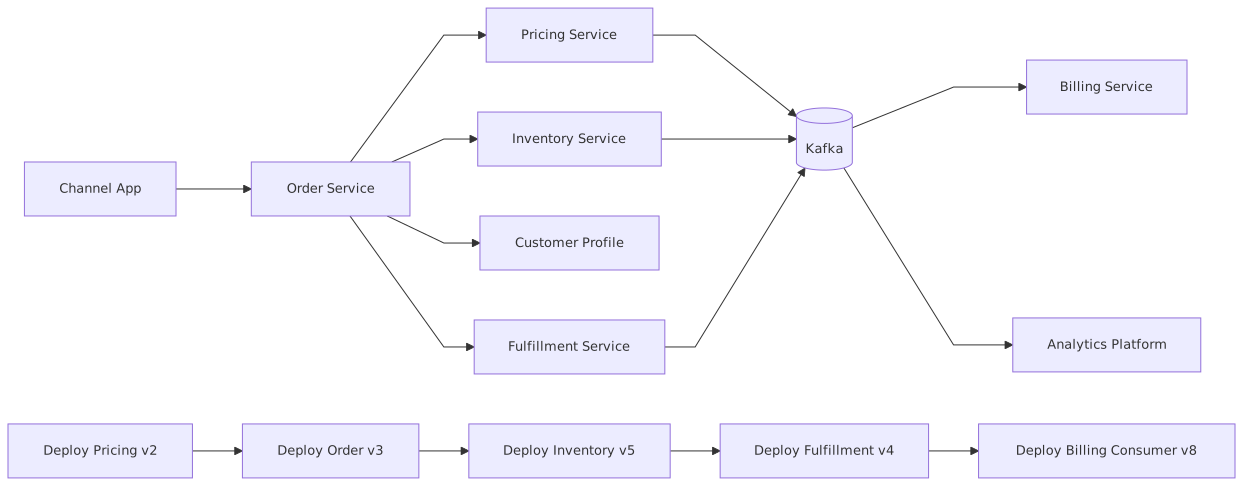
This diagram shows the common trap. Runtime interactions are one thing. But the release path underneath has become sequential. Pricing changes require Order to understand a new quote structure; Inventory needs new reservation semantics; Fulfillment republishes shipment events that Billing consumes. The line of business sees a “simple order enhancement.” Operations sees a five-team deployment chain.
The architectural move
The move is to design for compatibility windows.
- Pricing emits both
PriceCalculatedV1andPriceCalculatedV2during transition. - Order can read either event version and maps them to its own domain model.
- Inventory uses additive semantics: new reservation fields are optional until adoption is complete.
- Fulfillment publishes stable business events, not raw internal state.
- Billing adopts a tolerant consumer and treats missing fields sensibly.
Now the chain becomes a graph with looser timing, not a single sequence.
Domain semantics matter more than protocols
A lot of articles on microservices obsess over REST versus gRPC versus Kafka. Useful, but secondary. The real issue is domain meaning.
If OrderPlaced means “customer submitted cart” to one service and “commercially accepted order with credit approved” to another, deployment independence is impossible. You do not have a technical dependency problem. You have a language problem.
Domain-driven design gives us the right lens. Events and APIs must be published in the language of the bounded context, with clear semantics and state transitions. Anti-corruption layers should translate between contexts rather than pretending there is one universal model.
That translation is not overhead. It is insulation.
Contract evolution pattern
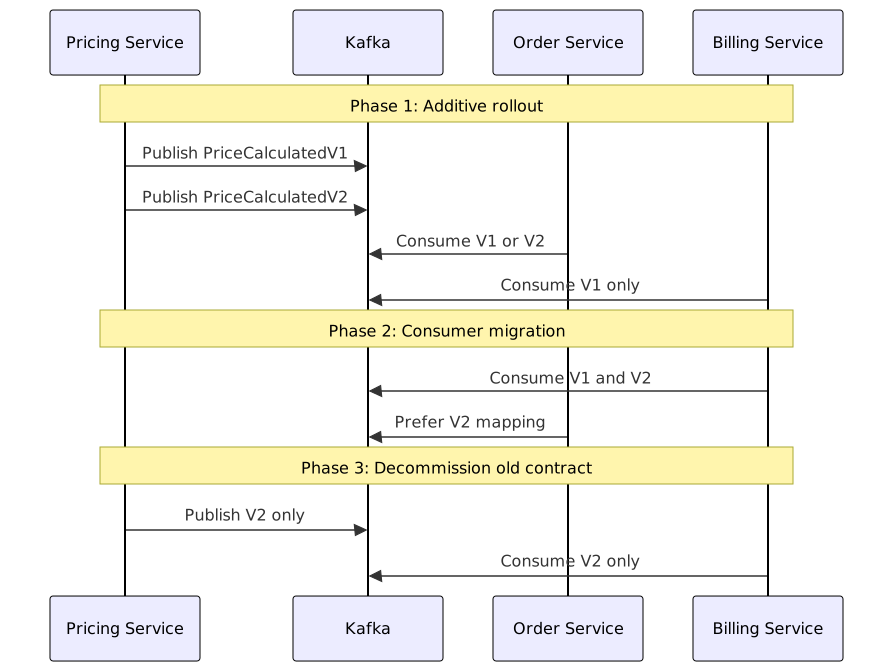
This is what “deployment decoupling” looks like in practice. Not magic. Not purity. Just a compatibility strategy with explicit phases.
Reconciliation is part of the architecture
In enterprises, asynchronous flows eventually drift. Events are delayed. Consumers fail. Dead-letter queues fill. Reference data gets out of sync. The answer is not to pretend this will not happen.
A sound architecture includes:
- replayable event logs
- idempotent consumers
- business keys for deduplication
- reconciliation jobs comparing source-of-truth and derived views
- compensating actions for irrecoverable mismatch
- observability on lag, drop, and repair rates
The architecture is not complete until it explains how the system returns to correctness after ordinary failure.
Migration Strategy
This is where many teams lose their nerve. They know the target architecture should reduce deployment dependency chains, but the existing landscape is packed with shared databases, tightly coupled APIs, and brittle release processes. So they attempt a heroic rewrite. Heroic rewrites are usually just a polite way to schedule failure later.
Use a progressive strangler migration instead.
The migration strategy should move from shared implementation and coordinated release to independent capability and compatibility-based release. Incrementally.
Step 1: Map the chain
Do not start with service inventory. Start with change inventory.
Ask:
- Which business changes required multi-team deployment last quarter?
- Which releases needed ordered sequencing?
- Which contract changes triggered rollback risk?
- Which services break when another team is late?
This gives you the actual dependency chain, not the org chart fantasy.
Step 2: Identify bounded context errors
Repeated deployment coupling often reveals a bad boundary. If Order and Fulfillment must evolve together every sprint, perhaps allocation logic is split across contexts incorrectly. If Customer Profile changes cascade into every service, the “customer” model is too broad and semantically overloaded.
Refactor boundaries where the language says they are wrong, not where the code layout looks ugly.
Step 3: Introduce anti-corruption layers
When strangling a legacy system, do not let every new service consume legacy semantics directly. That simply spreads the disease.
Put an anti-corruption layer between legacy and target contexts. Translate old concepts into the new bounded context language. This isolates change and reduces the chance that a legacy schema alteration creates a fresh deployment chain in the new estate.
Step 4: Move integration to events where timing can relax
Not every interaction should be asynchronous. Commands that require immediate user feedback may still need synchronous APIs. But many cross-context notifications do not.
Use Kafka for domain events where consumers can process independently. Keep event schemas owned and versioned by the publishing context. Use schema compatibility rules. Avoid “shared topic as shared database” behavior.
Step 5: Build reconciliation before cutover
This is the part teams skip because they are eager to switch traffic. Bad idea.
Before routing meaningful volume to the new path, build reconciliation reports and repair workflows:
- compare old and new order states
- verify counts, amounts, statuses, and timestamps
- track divergence by business key
- enable replay from Kafka or source logs
- establish manual and automated correction procedures
Reconciliation is how strangler migrations earn trust.
Step 6: Cut over by capability, not by system
Migrate one domain capability at a time: price calculation, stock reservation, shipment notification, invoice generation. Do not migrate “the order platform” in one movement. Enterprise systems do not move as a herd. They move as a procession.
Step 7: Remove coordinated release assumptions
Once compatibility windows exist and reconciliation is working, retire release runbooks that assume sequence. This is important culturally. If the organization keeps planning coordinated cutovers after the architecture no longer requires them, the old behavior persists.
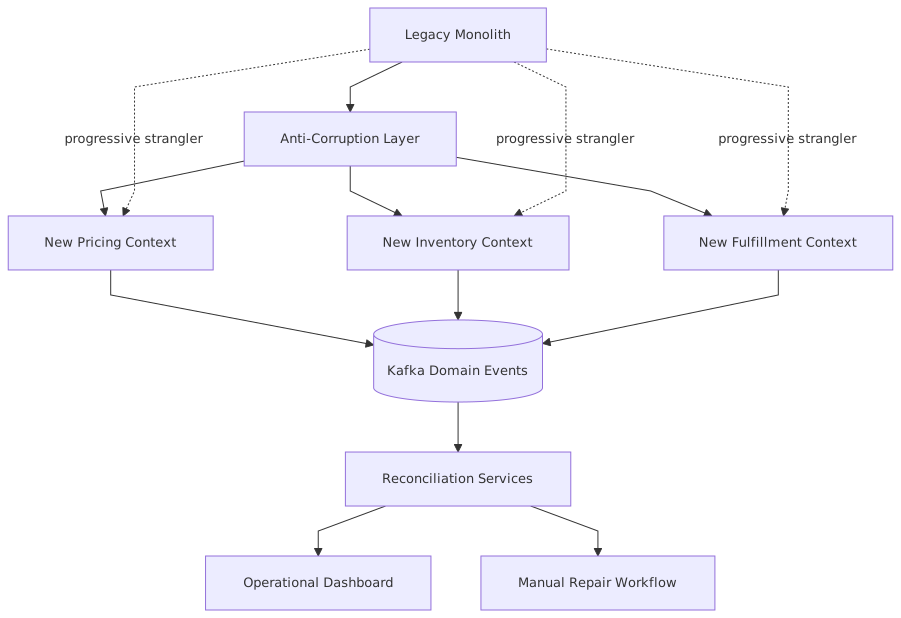
That is the migration picture you want: progressive extraction, translated semantics, event-driven propagation where suitable, and reconciliation wrapped around the whole thing.
Enterprise Example
Consider a global retailer modernizing its order-to-fulfillment estate. The legacy platform was a large commerce suite with direct database integrations into warehouse, finance, customer care, and analytics systems. The modernization program introduced microservices for pricing, order capture, inventory reservation, fulfillment orchestration, and billing.
At first glance, this looked sensible. In practice, every release became a chain.
A promotion change in Pricing altered discount breakdown semantics. Order Capture had to understand the new structure. Inventory needed promotion-funded reservation logic for bundled stock. Billing needed tax treatment updates. Analytics expected the old event shape. Deployments required six teams over a weekend. Rollback was nearly impossible because some events had already propagated.
The root cause was not “too many services.” It was poor domain semantics and no compatibility strategy.
Pricing published internal calculation detail as if it were enterprise truth. Order Capture leaked commercial acceptance rules into downstream events. Inventory depended on a payload structure instead of a stable reservation intent. Billing consumed operational events that should never have been part of its domain language.
The retailer corrected this in stages.
First, they reframed their bounded contexts. Pricing owned quote composition. Order Capture owned order acceptance. Inventory owned reservation commitments. Fulfillment owned shipment execution. Billing owned invoice and charge semantics. Those sound similar to the original service names, but the important change was semantic ownership.
Second, they redesigned events:
QuoteCalculatedOrderAcceptedInventoryReservedShipmentDispatchedInvoiceIssued
These were business events, not technical snapshots.
Third, they introduced Kafka with schema governance and compatibility checks. Producers could make additive changes without forcing synchronized consumer deployment. Consumers used tolerant readers and anti-corruption mappings. EA governance checklist
Fourth, they built reconciliation services comparing accepted orders, reserved units, dispatched shipments, and issued invoices. Every mismatch had a business key and a repair path.
Fifth, they strangled legacy integrations one capability at a time. Finance reporting stayed on the old path longer than warehouse allocation because the semantics were more tangled. That was the right call. Migration should follow domain readiness, not executive impatience.
The result was not perfect independence. Payment and fraud still had some coordinated release needs due to regulatory and risk controls. But the routine order-flow change no longer required a weekend deployment train. Lead time dropped. Rollbacks became smaller. Incident diagnosis improved because semantic boundaries were clearer.
This is what enterprise architecture looks like when it earns its keep: not by drawing boxes, but by reducing the number of people who must hold their breath at release time.
Operational Considerations
Deployment dependency chains are partly a design issue and partly an operations issue. Once the architecture allows independent evolution, operations must support it.
Version observability
You need to know which producer and consumer versions are running, which event versions are being published, and which consumers are still on old contracts. Without that visibility, compatibility windows become folklore.
Consumer lag and backpressure
Kafka helps decouple in time, but lag is not free. A delayed consumer can become a hidden deployment dependency if downstream business processes assume immediate propagation. Track lag against business tolerance, not just infrastructure thresholds.
Release policy
A mature estate has explicit rules:
- additive changes are preferred
- breaking changes require version transition plans
- old versions are removed only after usage evidence
- feature flags manage behavior rollout, not contract chaos
- rollback plans include event replay and data repair steps
Data lineage and auditability
When contracts evolve and reconciliation matters, you must be able to trace business records across contexts. Correlation IDs are helpful. Business keys are essential.
Testing strategy
Contract testing matters. So does mixed-version testing. Most organizations test “new producer with new consumer” and call it done. That is the least interesting case. The important cases are:
- new producer with old consumer
- old producer with new consumer
- delayed consumer catching up after schema changes
- duplicate and reordered event scenarios
Governance without central paralysis
Schema governance is necessary. Bureaucratic approval boards are not. Define compatibility rules, ownership, review automation, and deprecation standards. Keep the policy light but firm.
Tradeoffs
There is no free lunch here. Reducing deployment dependency chains creates other costs.
Backward compatibility windows mean carrying old and new contracts simultaneously. That adds code and operational complexity.
Asynchronous integration reduces release coupling but increases consistency lag and demands reconciliation. Some business stakeholders will dislike that. They are not wrong.
Anti-corruption layers preserve domain boundaries but can feel like “extra translation code” to delivery teams under pressure. Again, they are not wrong. It is extra code. It is also cheaper than semantic contagion.
Kafka can simplify temporal decoupling and replay, but it introduces platform dependency, event governance needs, and debugging complexity across distributed flows. ArchiMate for governance
Refactoring service boundaries may improve autonomy but can create short-term disruption, ownership changes, and rewritten integration paths.
In other words, deployment independence is not free. It is purchased with better contracts, more explicit semantics, and more operational discipline.
That is a price worth paying when change rate is high and team autonomy matters. It is not always worth paying.
Failure Modes
There are some classic ways this goes wrong.
Fake event-driven architecture
Teams move from REST to Kafka but continue publishing database-shaped payloads and expecting synchronized consumer upgrades. The transport changed. The coupling did not.
Version sprawl
Every breaking change becomes a new topic, new endpoint, or long-lived parallel contract with no retirement discipline. Soon nobody knows what is current. Compatibility windows become permanent debt.
Over-normalized domains
Architects split services too finely around nouns and create constant cross-service chatter. The result is microservices with monolith-level coordination cost.
Missing reconciliation
The system relies on eventual consistency but has no practical way to detect or repair divergence. Problems accumulate silently until finance or customers notice.
Hidden shared state
Teams claim service autonomy while reading each other’s databases, sharing caches, or depending on “temporary” common tables. Deployment chains reappear because the real coupling was never removed.
Big-bang migration dressed as strangler
A migration plan claims to be incremental but requires all consumers to switch by one deadline. That is not strangling. That is synchronized replacement with better branding.
When Not To Use
Do not wage war on every deployment dependency chain. Some systems should remain coordinated.
If you have a small system with one team and low change frequency, a modular monolith is often better. It gives you transactional simplicity and avoids distributed coordination theater.
If a process has strong consistency and regulatory requirements that demand tightly controlled release sequencing—certain financial posting flows, safety-critical industrial control, some identity and authorization paths—then coordinated deployment may be justified. The right move is to minimize and isolate that coupling, not to pretend it can disappear.
If your domain boundaries are not understood yet, introducing many microservices will create chains faster than it creates value. Learn the domain first. Split later.
And if your organization lacks the operational maturity for schema governance, observability, reconciliation, and event platform support, then aggressive decoupling strategies may simply exchange one kind of fragility for another.
Architecture should fit the organization that must run it on a bad Tuesday.
Related Patterns
Several patterns sit close to deployment dependency chains:
- Bounded Context: the foundation for defining semantic ownership
- Anti-Corruption Layer: protects new models from legacy meaning
- Strangler Fig Pattern: progressive replacement without big-bang cutover
- Saga: coordinates long-running business processes across contexts
- Transactional Outbox: reliable event publication from service state changes
- Consumer-Driven Contracts: validates integration expectations without synchronized deployment
- Tolerant Reader: allows consumers to survive additive contract changes
- Materialized View: supports read optimization without shared databases
- Reconciliation Process: repairs inevitable drift in eventually consistent systems
These patterns are not a menu to order blindly from. They work when they support clear domain semantics and staged migration.
Summary
Deployment dependency chains are one of the clearest signals that a microservice architecture is not as independent as it looks. They are operational symptoms of deeper design truths: weak bounded contexts, brittle contracts, shared semantics masquerading as APIs, and migrations that have not accepted coexistence.
The fix is not reckless decoupling. It is disciplined decoupling.
Use domain-driven design to get the boundaries right. Design contracts that survive mixed-version reality. Prefer additive evolution. Use Kafka where temporal decoupling and replay genuinely help. Build reconciliation because distributed systems drift. Migrate progressively with strangler patterns and anti-corruption layers. And be honest about tradeoffs, because eventual consistency and compatibility windows are not free.
Most of all, do not let deployment order become the mechanism that keeps your business coherent. That is architecture by choreography, and choreography breaks when someone misses a step.
A good enterprise architecture does something quieter and far more valuable. It lets teams change their part of the system without asking the rest of the estate to stop breathing.
Frequently Asked Questions
What is a service mesh?
A service mesh is an infrastructure layer managing service-to-service communication. It provides mutual TLS, load balancing, circuit breaking, retries, and observability without each service implementing these capabilities. Istio and Linkerd are common implementations.
How do you document microservices architecture for governance?
Use ArchiMate Application Cooperation diagrams for the service landscape, UML Component diagrams for internal structure, UML Sequence diagrams for key flows, and UML Deployment diagrams for Kubernetes topology. All views can coexist in Sparx EA with full traceability.
What is the difference between choreography and orchestration in microservices?
Choreography has services react to events independently — no central coordinator. Orchestration uses a central workflow engine that calls services in sequence. Choreography scales better but is harder to debug; orchestration is easier to reason about but creates a central coupling point.