⏱ 21 min read
Most distributed systems don’t fail because the code is bad. They fail because the architecture lies.
It says “these services are independent,” while every team knows that one leaked credential can still walk half the estate. It says “zero trust,” while a flat internal network quietly behaves like a medieval city with no walls, no gates, and one drunk guard by the river. It says “microservices,” but what it often delivers is a sprawling set of HTTP endpoints with shared assumptions, shared secrets, and shared blast radius. microservices architecture diagrams
Security boundaries are where architecture stops being a drawing and starts becoming a survival mechanism.
That is the heart of the matter. In a monolith, we mostly worried about code-level modularity and perimeter defense. In microservices, security becomes a first-class design concern because the boundaries are no longer just logical—they are networked, operational, organizational, and deeply tied to the domain itself. If we get those boundaries wrong, the system remains coupled in the worst possible way: not by compile-time dependencies, but by trust.
A trust boundary is not just a firewall rule. It is a declaration of what one part of the enterprise is allowed to know, invoke, mutate, and impersonate. A trust zone is where those declarations become concrete. And once you start treating trust zones as part of the domain architecture rather than security afterthoughts, a lot of otherwise messy decisions begin to make sense.
This article takes a practical, enterprise view of security boundaries in microservices architecture: what they are, why they matter, how they relate to domain-driven design, how to migrate toward them using a progressive strangler pattern, how Kafka and asynchronous integration affect the design, what fails in practice, and when this approach is simply too much machinery for the job. event-driven architecture patterns
Context
Microservices changed the shape of enterprise systems. We decomposed applications into smaller deployable units to improve team autonomy, release speed, scalability, and resilience. That part is familiar. But decomposition didn’t just create more services. It created more interactions. More APIs. More credentials. More message flows. More places where one team’s assumptions become another team’s vulnerabilities.
In a large enterprise, the network is rarely a neat set of stateless services talking over cleanly governed interfaces. It is a long accumulation of history: legacy identity systems, integration buses, partner gateways, regional data centers, cloud workloads, vendor-managed platforms, old firewall rules nobody wants to touch, and “temporary” privileged service accounts that have been around since the previous CIO.
That environment is exactly where security boundaries matter.
The key insight is this: service boundaries and security boundaries are related, but they are not the same thing.
A microservice may be a unit of deployment. A bounded context may be a unit of language and model. A trust zone is a unit of security posture. Sometimes those line up nicely. Often they do not.
For example, a Payments domain may contain multiple services—authorization, settlement, chargeback handling, fraud signals—but those services should usually sit inside a tighter trust zone than customer preference services or catalog search. Not because payment logic is “special” in a generic sense, but because the domain semantics, data sensitivity, compliance obligations, and failure consequences are different.
This is where domain-driven design earns its keep. Not as a modeling ceremony, but as a way to reason about security in business terms. If the domain says two concepts are separated by different business responsibilities, different data classifications, different actors, and different policies, then the architecture should not casually let them share trust.
That is the beginning of grown-up microservices security.
Problem
The classic anti-pattern is simple: organizations split a monolith into dozens or hundreds of services, then place them on the same broadly trusted internal network, often with weak service identity and coarse-grained access control.
Externally, they are paranoid. Internally, they are optimistic.
This creates several structural problems:
- East-west traffic becomes overtrusted.
- Service-to-service authorization is weak or absent.
- Secrets spread across environments and teams.
- Privileged internal APIs become accidental attack paths.
- Sensitive domains like payments, identity, employee records, and pricing engines inherit the same network posture as low-risk workloads.
- Event streams become side doors into critical data.
- Compromising one service can provide lateral movement into many others.
The architecture looks distributed, but the trust model remains monolithic.
There is another problem, more subtle and more common in enterprises: security boundaries are drawn by infrastructure convenience rather than domain semantics. Teams end up with zones based on VPCs, subnets, cluster layout, or platform ownership instead of bounded contexts, data sensitivity, and operational risk. The result is a mismatch. Security controls are present, but they are protecting the wrong seams.
A service that should only expose coarse business capabilities ends up exposing low-level internals to “trusted” neighbors. A customer-facing orchestration layer can directly call a settlement component because the route exists. Kafka consumers subscribe to broad topics because filtering is hard. Audit obligations become fuzzy because too many things can legitimately touch sensitive state.
That is the real problem: poor trust boundaries turn architecture into a negotiation with accident.
Forces
Good architecture emerges from forces in tension. Security boundaries in microservices are no exception.
Team autonomy vs centralized control
Microservices promise independent teams. Security teams often respond with centralized policies. Both are reasonable, and both can sabotage each other. If every service requires manual review for every trust change, teams route around the process. If every team chooses its own auth model, the estate becomes incoherent.
The answer is not choosing one side. It is creating standardized boundary mechanisms—identity, policy enforcement, secrets management, transport security, event authorization—so teams can move independently inside a controlled system.
Domain autonomy vs end-to-end workflows
Business processes cut across domains. An order touches customer, pricing, inventory, payment, fulfillment, and notifications. But just because a workflow spans domains does not mean those domains should be mutually trusted. End-to-end flow must be designed through contracts, claims propagation, policy checks, and asynchronous handoffs—not blanket network access.
Low latency vs stronger isolation
The tighter the security boundary, the more mediation you introduce: gateways, token exchange, policy checks, broker controls, schema validation, and auditing. These add latency and complexity. For high-volume transactional paths, especially in financial services or retail checkouts, this matters.
So boundaries must be deliberate. If every call traverses five policy layers, the business will eventually bypass them.
Consistency vs containment
Strong trust separation often pushes systems toward asynchronous communication, minimized direct data access, and duplicated read models. That improves containment but introduces eventual consistency and reconciliation concerns. You gain blast-radius reduction at the cost of temporal neatness.
Compliance vs usability
Regulated domains need tighter controls, stronger auditability, and better segregation. But if a policy model is too cumbersome, people create privileged break-glass accounts, static credentials, or broad topic subscriptions just to keep the business running.
A control that cannot be operated is not a control. It is paperwork.
Solution
The practical solution is to design explicit trust zones aligned to domain risk and interaction patterns, and to enforce those zones through strong service identity, fine-grained authorization, controlled ingress and egress, event governance, and data ownership.
This is not about drawing more boxes. It is about changing the rules of movement.
A good trust-zone architecture usually has these characteristics:
- Domain-aligned segmentation
Sensitive bounded contexts are isolated according to business semantics and data classification, not merely infrastructure topology.
- Strong workload identity
Every service has a verifiable identity. No shared service accounts where avoidable. Mutual TLS, workload identity federation, or service mesh identities can help, but only if tied to policy.
- Service-to-service authorization
Authentication is table stakes. Authorization is the game. “Who are you?” is less useful than “What are you allowed to do to this domain capability under what conditions?”
- Minimal cross-zone synchronous calls
Cross-zone interactions are coarse-grained, intentional, and often mediated by APIs or event contracts. Internal implementation endpoints stay internal.
- Event boundary controls
Kafka topics, schemas, ACLs, consumer groups, and data classification become part of the trust architecture. Event streams are not exempt from security design.
- Data ownership and no casual database sharing
Shared databases collapse trust boundaries faster than any other convenience. If two zones write the same data store, the boundary is theater.
- Observability with security semantics
Logs, traces, and audit records must show identity, decision, data classification, and policy outcome—not just response times.
A reference trust-zone shape
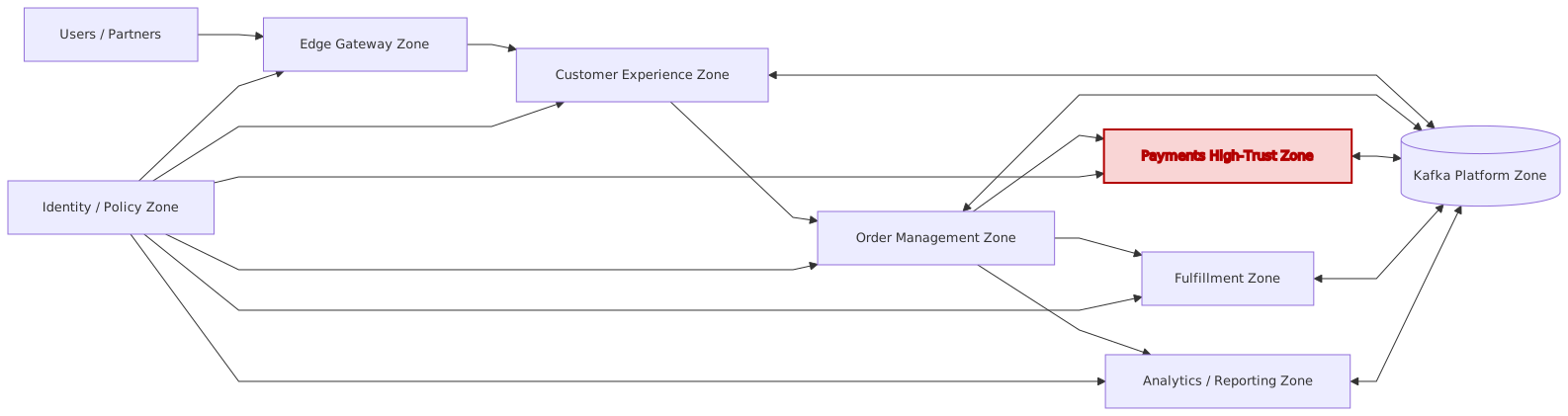
The shape matters less than the intent: not everything trusts everything else, and high-risk domains are treated as different species.
Architecture
Let’s make this concrete.
1. Start with bounded contexts, not subnets
Security boundaries should begin with domain-driven design. Identify bounded contexts, their ubiquitous language, their actors, and the sensitivity of the capabilities and data they own.
Typical examples:
- Customer Profile: personal data, consent, preferences
- Identity and Access: credentials, MFA state, session policies
- Payments: tokenized instruments, authorization, settlement
- Order Management: order lifecycle and business state
- Pricing: rules, contracts, promotions, often commercially sensitive
- Fulfillment: logistics and warehouse operations
- Analytics: derived data, broad internal readership, often lower trust
Not every bounded context deserves its own trust zone. That would be bureaucracy in diagram form. But bounded contexts tell you where to ask the right questions:
- Does this context own highly sensitive data?
- Does it have elevated business impact if abused?
- Does it require stronger operational separation?
- Is access tightly constrained by regulation or policy?
- Is there a strong reason for direct invocation from many peers?
Where the answer is yes, create stronger trust separation.
2. Distinguish interaction types
Not all communication is equal. A trust-aware microservices architecture separates:
- North-south traffic: external users and partners into the platform
- East-west synchronous calls: service APIs
- Asynchronous event flows: Kafka topics, streams, queues
- Operational access: admin tools, batch jobs, support tooling
- Data plane access: databases, caches, object storage
Most systems secure the first and hand-wave the rest. Mature systems do the opposite too: they become brilliant at east-west mTLS and forget that support tooling can mutate production state. You need all five.
3. Use identity as the primitive
Every service instance, job, and broker client should have a strong identity. This is the bedrock of trust zones. Without it, policy collapses into IP addresses, network locations, and static secrets—the oldest bad habits in enterprise computing.
A useful rule: if you cannot answer which workload called this capability, on whose behalf, with which claims, and under which policy, you do not have a meaningful security boundary.
4. Authorize business capabilities, not just endpoints
This is where domain semantics matter. Endpoint-level authorization is often too technical. Business capability authorization is more durable.
For instance:
PaymentService:AuthorizeChargePaymentService:CaptureAuthorizedFundsCustomerProfileService:ReadMarketingPreferencesOrderService:CreateOrderFromCheckedOutBasket
These should have different consumers, different claims requirements, different audit rules, and potentially different trust-zone crossing paths.
This avoids the common mistake where a service exposes ten low-level APIs and every neighboring service is allowed to call all of them because “they are internal.”
Internal is not a security model. It is nostalgia.
5. Treat Kafka as a boundary, not just plumbing
Kafka often sneaks past architecture review because it feels infrastructural. It is not. In many enterprises, Kafka is the real integration backbone, and therefore one of the biggest trust surfaces in the estate.
You need to design:
- topic ownership by bounded context
- producer authorization
- consumer authorization
- schema governance
- field-level data sensitivity rules
- replay access controls
- retention policies
- dead-letter handling
- auditability of subscriptions and reads
A topic is an API with better marketing. Treat it accordingly.

Notice the hidden design issue here: a high-trust zone like Payments may consume order events, but that does not mean Order can consume all payment events in return. Event relationships are directional and semantically constrained.
6. Design for reconciliation
The moment you enforce stronger boundaries, you reduce direct coupling and usually increase asynchronous integration. That means eventual consistency becomes normal, not exceptional.
This is not merely a technical inconvenience. It changes operational thinking.
You need explicit reconciliation processes for:
- mismatched order and payment state
- duplicate events
- delayed processing
- partial failures across zones
- broker outages or consumer lag
- compensating actions
- ledger vs operational state divergence
A lot of “security architecture” fails because it ignores these workflow realities. Teams then punch direct access holes across trust zones “just for support,” and the architecture rots.
Reconciliation is what lets you preserve boundaries without sacrificing business continuity.
Migration Strategy
No enterprise starts greenfield. They start with a monolith, a service mesh of convenience, or a hybrid estate where trust boundaries are implied rather than enforced. That means migration matters as much as target architecture.
The most sensible path is a progressive strangler migration, applied not just to functionality but to trust.
Phase 1: Observe before isolating
Map current service interactions, data flows, identities, topic subscriptions, and privileged paths. In most enterprises, this uncovers surprises:
- services using shared DB credentials
- broad Kafka consumer groups reading sensitive events
- back-office tools bypassing APIs
- lateral movement paths through low-risk services
- internal APIs carrying end-user claims with no validation
Do not begin with network lockdown. Begin with architectural truth.
Phase 2: Classify domains and define candidate zones
Use domain-driven design and data classification to identify which bounded contexts deserve stronger trust boundaries first. Typically:
- Identity
- Payments
- Customer PII
- Employee or HR data
- Commercially sensitive pricing or contract services
Start with the places where blast radius reduction has obvious value.
Phase 3: Introduce identity and policy mediation
Before heavy segmentation, establish workload identity, token propagation or exchange, service authorization, and centralized policy visibility. This gives you a way to enforce boundaries without flying blind.
Phase 4: Strangle high-risk paths
Move high-risk domain interactions behind explicit APIs, gateways, or controlled event contracts. Cut off direct DB access. Replace shared credentials. Narrow topic ACLs. Introduce mediation for cross-zone invocations.
Phase 5: Shift to asynchronous where it helps containment
Some direct calls should remain. Many should not. Cross-zone interactions involving state transfer, notifications, or non-immediate processes often benefit from Kafka-based integration, provided event contracts are governed and access is constrained.
Phase 6: Add reconciliation and support workflows
This is the difference between architecture and wishful thinking. Build the operational capability to detect and resolve divergence without violating trust boundaries.
Phase 7: Enforce network and platform isolation
Only once identity, authorization, and flows are understood should you harden network policies, cluster separation, namespace controls, broker segmentation, and admin access.
A strangler migration for trust often looks like this:
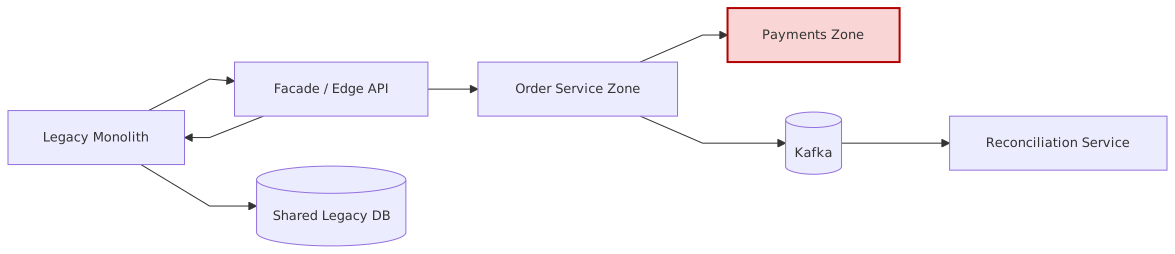
The point is not to migrate everything at once. The point is to progressively move sensitive capabilities into clearer trust zones while leaving lower-risk functionality behind until there is a reason to extract it.
That last clause matters. Many organizations extract too much too early. They create dozens of services and almost no meaningful boundaries.
Enterprise Example
Consider a global retailer modernizing its digital commerce platform.
Originally, checkout, order management, customer accounts, payment processing, promotions, and fulfillment all lived inside a large Java monolith. Over time, the organization extracted services around product catalog, search, customer profile, cart, order, and payment orchestration. Kafka was introduced for order events and downstream fulfillment integration.
On paper, this looked modern. In reality, the trust model remained dangerously flat:
- most services ran in the same Kubernetes cluster
- internal APIs were reachable across namespaces
- several services used shared technical accounts
- Kafka topics were broadly readable by multiple teams
- payment orchestration consumed order and customer events and also exposed internal endpoints for support scripts
- reconciliation was manual and often depended on direct database access
An internal security review found an uncomfortable truth: compromising a relatively low-risk service in customer preferences could provide enough internal reach to query payment-adjacent functions and read more event data than intended.
The retailer didn’t “fix security” with one heroic platform program. They re-architected around trust zones.
What changed
Payments became a high-trust bounded context with tighter runtime isolation, separate secrets handling, stronger service identity requirements, narrower ingress, and dedicated Kafka topic ACLs.
Order Management remained central, but all payment interactions were reduced to explicit business operations. No direct low-level endpoint access. No support script shortcuts.
Customer Profile was split between general preferences and sensitive identity-linked profile data. Different trust posture. Different consumers.
Kafka governance was overhauled. Topics gained clear ownership, schemas were versioned with approval gates, and replay access was restricted. Derived analytics topics replaced broad direct consumption of operational payment events.
Reconciliation services were introduced to compare order, payment authorization, capture, and settlement states. Instead of support engineers logging into databases across domains, they used controlled workflows and auditable compensations.
The result
The migration did not eliminate complexity. It moved it into the open. Latency increased slightly on a few cross-zone checkout paths. Teams had to build better event contracts. Some operational practices had to be rewritten from scratch.
But the blast radius shrank dramatically. Audit quality improved. Payment incidents became easier to isolate. Support access became less magical and more accountable. And most importantly, the architecture finally told the truth about the business risk in the system.
That is what good enterprise architecture feels like: not cleaner diagrams, but fewer lies.
Operational Considerations
Security boundaries are sustained operationally or they decay.
Policy lifecycle
Policies need versioning, ownership, testability, and rollback. A broken authorization policy can take out a business process just as surely as a bad deployment. Treat policy as code, but also as architecture.
Certificate and identity rotation
Strong service identity only helps if rotation is automatic and reliable. Expired certificates are a classic self-inflicted outage in trust-heavy architectures.
Support and break-glass access
You need controlled emergency access with auditability and short-lived privileges. If you do not provide this, teams will create permanent hidden bypasses.
Observability
Cross-zone calls and event flows should emit:
- caller identity
- target capability
- policy decision
- correlation ID
- business context
- data classification markers where appropriate
Not every log line needs all of this, but your investigative path absolutely does.
Kafka operations
Broker security and consumer governance matter: EA governance checklist
- topic ACL reviews
- schema compatibility checks
- retention management
- replay approvals
- dead-letter triage
- consumer lag monitoring by trust zone
A surprising number of organizations have stronger REST API controls than Kafka controls, even though events often contain the richer business payloads.
Reconciliation tooling
This deserves repeating. Reconciliation is not a side utility. It is part of the operating model when boundaries create asynchronous state transitions. Build dashboards, discrepancy queues, compensating workflows, and exception handling that respect the trust model.
Tradeoffs
There is no free lunch here.
More isolation means more complexity
Trust zones create more policy surfaces, more routing decisions, more identity handling, and more deployment coordination. If your engineering maturity is low, this can become chaos disguised as rigor.
Domain purity is not always operationally convenient
DDD may suggest elegant context separation, but operationally some contexts are tightly entangled. Forcing too much isolation too early can create excessive chatty communication, duplication, and brittle orchestration.
Asynchronous integration improves containment but complicates behavior
Kafka can reduce coupling and support decoupled cross-zone communication, but it introduces eventual consistency, ordering concerns, replay risks, poison message handling, and consumer authorization overhead.
Strong boundaries can hurt performance
Every cross-zone hop may add security enforcement and mediation. On hot transactional paths, this must be designed carefully.
Governance can become bureaucracy
If every topic, endpoint, schema change, and policy update requires six committees, the architecture will be bypassed. The right answer is paved roads, not sacred rituals.
Failure Modes
This is where many well-intentioned programs go off the rails.
1. Confusing network segmentation with security architecture
A subnet is not a trust model. If identities are weak and policies are broad, segmentation alone gives false comfort.
2. Over-separating tiny services
If every microservice becomes its own trust island, you create policy sprawl and operational misery. Boundaries should correspond to meaningful domain and risk distinctions.
3. Securing APIs but ignoring events
Sensitive payloads leak through Kafka topics, dead-letter queues, replay tools, or analytics subscriptions. Event-driven architecture without event security is unfinished work.
4. Shared databases across zones
This is the old sin in new clothes. Shared persistence collapses autonomy, weakens auditability, and lets one zone effectively bypass another’s policy model.
5. No reconciliation path
When asynchronous failures happen, teams need a way to recover without violating boundaries. If not, they introduce emergency backdoors that become permanent.
6. Token propagation without semantic control
Passing end-user identity across services sounds modern until downstream services make authorization decisions with incomplete or stale claims. Cross-zone delegation should be deliberate, often using token exchange or reduced-scope service assertions.
7. Ignoring operational tools
Admin consoles, support jobs, ETL processes, and reporting extracts frequently have broader access than runtime services. Attackers know this. Architects should too.
When Not To Use
Not every system needs elaborate trust zones.
Do not reach for this level of architecture when:
- you have a small, low-risk product with limited data sensitivity
- the system is effectively a modular monolith and team boundaries are not yet stable
- service sprawl already exceeds organizational capability
- you lack the platform foundations for identity, secrets, and policy automation
- the cost of segmentation is higher than the realistic risk reduction
A modular monolith with strong internal module boundaries, good authentication, and careful operational access control is often a better choice than premature microservices with performative security.
Likewise, if your domains are not yet understood, introducing hard trust boundaries can freeze bad decomposition in place. First find the bounded contexts. Then enforce the trust where it matters.
Architecture is not about maximum distribution. It is about fit.
Related Patterns
Several patterns commonly appear alongside trust-zone design.
Bounded Context
The DDD anchor for deciding where business language, policy, and data ownership differ enough to justify a boundary.
API Gateway / Backends for Frontends
Useful for north-south entry control, token handling, and reducing direct exposure of internal service structure.
Service Mesh
Helpful for mTLS, identity, and policy enforcement, but not sufficient on its own. A mesh can secure transport while leaving authorization semantics weak.
Event-Carried State Transfer
Often used across trust zones, but requires strict governance, schema discipline, and data minimization. ArchiMate for governance
Saga and Process Manager
Useful when business workflows span zones and require coordination without distributed transactions.
Strangler Fig Pattern
Essential for migrating from flat trust models and monoliths into progressively isolated domains.
Reconciliation Pattern
A practical necessity whenever asynchronous flows and stronger containment create eventual consistency and discrepancy handling needs.
Summary
Security boundaries in microservices architecture are not an infrastructure embellishment. They are the architecture.
A trust zone is where domain semantics, data sensitivity, runtime identity, and operational reality meet. Done well, trust zones reduce blast radius, improve auditability, clarify ownership, and force cleaner interaction contracts. Done badly, they become expensive theater: more hops, more diagrams, same old implicit trust.
The practical path is clear enough:
- start from bounded contexts and business semantics
- identify where risk and sensitivity genuinely differ
- establish strong workload identity
- authorize business capabilities, not just endpoints
- treat Kafka topics and event streams as first-class security boundaries
- build reconciliation into the design
- migrate progressively with a strangler approach
- harden operations, not just runtime traffic
And remain honest about the tradeoffs. More boundaries mean more complexity. More asynchronous design means more reconciliation. More control means more operational discipline.
But for large enterprises—especially those handling payments, identity, personal data, or regulated workflows—that is the price of architecture that tells the truth.
The test is simple. If one compromised service can still wander the estate like it owns the place, you do not have microservices with security boundaries. You have distributed software with shared fate.
Frequently Asked Questions
What is a service mesh?
A service mesh is an infrastructure layer managing service-to-service communication. It provides mutual TLS, load balancing, circuit breaking, retries, and observability without each service implementing these capabilities. Istio and Linkerd are common implementations.
How do you document microservices architecture for governance?
Use ArchiMate Application Cooperation diagrams for the service landscape, UML Component diagrams for internal structure, UML Sequence diagrams for key flows, and UML Deployment diagrams for Kubernetes topology. All views can coexist in Sparx EA with full traceability.
What is the difference between choreography and orchestration in microservices?
Choreography has services react to events independently — no central coordinator. Orchestration uses a central workflow engine that calls services in sequence. Choreography scales better but is harder to debug; orchestration is easier to reason about but creates a central coupling point.