⏱ 20 min read
Distributed systems rarely fail like a light bulb. They fail like city traffic.
One stalled intersection looks harmless at first. Then the lane backs up, then the junction behind it, then a bus blocks the crossing, and suddenly the problem is no longer “one slow car.” It is systemic congestion. Reactive microservices behave the same way. A single consumer that cannot keep pace with demand turns queues into reservoirs, latency into inventory, and harmless bursts into a cascading incident. What operations teams often call “Kafka lag,” “thread pool exhaustion,” or “timeouts everywhere” is usually the same architectural story told from different windows. event-driven architecture patterns
Backpressure is not a framework feature. It is a business reality wearing a technical coat.
That is the architectural point many teams miss. They adopt reactive libraries, use asynchronous messaging, and assume they have solved throughput. They have not. They have merely moved the place where pressure accumulates. If the architecture does not deliberately model how demand, capacity, and failure interact across service boundaries, pressure will propagate anyway. It just won’t do so politely.
This is where enterprise architecture has to get practical. Not just “use Reactor” or “add Kafka.” The real question is: how should pressure move through a landscape of services so that the system protects the domain instead of damaging it? Which workloads should slow down, which should shed load, which can buffer, and which must preserve correctness even under duress? Those are domain-driven design questions as much as integration questions.
In this article, I’ll walk through backpressure propagation in reactive microservices from an architectural perspective: the forces behind it, the shape of a sound solution, the migration path from brittle synchronous chains, operational realities, tradeoffs, failure modes, and when not to use this style at all. Along the way, I’ll anchor the discussion in Kafka-based microservices, progressive strangler migration, and the often-ignored need for reconciliation when pressure handling inevitably creates divergence. microservices architecture diagrams
Context
Most microservice estates did not start reactive. They started as sensible service decomposition efforts and accumulated behavior over time: a customer service here, an order service there, a payment integration with a retry loop, and a handful of synchronous APIs that looked innocent in isolation. Then the business grew. Traffic became bursty. Channels multiplied. Event streaming entered the picture. Batch jobs overlapped with real-time flows. Suddenly “independent deployability” was living next to “shared runtime fate.”
That is the natural habitat for backpressure problems.
A modern enterprise platform often mixes several interaction modes:
- synchronous request/response APIs
- asynchronous commands and events
- Kafka topics for integration and replay
- scheduled jobs and bulk ingestion pipelines
- external SaaS and legacy platforms with hard throughput ceilings
- read models, caches, and search indexes that lag by design
Each of these has a different pressure profile. HTTP clients tend to turn pressure into timeout storms. Queues turn it into backlog. Kafka turns it into consumer lag and retention pressure. Datastores turn it into lock contention, IO saturation, and replication delay. Humans experience all of it as “the system is slow.”
Reactive microservices promise a better way: non-blocking execution, bounded resource use, asynchronous flow control, and demand-aware consumption. Properly used, they can absorb bursts gracefully and prevent one slow dependency from monopolizing compute. Improperly used, they can amplify complexity while still collapsing under real load.
That is why this topic belongs in architecture, not just implementation.
Problem
The core problem is simple to state: downstream capacity is always finite, but upstream demand is often elastic, bursty, or uncapped.
When a producer emits faster than a consumer can process, something has to give. Data can be buffered, dropped, deferred, aggregated, rejected, reprioritized, or redirected. If no deliberate mechanism exists, the system chooses accidentally. Memory fills. Queues expand. Consumer lag grows. Retry loops multiply the traffic. Timeouts trigger duplicate requests. Dead-letter topics become archaeological sites.
In reactive terminology, backpressure is the mechanism by which a consumer signals how much it can handle. In enterprise architecture, backpressure propagation is the design of how that limit moves through the system.
Those are not identical.
A reactive stream may correctly ask for N elements at a time, but if the business workflow crosses service boundaries, topics, storage engines, and external vendors, then pressure management must survive translation between protocols and bounded contexts. There is no point applying perfect backpressure inside one service if the service then dumps unbounded work onto Kafka, hammers a mainframe adapter, or commits half a business process before stalling.
The deeper issue is semantic. Not all work is equal.
An “OrderPlaced” event is not the same as “CustomerProfileViewed.” A payment authorization cannot simply be dropped because buffers are full. A recommendation update can. A shipment reservation may be delayed if inventory remains consistent. A fraud check may need fast degradation with a compensating review process. Backpressure without domain semantics is plumbing without judgment.
That is why many incidents around reactive systems are not technical bugs in the narrow sense. They are modeling failures. The architecture treated all pressure as throughput pressure when some of it was really business criticality, consistency need, or time sensitivity.
Forces
Several forces shape the architecture here, and they tend to pull in opposite directions.
1. Throughput versus latency
Buffering smooths bursts and improves throughput, but it increases latency and hides trouble. Immediate rejection protects latency but may hurt business completion rates. Enterprises usually want both until reality intervenes.
2. Local autonomy versus end-to-end flow control
Each microservice wants to own its runtime policy. But pressure is contagious. One bounded context may make a perfectly rational local decision that causes systemic instability elsewhere.
3. Domain correctness versus availability
Some workloads can be eventually reconciled. Others cannot. If the domain demands exactly-once business effect, then aggressive dropping or duplicate retries are dangerous. If the domain allows soft-state rebuilding, then load shedding is perfectly acceptable.
4. Burst tolerance versus cost
The easiest way to survive bursts is to overprovision. The easiest way to avoid overprovisioning is to force demand shaping. Most enterprises need a middle path.
5. Decoupling versus observability
Asynchronous systems decouple runtime dependencies, which is good, but they also obscure where work is waiting, who owns it, and whether the backlog is harmless or fatal. Backpressure that cannot be seen cannot be governed.
6. Technical flow control versus business prioritization
A runtime can signal demand in messages per second. The business thinks in money at risk, SLA class, regulatory commitments, customer journey abandonment, and operational deadlines. Architecture has to connect the two.
7. Reactive elegance versus ecosystem messiness
Inside a reactive stack, backpressure can be explicit. Across HTTP, Kafka, databases, partner APIs, and legacy batch feeds, it becomes a negotiated compromise. Architects should not confuse a clean library abstraction with a clean enterprise reality.
Solution
The practical solution is to treat backpressure propagation as a first-class architectural capability with three layers:
- Runtime flow control inside services
- Pressure-aware contracts between services
- Domain-driven policies for what happens when capacity is exceeded
This is the crucial move. Do not start with transport. Start with business semantics.
For every important flow, ask:
- Is this work lossless, lossy, deferrable, or rejectable?
- What is the latest acceptable completion time?
- Can it be replayed or reconciled later?
- What is the business impact of duplication?
- Does order matter?
- What is the unit of throttling: event, customer, account, merchant, region?
- What should degrade first?
Once those answers exist, technical mechanisms follow more cleanly.
Core architectural principles
Use bounded queues, not wishful thinking
Unbounded buffering is just postponed failure. Memory-backed buffers and topic retention can hide overload long enough to turn a recoverable spike into a systemic recovery event. Every queue should have a reason, a size, and a policy.
Propagate demand, not just data
If downstream processing falls behind, upstream components should know whether to slow down, pause partitions, stop polling, reduce fan-out, or reject new requests. In Kafka-backed systems, that may mean controlling consumer concurrency, pausing partitions, adjusting poll cadence, and exposing lag-aware admission control to API edges.
Separate critical from non-critical flows
A recommendation update should not compete with payment capture on the same resource pool. Backpressure is much easier to govern when workloads have explicit service classes, topics, thread pools, partitions, and quotas.
Model compensability
When pressure forces deferral or temporary inconsistency, reconciliation is not an afterthought. It is part of the design. If a downstream bounded context misses updates during overload or sheds lower-priority work, there must be replay, reconciliation jobs, or authoritative-source rebuilds.
Make pressure visible in domain language
“Consumer lag is 2.4 million” is useful to platform engineers. “Settlement confirmations are delayed beyond regulatory cutoff for EU merchants” gets executive attention. You need both.
Architecture
A robust architecture for backpressure propagation in reactive microservices typically combines reactive execution inside services, Kafka for durable asynchronous decoupling where appropriate, and explicit overload policies at boundaries.
Here is a reference shape.
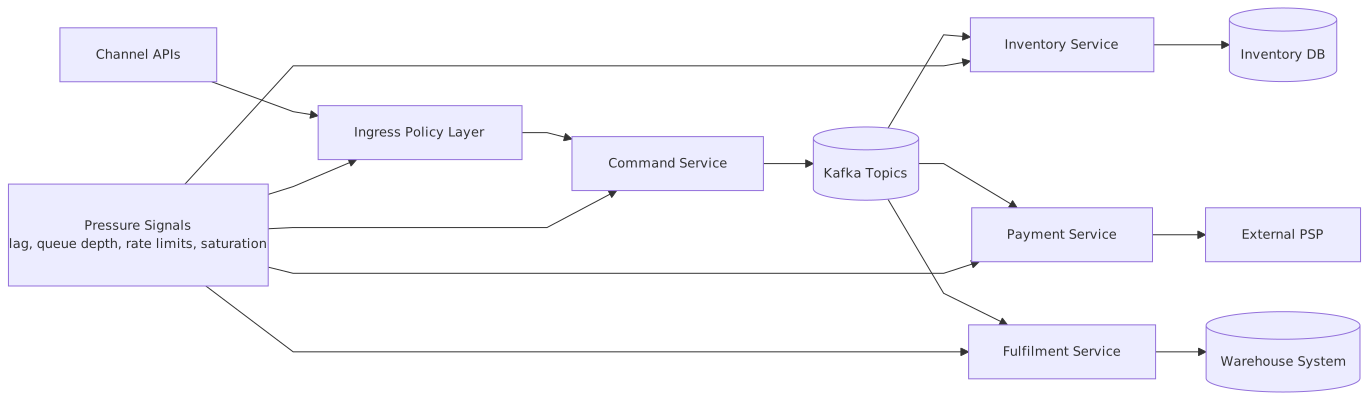
The ingress layer matters more than many teams admit. If the platform receives demand through APIs, mobile apps, batch uploads, or partner gateways, that is where admission control should live. It should not blindly accept work simply because downstream buffering exists. A well-designed ingress layer uses real-time pressure signals to shape traffic:
- reject low-priority work
- return “try later” with idempotency support
- degrade optional enrichment
- switch to asynchronous acceptance patterns
- route bulk work to deferred processing lanes
That is architecture doing its job.
Inside each service, reactive programming can help keep thread usage bounded and prevent blocking waits from consuming the world. But do not stop there. Service boundaries need pressure-aware contracts.
Pressure-aware contracts
A pressure-aware contract states more than schema. It states behavior under saturation. For example:
- command accepted synchronously but processed asynchronously
- event consumers may defer low-priority partitions
- retries must honor retry budgets and jitter
- callers receive explicit overload signals, not generic timeouts
- consumers may replay from an offset or request reconciliation snapshots
This is especially important with Kafka. Kafka is excellent for durable event streams, replay, decoupling producer and consumer lifecycles, and smoothing bursty traffic. But Kafka is not magical backpressure. It simply gives pressure a place to sit. If consumer groups cannot keep up, lag grows. If lag grows beyond retention or replay windows, recovery gets risky. If retries republish into the same hot path, you have built a feedback loop.
A better pattern is to distinguish between:
- operational buffers for short-lived burst absorption
- durable event logs for replay and state reconstruction
- work queues for controlled asynchronous execution
- dead-letter or quarantine lanes for exception handling
Conflating these is a classic enterprise mistake.
Cascading pressure diagram
The failure pattern usually looks like this.
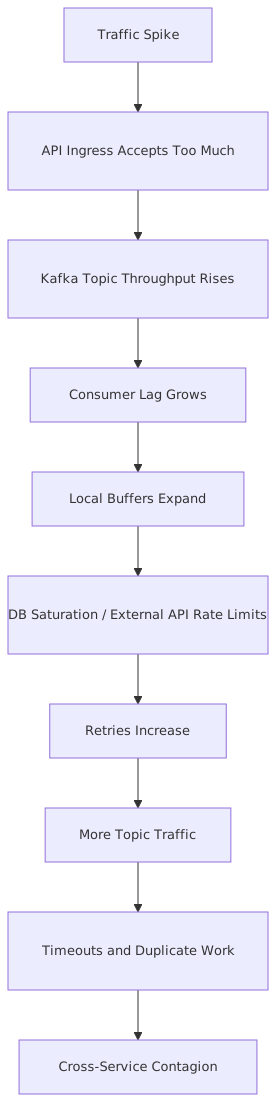
Every arrow in that diagram is a design decision, whether deliberate or accidental.
Domain-driven design thinking
Backpressure becomes tractable when bounded contexts own their own overload behavior. This is pure domain-driven design. Each context defines what service it provides to the enterprise, what invariants it must protect, and what degradation is acceptable.
For example:
- Payments bounded context protects authorization correctness and auditability. It may reject quickly rather than queue indefinitely.
- Inventory bounded context protects reservation integrity. It may serialize updates per SKU or warehouse and accept temporary backlog.
- Customer insights bounded context can drop or sample analytics events during overload because the domain tolerates approximation.
- Notifications bounded context can prioritize password resets over marketing campaigns.
That leads to different backpressure policies per context. Good. Uniformity is overrated when the domain is not uniform.
Partitioning and ordering choices
Kafka adds another domain-relevant choice: partitioning. Architects often partition by technical convenience and only later discover business consequences.
If you partition order events by orderId, you preserve per-order ordering but may scatter account-level workflows. If you partition by customerId, you can throttle per customer and preserve customer timeline order, but hot customers may create skew. If you partition by merchantId, you align with commercial blast radius and support tenant isolation, but not every domain process naturally follows merchant boundaries.
Backpressure and partitioning are linked. The partition key often defines the unit of fairness, isolation, and failure.
Reconciliation architecture
Pressure handling inevitably creates temporary divergence. The answer is not to pretend otherwise. The answer is to design reconciliation explicitly.
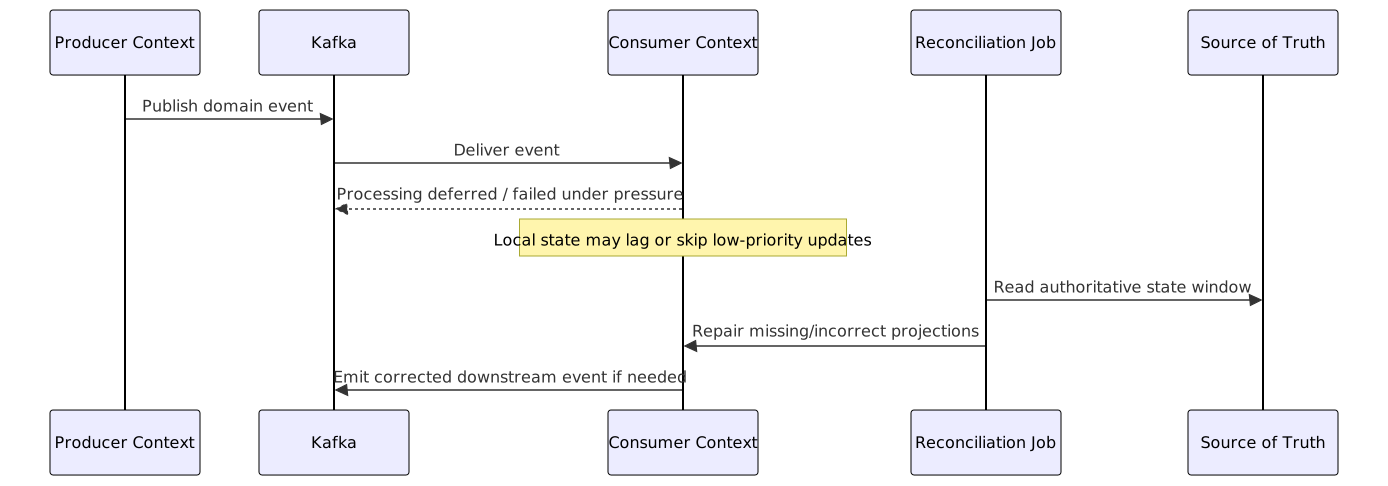
Reconciliation should not be a shameful secret hidden in operations scripts. It is a legitimate pattern for systems that prioritize resilience and throughput while preserving eventual correctness. Especially in read models, analytics, search indexes, and downstream projections, reconciliation is often the difference between graceful degradation and silent corruption.
Migration Strategy
Most enterprises cannot replace synchronous chains with a clean reactive estate in one move. Nor should they try. Backpressure architecture is best introduced through progressive strangler migration.
The migration journey usually has five stages.
1. Identify pressure hotspots
Start with evidence, not ideology. Find where load currently accumulates:
- APIs with timeout cliffs
- batch jobs colliding with online flows
- Kafka consumer groups with chronic lag
- services with retry storms
- thread pools or DB pools that saturate first
- external integrations with rate limits
Do not “reactify” the whole platform. Target the places where pressure propagation is already causing business pain.
2. Introduce ingress admission control
The biggest quick win is often at the edge. Before changing deep internals, implement rate shaping, quota classes, idempotent retry semantics, and asynchronous acceptance for work that need not complete inline. This prevents the front door from becoming a pressure amplifier.
3. Strangle synchronous workflows into evented steps
Take one business process at a time. Replace deep request chains with command acceptance and event-driven progression. Keep the existing system as the source of truth where necessary, and insert a new orchestration or event publication seam around it.
A common transition looks like this:
- legacy order API still records the order
- order accepted event is emitted to Kafka
- new downstream services consume the event for inventory, fraud, and notification
- old synchronous enrichments are gradually retired or moved behind asynchronous projections
- the new path introduces bounded queues, retry budgets, and replayability
This is classic strangler fig thinking: grow the new flow around the old one until the old path becomes irrelevant.
4. Add reconciliation before aggressive shedding
Teams often add load shedding too early. That is dangerous. First build replay and reconciliation so that deferred or skipped work can be repaired. Then introduce selective dropping or prioritization for lower-value traffic.
5. Move policy into the domain contexts
Over time, shift overload rules out of generic middleware into bounded context ownership. The payment team should define what “too much load” means for payment authorization. The inventory team should define reservation backlog tolerance. Platform standards matter, but semantics belong with the domain.
A migration success criterion is not “all services use reactive libraries.” It is “pressure now degrades predictable business capabilities instead of causing random cross-system collapse.”
Enterprise Example
Consider a large retail enterprise with e-commerce, store pickup, and marketplace channels. During seasonal peaks, the order platform ingests 8-10x normal traffic. Historically, the architecture relied on synchronous service calls:
- Order API
- Pricing service
- Inventory service
- Payment authorization
- Fraud scoring
- Notification service
Under peak load, payment provider latency rose, fraud calls slowed, and inventory DB contention increased. The API tier held requests open while each dependency struggled. Timeouts triggered client retries. The retries created duplicate order attempts. Customer support saw “payment taken but order missing” cases because failure happened after side effects but before the full workflow completed.
The organization blamed the payment provider. The real problem was pressure propagation without control.
The redesigned flow
The retailer restructured order handling into bounded contexts with explicit semantics:
- Order Management accepts orders and emits
OrderPlaced - Payment handles authorization as a high-priority bounded context with strict idempotency
- Inventory reserves stock asynchronously, partitioned by fulfillment node and SKU family
- Fraud operates in tiers: instant check for risky profiles, deferred review for medium-risk cases during peak
- Notification becomes entirely asynchronous and low-priority
- Search and recommendations consume derived events and may lag or sample updates during events
Kafka became the event backbone, but with discipline:
- separate topics by domain and service class
- bounded consumer concurrency
- pause/resume on lag thresholds
- retry topics with budgets instead of infinite loops
- reconciliation jobs against order and payment source-of-truth stores
What changed operationally
During pressure events, the platform now does the following:
- ingress rejects non-essential bulk partner updates
- recommendation refreshes are throttled
- notification fan-out is deferred
- fraud shifts some cases into manual-review backlog
- order acceptance stays available
- payment remains tightly controlled with quick fail or async pending states
- inventory projections may lag, but authoritative reservation correctness is preserved
This is not “the system stays perfect under load.” That fantasy is expensive and usually false. Instead, the architecture preserves the important parts of the business and lets less critical capabilities bend.
That is the mark of mature enterprise architecture.
Operational Considerations
Backpressure architecture lives or dies in operations.
Metrics that matter
You need more than CPU and memory. Watch:
- Kafka consumer lag by topic, partition, tenant, and priority class
- queue depth and age of oldest message
- request admission rate versus rejection rate
- downstream saturation: DB pool, thread pool, connection pool, external API rate-limit responses
- retry volume and retry success age
- end-to-end completion time by business workflow
- reconciliation volume and correction rates
Most importantly, correlate technical pressure with business state:
- orders pending payment
- reservations awaiting confirmation
- notifications delayed over SLA
- merchants impacted by throttling
- manual review queues
Retry discipline
Retries are one of the most common pressure multipliers. Every retry must answer:
- what failure is likely transient?
- what is the retry budget?
- what is the backoff?
- is the operation idempotent?
- will retry worsen shared downstream saturation?
Blind retries are the distributed systems version of shouting louder because the other person didn’t answer quickly enough.
Capacity policies
Autoscaling helps, but it is not a substitute for backpressure design. It works best for elastic compute, not for database write contention, hot Kafka partitions, or third-party rate limits. Use autoscaling where it helps, but always pair it with admission control and bounded work queues.
Runbooks and game days
Pressure incidents are messy because teams do not know which queue is healthy backlog and which queue is the beginning of customer harm. Runbooks should specify:
- where to shed load first
- which consumers may be paused
- which topics may be deprioritized
- how to invoke reconciliation
- when to stop retries
- who can declare degraded business modes
And then rehearse it. Architecture untested under stress is fiction.
Tradeoffs
Reactive backpressure propagation is not free. It buys resilience by spending complexity.
Benefits
- better control of bursty workloads
- reduced thread exhaustion and blocking collapse
- explicit handling of overload
- improved decoupling between producers and consumers
- clearer prioritization of domain-critical flows
- replay and reconciliation options through Kafka/event logs
Costs
- more moving parts
- harder debugging across asynchronous boundaries
- greater need for observability discipline
- more nuanced semantics around consistency and completion
- increased operational burden around topic design, retry policy, and replay
- possible developer confusion when reactive code is mixed with blocking dependencies
This is the recurring pattern: the architecture shifts from pretending capacity is infinite to making scarcity explicit. That is the right move, but it requires mature teams.
Failure Modes
Even well-intentioned designs go wrong in predictable ways.
Unbounded buffering
The team “just increases queue sizes” to survive spikes. This works until it doesn’t. Large buffers create long recovery tails and conceal failures until business deadlines are missed.
Retrying into saturation
A downstream service slows, upstream retries multiply traffic, Kafka fills with retry topics, and the platform burns its own oxygen.
Shared resource pools
High-priority and low-priority flows use the same consumer group, thread pool, or database. Under pressure, trivia strangles revenue.
Semantic mismatch
Framework-level backpressure exists, but business contracts still assume instant completion. Customers see accepted requests that never really completed, and support teams get ambiguity.
Hot partitions
One tenant, merchant, or product family dominates a Kafka partition. The system appears healthy on average while one slice of the business melts.
No reconciliation path
The architecture defers or sheds work but has no reliable repair mechanism. Temporary overload becomes permanent inconsistency.
Blocking in reactive clothing
A service uses reactive APIs but performs hidden blocking database calls or remote calls on the wrong scheduler. The code looks modern; the runtime behaves like old plumbing.
When Not To Use
Not every system needs sophisticated backpressure propagation.
Do not use this approach if:
- the domain is small, traffic is predictable, and simple synchronous design is sufficient
- workloads are primarily human-paced CRUD with no meaningful burst behavior
- the team lacks operational maturity for Kafka, replay, and asynchronous debugging
- the consistency requirements demand tightly coupled transactional processing and the scale does not justify decoupling
- the main bottleneck is organizational, not technical
In some enterprises, a well-designed modular monolith with clear bounded contexts and a few carefully throttled integrations is the better answer. Architects should resist fashion. Reactive microservices are powerful tools, not moral virtues.
Also, if your downstream systems are deeply blocking and cannot be isolated, wrapping them in reactive APIs may add complexity without real benefit. You cannot out-react a hard mainframe rate limit just by changing your controller style.
Related Patterns
Backpressure propagation sits alongside several related patterns:
- Bulkheads: isolate workloads and resource pools so one class of demand cannot sink another
- Circuit breakers: stop calling unhealthy dependencies, though beware using them as a substitute for demand shaping
- Load shedding: deliberately drop low-value work
- Queue-based load leveling: absorb bursts, but only with bounded queues and clear semantics
- Outbox pattern: ensure reliable event publication from transactional boundaries
- Saga orchestration/choreography: coordinate multi-step business processes with partial completion
- CQRS: separate write and read concerns so projections can lag and reconcile safely
- Strangler fig migration: progressively replace synchronous legacy flows with event-driven, pressure-aware ones
- Replay and reconciliation: repair state after overload, consumer failure, or selective shedding
These patterns are complements, not substitutes. A mature enterprise architecture often uses several together.
Summary
Backpressure propagation in reactive microservices is the architecture of saying “not so fast” without losing the plot.
That is the real job. Not making every service asynchronous for the sake of aesthetics. Not pushing every problem into Kafka and congratulating ourselves on decoupling. The job is to ensure that when demand exceeds capacity—as it always eventually does—the system degrades according to business value, not accidental topology.
The essential moves are clear:
- treat backpressure as an end-to-end concern, not a local library feature
- model overload behavior in domain terms inside each bounded context
- use bounded queues and explicit admission control
- separate critical from non-critical flows
- design Kafka usage around backlog, replay, and partition semantics
- build reconciliation before relying on shedding and deferral
- migrate progressively with strangler patterns, not heroic rewrites
- make pressure visible in both technical and business language
The best enterprise systems do not try to eliminate pressure. They learn how to carry it.
That is the difference between a platform that survives peak season and one that turns success into an outage.
Frequently Asked Questions
What is a service mesh?
A service mesh is an infrastructure layer managing service-to-service communication. It provides mutual TLS, load balancing, circuit breaking, retries, and observability without each service implementing these capabilities. Istio and Linkerd are common implementations.
How do you document microservices architecture for governance?
Use ArchiMate Application Cooperation diagrams for the service landscape, UML Component diagrams for internal structure, UML Sequence diagrams for key flows, and UML Deployment diagrams for Kubernetes topology. All views can coexist in Sparx EA with full traceability.
What is the difference between choreography and orchestration in microservices?
Choreography has services react to events independently — no central coordinator. Orchestration uses a central workflow engine that calls services in sequence. Choreography scales better but is harder to debug; orchestration is easier to reason about but creates a central coupling point.