⏱ 19 min read
Backlogs are honest in a way architecture diagrams rarely are.
A system can lie to you with green dashboards, healthy pods, and neat boxes connected by arrows. But the backlog does not lie. It tells you where work is accumulating, where demand has exceeded capacity, where upstream optimism has become downstream pain. In a microservices landscape, backlog is not just an operational metric. It is a structural signal. It reveals the shape of coupling, the health of domain boundaries, and the cost of pretending asynchronous processing has made complexity disappear. microservices architecture diagrams
Most teams discover this the hard way. They adopt Kafka, split a monolith into services, move to event-driven integration, and celebrate the new independence. Then traffic spikes, a downstream service slows, retries begin, consumer lag grows, order processing drifts behind customer expectations, and suddenly one team’s queue is everybody’s queue. The backlog propagates. It moves through the estate like water finding cracks in old concrete.
This article is about that propagation: what it is, why it happens, and how to design for it without turning your architecture into a shrine to buffering. The central idea is simple and often neglected: backlog is part of the domain and part of the architecture. You cannot treat it as a mere infrastructure concern. In enterprise systems, especially those with order management, payments, claims, inventory, trade processing, customer onboarding, or fulfillment, a backlog changes business meaning. A delayed payment is not just a late message. A delayed fraud decision is not just consumer lag. Delay reshapes promises, customer experience, risk, and accounting semantics.
That is the real architectural work here. Not “how to add a queue,” but how to model delayed work, isolate accumulation, reconcile eventually consistent state, and migrate toward these capabilities without breaking the business.
Context
Microservices give us smaller deployable units, local ownership, and the chance to align software boundaries with business capabilities. Done well, this is domain-driven design in practical clothes. A service should represent a coherent slice of the business, with its own language, policy, invariants, and data. “Orders” should mean something different from “Payments,” and “Inventory Allocation” should not be a hidden branch inside a giant transaction script.
But microservices also replace one kind of complexity with another. The old monolith often hid coordination costs inside process memory and database transactions. The new architecture externalizes those costs into networks, brokers, retries, dead-letter queues, lag metrics, reconciliation jobs, and support teams.
Backlog sits right in the middle of this.
Any architecture that decouples producers from consumers introduces the possibility of asynchronous accumulation. Sometimes that is the point. A queue or Kafka topic absorbs bursts, smooths demand, and protects downstream components from the tyranny of real-time traffic. That is a useful tool. But once several services participate in a business flow, backlog ceases to be local. It starts to propagate: event-driven architecture patterns
- One service falls behind.
- Upstream services continue producing.
- Downstream state becomes stale.
- Time-sensitive decisions become wrong.
- Retries and compensations amplify load.
- Operators add emergency scaling.
- Business users ask why “approved” orders have not shipped.
By then the backlog is no longer technical debt in motion. It is business drift.
Problem
The core problem is this: in a distributed microservices architecture, backlog accumulation in one component often changes the behavior, state, and promises of several others. If the system is designed as though queues are infinite, consumers are interchangeable, and all delay is tolerable, then backlog propagation turns a local slowdown into a cross-domain failure.
The failure is usually subtle before it becomes dramatic.
An Order service publishes OrderPlaced. Inventory consumes it and allocates stock. Pricing may enrich the order. Fraud may score it. Payment authorizes funds. Fulfillment creates a shipment. Customer Notifications send updates. Each service seems loosely coupled. Each team owns its own runtime and backlog. Yet the business process is coupled by time, semantics, and expectation.
Now imagine Fraud falls behind because a machine learning dependency slows. Kafka lag on the fraud-requests topic grows. Orders appear accepted but cannot proceed. Inventory may have reserved stock for too long. Payment authorizations may expire. Customer service sees “pending” orders with no clear reason. Notifications become inaccurate or misleading. The backlog in Fraud has propagated into inventory policy, payment timing, customer communication, and operational risk.
This is where architecture matters. Not in pretending we can avoid backlog, but in designing bounded propagation.
Forces
Several forces make backlog propagation a recurring enterprise problem.
1. Demand is bursty; capacity is not
Most business traffic is uneven. End-of-month billing, payroll cycles, holiday commerce, open enrollment, promotions, claims spikes during weather events, market open and close in financial services—these are not edge cases. They are the shape of the business. Buffers are unavoidable.
2. Domain semantics are time-sensitive
Delay changes meaning. A reserved item after two minutes is different from a reserved item after two days. A KYC check delayed by an hour may be acceptable; delayed by a week, it becomes a regulatory issue. Architects who ignore time in domain modeling end up with systems that are technically asynchronous and semantically wrong.
3. Service autonomy creates policy diversity
Each microservice team makes sensible local decisions: retry policies, batch sizes, concurrency levels, timeout thresholds, compaction strategies, retention settings. Together, these local choices can produce emergent backlog behavior no one intended.
4. Event-driven architecture hides queueing behind elegance
A topic diagram looks clean. It says nothing about consumer lag, poison messages, replay storms, partition skew, idempotency drift, or the brutal truth that “at least once” often means “many times under stress.”
5. Business processes cross bounded contexts
DDD helps here because it forces us to ask the right question: where does the meaning of the work actually live? Inventory backlog is not just Inventory’s problem if it delays order commitment. Fraud backlog is not isolated if it holds customer onboarding hostage. The queue is technical; the waiting is business.
6. Enterprises need recoverability, not just throughput
A startup might tolerate occasional inconsistency and manual cleanup. A bank, insurer, telecom, airline, or retailer at scale cannot. They need traceability, replay discipline, reconciliation, auditability, and operational control. That changes the architecture.
Solution
The solution is not “put Kafka in the middle.” Kafka is a tool, not a design.
The real solution is to architect controlled backlog propagation. That means four things:
- Model backlog as a first-class concern in the domain.
- Constrain where backlog may accumulate and what it may delay.
- Make state progression explicit through durable, observable workflow semantics.
- Provide reconciliation paths when event-driven flow and business truth diverge.
Put differently: you need to know where work can wait, how long it can wait, what business promise changes while it waits, and how you recover when the event path goes sour.
This usually leads to a few concrete architectural patterns.
Separate command intake from business commitment
Accepting a request is not the same as completing the business action. The system must distinguish between “received,” “validated,” “committed,” “allocated,” “authorized,” and “fulfilled.” These are not status codes for UI convenience. They are domain states. They let you absorb backlog without lying.
If your Order service says “confirmed” the moment a request hits Kafka, you have already lost. Better to say “accepted for processing” and carry a clear SLA and state model than to make a promise the architecture cannot keep.
Isolate backlog by business stage
Not all waiting should be allowed to spread. Use explicit stage boundaries and service contracts so that delays in one capability do not contaminate all others. That often means introducing orchestration or a process manager for long-running flows, especially when timeouts, expirations, and compensations matter.
Purists sometimes sneer at orchestration in event-driven systems. They should spend more time in regulated enterprises. Choreography is lovely until nobody can answer a simple question: “Why is this order still pending?”
Align topics and queues to domain events, not technical convenience
A topic called processing-events is an architectural confession. It means no one did the domain work. Prefer topics and streams tied to bounded contexts and meaningful facts: OrderAccepted, InventoryReserved, PaymentAuthorized, FraudReviewDeferred. This is not naming theater. It reduces semantic leakage and lets teams reason about backlog impact in business terms.
Make reconciliation a planned mechanism, not a shameful afterthought
Every serious event-driven enterprise architecture eventually needs reconciliation. Messages are delayed, duplicated, reordered, dropped into dead-letter queues, or become invalid because external state moved on. Reconciliation is how you restore business truth when the happy path has drifted.
If your architecture assumes the event log is always enough, you are building for demos, not production.
Architecture
A practical architecture for backlog propagation in microservices usually combines an event backbone such as Kafka with local service persistence, explicit workflow state, and reconciliation channels.
At a high level, the flow looks like this:
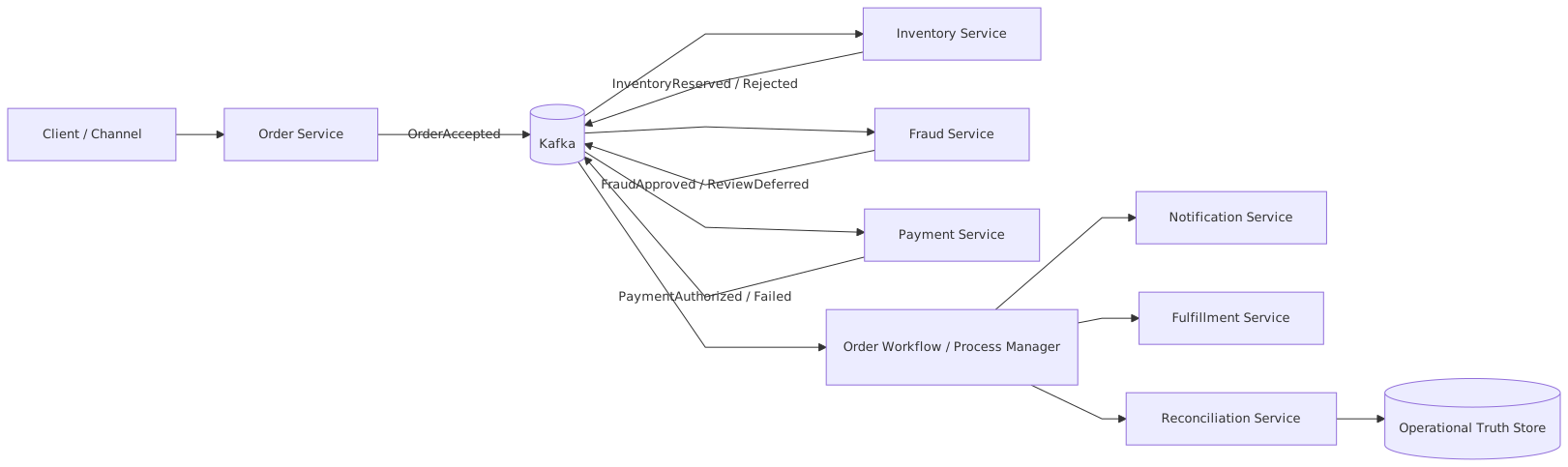
The important part is not the broker. It is the workflow state and policy boundary. Something must understand that an order can wait for fraud approval for 15 minutes, after which inventory reservation must be released and the customer must be informed. That something might be a dedicated process manager, a saga orchestrator, or a state machine embedded in a domain service. But it must exist somewhere coherent.
Domain semantics and bounded contexts
This is where DDD earns its keep.
Backlog behaves differently in different bounded contexts:
- In Order Management, backlog affects promise dates and customer expectation.
- In Inventory, backlog affects stock reservation expiry and oversell risk.
- In Payments, backlog affects authorization windows, settlement timing, and charge duplication risk.
- In Fraud, backlog affects risk posture and manual review queues.
- In Fulfillment, backlog affects labor scheduling and shipment batching.
Treating all backlog as generic “event delay” is a category error. The semantics differ, so the architecture must expose those differences.
A good design gives each bounded context its own language for waiting. For example:
AcceptedForProcessingAwaitingFraudDecisionInventoryHoldPendingAuthorizationExpiredReadyForFulfillmentManualReviewRequired
These are not just labels. They are a way to keep temporal drift visible and manageable.
Backlog control points
A mature design introduces explicit control points:
- Ingress buffer: absorb bursts at the system boundary.
- Per-stage queues/topics: isolate accumulation between major business stages.
- Consumer concurrency controls: prevent one hot partition or poison record from freezing progress.
- Priority lanes: allow urgent or aging work to bypass normal throughput paths.
- Expiry rules: prevent stale work from consuming valueless capacity.
- Compensation hooks: release reservations, reverse holds, notify users.
The architecture might look like this:
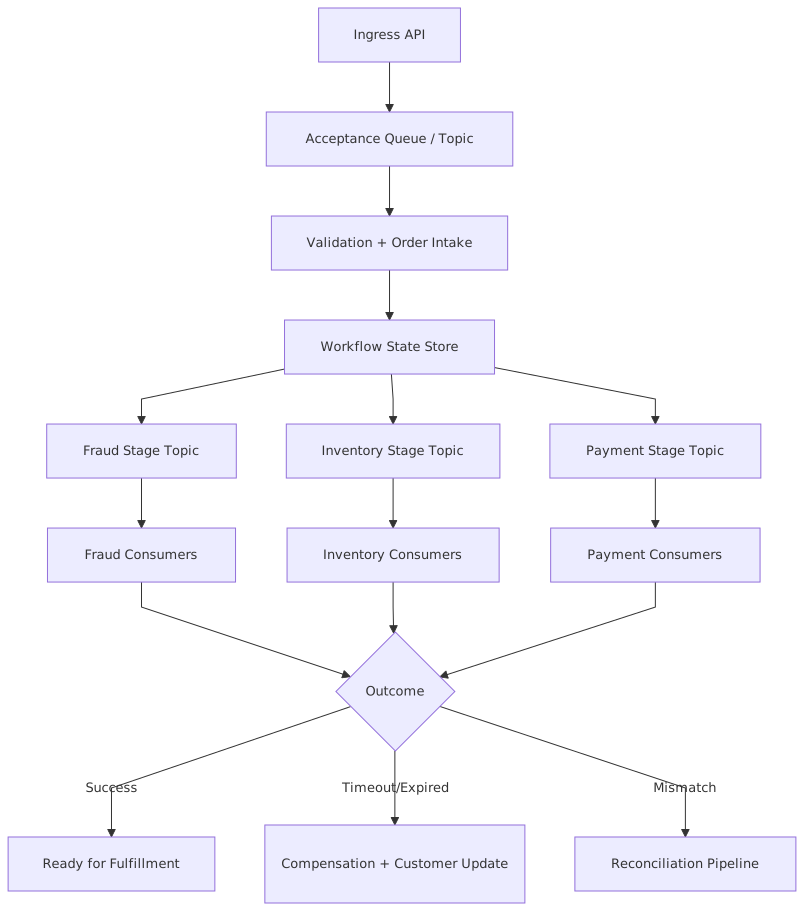
This is not glamorous architecture. It is architecture that survives contact with reality.
Kafka’s role
Kafka is often a sensible backbone here because it supports durable event streams, replay, partitioned scalability, and decoupled producers and consumers. But Kafka also introduces specific backlog mechanics:
- Consumer lag becomes a primary health signal.
- Partition skew can create localized backlog even when overall lag looks fine.
- Rebalances can briefly worsen processing latency.
- Replay can overload downstream systems if not rate-controlled.
- Retention can become both a safety net and a cost center.
- Exactly-once aspirations often collapse at the service boundary where side effects occur.
So use Kafka for what it is good at: durable event distribution and stream-based integration. Do not expect it to solve domain waiting, timeout policy, compensation, or reconciliation semantics on its own.
Migration Strategy
Most enterprises do not start with a clean greenfield architecture. They inherit a monolith, a batch-heavy estate, or a tangle of ESB flows and shared databases. Backlog propagation often already exists, just hidden inside nightly jobs, thread pools, and user complaint queues.
The migration path should be progressive and strangler-oriented.
Step 1: Surface existing backlog behavior
Before splitting anything, map where work accumulates today:
- batch jobs
- database tables used as implicit queues
- retry loops
- stuck workflow states
- manual work queues
- customer service escalations
This is more useful than another capability map. Architecture begins where the pain actually gathers.
Step 2: Define business states before technical events
Teams often jump straight to OrderCreated topics. Resist that. First define the lifecycle states and business commitments. What does it mean to accept, hold, reserve, authorize, release, cancel, expire, or reconcile? Once these semantics are clear, the event contracts become far less vague.
Step 3: Strangle one stage at a time
A sensible migration extracts a bounded context with clear waiting semantics—say Fraud Review or Inventory Allocation—rather than breaking the whole end-to-end process at once. Let the monolith continue as system of record for the remaining flow while the new service handles one business stage through events.
Step 4: Introduce dual-running and reconciliation early
For a while, both old and new paths may coexist. That is normal. Publish events from the legacy system, consume into the new service, compare outputs, and reconcile mismatches. This stage feels slow, but it is where trust is built.
Step 5: Move commitment points carefully
The most dangerous migration step is changing when the business considers work committed. If the monolith used a single transaction to place order, reserve stock, and authorize payment, and the new architecture breaks this into asynchronous stages, then customer-facing states and support procedures must change too. This is not just a refactor. It is a change in business contract.
Step 6: Retire hidden queues
Legacy systems often have hidden backlog stores: staging tables, cron-triggered exports, manually reprocessed files. If you leave these behind while adding Kafka, you create layered backlog with no coherent control. Drain and retire them deliberately.
A simple migration shape looks like this:
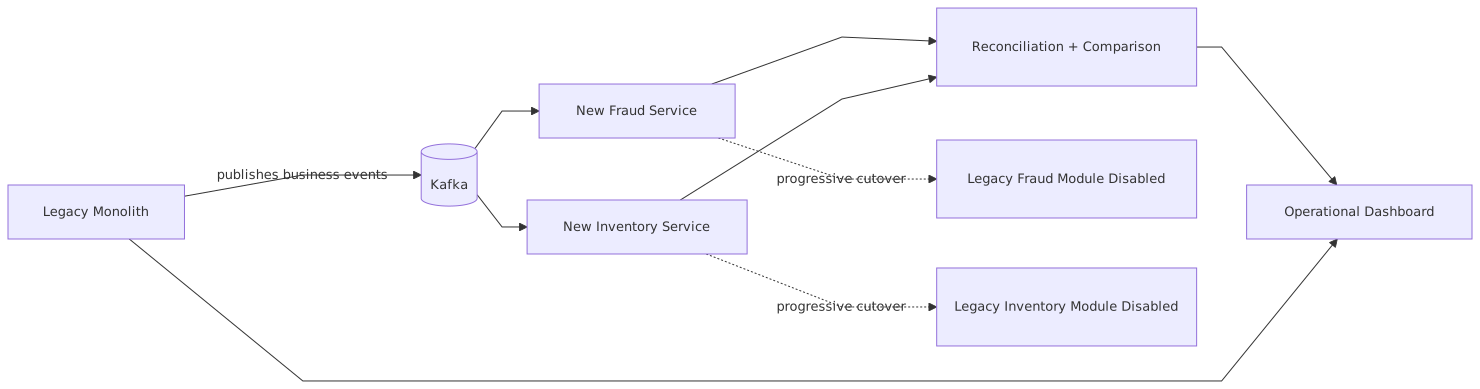
That is strangler migration in its grown-up form: not just redirecting traffic, but progressively moving domain responsibility while keeping backlog and truth visible.
Enterprise Example
Consider a global retailer modernizing its order management platform.
The original system was a large ERP-centered monolith with synchronous order placement. In practice, it was not truly synchronous at all. Inventory confirmation relied on batch updates from regional warehouses every few minutes. Fraud checks called an external provider with inconsistent response times. Payment authorization occasionally queued inside a gateway integration layer. During seasonal peaks, customer service saw thousands of “submitted” orders that were not really committable.
The company moved to microservices around bounded contexts: Order Intake, Fraud, Inventory Allocation, Payment, Fulfillment, and Customer Communications. Kafka was introduced as the event backbone.
At first, the design was textbook and wrong. Order Intake emitted OrderPlaced, and downstream services reacted independently. Each team optimized its own throughput. Fraud built a scalable consumer group. Inventory batched allocations. Payment retried aggressively on gateway timeouts. Notifications subscribed to broad order events and informed customers quickly.
Then Black Friday happened.
Fraud lag climbed due to an external scoring dependency. Inventory had already reserved stock based on incoming orders. Payment had authorized many cards. Notifications told customers their orders were “being prepared.” But the workflow was blocked waiting for fraud approval. By the time decisions returned, some authorizations had expired, some inventory reservations had timed out, and some customers had received contradictory emails.
The architecture had microservices, events, autoscaling, and dashboards. It did not have a coherent model of backlog propagation.
The remediation was architectural, not merely operational:
- The retailer introduced an explicit Order Workflow service as process manager.
- Customer-facing states were redefined:
Received,UnderReview,Confirmed,ReadyToShip. - Inventory reservation moved behind workflow-controlled policy with reservation TTL.
- Payment authorization timing was shifted later for high-risk segments.
- Fraud backlog thresholds triggered business policy changes, including degraded modes and manual review routing.
- A reconciliation service compared workflow state, payment gateway records, and warehouse reservations.
- Notification rules were tied to business commitment states rather than raw events.
The result was not perfect real-time processing. It was something better: truthful processing. During later peaks, some orders took longer, but the system knew which promises were still valid, which reservations should be released, and which customers needed accurate updates. Support calls dropped because ambiguity dropped.
That is what good enterprise architecture looks like. Not speed at any cost. Clarity under stress.
Operational Considerations
Backlog propagation is as much an operational design problem as a structural one.
Observability
You need more than CPU and error rates. Track:
- queue depth and Kafka consumer lag
- lag age, not just count
- partition skew
- retry volume
- dead-letter rates
- workflow state age
- percent of work breaching stage SLA
- compensation counts
- reconciliation mismatch rates
Most importantly, expose these by business stage. “Lag in topic X” is useful to engineers. “12% of orders awaiting fraud decision beyond customer SLA” is useful to the enterprise.
Capacity management
Buffering buys time, not infinite resilience. Capacity planning should model:
- burst characteristics
- service time variability
- external dependency latency
- replay load
- manual review capacity
- expiration and reprocessing policies
This is where many teams fail. They size normal flow and ignore degraded flow. But backlog architecture is judged in degraded flow.
Reconciliation operations
Reconciliation must be operable:
- idempotent reruns
- scoped replay by key or time window
- audit logs
- mismatch classification
- safe compensation paths
- business-facing exception queues
A reconciliation job that requires a senior engineer and three SQL scripts is not a mechanism. It is institutional luck.
Data retention and replay
Kafka retention and compacted topics can support recovery, but replay must be controlled. Replaying months of events into downstream consumers can create another backlog storm if side-effecting services are not shielded. Rate-limited replay and dedicated rehydration paths are often worth the effort.
Tradeoffs
There is no free architecture here.
More explicit workflow means more moving parts
Introducing a process manager, workflow state store, timeout logic, and reconciliation service adds complexity. Purity suffers. Operability improves. That is a trade worth making in many enterprises.
More buffering can hide problems
Buffers smooth spikes, but they also delay feedback. A queue is a shock absorber and a blindfold. Use it with intent.
Strong domain semantics slow initial delivery
Teams under pressure often prefer generic statuses and broad event contracts. It feels faster. Later, they pay in ambiguity, support costs, and migration pain.
Late commitment improves truthfulness but may frustrate users
Telling customers “received and under review” is more honest than “confirmed” before downstream commitments are secured. But it may be less satisfying. Architecture must negotiate with product promises, not surrender to them.
Reconciliation increases resilience but legitimizes inconsistency
Once reconciliation exists, some teams become careless about the mainline path. That is dangerous. Reconciliation should be a safety mechanism, not the primary integration strategy.
Failure Modes
Backlog propagation has recurring failure patterns.
Silent semantic drift
Messages continue flowing, but the business meaning has changed. Inventory reserved too long. Payment auth expired. Offers aged out. The system looks technically alive while becoming commercially wrong.
Retry storms
A slow downstream dependency triggers retries from several services. Backlog grows, latency worsens, and the architecture enters self-inflicted denial-of-service mode.
Poison message blockage
One malformed or semantically invalid event blocks a partition or consumer path. Lag builds behind it. This is especially nasty with key-based ordering requirements.
Orphaned side effects
One service commits a side effect, another misses the corresponding event, and the workflow drifts. Money is captured, stock is unreleased, customer status is stale.
Replay disasters
A recovery replay floods downstream services with historical events that trigger duplicate side effects or saturate dependencies.
Human backlog blindness
Operations teams watch infrastructure metrics but miss business-stage aging. The system is “healthy” while orders, claims, or applications rot in pending states.
When Not To Use
Not every system needs elaborate backlog propagation architecture.
Do not use this style if:
- the workflow is simple and truly synchronous
- delay has little or no business significance
- throughput is low and manual handling is acceptable
- a modular monolith can serve the domain better
- the team lacks operational maturity for event-driven systems
- reconciliation and observability cannot be funded properly
This is the unfashionable truth: many organizations would be better served by a well-structured modular monolith with explicit background jobs than by a fleet of microservices and Kafka topics. If your domain does not require independent scaling, separate team ownership, or asynchronous resilience, then distributed backlog management is needless complexity.
Architecture should earn its scars.
Related Patterns
Several patterns sit near this topic.
- Saga / Process Manager: coordinates long-running workflows with state and compensation.
- Outbox Pattern: ensures reliable publication of domain events from local transactions.
- Inbox / Idempotent Consumer: prevents duplicate side effects.
- Bulkhead: isolates capacity and prevents one backlog from consuming all resources.
- Circuit Breaker: stops retry amplification against slow dependencies.
- Dead Letter Queue: isolates poison or repeatedly failing messages for inspection.
- CQRS: can help separate write-side backlog from read-side responsiveness, though it does not solve propagation by itself.
- Strangler Fig Pattern: supports progressive migration from monolith to service-based flow.
- Reconciliation Batch / Audit Process: restores consistency when asynchronous paths drift.
These patterns are useful, but they are supporting actors. The lead role is still domain modeling. If you do not understand the business meaning of delay, no pattern catalog will rescue the design.
Summary
Service backlog propagation in microservices is what happens when time, load, and distributed ownership collide. It is not merely a queueing problem. It is a domain problem with architectural consequences.
The sound approach is to design for controlled propagation:
- model business states honestly
- align service boundaries to bounded contexts
- isolate backlog by stage
- make workflow progression explicit
- use Kafka and asynchronous messaging as infrastructure, not theology
- build reconciliation as a deliberate recovery path
- migrate progressively with strangler tactics and dual-running comparison
- observe the system in business terms, not just technical ones
The memorable line is this: a backlog is deferred truth. Handle it carelessly and the whole enterprise starts making promises on credit. Handle it well and asynchronous architecture becomes what it should be—resilient, transparent, and faithful to the business it serves.
Frequently Asked Questions
What is a service mesh?
A service mesh is an infrastructure layer managing service-to-service communication. It provides mutual TLS, load balancing, circuit breaking, retries, and observability without each service implementing these capabilities. Istio and Linkerd are common implementations.
How do you document microservices architecture for governance?
Use ArchiMate Application Cooperation diagrams for the service landscape, UML Component diagrams for internal structure, UML Sequence diagrams for key flows, and UML Deployment diagrams for Kubernetes topology. All views can coexist in Sparx EA with full traceability.
What is the difference between choreography and orchestration in microservices?
Choreography has services react to events independently — no central coordinator. Orchestration uses a central workflow engine that calls services in sequence. Choreography scales better but is harder to debug; orchestration is easier to reason about but creates a central coupling point.