⏱ 20 min read
Most microservice failures do not begin with technology. They begin with a bad cut.
Teams split a system along org charts, database tables, or someone’s sketch of “customer service,” “order service,” and “payment service.” It looks tidy on the whiteboard. Then reality arrives. One service changes every week because pricing rules keep moving. Another barely changes all year because ledger behavior is constrained by finance and regulation. A third sits in the middle, half stable and half chaotic, absorbing every emergency change until it becomes the new monolith in disguise.
That is the real problem of decomposition: not just identifying business capabilities, but understanding where change lives.
Volatility is one of the most practical lenses in service design. If one part of the domain changes frequently, under different pressures, with different release cadence, different stakeholders, and different failure tolerance, it probably deserves a different boundary from a part that is slow-moving and heavily governed. A volatility map makes that visible. It gives architects something better than intuition and something more operational than idealized domain models.
This is where domain-driven design earns its keep. DDD is not a religion about aggregates and ubiquitous language. It is a way to ask a harder question: which parts of the business mean different things, change for different reasons, and should therefore evolve independently? Volatility gives that question teeth.
In enterprise systems, decomposition by volatility is often a better starting point than decomposition by entity. Entities are static nouns. Volatility exposes motion. And architecture is mostly about motion: the movement of requirements, risk, ownership, data, and failure.
This article lays out how to use volatility as a primary design force in microservices, how to connect it with bounded contexts, how to migrate toward it without detonating a legacy platform, and where it goes wrong. microservices architecture diagrams
Context
Enterprises rarely start greenfield. They inherit platforms built over years, sometimes decades, where everything is entangled through convenience. A shared database here. A nightly batch there. A “temporary” integration that survives two CIOs. The result is familiar: a system that appears modular in PowerPoint but behaves like a ball of wet string in production.
Microservices are often introduced as the cure. But decomposition is where the cure can become the disease.
A common anti-pattern is slicing a system into CRUD-shaped services around core entities: Customer, Product, Order, Invoice. On paper, this feels reasonable. In practice, many of those entities participate in very different parts of the business with different rhythms of change. Product data for catalog display changes differently from product eligibility logic in a compliance workflow. Customer profile management changes differently from customer risk assessment. “Order” might be a single table in a monolith and three distinct concepts in the business.
Volatility mapping asks the architect to observe a more useful truth: systems do not change uniformly.
Some capabilities are innovation-heavy. Pricing, recommendation, fulfillment promises, fraud scoring, marketing campaigns, and channel experience often evolve continuously. Other capabilities are deliberately stable. General ledger posting, tax audit trails, financial close, settlement, identity proof records, and contractual obligations change slowly and carefully. The mistake is forcing both kinds of work into the same service boundary.
A volatility map is not merely a heat map of code churn. It is a model of business-driven change. It asks:
- Which business rules change most often?
- Who drives that change?
- What is the cost of change?
- What downstream contracts are affected?
- What consistency is required?
- What must remain stable while the business experiments elsewhere?
That is architecture grounded in enterprise reality.
Problem
Most service decomposition methods fail because they optimize for one force and ignore the rest.
If you optimize only for domain nouns, you get services that look semantically clean but release together because their behavior is coupled. If you optimize only for team boundaries, you get politically convenient seams that leak complexity across APIs. If you optimize only for data ownership, you can end up with brittle services that each own a table but none own a business outcome.
Volatility exposes a deeper coupling: change coupling.
When two parts of a system always change together, they may belong together even if they use different data. When they change for different reasons, they should probably not share a deployment unit even if they touch the same business object.
This matters because service boundaries create economic consequences:
- independent release or forced coordination
- local autonomy or cross-team negotiation
- contained failure or cascading outage
- event-driven flow or distributed transaction pain
- evolvable contracts or versioning chaos
A bad decomposition punishes every change request. Teams slow down. Kafka topics proliferate without meaning. Reconciliation jobs multiply because upstream and downstream disagree. Data pipelines become archaeology. Eventually the organization says “microservices are too complex,” when the actual issue was poor boundaries. event-driven architecture patterns
The problem is not simply “how do I split the monolith?” The problem is: how do I place boundaries where the business experiences change differently?
Forces
Volatility is not one thing. It is a composite force. Good architects separate it into dimensions.
1. Business rule volatility
Some rules are under constant experimentation: promotions, pricing models, eligibility logic, customer engagement workflows. Others are constrained by accounting policy, legal obligations, or audit controls.
A loyalty points expiration rule may change every quarter. Revenue recognition logic should not.
Those should not live in the same service merely because both reference an order.
2. Semantic volatility
Sometimes the vocabulary itself is unstable. A “customer” in marketing may mean a prospect. In billing it means a legally billable party. In support it means an account holder. If the semantics shift by context, that is a DDD signal that the boundary is wrong.
Semantic volatility often precedes technical volatility. When teams keep arguing about what a thing means, code is not far behind.
3. Integration volatility
A service exposed to many consuming channels, partners, or internal platforms experiences high contract pressure. APIs evolve. Events need versioning. Consumers use fields in unintended ways. These are different forces from internal rule changes.
A customer-facing API façade may change frequently because mobile and web channels move fast, while the underlying settlement logic remains stable.
4. Data volatility
Some data changes continuously and at high volume. Other data is historical, append-only, or rarely updated. High-write operational data and carefully governed reference data usually deserve different treatment.
5. Operational volatility
Different capabilities have different runtime patterns. Search, recommendation, fraud scoring, and campaign delivery may need elastic scaling and rapid rollback. Financial posting might prioritize correctness, traceability, and deterministic replay over speed.
6. Regulatory volatility
Counterintuitively, heavily regulated domains are not always low-volatility. Regulations can introduce bursts of mandatory change. But the shape of that change is different: controlled, deadline-driven, documentation-heavy, and risky.
That means architects need not just “stable vs unstable,” but different classes of volatility.
Solution
The core idea is simple: decompose services so that each boundary encloses behavior with a similar rate and reason for change.
This is not a replacement for bounded contexts. It is a way of finding and sharpening them.
A volatility map combines DDD domain analysis with change analysis. You identify business capabilities, model the language and workflows, then overlay patterns of change: code churn, incident history, stakeholder requests, release cadence, audit controls, consumer pressure, and coupling.
The result is a map with at least three useful zones:
- Stable core: low-frequency, high-assurance capabilities; correctness over speed
- Variable domain edge: moderate to high change in business logic; localized impact
- Experimental edge: high-frequency, market-driven, channel-driven, or optimization-heavy logic
The stable core should be small, explicit, and boring. Boring is good. Enterprises need boring things in the center.
The variable domain edge should support independent rule evolution. It may use asynchronous messaging, policy services, or event-carried state transfer where appropriate. This is where many domain decisions live.
The experimental edge should absorb product and channel change without contaminating core transactional semantics.
Here is a simplified volatility map:

The point is not a three-layer architecture. The point is to separate distinct change profiles.
A useful rule of thumb: if a capability changes because marketing learned something, keep it away from capabilities that change only when auditors demand it.
Another: don’t put exploratory logic and record-keeping logic in the same deployment unit unless you enjoy coordinated releases.
Domain semantics matter
Volatility-driven decomposition can become a mechanical code exercise if you ignore semantics. That would be a mistake.
Suppose “pricing” exists in your current monolith as one module. In the business, however, there may be several semantics:
- list price management
- promotional offer resolution
- negotiated contract pricing
- tax-inclusive display pricing
- settlement price used for invoicing
- accounting valuation basis
These are not one thing. They change under different forces. Grouping them because they all involve a numeric amount is architecture by spreadsheet.
DDD helps you ask: what is the bounded context? What language belongs here? What decisions are made here? What invariants must hold? Then volatility helps you ask: how often does this context change, under whose pressure, and with what blast radius?
Together, those questions produce boundaries that are both meaningful and operable.
Architecture
A volatility-oriented microservice architecture usually has a few recognizable characteristics.
Stable systems of record at the center
The center contains capabilities that require strong ownership of facts and durable history: order of record, payment authorization result, shipment confirmation, invoice issuance, ledger posting. These services should be cohesive, narrow, and conservative in interface design.
They should publish facts, not speculative decisions.
Policy and decision services at the edge of the core
Around the center sit services that compute decisions from changing rules: eligibility, routing, pricing, fraud policy, assignment, fulfillment promise. These often benefit from event-driven integration because they react to business facts and evolve independently.
Not every rule engine deserves to be a service, but volatile policy logic often does.
Channel and experience services further out
These services support mobile apps, web journeys, partner experiences, and campaign orchestration. They compose data for interaction and absorb rapid UX-driven change. They should not become accidental owners of transactional truth.
Event-driven flow and reconciliation
Kafka is particularly useful here because volatility boundaries often imply asynchronous collaboration. High-volatility services should not force synchronous dependency on every call into the stable core. Publish business events. Consume facts. Build local decisions where useful.
But architects should be honest: Kafka is not magic consistency dust. Event-driven systems need reconciliation because messages can be delayed, consumers can fail, schemas evolve, and humans still ask “why does this order show shipped in one place and pending in another?”
A realistic architecture includes:
- business event streams
- idempotent consumers
- outbox pattern for reliable publication
- replay strategy
- compensating actions
- reconciliation workflows and dashboards
The picture looks something like this:
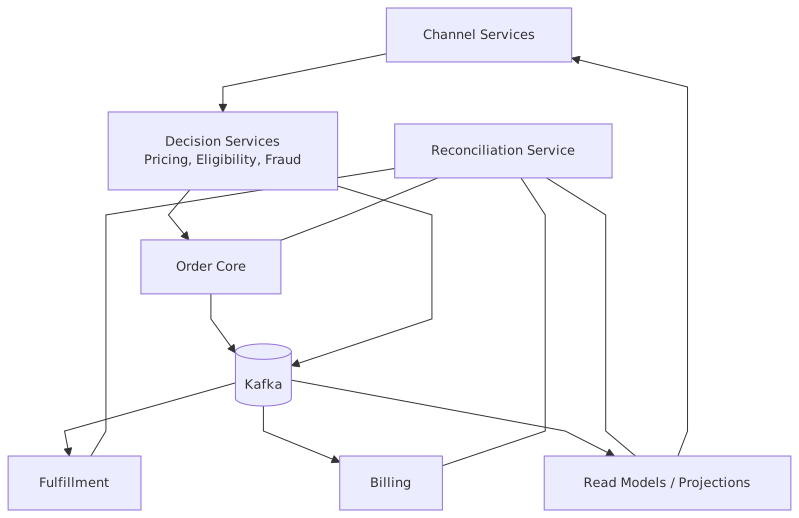
The reconciliation service here is not a glamorous component. It is simply what mature enterprises build after their first wave of optimism. It compares expected and actual states across services, spots drift, and triggers repair. You want it designed intentionally, not discovered in panic.
Data ownership with explicit duplication
Volatility-based decomposition often requires duplication of data across services. That is fine. In fact, it is often healthier than forced shared access.
The key distinction is between:
- authoritative ownership of a fact
- local cached or projected use of that fact
For example, the billing service may own invoice issuance facts. The customer experience service may maintain a denormalized invoice summary for display. The trouble begins when teams forget which is which.
Boundary styles by volatility
A practical way to think about service styles:
- Low volatility, high integrity: transactional core, explicit invariants, cautious change management
- Medium volatility, business rules: service boundaries around decision-making, event-driven collaboration, policy externalization where useful
- High volatility, experience and optimization: compositional APIs, BFFs, experimentation support, rapid deployment
The style of service should fit the shape of change.
Migration Strategy
You do not migrate to volatility-based decomposition in one move. You discover it progressively.
The sensible path is a progressive strangler migration. Start where volatility hurts most, not where the architecture diagram looks easiest.
That usually means finding a capability inside the monolith with three symptoms:
- frequent business change
- painful coordination with stable parts of the system
- manageable transactional boundaries
Pricing and fulfillment promise are common candidates. General ledger posting is not.
Step 1: Build the volatility map
Use a mix of qualitative and quantitative evidence:
- incident trends
- deployment frequency by module
- code churn and dependency analysis
- backlog sources
- release coordination patterns
- stakeholder interviews
- data ownership conflicts
- semantic disagreements in domain workshops
You are looking for places where change pressure and semantic cohesion line up.
Step 2: Identify seams in the monolith
Look for natural publication points: order created, payment authorized, item shipped, invoice issued. Often the monolith already has internal transaction boundaries and workflow stages. Those become extraction seams.
Step 3: Extract read-first or decision-first capabilities
The safest first extractions are often:
- read models and projections
- channel-specific composition
- decision services with bounded inputs and outputs
These minimize immediate consistency pain while creating independence.
Step 4: Introduce event publication
Use the outbox pattern from the monolith or core service to publish business events into Kafka. Start with facts that are already stable and understood.
Step 5: Add reconciliation from day one
Do not wait for drift to appear before planning for it. Every asynchronous migration should define:
- source of truth per data element
- acceptable staleness
- mismatch detection
- repair process
- business escalation path
Step 6: Move write ownership carefully
Eventually, some capabilities need their own write model and authority. This is the dangerous stage. You should transfer ownership only when the domain semantics are clear and downstream impacts are understood.
Here is a typical strangler path:

This is progressive for a reason. Enterprises do not fail because they moved too slowly. They fail because they moved authority before they moved understanding.
Migration reasoning
Why does this approach work?
Because volatility creates leverage. If you extract a high-change capability, you remove a disproportionate amount of release pain and coordination overhead. Teams see value early. The monolith becomes quieter in its unstable zones while the stable core continues operating.
That is a better migration economics story than trying to carve out the most central domain first.
Enterprise Example
Consider a large retailer with stores, e-commerce, and marketplace channels. Their original commerce platform was a classic monolith. Product, pricing, cart, checkout, order management, inventory reservation, promotions, and invoicing all sat in one codebase and one relational database.
On paper, it had modules. In production, every Black Friday change proved otherwise.
The retailer first tried decomposition by entity: Product Service, Order Service, Customer Service, Payment Service. It looked modern. It also made pricing worse. Why? Because pricing was not a single thing. The service became the dumping ground for list prices, channel prices, campaign offers, coupon stacking, tax display adjustments, and contract pricing for B2B buyers. Different teams changed it weekly. Every downstream consumer wanted something slightly different. The “Pricing Service” turned into a distributed monolith with APIs.
The second attempt used volatility mapping.
They discovered three separate bounded contexts hidden inside “pricing”:
- Price Catalog: base price and effective date management, relatively stable, controlled by merchandising
- Offer Decisioning: campaigns, bundling, coupon eligibility, highly volatile, driven by marketing
- Settlement Pricing: final legal and financial amount attached to order line at checkout, tightly coupled to invoicing and audit
Once separated, the architecture improved dramatically.
Offer Decisioning became an event-driven service consuming customer segment, cart context, and campaign facts from Kafka. It changed constantly and deployed independently.
Settlement Pricing moved close to checkout and order-of-record boundaries, with stricter contracts and deterministic calculation rules. It published immutable pricing facts once the order was confirmed.
Price Catalog remained a controlled system of reference data.
The retailer also discovered that inventory had similar volatility classes:
- inventory position of record
- availability promise for customer channels
- allocation heuristics for fulfillment optimization
Again, one noun had masked several change profiles.
Operationally, this mattered. Offer Decisioning scaled aggressively during campaigns. Settlement Pricing did not need the same elasticity but required traceability and replay. Availability Promise needed low latency and tolerated eventual consistency from inventory snapshots, while inventory position of record demanded more disciplined updates.
Reconciliation became essential. Sometimes a promotion event arrived late, or a projection lagged, or a checkout retried after timeout. Rather than pretending that eventual consistency was perfect, the retailer built reconciliation jobs that compared order lines, settlement prices, promotions applied, and invoice amounts. Discrepancies were flagged automatically. Some were auto-healed; others routed to operations.
The result was not purity. It was survivability.
Release coordination dropped. Campaign changes no longer risked invoicing logic. Black Friday war rooms became smaller. And perhaps most importantly, teams stopped arguing about what “pricing” meant because the architecture finally reflected the business language.
That is what a good decomposition does. It reduces both runtime and conversation failure.
Operational Considerations
Volatility-based service design changes how you run the platform, not just how you draw it.
Observability by business flow
Tracing should follow domain facts across services: quote generated, price settled, order placed, invoice issued. Technical spans are not enough. You need business correlation IDs and event lineage.
Contract governance
High-volatility services need disciplined schema evolution. Kafka events require versioning strategy, compatibility rules, and consumer testing. If not, the event backbone becomes a graveyard of accidental contracts.
Replay and audit
Stable core services often need deterministic replay. Decision services may need explainability: why was this customer deemed ineligible? Why was this promotion applied? Store input facts and decision traces where the business risk justifies it.
Backpressure and lag management
If Kafka consumers lag in a volatile edge service, customer-facing behavior may degrade while core systems remain correct. That is acceptable only if made explicit. Staleness budgets should be a product decision, not an accident.
Reconciliation as product capability
Reconciliation should not be a hidden technical script. It is an operational business capability with ownership, metrics, and response playbooks.
Measure:
- mismatch rate
- age of unresolved mismatches
- auto-heal success rate
- replay frequency
- event lag by critical flow
In mature enterprises, reconciliation is part of service design. In immature ones, it appears as a spreadsheet sent around at 7 a.m.
Tradeoffs
This pattern is powerful because it aligns architecture with change. But it is not free.
Pros
- better alignment between business change and technical release
- reduced coordination between stable and unstable domains
- clearer bounded contexts and semantics
- improved scalability patterns by workload type
- safer innovation at the edge without destabilizing the core
Cons
- more services than an entity-based model might suggest
- more data duplication and eventual consistency
- higher demand for event design and schema discipline
- need for explicit reconciliation
- harder end-to-end debugging without mature observability
The deepest tradeoff is simple: you exchange hidden coupling for visible complexity.
That is usually a good deal. Hidden coupling is poison. Visible complexity can be managed. But teams must be mature enough to manage it.
Failure Modes
Volatility-based decomposition has its own traps.
Mistaking code churn for domain volatility
A messy module may change often because it is badly written, not because the domain is inherently volatile. Refactoring may be the answer, not extraction.
Splitting too fine
If every fluctuating rule becomes its own service, you create a mesh of tiny dependencies and spend your life versioning APIs. Some volatility belongs in modules inside a service, not across the network.
Ignoring invariants
Certain operations demand atomic integrity. If you split across services where strong consistency is truly required, you create fragile sagas and compensation logic that users experience as broken behavior.
Treating Kafka as a substitute for design
Publishing events without clear business semantics creates integration theater. Topic proliferation is not architecture.
Neglecting reconciliation
Every asynchronous architecture drifts. If you do not design for drift, operations will invent manual workarounds and the business will lose trust in the platform.
Forgetting consumer volatility
Sometimes the provider is stable but consumers are not. A stable core can still be damaged by unstable downstream assumptions if contracts are not managed carefully.
When Not To Use
This pattern is not universal.
Do not reach for volatility-driven decomposition when:
The domain is small and cohesive
If the system is modest, owned by one team, and changes are synchronized naturally, modular monoliths may be better. A network boundary is a high price to pay for imaginary future scale.
Volatility is low across the board
If most changes are infrequent, governance-heavy, and centralized, decomposition by volatility may add complexity without meaningful payoff. EA governance checklist
Transactional consistency dominates
In domains where invariants are immediate and non-negotiable across a broad workflow, splitting services too early can create more risk than value. Better to keep a stronger transactional boundary and modularize internally.
Team maturity is weak
Event-driven decomposition demands ownership clarity, contract management, observability, and operations discipline. Without those, microservices become an expensive lesson.
The architecture lacks stable business language
If the organization cannot define core domain semantics, service decomposition will merely harden confusion into APIs.
Sometimes the right answer is not microservices. Sometimes it is a well-structured monolith with explicit modules, domain boundaries, and deployment discipline. Architecture is not a morality play.
Related Patterns
Volatility-based decomposition works well alongside several other patterns.
Bounded Contexts
The primary DDD companion. Volatility helps identify where bounded contexts should be sharper or split further.
Strangler Fig Pattern
The practical migration path for extracting volatile capabilities from legacy platforms incrementally.
Event-Driven Architecture
Useful for decoupling change rates and enabling asynchronous collaboration, especially through Kafka.
Outbox Pattern
Essential when publishing events reliably from transactional systems.
CQRS
Helpful when read-side volatility differs from write-side stability, especially for projections and channel-specific models.
Anti-Corruption Layer
Important when stable core semantics must be protected from unstable upstream or legacy language.
Saga and Compensation
Relevant when workflows span services, though often overused. Use only where true distributed coordination is needed.
Summary
Good service decomposition is not about drawing smaller boxes. It is about placing boundaries where change can happen safely.
Volatility is one of the best signals we have. It reveals where business rules evolve quickly, where semantics diverge, where contracts are under pressure, and where stable record-keeping must be protected from experimentation. Combined with domain-driven design, it leads to bounded contexts that are not just conceptually clean but operationally useful.
The pattern is straightforward:
- map where and why change happens
- separate stable facts from volatile decisions
- keep record systems boring
- let high-change capabilities evolve independently
- use Kafka and events where asynchronous collaboration fits
- design reconciliation as a first-class concern
- migrate progressively with a strangler approach
And remain honest about the tradeoffs. You will gain autonomy and lose simplicity. You will reduce hidden coupling and increase visible operational work. That is not a flaw. That is the architecture bill arriving in the right place.
The memorable line here is worth keeping: decompose by the shape of change, not just the shape of data.
Because data tells you what the business has. Volatility tells you where the business is going.
Frequently Asked Questions
What is a service mesh?
A service mesh is an infrastructure layer managing service-to-service communication. It provides mutual TLS, load balancing, circuit breaking, retries, and observability without each service implementing these capabilities. Istio and Linkerd are common implementations.
How do you document microservices architecture for governance?
Use ArchiMate Application Cooperation diagrams for the service landscape, UML Component diagrams for internal structure, UML Sequence diagrams for key flows, and UML Deployment diagrams for Kubernetes topology. All views can coexist in Sparx EA with full traceability.
What is the difference between choreography and orchestration in microservices?
Choreography has services react to events independently — no central coordinator. Orchestration uses a central workflow engine that calls services in sequence. Choreography scales better but is harder to debug; orchestration is easier to reason about but creates a central coupling point.