⏱ 20 min read
Microservices rarely fail because of Docker, Kubernetes, or the message broker. They fail because nobody can answer a simple question with confidence: who owns this now?
That sounds administrative. It isn’t. It is architectural.
In large enterprises, ownership is not a tidy box on an org chart. It is a living contract between teams, domains, systems, data, and operational responsibility. When ownership is blurry, defects linger in the seams, handoffs turn into escalations, and “autonomous teams” become a polite fiction. One team changes an event schema. Another team sees broken reconciliation jobs three days later. A customer record gets updated in one service and ignored in another. Everyone says, “That’s not ours.” The platform keeps running. The business starts bleeding.
This is where ownership transfer patterns matter.
I’m not talking about project transitions dressed up as architecture. I mean the deeper problem: how a capability, service, bounded context, or operational responsibility moves from one microservices team to another without tearing the domain apart. In practice, ownership transfer sits at the intersection of domain-driven design, team topology, service contracts, data gravity, and migration strategy. It is about moving responsibility while keeping meaning intact. microservices architecture diagrams
And meaning is the part architects routinely underestimate.
A service is not just code. It is domain knowledge encoded in workflows, schemas, invariants, alert runbooks, tribal lore, Kafka topics, dashboards, and pager fatigue. Handing off a service without handing off the domain semantics is like transferring a factory by mailing the keys and keeping the operators. The building changes hands. The production doesn’t. event-driven architecture patterns
This article lays out ownership transfer patterns for microservices teams, with a practical bias toward enterprise architecture. We’ll look at the forces at play, the patterns that work, the migration reasoning behind them, where Kafka and event-driven systems help or hurt, how reconciliation fits into the picture, and why some transfers should not happen at all.
Context
Most enterprises do not build microservices from a blank page. They inherit them. Sometimes from a monolith decomposition that was too eager. Sometimes from M&A. Sometimes from years of reorganizations where architecture followed the org chart instead of the domain.
At first, ownership seems simple. Team A owns Service A. Team B owns Service B.
Then reality arrives.
A customer onboarding flow spans identity verification, customer profile, risk scoring, document management, CRM synchronization, billing setup, and notification delivery. The original team structure mirrored delivery phases, not business capabilities. So now one team owns the API, another owns the Kafka events, a third team owns the database pipeline, and a fourth team owns the nightly reconciliation because nobody trusts the real-time path. Officially, everything is “distributed.” Unofficially, responsibility is fragmented.
This is where domain-driven design gives us a better lens. Ownership should follow bounded contexts and the language of the business, not simply technical assets. If a team owns “Customer Identity,” that means more than owning a service repository. It means owning what “verified identity” means, what events represent it, what invariants must hold, and how downstream consumers should interpret changes. In DDD terms, ownership is as much about the ubiquitous language as it is about deployment rights.
When organizations ignore that, they create pseudo-ownership. Teams own software they cannot safely change because the meaning lives elsewhere.
Ownership transfer is usually triggered by one of five enterprise realities:
- a domain boundary was drawn incorrectly
- a platform or shared services team should no longer own business logic
- a product line is being split or consolidated
- a monolith is being progressively strangled into domain services
- operational burden has drifted away from the team with domain expertise
These are not edge cases. They are the normal life cycle of enterprise systems.
Problem
The hard part of ownership transfer is not moving code. It is moving authority over behavior without breaking consumers, operational safety, or domain coherence.
Suppose a “Customer Profile” service is owned by a central CRM integration team. Over time, the digital onboarding team becomes the real source of customer profile creation and enrichment. They know the workflow, the edge cases, the fraud checks, the retry behavior, and the exceptions. But the CRM team still owns the service and schema changes. Every change becomes a negotiation. Lead times rise. Incidents bounce between teams. No one can improve the model because the owner is not the expert and the expert is not the owner.
So the enterprise decides to transfer ownership.
That transfer creates immediate questions:
- Does the new team own just runtime operations, or also the data model and APIs?
- Are Kafka topics transferred, mirrored, or deprecated?
- Who owns backward compatibility for existing consumers?
- Can the old team still patch production during the transition?
- How are invariants preserved while two teams temporarily touch the same behavior?
- Which system is authoritative during migration?
- How do we detect semantic drift between old and new implementations?
Without explicit answers, ownership transfer becomes a period of dangerous ambiguity. And ambiguity in distributed systems is expensive.
Forces
Several forces pull against one another here.
Domain alignment vs operational convenience
The right team from a domain perspective is not always the team with the current operational muscle. A platform team may be better at scaling Kafka, operating clusters, and managing observability. But if they own business behavior too long, they become a semantic bottleneck.
A useful rule: platform teams should own platforms; domain teams should own domain decisions. The gray area is integration-heavy services, where technical and semantic responsibilities are intertwined.
Stability vs change velocity
Ownership transfer often happens because change is too slow. But the transfer itself introduces instability. For a while, velocity usually dips before it rises. Enterprises that pretend otherwise push teams into risky cutovers.
Consumer continuity vs domain correction
Sometimes the current APIs, topics, and schemas reflect a bad domain model. The new owner wants to fix the language. Consumers want zero disruption. Both are reasonable. You have to choose where to absorb complexity: in the provider, in translation layers, or in downstream remediation.
Central governance vs team autonomy
In regulated enterprises, ownership is tied to controls: access rights, audit evidence, support models, change windows, and risk sign-offs. This can make transfers bureaucratic. Yet skipping those controls creates a support vacuum the first time a production incident crosses old and new boundaries.
Event-driven decoupling vs hidden coupling
Kafka can make ownership transfer easier because event consumers are decoupled from direct APIs. It can also make it worse because topics become de facto shared databases with dozens of undocumented consumers. A topic with broad enterprise reuse is not a clean handoff asset; it is a public square with no zoning laws.
Local optimization vs end-to-end accountability
Teams often optimize the transfer of a single service. Customers experience business processes. If ownership changes improve a service but fracture the end-to-end flow, the architecture has gone backward.
Solution
The most effective pattern is not a single handoff. It is a progressive transfer of authority across domain, interface, data, and operations.
Think of ownership transfer as four layers:
- Semantic ownership — who defines the business meaning and invariants
- Interface ownership — who governs APIs, events, and contracts
- Data ownership — who is the system of record for key aggregates
- Operational ownership — who runs, supports, and is paged for it
Many failed transfers happen because only one layer moves. The repository changes teams, but schema decisions remain elsewhere. Or production support moves, but code authority does not. Or the data source changes, but event semantics stay owned by the previous team. That creates split-brain organizations.
A better approach is to move these layers deliberately, often in sequence.
The core pattern: staged ownership handoff
A practical ownership transfer usually follows these stages:
- Stage 1: Shadow stewardship
The receiving team learns the domain, codebase, contracts, and production behavior while the current team remains accountable.
- Stage 2: Joint change authority
Both teams approve domain-impacting changes; the receiving team starts making supervised changes.
- Stage 3: Operational handoff
Alerts, dashboards, runbooks, and incident response move first or in parallel, depending on risk appetite.
- Stage 4: Contract and data authority transfer
The receiving team becomes authoritative for APIs, events, schemas, and system-of-record decisions.
- Stage 5: Legacy detachment
The previous team exits the critical path. Temporary translators, reconciliation processes, and fallback procedures remain until confidence is high.
This looks slower than a ticket-based handoff. It is slower. And it is cheaper than a botched cutover.
Here is the mental model.

This pattern works because it acknowledges a truth architects learn the hard way: ownership is transferred by confidence, not by announcement.
Architecture
At the architecture level, ownership transfer patterns vary depending on whether the system is synchronous, event-driven, or hybrid.
1. Control-plane handoff for APIs
For service-to-service APIs, ownership transfer often begins with interface governance. The receiving team should not immediately redesign the public contract unless the existing model is actively harmful. Instead, place a control layer in front of the service—a gateway, façade, or adapter—where new ownership can begin without forcing instant consumer rewrites. EA governance checklist
This lets the new team manage contract evolution while the old implementation still executes parts of the behavior.
This is especially useful when the business wants a new domain boundary but the implementation is still entangled.
2. Event authority transfer with Kafka
In Kafka-centric architectures, the key issue is not just producing to a topic. It is deciding who owns the event meaning.
There are two broad patterns:
- Producer authority transfer: the new team takes ownership of event production for an existing topic, preserving schema compatibility
- Topic succession: the new team creates a new topic aligned to a corrected domain model, with bridge publishing or translation for legacy consumers
The first is less disruptive. The second is often cleaner when the original topic is semantically muddy.
A rule worth remembering: if a topic mixes multiple bounded contexts, transferring ownership of it is usually the wrong move. Split the model before you split the team.
3. Reconciliation as a first-class architectural mechanism
During transfer, real-time paths cannot be trusted completely. There will be dropped events, duplicate processing, stale caches, ordering issues, and old consumers interpreting new states with old assumptions. This is normal.
So reconciliation is not a sign of failure. It is a designed safety net.
In ownership transfer, reconciliation serves three purposes:
- verifies that old and new systems converge on the same business facts
- detects semantic mismatches during parallel running
- supports financial, regulatory, or customer-impacting correctness where eventual consistency alone is not enough
Reconciliation can be event-log based, snapshot based, or workflow-state based. In enterprises, nightly jobs remain common, but near-real-time reconciliation is better when customer journeys are sensitive.
4. Dual-write avoidance
One of the ugliest failure modes is letting both teams write the same aggregate during transition. It feels pragmatic. It is usually poison.
If both old and new owners can mutate the same domain object independently, you get contention, hidden overwrite rules, and impossible incident narratives. Prefer one of these instead:
- single writer with replicated views
- command forwarding from old interface to new owner
- event capture from old owner while new owner remains read-only
- phased aggregate transfer by subdomain or segment
A single writer is boring. Boring wins.
Here is a common transitional architecture.
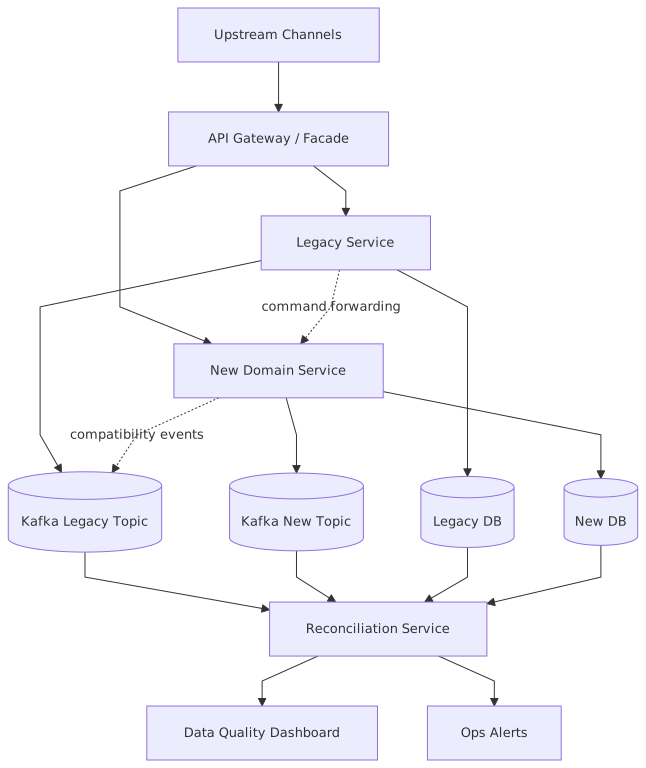
This diagram shows a pattern I like in messy enterprises: new authority behind old interfaces, with reconciliation proving correctness until consumers can move.
Migration Strategy
Ownership transfer should usually follow the same instinct as a strangler fig migration: grow the new authority around the old system until the old one becomes unnecessary.
That is more than a code migration pattern. It is an organizational migration pattern.
Step 1: Identify the real bounded context
Before moving anything, clarify what is actually being transferred.
Is it:
- a technical service?
- a business capability?
- an aggregate root and its lifecycle?
- a set of operational responsibilities?
- an integration function masquerading as a domain service?
This matters because many so-called microservices are really integration wrappers or CRUD shells. Transferring them as if they were meaningful domains simply relocates confusion.
Use domain event inventories, consumer maps, and decision logs to surface the true semantics. If the ubiquitous language is unstable, stop and fix that first.
Step 2: Map consumers and hidden dependencies
No ownership transfer plan survives contact with undocumented consumers. Kafka topics are notorious here. An event may be consumed by official systems, shadow ETL jobs, compliance tools, dashboards, and half-retired batch integrations.
Build a dependency map of:
- API consumers
- event consumers
- database readers, if any still exist
- operational dependencies
- reporting and reconciliation jobs
- support processes and manual workarounds
In enterprises, manual workarounds are architecture. If operations staff export CSVs every morning to fix state mismatches, that is part of the system whether you like it or not.
Step 3: Introduce semantic translation if needed
If the target domain model differs from the current one, insert translation boundaries instead of forcing all consumers to adapt at once. This can be:
- an anti-corruption layer
- a façade
- event translation streams
- schema registry compatibility policies
- canonical-to-domain mapping, used carefully
I’m wary of “canonical models” at enterprise scale because they often become abstraction swamps. But temporary translation can be justified during handoff.
Step 4: Run parallel authority with single write ownership
During migration, let the receiving team process commands or events in parallel, build derived state, and compare outcomes. But keep one system authoritative for writes until reconciliation proves confidence.
This is classic strangler migration logic applied to ownership.
Step 5: Shift the source of truth
Only after confidence thresholds are met should system-of-record authority move. This shift should be explicit. It needs:
- cutover criteria
- rollback or fallback criteria
- schema freeze windows where necessary
- comms to consumer teams
- audit trail for regulated changes
Step 6: Deprecate old contracts deliberately
Do not leave “temporary compatibility” in place forever. It becomes permanent tax.
A transfer is done only when:
- consumers use the new ownership path
- production support no longer routes through the old team
- old schemas/topics/interfaces are deprecated with dates
- reconciliation exceptions are below agreed thresholds
- decision rights are clearly with the new team
Enterprise Example
Consider a global bank with a central Customer Master team. Years ago, they built a “Customer Profile Service” to unify customer data across retail, wealth, and commercial systems. Over time, the retail digital onboarding team built most of the real customer acquisition journey: KYC, sanctions screening, mobile enrollment, communication preferences, and identity verification. They produced Kafka events for onboarding milestones but still had to call the Customer Profile Service to create and mutate customer records.
This created a bad split.
The Customer Master team owned the profile schema and service runtime, but they did not understand onboarding edge cases. The onboarding team understood the process but could not change profile semantics without negotiating every field addition, state transition, and event tweak. Incident response was worse. A failed onboarding journey might involve API retries in onboarding, stale data in the customer master database, delayed CDC events, and missed notifications downstream.
The bank decided to transfer ownership of retail customer profile creation and lifecycle events to the onboarding team, while keeping enterprise-wide customer identity matching with the Customer Master team.
That distinction saved them.
Instead of transferring the entire service, they redrew the domain boundary:
- Onboarding team: retail customer profile lifecycle during acquisition
- Customer Master team: enterprise identity resolution and cross-line golden record matching
This was classic DDD boundary correction. They stopped treating “customer” as one thing. In the business, it wasn’t.
The migration unfolded in phases:
- onboarding team became joint approver for schema and event changes affecting retail profile creation
- a façade routed retail create/update commands through the onboarding domain service
- onboarding produced a new Kafka topic for retail profile lifecycle events
- compatibility events were published to legacy topics for existing consumers
- reconciliation compared retail onboarding state, legacy profile records, and downstream CRM projections
- after exception rates dropped, retail profile authority moved to the onboarding service
- the Customer Master team retained matching and master identity correlation as a separate downstream capability
The key architectural choice was to use Kafka for propagation, but not as the source of truth by itself. The onboarding service became the transactional authority for retail acquisition state. Events fed downstream systems. A reconciliation service compared:
- onboarding aggregate state
- legacy customer profile state
- CRM customer projections
- sanctions screening completion state
They found ugly mismatches early:
- duplicate “customer created” events due to retry behavior
- legacy consumers assuming all profile updates implied KYC completion
- out-of-order event processing in one downstream risk system
- a manual operations dashboard reading the legacy database directly
None of these would have been fixed by changing repository ownership. They were ownership failures in disguise.
The result was not perfect purity. For nearly nine months, the bank ran translation and reconciliation layers. That sounds expensive. It was cheaper than another year of cross-team friction on a revenue-critical journey.
Operational Considerations
Ownership transfer lives or dies in operations.
Runbooks are part of the architecture
If the receiving team cannot explain the top ten incident patterns, they do not own the service yet. A runbook is not documentation garnish. It is the executable memory of the system.
Observability must follow domain language
Dashboards built around CPU, consumer lag, and HTTP 500s are not enough. The new owner needs domain metrics:
- customer profiles created
- onboarding states stuck beyond threshold
- verification completion latency
- reconciliation mismatch counts
- duplicate event rates
- contract version adoption
Technical telemetry tells you the machine is noisy. Domain telemetry tells you the business is injured.
Access and controls matter
Ownership transfer in enterprises requires IAM changes, deployment permissions, topic ACLs, schema registry rights, support routing, and audit responsibilities. If these lag behind the announced handoff, the old team remains the real owner whether anyone admits it or not.
Reconciliation needs product management
Reconciliation processes often start as “temporary.” Then they become permanent critical controls. Treat them as products:
- with owners
- thresholds
- exception workflows
- observability
- retention rules
- business sign-off on acceptable variance
That is especially true in financial services, healthcare, and supply chain.
Tradeoffs
No ownership transfer pattern is free.
The staged handoff pattern increases short-term complexity. You may run duplicate pipelines, bridge events, translation layers, and temporary dashboards. Architecture gets messier before it gets cleaner.
But the alternative is abrupt transfer, which usually hides risk rather than removing it.
There is also a tradeoff between preserving contracts and correcting the domain. Preserve too much, and the new team inherits semantic debt. Correct too aggressively, and consumers revolt. The right answer is often selective compatibility: preserve interfaces where cost of change is high, but draw new boundaries internally as soon as possible.
Kafka introduces its own tradeoff. It reduces direct coupling, which helps ownership transitions. But it increases discovery and governance problems. Event-driven ownership transfer works best when topics are clearly bounded, schemas are versioned, consumers are discoverable, and retention supports replay for validation. ArchiMate for governance
Reconciliation is another tradeoff. It adds operational overhead and can mask weak upstream design if used lazily. But for transfers involving money, compliance, customer entitlements, or critical records, not having reconciliation is wishful thinking in production clothing.
Failure Modes
A few failure modes appear again and again.
The ownership theater problem
The org chart says Team B owns it. In practice, Team A still approves schema changes, joins every incident bridge, and patches urgent defects. This is not shared ownership. It is delayed clarity.
Split-brain write authority
Both teams can mutate the same records during migration. Conflicts appear as intermittent data weirdness, the worst kind of enterprise bug.
Semantic drift
The new team copies interfaces but changes meaning subtly. A status of ACTIVE no longer implies the same business conditions, but consumers are never told. Systems keep integrating. Trust decays quietly.
Topic capture
A team “takes ownership” of a Kafka topic with dozens of consumers and starts evolving it for local needs. The topic was effectively enterprise public infrastructure; now it becomes a team-specific contract by accident.
Reconciliation without action loops
Mismatches are detected but not resolved systematically. The dashboard glows red every day. Operations normalize the pain. That is not control; that is ritual.
The endless transition
Compatibility publishers, old routes, bridge adapters, and dual support models remain for years. The transfer never finishes, and architecture accumulates sediment.
When Not To Use
Do not use a formal ownership transfer pattern when the thing being transferred should not exist as a separate service in the first place.
If a service is just thin CRUD over shared data with no meaningful domain behavior, moving it between teams may be rearranging furniture in a bad room. Sometimes the right move is consolidation, not transfer.
Do not use a heavy staged transfer for low-value internal utilities with minimal consumers and trivial semantics. A simpler operational handoff may be enough.
Do not transfer ownership before clarifying the bounded context. If the domain is still contested, you will transfer code and keep the argument.
And do not use Kafka as a handoff bandage if the underlying issue is synchronous transaction coupling that should remain within one bounded context. Not every ownership problem needs an event stream. Sometimes the honest answer is that the service boundary is wrong.
Related Patterns
Several related patterns often appear alongside ownership transfer:
- Strangler Fig Pattern for progressive migration from old authority to new
- Anti-Corruption Layer when the new owner needs to protect a cleaner domain model
- Backend for Frontend or Façade to shield consumers during transition
- Outbox Pattern for reliable event publication during system-of-record shifts
- Saga orchestration/choreography where process ownership spans multiple teams, though this can complicate transfer
- Consumer-driven contracts to manage interface evolution
- Team Topologies interaction modes for clearer collaboration during the transfer window
One pattern deserves caution: shared services. Enterprises often centralize too much, then use ownership transfer as a correction mechanism. Better to avoid over-centralization in the first place.
Here is a simplified view of team and domain alignment before and after transfer.
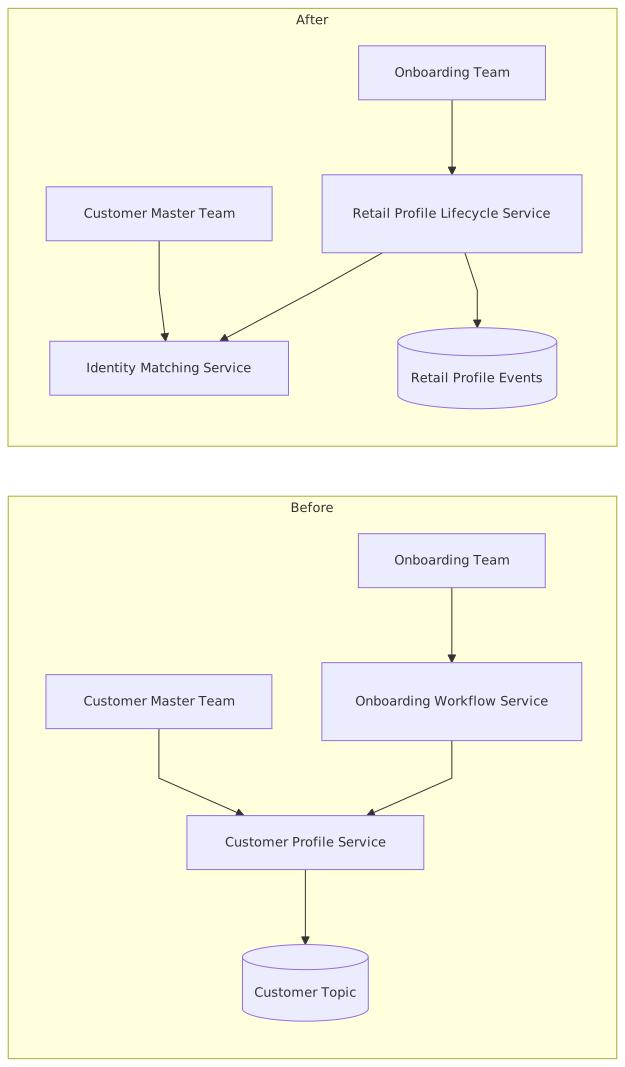
The point is not more services. The point is better semantics and cleaner ownership.
Summary
Ownership transfer in microservices teams is not administration wrapped in Jira workflow. It is architecture under pressure.
The real asset being transferred is not the codebase. It is the right to define behavior, evolve contracts, interpret domain meaning, and carry operational consequence. When those pieces move together, teams gain autonomy and systems become easier to change. When they move separately, enterprises create shadow ownership, semantic drift, and incident pinball.
The patterns that work are staged, explicit, and domain-led:
- clarify the bounded context
- separate semantic, interface, data, and operational ownership
- use progressive strangler migration rather than abrupt cutover
- prefer single-write authority
- use Kafka carefully, with topic semantics and discoverability in mind
- design reconciliation as a first-class control
- complete the transfer by removing temporary scaffolding
The memorable line here is simple: ownership is where the business meaning lives when production is on fire.
If the wrong team answers that call, your architecture is lying to you.
Frequently Asked Questions
What is a service mesh?
A service mesh is an infrastructure layer managing service-to-service communication. It provides mutual TLS, load balancing, circuit breaking, retries, and observability without each service implementing these capabilities. Istio and Linkerd are common implementations.
How do you document microservices architecture for governance?
Use ArchiMate Application Cooperation diagrams for the service landscape, UML Component diagrams for internal structure, UML Sequence diagrams for key flows, and UML Deployment diagrams for Kubernetes topology. All views can coexist in Sparx EA with full traceability.
What is the difference between choreography and orchestration in microservices?
Choreography has services react to events independently — no central coordinator. Orchestration uses a central workflow engine that calls services in sequence. Choreography scales better but is harder to debug; orchestration is easier to reason about but creates a central coupling point.