⏱ 22 min read
Architecture diagrams lie. Not because architects are dishonest, but because the enterprise moves faster than its own self-image.
A team draws a clean picture in a workshop: payment service talks to order service, order emits events to Kafka, inventory updates stock, customer profiles live behind a tidy API boundary. Six months later, the real system has accumulated side doors, emergency patches, convenience integrations, shared databases, direct calls nobody approved, event consumers nobody owns, and a Terraform stack that drifted just enough to make incident response feel like archaeology. The diagram still hangs in Confluence like a family portrait from before the divorce.
This is architecture drift.
And in cloud microservices, drift is not an edge case. It is gravity.
The problem is not simply that the “actual” architecture differs from the “expected” one. The deeper problem is that enterprises keep treating architecture as a static document instead of a living hypothesis. Once you accept that architecture is a hypothesis, drift detection becomes less about compliance theater and more about reconciliation between intent and reality. That is where things get interesting.
What follows is a practical architecture for detecting drift in cloud-native microservices environments: comparing expected relationships, boundaries, and operational constraints against what the platform is actually doing. It includes domain-driven design thinking, progressive strangler migration, Kafka-heavy event landscapes, and the tradeoffs that matter when you have both developers and auditors asking difficult questions. event-driven architecture patterns
Context
Most microservices estates start with good intentions and end in negotiation.
The early architecture usually reflects domain boundaries: Orders, Payments, Inventory, Pricing, Customer, Fulfillment. These are not technical boxes; they are business commitments. A bounded context says, “inside here, this language means something precise.” That matters. “Order accepted” in the Orders context is not the same thing as “payment settled” in the Payments context, even if both appear in the same customer journey. Domain semantics are the first line of defense against accidental coupling.
But cloud platforms are extremely efficient at making coupling easy. Service meshes make calls look harmless. Kafka makes event publication almost frictionless. Infrastructure as code promises consistency, until half the estate is managed through pipelines and the other half by people clicking in consoles at 2 a.m. A platform team adds a shared secret store; application teams begin to infer dependencies. A reporting team subscribes directly to internal topics. A “temporary” direct read into another service’s database survives three annual budgeting cycles.
The enterprise still has an architecture. It just no longer has one architecture.
What it has instead is:
- an intended architecture captured in diagrams, ADRs, domain maps, policy rules, IaC repositories, and platform standards
- an actual architecture observable through runtime traffic, deployment manifests, cloud resource topology, Kafka topic relationships, IAM policies, traces, and data lineage
- a widening gap between the two
That gap is not merely a governance concern. It affects resilience, security, cognitive load, cost, and the integrity of domain boundaries. If your Customer service starts calling Pricing synchronously during checkout because someone found it convenient, that is not just a technical drift. It can quietly move pricing authority out of its bounded context and into somebody else’s transaction path.
Architecture drift detection is the mechanism for seeing this before it becomes institutionalized.
Problem
The naive version of the problem sounds simple: compare the expected architecture diagram with the actual deployed system. In reality, it is much harder because “expected” and “actual” each contain ambiguity.
Expected architecture is often fragmented across multiple sources:
- DDD context maps
- C4 or logical component diagrams
- API specifications
- Kafka topic ownership declarations
- Kubernetes manifests
- Terraform modules
- OPA or policy-as-code rules
- CMDB records that are wrong with confidence
- tribal knowledge in Slack threads
Actual architecture is also fragmented:
- service-to-service calls from traces or mesh telemetry
- Kafka producers and consumers from broker metadata and ACLs
- cloud resources from AWS, Azure, or GCP APIs
- IAM trust chains
- DNS and ingress routes
- data movement via ETL, CDC, and object storage
- undocumented manual exceptions
- dormant integrations that wake up only at quarter close
Now add time. Drift is temporal. A one-off connection during a controlled migration is not the same as a long-lived dependency. A canary path is not necessarily an architectural violation. A reconciliation batch job that reads from three domains may be legitimate if it sits in a reporting context, illegitimate if it starts mutating operational data.
So the real problem is this:
How do we continuously reconcile intended domain boundaries, service relationships, infrastructure policies, and event topology against observed runtime and deployment reality, in a way that distinguishes acceptable evolution from dangerous drift?
That is the heart of it.
Forces
Any serious design here has to navigate a set of tensions. Ignore them and you build a brittle governance machine nobody trusts. EA governance checklist
1. Domain purity versus delivery speed
Domain-driven design asks for clear bounded contexts and explicit integration patterns. Delivery pressure asks for “just call the other service.” Drift often begins as pragmatism with a deadline.
2. Design-time truth versus runtime truth
What teams declare is not always what the platform observes. If I had to choose, I trust runtime data more. But runtime data without domain intent is just noise. A TCP connection tells you that a dependency exists, not whether it should.
3. Central visibility versus team autonomy
A central architecture function wants enterprise-wide visibility. Product teams want freedom to evolve. Drift detection that feels like surveillance will be bypassed. Drift detection that is too passive becomes decorative.
4. Static topology versus event-driven behavior
Synchronous service calls are relatively easy to observe. Kafka ecosystems are trickier. Topics are often shared, consumer groups are dynamic, and event contracts evolve independently. Drift in event-driven systems frequently hides in semantics, not wires.
5. Policy enforcement versus migration reality
In a greenfield world, you can enforce strict rules. In a real enterprise, you inherit shared databases, mainframe feeds, legacy ESBs, nightly reconciliations, and BI extracts nobody can retire. Progressive strangler migration requires temporary states. Your drift detection model must understand sanctioned exceptions.
6. Precision versus operability
A system that reports every unexpected edge will drown teams in false positives. A system that only flags catastrophic drift will miss the slow rot. You need thresholds, durations, confidence scores, and business context.
This is not a technical puzzle alone. It is a socio-technical one. Which is why the architecture has to encode both machine-observable facts and business meaning.
Solution
The most effective pattern is to build an architecture reconciliation capability rather than a static documentation repository.
I use the word reconciliation deliberately. Enterprises already understand reconciliation in finance: expected ledger balance versus actual transactions, with controls for variance. Architecture drift detection should work the same way. You maintain a declared model of expected architecture, collect observed evidence of actual architecture, compare them continuously, classify differences, and route outcomes into governance, engineering workflow, and migration planning. ArchiMate for governance
The key design move is to treat expected architecture as executable intent.
That expected model should contain more than boxes and arrows. It should include:
- bounded contexts and service ownership
- allowed and forbidden service dependencies
- API interaction styles
- Kafka topic ownership, producer rules, and consumer policies
- data residency and data access constraints
- infrastructure placement constraints
- environment-specific exceptions
- migration windows and approved temporary dependencies
Then you collect actual state from multiple telemetry planes:
- runtime traces for HTTP/gRPC calls
- service mesh or eBPF network observations
- Kafka metadata and ACLs
- Kubernetes and cloud control plane inventories
- IAM relationships
- schema registry and event contract lineage
- database connectivity and CDC flows
- CI/CD deployment metadata
Finally, you compare them through a policy engine and produce a set of drift records with severity, confidence, duration, domain impact, and ownership.
This is not just another observability dashboard. Observability tells you what happened. Drift detection tells you what should not be happening, what is unexpectedly absent, and what has changed the architecture’s meaning.
Core principles
- Model domains first, technology second.
If the system only knows pods and topics, it cannot reason about architectural integrity.
- Capture expected architecture as data.
Diagrams are useful. Machine-readable declarations are essential.
- Observe from several sources.
One data source will always be incomplete or misleading.
- Differentiate persistent drift from transient change.
Duration matters.
- Support sanctioned exceptions and migration intent.
Architecture that cannot tolerate transitional states is fantasy architecture.
- Close the loop.
Drift that is detected but not assigned, triaged, and fed back into backlog or policy is merely expensive awareness.
Architecture
At a high level, the architecture has five capabilities:
- Expected Model Registry
- Actual State Collectors
- Reconciliation Engine
- Drift Knowledge Store
- Action and Visualization Layer
Here is the conceptual shape.
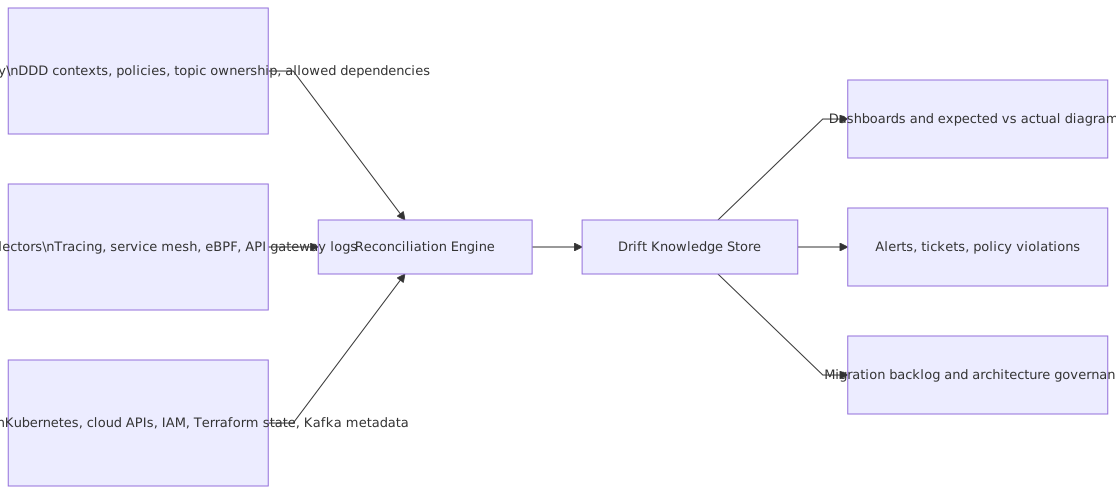
Expected Model Registry
This is the backbone. Without it, drift detection degenerates into anomaly detection.
The registry should store a machine-readable model of architecture intent. The format can vary: YAML in Git, a graph model, Backstage catalog extensions, a custom metadata service, or all three with synchronization. The point is not tooling fashion. The point is explicitness.
A service record might include:
- service name and owner
- bounded context
- upstream/downstream allowed relationships
- integration mode: synchronous API, async event, batch, CDC
- Kafka topics produced and consumed
- data classification
- deployment constraints
- approved exceptions with expiry date
- migration tags such as
strangler-phase=2
This is where DDD matters. If services are not mapped to bounded contexts and domain capabilities, you will detect topology drift without understanding semantic drift. That is dangerous because some violations matter much more than others. A direct call from Customer to Pricing may be inconvenient. A direct write from Reporting into Orders may corrupt the business model.
Actual State Collectors
The actual system is assembled from evidence.
For synchronous dependencies, distributed tracing is ideal because it captures causality. Service mesh telemetry or eBPF-based network observation can supplement where tracing coverage is incomplete. API gateway logs are useful for edge-to-service visibility.
For Kafka, collect:
- topic metadata
- producer identities
- consumer groups
- ACLs
- schema versions and ownership
- dead-letter topics
- lag patterns
- undocumented consumers discovered from broker metadata
For infrastructure drift:
- Kubernetes deployments, namespaces, services, ingress, network policies
- cloud load balancers, storage buckets, IAM roles, security groups
- Terraform state versus cloud API reality
- secret and certificate access patterns
You are building a graph of what actually exists and what actually talks to what.
Reconciliation Engine
This is the decision point. The engine compares expected and actual graphs, but it should do more than diff edges.
It should classify findings such as:
- Unexpected dependency: service A calls service B, not in approved model
- Missing dependency: expected path absent, indicating stale docs or broken deployment
- Boundary violation: access crosses forbidden domain boundary
- Topic ownership violation: unauthorized producer publishes to a domain event topic
- Infrastructure placement drift: service deployed outside approved zone/account/cluster
- Policy drift: network policy, IAM, or encryption rule violated
- Semantic drift signal: event schema used in ways inconsistent with ownership or contract intent
Severity should be domain-aware. A forbidden call into a PCI payment context is more serious than an extra metrics sidecar path.
Drift Knowledge Store
Persist drift over time. This matters.
If you only compute current differences, you cannot distinguish a migration window from long-term entropy. The knowledge store should track:
- first seen / last seen
- frequency and duration
- environments affected
- owner acknowledgment
- waiver or exception status
- linked incidents or changes
- remediation state
This historical layer turns drift detection into architecture memory.
Action and Visualization
Teams need two views:
- Architect view: expected vs actual graphs, drift trends, domain boundary health
- Team view: findings for a specific service, suggested actions, related ADRs and policies
And yes, you need an expected-versus-actual diagram. People think visually. But the diagram must be generated from the model and observations, not manually curated after the fact.
Here is an example focused on a commerce domain.

That picture is useful because it tells a story quickly. But the machine-readable details behind it are what drive action.
Migration Strategy
Most enterprises cannot introduce this capability in one shot. Nor should they.
The right approach is a progressive strangler migration: start by observing and modeling a narrow slice of the estate, prove value, and gradually replace manual architecture conformance checks with automated reconciliation.
This is the migration path I recommend.
Phase 1: Passive discovery
Begin with runtime and platform collectors. Build the actual dependency graph for a small but meaningful domain—say, order-to-cash. Do not enforce anything yet. Let teams see their own topology. This alone is often eye-opening.
You will discover:
- hidden dependencies
- undocumented consumers
- duplicate services
- environment-specific drift
- stale diagrams nobody should be trusting
Phase 2: Declare expected architecture for one value stream
Pick one business capability and model it explicitly: bounded contexts, approved dependencies, Kafka topic ownership, and key policy rules. Keep the model small. Precision beats breadth early on.
This is where domain semantics must be handled carefully. You are not simply declaring that orders-service can call payments-service. You are declaring why that relationship exists and whether it should be synchronous, asynchronous, or forbidden under specific conditions.
Phase 3: Reconcile and review manually
Run reconciliation as a report, not as a gate. Review findings with domain teams and platform engineers. Expect disagreement. That disagreement is valuable. It exposes where the declared architecture is unrealistic or where actual behavior has escaped design intent.
Phase 4: Introduce policy-backed guardrails
Once the model is trustworthy, begin enforcing a subset of high-value rules:
- forbidden direct database access
- unauthorized Kafka producers
- deployments outside regulated boundaries
- service calls that cross sensitive contexts
- expired migration exceptions
Use warnings before hard blocks unless the risk is severe.
Phase 5: Expand through strangler coverage
Gradually onboard more domains and legacy integration paths. Replace spreadsheet-based governance with automated drift controls. Feed findings into portfolio planning and modernization programs.
Here is the migration pattern in simplified form.

Why strangler matters here
Because drift detection itself must coexist with legacy architecture practice. You are not merely deploying a tool. You are migrating the enterprise from architecture as periodic documentation to architecture as continuously reconciled operational truth.
That is a cultural migration as much as a technical one.
Enterprise Example
Consider a global retailer modernizing its order management estate.
The retailer had:
- a legacy ERP
- an e-commerce platform
- new cloud microservices for orders, payments, inventory, pricing, and customer profile
- Kafka as the integration backbone
- regional deployment constraints for customer data
- a reporting landscape consuming everything it could reach
On paper, the architecture was clean. Orders published OrderPlaced, Payments published PaymentAuthorized, Inventory consumed order events and emitted stock reservation outcomes. Reporting consumed curated data products, not internal operational topics. Customer data stayed within region-specific boundaries.
Reality was messier.
During a peak-season initiative, one team added a direct synchronous call from Orders to Inventory to “speed up reservation certainty.” Another team created an undocumented consumer group reading internal payment topics for fraud analytics. A support utility gained direct database read access to Orders. In one region, the Customer service was deployed in the wrong account because of an infrastructure pipeline misconfiguration. None of this was reflected in the approved architecture.
The retailer introduced architecture drift detection in the order-to-cash value stream.
Expected model
They declared:
- Orders belongs to the Order Management bounded context
- Inventory belongs to the Stock bounded context
- Orders may publish reservation requests through Kafka but may not synchronously call Inventory
- Payment topics are owned by Payments and may only be consumed by approved services
- Customer PII workloads must remain in region-bound accounts
- Reporting must consume curated topics only
Actual observation
Using tracing, Kafka broker metadata, cloud APIs, and IAM inventory, they built the actual graph. The reconciliation engine found:
- Unexpected sync call from Orders to Inventory
- Unauthorized consumer group on payment topics
- Direct DB read path into Orders
- Regional deployment drift for Customer service
- Missing event consumption path in one market due to failed deployment
This is where the value became obvious. The findings were not just “violations.” They surfaced business risk:
- The sync call increased checkout latency and introduced a new failure mode where inventory slowness could now block order acceptance.
- The unauthorized payment topic consumer violated data access policy and increased schema change risk.
- Direct DB reads bypassed the Orders context, undermining the domain model.
- Regional deployment drift created a compliance exposure.
- Missing event consumption meant stock updates were stale in one market.
Outcome
The enterprise used progressive strangler tactics:
- The sync Orders-to-Inventory call was allowed temporarily under an exception with expiry, while a Kafka-based reservation flow was stabilized.
- Fraud analytics was moved to curated, contract-governed topics.
- The support utility was replaced with an explicit read model API.
- Infrastructure pipelines were updated with region policy checks.
- Drift findings were integrated into architecture review, not as a separate bureaucratic lane but as evidence.
The memorable lesson from that program was simple: they stopped arguing about whose diagram was right, because they had a reconciliation system that could show where reality and intention diverged.
That is a different level of conversation.
Operational Considerations
This capability lives or dies on operational discipline.
Data quality and coverage
Tracing coverage is rarely complete. Kafka metadata may not reveal semantic intent. Cloud APIs tell you what exists, not why. Expect partial truth. The design should attach confidence scores to findings and combine multiple signals before escalating.
Identity and naming consistency
Microservices estates often suffer from naming chaos. Service names differ between code, deployment, tracing, IAM, and Kafka ACLs. Invest early in service identity normalization. It is dull work. It is essential work.
Event semantics
Kafka drift detection is not just about who consumes what. It is about domain meaning. If a topic named customer-events carries both profile changes and marketing preferences from different ownership models, your architecture is already drifting semantically. Schema registry metadata, topic contracts, and ownership catalogs should be part of the expected model.
Reconciliation windows
Run continuously, but classify over time. A one-hour unexpected edge during deployment is not the same as a 45-day persistent dependency. Add time thresholds and deployment awareness.
Integration with delivery workflow
The system should create tickets, annotate pull requests, feed scorecards, and expose APIs. If findings only live in a central dashboard, teams will ignore them until the architecture board waves a red flag.
Exceptions management
Temporary waivers need expiry dates and named owners. Nothing becomes more permanent in an enterprise than a temporary integration path without a sunset.
Security and privacy
Drift detection sees a lot: network paths, topic relationships, resource topology, identity mappings. That makes it sensitive. Apply least privilege and be careful with who can see cross-domain topology, especially in regulated environments.
Tradeoffs
There is no free lunch here.
Benefit: architectural integrity
Cost: modeling overhead
Teams must declare expected relationships and keep them current. Some will see this as bureaucracy. They are not entirely wrong. But the alternative is unmanaged entropy disguised as agility.
Benefit: early detection of risky coupling
Cost: false positives
Runtime observations can mislead. Shared infrastructure, sidecars, ephemeral jobs, and migrations all create noise. If you lack contextual suppression, teams will lose trust quickly.
Benefit: stronger DDD boundaries
Cost: up-front semantic work
You cannot automate domain reasoning you have never made explicit. Enterprises that skipped bounded context thinking will feel this pain.
Benefit: safer migration and modernization
Cost: transitional complexity
Supporting temporary exceptions, dual-write windows, and strangler phases complicates the reconciliation model. Necessary, but not pretty.
Benefit: better governance evidence
Cost: governance temptation
Once such a platform exists, every control function will want to pile on. Resist turning drift detection into a universal enterprise control tower. Keep it focused on architecture integrity, not every conceivable compliance issue.
My bias is clear: the tradeoff is worth it in medium-to-large microservices estates, especially where Kafka and cloud infrastructure create a lot of hidden coupling. But this is not a toy to build because “graph databases are interesting.” microservices architecture diagrams
Failure Modes
This pattern can fail in predictable ways.
1. Diagram theater with machine lipstick
The enterprise builds a fancy expected-versus-actual view, but the expected model is still manually curated and mostly stale. You have simply digitized old failure.
2. Tool-first, domain-later
A platform team buys or builds a dependency mapping tool and assumes architecture understanding will emerge. It will not. Without bounded contexts, ownership, and semantic policy, the system produces technically accurate but architecturally shallow output.
3. Alert fatigue
Every unexpected edge becomes a violation. Teams drown. The platform is muted. Drift becomes normalized again.
4. No migration semantics
The engine flags every transitional state during strangler migration as drift. Teams learn to treat findings as background radiation. The system loses authority.
5. Runtime-only bias
You trust observed traffic but ignore unexercised dependencies and latent risk. Dormant consumers, over-permissive IAM, and declared-but-unused paths can still matter.
6. Governance without remediation path
Findings are raised, but nobody owns fixing them, and delivery plans do not account for architecture debt. Drift detection then becomes a reporting machine for unresolved anxiety.
7. Shared topic chaos
In Kafka-heavy enterprises, teams use topics as public sidewalks. If ownership is weak and schemas are loosely governed, drift detection may tell you the estate is tangled without offering clean remediation because the architectural policy itself was never disciplined.
A good architecture should not just detect failure. It should make failure legible.
When Not To Use
This pattern is not always justified.
Do not reach for architecture drift detection if:
- you have a small system with a handful of services and high team awareness
- your architecture changes infrequently and is easy to review manually
- domain boundaries are still highly volatile and not yet worth formalizing
- observability maturity is too low to produce trustworthy actual-state data
- the organization lacks appetite to act on findings
- your estate is effectively a modular monolith and should remain one
A modular monolith with strong internal boundaries often benefits more from static architecture tests and code-level dependency rules than from a full cloud drift detection platform.
Likewise, if your enterprise has not invested in service ownership, domain maps, and platform metadata, start there. Drift detection without ownership is like a smoke alarm in a building with no exits.
Related Patterns
This pattern sits well with several adjacent practices.
Architecture fitness functions
Useful for enforcing specific rules in CI/CD. Drift detection complements them by comparing design intent with runtime and platform reality.
Policy as code
OPA, Kyverno, cloud policy engines, and admission controllers are natural enforcement mechanisms for a subset of drift rules.
Service catalog / developer portal
Backstage or similar catalogs can host expected architecture metadata, ownership, and links to drift findings.
Event contract governance
Schema registry, consumer-driven contracts, and topic ownership policies are essential in Kafka landscapes where semantic drift is common.
Data lineage and reconciliation
Especially relevant where domain events feed analytics or regulatory reporting. Data reconciliation and architecture reconciliation reinforce each other.
Strangler fig pattern
Central to adopting drift detection in legacy-heavy enterprises and to managing temporary exceptions during modernization.
Domain observability
An emerging and useful idea: observing not just service health but domain outcomes and semantic flow. Drift detection becomes much more valuable when linked to business capabilities rather than only technical components.
Summary
Architecture drift detection is not a better diagramming exercise. It is a reconciliation capability for the modern enterprise.
In cloud microservices, the expected architecture and the actual architecture will diverge. That is normal. What matters is whether the divergence is visible, classified, intentional, temporary, and governed. The right design combines domain-driven thinking, machine-readable architecture intent, multi-source runtime observation, and a reconciliation engine that can tell the difference between evolution and decay.
The crucial move is to model domain semantics, not just service topology. Bounded contexts, Kafka topic ownership, policy constraints, and migration exceptions must all be explicit. Then you can generate expected-versus-actual diagrams that mean something, support progressive strangler migration without drowning teams in false alarms, and make architecture a living operational discipline instead of a stale slide deck.
The enterprises that do this well stop treating architecture as artwork. They treat it as a ledger to be reconciled.
That is a much healthier habit.
Frequently Asked Questions
What is a service mesh?
A service mesh is an infrastructure layer managing service-to-service communication. It provides mutual TLS, load balancing, circuit breaking, retries, and observability without each service implementing these capabilities. Istio and Linkerd are common implementations.
How do you document microservices architecture for governance?
Use ArchiMate Application Cooperation diagrams for the service landscape, UML Component diagrams for internal structure, UML Sequence diagrams for key flows, and UML Deployment diagrams for Kubernetes topology. All views can coexist in Sparx EA with full traceability.
What is the difference between choreography and orchestration in microservices?
Choreography has services react to events independently — no central coordinator. Orchestration uses a central workflow engine that calls services in sequence. Choreography scales better but is harder to debug; orchestration is easier to reason about but creates a central coupling point.