⏱ 21 min read
There is a moment in every large architecture program when the team realizes the old system is not going away on Friday.
It never does.
The mainframe still settles the books. The monolith still knows how pricing really works. The old SOAP service, that strange survivor from three CIOs ago, still drives claims, orders, or customer onboarding in ways no one fully admits in the steering committee. Meanwhile, the business wants mobile apps, partner APIs, event streams, near-real-time decisions, and product teams that can ship independently. So we invent a polite fiction: we say we are “modernizing.” What we usually mean is that we are trying to change everything important without breaking anything that pays the bills.
That is where API compatibility layers earn their keep.
A compatibility layer is not glamorous. It is not the thing you put on the conference slide next to “cloud-native” and “AI-enabled.” It is a translation membrane. It absorbs the mismatch between what the old world means and how the new world wants to behave. It allows one side of the enterprise to evolve without forcing the other side to collapse in panic. In microservices, where we prefer autonomous teams and bounded contexts, compatibility layers become one of the few sane ways to migrate from legacy interfaces to domain-aligned services without detonating every consumer. microservices architecture diagrams
Used well, a compatibility layer buys time, isolates churn, and preserves domain semantics through change. Used badly, it becomes a museum of historical mistakes with a REST endpoint.
This article is about the difference.
Context
Microservices architecture promised independent deployability, bounded contexts, and systems organized around business capabilities rather than technical layers. Much of that promise is real. But in established enterprises, microservices rarely start on a clean field. They grow around existing systems: core banking platforms, policy administration engines, ERPs, warehouse systems, and homegrown monoliths that long ago became institutional memory encoded in Java and SQL.
The friction shows up at the seams.
Legacy systems often expose interfaces that reflect internal structure, not business intent. Methods such as updateCustomerRecord, setStatusCode, or processOrderV2 tell you more about database tables and release history than about the domain. Modern microservices, especially those designed with domain-driven design in mind, want clearer language: Customer Profile, Order Fulfillment, Payment Authorization, Claims Adjudication. They want contracts that represent meaningful business capabilities and explicit ownership.
The problem is that consumers cannot all change at once. Mobile apps, partner integrations, branch systems, batch jobs, analytics pipelines, and upstream services each move on their own timeline. That means the architecture must tolerate semantic drift while migration is underway.
This is why compatibility layers matter. They give you a place to convert old APIs into new service contracts, bridge synchronous and asynchronous interaction styles, and preserve continuity while the underlying architecture changes. They are often the practical mechanism behind a strangler migration, especially where Kafka, event-driven integration, and phased decomposition are part of the modernization strategy. event-driven architecture patterns
Problem
A legacy API is rarely just “an API.” It is a bundle of assumptions.
It assumes a certain data shape.
It assumes a transaction boundary.
It assumes a sequence of calls.
It assumes error codes that only make sense if you know the old system.
It assumes that “customer” means one thing, when in practice sales, billing, support, and risk each mean something different.
When teams decompose a monolith into microservices, they often discover that consumers are tightly coupled to those assumptions. You can replace an endpoint signature and call it version 2, but that does not solve the harder issue: the meaning of the operation has changed.
That is the heart of API compatibility in microservices. The challenge is not merely protocol conversion from SOAP to REST, or XML to JSON. The challenge is preserving or deliberately reshaping domain semantics while multiple generations of systems coexist.
Typical symptoms include:
- Legacy clients depend on coarse-grained APIs that bundle several business operations together.
- New microservices split those operations across bounded contexts.
- The old request-response model collides with event-driven workflows.
- Data models differ in granularity, identity, and lifecycle.
- Transactionality expectations shift from ACID-style updates to eventual consistency.
- Error handling and retry behavior become ambiguous across boundaries.
Without a compatibility layer, every consumer has to understand the migration details. That is architectural leakage. It spreads coupling across the estate. It forces dozens of teams to coordinate around internals they should never have needed to know.
And coordination is the tax that kills most modernization programs.
Forces
This design space is shaped by competing forces. Ignore them and the architecture becomes either rigid or dishonest.
Stability versus progress
Consumers want stable contracts. Platform and domain teams want to improve models, split services, and reduce accidental coupling. A compatibility layer exists because both are right.
Domain purity versus delivery reality
DDD encourages clean bounded contexts and language that reflects the business. Good. But the enterprise runs on half-clean, historically layered semantics. A compatibility layer often has to map from an old, distorted model to a more honest one. Purists hate this. Operations teams usually love it, because the business keeps running.
Synchronous expectations versus asynchronous truth
Legacy APIs often assume immediate completion: call a service, get the answer, commit the work. Modern microservices frequently rely on Kafka and asynchronous collaboration. Compatibility layers must bridge this gap. Sometimes they acknowledge a request immediately and reconcile later. Sometimes they orchestrate multiple backend calls to simulate the old synchronous contract. Both choices have cost.
Consumer independence versus central translation complexity
A compatibility layer reduces migration burden on consumers, but it centralizes translation logic. Done carefully, that is useful leverage. Done carelessly, it becomes a God adapter, the new monolith wearing JSON.
Technical translation versus semantic translation
Transforming XML to JSON is cheap. Translating “policy issued” from one domain model to another is not. Semantic compatibility requires business understanding, not just middleware.
Short-term migration tool versus permanent enterprise asset
Some compatibility layers should die after migration. Others become long-lived products: partner façades, channel APIs, anti-corruption layers around packaged systems. The expected lifespan affects design choices, testing, observability, and governance. EA governance checklist
Solution
An API compatibility layer is a mediating boundary that exposes a stable contract to existing consumers while internally routing, transforming, orchestrating, or publishing interactions to a new set of microservices.
At its best, it acts as an anti-corruption layer in the DDD sense. It prevents the old model from bleeding into the new one. This point matters. Many so-called compatibility layers do the opposite: they reproduce legacy naming, legacy data structures, and legacy assumptions directly inside the new microservices. That is not compatibility. That is contamination.
The better approach is to put the mess at the edge.
The compatibility layer should:
- Preserve required legacy behaviors for existing consumers.
- Translate requests and responses into domain-aligned service contracts.
- Handle protocol adaptation, including REST, SOAP, gRPC, messaging, or Kafka events.
- Manage versioning and deprecation policies.
- Encapsulate orchestration needed to emulate former coarse-grained interactions.
- Support reconciliation when asynchronous workflows replace immediate consistency.
- Provide observability for both old and new interaction paths.
There are several implementation styles.
1. Pass-through translation
This is the simplest form. The layer remaps field names, data types, and endpoint structure, then forwards requests to a target microservice. Useful when semantics remain close.
2. Composite façade
The layer receives one legacy request and coordinates several backend microservices to fulfill it. Common during decomposition of a monolith where one old API covered multiple business capabilities.
3. Protocol bridge
The layer exposes one protocol externally and uses another internally. SOAP-to-REST, REST-to-Kafka command publishing, or synchronous request to asynchronous workflow initiation all fall here.
4. Semantic anti-corruption layer
The layer actively translates between domain models. This is the most important and the most difficult form. It maps concepts, identity, states, and business rules between bounded contexts.
A good compatibility layer is explicit about what it preserves and what it changes. It should document where behavior is exact, where it is approximated, and where consumers must eventually adapt.
If you hide those differences, you merely defer pain.
Architecture
The simplest useful architecture places the compatibility layer between legacy consumers and the new service landscape. But the internal shape matters.
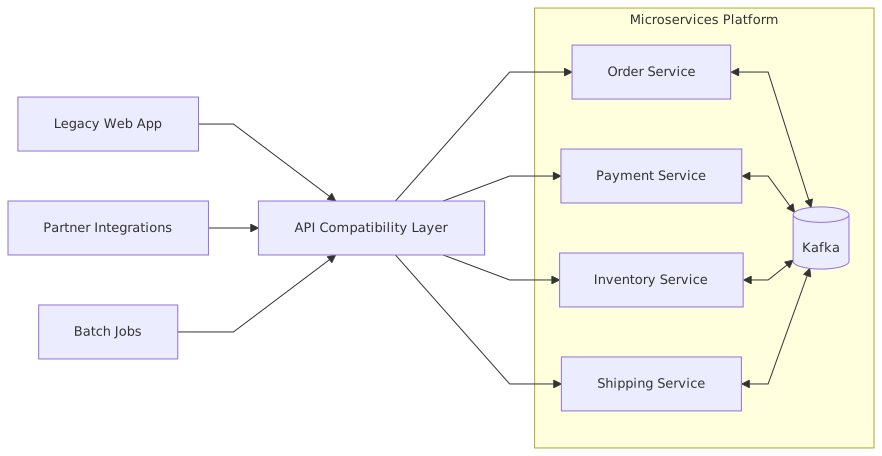
This picture is deceptively calm. The real questions are around responsibility.
What belongs in the compatibility layer?
The compatibility layer should own:
- consumer-specific contract preservation
- transformation and mapping
- coarse orchestration required by old contracts
- protocol mediation
- compatibility-level authorization or routing where necessary
- correlation IDs and migration observability
The compatibility layer should not own:
- core domain decisions
- canonical business rules for new capabilities
- long-term workflow state unless it is specifically acting as a migration façade
- direct persistence of business entities except for migration metadata, idempotency, or reconciliation markers
That split is crucial. Once business rules start accumulating inside the layer, you have built a second monolith in front of your microservices.
Domain semantics and bounded contexts
Suppose the legacy API exposes a Customer object. In the new platform, there may be several bounded contexts:
- Customer Profile owns identity and contact details.
- Billing Account owns invoicing relationships.
- Risk owns KYC status and exposure.
- Support owns service interaction history.
A compatibility layer may still need to expose Customer to old consumers. But internally it should understand that this is a composite legacy view, not a single source of truth. It is translating a broad historical concept into multiple domain concepts with distinct owners.
This is where domain-driven design pays off. It gives the architecture language to explain why there is no single replacement endpoint for the old API. The monolith hid multiple domains under one table. The new architecture names them.
Synchronous façade over asynchronous core
A common pattern is to preserve a synchronous legacy API while internally using Kafka for distributed workflow. For example, a legacy PlaceOrder call may now initiate a command, trigger inventory reservation, payment authorization, and shipping preparation via events.
The compatibility layer has several choices:
- Wait for the full workflow and return a final result.
Good for preserving behavior. Bad for latency, fragility, and cascading failure.
- Return acceptance with a tracking ID.
Honest architecture, but incompatible with clients expecting immediate completion.
- Return a provisional response that may later be corrected through reconciliation.
Operationally messy, but sometimes the only path in enterprise migration.
The right answer depends on business semantics, not style preference. If a regulation or customer promise requires final confirmation before response, you cannot hide behind eventual consistency. If the old synchronous API only appeared final while downstream batch reconciliation corrected mistakes later, then an asynchronous model may actually be more faithful to reality.
Here is a common compatibility pattern for that scenario:
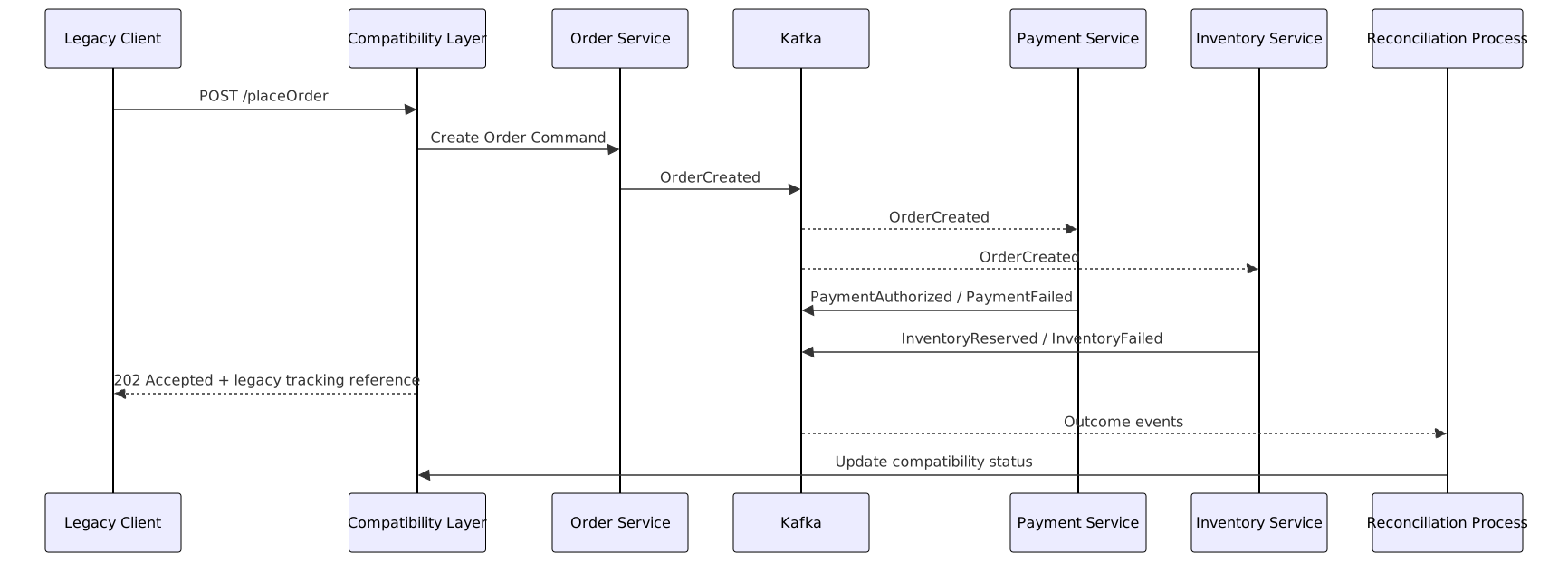
This design works if the enterprise accepts the shift from immediate completion to tracked completion. It fails if consumers silently depend on old timing guarantees they never documented.
Data mapping and identity management
Compatibility layers often need a mapping registry:
- old customer IDs to new profile IDs
- old status codes to domain states
- old error code taxonomies to modern API errors
- legacy composite keys to explicit aggregate identities
That mapping may be static, derived, or stored. Be careful. Stored mappings can become a hidden master data system. If the compatibility layer starts inventing identifiers and owning cross-domain reference truth, it becomes a dangerous center of gravity.
Reconciliation
Any time a compatibility layer bridges old synchronous assumptions to new asynchronous workflows, reconciliation becomes part of the architecture, not an afterthought.
Reconciliation means:
- detecting incomplete or divergent outcomes
- comparing compatibility-layer records with downstream service truth
- replaying messages or compensating actions
- surfacing unresolved mismatches to operations teams
In other words, the compatibility layer must remember enough to know when the world did not line up as expected.
That memory may include:
- idempotency keys
- correlation IDs
- request snapshots
- expected event timelines
- terminal or compensating status
A serious enterprise design treats reconciliation like accounting, not like logging. If money, inventory, entitlements, or legal commitments are involved, you need a visible mechanism to prove consistency and recover from mismatch.
Migration Strategy
Compatibility layers are most useful in progressive strangler migration. The idea is simple: keep the external contract stable while gradually rerouting behavior from the monolith to new services.
Simple ideas can still be hard work.
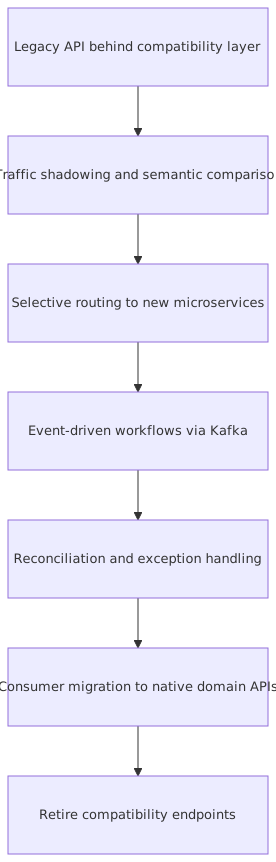
A practical migration usually moves in phases:
Phase 1: Front the legacy API
Introduce the compatibility layer in front of the existing system with minimal behavior change. This establishes a new control point for routing, telemetry, and policy enforcement.
Phase 2: Mirror and observe
Send a subset of traffic or duplicate requests to candidate microservices without affecting customer outcomes. Compare responses, timings, and semantic mismatches. This is where hidden assumptions emerge.
Phase 3: Strangle by capability
Move specific operations behind the compatibility layer from the old platform to new services. Start with capabilities that are low risk, high understanding, and have relatively clear bounded contexts.
Phase 4: Introduce asynchronous behavior carefully
Where decomposition requires event-driven collaboration, preserve the old contract initially if possible. If not possible, introduce tracking and reconciliation before broad consumer migration.
Phase 5: Deprecate compatibility features
As consumers adopt native APIs aligned to bounded contexts, simplify the compatibility layer. Remove special cases. Shrink orchestration. Kill old mappings. Migration debt should burn down, not become cultural heritage.
A migration roadmap might look like this:
Migration reasoning
Why not just version the API and force consumers to change?
Because enterprises are not greenfield product teams. A bank, insurer, retailer, or manufacturer may have hundreds of consumers, many outside direct control. Some are internal, but frozen by release cycles. Some are partner systems. Some are regulatory reporting jobs that no one wants to touch in Q4. Forcing a synchronized rewrite is usually fantasy.
The compatibility layer changes the economics of migration. It lets the platform team absorb more complexity temporarily so the broader enterprise can move incrementally.
That is a tradeoff, not free magic. You are shifting complexity to reduce coordination cost. Often, that is exactly the right move.
Enterprise Example
Consider a global retailer modernizing its order management stack.
The legacy estate had a single OrderManagement application exposing SOAP services to stores, call centers, e-commerce sites, and logistics partners. The service had methods like createOrder, amendOrder, cancelOrder, and getOrderStatus. On paper, this looked straightforward. In reality, each operation touched pricing, fraud checks, stock allocation, payment authorization, shipment planning, and customer notifications. The old service returned a neat response. The actual process involved synchronous database updates, timed jobs, and manual recovery scripts.
The retailer wanted a microservices platform using Kafka:
- Order Capture
- Pricing
- Fraud
- Inventory Allocation
- Payment
- Fulfillment
- Customer Communication
The first instinct from several teams was to expose new REST APIs directly and tell channels to migrate over a year. That would have been a mistake. The call center platform had a frozen vendor release cycle. Several store systems only spoke SOAP. A major marketplace partner had quarterly certification windows. A direct cut would have created a multi-front coordination failure.
Instead, the retailer built a compatibility layer with three major responsibilities:
- Preserve the old SOAP contract for channel applications and partners.
- Translate legacy
Ordersemantics into commands across bounded contexts. - Maintain a compatibility status model for reconciliation and operational support.
What happened in practice?
createOrderno longer executed as one transaction.- The compatibility layer accepted the request, created a correlation record, and published an order capture command.
- Downstream services processed pricing, stock, payment, and fulfillment using Kafka events.
- For channels that could tolerate delay, the compatibility layer returned an accepted response with a tracking reference.
- For specific high-value call center interactions, the compatibility layer synchronously waited up to a bounded threshold for critical confirmations before responding.
- A reconciliation process flagged orders stuck in partial completion states, enabling operations teams to intervene or trigger compensations.
This was not elegant in the pure-software sense. It was effective in the enterprise sense.
Within 18 months, the retailer moved most channel traffic off direct monolith execution. More importantly, the new domain services did not inherit the old SOAP object model. The compatibility layer acted as an anti-corruption boundary. That preserved the integrity of the new bounded contexts.
The hard parts were not technical translation. The hard parts were:
- agreeing what “order created” meant in each channel
- deciding when a provisional order became a contractual commitment
- mapping historical status codes to a more honest event lifecycle
- handling edge cases like split shipments, partial payment failures, and inventory substitution
That is the real work in compatibility architecture: semantics, not serialization.
Operational Considerations
Compatibility layers are operational systems, not just design artifacts.
Observability
You need end-to-end tracing across:
- consumer request
- compatibility translation
- downstream service calls
- Kafka topics and consumer groups
- reconciliation jobs
- compensating actions
A compatibility layer without strong correlation IDs is a blame generator. Every incident turns into a room full of people reading logs from six systems with no shared reference.
Idempotency
Legacy consumers often retry aggressively, especially if they were built around unreliable networks or batch schedulers. If the compatibility layer bridges to event-driven backends, duplicate handling becomes essential. Use idempotency keys and define whether idempotency is per request, per business command, or per consumer reference.
Backpressure and timeouts
If the layer preserves synchronous APIs while talking to distributed services, timeout policy is a business decision disguised as infrastructure. Too short, and you create false failures. Too long, and you amplify cascading outages. Be explicit about:
- timeout budgets
- fallback behavior
- accepted partial outcomes
- retry ownership
Versioning and deprecation
A compatibility layer often serves multiple generations at once. That is manageable only if there is a visible contract lifecycle:
- supported versions
- deprecation dates
- compatibility guarantees
- known behavior deviations
If versioning remains informal, the layer will accumulate endless conditional logic.
Security and compliance
Because compatibility layers sit at a boundary, they often inherit awkward security requirements:
- legacy authentication schemes externally
- modern token-based authorization internally
- field-level masking
- audit logging
- data residency constraints
Do not let the layer become a shortcut around zero-trust principles. Boundary systems attract exceptions like old buildings attract cables.
Testing strategy
You need more than unit tests:
- contract tests against consumers
- semantic regression tests comparing old and new outcomes
- replay tests with production-like traffic
- resilience tests around Kafka lag, duplicate events, and out-of-order delivery
- reconciliation scenario tests
Most migration bugs are semantic edge cases. “Field mapped correctly” is not the same as “business behavior preserved.”
Tradeoffs
Compatibility layers are useful because they move pain. They do not remove it.
Benefits
- decouple consumer migration from backend modernization
- preserve business continuity
- protect new bounded contexts from legacy model pollution
- enable progressive strangler patterns
- reduce synchronized enterprise change
- centralize observability during transition
Costs
- another runtime component to operate
- risk of centralizing too much orchestration
- translation complexity that can grow non-linearly
- semantic ambiguity hidden behind “backward compatibility”
- temptation to keep the layer forever
- duplicate logic during migration
The biggest tradeoff is this: compatibility layers make modernization possible by introducing temporary architectural dishonesty. They let old consumers believe the world still works the old way while the backend changes under them. That is acceptable only if the dishonesty is controlled, visible, and steadily reduced.
If the compatibility layer becomes the permanent place where the enterprise hides conceptual mismatch, you have not modernized. You have laminated your legacy.
Failure Modes
Architectures fail in recognizable ways. Compatibility layers are no exception.
1. The layer becomes the new monolith
Every special case, every consumer rule, every exception path lands in the compatibility codebase. Soon all real behavior lives there, and the “microservices” behind it are thin wrappers. This is the most common failure.
2. Semantic leakage into domain services
Teams under pressure simply copy legacy structures into the new services to avoid translation complexity. The result is a distributed legacy model with worse latency.
3. False synchronous guarantees
The compatibility layer pretends to provide immediate success, while downstream workflows remain uncertain. This creates hard-to-reconcile customer and financial errors.
4. Reconciliation is missing or weak
If asynchronous flows are involved and there is no robust reconciliation process, partial failures become silent data corruption.
5. Version sprawl
The layer supports too many consumer-specific variations without retirement discipline. Change slows to a crawl.
6. Hidden ownership
No team clearly owns the contract, mappings, deprecation policy, or semantic correctness. The layer becomes an orphan with production traffic.
7. Kafka used as perfume
Publishing events does not automatically create a good architecture. If the domain boundaries are wrong, Kafka simply distributes confusion faster.
When Not To Use
Compatibility layers are not always the right answer.
Do not use one when:
The consumer population is small and controllable
If three internal consumers can migrate together in one release train, direct contract change may be simpler.
The legacy contract is fundamentally harmful
Sometimes the old API encodes the wrong business shape so deeply that preserving it blocks progress. In that case, a compatibility layer only prolongs damage.
The migration is really a domain redesign
If the business process itself is changing significantly, backward compatibility may be an illusion. Better to create a new product-style API and migrate consumers consciously.
The layer would need to own core business logic permanently
If preserving compatibility requires the adapter to become the real decision-maker, stop. Reevaluate service boundaries or keep the capability intact longer.
Latency and throughput constraints are extreme
Translation, orchestration, and protocol mediation add cost. In very high-throughput scenarios, especially low-latency transactional systems, the extra hop may be unacceptable unless tightly engineered.
A good architect knows when not to be clever. Sometimes the cleanest move is to leave the old interface alone until a complete capability replacement is viable.
Related Patterns
API compatibility layers sit near several adjacent patterns.
Anti-Corruption Layer
The most important related pattern from DDD. It protects one model from another. In migration, the compatibility layer often plays this role for new microservices.
Strangler Fig Pattern
The migration pattern where new capabilities gradually replace old ones while the façade remains stable. Compatibility layers are often the operational mechanism for strangler execution.
Backend for Frontend
A BFF is optimized for channel-specific experience. A compatibility layer is optimized for preserving old contracts during transition. Sometimes one system does both, but they are not the same architectural intent.
API Gateway
A gateway handles routing, auth, quotas, and edge concerns. A compatibility layer goes further into semantic translation and migration logic. Confusing the two leads to bloated gateways.
Saga and Process Manager
If compatibility requires coordination across several microservices, saga-style workflows may sit behind the layer. The key is to keep workflow ownership explicit and not bury it accidentally in adapter code.
Event-Carried State Transfer and CDC
Kafka, change data capture, and event streams often support migration and reconciliation. They help, but they do not remove the need for semantic mapping.
Summary
API compatibility layers exist because enterprises have memory.
Systems accumulate it. Contracts embody it. Consumers depend on it long after anyone remembers why. Microservices do not erase that reality. They sharpen it. As soon as you decompose a monolith into bounded contexts, old APIs reveal themselves as mixtures of domain concepts, transaction assumptions, and historical accidents.
A well-designed compatibility layer gives you room to move. It protects consumers from backend churn, protects new domain services from legacy pollution, and enables progressive strangler migration without pretending the whole enterprise can change at once. It is especially valuable when bridging synchronous legacy interfaces to Kafka-based, event-driven microservices, where reconciliation becomes part of the design rather than an afterthought.
But this pattern is not innocent. It centralizes complexity. It can become the new monolith. It can hide semantic mismatch instead of resolving it. It can preserve bad contracts long past their usefulness. The discipline is to treat it as a boundary with a purpose, not a dumping ground.
Here is the line worth remembering: compatibility is a business promise, not a technical trick.
If you honor that promise with clear domain semantics, honest migration tradeoffs, robust reconciliation, and an aggressive plan to retire what should not live forever, compatibility layers become one of the most practical tools in enterprise modernization.
If you do not, they become archaeology with an API.
Frequently Asked Questions
What is a service mesh?
A service mesh is an infrastructure layer managing service-to-service communication. It provides mutual TLS, load balancing, circuit breaking, retries, and observability without each service implementing these capabilities. Istio and Linkerd are common implementations.
How do you document microservices architecture for governance?
Use ArchiMate Application Cooperation diagrams for the service landscape, UML Component diagrams for internal structure, UML Sequence diagrams for key flows, and UML Deployment diagrams for Kubernetes topology. All views can coexist in Sparx EA with full traceability.
What is the difference between choreography and orchestration in microservices?
Choreography has services react to events independently — no central coordinator. Orchestration uses a central workflow engine that calls services in sequence. Choreography scales better but is harder to debug; orchestration is easier to reason about but creates a central coupling point.