⏱ 19 min read
Distributed systems fail in boring ways first.
Not with dramatic outages. Not with a database exploding in a ball of fire. They fail because one service quietly decides that customer_status = ACTIVE means “approved for billing,” while another assumes it means “not deleted yet.” They fail because an event called OrderUpdated carries twenty fields, half of them optional, and nobody can say which ones are authoritative. They fail because the data still moves, dashboards stay green, and the business slowly drifts off course.
That is the real problem of data synchronization in microservices. Not transport. Not serialization. Meaning. microservices architecture diagrams
Teams often discover this too late. They build services around autonomy, give each one its own datastore, wire them together with Kafka, REST, change data capture, or all three, and call it modern architecture. Then the organization starts asking awkward questions. Why does finance show a different customer balance than operations? Why did the order management service ship a cancelled order? Why does a replay from Kafka not rebuild the same state as production? Why does every integration test feel like archaeology? event-driven architecture patterns
The answer, more often than architects like to admit, is the absence of a proper synchronization contract.
A data synchronization contract is not merely a schema. It is the explicit agreement about what data means, who owns it, when it changes, how it propagates, what consumers may assume, and how divergence is detected and corrected. In a microservices estate, this contract becomes the difference between loosely coupled systems and loosely coordinated confusion.
This article takes a hard line: if your microservices exchange data without a synchronization contract grounded in domain semantics, you do not have event-driven architecture. You have distributed shared state with better marketing.
Context
Microservices push us toward local autonomy. Each service owns its model, its persistence, and ideally its pace of change. That is the point. The order service should not wait for the customer service to deploy. The billing service should not query inventory tables directly. Teams need boundaries, and boundaries need ownership.
But enterprises do not run on isolated truths. They run on connected workflows.
A customer is onboarded in one place, risk-scored in another, invoiced elsewhere, and reported in a fourth system that still has “temporary” COBOL interfaces from 2009. The business sees one customer. The architecture sees five representations, each optimized for a different purpose. Somewhere between those two views lies synchronization.
This is where domain-driven design matters. In DDD, we do not pretend there is one universal data model. We accept that different bounded contexts hold different truths. “Customer” in CRM is a relationship entity. “Customer” in billing is a legal and financial entity. “Customer” in support is a case history anchor. Same word, different semantics. That is not a bug. It is healthy modeling.
The trouble starts when integration ignores those semantic differences.
A synchronization contract should sit precisely at the seam between bounded contexts. It should define not just fields, but intent:
- Which context is the source of truth for a concept?
- Is the recipient maintaining a projection, a cache, a derivative model, or an independent interpretation?
- Is the flow event-driven, request-driven, batch-driven, or reconciled periodically?
- What consistency is required by the business, not by engineering taste?
- What happens when updates arrive late, out of order, duplicated, or not at all?
These are architecture questions, not API design trivia.
Problem
The classic microservices mistake is to treat synchronization as a plumbing exercise.
Teams pick Kafka and define topics. Or they expose REST endpoints and call them from background jobs. Or they use CDC from a relational database and stream row changes into downstream systems. All useful tools. None sufficient on their own.
Without a synchronization contract, several familiar pathologies appear.
First, consumers infer semantics from implementation detail. A service sees a field in an event and assumes it can rely on it forever. The producer later changes the meaning, drops population on some paths, or republishes from a new system with slightly different rules. The schema still validates. The business logic breaks.
Second, ownership gets muddy. Two services start updating overlapping attributes. One system thinks it owns shipping_address; another corrects it after fraud review; a third enriches it for logistics formatting. Nobody can explain the canonical lifecycle. This is not autonomy. This is a custody dispute.
Third, synchronization becomes asymmetric. Producers publish “facts” but consumers actually need “state transitions with guarantees.” A topic may emit CustomerChanged, yet downstream teams need to know whether the customer became credit-blocked, whether the change supersedes earlier ones, and whether historical replay is valid. Generic events are easy to publish and expensive to understand.
Fourth, operational reality catches up. Consumers go down. Partitions lag. Messages arrive twice. Topics are compacted. A backfill floods the system with old updates. New services need bootstrap state before they can consume deltas. Reconciliation scripts appear. Then more scripts. Eventually the scripts become the real architecture.
Most enterprises arrive here by accident. They wanted decoupling and got semantic diffusion.
Forces
Data synchronization contracts exist because there are competing forces, and none of them go away just because the architecture diagram says “event-driven.”
1. Autonomy versus shared business truth
Services need independence. The business needs coherence. These forces are naturally in tension. The more services own localized models, the more carefully you must define the data they exchange.
2. Timeliness versus correctness
Near-real-time updates sound wonderful. Until you realize the business would rather see data five minutes late than wrong for twelve hours. Some domains need immediate propagation. Others need verified synchronization with reconciliation. Architecture should reflect that distinction.
3. Generic platforms versus domain semantics
Platform teams love reusable event buses and standard envelopes. They should. But a beautifully standardized message wrapper cannot rescue a semantically vague payload. The domain model still matters more than the transport.
4. Producer simplicity versus consumer stability
A producer always wants to emit whatever is convenient from its internal model. A consumer wants stable, deliberate data contracts. If the producer wins every time, consumers become hostages to implementation churn.
5. Event purity versus operational pragmatism
Architects enjoy discussing event sourcing, immutable logs, and temporal models. Operations teams enjoy systems that can be repaired on Tuesday at 2 p.m. with ordinary tools. The synchronization contract has to survive production reality, not conference talk.
Solution
The practical solution is to define explicit data synchronization contracts between bounded contexts.
This contract should include five things.
1. Domain ownership
State clearly which service owns which business concept and which attributes. Not “the customer topic contains customer data.” That is too vague. Say: CRM owns customer contact preferences. Billing owns tax registration and invoice account status. Support consumes both but owns neither.
Ownership is the first defense against semantic sprawl.
2. Exchange model
Define what is being synchronized:
- domain events
- current-state snapshots
- reference data
- commands or requests
- derived projections
These are not interchangeable. An event saying CustomerEmailChanged is different from a compacted topic containing the latest CustomerProfile. Both can coexist. They solve different problems.
3. Behavioral guarantees
A serious contract must define behavior, not just structure:
- ordering expectations
- idempotency rules
- duplication tolerance
- replay semantics
- retention assumptions
- bootstrap mechanism for new consumers
- version compatibility policy
This is where many “contracts” go thin. In production, these details matter more than the field list.
4. Semantic versioning of meaning
Schema evolution is not enough. A field can remain a string and still completely change meaning. Version the contract when semantics change, not only when syntax changes. “Status” that once represented lifecycle state but now encodes compliance eligibility is a breaking change even if the JSON validator shrugs.
5. Reconciliation model
Every nontrivial synchronization path needs a reconciliation story. Not as a last resort. As part of the design.
Ask upfront:
- How do we detect divergence?
- Which system is authoritative during repair?
- Can we replay events to rebuild downstream state?
- Do we need periodic snapshot comparison?
- What is the operator workflow when counts drift?
A synchronization architecture without reconciliation is faith-based computing.
Architecture
A robust microservices synchronization architecture usually combines event streams, local storage, and periodic reconciliation. It is rarely one mechanism alone.
At the center sits a clear distinction between authoritative state and replicated state.
- The source bounded context owns the business fact.
- Downstream contexts maintain local projections for their own workflows.
- Synchronization propagates only what downstream contexts are entitled to know and capable of using meaningfully.
In Kafka-centric environments, this often means a producer service emits domain-aligned events or state topics, while consumer services materialize local views. But the topic is not the contract. The contract is the agreement around the topic.
Here is a typical pattern.
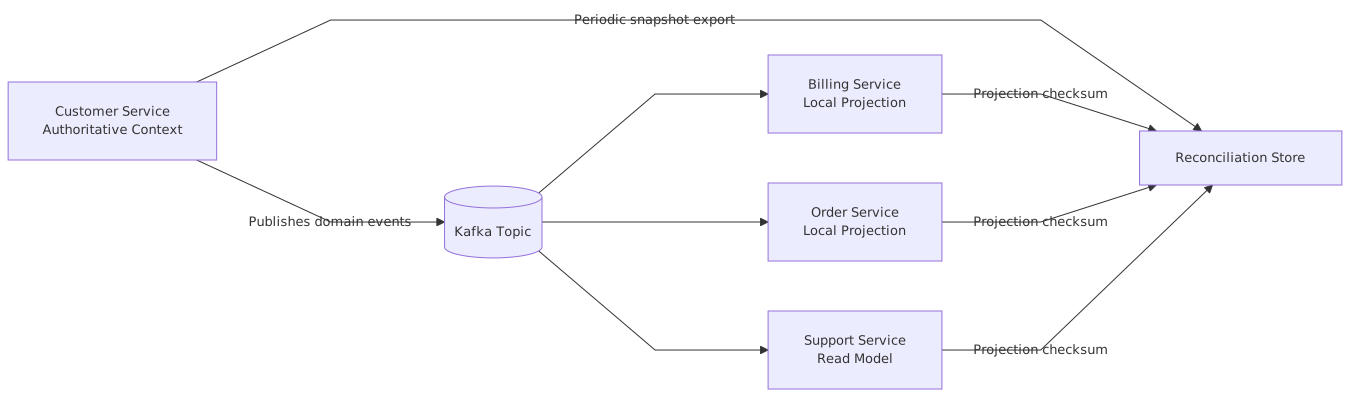
This architecture has a few healthy properties.
The producer remains authoritative for its domain. Consumers do not call back synchronously for every read, which protects autonomy and performance. Kafka provides temporal decoupling and replay, but replay is bounded by explicit contract rules. Reconciliation gives the enterprise a repair path when reality disagrees with the event log.
Notice what is absent: direct database sharing, ambiguous “update” events, and hidden dependencies on producer internals.
Contract shape
A contract should usually separate transport envelope from business payload.
The envelope handles things like:
- event ID
- contract version
- event time
- source service
- correlation ID
- causation ID
- partitioning key
The payload handles domain semantics:
- aggregate identifier in the source context
- type of business change
- business-effective date
- changed attributes or full state representation
- invariant-relevant flags
- optional reason codes
This allows platform consistency without flattening the domain.
Event versus state topics
A mature architecture often uses both.
Domain events capture meaningful changes such as CustomerCreditBlocked or OrderAllocated. They are excellent for process reactions and auditability.
State synchronization topics provide the latest known representation keyed by business ID, often compacted in Kafka. They are excellent for bootstrapping consumers and maintaining projections.
Architects should stop pretending one of these eliminates the need for the other. In large enterprises, they complement each other.
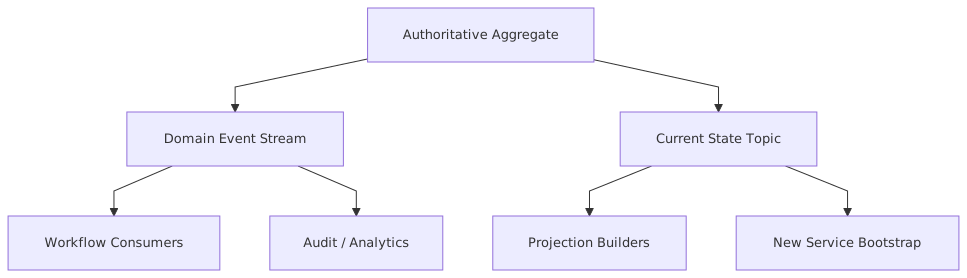
The rule of thumb is simple: use events for behavior, state for synchronization. Mix them carelessly and you get brittle consumers.
DDD alignment
The contract should be anchored in bounded contexts, not enterprise-wide canonical fantasies.
Canonical data models usually look sensible in PowerPoint and miserable in delivery. They erase useful context distinctions and create giant committees around every field change. Better to define explicit anti-corruption layers and translation rules between bounded contexts.
For example:
- CRM publishes
CustomerContactPreferencesChanged - Billing consumes only communication opt-in flags relevant to invoicing
- Support builds a richer local profile by combining CRM and account events
- None of them are forced into one grand unified “CustomerMasterRecord”
That is DDD applied to synchronization. Respect context. Translate deliberately.
Migration Strategy
Most enterprises do not get to design synchronization contracts on greenfield systems. They inherit a tangle: shared databases, nightly ETL, brittle APIs, spreadsheet-driven fixes, and Kafka topics that were created before anyone decided what should go in them.
So the migration strategy matters as much as the target architecture.
The best pattern here is a progressive strangler migration.
Do not attempt a heroic rewrite of all integrations. That produces multi-year architecture theatre and very little business value. Instead, introduce synchronization contracts one bounded context at a time, one dependency seam at a time.
Step 1: Identify authoritative domains
Map which systems truly own business decisions today, even if the implementation is ugly. Ownership may be split awkwardly; expose that truth first. A migration built on false ownership assumptions simply automates confusion.
Step 2: Define contract around one high-value relationship
Pick a specific domain seam. Customer-to-billing. Order-to-fulfillment. Product-to-pricing. Define the synchronization contract for that seam with explicit semantics, guarantees, and reconciliation.
Step 3: Publish without cutting consumers over
Start emitting the new contract alongside existing interfaces. This dual-run phase matters. Let downstream teams validate payload meaning, lag behavior, replay assumptions, and edge cases without taking operational risk all at once.
Step 4: Build consumer projections and compare
Consumers should materialize local state from the new contract while still using their current integration path for production decisions. Compare outcomes. Measure drift. This is where reconciliation becomes migration tooling, not just operational tooling.
Step 5: Cut over consumer-by-consumer
Move individual consumers to the new contract once parity is acceptable. Keep old integrations alive only as long as needed. Do not let “temporary fallback” become architecture sediment.
Step 6: Strangle legacy sources
Once downstream dependencies are migrated, remove the old synchronization path, including hidden reports and ad hoc extracts. The graveyard of enterprise architecture is full of “retired” interfaces that still feed one finance spreadsheet.
Here is the migration shape.

Why progressive migration works
Because synchronization failures are often semantic, not technical. You discover them through side-by-side behavior, business review, and reconciliation reports. A strangler approach lets you learn safely.
And because enterprises have history. You cannot “just switch to events” when thirty downstream systems have quietly built assumptions around a batch file naming convention.
Enterprise Example
Consider a large insurer modernizing policy administration.
The estate contains a core policy platform, a billing platform, a claims platform, CRM, document management, and a customer portal. Historically, customer and policy data were copied through nightly ETL jobs plus a handful of synchronous APIs for urgent lookups. Over time, every system accumulated its own interpretation of policy status. Claims thought a policy was active once bound. Billing thought it was active after first premium collection. CRM exposed both values in different screens and confused everyone equally.
The modernization program introduced microservices around customer servicing and policy events, with Kafka as the backbone. The first instinct was to publish broad events like PolicyUpdated. That looked efficient and kept options open. In practice it solved nothing. Consumers still had to reverse-engineer meaning from a large payload. Claims missed underwriting suspensions. Billing reacted to cosmetic changes. Replays produced inconsistent local state because historical events reflected producer behavior from several implementation eras.
The team reset and introduced synchronization contracts by bounded context.
- Policy Administration became authoritative for policy lifecycle transitions.
- Billing became authoritative for receivable status and delinquency.
- CRM consumed both and exposed a customer-facing composite view.
- Claims consumed only policy coverage-effective facts relevant to eligibility.
- Document management did not subscribe directly to internal state changes; it received explicit business events for document-required transitions.
They separated policy lifecycle events from current policy synchronization state. Kafka topics for lifecycle events drove workflows. A compacted state topic keyed by policy ID allowed CRM and portal services to bootstrap and recover.
Most importantly, they defined semantics in business language. “Active for claims eligibility” and “active for billing” were no longer overloaded into one status field. They became explicit contract attributes, sourced from different bounded contexts, with documented rules.
Reconciliation was built in from day one. Each downstream service stored source version markers and daily counts by policy state. A reconciliation job compared authoritative snapshots from policy admin and billing with local projections in CRM and claims. Drift above threshold triggered an operational workflow, not a panic.
The result was not perfection. They still had late events during peak renewals. They still needed replay windows and backfill controls. But they moved from accidental synchronization to governed synchronization. That is a meaningful enterprise step.
Operational Considerations
Architecture diagrams are aspirational. Operations is where they are judged.
Idempotency
Consumers must be idempotent. Kafka gives at-least-once realities in many practical deployments, and even where exactly-once semantics are advertised, business idempotency still matters. If CustomerCreditBlocked is processed twice, the local projection and side effects must remain valid.
Ordering
Ordering is local, not global. If your contract requires ordering, define it by key and partition strategy. Never let consumers assume universal sequencing across unrelated entities. That is how subtle bugs become long weekends.
Bootstrap and replay
New consumers need an initialization path. A compacted current-state topic can help, but only if retention, keying, and tombstone semantics are understood. Historical replay must answer a business question: does replay reconstruct valid current state, valid audit state, or merely a best-effort projection?
Reconciliation cadence
Not every divergence justifies immediate action. Define reconciliation windows according to business impact. Payment balances may require near-continuous checks. Marketing preferences may tolerate daily comparison. Precision without prioritization becomes operational noise.
Observability
Monitor more than lag and throughput. Track semantic health:
- projection drift counts
- percentage of events failing validation
- stale projection age
- checksum mismatches
- replay success rate
- contract version distribution among consumers
These are better indicators of synchronization quality than broker CPU.
Data governance and privacy
Synchronization contracts tend to spread data quickly. That is useful and dangerous. Apply data minimization by contract. Publish what downstream contexts need, not whatever the source happens to have. PII leakage through “convenient” event payloads is a common and expensive enterprise mistake.
Tradeoffs
There is no free lunch here. A synchronization contract buys clarity at the cost of discipline.
The biggest tradeoff is speed of local change. Producers lose some freedom because they now have to think about external semantics, compatibility, and migration paths. This is good architecture and slower coding. Accept it.
Another tradeoff is duplication. Consumers maintain local copies of data. Purists complain. They should spend more time in production. Duplication is often the price of autonomy, resilience, and performance. The danger is not duplication itself; it is undocumented, uncontrolled duplication.
There is also a governance tradeoff. Too little governance and contracts decay into folklore. Too much governance and every field change turns into architecture parliament. The sweet spot is federated governance: domain teams own contracts, with enterprise standards for versioning, discoverability, observability, and policy controls. EA governance checklist
Finally, reconciliation adds operational cost. Storage, jobs, dashboards, exception workflows. It is tempting to skip. But the cost of not knowing your systems disagree is usually much higher.
Failure Modes
The failure modes are painfully consistent across enterprises.
1. Integration events masquerading as domain events
CustomerUpdated is not a domain event. It is a confession that nobody wanted to decide what changed and why. These catch-all events create fragile consumers and semantic drift.
2. Shared canonical model
A single enterprise-wide contract for “Customer,” “Order,” or “Product” often becomes an oversized compromise object. Everyone adds fields. Nobody owns meaning. Change slows to a crawl.
3. No bootstrap strategy
A new consumer cannot reconstruct state from the live stream because the stream contains only deltas, or retention is too short, or old events had different semantics. The team falls back to ad hoc database extracts. Confidence disappears.
4. Reconciliation as an afterthought
When drift is finally discovered, there is no agreed source of truth or repair procedure. Operations invent manual fixes. Those fixes become shadow integrations.
5. Contract versioning only at schema level
The shape stays stable, but a field’s business meaning changes. Old consumers keep working syntactically and fail logically. These are some of the nastiest defects because nothing crashes.
6. Producer-centric payloads
Events mirror the producer’s internal entity graph rather than downstream domain needs. Consumers become coupled to implementation detail and absorb churn from producer refactoring.
When Not To Use
Data synchronization contracts are not a religion. There are cases where they are the wrong tool.
Do not use a heavy synchronization model for tightly coupled, transaction-centric operations that truly require immediate consistency and live within one bounded context. Split the service boundary first if needed; do not paper over a bad cut with more messaging.
Do not create Kafka topics and contract governance for trivial lookup data that could be served cleanly through a simple API with caching. Architecture should fit the volatility and criticality of the domain. ArchiMate for governance
Do not push replicated state into downstream services that have no business reason to own it locally. Every copied dataset is a future reconciliation problem.
And do not adopt complex event synchronization just because the platform team has standardized on Kafka. A queue is not a strategy. If the business workflow is naturally request-response and low volume, use that. Good architects are suspicious of platform monocultures.
Related Patterns
Several related patterns often sit beside synchronization contracts.
Outbox pattern helps publish contract events reliably from transactional systems without dual-write inconsistency.
Change Data Capture can accelerate migration, especially during strangler phases, but CDC should usually be a transitional mechanism or infrastructure feed, not your primary domain contract. Row changes rarely equal business meaning.
CQRS projections are natural consumers of synchronization contracts. They maintain read models tailored to local needs.
Event sourcing can strengthen auditability and replay, but it does not remove the need for explicit contracts between bounded contexts. Internal event stores are not automatically external integration contracts.
Anti-corruption layers are essential when consuming legacy or canonical models. They preserve local domain language and stop semantic pollution.
Saga orchestration or choreography may consume domain events, but they should depend on clear business transitions, not generic “updated” messages.
Summary
Microservices make synchronization inevitable. Good architecture makes it explicit.
A data synchronization contract is the formal agreement that defines how meaning moves between bounded contexts: ownership, semantics, guarantees, evolution, and reconciliation. It is how an enterprise avoids turning autonomous services into a federation of contradictory spreadsheets with APIs.
The central idea is simple and worth being stubborn about: synchronize domain meaning, not just data shape.
Use domain-driven design to define bounded contexts and ownership. Use Kafka or similar platforms where asynchronous propagation makes sense. Separate domain events from current-state synchronization when the problem demands both. Build reconciliation into the architecture from the start. Migrate progressively with a strangler strategy, validating behavior in parallel before cutover. And be honest about tradeoffs, because every copied truth has an operational cost.
If there is one memorable line to keep, make it this: in distributed systems, the contract is not the message format; the contract is the shared understanding of truth under failure.
That is the real architecture.
Frequently Asked Questions
What is a service mesh?
A service mesh is an infrastructure layer managing service-to-service communication. It provides mutual TLS, load balancing, circuit breaking, retries, and observability without each service implementing these capabilities. Istio and Linkerd are common implementations.
How do you document microservices architecture for governance?
Use ArchiMate Application Cooperation diagrams for the service landscape, UML Component diagrams for internal structure, UML Sequence diagrams for key flows, and UML Deployment diagrams for Kubernetes topology. All views can coexist in Sparx EA with full traceability.
What is the difference between choreography and orchestration in microservices?
Choreography has services react to events independently — no central coordinator. Orchestration uses a central workflow engine that calls services in sequence. Choreography scales better but is harder to debug; orchestration is easier to reason about but creates a central coupling point.