⏱ 20 min read
Modernization projects rarely fail because teams cannot write code. They fail because they move semantics before they move understanding.
That is the uncomfortable truth at the heart of microservices refactoring. Organizations like to tell themselves a cleaner story: break the monolith apart, put the pieces into containers, add Kafka, maybe sprinkle in some event-driven architecture, and the enterprise will emerge lighter, faster, and somehow more adaptable. But a monolith is not merely a deployment artifact. It is accumulated business behavior, hidden policy, implicit coupling, half-forgotten workflows, and years of institutional bargains encoded in software. Pull on one thread and you often discover it is stitched into ten others.
So service migration is not a technical carve-up. It is an exercise in moving meaning without breaking the business.
That is why migration phases matter. Not because architects enjoy drawing roadmaps, but because enterprises need a controlled sequence for changing both system structure and operational reality. A proper migration roadmap gives you more than project governance. It gives you a way to expose dependencies, preserve domain integrity, control risk, and keep the lights on while changing the wiring behind the walls. EA governance checklist
In practice, successful microservices migration looks less like demolition and more like city planning. You don’t dynamite downtown and hope neighborhoods reappear in better places. You introduce bypasses, reroute traffic, move services district by district, and keep tax collection working throughout. The same is true in enterprise systems. Payroll must still run. Orders must still ship. Claims must still settle. Finance closes the books whether architecture is elegant or not.
This article lays out a pragmatic, domain-driven roadmap for service migration phases in microservices refactoring. It covers the forces at play, the architecture patterns that hold things together during transition, progressive strangler migration, reconciliation, Kafka-based integration where it actually helps, operational concerns, tradeoffs, and the failure modes that quietly sink large programs. event-driven architecture patterns
Context
Most large organizations do not start from a blank slate. They inherit monolithic systems, tightly coupled applications, packaged software, shared databases, and integration logic smeared across ETL jobs, schedulers, APIs, and tribal knowledge. The desire to move to microservices usually comes from real pressure: microservices architecture diagrams
- change cycles are too slow
- one release breaks unrelated capabilities
- scaling a single hot path means scaling everything
- teams are blocked on one another
- domain logic is tangled across modules
- auditability and resilience are poor
- cloud adoption is stalled by coarse-grained systems
These are legitimate reasons. But they do not automatically justify microservices.
The move only makes sense when the business domain has enough complexity, enough rate of change, enough team autonomy pressure, and enough operational maturity to benefit from service boundaries. Otherwise, microservices become an expensive way to recreate the monolith over the network.
This is where domain-driven design earns its keep. DDD is not a ceremony for naming services. It is the discipline of discovering where business meaning coheres. Bounded contexts are useful not because they look neat in a diagram, but because they identify where language, rules, and change tend to move together. A migration roadmap without this semantic grounding tends to produce technical services—customer-service, order-service, pricing-service—whose names sound plausible while their responsibilities are hopelessly interwoven.
Good migration starts with the domain, not the deployment target.
Problem
The central problem in microservices refactoring is deceptively simple: how do you move from a system with shared runtime and often shared data to independently deployable services without disrupting business operations or corrupting domain behavior?
Under that question sit harder ones:
- Which capability should move first?
- How do we separate data ownership without breaking workflows?
- What happens to transactions that previously ran in-process?
- How do we preserve reporting and regulatory obligations during transition?
- How do old and new paths coexist?
- How do we know the new service produces equivalent outcomes?
- When do we cut over reads, writes, or both?
- How do we avoid creating distributed chaos masquerading as modernization?
The migration challenge is not merely decomposition. It is coexistence. For a meaningful period, old and new worlds run at the same time. That means duplicate logic, partial routing, asynchronous propagation, temporary inconsistency, reconciliation processes, and operational ambiguity. The migration path itself becomes an architecture.
And if you ignore that, the architecture will ignore you back.
Forces
Several forces shape service migration. The trick is to respect them instead of pretending they can be wished away.
1. Domain cohesion versus technical decomposition
A clean codebase can still represent a poor domain model. Teams often try to split along CRUD entities because those are visible. But business capabilities rarely align neatly to tables. “Customer” might span onboarding, identity verification, credit assessment, service entitlement, support profile, and billing responsibility. One entity name does not imply one service.
DDD pushes us to look for bounded contexts, not nouns.
2. Data gravity
Shared databases are the great anchor of legacy systems. They make decomposition difficult because business behavior often leaks into schema conventions, triggers, reporting extracts, and ad hoc integrations. The database is not just storage; in many enterprises it is a social contract.
Breaking that contract takes care.
3. Availability of the existing system
Unlike greenfield builds, migration must preserve business continuity. The monolith is not a bad thing to be destroyed; it is the thing currently paying the bills. Enterprises need incremental migration patterns that allow old and new implementations to coexist.
4. Consistency expectations
Users and downstream systems are often accustomed to immediate consistency because everything happened in one process and one database transaction. Microservices replace that convenience with autonomy, explicit workflows, and often eventual consistency. That shift is architectural and organizational.
5. Team structure
Conway still wins. If teams cannot own services end-to-end—code, data, runtime, operational support—microservices boundaries rot. Migration phases must account for who will own what after the move, not just what can technically be extracted.
6. Risk concentration
Big-bang migration concentrates risk in one moment. Progressive migration spreads risk but increases temporary complexity. This is the central tradeoff of refactoring at scale.
Solution
The most reliable solution is a phased, progressive strangler migration organized around bounded contexts, explicit contracts, and observable coexistence.
This is not glamorous. It is the architecture of patience.
At a high level, the migration sequence looks like this:
- Identify domain boundaries and candidate capabilities.
- Establish edge routing and integration seams.
- Extract one bounded context at a time.
- Move reads before writes where feasible.
- Introduce event streams and asynchronous collaboration judiciously.
- Reconcile old and new outcomes during coexistence.
- Cut over traffic gradually.
- Retire legacy functionality only after operational proof.
The strangler pattern works because it changes the question from “When do we replace the monolith?” to “What behavior can we safely divert next?” That is a far better question.
It also aligns well with domain-driven design. Services should be carved from coherent business capabilities: claims adjudication, pricing, fulfillment orchestration, inventory allocation, customer identity verification. Each extracted service should own its data and enforce its rules within a bounded context. Integration between contexts then becomes explicit, not accidental.
Migration phases at a glance

The important point is sequence. Enterprises get into trouble when they jump from assessment straight to extraction, skipping seam creation, observability, and reconciliation. That is like replacing an airplane engine in flight while refusing to install instruments.
Architecture
A migration architecture needs to support coexistence more than purity. During refactoring, the architecture should optimize for controlled transition, auditability, and reversibility.
That usually means a few things.
Edge routing and anti-corruption
The first seam is often at the edge: API gateway, application facade, routing proxy, or UI composition layer. This is where traffic can be directed to legacy or new services based on feature flags, tenants, business rules, or percentages.
Where legacy concepts are ugly—and they usually are—an anti-corruption layer protects the new domain model from old semantics. This matters. If you let the monolith’s vocabulary leak into every extracted service, you are not migrating; you are distributing the monolith.
Context ownership and data separation
Each extracted service should own its own schema, persistence model, and business rules. Shared databases during migration are sometimes unavoidable as an intermediate step, but they should be treated as temporary debt with a retirement plan. If two services update the same tables, you have not achieved service autonomy. You have simply moved coordination into runtime incidents.
Event backbone where appropriate
Kafka can be very effective in migration, especially for change propagation, integration decoupling, audit trails, and rebuilding read models. But Kafka is not a substitute for domain design. It is plumbing. Good plumbing matters, but nobody confuses pipes with city planning.
Use Kafka where events represent meaningful business facts, such as OrderPlaced, PaymentAuthorized, InventoryReserved, ClaimSubmitted, PolicyIssued. Avoid turning internal table changes into fake domain events. “RowUpdated” is not a business event. It is a confession.
Read/write decoupling
One practical migration move is to separate query concerns from command concerns. Read models can often be extracted earlier because they are less risky. A new service can subscribe to legacy changes, build its own projection, and serve queries while writes still go to the monolith. This gives teams operational experience and semantic validation before they take on write ownership.
Reconciliation capability
Reconciliation is the quiet hero of enterprise migration. During coexistence, there will be divergence: timing gaps, duplicate events, out-of-order delivery, data mapping defects, edge-case business rules, manual corrections. You need a formal way to detect and resolve mismatches between old and new worlds.
A migration without reconciliation is a faith-based initiative.
Example coexistence architecture
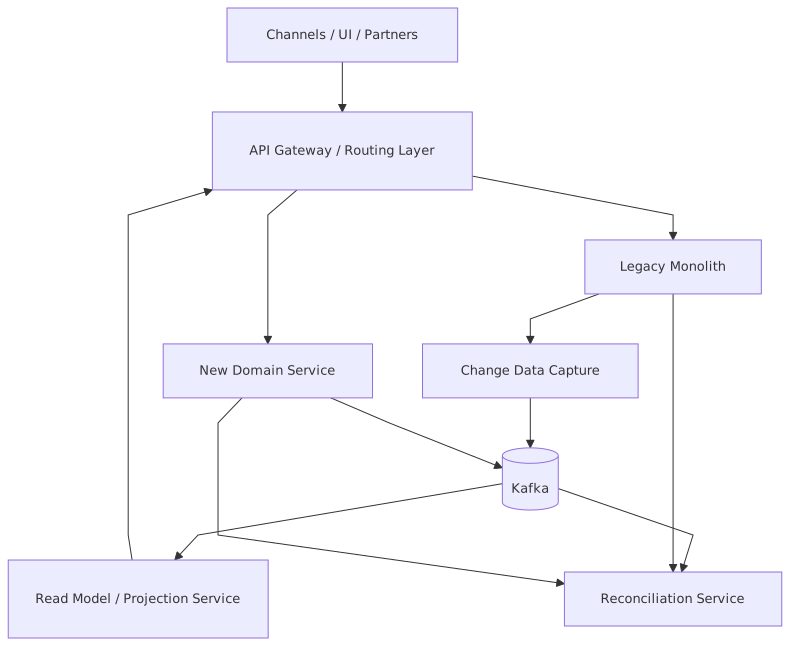
This architecture is not the destination. It is the bridge. The bridge matters because most of the risk lives there.
Migration Strategy
A credible migration strategy is phased, measurable, and domain-led. The following sequence works well in large enterprises.
Phase 1: Domain discovery and candidate selection
Start by identifying bounded contexts, core domain capabilities, supporting domains, and generic capabilities. This is classic DDD thinking, but applied pragmatically. You are looking for:
- business capabilities with clear ownership
- modules with high change frequency
- pain points where release friction is high
- areas with natural event boundaries
- capabilities that can be isolated behind contracts
- low-blast-radius first movers
Do not start with the most critical, most entangled part of the system. Start where the domain is meaningful but the risk is survivable.
A good first candidate is often something like pricing rules, document generation, customer notification, inventory availability, or onboarding assessment—not the full order lifecycle or general ledger.
Phase 2: Establish seams
Before extraction, create seams:
- facade APIs over monolith functions
- routing controls
- observability for requests and outcomes
- contract tests
- event publication or CDC pipelines
- identity and authorization boundaries
This is the scaffolding phase. Teams often resent it because it does not feel like feature delivery. Ignore that instinct. Scaffolding is what keeps the building from collapsing while you alter it.
Phase 3: Extract read models
Move queries first where possible. Build a service that owns a read model derived from monolith data, Kafka events, or CDC. This provides several benefits:
- validates your domain understanding
- establishes service operations without write-side risk
- improves performance for targeted query use cases
- surfaces data quality issues early
- creates confidence with stakeholders
This phase also exposes semantic ambiguity. Two reports that supposedly show the same “active customer” count often differ because the business never agreed on what active means. Better to learn that now than during write cutover.
Phase 4: Extract command ownership
Once the team understands the domain and can serve reliable reads, move write responsibility for a bounded context. This is the real extraction. It requires:
- clear command boundaries
- owned persistence
- business rule enforcement
- integration contracts to upstream/downstream contexts
- idempotency controls
- compensating workflows where transactions cross services
At this point, service autonomy becomes real.
Phase 5: Introduce asynchronous collaboration and events
As write ownership shifts, events become more valuable. Kafka can carry business events to other services, analytics consumers, search indexes, and operational monitors. But use events deliberately.
Events should say something the business would recognize. They should be versioned, durable, and traceable. Teams should know which events are authoritative, which are derived, and what consumers may assume.
Phase 6: Parallel run and reconciliation
Run both paths in parallel where the risk justifies it. This may involve shadow writes, dual reads, comparison jobs, or controlled tenant-based cutovers.
Reconciliation should compare not only raw records but business outcomes:
- same premium calculation?
- same fulfillment route?
- same eligibility decision?
- same invoice totals?
- same policy effective dates?
Business equivalence matters more than byte-for-byte sameness.
Phase 7: Gradual cutover
Use feature flags, business segment routing, tenant waves, or geographic rollout to shift traffic. Watch operational metrics and domain metrics together.
If latency is green but orders are mysteriously unshippable, you do not have a successful cutover.
Phase 8: Legacy retirement
Only retire legacy paths when:
- traffic is fully cut over
- reconciliation discrepancies are understood and acceptable
- support teams have runbooks
- downstream consumers have migrated
- historical access requirements are addressed
- rollback strategy is no longer required
Deletion is architecture too. Unretired legacy code becomes a zombie dependency.
Reconciliation during migration
Reconciliation deserves its own section because enterprises consistently underestimate it.
The simplest version is record-level comparison between monolith and new service. That catches obvious defects but misses semantic ones. Better reconciliation includes:
- entity state comparison
- event sequence comparison
- business result comparison
- timing tolerance windows
- duplicate detection
- manual override handling
- exception workflow for known divergence classes
In event-driven migration, reconciliation often consumes both legacy change streams and new service events, correlates them by business key, and flags mismatches. Some teams treat reconciliation as temporary. That is naive. In regulated industries especially, reconciliation capabilities often remain useful long after migration as operational controls.
Reconciliation flow
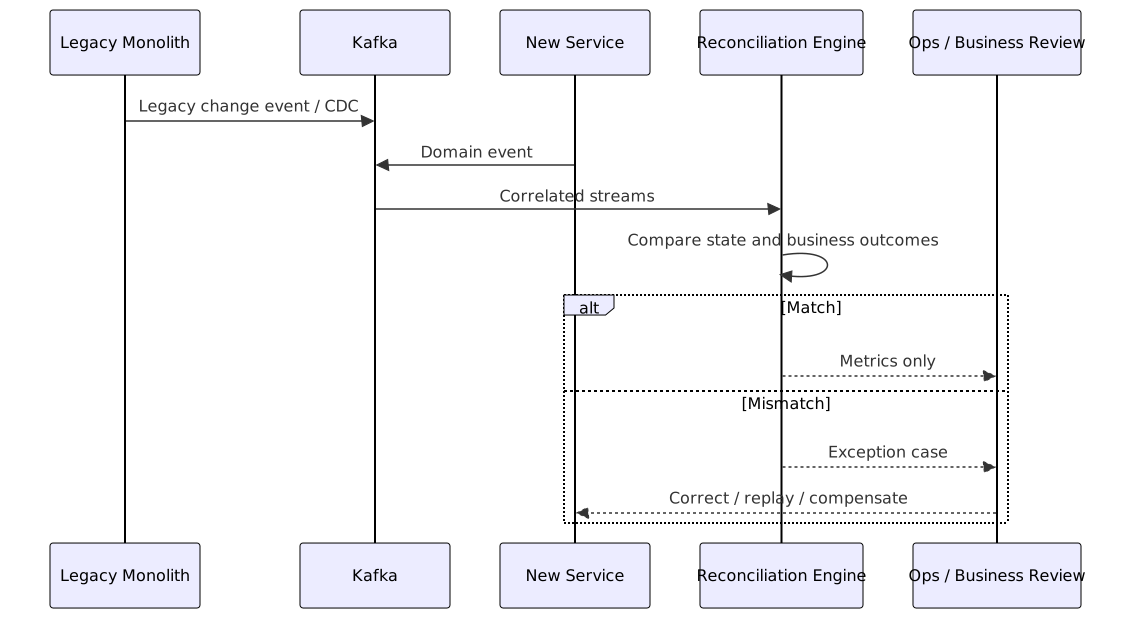
The point is not to eliminate all mismatch. The point is to know when it happens, why it happened, and what to do next.
Enterprise Example
Consider a large insurer refactoring a policy administration monolith. The monolith handles quote generation, policy issuance, endorsements, billing interactions, claims notifications, and regulatory reporting. Over fifteen years, every product line added special rules. Releases are slow, and one change to commercial property often destabilizes personal auto.
Leadership wants microservices. Fair enough. But a reckless split by technical module would be disastrous because the real domain boundaries are not aligned to code packages.
Using domain-driven design, the architecture team identifies bounded contexts such as:
- quoting
- underwriting decisioning
- policy issuance
- billing account management
- claims intake
- document production
They do not extract “customer” first because customer data is shared across nearly everything and semantics differ by context. That would be a trap disguised as a master service.
Instead, they start with document production. It is high volume, operationally painful, and semantically separable. A new document service is created with its own templates, rendering pipeline, and event-driven generation. The monolith emits policy and claims events through Kafka. The document service subscribes, produces documents, and stores metadata independently. This delivers business value early without destabilizing the core policy workflow.
Next comes quoting read models. The team builds a quote query service using event projections so digital channels can retrieve quote summaries and comparison views without hammering the monolith. This reveals several inconsistencies in product rules and status definitions. Painful, yes. Useful, absolutely.
Only after these steps does the team extract underwriting decisioning for one product line. Commands route through the API layer to the new service for selected brokers in one region. Decisions are published as business events. The monolith still owns policy issuance at this stage, so a translation layer maps the new underwriting outcome into the monolith’s expected structure. It is ugly. Temporary ugliness in service of controlled migration is acceptable. Permanent ugliness is not.
During parallel run, the reconciliation engine compares underwriting outcomes from old and new paths. It finds divergence in edge cases involving manual risk overrides and state-specific rules. These are not infrastructure defects. They are domain defects. The migration flushes out policy logic that nobody had fully understood. That is the value of doing it in phases.
After confidence grows, policy issuance is extracted for that product line. Billing remains integrated through events and APIs because financial controls require a slower transition. By the end, the insurer has not “moved to microservices” in one heroic act. It has built a portfolio of bounded-context services with clear ownership and has retired large parts of the monolith in a sequence the business could survive.
That is what real enterprise modernization looks like.
Operational Considerations
Microservices migration is as much an operational change as a structural one.
Observability
You need end-to-end tracing across monolith and services, correlation IDs, domain event lineage, and dashboards that combine technical and business metrics. Request latency alone is not enough. Track quote success rate, policy issuance completion, reconciliation mismatch counts, duplicate event rate, and backlog age.
Deployment and rollback
Every migration phase should have a rollback stance. Not every rollback is a binary switch. Sometimes rollback means routing new traffic to legacy while letting in-flight work drain. Sometimes it means replaying events into rebuilt projections. Sometimes it means compensating transactions.
If your rollback plan is “we’ll know if something goes wrong,” you do not have a plan.
Data management
Data retention, lineage, privacy obligations, and legal hold requirements do not disappear in a service architecture. In fact, they get harder. Teams must know which service is system of record for which data and how historical snapshots are preserved.
Event operations
Kafka introduces its own discipline:
- topic ownership
- schema evolution
- retention policies
- replay strategy
- poison message handling
- consumer lag monitoring
- idempotent processing
- exactly-once claims treated with suspicion
A great many event-driven architectures are powered mostly by optimism. Production is less forgiving.
Support model
When the migration creates incidents, support teams need runbooks that explain where to look: monolith logs, gateway routing, Kafka lag, reconciliation exceptions, service health, stale projections, contract mismatches. During transition, support complexity is often at its highest. Plan staffing accordingly.
Tradeoffs
There is no free lunch here. Only different bills.
Incremental migration versus big-bang replacement
Incremental strangler migration lowers catastrophic risk and allows learning. But it introduces temporary complexity, duplicate logic, routing layers, reconciliation processes, and coexistence costs.
Big-bang replacement avoids long transition periods in theory. In practice, it concentrates semantic, technical, and organizational risk into one date. Enterprises usually regret it.
Synchronous APIs versus event-driven integration
Synchronous calls are simpler to reason about for request-response workflows, but they increase runtime coupling and reduce resilience. Event-driven integration with Kafka improves decoupling and auditability, but adds eventual consistency, consumer management, and failure handling.
Use synchronous interaction when a user-facing workflow truly requires immediate response. Use events for state propagation, process choreography where appropriate, and decoupled downstream reactions. Most enterprises need both.
Shared data as a bridge versus hard data ownership
Temporary shared data access can accelerate extraction. It can also freeze the migration in an ambiguous halfway state. Hard data ownership is the goal, but the route there may include transitional compromises. Make them explicit and time-bound.
Purity versus practicality
Architects sometimes cling to ideal service boundaries even when operational reality argues for a slightly larger service. Better a coherent, somewhat chunky bounded context than a constellation of tiny services coupled by endless chatter.
Failure Modes
The most common migration failures are not exotic.
Splitting by entity instead of bounded context
This creates services that look neat in diagrams and behave terribly in production. Domain behavior ends up scattered, and every real workflow becomes a distributed transaction.
Moving code without moving ownership
If the same team still governs multiple services as one release unit, or if data remains centrally controlled, the migration has changed form more than function.
Event theater
Teams publish floods of low-value events because event-driven sounds modern. Consumers become dependent on internal state changes, schemas churn, and nobody can explain which events matter to the business.
Ignoring reconciliation
Without reconciliation, teams discover mismatches through customers, auditors, or month-end finance. That is a bad way to learn.
Underestimating support complexity
The coexistence period often doubles the number of places a defect can hide. If operations are not ready, confidence collapses and the organization blames microservices for what is really migration immaturity.
Extracting the hardest thing first
Enterprises sometimes choose the core order engine or billing ledger as the first microservice because it is strategically important. Strategic importance is not the same as migration suitability. First moves should teach, not traumatize.
When Not To Use
Microservices refactoring is not a universal answer.
Do not use this approach when:
- the domain is simple and stable
- one team can comfortably evolve the system
- operational maturity is low
- the business cannot tolerate prolonged coexistence complexity
- the main problem is bad code quality rather than architecture
- there is no realistic path to service ownership
- the organization wants microservices as branding rather than capability
In these cases, a modular monolith, clearer domain modules, better testability, improved deployment automation, and selective extraction at the edges may be the smarter move.
A well-structured monolith is not a failure. It is often the right answer for longer than people admit.
Related Patterns
Several patterns complement phased service migration:
- Strangler Fig Pattern: progressively replace legacy capabilities behind controlled routing.
- Anti-Corruption Layer: shield new domain models from legacy semantics.
- Branch by Abstraction: introduce abstraction points before switching implementations.
- Change Data Capture: stream legacy changes into Kafka to build projections or trigger downstream processing.
- CQRS: separate reads and writes when that helps migration and scaling.
- Saga / Process Manager: coordinate long-running workflows across services where no distributed transaction exists.
- Outbox Pattern: publish reliable events from service state changes.
- Bulkhead and Circuit Breaker: contain failure in mixed legacy-service environments.
- Modular Monolith: often the staging ground before or instead of microservices.
The key is not to collect patterns like souvenirs. Use them to solve specific migration problems.
Summary
Service migration phases in microservices refactoring are not administrative milestones. They are the architecture.
A good roadmap starts with domain semantics, not infrastructure fashion. It uses bounded contexts to decide what should move, seams to control how it moves, and progressive strangler migration to keep business continuity intact. It introduces Kafka and event-driven integration where business facts need to flow, not where architects want novelty. It treats reconciliation as a first-class capability because coexistence always creates ambiguity. And it accepts tradeoffs openly: lower cutover risk in exchange for temporary complexity, better autonomy in exchange for more explicit consistency management.
The enterprises that do this well are not the ones with the slickest slide decks. They are the ones willing to respect the awkward middle. They know migration is a long bridge, not a leap.
In the end, successful microservices refactoring is less about breaking a monolith apart than about relocating trust—one bounded context, one workflow, one cutover at a time.
Frequently Asked Questions
What is a service mesh?
A service mesh is an infrastructure layer managing service-to-service communication. It provides mutual TLS, load balancing, circuit breaking, retries, and observability without each service implementing these capabilities. Istio and Linkerd are common implementations.
How do you document microservices architecture for governance?
Use ArchiMate Application Cooperation diagrams for the service landscape, UML Component diagrams for internal structure, UML Sequence diagrams for key flows, and UML Deployment diagrams for Kubernetes topology. All views can coexist in Sparx EA with full traceability.
What is the difference between choreography and orchestration in microservices?
Choreography has services react to events independently — no central coordinator. Orchestration uses a central workflow engine that calls services in sequence. Choreography scales better but is harder to debug; orchestration is easier to reason about but creates a central coupling point.