⏱ 21 min read
There is a moment in every large system when the old model still pays the bills, while the new model promises the future. That is the uncomfortable middle of enterprise architecture: not the clean greenfield fantasy, but the muddy crossing where both worlds must run at once. The business cannot stop. Orders still need processing, policies still need underwriting, claims still need paying, and customers remain blissfully uninterested in our refactoring plans.
This is where the Parallel Change Pattern earns its keep.
It is one of the few migration patterns that respects the only constraint that really matters in big organizations: the system must continue to operate while we change its bones. In microservices refactoring, parallel change is the discipline of introducing a new path beside the old one, keeping them both alive for a while, and shifting behavior gradually until the legacy path can be retired without drama. Not elegant. Not pure. But deeply effective. microservices architecture diagrams
If the strangler pattern is about replacing a tree branch by branch, parallel change is about building a second bridge while traffic still flows over the first. For a while, you maintain both bridges, inspect every vehicle, compare journeys, and only then redirect the highway. That dual-path reality is expensive. It is also often the safest way to move a critical domain from a monolith or legacy service landscape into a more coherent microservices architecture.
This article looks at the pattern in the way architects actually encounter it: through domain boundaries, migration pressure, data inconsistency, Kafka topics, reconciliation jobs, ugly tradeoffs, and operational nerves. Not as a tidy textbook pattern, but as a practical technique for refactoring enterprise systems without betting the company on a weekend cutover. event-driven architecture patterns
Context
Most large-scale microservices refactoring efforts do not begin because someone had a sudden insight about service granularity. They begin because the current system has become too hard to change.
A monolith might have become a tangle of workflows, shared tables, and batch dependencies. A so-called service-oriented architecture may have decayed into distributed shared database access with XML in the middle. Or an earlier generation of microservices may have split infrastructure concerns while ignoring domain semantics, leaving teams with too many services and too little business clarity.
At that point, the enterprise starts asking for one or more of the following:
- faster product changes
- independent deployment
- clearer ownership by domain team
- lower release risk
- better auditability
- event-driven integration
- resilience around core customer journeys
The instinctive answer is often “split the monolith” or “extract microservices.” But the extraction itself is the dangerous part. Core transactional systems usually contain business rules accumulated over years—pricing exceptions, entitlement rules, fraud checks, legal retention constraints, region-specific tax handling, all hidden behind a stable user interface.
You are not merely moving code. You are relocating meaning.
That is why domain-driven design matters here. Before discussing migration mechanics, we must understand which domain capabilities deserve to become services, what bounded contexts exist, where language diverges, and where one team’s “customer” is another team’s “account holder,” “subscriber,” or “party.” Refactoring without semantic clarity simply moves ambiguity into smaller deployables.
Parallel change works best when architecture is driven by bounded contexts, not by technical slicing. It gives us a way to preserve behavior while we reshape the model.
Problem
A direct cutover from legacy implementation to new microservices is usually seductive and usually reckless.
The trouble is simple. The old path already contains hidden behavior. The new path will miss some of it. Not because teams are careless, but because enterprise systems encode policy in surprising places:
- database triggers
- batch jobs
- front-end validation
- manually maintained reference tables
- downstream consumer expectations
- settlement reports
- integration partner assumptions
- support team workarounds
If you replace the old path in one move, you discover those dependencies in production.
The Parallel Change Pattern addresses this by letting old and new paths coexist. Requests, commands, or events can be processed through both paths for a period of time. Outputs are compared. Side effects are controlled. Ownership shifts gradually.
This is especially relevant when refactoring:
- monolith to microservices
- synchronous APIs to event-driven flows
- shared database integrations to service-owned data
- batch-heavy operational systems to streaming architectures
- coarse-grained legacy services to bounded-context services
The pattern is not only about routing traffic. It is also about managing schema evolution, event versioning, dual writes, read-model divergence, and reconciliation between systems that temporarily represent the same business capability.
The problem, in short, is this: how do you change a mission-critical capability without introducing a cliff edge?
Parallel change says: do not jump the cliff. Build a second path, instrument the crossing, and move traffic in slices.
Forces
This pattern exists because opposing forces pull on architecture at the same time.
Business continuity versus architectural improvement
The business wants modernization, but not interruption. Every migration plan must satisfy both. If your architecture strategy requires downtime, broad freeze windows, or mass retraining all at once, it is not a strategy. It is a gamble.
Domain clarity versus legacy entanglement
We want bounded contexts with explicit ownership. But legacy systems often mix contexts in one transaction: customer update, credit check, pricing, order creation, and fulfillment reservation all in a single call. Untangling this is not just technical decomposition; it is semantic decomposition.
Speed versus confidence
A big-bang rewrite is fast only in PowerPoint. Parallel change is slower upfront because you maintain two paths, but it buys confidence through comparison and staged rollout.
Data consistency versus autonomy
Microservices favor service-owned data and asynchronous collaboration. Legacy systems often assume one canonical relational model. During migration, both worlds coexist, and consistency becomes probabilistic, delayed, and operationally managed rather than transactionally guaranteed.
Simplicity versus observability
A single path is simpler. Dual path requires richer telemetry, correlation IDs, decision logs, outcome comparison, replay, idempotency, and exception handling. You trade implementation simplicity for migration control.
Cost versus risk reduction
Running both paths costs money: duplicate processing, duplicated support effort, higher cloud usage, and engineering time spent on comparison tooling. But that cost is often cheaper than a failed cutover in a regulated, revenue-bearing system.
Solution
The Parallel Change Pattern introduces a new implementation path alongside the existing one, then migrates behavior incrementally rather than replacing everything at once.
At a high level, the solution has four stages:
- Prepare the seam
Create explicit interfaces around the capability being changed: API façade, command handler, event boundary, anti-corruption layer, or routing gateway.
- Introduce the new path
Build the new service or service collaboration behind that seam, aligned with bounded contexts and domain language.
- Run both paths in parallel
Send selected traffic, mirrored traffic, or replayed events to both systems. Compare outputs, side effects, and domain outcomes. Use reconciliation where exact equivalence is impossible.
- Shift and retire
Gradually move read and write responsibility to the new path, decommission old flows, and simplify the architecture before “temporary” becomes permanent.
The pattern can appear in several forms:
- parallel reads: old and new systems both serve read models for comparison
- parallel writes: both systems receive change commands, often with careful side-effect suppression
- shadow mode: new path processes production inputs but does not affect customers
- traffic slicing: a percentage of users, products, geographies, or channels move first
- event replay: historical Kafka events are replayed into the new service for validation
- dual publishing: old system emits legacy integration and new domain events simultaneously
The right variant depends on the domain and the risk profile. Payment processing is not migrated like product catalog. Claims adjudication is not migrated like notification preferences.
Here is the core shape.
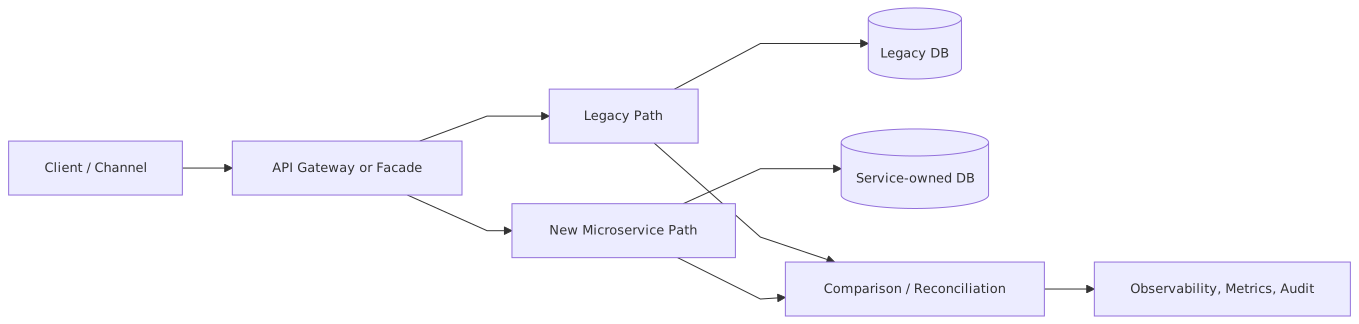
This looks simple. In reality, the hard part is not routing but semantics. The old and new paths may produce technically different outputs while being business-equivalent, or technically similar outputs while violating business rules. Architects must insist on domain-level comparison, not just payload diffing.
For example:
- Did both paths calculate the same premium exposure?
- Did both reserve inventory under the same policy?
- Did both create equivalent customer entitlements?
- Did both emit downstream events with acceptable meaning and timeliness?
That is the heart of the pattern: preserving business behavior while changing technical structure.
Architecture
Parallel change only works when architecture exposes the capability boundary cleanly enough to host two implementations. This is why many migrations begin with a façade, adapter, or anti-corruption layer. Not glamorous, but necessary.
1. Establish the migration seam
The seam is the point where you can intercept requests or events and decide what happens next. This can be:
- an API gateway
- a backend-for-frontend
- a domain command endpoint
- an event subscription boundary
- a process orchestration layer
- a façade over a legacy module
A good seam separates the channel from implementation detail. It lets you route by feature flag, tenant, geography, product line, or transaction type.
2. Define bounded contexts first
This is where domain-driven design stops being decorative and becomes operational. If the new path is not organized around bounded contexts, parallel change simply creates a modern-looking duplicate of the same confusion.
A bounded context should own a cohesive domain capability and the language around it. In an insurance platform, for instance:
- Policy Administration manages policy state and endorsements
- Pricing calculates premium under explicit rules
- Billing manages invoices, collections, and payment plans
- Claims handles adjudication and settlement
Do not extract a “CustomerService” simply because every system uses customer data. Shared nouns are not sufficient boundaries. Focus on behavior, ownership, and ubiquitous language.
3. Support dual path at the integration layer
If Kafka is part of the landscape, it becomes a practical enabler for parallel change. Events can be mirrored, replayed, versioned, and consumed by both old and new paths.
A typical event-driven migration shape looks like this:
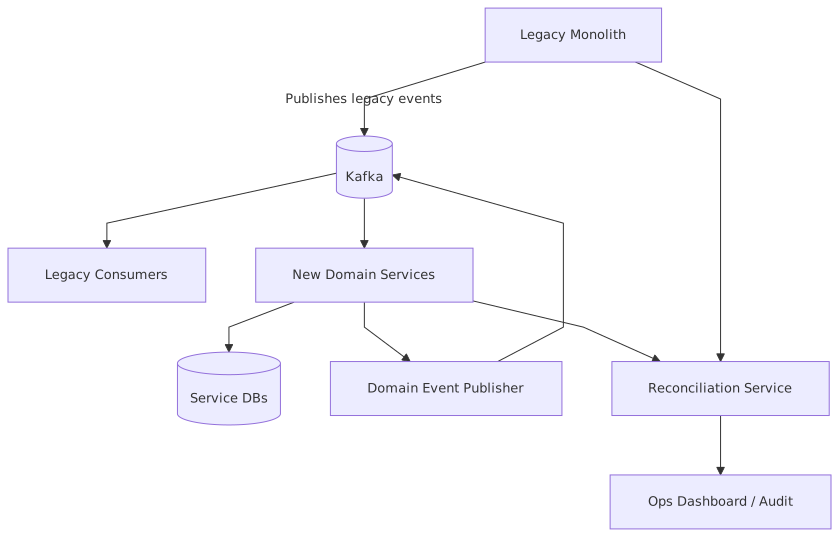
Kafka helps, but it does not remove the hard parts. It amplifies them unless you design carefully:
- event versioning
- key strategy and partitioning
- idempotency
- ordering assumptions
- replay safety
- poison message handling
- consumer lag visibility
If a legacy system emitted state-change events that were never intended as domain events, do not pretend otherwise. Introduce an anti-corruption layer that translates legacy event semantics into cleaner domain language. Migration is a chance to improve the contract, not just the plumbing.
4. Separate comparison from production side effects
One of the easiest ways to break parallel change is to let the new path cause irreversible side effects too early. Sending duplicate settlement instructions, duplicate shipment requests, or duplicate customer emails is a very expensive way to “test in prod.”
The architecture needs explicit side-effect control:
- process in shadow mode without emitting external actions
- write into isolated stores
- use dry-run adapters
- compare business decisions before enabling downstream effects
- gate irreversible actions behind feature flags
5. Build reconciliation as a first-class capability
Many teams treat reconciliation like an afterthought. That is a mistake. During dual running, divergence is not an exception; it is expected. The system must tell you where, why, and how often old and new paths differ.
Reconciliation can compare:
- command acceptance or rejection
- calculated values
- state transitions
- event emission
- latency profiles
- downstream side effects
- aggregate counts over time windows
Some divergence is acceptable. Some is catastrophic. Architecture must encode the difference.
Migration Strategy
The migration strategy should be progressive, observable, and reversible. The word “progressive” matters. A strangler migration is not just about redirecting traffic around the monolith. It is about shrinking the old capability incrementally while confidence in the new one grows.
A useful sequence looks like this.
Stage 1: Understand current behavior
Before building anything, mine production behavior:
- actual use cases
- transaction volumes
- edge-case distributions
- downstream dependencies
- hidden manual corrections
- data quality defects
In enterprises, what the code does and what the business believes it does are often different things. Capture both.
Stage 2: Model the target bounded context
Use domain workshops to define:
- aggregates
- invariants
- commands
- events
- ownership boundaries
- upstream and downstream relationships
This is where domain semantics become migration-critical. If the legacy model uses “account” to mean billing relationship, while the target domain uses “account” to mean digital login principal, you must resolve that language mismatch now. Dual path magnifies semantic confusion.
Stage 3: Introduce dual writes carefully, or avoid them
Dual writes are sometimes necessary and frequently treacherous. If a request must persist to both old and new stores, failures create split-brain scenarios.
Prefer one of these approaches:
- route command to one source of truth and publish events to the other
- mirror requests in shadow mode without external side effects
- replay events into the new path
- move reads before writes, where possible
If dual write is unavoidable, treat it as a temporary migration mechanism with compensations, retries, and reconciliation—not as a new permanent architecture.
Stage 4: Run shadow traffic
Shadow traffic is often the safest first step. The customer sees the legacy response, while the new path processes the same input and stores decisions for comparison.
This gives you:
- coverage on real production cases
- visibility into divergence
- confidence in domain logic
- performance benchmarks under load
It also reveals whether your new service can survive malformed data that the old system quietly tolerated for years.
Stage 5: Slice traffic intentionally
Do not start with random percentages if business semantics matter. Better slices are:
- one geography
- one product line
- one channel
- one customer segment
- one internal user group
- low-value transactions before high-value transactions
Migration should follow domain understanding, not just convenience.
Stage 6: Shift system of record
This is the real moment of change. The new service becomes authoritative for a subset of behavior or data. Legacy systems become consumers, adapters, or eventually retired components.
That handoff needs:
- ownership clarity
- contractual changes
- updated operational playbooks
- support escalation changes
- audit and compliance validation
Stage 7: Remove the old path
Architects are often good at adding temporary structures and bad at removing them. A dual path left in place too long becomes institutional debt.
Retirement criteria should be explicit:
- divergence below threshold for defined period
- complete feature coverage
- side effects validated
- support team trained
- rollback no longer needed
- compliance sign-off completed
The migration path often looks like this:
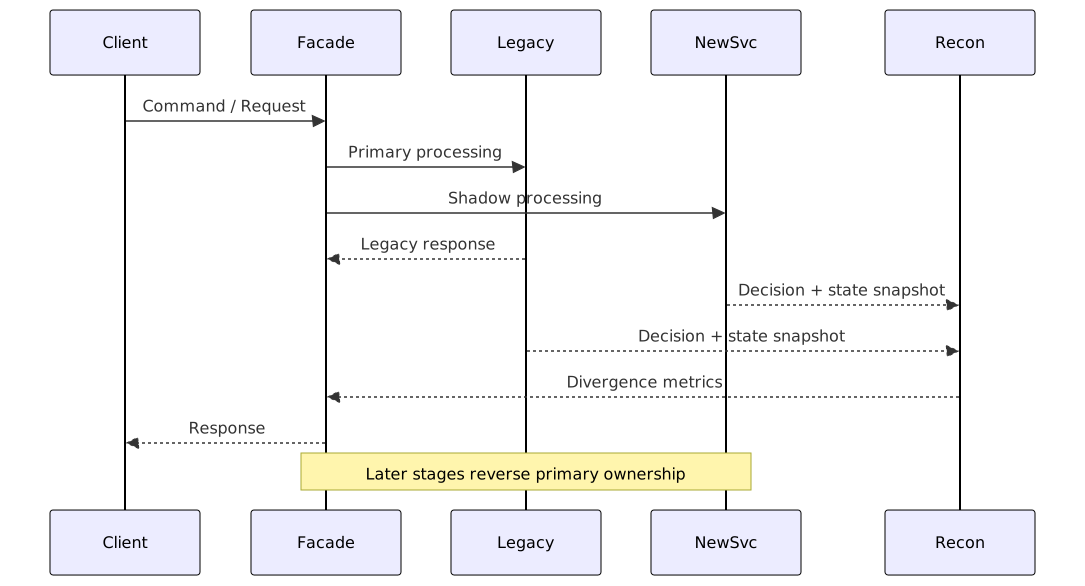
That reversal is the key. At first, the new path observes. Then it advises. Then it serves. Finally, it owns.
Enterprise Example
Consider a global insurer refactoring its policy servicing capability.
The legacy platform is a large policy administration monolith running policy issuance, endorsements, cancellations, renewals, billing handoff, and regulatory reporting. Over fifteen years, regional rules, broker exceptions, and product-specific logic have piled into the same codebase. Releases are monthly, defect triage is constant, and every change to endorsements risks breaking renewals.
The business wants faster product innovation and better digital self-service. The architecture team identifies bounded contexts:
- Policy Service for policy state transitions
- Pricing for premium recalculation
- Billing for payment schedules
- Document Generation for policy documents
- Customer Interaction for portal and broker workflow
A direct cutover is impossible. Endorsements alone have hundreds of rule variations. So the team uses parallel change.
First, they introduce a façade for endorsement requests. All channels—broker portal, call center UI, partner API—go through the same command endpoint.
Next, they build a new Policy Service focused only on a subset of endorsements for one commercial product in one region. Kafka is introduced as the event backbone. The monolith continues to process all endorsement requests as the primary path, but the new service receives the same commands in shadow mode.
The new service:
- validates request semantics
- calculates target policy state
- publishes draft domain events
- writes to its own event store and read model
- suppresses downstream side effects initially
A reconciliation service compares:
- endorsement acceptance/rejection
- recalculated premium values
- resulting policy dates
- emitted document requests
- billing schedule changes
The first surprises are exactly where experienced architects expect them:
- legacy logic applies broker-specific overrides hidden in a reference table maintained by operations
- one region tolerates invalid effective dates due to a front-end workaround
- premium rounding differs because the old system rounds at line level and the new one rounds at aggregate level
- some downstream reporting jobs infer business status from undocumented database columns
None of this appears on migration slides. All of it determines success.
Over three months, divergence rates fall. The new path becomes primary for internal users handling that product line, while the monolith still runs in parallel for verification. Then a single broker channel is moved. Then all brokers in that region.
Eventually the new Policy Service becomes system of record for that endorsement type. The monolith still handles renewals and cancellations, but endorsement responsibility has been strangled out. Billing and document generation now consume clean domain events instead of scraping internal policy tables.
This is a real enterprise outcome: not “the monolith is gone,” but “a high-change domain capability has been safely extracted with business control intact.”
That is what good migration looks like. It creates room to keep going.
Operational Considerations
Parallel change is as much an operational pattern as an application pattern.
Observability is non-negotiable
You need:
- correlation IDs across both paths
- command and event lineage
- divergence dashboards
- latency comparison
- consumer lag monitoring for Kafka
- per-slice migration health metrics
- business KPI overlays, not just technical metrics
If customer conversion drops only in migrated traffic slices, that matters more than CPU graphs.
Idempotency saves lives
During replay, retries, failover, and duplicate delivery, the new path must handle repeated messages safely. Kafka gives you durable transport, not exactly-once business semantics in the real-world sense architects care about.
Make commands and consumers idempotent where possible. Use stable business keys. Record processed message IDs or state versions where needed.
Backfill and replay need discipline
Historical replay into the new service is powerful. It is also dangerous if:
- old events lack complete semantics
- ordering is inconsistent
- reference data changed since the original event
- side effects are not suppressed
- the replay path differs from live processing
Treat replay as a migration product, not a script.
Support model must evolve
Dual-path systems create strange incidents:
- old path succeeded, new path failed
- both paths succeeded but disagreed
- new path lagged and looked stale
- reconciliation flagged drift after customer-visible completion
Support teams need runbooks that explain which path is authoritative at each migration stage.
Governance should be light but explicit
You do not need a migration committee for every feature flag. You do need:
- decision records
- retirement criteria
- ownership matrices
- rollback triggers
- compliance checkpoints for regulated domains
Without these, the organization forgets which temporary compromises are still in force.
Tradeoffs
Parallel change is a pragmatic pattern, not a free lunch.
What you gain
- lower cutover risk
- production-like validation
- gradual migration by domain slice
- better understanding of legacy behavior
- reversible rollout
- stronger confidence in bounded context extraction
What you pay
- duplicate infrastructure and processing cost
- more complex observability
- longer migration period
- team cognitive load from dual semantics
- temporary inconsistency risk
- temptation to leave transitional architecture in place forever
The biggest tradeoff is this: you are buying safety with complexity.
That is usually worth it for core domains—payments, orders, policy servicing, claims, billing, identity, fulfillment. It is often not worth it for simple or low-risk capabilities.
Another tradeoff concerns architectural purity. During migration, you may accept anti-corruption layers, duplicate models, and compensating jobs that you would never design into a clean greenfield system. That is fine. Migration architecture is allowed to be transitional, so long as it has an end date.
Failure Modes
Parallel change fails in recurring, predictable ways.
1. Technical parallelism without domain alignment
Teams run two code paths but never define what “equivalent business outcome” means. They compare JSON shapes, not decisions. The migration drifts into false confidence.
2. Dual write split-brain
Old and new systems both accept writes, one succeeds, one partially fails, and now there is no clear source of truth. Reconciliation becomes permanent surgery.
3. Side effects enabled too early
The new path sends real emails, invoices, shipments, or settlement instructions before its semantics are proven. Congratulations: your test harness is now a customer incident.
4. Incomplete observability
You know error rates, but not divergence rates. Or you know Kafka lag, but not whether policy outcomes differ. Migration proceeds blind.
5. Temporary architecture becomes permanent
Feature flags linger. Reconciliation jobs never die. Legacy adapters remain on critical paths for years. The new architecture inherits the complexity of the old one instead of replacing it.
6. Ignoring data quality debt
The old system worked only because humans compensated for bad data and hidden defaults. The new path is “correct” and therefore breaks real workflows. Parallel change exposes this, but only if teams are willing to see it.
7. Wrong migration slice
A random 5% rollout sounds scientific until those 5% include the most complex broker contracts or highest-value enterprise customers. Slicing should follow business topology, not statistical fashion.
When Not To Use
Parallel change is powerful, but not universal.
Do not use it when:
- the domain capability is small, low-risk, and easy to replace directly
- maintaining two paths would cost more than a short, controlled cutover
- side effects cannot be safely suppressed or duplicated
- you lack observability and reconciliation capability
- the target domain is still poorly understood
- the organization cannot support temporary operational complexity
- the migration window is too short to benefit from staged confidence
There are cases where a big-bang replacement, though unfashionable, is actually simpler—particularly for isolated internal tools, low-volume back-office workflows, or systems already near end-of-life.
Likewise, if the existing domain is fundamentally wrong and every outcome will intentionally change, parallel equivalence may be the wrong goal. In that case, focus on coexistence and controlled business transition rather than comparison.
The pattern is best when you need continuity of behavior during structural change. If continuity is not required, use something simpler.
Related Patterns
Parallel change rarely stands alone. It usually works in concert with other patterns.
Strangler Fig Pattern
The closest relative. Strangler migration incrementally replaces legacy functionality at the edges. Parallel change is often the mechanism used within a strangler step.
Anti-Corruption Layer
Essential when legacy contracts or data models do not fit the new bounded context. It preserves domain language in the new service.
Branch by Abstraction
Useful within codebases to swap implementations behind an abstraction before moving runtime traffic.
Event Interception and Replay
Common in Kafka-based migrations where historical or mirrored events drive the new system before full cutover.
Saga / Process Manager
Relevant when the new path coordinates multiple services and cannot rely on monolithic transactions.
Change Data Capture
Sometimes used to feed the new path from legacy data updates, though it should not replace proper domain event design where semantics matter.
Reconciliation Pattern
A close companion. In enterprises, reconciliation is often the difference between a credible migration strategy and wishful thinking.
Summary
The Parallel Change Pattern is architecture for grown-up systems.
It accepts that enterprise refactoring happens in motion, under load, with regulatory pressure, hidden business rules, and zero appetite for catastrophic failure. It does not promise elegance. It promises controlled transition.
Done well, it starts with domain-driven design: bounded contexts, clear language, explicit ownership. It continues with a progressive strangler migration: create a seam, build the new path, run both, reconcile outcomes, slice traffic deliberately, then retire the old path. Kafka and event-driven approaches can help, especially for replay, decoupling, and observability, but they do not absolve us from semantic rigor.
The pattern’s real value is not “running two systems.” It is learning safely while changing decisively.
That is the line worth remembering: parallel change is not duplication for its own sake; it is a temporary truth machine. It tells you whether the new architecture actually preserves the business you thought you understood.
And in enterprise modernization, that is often the difference between refactoring and self-deception.
Frequently Asked Questions
What is a service mesh?
A service mesh is an infrastructure layer managing service-to-service communication. It provides mutual TLS, load balancing, circuit breaking, retries, and observability without each service implementing these capabilities. Istio and Linkerd are common implementations.
How do you document microservices architecture for governance?
Use ArchiMate Application Cooperation diagrams for the service landscape, UML Component diagrams for internal structure, UML Sequence diagrams for key flows, and UML Deployment diagrams for Kubernetes topology. All views can coexist in Sparx EA with full traceability.
What is the difference between choreography and orchestration in microservices?
Choreography has services react to events independently — no central coordinator. Orchestration uses a central workflow engine that calls services in sequence. Choreography scales better but is harder to debug; orchestration is easier to reason about but creates a central coupling point.