⏱ 20 min read
Large systems rarely fail because one thing is broken. They fail because a small change travels farther than anyone expected.
That is the real blast radius problem in microservices. Not whether you have ten services or two hundred. Not whether you use Kubernetes, Kafka, or a service mesh. The hard problem is simpler and more dangerous: when one team changes one thing, how many other teams wake up with an incident? event-driven architecture patterns
A lot of microservice architecture is sold as if decomposition automatically creates safety. Split the monolith, put APIs in front of everything, add events, and somehow change becomes local. In practice, many organizations just replace one big failure surface with a web of smaller but more obscure ones. The monolith had one body. The microservice estate has a nervous system. Touch the wrong nerve and the whole organism twitches. microservices architecture diagrams
That is why blast radius matters. It is the practical measure of architectural coupling. It tells you how much organizational coordination, technical risk, data reconciliation, and operational disturbance a change is likely to create. It is one of the few architecture concepts that executives, engineers, and operators can all understand. If a pricing rule changes, who else is affected? If customer identity semantics evolve, which bounded contexts need to adapt? If an event schema changes in Kafka, what downstream consumers become fragile? If an operational dependency such as a shared database or synchronous chain goes unhealthy, how much business capability goes dark?
This article argues a blunt point: the blast radius of change is a better indicator of microservice architecture quality than service count, deployment frequency, or cloud spend. Good architecture does not eliminate change propagation. It puts walls around it. It lets semantics evolve in one bounded context without forcing emergency coordination across the enterprise. It limits the number of teams, data stores, topics, contracts, and runtime paths that must move together.
That takes more than technology. It takes domain-driven design, careful interface design, event thinking with discipline, and migration strategy that acknowledges reality. Most estates are not greenfield. They are hybrids: some legacy core systems, some APIs, some Kafka streams, some SaaS platforms, and a lot of institutional history. Architecture lives there, in the mess.
Context
The phrase “blast radius” comes from operations and security, but it belongs equally in application architecture. In microservices, blast radius is the set of systems, teams, data flows, and business processes affected by a change or failure. There are at least four kinds worth separating:
- Code blast radius: how many codebases and pipelines must change
- Contract blast radius: how many APIs, schemas, and event consumers are affected
- Runtime blast radius: how many live requests or workflows fail when one dependency goes bad
- Semantic blast radius: how many business meanings change together
That last one is the one architects often miss.
A field called customerStatus looks harmless until you discover Sales means prospect maturity, Billing means payment standing, Risk means fraud posture, and Support means service tier. A naïve “shared customer service” compresses all that meaning into one model and then every change becomes political. The blast radius is not caused by distributed systems alone. It is caused by weak domain boundaries.
This is where domain-driven design earns its keep. Bounded contexts are not nice-to-have diagrams for the architecture review board. They are safety barriers. They define where language is consistent and where translation is required. If the order domain says “confirmed,” that should not accidentally impose meaning on inventory reservation or invoice issuance. If those concepts really are distinct, forcing them into a shared state machine expands semantic blast radius. It feels efficient until the first major change.
In large enterprises, the problem is amplified by platform gravity. Shared CRM, ERP, master data, IAM, and data lake initiatives often centralize information without centralizing meaning. The result is a dangerous illusion: one source of truth, many interpretations, endless coupling.
Problem
Most microservice failures around change do not start with infrastructure. They start with architecture that confuses integration with ownership.
Consider a typical enterprise flow: customer places an order, pricing is calculated, fraud is checked, stock is reserved, payment is authorized, fulfillment is scheduled, and CRM is updated. On paper, it looks nicely decomposed. In reality, there are several common traps:
- Synchronous dependency chains
Order calls Pricing, Pricing calls Customer, Order calls Inventory, then Payment, then Fulfillment. One request now depends on half the estate being healthy within timeout budget.
- Shared canonical models
Everyone agrees to use a central Customer, Order, or Product schema. Every semantic change becomes enterprise change management.
- Database integration disguised as service architecture
Teams read each other’s tables or share one database cluster. Runtime coupling becomes data coupling, which is usually worse.
- Unversioned event contracts
Kafka topics become dumping grounds. Producers evolve payloads casually. Consumers break in strange, delayed ways.
- Over-factored services
Teams split by technical layer rather than business capability. The architecture gains hops but not autonomy.
- Migration by big-bang replacement
Legacy systems are swapped out wholesale, forcing all dependencies to move at once. Blast radius becomes existential.
The hidden cost is coordination. Every “small” change requires architecture forums, release trains, integration testing, and rollback choreography across multiple teams. Velocity looks acceptable until the first urgent business change arrives. Then everyone discovers the architecture has many services but very little independence.
Forces
Good architecture is a negotiation between opposing forces. Blast radius sits right in the middle of several ugly tradeoffs.
Local autonomy vs enterprise consistency
Teams want to move independently. The enterprise wants coherent customer data, compliant processes, and traceable outcomes. Too much autonomy and you get semantic drift. Too much centralization and every change becomes committee work.
Synchronous certainty vs asynchronous resilience
A synchronous API call gives an immediate answer. It also imports dependency health and latency into your user journey. Events and Kafka decouple runtime paths, but they introduce eventual consistency, reconciliation, and a different style of failure.
Reuse vs coupling
Shared libraries, shared schemas, shared platforms, and shared services all look efficient. Sometimes they are. But every shared thing is a potential amplifier for change. Reuse saves effort now and taxes autonomy later.
Domain purity vs migration reality
Architects love clean bounded contexts. Enterprises inherit package applications, mainframes, batch windows, and historical contracts. A good design has to survive contact with SAP, Salesforce, COBOL, and procurement schedules.
Data ownership vs reporting convenience
If each service owns its data, operational boundaries improve. But enterprise reporting teams often want one integrated view. Push too hard for operational autonomy without analytics strategy and someone will sneak in cross-service database joins.
That never ends well.
Solution
The practical answer is not “use microservices carefully.” It is more concrete than that:
Design for small semantic blast radii, small contract blast radii, and tolerable runtime blast radii.
That means four things.
1. Align services to business capabilities and bounded contexts
A service should own a coherent piece of domain behavior, not just a table or technical function. If you cannot describe its business responsibility without saying “it stores” or “it exposes,” it is probably not a strong boundary.
In domain-driven design terms, each bounded context should own its language, rules, and data. Relationships between contexts should be explicit translations, not accidental leakage. This reduces semantic blast radius because changes in one context do not automatically redefine concepts elsewhere.
A Customer Profile context, a Credit Risk context, and a Billing Account context may all refer to the same real-world human or company, but they do not have to share the same model or lifecycle.
2. Prefer event-carried integration for cross-context propagation, but keep commands deliberate
Kafka is useful here, but only when treated as a domain integration mechanism rather than a distributed database log for everyone. Publish domain events that describe facts meaningful within a context, not internal table mutations.
Good:
OrderPlacedCreditApprovedPaymentCapturedShipmentDispatched
Bad:
OrderRowUpdatedCustomerRecordChangedV17
Commands still matter where intent and accountability are required. Inventory reservation, payment capture, and cancellation often need directed behavior, not vague eventual hope. Use commands carefully. Use events broadly but with semantic discipline.
3. Introduce anti-corruption layers around legacy and shared enterprise systems
This is non-negotiable. The anti-corruption layer is how you stop a legacy model from infecting every new service. It translates language, protects your bounded context, and gives you room to evolve.
Without it, legacy semantics become enterprise semantics by default. Then your migration simply distributes old coupling over new runtime infrastructure.
4. Build reconciliation into the design, not as an afterthought
Event-driven microservices fail in ways that are subtle. Consumers lag. Messages are duplicated. Downstream updates partially apply. External systems accept requests and lose acknowledgments. If your architecture assumes every event flow is perfect, you do not have architecture. You have optimism.
Reconciliation is the mechanism that shrinks failure blast radius when eventual consistency goes wrong. That includes:
- idempotent consumers
- replay capability
- compensating actions
- periodic state comparison
- business exception queues
- lineage and traceability between commands, events, and outcomes
The mature estate is not the one that never drifts. It is the one that detects, explains, and repairs drift routinely.
Architecture
A useful way to think about blast radius is to map dependencies into three layers: interaction, integration, and data ownership.
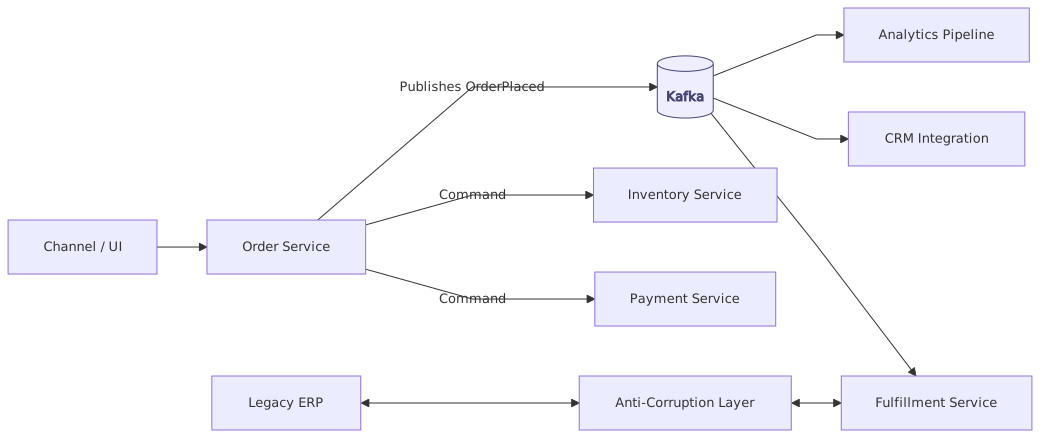
In this shape, the order service owns transaction initiation and directly commands only what must happen in-line. Broader propagation happens through Kafka. Legacy ERP is isolated behind an anti-corruption layer, not allowed to become a first-class domain authority over every service.
This is not dogma. It is a choice to contain runtime and semantic coupling. If fulfillment lags, analytics should still work later. If CRM integration fails, order capture should not necessarily fail. The business process must distinguish between critical path and downstream propagation.
That distinction is architecture.
Bounded context map and semantic barriers
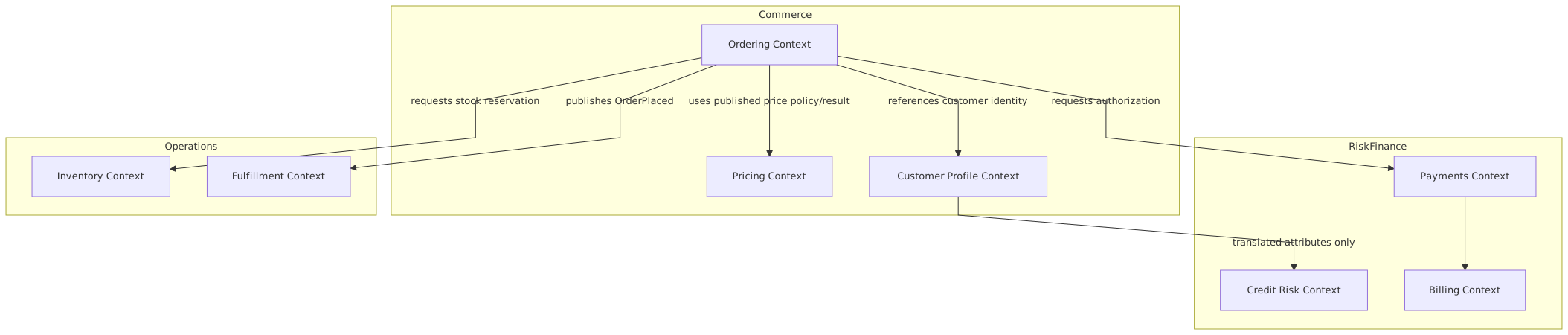
Look carefully at the arrows. They are not all the same kind of relationship. Some are references, some are commands, some are event propagation, some are translated attributes. That is deliberate. Many bad microservice architectures flatten these into “service talks to service.” But the nature of the interaction determines the blast radius.
If Ordering needs a direct dependency on Customer Profile for every request because basic reference data cannot be cached or replicated safely, you probably do not have a stable context boundary yet. If Risk consumes translated customer attributes rather than the full customer domain model, you reduce semantic coupling. If Fulfillment reacts to OrderPlaced rather than joining the order database, you reduce data coupling.
Runtime path design
Architects should identify:
- what must succeed now
- what may complete later
- what may be retried
- what may be compensated
- what must be reconciled
A checkout journey may require:
- synchronous payment authorization
- synchronous stock reservation in some businesses
- asynchronous CRM update
- asynchronous recommendation update
- asynchronous shipping label pre-generation
Trying to make all of them synchronous for certainty creates a brittle dependency chain. Making all of them asynchronous creates user ambiguity and hard compensation. The shape depends on business policy, not architectural fashion.
Migration Strategy
The strangler fig pattern is still the best metaphor because it captures the uncomfortable truth: replacement is gradual, opportunistic, and often asymmetrical. New capability grows around the old system. It intercepts specific behavior. It does not politely wait for a grand cutover plan to be approved.
But strangler migration only reduces blast radius if done by domain seam, not by technical layer.
Too many migrations start by putting an API gateway in front of the monolith and calling it modernization. That changes the route, not the dependency. The real work is to carve out bounded contexts where semantics can be owned independently.
A useful sequence looks like this:
- Map business capabilities and event boundaries
- Identify high-change, high-pain areas
- Create anti-corruption layers around legacy
- Extract read use cases first where possible
- Extract one write capability with clear ownership
- Introduce event publication and reconciliation
- Retire legacy responsibility gradually
- Continuously measure blast radius of each change
Here is what progressive strangler migration often looks like in practice.
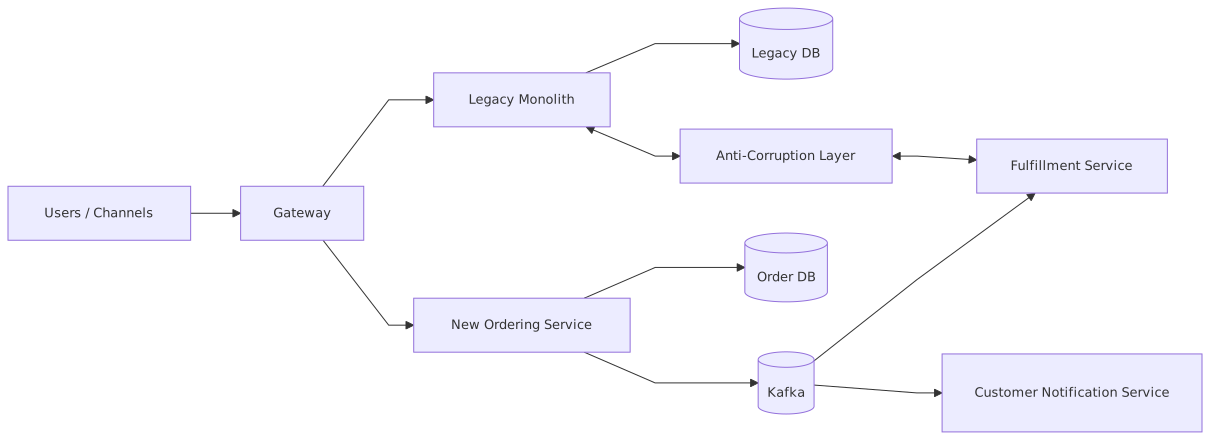
Initially, the monolith still handles most behavior. The new ordering service intercepts a narrow capability. It publishes events. New downstream consumers adopt those events. Legacy interactions flow through an anti-corruption layer.
Over time, responsibility moves:
- first order capture
- then order status management
- then fulfillment coordination
- then customer communications
- eventually portions of customer servicing and billing integration
The key is that each step should reduce future coordination, not just move code. If you extract a service but keep shared database writes, synchronized release windows, and legacy semantics, you have increased complexity without shrinking blast radius.
Why reconciliation is central to migration
During migration, dual writes and split authority are common. They are also dangerous. You may need a period where both legacy and new systems receive order information, or where the new service becomes system of engagement while legacy remains system of record for a while.
This is where reconciliation stops being a technical nuisance and becomes a business control.
You need to answer:
- Did every accepted order reach billing?
- Did every captured payment map to an invoice?
- Did every fulfilled shipment reconcile with ERP?
- Which source is authoritative for disputes during transition?
A mature migration explicitly defines authoritative source by business datum and by time period. It does not say “both systems are in sync.” They never are, not perfectly.
Enterprise Example
Take a global retailer modernizing order management across digital and store channels. The existing estate includes:
- e-commerce platform
- ERP for inventory and finance
- CRM
- store systems
- central customer master
- batch-based reporting
- a large order management monolith
The business pressure is familiar: add same-day pickup, support partial fulfillment from stores, improve checkout conversion, and ship pricing changes weekly instead of quarterly.
The first instinct in many enterprises is to build a “central order microservice” and wire everyone to it. That usually fails because “order” means too many things. Order capture, payment obligation, fulfillment request, customer promise, financial commitment, and store workload are related but not the same.
A better decomposition would separate:
- Ordering: customer intent and order lifecycle at capture time
- Pricing: offer and discount rules
- Inventory Availability: sellable promise, reservation policy
- Payments: authorization and capture
- Fulfillment: pick, pack, ship, collect
- Billing/Finance: invoice and financial posting
The retailer used Kafka to publish OrderPlaced, PaymentAuthorized, ReservationConfirmed, and FulfillmentCompleted. But the crucial move was not Kafka. The crucial move was refusing to let ERP item and order semantics leak into every context.
ERP remained authoritative for financial posting and some inventory balances. It was not made authoritative for customer promise or checkout interaction. An anti-corruption layer translated between modern order events and ERP document structures.
This sharply reduced blast radius in two ways.
First, pricing changes stopped forcing updates across fulfillment and finance models. Pricing owned promotion semantics. Downstream services consumed only outcomes they cared about.
Second, runtime dependencies were narrowed. Checkout depended on pricing, payment authorization, and reservation policy. CRM updates, loyalty accrual, and analytics moved asynchronously. During a CRM outage, sales still flowed.
Did this eliminate problems? Of course not.
Failure moved. Sometimes store systems accepted a fulfillment task late. Sometimes ERP posting failed after shipment. Sometimes Kafka consumers lagged during promotional peaks. But these failures were visible and bounded. They did not automatically collapse checkout.
That is the test that matters.
Operational Considerations
Blast radius is architectural, but operations reveals whether the architecture is honest.
Observability
Distributed tracing is useful, but business tracing matters more. You need correlation IDs that follow an order, payment, reservation, and shipment across APIs and Kafka topics. More importantly, you need to map them to business states, not just spans and logs.
Operators should be able to answer:
- Which orders are accepted but not paid?
- Which payments are captured but not invoiced?
- Which shipments completed without customer notification?
- Which event consumers are behind, and what business impact does that create?
Contract governance
Schema evolution in Kafka is where many estates quietly enlarge blast radius. Use schema registries, compatibility rules, and explicit event versioning. More importantly, teach teams that backward compatibility is not enough if semantic meaning changes.
A field can remain syntactically compatible and still break the business.
Retry discipline
Blind retries are architecture theater. A retry policy must reflect business semantics:
- retry transient network errors
- do not replay irreversible side effects without idempotency
- separate transport retry from business reprocessing
- quarantine poison messages with diagnostics
Data retention and replay
Kafka replay is powerful, but replaying everything into side-effecting consumers can create duplicate business actions. Replays need fences, idempotency keys, and context-aware handlers.
Dependency budgets
Every critical user flow should have explicit budgets:
- maximum synchronous hops
- timeout budget
- fallback behavior
- degraded-mode policy
If a customer checkout path requires six remote calls, the architecture is already in debt.
Tradeoffs
There is no free lunch here. Reducing blast radius usually means accepting some friction elsewhere.
More duplication of data and logic
Bounded contexts often replicate data. That offends people raised on normalization. It should not. Some duplication is the price of autonomy. The question is whether the duplicated data is translated and governed, not whether it exists.
Event-driven designs are harder to reason about at first
Synchronous request-response is easy to visualize. Event choreography is not. Teams need stronger discipline around state modeling, idempotency, and operational diagnostics.
Anti-corruption layers add code
Yes. They also save you from spreading legacy complexity everywhere. Translation code is cheaper than enterprise-wide semantic infection.
Reconciliation is operational overhead
Also yes. But if your business depends on eventual consistency, then reconciliation is not optional overhead. It is control.
Sometimes a modular monolith is better
If the domain is still fluid, team boundaries are immature, or operational capability is weak, a modular monolith can give you smaller semantic blast radius than poorly designed microservices. Many organizations need that sentence tattooed on their roadmap.
Failure Modes
The architecture patterns are well known. The ways they fail are even more predictable.
Shared topic, accidental enterprise contract
A Kafka topic becomes the de facto canonical data model. Too many consumers subscribe. Producers become afraid to evolve. Change freezes.
“Microservices” with shared database
Teams deploy independently in theory but coordinate constantly because data coupling remains central. One schema change causes hidden production breakage.
Choreography with no owner
Everything is event-driven, nobody owns end-to-end outcomes, and incidents turn into archaeology. A business process still needs accountability even if technically decentralized.
Synchronous orchestration everywhere
An orchestration layer becomes a distributed monolith. It knows too much, calls too many services, and turns local outages into enterprise incidents.
Semantic drift across bounded contexts
Names remain the same while meanings diverge. Teams assume shared understanding where none exists. Reporting, compliance, and customer experience become inconsistent.
Big-bang cutover
The migration plan says “switch all traffic on weekend.” That is not a strategy. That is hope wearing a project plan.
When Not To Use
Not every problem needs blast-radius-optimized microservices.
Do not use this style when:
- your system is small and handled by one team
- the domain is not yet understood well enough to define bounded contexts
- operational maturity for observability, event governance, and reconciliation is weak
- latency requirements demand tight in-process coordination
- regulatory or transaction constraints strongly favor a single consistent boundary
- your actual problem is poor modularity, not deployment topology
In these cases, a well-structured modular monolith, perhaps with internal domain modules and clear integration seams, is often the better architecture. It gives you lower operational complexity and still allows future extraction when the domain stabilizes.
Microservices are not a virtue. They are an expensive way to buy some kinds of independence.
Related Patterns
Several patterns work naturally with blast radius thinking:
- Bounded Context: the primary semantic containment boundary
- Anti-Corruption Layer: protects new domains from legacy semantics
- Strangler Fig: progressive replacement with controlled migration risk
- Saga: coordinates long-running distributed transactions, though often overused
- Outbox Pattern: improves reliability between state change and event publication
- CQRS: useful when read models need separate scaling or composition
- API Composition: acceptable for read aggregation, dangerous for core write paths if overused
- Consumer-driven contracts: helps manage API evolution, but do not confuse contract compatibility with semantic compatibility
- Bulkhead and circuit breaker: reduce runtime blast radius when dependencies fail
The important thing is not collecting patterns like stamps. It is using them to draw lines around change.
Summary
The architecture question is not “should we use microservices?” It is “how far does change travel when one thing changes?”
That is the essence of blast radius.
In a healthy microservice architecture:
- bounded contexts contain semantics
- APIs and events expose intent, not internals
- Kafka is used to decouple propagation, not centralize meaning
- anti-corruption layers isolate legacy gravity
- reconciliation handles the reality of eventual consistency
- migration proceeds by domain seam through a strangler strategy
- runtime dependencies are narrow and deliberate
- failures are bounded, visible, and repairable
In an unhealthy one, every service is small but every change is big.
That is the trap. Teams celebrate decomposition while living with constant coordination. They have many deployables, many topics, many dashboards, and one giant blast radius.
Good enterprise architecture is more practical than fashionable. It draws boundaries that match business language. It accepts that some things must be synchronous and some should not be. It puts translation where meaning changes. It plans migration around ownership, not around infrastructure. And it treats reconciliation as a first-class design concern.
The best microservice architecture is not the one with the most services. It is the one where a pricing change stays in pricing, a fulfillment outage stays in fulfillment, a schema evolution does not become a board-level event, and a legacy migration can happen one bounded context at a time.
That is what reducing blast radius really means. Not avoiding change, but stopping change from becoming shrapnel.
Frequently Asked Questions
What is a service mesh?
A service mesh is an infrastructure layer managing service-to-service communication. It provides mutual TLS, load balancing, circuit breaking, retries, and observability without each service implementing these capabilities. Istio and Linkerd are common implementations.
How do you document microservices architecture for governance?
Use ArchiMate Application Cooperation diagrams for the service landscape, UML Component diagrams for internal structure, UML Sequence diagrams for key flows, and UML Deployment diagrams for Kubernetes topology. All views can coexist in Sparx EA with full traceability.
What is the difference between choreography and orchestration in microservices?
Choreography has services react to events independently — no central coordinator. Orchestration uses a central workflow engine that calls services in sequence. Choreography scales better but is harder to debug; orchestration is easier to reason about but creates a central coupling point.