⏱ 20 min read
Microservices fail the way cities flood: not all at once, and never in the neat lines architects draw on whiteboards.
A payment service slows down. A customer profile service times out. A recommendation engine starts returning empty lists because a cache cluster is rebalancing. Then someone in the war room asks the wrong question: “Why isn’t the platform resilient?” As if resilience were a binary switch, an attribute you either bought or forgot to install.
That framing is the first mistake.
In serious enterprise systems, resilience is not uniform. It is tiered. Some capabilities must continue at almost any cost. Some may degrade gracefully. Some should simply stop rather than spread corruption. Treating every microservice as equally critical is one of the fastest routes to over-engineered platforms, bloated operating costs, and failure modes that are harder to control precisely because everything was made “highly available.” microservices architecture diagrams
The better approach is to classify resilience according to business semantics, not technical vanity. Orders are not recommendations. Ledger posting is not email notification. Identity verification is not thumbnail generation. If the domain says these things carry different consequences when they fail, then the architecture should say so too.
That is what resilience tiering is about: assigning different continuity, consistency, recovery, and degradation expectations to different services and flows based on the value stream they serve. Not because architects enjoy classification schemes. Because businesses survive disruption by preserving the right things first.
This matters even more in event-driven environments built around Kafka and asynchronous collaboration. Once you move from call chains to streams, failure doesn’t disappear. It changes shape. A timeout becomes lag. A crash becomes replay. A partial outage becomes reconciliation work. Resilience tiering gives that landscape a language and a structure. event-driven architecture patterns
Done well, it becomes a bridge between domain-driven design and operational architecture. Done badly, it becomes a decorative matrix no one uses while everything still fails the same way.
Let’s talk about how to do it properly.
Context
Most enterprises did not arrive at microservices by clean design. They arrived through pressure. Faster delivery. Multiple product teams. Legacy systems that resisted change. Acquisitions. Cloud migration. Regulatory carve-outs. A need to scale digital channels independently. The result is usually a mixed estate: some synchronous REST APIs, some Kafka topics, a few orchestrated workflows, pockets of batch integration, and at least one core system everyone is afraid to touch. cloud architecture guide
Inside that estate, resilience tends to evolve accidentally.
Customer-facing teams push for uptime. Platform teams add retries, circuit breakers, replicated clusters, and autoscaling. Data teams introduce asynchronous pipelines to decouple dependencies. Security teams demand stricter control around identity and audit flows. Then finance notices cloud spend has drifted from “strategic investment” into “quiet emergency.”
What’s often missing is a shared model for deciding where resilience is worth paying for.
This is where domain-driven design becomes more than a modeling technique. It becomes a prioritization lens. In DDD terms, not every bounded context is equally central to the business. Some domains are core. Some are supporting. Some are generic. The same should be true operationally. Core domains deserve stronger guarantees and more carefully designed failure containment. Supporting services often need good-enough continuity, not military-grade fault tolerance. Generic capabilities may be better consumed as managed services with explicit dependency risk.
If you skip this distinction, you end up with one of two anti-patterns.
The first is flat resilience: every service gets the same templates, same infrastructure patterns, same availability target, same backup model, same recovery assumptions. This sounds fair. It is not. It is architectural socialism funded by someone else’s budget.
The second is heroic resilience: a handful of critical flows get hardened through bespoke engineering, but no coherent model exists across the estate. Teams guess. Priorities change during incidents. Recovery becomes tribal knowledge.
Resilience tiering gives enterprises a middle path: explicit, repeatable classification tied to business outcomes.
Problem
The core problem is simple: microservice estates contain capabilities with radically different business criticality, yet they are often engineered as though they deserve the same runtime treatment.
That mismatch creates three classes of damage.
First, overprotection. Teams build active-active deployments, multi-region failover, exactly-once fantasies, and aggressive retry machinery around services whose temporary absence would be inconvenient but tolerable. This inflates cost and complexity while increasing the blast radius of coordination errors.
Second, underprotection. Truly critical capabilities—payment authorization, fraud decisioning, entitlement validation, inventory reservation, regulatory reporting—are left exposed to generic patterns that are insufficient for their domain consequences. The system looks modern right up until a queue backlog causes double fulfillment or a replay republishes business events without deduplication.
Third, semantic confusion. During a failure, operators know systems are unhealthy but not what business mode the enterprise is actually in. Can orders still be accepted? Can they be accepted but not committed? Can customer updates be delayed? Is the ledger source of truth or merely behind? If resilience is not expressed in domain language, incident response descends into technical guesswork.
This becomes especially painful in Kafka-centric architectures. Event streaming is good at decoupling time. It is not magic. If a consumer falls behind, downstream business facts become stale. If producers emit duplicate events, consumers must reconcile. If schemas drift carelessly, recovery replays become archaeology. Without resilience tiers, teams treat these as generic middleware concerns. They are not. They are domain continuity concerns.
A payment capture event delayed by six minutes and a recommendation refresh delayed by six hours are not the same incident. One affects cash and trust. The other affects conversion optimization. Architecture should encode that distinction.
Forces
Resilience tiering exists because several forces pull in opposing directions.
Business continuity versus cost
The business wants critical journeys to survive failure. Finance wants infrastructure spend to remain sane. These are both reasonable positions. The architecture must decide where expensive resilience mechanisms—cross-region replication, hot standby, synchronous quorum writes, premium support models—actually belong.
Consistency versus availability
Some business facts must not drift far from truth. Others can tolerate lag. Domain semantics matter here. Inventory reservation and ledger posting usually need stronger consistency boundaries than analytics enrichment or notification preference propagation. In distributed systems, you do not eliminate this tradeoff. You choose where to place it.
Autonomy versus control
Microservices promise team autonomy. Enterprises require guardrails. Resilience tiering must support local design choices while still enforcing estate-wide policies around RTO, RPO, failover testing, event retention, reconciliation, and dependency classification.
Speed versus recoverability
Teams move quickly when they can emit events, subscribe freely, and evolve services independently. But speed without recovery discipline produces brittle systems. If you cannot replay safely, rehydrate projections, or reconcile divergent states, then your architecture is fast in the same way a shopping cart rolling downhill is fast.
Synchronous user experience versus asynchronous robustness
Users expect immediate feedback. Architects know that coupling critical flows through deep synchronous call chains is asking for trouble. Tiering helps separate the interaction pattern from the business guarantee. For example, an order may be accepted synchronously while fulfillment and notification proceed asynchronously under a different resilience posture.
Solution
The solution is to define explicit resilience tiers and apply them to business capabilities, service interactions, and data flows.
The key word is explicit. If a tier is only implied, it will be ignored at the first deadline.
A practical model usually has three or four tiers. Three is enough for most enterprises.
Tier 1: Mission-critical continuity
These services support core domain capabilities where outage, duplication, or corruption has immediate material impact. Think payment authorization, order acceptance, account balance integrity, policy issuance, eligibility determination, or safety-critical operational control.
Characteristics:
- strict recovery objectives
- highly controlled dependencies
- limited fan-out
- strong observability
- rehearsed failover
- deterministic reconciliation
- idempotent message handling
- data integrity prioritized over convenience features
These services should degrade narrowly, not broadly. If they must fail, they fail in ways the business understands.
Tier 2: Business-essential but degradable
These capabilities matter, but the business can tolerate delay, stale data, or temporary manual workarounds. Examples include customer profile enrichment, pricing cache refresh, shipping estimation, document generation, and most workflow coordination services.
Characteristics:
- asynchronous-first where practical
- queue buffering and eventual consistency accepted
- moderate RTO/RPO
- replay and backfill supported
- user messaging and process fallbacks defined
The trick with Tier 2 is to design graceful degradation deliberately. Not all degraded modes are graceful. Some are merely hidden outages.
Tier 3: Deferrable or non-critical support
These capabilities can stop temporarily without threatening core value delivery. Recommendations, audit dashboards, search indexing refreshes, campaign segmentation, and non-essential notifications often sit here.
Characteristics:
- best-effort processing
- longer recovery windows
- low-cost infrastructure patterns
- simplified failover
- minimal synchronous dependency burden on higher tiers
Tier 3 is not sloppy engineering. It is disciplined restraint.
Here is a simple tiering model:
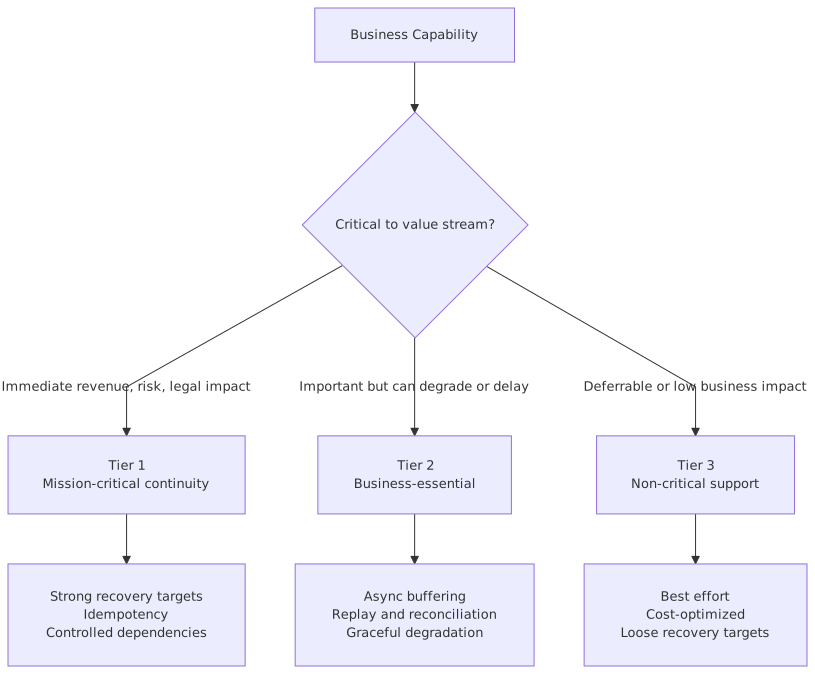
The tier is not just a label on a service catalog. It drives architecture decisions:
- sync versus async interaction
- data replication and backup strategy
- event retention period
- schema governance rigor
- dependency approval rules
- reconciliation requirements
- SLO targets
- test frequency for failover
- operator runbooks
- manual fallback process design
A good rule: classify the business capability first, then the service, then the integration. A single service may participate in multiple flows with different resilience expectations, but usually one dominant classification emerges from its bounded context.
Architecture
Resilience tiering works best when layered across domains, not merely infrastructure.
In DDD terms, start with bounded contexts and ask:
- What business decision does this context own?
- What happens if it is unavailable?
- What happens if it is stale?
- What happens if it processes the same fact twice?
- Can another context continue without it?
- Is compensation acceptable, or must the operation be prevented?
This framing forces domain semantics into operational design.
Consider a retail platform:
- Order Management is core. Tier 1.
- Inventory Reservation is core. Tier 1 or upper Tier 2 depending on fulfillment model.
- Customer Profile is important, but temporary lag is acceptable. Tier 2.
- Recommendation Engine is useful, not critical. Tier 3.
- Notification Service is often split: fraud SMS may be Tier 1/2, promotional email Tier 3.
Now introduce Kafka.
Kafka is a strong fit for resilience tiering because it enables temporal decoupling. Tier 1 services should avoid depending synchronously on lower-tier services. They can emit events and proceed within a tightly governed transaction boundary. Downstream processing then happens according to the resilience posture of each consuming domain.
But this only works if you design for replay and reconciliation. Event-driven systems are not self-healing by default. They are recoverable if disciplined.
A common pattern looks like this:
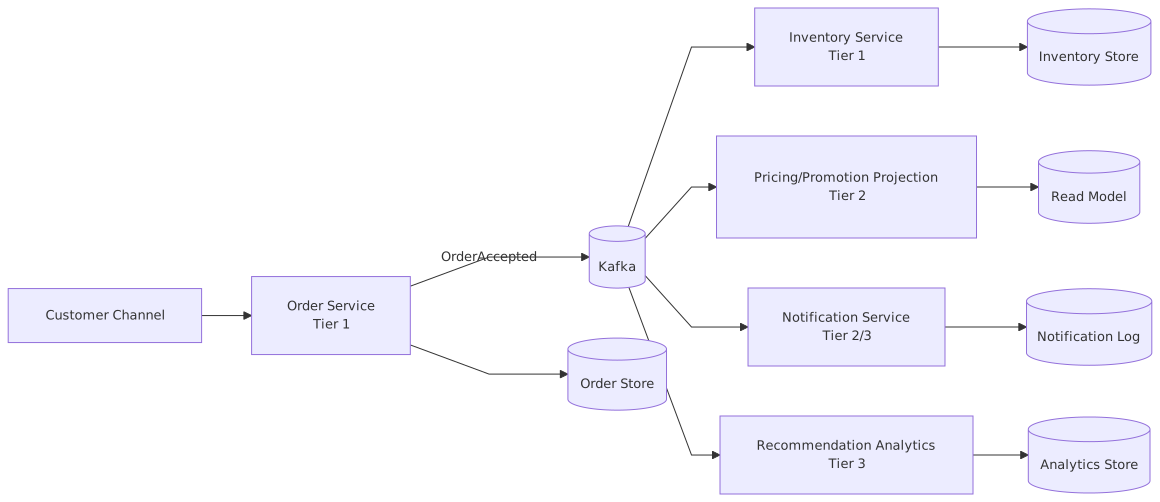
Notice what this diagram implies:
- Order acceptance does not synchronously wait for recommendations or marketing events.
- Lower-tier consumers can lag without immediately breaking order capture.
- Tier 1 consumers still require careful handling of duplicate or delayed events.
- Each service owns its own data, but ownership does not excuse semantic ambiguity.
That last point matters. In microservices, “each service owns its database” is repeated like scripture. It is useful advice. It is not enough. Resilience tiering demands clarity about the meaning of data across contexts. An OrderAccepted event is not just a payload; it is a business fact with timing, source, causality, and recovery implications.
Domain semantics and event design
If you want resilient systems, name events after business facts, not CRUD operations. OrderAccepted is better than OrderCreated. PaymentAuthorized is better than PaymentUpdated. Semantics matter during failure. Operators and reconcilers need to know whether an event represents intent, acceptance, completion, or notification.
This distinction becomes critical when replaying Kafka topics. If an event means “request to attempt,” replay may be dangerous. If it means “fact that occurred,” replay is typically safer, provided consumers are idempotent.
That is why Tier 1 services should strongly prefer:
- immutable domain events
- stable keys
- idempotency tokens
- consumer deduplication
- explicit versioning
- outbox patterns where atomicity matters
Tier 2 services often tolerate broader eventual consistency, but they still need reconciliation. Stale state is acceptable only if you can detect and repair it.
Reconciliation as a first-class capability
Most microservice architecture diagrams omit reconciliation because it ruins the elegance. Real systems need it anyway.
Reconciliation is how the enterprise regains confidence after partial failure, delayed consumers, poison messages, manual intervention, or replay. It compares authoritative facts with derived state and resolves divergence. In tiered resilience, reconciliation requirements differ by tier:
- Tier 1: automated and deterministic where possible, human-approved where required
- Tier 2: periodic repair jobs, replay pipelines, backfill from authoritative topics
- Tier 3: often rebuild from source or accept eventual catch-up
If your architecture has no reconciliation story, your resilience claim is marketing.
Migration Strategy
Most enterprises cannot impose resilience tiering in one grand redesign. They have too much legacy, too many teams, and too many active programs. The migration must be progressive, and this is where the strangler pattern earns its keep.
Start by mapping critical business journeys end to end. Not applications. Journeys. Order-to-cash. Quote-to-bind. Claim-to-settle. Admit-to-discharge. Then identify the system interactions that actually determine business continuity.
You are not trying to modernize everything. You are trying to stop the most expensive failures first.
A sensible migration sequence looks like this:
- Classify business capabilities into resilience tiers
- Identify synchronous dependencies from high-tier services to lower-tier services
- Decouple those dependencies using events, local caches, or precomputed read models
- Introduce outbox/inbox and idempotency patterns
- Stand up Kafka for durable event propagation where useful
- Add reconciliation pipelines before broadening event-driven adoption
- Strangle legacy endpoints flow by flow, not system by system
This often means the first migration win is not replacing a monolith. It is reducing the fragility of a core path.
For example, if order capture currently calls customer profile, inventory, pricing, fraud, email, and CRM synchronously, do not begin with a rewrite. Begin by asking which of those dependencies are truly Tier 1. Usually fewer than people think.
A progressive target state may look like this:
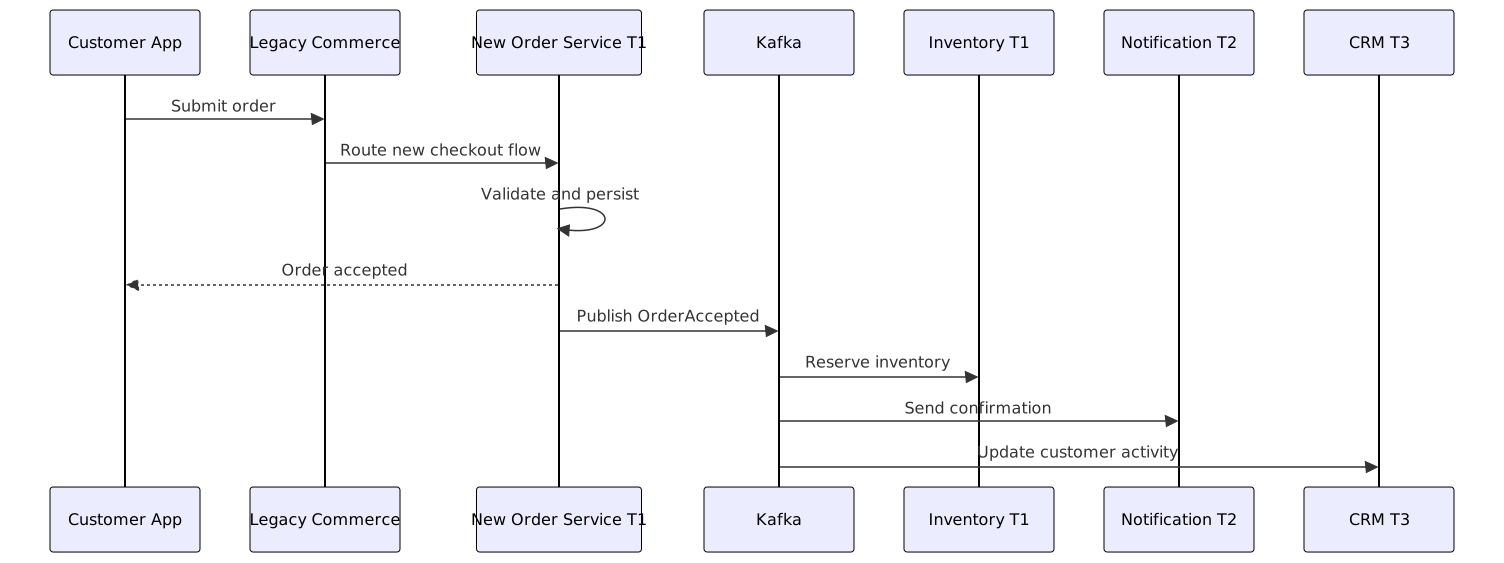
That sequence illustrates strangler migration correctly:
- customer traffic is progressively routed
- the new Tier 1 capability becomes authoritative for the critical decision
- lower-tier concerns move behind asynchronous boundaries
- the legacy platform remains in the picture temporarily, but no longer dominates the resilience model
Migration reasoning
The hard part is usually not code. It is authority.
Which system is authoritative for the business fact during transition? If the monolith and the new service can both accept orders, you need explicit cutover rules, event sourcing boundaries, deduplication, and reconciliation. During migration, ambiguity is the enemy.
A practical approach:
- choose one system as the write authority per business fact
- emit canonical domain events from that authority
- use anti-corruption layers around the legacy system
- maintain reconciliation reports between legacy and new state
- only retire a legacy step once the business can explain failures in the new path
This is slower than the slideware version of modernization. It is also how you avoid creating two broken systems instead of one old system.
Enterprise Example
Consider a multinational insurer modernizing claims processing.
The legacy claims platform is a large policy administration suite with nightly batch synchronization to payments, document management, fraud analytics, and customer communications. The business wants digital first notice of loss, straight-through processing for simple claims, and faster partner integration.
The initial instinct is familiar: carve the monolith into microservices.
That would be naive.
A better approach starts with resilience tiers across bounded contexts:
- Claim Intake and Coverage Validation: Tier 1
- Fraud Scoring: Tier 2, because temporary fallback to manual review is acceptable
- Document Generation: Tier 2
- Customer Notifications: mixed Tier 2/3
- Analytics and Portfolio Dashboards: Tier 3
The insurer introduces a new Claim Intake service as the authority for digital submissions. It persists the intake decision, publishes ClaimSubmitted and CoverageValidated events to Kafka, and stores immutable audit references. Fraud scoring consumes events asynchronously. If fraud services are unavailable, claims are marked for manual review rather than blocking intake. Document generation and outbound notifications happen later and can be retried.
This changes the resilience profile dramatically. The business can keep accepting claims even when non-core support systems are impaired. That is not theoretical value. During a weather catastrophe, it is the difference between scaling intake and creating a public relations disaster.
But there is a catch. Payments remain in the legacy policy system. So reconciliation becomes mandatory. The architecture adds:
- claim-to-payment correlation IDs
- daily and near-real-time mismatch reports
- replayable event streams for downstream rebuild
- exception queues for manual adjudication
This is what real enterprise architecture looks like: not perfect autonomy, but careful authority, explicit seams, and survivable failure.
Operational Considerations
Resilience tiering changes operations as much as design.
Observability by business tier
Metrics should reflect business consequence, not just CPU and latency. Tier 1 dashboards should answer:
- Are we still accepting orders, claims, or payments?
- Is decision latency within business tolerance?
- Are duplicate or orphan events increasing?
- Are reconciliation gaps growing?
Tier 2 and Tier 3 observability can be lighter, but they still need lag, failure, and replay visibility.
SLOs and error budgets
Set SLOs by resilience tier, not uniformly by platform policy. A Tier 1 service may require very high availability and strict processing correctness. A Tier 3 service may be allowed longer outages if recovery is cheap and business impact is low.
Kafka retention and replay policy
Retention is architecture, not plumbing. Tier 1 topics often need retention long enough to support audited replay and investigation. Tier 2 may need replay windows for backfill. Tier 3 may settle for shorter retention if projections can be rebuilt elsewhere.
Runbooks and incident modes
Each tier should have defined operating modes:
- normal
- degraded
- isolated
- recovery
- reconciliation
If operators do not know what degraded mode means in business terms, the tiering model has failed.
Dependency governance
High-tier services should not casually depend on lower-tier synchronous APIs. This should be a visible architecture rule, not a suggestion buried in a wiki.
Tradeoffs
Resilience tiering is useful because it makes tradeoffs explicit. It does not eliminate them.
The biggest tradeoff is complexity in classification. Teams will debate whether a service is Tier 1 or Tier 2. Good. Those arguments are architecture doing its job. What matters is resolving them against business semantics rather than ego.
Another tradeoff is that asynchronous decoupling often shifts complexity into reconciliation and data freshness management. You reduce immediate coupling but increase the need for event discipline, idempotency, replay testing, and state repair.
There is also an organizational tradeoff. Tiering creates differentiated expectations. Some teams will feel they are being labeled “less important.” That is a management issue dressed as architecture. The answer is simple: lower-tier does not mean low quality. It means the business impact of temporary failure is different.
And of course there is cost. Tier 1 services are expensive to build and operate properly. That is exactly why not everything should be Tier 1.
Failure Modes
Resilience tiering fails in predictable ways.
Everything becomes Tier 1
This is the classic enterprise disease. No team wants to admit its service can degrade. The result is inflated infrastructure, excessive coupling, and fake criticality.
Tiers are assigned by technology, not domain
For example, “all Kafka services are Tier 2” or “all customer-facing APIs are Tier 1.” That is lazy thinking. The tier belongs to the business capability and flow.
No reconciliation path
Teams implement asynchronous patterns but cannot detect divergence or repair it safely. Recovery becomes manual database surgery, which is not resilience; it is quiet desperation.
Lower-tier dependencies leak upward
A Tier 1 service starts calling a Tier 3 recommendation or CRM API because “it was easy.” During the next outage, the core journey fails for a non-core reason.
Event semantics are weak
Events represent mutable state dumps or ambiguous updates. Replay causes duplicates, missed side effects, or inconsistent projections. Architects then blame Kafka for what is really poor domain modeling.
Degraded mode is undefined
A service is “up,” but the business process is not viable. This happens when technical uptime masks semantic failure.
When Not To Use
Resilience tiering is not always the right investment.
Do not use a formal tiering model if your system is small, the domain is simple, and a modular monolith with clear internal boundaries will do the job. Many organizations would be better served by fewer deployable units and stronger transactional consistency than by a sprawling microservice estate with beautifully named tiers.
Do not apply it mechanically to every internal utility. Some services are simple enough that standard platform defaults are sufficient.
Do not force Kafka or event-driven patterns where the domain requires immediate transactional guarantees and the scope is contained enough to keep that consistency local.
And do not use resilience tiering as a substitute for basic engineering discipline. A badly written Tier 1 service is still badly written.
Related Patterns
Several patterns complement resilience tiering well:
- Strangler Fig Pattern for progressive replacement of legacy flows
- Outbox Pattern for reliable event publication from transactional boundaries
- Inbox/Idempotent Consumer for duplicate-safe processing
- Bulkheads for isolation of resource contention
- Circuit Breakers where synchronous calls remain necessary
- Saga or process manager patterns for long-running business workflows, used carefully
- CQRS/read models for isolating query scale and reducing synchronous dependency
- Anti-Corruption Layer when integrating with legacy systems or acquired platforms
Used together, these patterns turn tiering from a categorization exercise into an executable architecture.
Summary
Resilience in microservices should not be flat. It should be tiered, explicit, and anchored in domain meaning.
The point is not to make everything survive. The point is to preserve the business capabilities that matter most, degrade the ones that can bend, and avoid spending premium engineering effort on what can safely wait. That requires domain-driven design thinking, not just infrastructure templates. It requires migration discipline, especially through progressive strangler strategies. It requires Kafka and asynchronous patterns to be paired with replay safety, reconciliation, and semantic clarity.
Most of all, it requires honesty.
A resilient enterprise is not one where nothing fails. It is one where failure lands in the places the business has chosen, in forms it knows how to absorb, and with recovery paths that do not depend on heroics at 2 a.m.
That is resilience tiering. Not glamour. Not ceremony. Just architecture finally admitting that some things matter more than others—and designing accordingly.
Frequently Asked Questions
What is a service mesh?
A service mesh is an infrastructure layer managing service-to-service communication. It provides mutual TLS, load balancing, circuit breaking, retries, and observability without each service implementing these capabilities. Istio and Linkerd are common implementations.
How do you document microservices architecture for governance?
Use ArchiMate Application Cooperation diagrams for the service landscape, UML Component diagrams for internal structure, UML Sequence diagrams for key flows, and UML Deployment diagrams for Kubernetes topology. All views can coexist in Sparx EA with full traceability.
What is the difference between choreography and orchestration in microservices?
Choreography has services react to events independently — no central coordinator. Orchestration uses a central workflow engine that calls services in sequence. Choreography scales better but is harder to debug; orchestration is easier to reason about but creates a central coupling point.