⏱ 21 min read
Most integration estates do not fail because the technology is old. They fail because the seams are wrong.
That is the uncomfortable truth behind a surprising number of “microservices transformations.” Teams proudly containerize a monolith, wire everything through Kafka, publish a few APIs, and still live inside the same old mess. They have moved the furniture but not changed the floor plan. The real work is not splitting code. It is extracting boundaries where the business meaning is coherent, where ownership is real, and where integration stops being a sprawling rumor network.
Integration boundary extraction is the act of identifying, isolating, and then formalizing the edges where one domain’s responsibility ends and another begins. In practice, it is the difference between a microservice landscape that can evolve and one that turns into distributed mud. If you get it right, integration becomes legible. If you get it wrong, every service knows too much, every event means three things, and every release becomes a negotiation between tribes. microservices architecture diagrams
This article looks at integration boundary extraction as an architectural move, not just a refactoring technique. We will look at the domain-driven thinking behind it, the migration mechanics, why Kafka often helps and sometimes hurts, and how reconciliation becomes essential once you stop pretending distributed systems are perfectly synchronized. event-driven architecture patterns
Context
Enterprises rarely start with clean boundaries. They start with growth.
A sales platform acquires pricing logic. Pricing starts making commitments to finance. Finance leaks credit rules back into order management. Customer service adds overrides. Marketing wants campaign eligibility. Soon enough, one system of record becomes five systems of partial truth, all integrated through APIs, batch jobs, database reads, file drops, and a Kafka cluster that was originally introduced to “decouple things.”
This is the common setting for boundary extraction:
- a monolith or large modular platform with deep internal coupling
- multiple consuming channels: web, mobile, call center, partners
- mixed integration styles: synchronous APIs, asynchronous events, ETL, CDC
- inconsistent semantics across teams
- duplicated business rules across systems
- high change cost around certain workflows
What makes the problem hard is not the mechanics of exposing an interface. It is the semantics. Different parts of the enterprise use the same words to mean different things, and different words to mean the same thing.
“Customer” in CRM often means a prospectable party.
“Customer” in billing means a financially accountable account.
“Customer” in support means the person with an open case.
“Customer event” therefore becomes a dangerous phrase.
Boundary extraction starts when architecture stops asking “what can we split?” and starts asking “what does this capability actually mean, who owns it, and where should others stop reaching inside?”
That is deeply domain-driven design territory. Not the cargo-cult version where every noun becomes a service, but the practical version: bounded contexts, explicit language, and integration models that respect domain differences instead of papering over them.
Problem
The problem is easy to spot once you know the smell.
A single change in pricing requires updates in product catalog, order submission, invoicing, and partner APIs. A new fulfillment rule breaks customer notifications because both depend on order status codes that nobody truly owns. Teams publish events that are really database change notices with domain labels glued on top. Other teams subscribe because they need something, then infer meaning from fields that were never intended as public commitments.
Over time, integration becomes a second codebase, one made of assumptions.
The operational symptoms are familiar:
- event contracts drift without governance
- services depend on internal states of other services
- duplicate commands race through different channels
- retries create side effects
- reports don’t match operational systems
- teams argue over who owns “truth”
- migration stalls because no one can define a safe extraction point
At this stage, microservices do not simplify the landscape. They distribute ambiguity.
The core issue is the absence of explicit integration boundaries. Without them, every interaction becomes bespoke. Every API is potentially a backdoor. Every event is a semi-public internal detail. Every consumer creates another hidden dependency. Architects often describe this as coupling, but that is too polite. It is territorial confusion.
Boundary extraction is how you restore sovereignty.
Forces
Several forces shape this decision, and they pull in opposite directions.
1. Domain coherence vs delivery speed
The cleanest boundary is often not the quickest one to implement. Teams under pressure tend to split by technical module or by current org chart. That is understandable and often wrong. A fast split around unstable domain meaning simply exports confusion.
2. Consumer needs vs provider autonomy
Consumers want rich, convenient interfaces. Providers want freedom to change internals. If a service exposes too much structure, consumers become coupled to implementation detail. If it exposes too little, consumers rebuild the provider’s logic locally. Neither is healthy.
3. Transactional certainty vs asynchronous scale
Synchronous integrations give immediate feedback and easier reasoning at the point of interaction. Event-driven integration with Kafka scales better and decouples time, but it introduces delay, duplication, ordering concerns, and reconciliation burden. The boundary must account for this, not ignore it.
4. Local optimization vs enterprise semantics
A team can model its own service elegantly while still damaging the enterprise if it emits vague or overloaded events. Boundary extraction has to honor local bounded contexts while creating comprehensible translation at the edges.
5. Migration safety vs target purity
A theoretically ideal target architecture is useless if you cannot get there incrementally. Boundary extraction that requires a “big red weekend” cutover is usually a fantasy. Progressive strangler migration matters because enterprises do not stop selling while architects draw cleaner boxes.
6. Control vs observability
Once logic crosses service boundaries, failure analysis changes. You no longer debug one process; you investigate a narrative across systems. Boundaries that reduce direct coupling often increase operational indirection. Good architecture accepts this and invests in traceability and reconciliation.
Solution
The solution is to extract integration boundaries around bounded contexts, then formalize those boundaries through purpose-specific contracts: commands, queries, domain events, and published views. The point is not merely to separate systems. It is to separate meanings.
In practical terms, boundary extraction means:
- Identify the domain capability that has stable ownership.
Not “orders table,” but “order commitment.” Not “customer master,” but “party profile” or “billing account,” depending on actual semantics.
- Define what the owning context is authoritative for.
Authority is the heart of the boundary. If everyone can interpret or mutate the same concept differently, there is no boundary.
- Classify integrations by intent.
- Command: ask the owner to perform a business action.
- Query: request information optimized for a use case.
- Domain event: inform others of a completed business fact.
- Published data product: provide derived or analytical views without exposing internals.
- Introduce anti-corruption layers where semantics differ.
This is one of the least glamorous and most valuable moves in enterprise architecture. Translation protects both sides. It prevents one bounded context from becoming linguistically colonized by another.
- Separate operational workflow from data synchronization.
Too many architectures use events to do both without distinction. A business event like OrderConfirmed is not the same thing as replicating every field of an order. Treating them as identical creates brittle integration.
- Design for reconciliation from the start.
Once systems are autonomous, they will diverge temporarily. Some divergences are normal. The architecture should specify how they are detected, explained, and repaired.
This is not a diagramming exercise. It is a commitment model.
A simple conceptual shape

The key point in this picture is not that Kafka exists. It is that the meaning of interactions is explicit. Sales submits an order. Order Management owns commitment. Other contexts react to business facts, not table updates. The customer portal consumes a published view, not internal order state.
That is boundary extraction in one glance.
Architecture
A useful architecture for integration boundary extraction has four layers of concern.
1. Domain ownership layer
Each microservice or bounded context owns specific business concepts and invariants. This is where domain-driven design earns its keep. Ownership is not about database possession; it is about decision rights over business rules.
Examples:
- Pricing owns price calculation policies and effective offers
- Order Management owns order acceptance and lifecycle commitments
- Billing owns invoice generation and financial accountability
- Fulfillment owns shipment orchestration and delivery execution
When a concept spans multiple areas, resist the temptation to create a “shared master service” too early. Shared concepts are often a sign of hidden context differences. “Customer” is usually several things pretending to be one.
2. Interaction layer
Use different integration styles for different reasons.
- Commands over APIs when a caller needs a business decision now
- Events over Kafka when downstream contexts need to react independently
- Queries via read models or API composition when clients need tailored views
- CDC or replication sparingly for migration bridges, not as the default semantic model
A lot of architectural pain comes from using one tool for every job. Kafka is excellent for asynchronous propagation of business facts. It is poor as a substitute for every operational conversation.
3. Translation layer
This is where anti-corruption and semantic mapping live. One context’s AccountSuspended may mean “commercial hold,” while another requires “service termination prohibited.” If you pass events through unchanged and hope downstream consumers interpret them “correctly,” you are not integrating; you are gambling.
Translation may be implemented as:
- dedicated adapter services
- event transformation pipelines
- API façades
- contract-specific mappers in the consuming context
The mechanism matters less than the discipline.
4. Reconciliation and observability layer
Distributed boundaries create eventual consistency. That means you need visible state transitions, lineage, and compensating processes. The architecture should include:
- idempotency keys
- correlation IDs
- business process IDs
- replay strategy for Kafka consumers
- drift detection reports
- reconciliation workflows for mismatches
If you skip this layer, your architecture will look elegant in PowerPoint and miserable in production.
Migration Strategy
Boundary extraction is usually done under fire. The business wants new capabilities while the old platform still runs the revenue stream. This is why progressive strangler migration is the right default.
The pattern is simple in principle: intercept demand at the edge, route selected capabilities to the new boundary, gradually let the new context become authoritative, and shrink the old platform’s role over time. In reality, it requires patience and careful semantics.
Step 1: Discover candidate seams
Look for places where:
- business ownership is relatively clear
- change demand is high
- dependencies are painful but understandable
- a stable business fact can be emitted
- consumers can tolerate temporary duplication or lag
Good extraction candidates are often capabilities with externally visible outcomes: quoting, order validation, inventory reservation, shipment tracking, invoice generation.
Bad first candidates are often deeply intertwined reference models with weak semantic agreement.
Step 2: Define authority before implementation
This step gets skipped far too often. Before writing a service, document:
- what decisions the new boundary owns
- what source of truth changes
- what events it publishes
- what data others may cache
- what remains in the legacy platform temporarily
If authority is ambiguous, the migration will produce a split-brain domain.
Step 3: Build an anti-corruption shell around the legacy core
Do not let new services directly roam through legacy tables or proprietary message formats if you can avoid it. Introduce a translation layer. This buys two things: semantic clarity and a place to gradually move logic.
Step 4: Emit business events, not raw change data
During migration, teams are tempted to expose CDC from legacy databases as if it were a domain API. Sometimes that is a useful bridge. It is not a long-term boundary. Use CDC to bootstrap projections or synchronize temporary stores, but move toward explicit events like QuoteAccepted, OrderCommitted, InvoiceFinalized.
Step 5: Run dual paths carefully
There are moments when both old and new paths operate together. This is dangerous territory.
Use shadow reads, side-by-side calculations, and compare outputs. For write paths, prefer one authoritative writer and one observational shadow processor before enabling active dual write. Dual write across old and new systems is a classic failure generator.
Step 6: Introduce reconciliation as a first-class process
Once the new service becomes authoritative for part of the workflow, downstream systems may still rely on legacy structures. Reconciliation closes the gap.
Examples:
- compare accepted orders in the new service against invoices generated downstream
- detect fulfillment records missing for committed orders after SLA windows
- compare customer-visible status projections with underlying operational events
Reconciliation is not a sign of weak architecture. In large enterprises, it is the price of honesty.
Step 7: Cut dependency paths, not just traffic
A migration is incomplete if the old system still remains the hidden semantic authority. True extraction happens when consumers stop reading old internals, old status codes stop defining enterprise behavior, and ownership shifts in both technology and process.
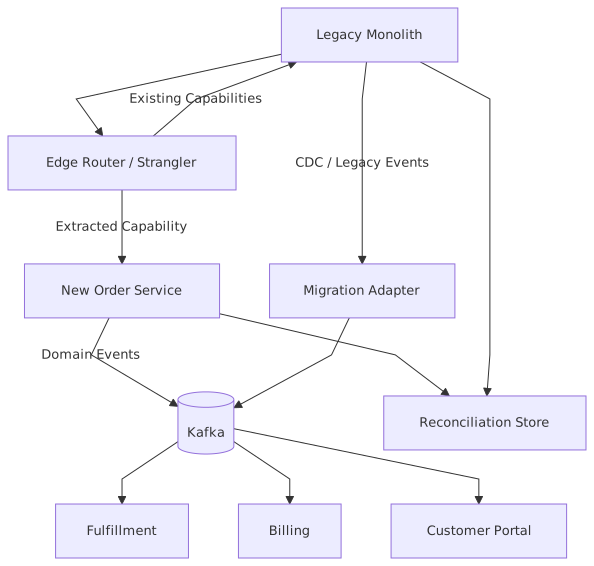
This diagram shows a common migration reality: both old and new worlds coexist. The important part is that the adapter and reconciliation store make this coexistence explicit and governable.
Enterprise Example
Consider a large telecommunications provider modernizing its order-to-cash platform.
The legacy estate had one giant order management system serving consumer broadband, mobile, and enterprise products. It handled product eligibility, pricing, order capture, provisioning orchestration, billing triggers, and customer notifications. Over twenty years, every channel integrated with it differently. Some used SOAP APIs, some read database views, some consumed nightly extracts, and newer teams had added Kafka topics sourced from database change events.
Leadership wanted “microservices.” The first attempt failed. They split by technical layers: catalog service, order service, customer service, notification service. It looked tidy. It was not. Pricing logic still lived in three places. Enterprise products had different commitment rules from consumer products. Order status codes were overloaded across billing and provisioning. Kafka topics spread these ambiguities at speed.
The second attempt focused on integration boundary extraction.
What changed
The architecture team started with event storming and domain language workshops across sales, fulfillment, and finance. Not because workshops are fashionable, but because language was the problem.
They discovered that “order” meant at least three things:
- a sales submission
- a commercial commitment
- a technical fulfillment request
The old platform had mashed these together. Every downstream consumer interpreted status codes according to its own needs.
So they extracted boundaries accordingly:
- Sales Order Context owned channel submission and quote conversion
- Commercial Order Context owned acceptance, commitment, and contract creation
- Service Fulfillment Context owned provisioning tasks and technical activation
- Billing Trigger Context owned financial billability events
That was the crucial move. Instead of one generic order service, they split by business meaning.
Integration model
- Channels sent commands to Sales Order APIs
- Commercial Order emitted
OrderCommittedandOrderRejected - Service Fulfillment consumed commitment events and emitted
ServiceActivated - Billing Trigger consumed billable milestones, not generic order updates
- Customer channels read from a unified order status projection assembled from domain events
Kafka was used for domain event distribution between contexts, but not as the sole interface. Order acceptance remained synchronous because channels needed immediate confirmation. Fulfillment remained asynchronous because technical activation could take hours.
Migration approach
They applied a strangler at the channel gateway. New mobile broadband orders were routed first to the new Sales Order and Commercial Order services, while legacy enterprise products continued through the monolith. A migration adapter translated legacy provisioning acknowledgements into the new event vocabulary so customer channels could begin consuming a consistent projection.
For six months, reconciliation jobs compared:
- commercial commitments in the new domain
- provisioning starts in legacy orchestration
- billing trigger creation downstream
This surfaced missing mappings and timing assumptions. It also exposed a painful truth: some legacy channels had been relying on internal order states that were never intended as business milestones. Without reconciliation, those invisible contracts would have continued to sabotage the migration.
Outcome
Lead time for changes in mobile broadband dropped dramatically because pricing and commitment rules no longer required coordinated monolith releases. More importantly, incident analysis improved. A failed order journey could be traced through explicit domain events instead of inferred from half a dozen status tables.
That is the practical value of extracted boundaries. Not elegance. Operability and changeability.
Operational Considerations
Architecture is judged in production, where all diagrams become weather.
Contract governance
Every boundary needs contract discipline. This includes versioning policies, schema compatibility rules for Kafka topics, API change review, and explicit deprecation periods. Event schemas should be treated as public products, not side effects of internal persistence models.
Idempotency and duplicate handling
Kafka consumers will see retries. APIs will be called twice. Humans will resubmit orders. If a boundary owns a business commitment, it must defend against duplicate intent with idempotency keys and deduplication logic tied to business identity, not merely transport identity.
Ordering assumptions
Many distributed failures are really hidden ordering assumptions. Teams assume OrderCommitted always arrives before PriceAdjusted, or that all events for a customer are consumed in perfect sequence across services. Design so consumers can tolerate partial order and delayed arrival.
Reconciliation operations
Reconciliation needs ownership, tooling, and SLAs. Do not dump it on an operations team as a weekly spreadsheet exercise. Build dashboards for drift, exception queues for repair, and audit trails showing the journey of business entities across boundaries.
Observability
At minimum:
- distributed tracing for synchronous hops
- correlation IDs across API and Kafka flows
- event lineage metadata
- business milestone monitoring
- dead-letter queue handling with triage paths
You want to ask not only “is the service up?” but “how many committed orders failed to become billable within four hours?”
That is the operational question that matters.
Data retention and replay
Kafka replay is powerful and dangerous. It can rebuild projections and recover consumers, but it can also repeat side effects if consumers are not designed properly. Separate side-effect processing from projection rebuilding where possible.
Tradeoffs
There is no free lunch here, only better bills.
Benefit: clearer ownership
Cost: more explicit coordination
Once boundaries are extracted, teams can evolve independently. But enterprise workflows still span contexts, so coordination moves from shared code into contracts and process. That is healthier, but it is not cheaper in the short term.
Benefit: decoupled evolution
Cost: eventual consistency
You gain autonomy and scalability. You lose instantaneous global truth. Users may briefly see different states in different channels. Business stakeholders need to understand which inconsistencies are acceptable and which require synchronous guarantees.
Benefit: domain clarity
Cost: translation overhead
Anti-corruption layers and semantic mapping add code and cognitive load. Some teams resent this because direct reuse seems faster. It is faster right up until one domain infects another.
Benefit: resilient integration via Kafka
Cost: operational complexity
Event-driven architectures handle load and independent consumption well. They also introduce replay, lag, poison messages, ordering ambiguity, and schema evolution headaches. Kafka is not complexity removal. It is complexity relocation.
Benefit: progressive migration
Cost: temporary duplication
During strangler migration, logic and data may exist in two places. This is acceptable if it is temporary and governed. It is dangerous if it becomes the new normal.
Failure Modes
The failure modes are worth naming plainly.
1. Boundary extraction by entity, not by domain meaning
The classic mistake: create CustomerService, OrderService, ProductService because those are obvious nouns. If those services merely mirror old tables while business rules stay tangled, you have built distributed CRUD.
2. Kafka topics as shared database
Publishing low-level change events and letting consumers derive business meaning is boundary erosion masquerading as decoupling. It creates semantic drift and brittle consumers.
3. Split-brain authority during migration
Both legacy and new services accept updates for the same concept. Reconciliation can report the mess, but it cannot make ambiguity healthy. Pick one writer.
4. Projection treated as source of truth
Read models are seductive. Teams begin writing back to them or inferring authority from them. Resist that. A projection serves consumption. It does not own the domain.
5. Ignoring exception workflows
Happy path domain events look beautiful. Real enterprises run on reversals, retries, cancellations, corrections, legal holds, and manual intervention. If the boundary model does not include exception semantics, operations will invent side channels.
6. Reconciliation designed as an afterthought
Without built-in comparison points and business identifiers, you cannot easily prove where the journey failed. At that point, every incident becomes detective work.
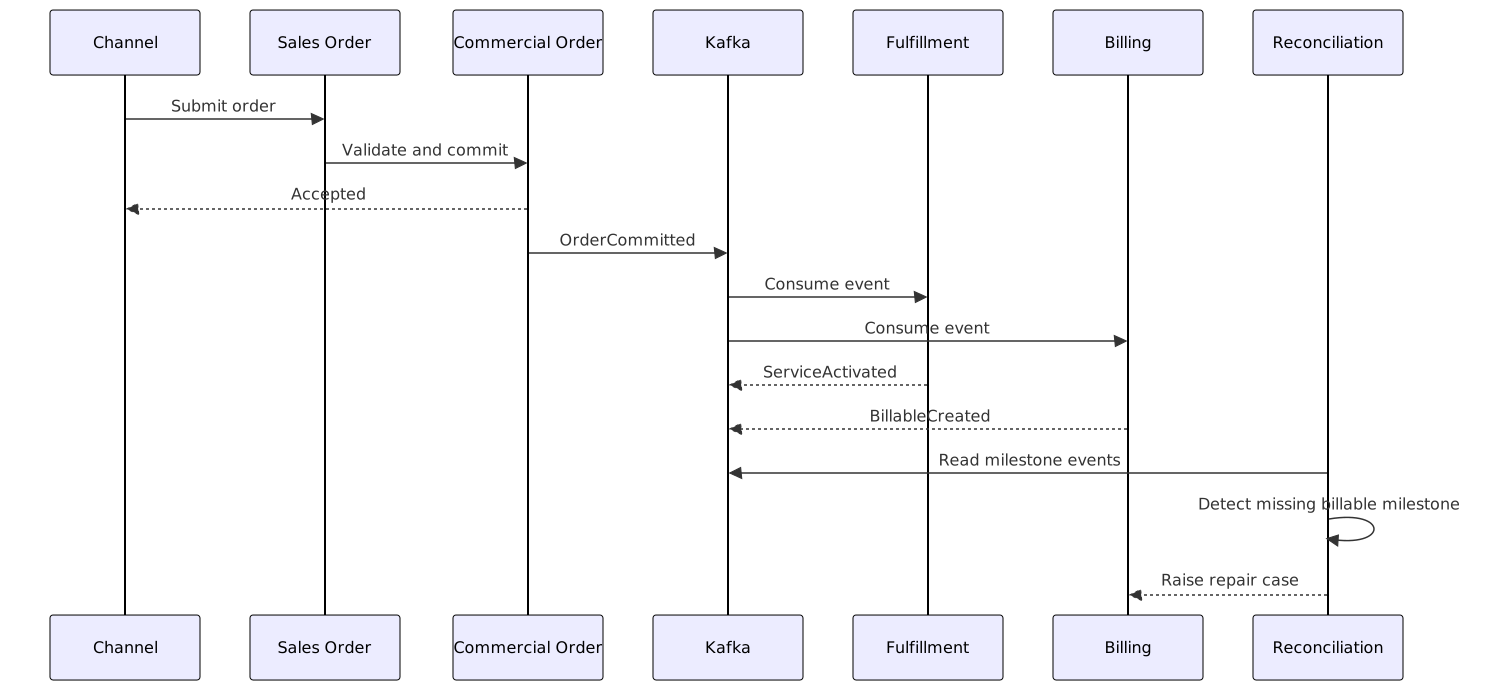
This sequence illustrates a healthy posture: asynchronous flow, explicit milestones, and reconciliation that detects missing progress rather than pretending all subscribers stay perfectly aligned.
When Not To Use
Boundary extraction is powerful, but not universal.
Do not use this approach when the domain is small, stable, and handled effectively by a modular monolith. A clean monolith with strong internal module boundaries is often the better engineering choice. If your team is small and your release cadence is manageable, distribution may buy very little.
Do not force event-driven boundary extraction when the business process requires tight, immediate consistency across a handful of operations and the scale does not justify asynchronous complexity. Sometimes a well-designed transactional service is exactly right.
Do not attempt large-scale extraction if the organization cannot sustain domain ownership. Microservices with no real product ownership become enterprise pinball. The architecture only works when teams own semantics, contracts, and operations.
Do not start here if your biggest issue is poor internal modularity inside one application. Fix the model before you scatter it across the network.
And do not use boundary extraction as a political escape hatch. Splitting systems to avoid collaboration usually produces APIs that encode unresolved conflict.
Related Patterns
Several adjacent patterns often work with integration boundary extraction.
Bounded Context
The foundation. Boundaries should align to coherent language and rules, not just technical decomposition.
Anti-Corruption Layer
Essential during migration and whenever two contexts have different semantics for similar concepts.
Strangler Fig Pattern
The practical migration mechanism for progressive extraction from monoliths or legacy suites.
Outbox Pattern
Useful when publishing domain events reliably from transactional services into Kafka.
Saga or Process Manager
Helpful when a business process spans multiple services and requires coordinated progress without distributed transactions.
CQRS and Read Models
Valuable for published views and customer-facing status projections, especially when multiple context events must be assembled.
Canonical Data Model
Use carefully. A light enterprise canonical vocabulary can help integration, but a heavy canonical model often becomes a bureaucratic tar pit that flattens real domain distinctions.
That last point matters. Enterprises love canonical models because they promise one language for everyone. Reality tends to be messier. A small set of shared reference concepts is useful. A universal semantic empire is not.
Summary
Integration boundary extraction is not about drawing more boxes. It is about deciding where business meaning lives and defending that decision with contracts, ownership, and operational discipline.
The strongest microservice architectures are not the most fragmented. They are the most deliberate about semantics. They know which context is authoritative, which interactions are commands versus events, where translation is necessary, and how inconsistency is reconciled without panic.
If you remember one thing, make it this: a boundary is only real when it changes the meaning of integration, not just the location of code.
Use domain-driven design to find bounded contexts with genuine authority. Use progressive strangler migration to move safely. Use Kafka where asynchronous business facts help, not as a magic bus for every conversation. Build reconciliation early because distributed truth arrives in pieces. Accept the tradeoffs. Name the failure modes. And resist the temptation to split by nouns alone.
In enterprise architecture, the seams decide the fate of the system. Extract the right ones, and complexity becomes negotiable. Extract the wrong ones, and complexity just learns to travel.
Frequently Asked Questions
What is a service mesh?
A service mesh is an infrastructure layer managing service-to-service communication. It provides mutual TLS, load balancing, circuit breaking, retries, and observability without each service implementing these capabilities. Istio and Linkerd are common implementations.
How do you document microservices architecture for governance?
Use ArchiMate Application Cooperation diagrams for the service landscape, UML Component diagrams for internal structure, UML Sequence diagrams for key flows, and UML Deployment diagrams for Kubernetes topology. All views can coexist in Sparx EA with full traceability.
What is the difference between choreography and orchestration in microservices?
Choreography has services react to events independently — no central coordinator. Orchestration uses a central workflow engine that calls services in sequence. Choreography scales better but is harder to debug; orchestration is easier to reason about but creates a central coupling point.