⏱ 19 min read
Microservices rarely fail in the places the architecture diagram promised. The boxes look clean, the arrows look confident, and every team says they have “good test coverage.” Then production arrives and teaches its usual lesson: most defects are not hiding inside a service. They live in the seams. In the timing gaps between events. In the misunderstood meaning of a status. In the tiny mismatch between what one bounded context emits and what another one thinks it heard.
That is why integration test topology matters.
Not integration testing as a generic checkbox. Not a vague statement that “we test APIs end to end.” I mean the deliberate shape of how tests are arranged across service boundaries, event brokers, databases, contract edges, and business capabilities. Topology is the right word because this is about structure. Which test sits where. Which interactions are verified locally. Which flows are exercised through real infrastructure. Which assertions belong to domain semantics rather than transport mechanics. And where the organization chooses to spend its confidence budget.
In a monolith, integration testing is often messy but survivable. In microservices, bad integration testing becomes an enterprise tax. Teams start compensating with broad end-to-end suites, late-stage environment testing, and endless release coordination. The result is familiar: slow pipelines, brittle test environments, low trust in failures, and a production support model built on hope and dashboards.
A better approach starts by accepting a hard truth. A microservice estate is not one system with many deployment units. It is a set of cooperating domain models, each with its own rules, data, and pace of change. Testing must respect that shape. If the architecture is domain-driven, the test topology must be domain-driven too. microservices architecture diagrams
This article lays out how to think about integration test topology in a microservices landscape, especially where Kafka, asynchronous messaging, and progressive migration are in play. I will make a strong argument: most enterprises overinvest in broad environment-heavy end-to-end testing and underinvest in targeted boundary verification, semantic contracts, and reconciliation-based confidence. The right topology gives you faster delivery, fewer false alarms, and better alignment between technical tests and business meaning.
Context
Microservices became popular because they promise local autonomy. Teams can own a bounded context, deploy independently, and evolve a service without dragging the entire organization through a shared release train. That part is real. The part people underestimate is that autonomy creates more interfaces, more eventual consistency, and more opportunities for semantic drift.
Consider a typical enterprise platform: customer onboarding, billing, fulfillment, payments, notifications, fraud, reporting, and identity. In a monolith, many of those interactions are in-process calls and shared transactions. In microservices, they become HTTP APIs, Kafka events, CDC feeds, caches, and read-model projections. The architecture shifts from transactional correctness at a single write boundary to coordinated correctness across multiple bounded contexts. event-driven architecture patterns
That changes the meaning of integration testing.
The old mental model was simple: “Spin up several components and verify they work together.” The new one is more disciplined. We need to ask:
- Which business capability crosses service boundaries?
- Which domain events define the integration language?
- Which dependencies are truly external to the bounded context?
- Which semantics must be preserved even when messages are delayed, duplicated, or reordered?
- Which assurances belong in fast pipeline tests, and which belong in slower environment verification?
Without those questions, teams end up testing plumbing while missing meaning.
There is also a migration dimension. Very few enterprises build greenfield microservices from scratch. Most are extracting services from a monolith or from a large distributed estate. During this period, test topology becomes part of the migration architecture. It is not just a quality activity. It is a safety mechanism for strangling legacy behavior, verifying parity, and reconciling divergent models while the old and new worlds coexist.
Problem
The common failure pattern looks like this.
A company decomposes a monolithic business system into dozens of services. Each team writes strong unit tests and some local integration tests against its own database. At the organizational level, confidence is delegated to a large suite of end-to-end tests running in a shared staging environment. Those tests cover critical flows like “create customer,” “place order,” “authorize payment,” and “issue refund.”
At first, this feels sensible. Then entropy arrives.
The staging environment becomes unstable because too many teams share it. Test data leaks across runs. Kafka topics retain old messages. Consumer offsets behave differently than expected. One team changes a field name in an event payload, another team changes status semantics, and the end-to-end suite fails in ten places for reasons no one can quickly diagnose. Pipelines slow down, teams rerun suites “just in case,” and eventually the loudest coping mechanism appears: manual signoff.
That is not a test strategy. It is institutionalized fear.
The deeper problem is that broad end-to-end tests are being asked to do work they are bad at. They are slow, expensive, and poor at localization. They can tell you that the estate is unhappy. They cannot tell you, with precision, whether the fault is in a producer schema, a consumer assumption, a missing idempotency rule, a stale read model, or a business invariant violated by a race condition.
Worse, they usually verify technical completion rather than business truth. A test may confirm that an OrderCreated event reached three consumers. But did all consumers interpret “created” the same way? Was inventory reserved or merely requested? Did billing treat the event as financially binding or informational? Domain semantics are where enterprises bleed.
This is why test topology has to be designed, not accumulated.
Forces
Several forces pull against each other in microservice integration testing.
1. Speed versus realism
Fast tests are cheap and fit into pull-request pipelines. Realistic tests require real brokers, real persistence, and sometimes realistic infrastructure behavior. The trap is pretending you can have full realism everywhere. You cannot. The right question is where realism actually pays for itself.
2. Local team autonomy versus cross-service confidence
Teams should not need the entire estate running to change a validation rule in their service. But they also need confidence that their service still speaks correctly to upstream and downstream contexts. This is where consumer-driven contracts, event schema validation, and semantic integration tests come in.
3. Technical compatibility versus domain compatibility
A JSON schema may still be valid while the business meaning has changed. A field named status can be the most dangerous field in the company. “Pending” to one service can mean “approved but not posted,” while to another it means “awaiting validation.” Domain-driven design matters because tests must verify the ubiquitous language, not just the payload shape.
4. Synchronous versus asynchronous interactions
HTTP call chains fail loudly and immediately. Kafka-driven flows fail quietly and later. With asynchronous messaging, “success” is often provisional. The producer writes an event. The broker accepts it. Consumers process eventually. Some fail and retry. Some apply compensating logic. Some update projections. Test topology must reflect that not all truth is immediate.
5. Migration safety versus delivery speed
During progressive strangler migration, old and new implementations coexist. You need parity checks, shadow execution, event duplication controls, and reconciliation jobs. Those are not nice extras. They are part of the testing and verification fabric of the migration.
6. Enterprise governance versus practical engineering
Architects love standardization; teams need pragmatism. A good topology defines a common model for confidence while allowing service-specific variations. A payment service should not be tested like a notification service. The blast radius is different. The business invariants are different. The tolerance for eventual consistency is different.
Solution
The useful pattern is a layered integration test topology, centered on bounded contexts and business seams rather than deployment environments.
In plain terms: verify most integrations close to the service boundary, verify domain semantics at the contract level, reserve end-to-end flows for a small number of critical cross-domain journeys, and use reconciliation as a first-class confidence mechanism for asynchronous systems.
Here is the shape.
Layer 1: Intra-service integration tests
These verify the service with real adapters: database, ORM mappings, Kafka serializers, outbox behavior, HTTP controllers, and local configuration. They answer the question: can this service, in isolation, correctly persist, publish, consume, and expose what it claims?
Use real infrastructure where it matters. A Kafka producer tested only with mocks is not tested. An outbox relay tested without a real database transaction boundary is theatre.
Layer 2: Boundary contract tests
These verify compatibility between a provider and its consumers, or between event producers and event consumers. For synchronous APIs, this can be consumer-driven contracts. For Kafka, it includes schema compatibility, topic conventions, headers, keying strategy, and versioning expectations.
But the serious point is semantic contracts. Beyond “field exists,” verify business interpretation. If PaymentAuthorized means funds are guaranteed for capture within a time window, tests must reflect that meaning. Contract tests without domain semantics are like checking grammar in a fraudulent contract.
Layer 3: Cross-context workflow tests
These exercise important business flows across a small number of services. Not everything. Just the flows where cross-boundary orchestration or choreography creates real business risk: order-to-cash, claim-to-settlement, identity verification, refund issuance.
These tests should run against realistic infrastructure, often ephemeral environments or isolated namespaces. They should be narrowly curated and owned as product assets, not as an afterthought in a QA bucket.
Layer 4: Reconciliation and observability-driven verification
For asynchronous and eventually consistent systems, some correctness cannot be asserted at one instant in one test. It has to be observed over time and reconciled. This includes checking that all orders accepted in one context eventually appear in billing, that all emitted events result in exactly one business outcome, or that dual-written states during migration converge.
This layer is underused. It is one of the best tools in enterprise architecture.
Layer 5: Production verification safeguards
Canary assertions, synthetic transactions, dead-letter queue monitoring, lag thresholds, schema registry policy checks, and business-level invariants in telemetry. These are not substitutes for testing, but they complete the topology. In distributed systems, some truths are only visible under production conditions.
Architecture
A practical test topology for microservices often looks like this:
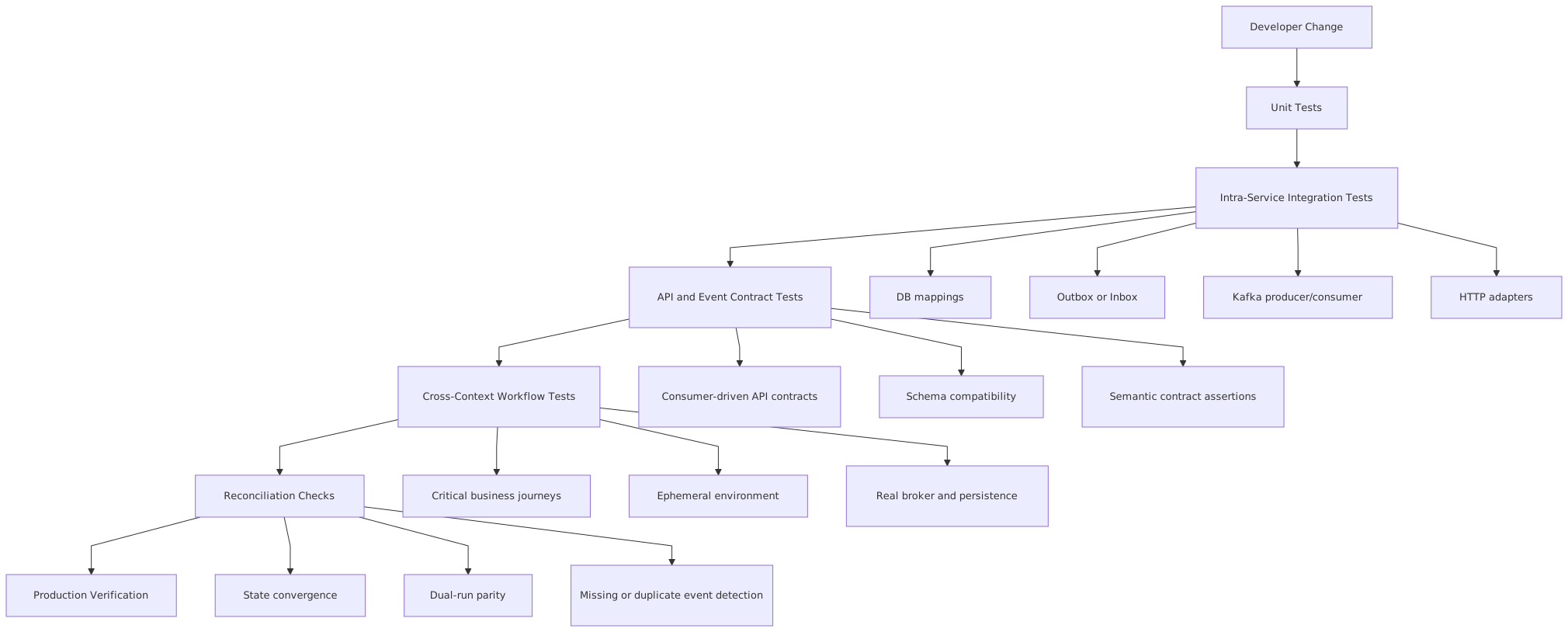
That diagram is deceptively simple. The hard part is deciding what belongs where.
Domain semantics first
A service boundary is not just a network hop. It is a domain boundary. In domain-driven design terms, each microservice should own a bounded context with its own model and language. Integration tests should verify published language at that boundary.
If Customer says AccountClosed, what does that mean for Billing? Can open invoices still be collected? Can Notifications still send reminders? Is “closed” reversible? The event is not merely a transport artifact. It is a business fact crossing contexts. Testing has to assert those semantics.
That is why I prefer event storming or context mapping as input to test design. The integration topology should be derived from domain interactions, not from whatever frameworks the teams happen to use.
Kafka changes the topology
Kafka often improves decoupling, but it also introduces a dangerous illusion: because services are no longer directly calling each other, people assume the integration risk is lower. In fact, the risk has moved from temporal coupling to semantic and operational coupling.
With Kafka, your test topology must account for:
- schema evolution
- partition key choices
- ordering assumptions
- duplicate delivery
- retry and dead-letter handling
- idempotent consumers
- replay safety
- compaction and retention effects
- offset management across environments
You do not need end-to-end tests for every possible event path. You do need focused tests for each service’s publish-consume obligations, plus a small number of real multi-service flows for critical business journeys.
Here is a representative event-driven topology:
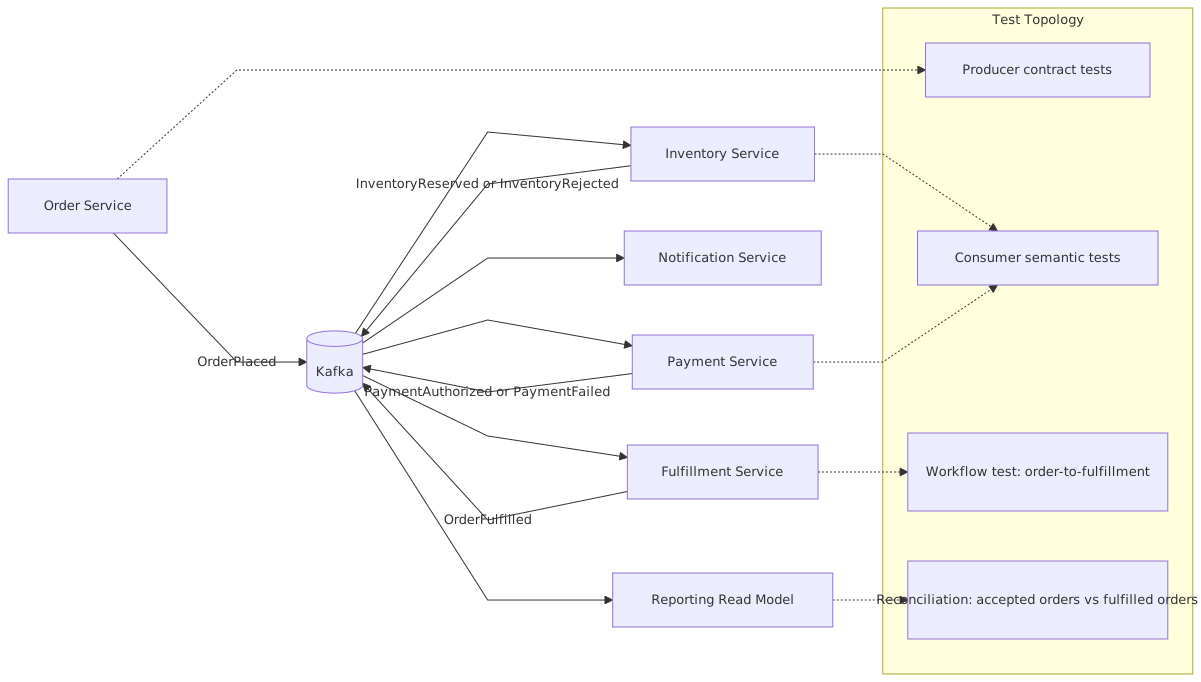
The point is simple: not every consumer of OrderPlaced needs to be tested together all the time. But each consumer’s interpretation of the event needs explicit verification, and the business flow as a whole needs a small number of realistic path tests plus reconciliation.
The outbox and inbox matter
If you use transactional outbox or inbox patterns, treat them as first-class integration surfaces. They are often where reliability is won or lost. Test for duplicate publication, delayed relay, crash recovery, and replay behavior. A service that “works” in a happy-path test but republishes inconsistent events under restart conditions is not fit for production.
Migration Strategy
The best integration test topology is not static. It evolves with the architecture, especially during modernization.
Most enterprises do not leap from monolith to neat microservice estate. They move by strangling capabilities at the edges, one bounded context at a time. During that journey, testing has two jobs: prevent regression and expose semantic divergence.
A useful migration path has four stages.
Stage 1: Characterize the legacy behavior
Before extraction, write characterization tests around the monolith’s externally visible behavior for the target capability. Not because the monolith is elegant, but because you need to know what “equivalent enough” means. Some legacy behavior will be accidental and should not be preserved. This is where domain experts matter.
Stage 2: Introduce a façade and route selectively
Place an API façade, event interceptor, or anti-corruption layer in front of the monolith. New requests for the extracted capability can be routed to the new service while the rest remain in the old system. Contract tests now verify both the façade and the new service behavior.
Stage 3: Dual run and reconcile
For a period, run legacy and new logic in parallel for selected cases. Compare outputs, states, and emitted events. This is where reconciliation becomes central. You are not just testing for exact line-by-line parity. You are verifying acceptable business equivalence.
Stage 4: Cut over and keep reconciliation alive
After primary traffic moves, keep reconciliation checks in place. Migration defects often surface after rare edge cases or back-office processes wake up. Turning off verification too soon is one of the oldest modernization mistakes.
A strangler migration topology might look like this:
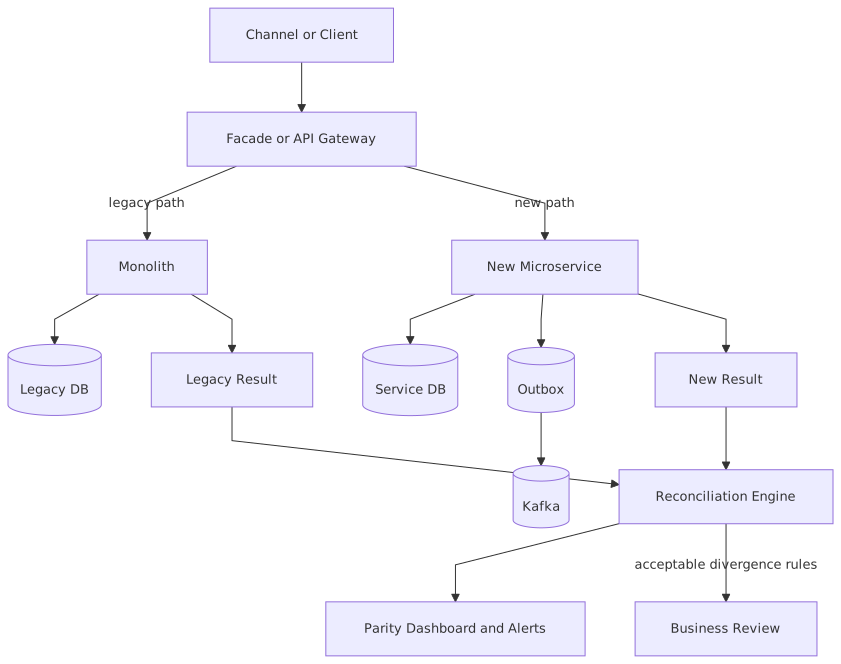
The important phrase here is acceptable divergence. New systems often fix old defects, normalize data, or make timing visible that used to be hidden. Demanding bit-for-bit parity is usually naive. Demanding no reconciliation strategy is worse.
Enterprise Example
Let me make this concrete.
A large insurer I worked with was decomposing a claims platform. The monolith handled claim intake, coverage validation, reserve calculation, payment approval, correspondence, and reporting in one tangled system. The first extraction target was payment approval, because it had distinct business rules and a heavy release cadence driven by regulation.
The early testing approach was conventional and failing. Teams had unit tests in each service and a giant staging suite that simulated claim creation through payment issuance. It took hours, failed often, and became a weekly negotiation between teams. Kafka had been introduced for decoupling, but the tests still behaved as if everything was a synchronous transaction.
The architectural fix was not “more end-to-end tests.” It was a new topology.
First, the Payment Approval service got serious intra-service integration tests around decision rules, persistence, outbox publication, and Kafka consumer idempotency. Second, semantic contract tests were defined around events like ClaimValidated, ReserveAdjusted, and PaymentApproved. The contracts specified not just fields, but domain obligations. For example, PaymentApproved could only be published if reserve sufficiency had been established in the current claim version, not just at any earlier point in time.
That one semantic rule caught more real defects than dozens of UI-style end-to-end tests.
Third, only three cross-context workflow tests were retained as top-tier flow tests: straight-through low-value claim payment, high-value claim requiring manual review, and post-approval reserve adjustment leading to compensation. These ran in isolated environments with real Kafka topics and real persistence.
Fourth, a reconciliation service compared approved payments between the monolith and the new service during dual-run migration. It allowed for known acceptable differences such as normalized rounding and corrected date handling, but flagged mismatches in approval status, amount, and audit trail completeness.
The result was dramatic. Pipeline time dropped. Teams trusted failures more because they were localized. Production incidents decreased not because every flow was tested everywhere, but because semantics were tested where they mattered and reconciliation covered the long tail of asynchronous and migration risk.
This is what enterprise architecture should feel like: less ceremony, more truth.
Operational Considerations
Integration test topology is architecture, which means it has runtime consequences.
Environment strategy
Shared test environments are cheap to imagine and expensive to operate. For cross-context workflow tests, prefer ephemeral environments, isolated namespaces, or dedicated topic prefixes and databases. If you must share, you need hard isolation: unique test data, topic scoping, offset control, and deterministic cleanup.
Data management
Test data is a first-class architectural concern. In event-driven systems, stale messages and retained events can poison results. Build repeatable fixtures, support idempotent setup, and use business-meaningful datasets. Randomized junk data may test plumbing but miss semantic edge cases like policy lapse, partial shipment, or account freeze.
Observability in tests
A modern integration test should assert through telemetry as well as API responses. Trace spans, event headers, lag metrics, and dead-letter counters provide stronger diagnosis than black-box polling alone. Especially with Kafka, if your tests cannot inspect consumer lag or failed-processing paths, you are blind in exactly the place microservices hurt most.
Reconciliation pipelines
Reconciliation should not be manual spreadsheet work done by an operations analyst at 3 a.m. Build automated reconciliation jobs with explicit business keys, tolerance rules, and dashboards. They become part of migration safety and ongoing production verification.
Ownership
Each bounded context team should own its local integration and contract tests. Cross-context workflow tests need explicit product ownership, often shared by the teams responsible for the end-to-end business capability. Without ownership, broad integration suites become abandoned ruins.
Tradeoffs
There is no free lunch here. A layered topology introduces more kinds of tests and more discipline in deciding what goes where.
The main tradeoff is complexity for precision. You replace one giant ambiguous test suite with multiple focused mechanisms: local integration tests, contract tests, workflow tests, reconciliation, and production verification. That requires stronger architecture thinking and better engineering hygiene. It also pays off.
Another tradeoff is that semantic contracts require domain work. Teams have to agree on meanings, not just schemas. That can be uncomfortable in enterprises where service boundaries were drawn around org charts rather than domain boundaries. Good. The discomfort is information.
There is also a tooling tradeoff. Kafka integration testing is more demanding than mocking HTTP calls. You need broker-aware test harnesses, schema management, deterministic topic setup, and replay-safe consumers. If the organization is not willing to invest in those capabilities, it will drift back toward brittle staging tests.
Finally, reconciliation introduces delayed confidence. Some assertions are no longer instantaneous. Architects raised on synchronous transaction thinking often dislike this. But eventual consistency means delayed truth is still truth. Better to design for it explicitly than to pretend it does not exist.
Failure Modes
A bad test topology usually fails in recognizable ways.
Everything becomes end-to-end
This is the most common enterprise mistake. Teams skip contract rigor and semantic verification, then rely on giant integrated flows. The suite becomes slow, flaky, and politically sensitive. It gives the illusion of confidence while eroding delivery performance.
Contracts verify shape, not meaning
Schema passes, business fails. Events remain “compatible” while consumers quietly misinterpret them. This often shows up in status transitions, monetary fields, units of measure, and lifecycle events.
Asynchronous flows are tested synchronously
Teams publish an event, wait a few seconds, and assert a database row exists. That is not a robust test strategy. It ignores lag, retry, duplication, dead-letter paths, and compensation logic. It also produces fragile timing-based failures.
Migration drops verification too early
Dual-run looks clean for a week, so reconciliation is removed. Then an end-of-month process, rare regulatory adjustment, or historic replay exposes divergence. Progressive strangler migration needs patience.
Shared environments rot
Cross-team dependencies, polluted topics, inconsistent offsets, and data collisions make test results untrustworthy. Once engineers stop trusting failures, the suite is already dead.
No one owns business journeys
Cross-context workflow tests are everyone’s concern and no one’s responsibility. They age badly, become overbroad, and stop reflecting actual business value.
When Not To Use
Not every system needs a rich integration test topology.
If you have a small monolith with a cohesive domain, strong module boundaries, and one deployment pipeline, adding a microservice-style topology will likely waste effort. Test modules well, keep a few integration tests, and enjoy the simplicity.
If your services are mostly CRUD wrappers over a shared enterprise database, the real problem is probably not testing. It is architecture. Layering sophisticated contract and event testing over poorly bounded services is lipstick on a mainframe.
If the domain has minimal asynchronous behavior and low business criticality, you can keep the topology lighter. A handful of contract tests and a few realistic integration flows may be enough.
And if your organization lacks stable bounded contexts, stop there first. Domain-driven design is not decoration. If the service boundaries do not reflect business language and ownership, no test topology will rescue you from semantic churn.
Related Patterns
Several patterns fit naturally alongside integration test topology.
Consumer-driven contracts help verify API compatibility from the consumer’s point of view.
Schema registry and compatibility policies are essential for event-driven systems, especially with Kafka.
Transactional outbox and inbox improve reliability of event publication and consumption, and should be tested explicitly.
Anti-corruption layers are critical during migration, shielding new bounded contexts from legacy semantics.
Saga orchestration or choreography affects where workflow tests should sit, especially for compensating transactions.
Shadow traffic and dual run support strangler migration and parity validation.
Reconciliation services close the loop for asynchronous consistency and migration confidence.
These patterns are not random accessories. Together, they form the operating system of safe microservice evolution.
Summary
Integration test topology is the missing architectural conversation in many microservice programs. People talk about service granularity, Kafka partitions, platform engineering, and CI pipelines. All important. But the real measure of a distributed system is whether change can happen without fear. That depends on where and how you verify integration.
The essential idea is straightforward. Test close to the boundary. Verify domain semantics, not just payloads. Use realistic cross-context workflow tests sparingly and intentionally. Treat reconciliation as a core mechanism, especially for asynchronous flows and strangler migrations. Keep production verification in the picture. And let bounded contexts drive the topology.
If you remember one line, remember this: in microservices, the seams are the system.
Design your tests there.
Frequently Asked Questions
What is a service mesh?
A service mesh is an infrastructure layer managing service-to-service communication. It provides mutual TLS, load balancing, circuit breaking, retries, and observability without each service implementing these capabilities. Istio and Linkerd are common implementations.
How do you document microservices architecture for governance?
Use ArchiMate Application Cooperation diagrams for the service landscape, UML Component diagrams for internal structure, UML Sequence diagrams for key flows, and UML Deployment diagrams for Kubernetes topology. All views can coexist in Sparx EA with full traceability.
What is the difference between choreography and orchestration in microservices?
Choreography has services react to events independently — no central coordinator. Orchestration uses a central workflow engine that calls services in sequence. Choreography scales better but is harder to debug; orchestration is easier to reason about but creates a central coupling point.