⏱ 19 min read
API Aggregation Pitfalls in Microservices | fan-in bottleneck diagram microservices architecture diagrams
Microservices teams often start with a promise and end with a traffic jam.
The promise is seductive: break the monolith into cleanly bounded services, let teams move independently, scale parts of the system that matter, and stop coordinating every small change across a giant codebase. Then reality arrives wearing a very corporate badge. A mobile app needs a customer profile page. The web portal needs an order history dashboard. The partner API needs a “single response” for a workflow that spans billing, shipping, identity, pricing, inventory, and entitlements. Suddenly somebody inserts an aggregation layer in front of the services. It seems harmless. Helpful, even.
That layer is often where a distributed system quietly begins reassembling its monolith, one fan-in call at a time.
API aggregation is not a bad idea. In many enterprises, it is the only sane way to present coherent experience-oriented APIs over a field of operational services. But it is also one of the easiest places to create a bottleneck, erase domain boundaries, and move complexity into a component that every team depends on yet nobody truly owns. The result is familiar: high tail latency, tangled orchestration logic, retries amplifying outages, and a “temporary” integration service that has become the most business-critical application in the estate.
This article looks at API aggregation in microservices from the viewpoint that matters in the real world: domain semantics, migration pressure, operational failure, and enterprise compromise. We will examine why fan-in bottlenecks emerge, how to design aggregation without destroying service autonomy, when Kafka and asynchronous patterns help, where reconciliation becomes necessary, and when the pattern should simply be avoided. event-driven architecture patterns
Context
Most enterprise landscapes do not begin with microservices. They begin with line-of-business systems, channel platforms, packaged products, and decades of integration sediment. An organization modernizes by carving out domains: customer identity, product catalog, order management, pricing, payments, shipping, notifications. Teams define APIs and events, adopt Kubernetes, maybe Kafka, and talk confidently about bounded contexts.
Then the channels show up with their own needs.
A customer-facing channel does not want six separate APIs to render a screen. It wants “Account Overview.” A call-center desktop does not want order lines, invoice balances, loyalty status, and shipment events separately. It wants “Can I tell the customer what’s going on right now?” The semantics shift from operational domains to experience composition. That shift matters. It is where many teams start confusing domain ownership with data retrieval convenience.
The aggregator is usually born here: a backend-for-frontend, composition API, edge service, or “customer 360” facade that calls many downstream services and returns one response. In moderation, this is perfectly defensible. In excess, it becomes a semantic junk drawer.
The first mistake is technical. The second is conceptual.
The technical mistake is assuming fan-in is just plumbing. It isn’t. Fan-in changes latency, availability, scaling behavior, observability, failure isolation, and release coordination.
The conceptual mistake is ignoring that aggregation creates a new model. The moment you combine pricing from one service, entitlements from another, and customer status from a third, you are no longer merely “passing through” data. You are shaping a new domain view. If that view has real business meaning, it deserves design discipline, ownership, and language.
That is domain-driven design territory, whether the team admits it or not.
Problem
The classic aggregation failure is simple: one upstream request triggers many downstream calls, often serially, sometimes in parallel, occasionally with hidden dependencies between them. This creates a fan-in bottleneck.
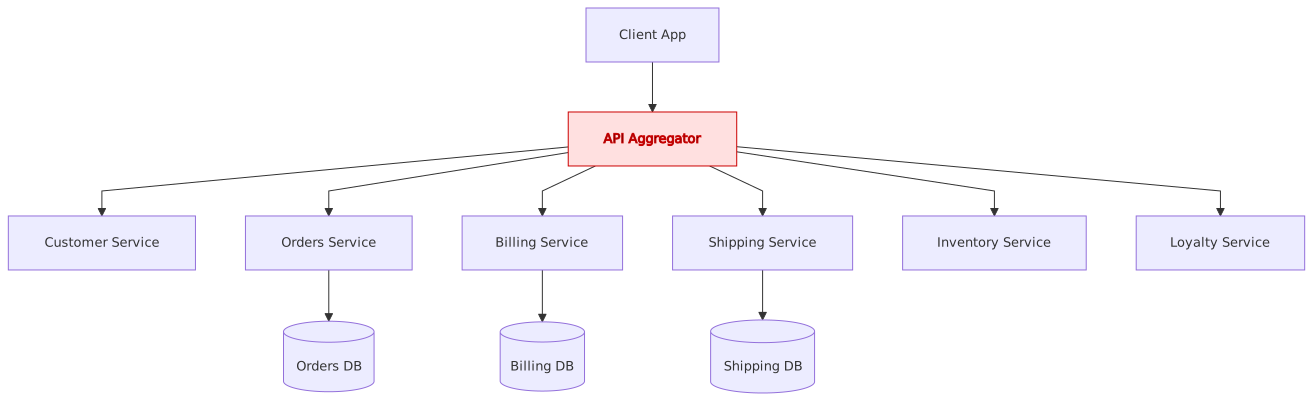
It looks neat on a diagram. It behaves badly under stress.
If one downstream call is slow, the user waits. If one call fails and the response requires it, the whole request fails. If the aggregator retries aggressively, it can double the load on already struggling dependencies. If traffic increases, the aggregator must scale not just for its own CPU but for the multiplied concurrency it generates downstream. In effect, it becomes a load amplifier.
Worse, as more teams discover the convenience of “just expose it through the aggregator,” business logic starts to creep upward. Filtering, enrichment, fallback rules, eligibility decisions, data precedence, canonicalization, and cross-domain joins move into the composition layer. Now the aggregator is not only a bottleneck. It is a shadow domain service built out of HTTP calls.
This is how distributed monoliths happen: not because services are too small, but because coordination logic is too centralized.
There is another, subtler problem. Aggregators often flatten domain semantics. They turn “Order Submitted,” “Invoice Posted,” “Shipment Dispatched,” and “Credit Hold Applied” into one amorphous JSON blob called status. That may simplify a front-end. It also hides the meaning and timing of business facts. Once that happens, downstream consumers build expectations on a synthetic view that does not map cleanly to any bounded context. Every change becomes political.
In enterprises, these systems rarely fail dramatically at first. They decay. Latency creeps up. Feature lead time slows down. Release windows require negotiation. Incident bridges become crowded with teams who all insist their service is healthy while the customer experience remains broken. Aggregation doesn’t just create coupling. It creates ambiguity about where truth lives.
Forces
Architecture is the art of balancing forces, not winning arguments with diagrams. API aggregation sits in the middle of competing pressures.
Channel simplicity versus service autonomy
Channels want simple, stable APIs aligned to user tasks. Service teams want autonomy and crisp bounded contexts. These goals are both valid and often in tension. If channels compose everything themselves, client complexity explodes. If a central aggregator composes everything, service boundaries erode.
Real-time freshness versus operational resilience
A synchronous aggregator promises fresh data because it asks each source in real time. But freshness comes at the price of availability and latency. The more services involved, the more likely one will be degraded. A precomputed view is less fresh but far more resilient.
Domain purity versus pragmatic integration
Domain-driven design encourages bounded contexts with explicit language. Enterprise delivery encourages “just get the dashboard out by quarter end.” Aggregators are where those pressures collide. A good architect resists purity theater but also knows expedient integrations can become permanent architecture in less than a fiscal year.
Team topology
If one platform team owns the aggregator and ten domain teams own the services, then every meaningful user-facing change may require negotiation through the platform team. This can help consistency. It can also become an organizational choke point.
Regulatory and reconciliation needs
In finance, telecom, healthcare, and logistics, what the customer sees may need to be explainable and auditable. If an aggregate response combines eventually consistent sources, then discrepancies are not a bug in the philosophical sense; they are a support ticket in the commercial sense. Reconciliation is not optional in these environments.
Event-driven opportunities
Kafka and similar event platforms offer a different path: rather than compose at request time, build materialized views from domain events. This reduces fan-in at the edge but introduces lag, replay concerns, schema evolution, and the need to reason carefully about business correctness under eventual consistency.
These are not mere implementation details. They are the shape of the problem.
Solution
My preferred position is blunt: aggregate at the edge only for lightweight experience composition; move business-significant aggregation into explicit read models or domain-level composition services with clear ownership.
That means there are really three kinds of aggregation, and teams should stop pretending they are the same.
- Presentation aggregation
Simple composition for a screen or client workflow. Minimal business logic. Often implemented as a backend-for-frontend.
- Process orchestration
Coordinating a cross-domain business action such as checkout, account opening, or claim submission. This is not just aggregation; it is workflow and should be modeled as such.
- Read model consolidation
Creating a coherent queryable view from multiple domains, often asynchronously using events and materialized projections.
The trap is using one component to do all three.
A healthy design usually separates them. Keep the edge aggregator thin. Push domain logic back into the owning bounded context or into an explicitly modeled process/domain service. For high-volume or expensive read scenarios, use event-driven projections rather than repeated runtime joins.
A practical target architecture often looks like this:
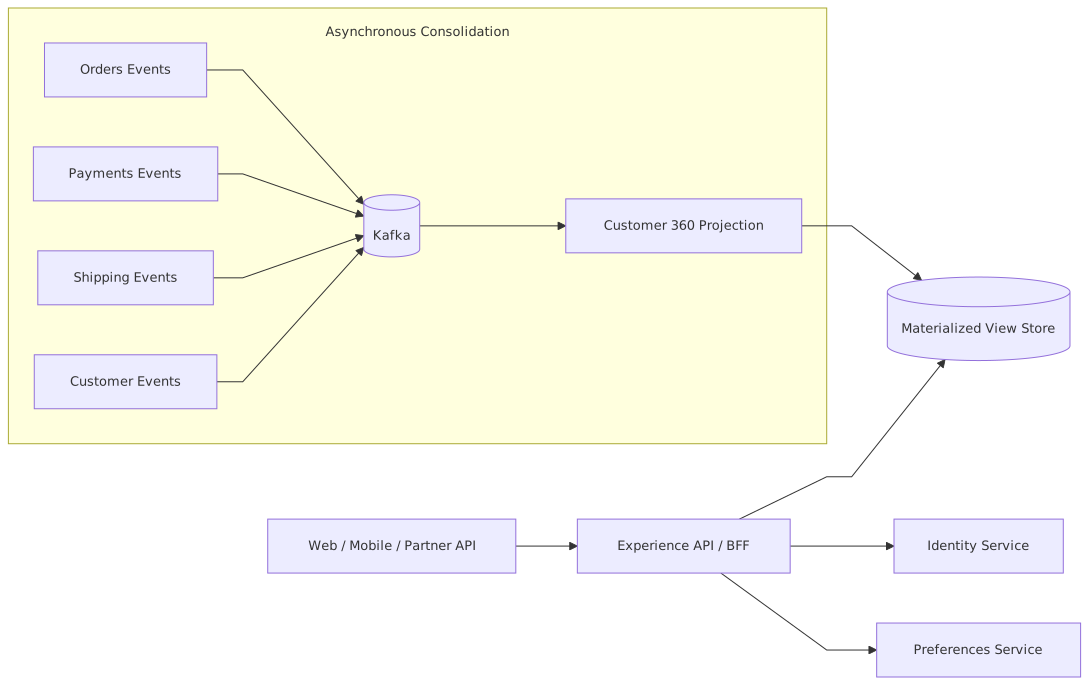
The important idea is semantic separation.
If the channel needs “Customer Account Summary,” ask whether that is:
- a transient presentation composition,
- a domain concept with meaning of its own,
- or a read-optimized view built from multiple truths.
If it has business significance, name it properly and give it an owner. That is textbook domain-driven design, but in practice it is just responsible architecture. Names matter because they reveal where logic belongs.
For instance, “customer profile page response” is not a domain concept. “Credit exposure summary” might be. The former can live in a BFF. The latter probably should not.
Architecture
Let’s get concrete about a robust approach.
1. Keep the synchronous aggregator narrow
A synchronous aggregator should do:
- request shaping,
- parallel calls where appropriate,
- response assembly,
- protocol translation,
- auth propagation and coarse access control,
- graceful degradation for optional fields.
It should avoid:
- owning business rules that determine system-of-record behavior,
- cross-domain transaction logic,
- hidden data corrections,
- semantic conflation of incompatible states,
- bespoke retry storms.
If the edge service starts containing rules like “if payment is pending but shipment is allocated and account is premium, show eligible for expedited intervention,” that is no longer mere composition. It is domain logic.
2. Design around bounded contexts, not tables over HTTP
One of the ugliest anti-patterns in microservices is the distributed join, where the aggregator effectively rebuilds a normalized relational model through API calls. This is database thinking smuggled through REST.
Bounded contexts exist because different domains define reality differently. Billing status is not shipping status. Product availability is not reservable inventory. “Customer” in CRM is not the same object as “account holder” in risk systems. Aggregators that naively merge these concepts produce brittle lies.
Instead, define explicit contracts for what each context contributes to a composite view. Preserve provenance. Make timing visible. Sometimes the correct answer is not a single status field but a set of statuses with clear labels and timestamps.
3. Prefer asynchronous projections for expensive or high-traffic aggregates
If a channel repeatedly needs the same multi-domain summary, building it at request time is usually wasteful and fragile. Use Kafka or another event backbone to build a materialized view. This is especially useful for dashboards, history views, account summaries, and search-oriented experiences.
This comes with discipline:
- events must reflect business facts, not database noise;
- schemas need evolution strategy;
- consumers must be idempotent;
- projections need replay and backfill tooling;
- timestamps and ordering semantics must be explicit.
A projection is not a cache. It is a read model. Treat it as a product.
4. Reconciliation is part of the design
Event-driven read models drift. Downstream services emit late, out of order, or not at all. Data pipelines fail. Human operators make corrections directly in source systems. If you aggregate important enterprise views asynchronously, then reconciliation is part of the architecture, not a cleanup task.
That means:
- periodic comparison against source-of-record systems,
- drift detection thresholds,
- compensating rebuild jobs,
- support tooling to explain mismatches,
- lineage metadata showing the event/version/timestamp behind each field.
In regulated enterprises, the question is never “can drift happen?” It is “how will we detect it before customers or auditors do?”
5. Build partial responses intentionally
Not all data is equally important. A customer overview can often tolerate missing loyalty points but not missing account suspension status. Design for partial availability. Classify fields as:
- mandatory,
- important but degradable,
- optional.
That classification should drive timeout budgets, fallback behavior, and UI contracts. Otherwise every missing widget becomes a Sev-1.
Migration Strategy
Most organizations already have a monolith or a large middleware/API gateway acting as the composition point. The goal is not to replace it in one burst of righteousness. The goal is to strangle it progressively without recreating the same bottleneck elsewhere.
A sensible migration strategy is a strangler pattern with semantic checkpoints.

Phase 1: Observe before cutting
Instrument the existing aggregator or monolith endpoints. Measure:
- top fan-in endpoints by traffic,
- downstream call count per request,
- p95/p99 latency,
- partial failure frequency,
- payload sizes,
- coupling hot spots where every release triggers many teams.
Without this, migration becomes theology.
Phase 2: Identify aggregation types
Classify each endpoint:
- pure presentation composition,
- workflow/process orchestration,
- reporting/query view,
- accidental cross-domain join.
This is where domain semantics pay off. Don’t migrate by URL path alone. Migrate by meaning.
Phase 3: Pull out stable read models first
The easiest wins are high-read, low-write aggregate queries: order history, account summary, product browse enrichments, shipment timeline. Build event-fed projections and route selected channel traffic to them. Keep source systems authoritative for writes.
This delivers visible latency and reliability improvements while reducing runtime fan-in.
Phase 4: Separate orchestration from aggregation
If an endpoint does things rather than merely shows things, model that explicitly. Checkout should become a process service or saga coordinator, not a giant aggregate endpoint with side effects hidden among reads.
Kafka often helps here for long-running workflows, but only if the team is prepared for compensations and eventual consistency. If the business process requires immediate transactional certainty across systems, do not pretend choreography will magically provide it.
Phase 5: Incrementally thin the legacy layer
Once stable read models and explicit process services exist, the old aggregator can become a routing facade and eventually retire. Some legacy composite endpoints will remain for longer than planned. That is normal. The mistake is letting them continue to absorb new logic “until migration finishes.” Migration never finishes if the old layer remains the easiest place to change.
Phase 6: Add reconciliation and support tooling early
Teams often delay this because it feels non-functional. Then the first discrepancy incident arrives and everyone reverse-engineers the state by hand. Build drift dashboards, replay tooling, and provenance inspection from the start of the projection journey.
Enterprise Example
Consider a large insurer modernizing its customer service platform.
The old world had a call-center application backed by an ESB and a policy admin suite. To render a single customer interaction screen, the middleware fetched customer details, active policies, billing balances, recent claims, payment method status, document delivery preferences, and outbound communication history. Response time averaged three seconds on a good day, with spectacular spikes whenever the claims system slowed down.
The modernization program split domains into services: Customer, Policy, Billing, Claims, Documents, Communications. A central API aggregation team then built a “Customer 360 API” in front of them. At first it was successful. The front-end team loved the single endpoint. Executives saw modern APIs and nodded approvingly.
Six months later, the service had become the most dangerous part of the platform.
Why? Because “Customer 360” was not a screen API. It had become a business concept with hidden rules:
- which address to show when CRM and policy records disagree,
- whether a lapsed policy still counts as “active” for agent context,
- how to prioritize claim statuses from multiple back-end products,
- whether unpaid invoices should block self-service changes,
- which document preference wins when policy-level and customer-level settings conflict.
Those are not formatting decisions. They are semantics.
The team corrected course in three steps.
First, they split the edge API from the view model. The BFF became a thin channel-oriented service. The heavy lifting moved into a read model called Customer Interaction Summary, built from Kafka events published by the domain services and, temporarily, change data capture from the remaining policy admin database.
Second, they defined field provenance. Every major section in the summary carried source system and last-updated metadata. Support staff could now explain discrepancies instead of escalating blindly.
Third, they introduced reconciliation jobs. Claims and billing had occasional event publication gaps. Nightly and on-demand reconciliation compared source snapshots to the projection, queued repairs, and surfaced drift in an operations dashboard.
The result was not “perfect consistency.” It was far better: fast responses, predictable degradation, and an architecture that made disagreement visible instead of burying it.
The deeper lesson was cultural. Once the insurer acknowledged that Customer Interaction Summary was a real business view with its own language and ownership, the architecture became tractable. Before that, they were pretending it was just an API convenience.
Operational Considerations
Aggregators fail in production in ways architects should anticipate, not discover theatrically.
Latency budgets
Set explicit per-dependency budgets. If the user-facing SLA is 500 ms, a seven-call fan-in graph has no room for optimism. Use parallelism carefully, but do not mistake parallelism for free performance. Tail latency still accumulates.
Concurrency amplification
One incoming request can produce many outbound requests. Under load, this can exhaust connection pools, thread pools, or downstream rate limits. Capacity planning for aggregators must include multiplication effects, not just ingress QPS.
Timeouts, retries, and circuit breakers
Retries are medicine with side effects. In aggregation paths, indiscriminate retries often intensify incidents. Retry only where idempotent and useful. Prefer bounded retries with jitter. Combine with circuit breakers and fallback behavior for non-critical dependencies.
Observability
Distributed tracing is mandatory. Logs alone are archaeology. You need request graphs, per-hop latency, dependency health, and field-level freshness indicators for read models. For asynchronous projections, monitor lag, poison messages, replay duration, and schema errors.
Schema and contract evolution
Aggregated APIs age badly when upstream contracts evolve independently. Versioning strategy must be intentional. For Kafka-based views, use schema governance and compatibility rules, or you will eventually break projection consumers in ways that only appear hours later. EA governance checklist
Security and data minimization
Aggregators tend to become data magnets. Because they “need everything,” they often expose too much. Apply least privilege both downstream and upstream. Sensitive fields should not hitchhike just because the edge service already called the source.
Caching
Caching can help, but it should not be used to disguise broken semantics. Cache immutable or slow-moving fragments, not business-critical statuses that users expect to be current. If you cache, expose freshness. Stale certainty is worse than explicit uncertainty.
Tradeoffs
There is no free architecture here.
A synchronous aggregator gives simplicity and immediacy. It also gives fragility and fan-in pain.
An asynchronous read model gives resilience and speed. It also gives eventual consistency and reconciliation overhead.
A thin BFF preserves service ownership. It may still leave front-end teams negotiating multiple APIs and semantics.
A central composition layer enforces consistency. It can also become a gatekeeper with a backlog longer than the runway.
Kafka-based consolidation reduces runtime coupling. It increases platform dependence and operational sophistication requirements. Teams that cannot run event-driven systems well should not use Kafka as an aspirational decoration.
This is the key tradeoff line: you can pay complexity at request time or in data pipeline design time. You do not get to avoid paying it.
Failure Modes
The common failure modes are painfully repeatable.
The god aggregator
Every new requirement lands in one service because “it already talks to everything.” Over time it owns validation, enrichment, policy, mapping, and fallback logic across domains. Nobody can change anything without touching it.
Hidden orchestration
A nominally read-only aggregate endpoint starts triggering side effects: prefetch updates, status recalculations, eligibility refreshes. Now a GET request is participating in workflow. Incidents become absurd.
Semantic flattening
Conflicting domain states get merged into one simplified response model. Consumers depend on that simplification. Eventually a business exception appears and the model can no longer express reality.
Retry storm
One downstream dependency slows. The aggregator times out and retries. Traffic doubles toward the degraded service. Circuit breakers open too late. The incident spreads.
Projection drift
An event consumer misses messages or applies them out of order. The materialized view becomes incorrect. Without reconciliation and provenance, support teams lose trust in the system.
Team bottleneck
A central API team becomes the gate through which all user experience changes must pass. Delivery slows. Domain teams work around them. Shadow APIs appear.
When Not To Use
Do not use API aggregation as the default response to every cross-service need.
Avoid it when:
- the client can reasonably compose a small number of stable APIs itself;
- the use case is fundamentally workflow orchestration rather than read composition;
- the aggregate requires strong transactional consistency across multiple domains;
- your organization lacks operational maturity for distributed tracing, timeout management, or event-driven projections;
- the proposed aggregator is really a disguised canonical model effort trying to erase bounded contexts;
- one team would become a permanent choke point for changes across many domains.
And do not use Kafka-backed projections just because they sound modern. If the business cannot tolerate stale data and there is no practical reconciliation path, an eventually consistent read model may be the wrong answer.
Related Patterns
A few related patterns matter here.
Backend for Frontend (BFF)
Good for channel-specific shaping. Keep it thin. It is not a place to centralize enterprise policy.
API Gateway
Useful for routing, auth, throttling, and coarse mediation. Dangerous if treated as an application runtime for domain logic.
Saga / Process Manager
Appropriate for long-running, cross-domain workflows. Different problem from read aggregation, though teams often confuse the two.
CQRS and Materialized Views
Excellent for high-read aggregates where eventual consistency is acceptable and explainable.
Strangler Fig Pattern
Essential for migrating legacy composite APIs progressively rather than rewriting all integration in one leap.
Anti-Corruption Layer
Helpful when legacy systems have awkward semantics. Better to isolate translation than smear it across every aggregate endpoint.
Summary
API aggregation in microservices is one of those patterns that looks trivial until it becomes strategic. The fan-in bottleneck is not just a performance issue. It is an architecture smell that often reveals deeper problems: confused domain boundaries, hidden orchestration, flattened semantics, and a central team carrying too much cognitive and operational load.
The right answer is not “never aggregate.” Enterprises need composition. Channels need coherent APIs. The right answer is to aggregate deliberately.
Keep edge aggregation light. Treat business-significant composite views as explicit models with ownership. Use Kafka and asynchronous projections where they buy resilience and speed, but pair them with reconciliation and provenance. Separate workflow orchestration from query composition. Migrate progressively with the strangler pattern. And above all, respect domain semantics. If you combine truths from multiple bounded contexts, you are creating a new model whether you planned to or not.
That model deserves architecture, not improvisation.
Because the fastest way to rebuild a monolith is not in the database. It is in the API layer, smiling politely, returning one convenient JSON payload.
Frequently Asked Questions
What is a service mesh?
A service mesh is an infrastructure layer managing service-to-service communication. It provides mutual TLS, load balancing, circuit breaking, retries, and observability without each service implementing these capabilities. Istio and Linkerd are common implementations.
How do you document microservices architecture for governance?
Use ArchiMate Application Cooperation diagrams for the service landscape, UML Component diagrams for internal structure, UML Sequence diagrams for key flows, and UML Deployment diagrams for Kubernetes topology. All views can coexist in Sparx EA with full traceability.
What is the difference between choreography and orchestration in microservices?
Choreography has services react to events independently — no central coordinator. Orchestration uses a central workflow engine that calls services in sequence. Choreography scales better but is harder to debug; orchestration is easier to reason about but creates a central coupling point.