⏱ 21 min read
Microservices discussions often go off the rails in the first ten minutes because people use one word to mean two different things.
They say service when they mean a deployable artifact. They say microservice when they mean a team boundary. They say API when they mean a business capability. Then six months later they are staring at a CI/CD pipeline that deploys fifteen containers together, wondering why their “independent services” behave like a distributed monolith wearing Kubernetes makeup.
This distinction matters more than most architecture diagrams admit: a service is a logical boundary, while a deployment unit is a runtime and release boundary. Sometimes they align. Often they should not. Confusing the two is one of the most expensive category errors in enterprise architecture.
A useful architecture starts with semantics, not packaging. In domain-driven design terms, the service boundary should be shaped by the bounded context, the language of the business, the consistency rules, and the ownership model. The deployment unit is a later decision. It is shaped by release cadence, operational risk, scaling characteristics, compliance, runtime constraints, and migration path.
That sounds obvious. In practice, organizations still carve software as if every conceptual capability must become its own repository, container, Helm chart, and on-call rotation. It is architectural literalism. And literalism is rarely a good way to build a living system.
The better mental model is this: a service is what the business means; a deployment unit is how the platform carries it.
Sometimes one horse pulls one cart. Sometimes several business capabilities travel in the same wagon because splitting them creates more pain than value. Sometimes a single logical service spans multiple runtime components because throughput, geography, or regulation demands it. Architecture is not an exercise in one-to-one mapping. It is the art of preserving meaning while managing change.
This article digs into that distinction deeply: what it means, why it matters, how domain semantics should guide the logical boundary, when deployment boundaries should diverge, how to migrate progressively with the strangler pattern, where Kafka fits, how reconciliation becomes necessary in the real world, and what failure looks like when teams get this wrong. event-driven architecture patterns
Context
Microservices were supposed to buy us autonomy. Independent delivery. Team ownership. Targeted scalability. Faster experimentation. Better fault isolation.
And they can. But there is a nasty trap hidden inside the word independent. Independence is not binary. A service can be independent in one dimension and tightly coupled in another.
Consider a retail enterprise. The business talks about Orders, Payments, Inventory, Pricing, Customer Accounts, Fulfillment, and Returns. These are meaningful domain concepts. They have different rules, policies, invariants, and teams. This is the language of the business. Good.
Now look at runtime reality. Pricing logic may change weekly, Inventory must cope with sudden spikes, Payments sits under regulatory scrutiny, Orders needs strong auditability, and Returns may still be trapped in an old ERP. If we insist every one of these contexts must become exactly one deployment unit, we force organizational and operational constraints onto the domain model. The result is usually brittle.
The alternative is not “just make a monolith.” The alternative is to separate two decisions:
- What is the logical service boundary?
- What is the deployable unit right now?
This is not a semantic nicety. It is a design move that makes migration, operations, and governance much more tractable. EA governance checklist
Problem
The core problem is simple to state:
Architects often conflate logical business boundaries with deployable runtime artifacts.
That confusion leads to several common pathologies:
- business capabilities split too finely because teams equate “micro” with “small codebase”
- deployment units proliferate before domain boundaries are stable
- services that should remain part of one bounded context are broken apart by technical layers
- teams create synchronous chatter between processes for things that used to be a method call
- release independence is claimed but not achieved because services still require coordinated deployment
- data ownership gets muddled because multiple deployables share the same domain semantics
- migration from monolith to microservices becomes riskier than necessary
The biggest irony is that many “microservices” estates are less autonomous than the monoliths they replaced. They have more pipelines, more dashboards, more YAML, and more incidents. But the business still cannot change policy safely because the core semantics are scattered across multiple deployables. microservices architecture diagrams
A service boundary should reduce cognitive load. A bad deployment split increases it.
Forces
Any serious enterprise architecture decision sits in a field of competing forces. This one is no different.
Domain cohesion
A logical service should encapsulate a cohesive business capability with its own language, rules, and data meaning. This is classic domain-driven design. If two concepts constantly change together and share invariants, separating them into different services may be premature or simply wrong.
Team ownership
Team topologies matter. A service should usually map to clear ownership. But ownership does not require a separate deployment artifact on day one. A team can own multiple logical modules in one deployable system while boundaries mature.
Release independence
Different capabilities often need different release cadences. A fraud model may be released several times a day. Billing policy may need careful controls and approval. This pushes toward separating deployment units.
Operational isolation
Certain workloads need independent scaling, memory profiles, fault domains, or geographic placement. A recommendation engine and a customer profile service may belong to adjacent domains but have radically different runtime characteristics.
Consistency and transaction semantics
Some domain rules require strong consistency within a bounded context. If we split those rules into multiple deployables too early, we replace local transactions with distributed workflows, sagas, retries, and reconciliation. Sometimes that is worth it. Often it is not.
Regulatory and security constraints
Payment processing, PII handling, and audit-sensitive functions may need isolated runtimes, stricter controls, or separate trust zones.
Migration constraints
In established enterprises, the current state matters. You are not designing on a whiteboard. You are moving from a monolith, ERP, mainframe, or vendor product. Sometimes the sensible intermediate step is keeping several logical services in one deployment unit.
Platform maturity
A mature platform can support many deployables with reasonable operational cost. An immature platform turns each new deployment unit into a tax. If every service requires custom monitoring, networking work, secrets handling, and manual release coordination, your architecture is paying interest from day one.
These forces are why simplistic rules fail. “One bounded context equals one service equals one container” is neat, memorable, and often wrong.
Solution
The practical solution is this:
Treat service boundaries as logical domain boundaries first, and deployment boundaries as an independent optimization second.
That means:
- identify services through business capabilities and bounded contexts
- keep domain semantics coherent even if multiple logical services initially live in one deployable
- split deployment units only when there is a real reason: scaling, release cadence, risk isolation, compliance, or migration progress
- avoid premature distribution
- use events, APIs, and explicit contracts to protect logical boundaries even before runtime separation
- migrate progressively with observable seams, not big-bang extraction
This gives us a more resilient architecture vocabulary.
Logical service
A logical service is defined by:
- business capability
- ubiquitous language
- clear ownership
- explicit data responsibility
- stable contracts
- internal consistency rules
It may exist as:
- a module inside a modular monolith
- a package with strict boundaries
- a namespace and API surface in a shared deployment
- one or more runtime processes if scale or regulation demands it
Deployment unit
A deployment unit is defined by:
- versioning and release mechanism
- runtime isolation
- infrastructure footprint
- scaling policy
- operational ownership
- failure domain
It may contain:
- one logical service
- multiple logical services
- parts of one logical service
That last case surprises people, but it is real. For example, a logical “Customer Identity” service may have separate runtime components for interactive APIs, token issuance, and asynchronous verification workflows. One service. Several deployment units.
Here is the key architectural rule:
Do not let deployment convenience rewrite domain truth.
Architecture
A good way to think about this is a two-layer model: logical boundaries over runtime topology.
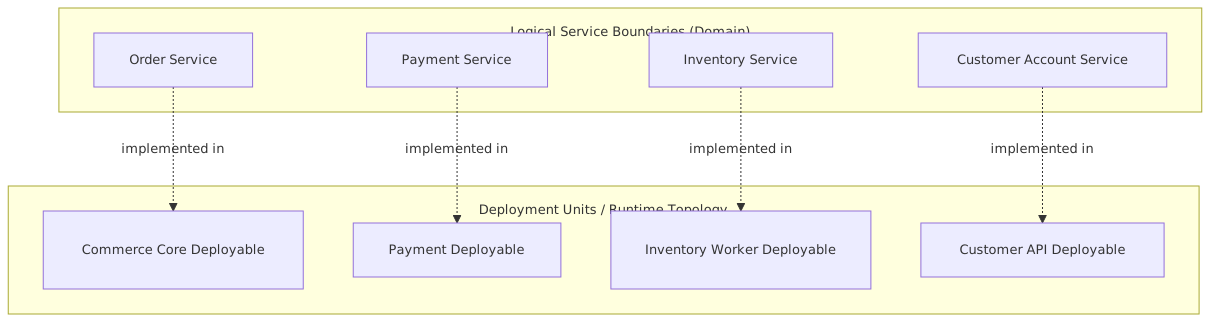
That is the simple case, close to one-to-one.
But many enterprises start here:
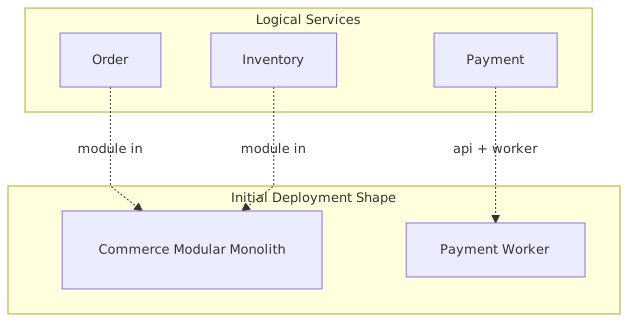
This is not architectural failure. This can be a very sensible staging point. Orders and Inventory may still share too many invariants to justify process separation. Payment may require independent controls and isolation. Good. Be honest about the shape you have.
Domain semantics first
The heart of the design comes from bounded contexts. If your domain model says Order means a customer commitment to purchase, Payment means authorization and settlement of funds, and Inventory means stock reservation and allocation, then these are distinct semantic spaces. They interact, but they are not the same thing.
That distinction matters because data fields with identical names may not mean identical things.
- “status” in Orders is not “status” in Payments
- “reservation” in Inventory is not “hold” in Payments
- “customer” in CRM may not be “account holder” in Billing
This is where domain-driven design earns its keep. The service boundary is less about classes and more about meaning. If you miss this, deployment choices become cargo cult. You can split code forever and still have no clear architecture.
Contract before extraction
A powerful tactic is to introduce service contracts before introducing separate deployables.
For example:
- define
OrderApplicationServiceandInventoryPolicyinterfaces inside a modular monolith - enforce no direct table access across modules
- publish domain events internally first
- expose APIs at module boundaries
- let teams own those contracts even while shipping one artifact
This does two things:
- It reduces accidental coupling.
- It creates extraction seams for later migration.
In other words, you can make the monolith behave like a set of services long before you deploy it that way. This is often the fastest route to a healthy microservices architecture.
Kafka and asynchronous boundaries
Kafka becomes useful when service boundaries are real and event flows matter. It is not useful merely because the architecture review board likes event-driven diagrams.
Kafka is appropriate when:
- multiple services react to domain events
- throughput is high
- temporal decoupling helps
- replay and audit are valuable
- you need independent consumers
- event streams are first-class integration contracts
For example:
OrderPlacedPaymentAuthorizedInventoryReservedShipmentDispatched
These events let downstream services respond without synchronous coupling. But this only works if events reflect domain truth, not internal implementation accidents. An event like OrderRowUpdated is not a domain event. It is database leakage in a suit.
Kafka also changes failure semantics. You move from “did the remote call succeed?” to “was the event published, consumed, applied, retried, or dead-lettered?” That is not simpler. It is often better, but only if the business process can tolerate eventual consistency and the organization can handle reconciliation.
Migration Strategy
The migration from monolith to services is where this distinction becomes operationally decisive.
If you assume logical service = deployment unit from day one, migration tends to become a violent extraction exercise. Teams peel code into new repos too early, discover hidden data coupling, then build a forest of synchronous APIs to recover lost locality. The monolith becomes a distributed monolith in installments.
A better path is progressive strangler migration.
Step 1: Discover bounded contexts
Start with event storming, domain mapping, and production reality. Not PowerPoint fantasy. Identify:
- business capabilities
- ownership
- data semantics
- consistency rules
- pain points
- change frequency
- compliance needs
This gives you candidate logical service boundaries.
Step 2: Build a modular monolith or strengthen the current one
Separate by module, not process first:
- explicit internal APIs
- no shared database access across modules
- separate test suites by module
- domain events inside the application
- independent ownership where possible
This is where most organizations are impatient. They should not be. Internal modularization is not hesitation. It is architecture.
Step 3: Extract edge capabilities first
The best first extraction is usually not the most important domain. It is the one with:
- clear semantics
- stable contracts
- low transaction coupling
- operational need for isolation
Payment adapters, notification services, document generation, fraud scoring, and customer communication are common early wins.
Step 4: Introduce event-driven integration where it helps
As modules become externally deployed services, move integration from direct database sharing to:
- APIs for commands/queries
- Kafka events for state changes and workflows
- outbox pattern for reliable event publication
Step 5: Reconcile, observe, and harden
This is where many migrations fail. Distributed systems drift. Messages arrive late. Consumers break. Legacy systems are inconsistent. Reconciliation is not a sign of bad architecture. It is the cost of reality.
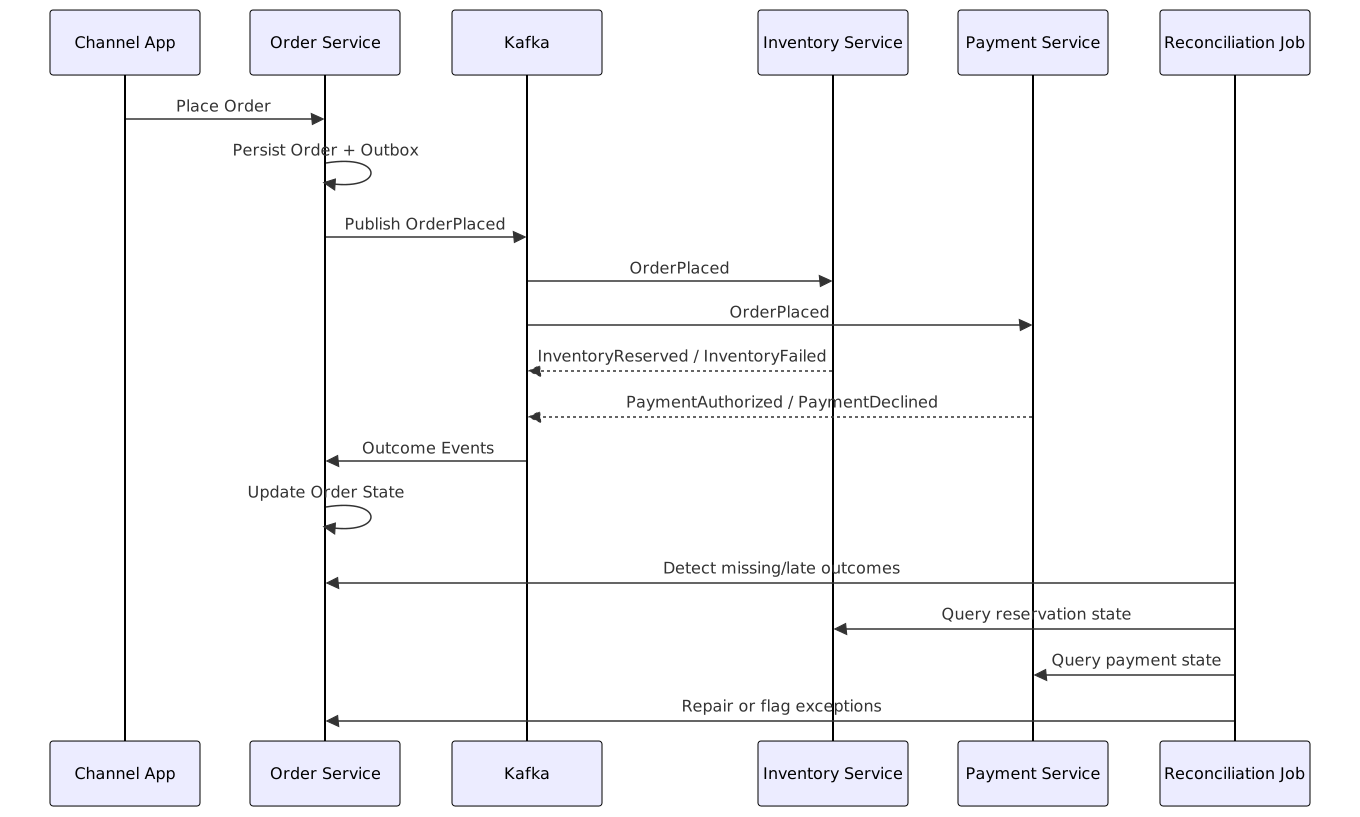
Reconciliation as a first-class design concern
In synchronous monolith thinking, architects often assume the system state is what the database says right now. In event-driven microservices, truth is messier. You need mechanisms for:
- replay
- idempotency
- duplicate handling
- compensating actions
- periodic consistency checks
- exception queues
- manual operations support
This is especially true in finance, supply chain, and order management.
A reconciler asks: “Given our intended process and our observed events, where did reality diverge?” That is enterprise architecture, not afterthought plumbing.
A note on data migration
Do not begin with a heroic “database decomposition” program if domain boundaries are not proven. Move ownership gradually:
- first establish API access
- then stop cross-module table writes
- then replicate or publish events
- finally move the physical store if justified
The last mile of migration should follow semantic separation, not precede it.
Enterprise Example
Consider a large insurer modernizing policy administration.
The legacy platform had one giant core application handling:
- quote
- underwriting
- policy issuance
- billing
- claims intake
- document generation
- agent commissions
The first wave of modernization tried to carve all of these into separate microservices and deploy them independently on Kubernetes. It looked modern. It was also a mess.
Why? Because underwriting and policy issuance shared core invariants around product rules, risk acceptance, endorsements, and effective dates. Splitting them too early forced teams into synchronous calls for every policy decision. Failures cascaded. Releases were still coordinated. The “services” were independent only in slideware.
The architecture was reset.
The second approach used domain-driven design properly:
- Policy became a bounded context with underwriting rules and issuance semantics
- Billing became a separate bounded context with its own ledger, schedules, and payment behavior
- Claims Intake remained adjacent but separate
- Document Generation became a utility capability and an early deployable extraction
- Commissions moved to asynchronous processing because eventual consistency was acceptable
Initially, Policy remained one deployment unit as a modular monolith. That was the right choice. The domain was still changing rapidly, and the consistency demands were high. Billing, however, was separated physically because it needed independent release controls, stronger auditability, and integration with payment processors. Kafka carried domain events such as:
PolicyIssuedPolicyEndorsedPaymentReceivedCommissionCalculated
Reconciliation became essential. A payment might be received in Billing but delayed before the Policy context updated coverage state. Rather than pretending this could not happen, the architecture included a reconciliation service and operations dashboard from the start.
Three years later, the insurer had fewer deployables than the original microservices program proposed, but far better autonomy. Policy was eventually split into separate deployment units for quote APIs and underwriting batch evaluation because runtime profiles diverged. The logical boundary stayed stable; the deployment boundary evolved.
That is what good architecture looks like: semantics first, topology second.
Operational Considerations
Deployment choices are not abstract. They land in pipelines, incident response, observability, and cost.
Versioning and release management
If multiple logical services live in one deployment unit, they share a release train. That can be perfectly acceptable, especially early in migration. But make it explicit:
- shared versioning
- clear change approval model
- module-level contract tests
- release notes by logical capability
If one logical service becomes release-constrained by another, that is a signal to revisit deployment shape.
Observability
When service and deployment boundaries differ, observability must preserve both views:
- runtime metrics by deployable
- business metrics by logical service
- traces across API and event boundaries
- domain event lineage
Do not settle for pod-level dashboards when the business asks “why are orders stuck in pending payment?”
Data ownership
One deployment unit containing multiple logical services can still respect data ownership if:
- each module owns its schema or schema segment
- access is mediated through contracts
- no module updates another module’s tables directly
Shared database does not automatically mean shared model. But it is dangerous because people cheat. Governance and automation matter. ArchiMate for governance
Scaling
Deployment units should align with real scaling needs, not imagined future volume. If Order orchestration and Inventory rules scale together, keep them together. If one asynchronous worker consumes 100x more CPU than the API, split it.
Security and compliance
Separate deployment units may be necessary when:
- sensitive workloads require hardened runtime controls
- PII and tokenized payment data need isolated trust boundaries
- audit evidence depends on restricted deployment procedures
Compliance is one of the most legitimate reasons to diverge deployment from domain shape.
Team cognitive load
Every deployment unit adds cognitive overhead:
- pipeline ownership
- runtime tuning
- secrets
- monitoring
- incident response
- patching
- dependency management
If the platform is weak, each deployable is a small tax office. Multiply enough of them and development slows to a crawl. Architecture should be in the business of reducing cognitive load, not manufacturing it.
Tradeoffs
There is no free lunch here. Only better bargains.
Aligning service and deployment unit
Pros
- simple mental model
- easy ownership mapping
- strong operational isolation
- potentially independent scaling and release
Cons
- risk of premature decomposition
- more distributed transactions
- more inter-service calls
- more operational burden
- likely overuse of orchestration and retries
This works best when the domain boundary is mature and operational needs justify separation.
Multiple logical services in one deployment unit
Pros
- lower operational overhead
- easier refactoring
- local transactions remain local
- good intermediate migration state
- useful when semantics are clear but deployability need is not
Cons
- shared release cadence
- weaker fault isolation
- temptation toward boundary violations
- can become a hidden monolith if contracts are not enforced
This is often the right move early on, and sometimes permanently.
One logical service across multiple deployment units
Pros
- supports workload-specific scaling
- separates interactive and batch concerns
- helps compliance and geographic placement
- can improve resilience
Cons
- harder observability
- more internal coordination
- risk of splitting one domain into accidental subdomains
- needs disciplined contracts and ownership
Useful when one business capability has heterogeneous runtime needs.
Failure Modes
Most microservices failures are not caused by the wrong technology. They are caused by the wrong boundary assumptions.
1. Technical-layer services
Splitting into CustomerControllerService, CustomerDataService, and CustomerValidationService is not microservices architecture. It is object-oriented layering projected onto the network. Domain semantics vanish, latency grows, and every user request fans out across multiple calls.
2. Shared database as a backdoor
Teams declare separate services but keep writing directly into each other’s tables. This preserves hidden coupling while removing local safety. It is the worst of both worlds.
3. Event spam without semantics
Publishing every internal state change to Kafka creates noisy, unstable contracts. Downstream consumers bind to implementation detail. Schema churn becomes constant. Events should capture domain facts, not every twitch of the code.
4. Synchronous orchestration everywhere
If every workflow becomes a chain of blocking HTTP calls, the system inherits all the coupling of a monolith and all the failure modes of distribution. Timeouts become business logic. Retries become duplicate orders. A service mesh cannot save a bad domain split.
5. No reconciliation strategy
Sooner or later messages are lost, delayed, duplicated, or poison consumers. Without reconciliation, teams resort to database surgery, manual scripts, and expensive incident bridges.
6. Premature independent deployment
A team extracts a service because “that’s the target architecture,” but the domain is still unstable. The result is constant contract churn and cross-team negotiation. The architecture freezes learning instead of enabling it.
7. Organization ignores domain ownership
If the same business concept is owned by three teams across four deployables, service boundaries are fiction. Conway always collects the debt.

That diagram is funny because it is true. Plenty of estates look like this. They are not modular; they are merely fragmented.
When Not To Use
The distinction between logical service and deployment unit is broadly useful, but there are cases where the effort is not worth it.
Small systems with one team
If one team owns a modest application with a coherent domain and low scale, a well-structured monolith is usually better. Add modular boundaries, sure. But do not create deployment gymnastics for sport.
Domains with heavy transactional coupling
If the business process requires lots of strong consistency across concepts that are not yet stable, keep them together until the model matures. Distribution will not make the problem easier.
Immature engineering platform
If observability, CI/CD, security automation, and runtime operations are weak, many deployment units will become a drag. Fix the platform or keep deployment coarse-grained.
Low business rate of change
Independent deployability only pays off when parts of the system need to move independently. If everything changes together on a quarterly cadence, physical decomposition may not buy enough.
Organizations not ready for autonomous ownership
Microservices require product and platform discipline, not just containers. If teams cannot own contracts, incidents, data, and runtime behavior, more services simply mean more confusion.
Related Patterns
This topic sits beside several important patterns.
Bounded Context
The primary source of logical service boundaries. If your service design ignores bounded contexts, it is likely drawing lines around code structure, not business meaning.
Modular Monolith
Often the best starting point. It provides strong internal boundaries, lower operational cost, and a safer migration path. Too many architects treat it as a compromise. It is not. It is often the adult choice.
Strangler Fig Pattern
Ideal for progressive modernization. Extract capability by capability, route traffic gradually, and keep old and new coexisting while risk is burned down.
Outbox Pattern
Critical when using Kafka or other event brokers. It ensures state changes and event publication remain reliable without distributed two-phase commit.
Saga
Useful for long-running business transactions across services. But sagas are not permission to split domains badly. They coordinate distributed work; they do not fix semantic confusion.
Anti-Corruption Layer
Essential when integrating with legacy systems or vendor platforms whose data and behavior do not match your domain language.
Reconciliation
Not always listed as a named pattern, but in enterprises it should be. Batch verification, ledger balancing, exception handling, and drift detection are what keep asynchronous estates honest.
Summary
A service is not a container. It is not a repo. It is not a Helm release. A service is a logical business boundary shaped by domain semantics, ownership, and consistency rules.
A deployment unit is something else entirely. It is a release and runtime boundary shaped by operational reality.
Sometimes the two line up neatly. Sometimes they should. Sometimes they absolutely should not.
The architecture move that matters is to separate these concerns deliberately:
- use domain-driven design to define the logical service
- use migration and operational reasoning to define the deployment unit
- keep boundaries explicit even before physical extraction
- migrate progressively with strangler patterns
- use Kafka where event streams bring real value
- design for reconciliation because distributed systems drift
- split only when there is evidence, not fashion
In enterprise architecture, the cleanest diagram is rarely the best system. The best system is the one that preserves business meaning while giving teams room to change safely.
That is the point.
Not microservices.
Not containers.
Not even independence in the abstract.
The point is coherent change. And coherent change begins by knowing the difference between what a service is and how it happens to be deployed today.
Frequently Asked Questions
What is a service mesh?
A service mesh is an infrastructure layer managing service-to-service communication. It provides mutual TLS, load balancing, circuit breaking, retries, and observability without each service implementing these capabilities. Istio and Linkerd are common implementations.
How do you document microservices architecture for governance?
Use ArchiMate Application Cooperation diagrams for the service landscape, UML Component diagrams for internal structure, UML Sequence diagrams for key flows, and UML Deployment diagrams for Kubernetes topology. All views can coexist in Sparx EA with full traceability.
What is the difference between choreography and orchestration in microservices?
Choreography has services react to events independently — no central coordinator. Orchestration uses a central workflow engine that calls services in sequence. Choreography scales better but is harder to debug; orchestration is easier to reason about but creates a central coupling point.