⏱ 18 min read
Software architecture usually fails in one of two embarrassingly human ways. Either we build systems so rigid that every change feels like surgery with a chainsaw, or we build them so dynamic that nobody can tell what is actually running in production. Runtime feature injection sits right on that fault line.
Done well, it gives you a system that can grow new capabilities without a full redeploy, without turning every enhancement into a cross-team release train, and without forcing core platforms to know every future business variation in advance. Done badly, it becomes a haunted house of hidden dependencies, surprising side effects, and support calls that start with the phrase, “it only breaks for this tenant.”
That’s why this topic matters. Modern enterprises are not short of variability. Product lines fork. Regulations differ by country. Tenants negotiate bespoke rules. Internal platforms become ecosystems. The business wants one product, but reality keeps producing many. Somewhere between hard-coded customization and plugin chaos lies a more disciplined approach: runtime feature injection in a modular architecture.
This is not just a technical trick. It is a design decision about how you represent business capability, how you preserve domain semantics, and how you evolve a platform without freezing it in place. The interesting part is not “can I load a module dynamically?” Of course you can. The real question is whether the system can absorb new behavior at runtime while keeping the domain coherent, operationally visible, and safe to migrate.
That is where architecture earns its keep.
Context
Enterprises rarely have a single, clean, greenfield application. They have a core platform, a few strategic services, a dozen awkward integrations, and at least one revenue-critical process no one wants to touch. Over time, modularity emerges not because architects love elegance, but because the business keeps asking for local variation on top of a shared backbone.
Think about insurance, banking, telecom, healthcare, or retail marketplaces. The company wants common customer onboarding, common billing, common identity, common audit. But they also need market-specific underwriting rules, channel-specific eligibility checks, partner-specific enrichment, and temporary campaign logic that somehow survives for seven years.
If you treat every variation as a branch in the core codebase, you create a change tax. Every release becomes a negotiation. Every dependency graph gets denser. Teams stop moving because every “small change” risks everyone else’s runtime.
If you treat every variation as a standalone service, you create a distributed scavenger hunt. The architecture looks decoupled on a slide but behaves like procedural code stretched across the network. Domain logic gets fragmented, latency rises, and troubleshooting turns into archaeology.
Runtime feature injection is a response to this tension. It allows a stable host application or platform to expose intentional extension points where features can be attached, activated, replaced, or withdrawn based on configuration, tenancy, workflow state, or policy. The host owns the contract. Injected features supply behavior. The domain model remains central.
That last point is the difference between architecture and gadgetry.
Problem
The problem is not simply extensibility. The problem is controlled variability in systems that must remain understandable.
A modular architecture usually starts with good intentions: clear boundaries, cohesive modules, explicit contracts. But the moment the platform succeeds, requests arrive that do not fit the original assumptions.
- “This tenant needs a different pricing calculation.”
- “That market requires an additional compliance step.”
- “This premium customer wants an external fraud provider before approval.”
- “We need to turn on a pilot feature for three regions and two channels only.”
- “The old order orchestration still exists, but the new fulfillment rules must apply now.”
Hard-coding these differences in the core creates a brittle monolith, even if the deployment unit is split into microservices. The physical topology does not save you from logical coupling. A distributed monolith is still a monolith with network latency. microservices architecture diagrams
On the other hand, pushing every variation into independently deployed external services can hollow out the domain. The core becomes an anemic router, while critical business meaning leaks into scattered components with inconsistent lifecycle management.
The architectural challenge is to support dynamic behavior while preserving three things:
- Domain integrity: the business concepts still mean one thing.
- Operational visibility: you can tell which behavior was active, why, and for whom.
- Migration control: you can evolve legacy behavior toward a new model without a big-bang rewrite.
Forces
Several forces pull in different directions here.
Stability versus adaptability
Core platforms are expected to be reliable. Business features are expected to change. Runtime injection tries to let the platform remain stable while allowing behavior at the edges to vary. That sounds sensible until you realize edge behavior often affects core outcomes: risk decisions, eligibility, pricing, settlement, and compliance.
So the design has to allow variation without making the core unknowable.
Domain semantics versus technical extensibility
Most plugin models are technically elegant and semantically naive. They ask, “how can arbitrary code be loaded?” A domain-driven design approach asks, “where does variability naturally belong in the business model?”
That distinction matters. A fraud screening policy is not the same kind of extension as a UI widget. A pricing strategy is not the same kind of extension as a logging hook. If you do not reflect those differences in your extension model, you eventually create a general-purpose trapdoor that bypasses the domain.
Local change versus system-wide consequences
A feature injected into one stage of a process may alter downstream events, reporting, billing, reconciliation, and customer support scripts. Dynamic wiring gives teams local autonomy, but the enterprise still pays for the global effects.
Runtime dynamism versus testability
If behavior changes by tenant, environment, event type, or policy bundle, then the number of effective runtime combinations can explode. The architecture has to reduce that complexity with contracts, compatibility rules, and observability.
Migration speed versus operational safety
A progressive strangler migration often needs old and new behavior to coexist. Runtime injection can provide that bridge. But coexistence means reconciliation. You need to compare results, route selectively, and recover from mismatches.
That is where many designs become heroic on diagrams and miserable in production.
Solution
The sensible pattern is to treat runtime feature injection as policy-bound behavior attached to explicit domain extension points.
That sentence carries the whole architecture.
A host module exposes extension points in places where the domain genuinely varies: pricing policy, eligibility checks, enrichment stages, validation rules, fulfillment routing, case workflow transitions, document generation, notification strategies. Injected features implement a known contract and are activated through a wiring layer that understands business context.
The wiring layer is not just a dependency injection container with better marketing. It makes runtime decisions using domain facts: tenant, product, market, channel, regulation set, customer segment, process stage, feature flag, migration cohort, or event schema version.
In other words, the system does not just load code. It chooses business behavior.
A practical version of this solution usually contains these elements:
- Stable host domain services with explicit extension points
- Feature modules packaged with metadata, version, contract declarations, and operational tags
- Runtime registry or catalog that records available injectables and compatibility
- Decisioning layer that maps domain context to feature activation
- Event-driven propagation where injected behavior produces domain events through standard contracts
- Reconciliation mechanisms for side-by-side execution during migration
- Observability hooks to trace which feature executed and with what outcome
This gives you dynamic wiring without surrendering the architecture.
Architecture
The cleanest way to understand this is as a host-and-extension model wrapped around bounded contexts.
Domain-driven design matters here because not every extension belongs everywhere. A feature should be injected inside the bounded context that owns the concept. Pricing variations belong in Pricing. Fraud decision strategies belong in Risk. Shipment routing belongs in Fulfillment. If a “generic rules engine” starts spanning all of these without regard for language and ownership, you have built a central confusion service.
Here is a representative structure.
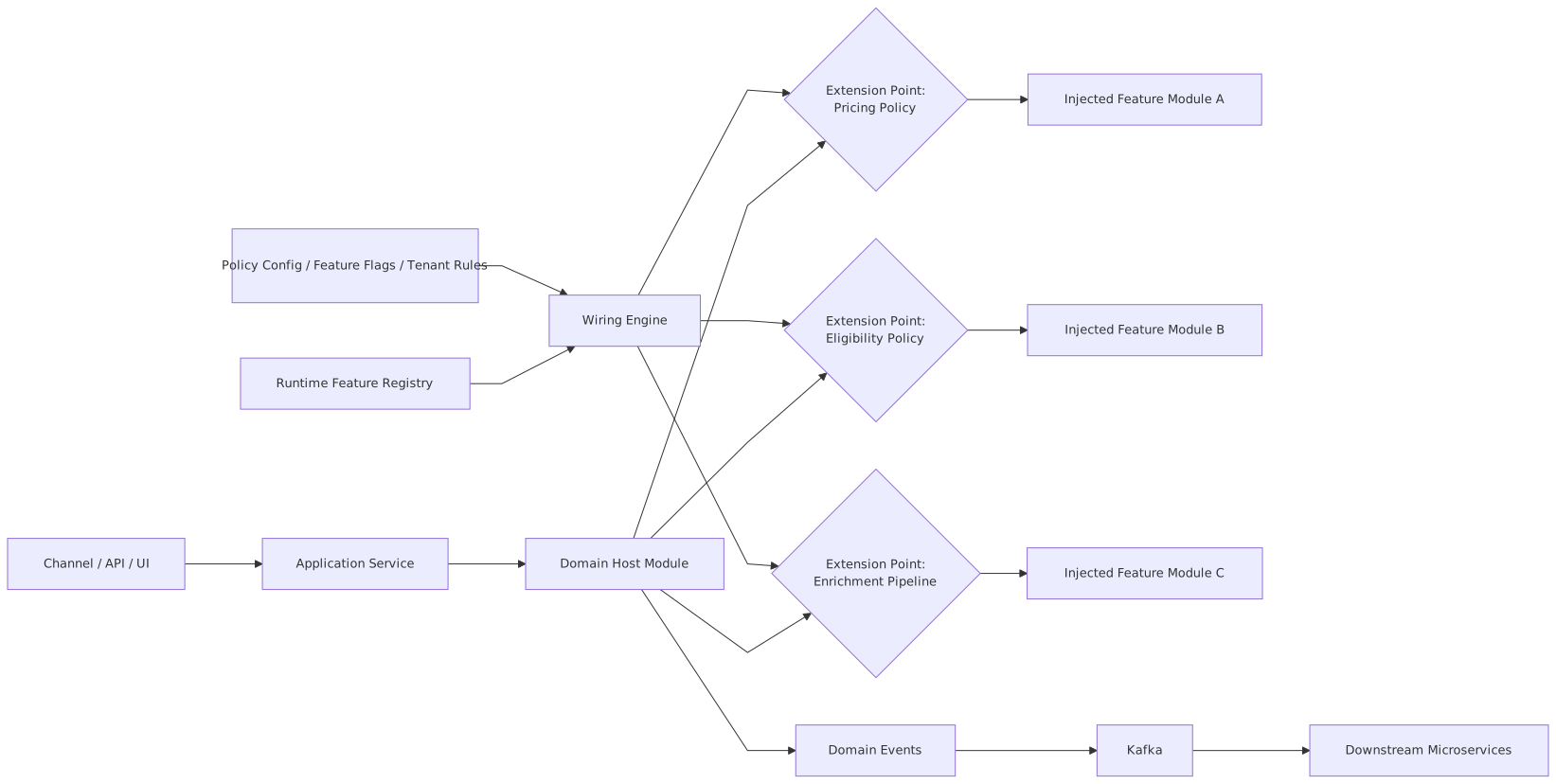
The host module owns invariants, transaction boundaries, and domain vocabulary. It does not ask injected modules to invent the meaning of core concepts. Instead, it allows them to participate in well-defined decisions or processing stages.
A good extension contract typically includes:
- input domain objects or immutable facts
- expected output shape
- side-effect rules
- timeout and failure semantics
- version compatibility
- observability fields
- idempotency expectations where external effects exist
That last one matters more than teams admit. Runtime injection often touches event-driven systems. If an injected feature enriches or transforms behavior before publishing events to Kafka, retries can duplicate impact unless the extension contract is explicit about idempotency and replay handling. event-driven architecture patterns
Dynamic wiring model
The wiring engine decides which module to attach at runtime. This can be based on static configuration, service discovery, policy rules, or feature management tooling. But it should produce a deterministic answer for a given business context.
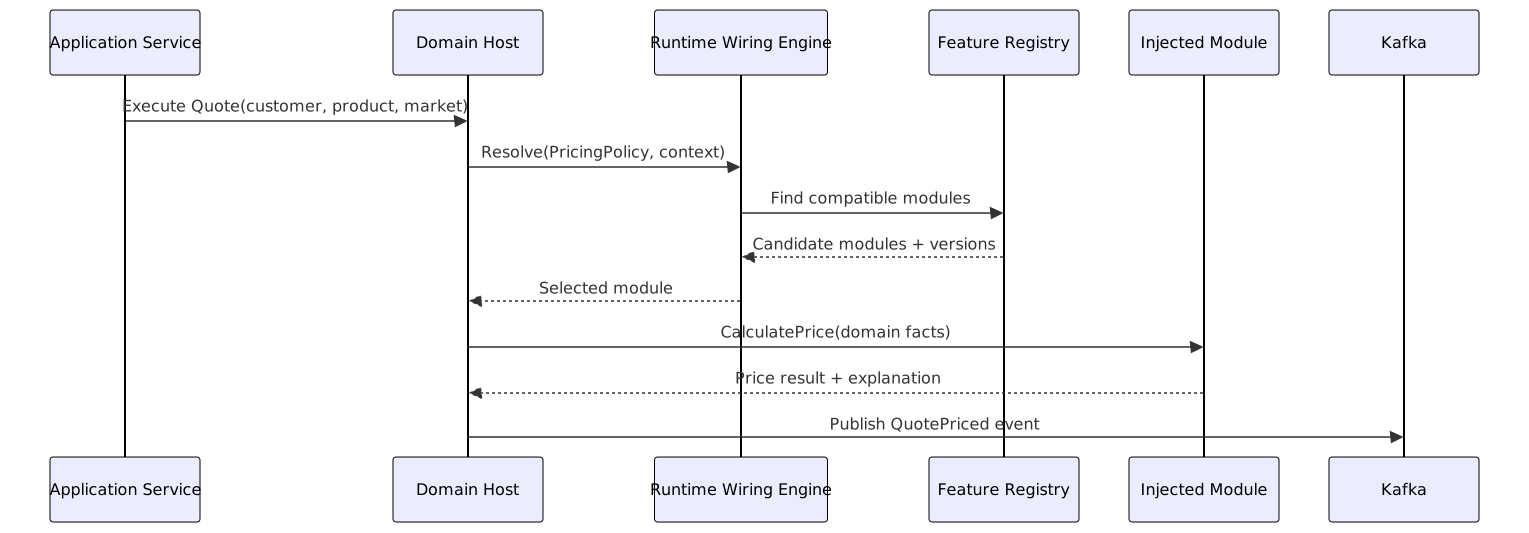
The phrase price result + explanation is not decorative. If injected logic affects critical business outcomes, the platform should capture not just the result but the reason path, policy version, and module identity. Otherwise support teams will spend their lives guessing.
Domain semantics discussion
This is where many architectures go wrong. They create extension points based on technical layers instead of business meaning.
Bad extension points:
- “before save”
- “after request”
- “custom processor”
- “post handler”
Useful extension points:
- “claim reserving strategy”
- “order allocation policy”
- “account opening validation”
- “offer eligibility rule”
- “payment retry strategy”
The difference is profound. Domain-named extension points anchor variability in the ubiquitous language. They help architects and domain experts discuss whether variation is legitimate, temporary, strategic, or dangerous. They also make migration possible because old and new behaviors can be compared within the same semantic frame.
If you cannot describe an extension point in domain language, you probably should not inject behavior there.
Migration Strategy
This pattern shines during progressive strangler migration.
A classic strangler fig migration replaces legacy behavior piece by piece while the old system continues to operate. Runtime feature injection gives you the seam to do that with less violence. Instead of moving entire applications at once, you redirect specific decision points or workflow stages to new modules while the host process and surrounding context remain stable.
The migration works best in stages.
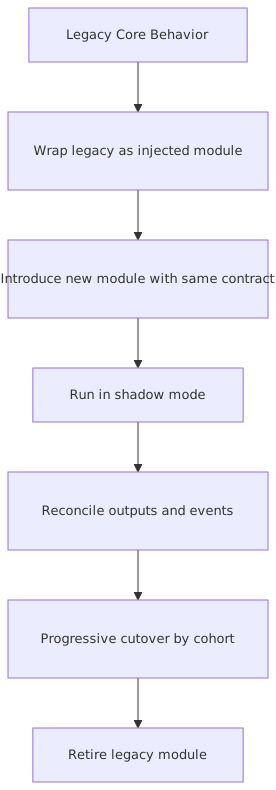
1. Identify stable host capabilities
First, identify what must remain stable during migration: command handling, persistence boundary, event contract, audit trail, user flow, or orchestration shell. This becomes the host.
2. Carve out extension points
Next, isolate variation points where legacy logic can be replaced incrementally: underwriting rules, discount policy, entitlement checks, routing decisions, or document assembly.
3. Wrap legacy behavior as a feature module
This is the unfashionable but practical move. Do not rewrite everything first. Put the legacy behavior behind the same contract as the target new module. That gives you a baseline and keeps the host consistent.
4. Introduce new modules side by side
Run old and new implementations in parallel for selected cohorts. One may be authoritative while the other is observational.
5. Reconcile outcomes
Reconciliation is the grown-up part of migration. If old and new modules compute different answers, you need to classify that difference:
- expected due to intentional policy change
- defect in the new implementation
- hidden dependency in legacy logic
- stale reference data
- sequencing issue from asynchronous events
Without structured reconciliation, side-by-side execution just creates noise.
6. Shift authority gradually
Once outcome deltas are understood, authority moves from legacy module to new module by tenant, channel, market, or product line.
7. Retire legacy modules and contracts
Only then do you remove the old behavior. Enterprises are bad at the last step. They love coexistence because it feels safe. In reality, long-lived coexistence is compound interest on complexity.
Here is a migration view.
Reconciliation discussion
Reconciliation deserves special attention in event-driven estates.
Suppose a new pricing module and a legacy pricing module both process the same quote request. The host records both outputs. The authoritative result is returned to the user, but both outcomes are emitted into Kafka on separate migration topics. A reconciliation service compares values, applied policy identifiers, timing, and downstream effects. If divergence exceeds thresholds, the cohort remains on legacy.
This is more than technical diffing. It is domain reconciliation. For example:
- A one-cent difference in tax rounding may be acceptable in quoting but not in settlement.
- A different fraud score may be acceptable if decision category is unchanged.
- A different routing choice may be acceptable only if SLA and cost remain within tolerance.
That means reconciliation rules should be domain-specific, not generic “compare payloads” tooling.
Enterprise Example
Consider a multinational insurer modernizing claims handling across eight markets.
The legacy claims platform has a central workflow engine with country-specific code tangled into every stage: intake, fraud check, reserve calculation, medical review, partner referral, payment approval, and regulatory reporting. Every market insists it is unique. Most of them are half right.
The insurer wants a common claims platform, event-driven integration through Kafka, and market variability without forking the system. They adopt a modular host architecture around the Claims bounded context.
The host owns:
- claim aggregate lifecycle
- canonical claim events
- audit and case history
- security and authorization
- workflow state transitions
- transactional integrity for claim decisions
Injection points are defined for:
- fraud screening strategy
- reserve estimation policy
- document requirement policy
- settlement approval policy
- external partner referral routing
Each injected module carries metadata:
- market applicability
- product line applicability
- contract version
- effective dates
- compliance tags
- operational owner
At runtime, the wiring engine selects modules based on claim type, market, product, channel, and migration cohort. Germany can use one reserve strategy, Spain another, and a pilot medical enrichment feature can be enabled only for travel claims in one region.
Kafka distributes canonical events such as ClaimRegistered, FraudAssessed, ReserveCalculated, and SettlementApproved. Downstream services consume these events without needing to know whether the behavior came from legacy wrapped logic or a new injected module. That is the architectural win: evolution without changing every subscriber.
During migration, the old reserve logic is wrapped as a legacy module. A new actuarial service is introduced as a replacement module. For three months, both run in parallel for selected products. A reconciliation service compares reserve outputs and downstream reserve adjustments. Where divergence is material, analysts review whether the issue is data quality, hidden assumptions, or intended policy change.
This approach avoids a full rewrite and keeps market variability controlled inside the Claims context. It also makes operating reality visible. Support can answer, “which reserve policy ran for this claim?” because policy identity is in the audit record.
That is what enterprise architecture should do: make change possible without making the system mysterious.
Operational Considerations
Dynamic architectures fail operationally before they fail conceptually.
Observability
Every injected execution should emit:
- module identity
- contract version
- selection reason
- execution duration
- outcome code
- domain correlation ID
- tenant/market/product context
- fallback usage if any
Without this, runtime injection becomes invisible complexity.
Distributed tracing should show both the host service and the injected module path. If modules are remote microservices rather than in-process plugins, trace continuity is mandatory. Otherwise teams will debate latency with feelings instead of facts.
Versioning
Feature contracts need disciplined versioning. Backward compatibility should be explicit, not assumed. A registry should prevent incompatible modules from being activated against a host expecting a different contract.
Security and governance
If the platform allows dynamic code or dynamic service wiring, you need governance. Enterprises should be able to answer: EA governance checklist
- who approved this module
- what data can it access
- which tenants can use it
- what happens on timeout
- can it trigger side effects
- how is it rolled back
Runtime injection without governance is how you accidentally build a shadow platform inside the platform. ArchiMate for governance
Resilience
Injected features must have clear resilience semantics:
- timeout thresholds
- retry policy
- fallback behavior
- circuit breaking
- cached/default policy use
- degradation mode
Not every extension point can safely degrade. A recommendation module may fail open. A compliance validation module probably cannot.
State and consistency
The safest injected modules are pure decision functions. The more stateful and side-effect-heavy they become, the more painful reconciliation, replay, and rollback become.
If modules publish or transform Kafka events, idempotency keys and ordering expectations must be explicit. Reprocessing a topic should not trigger duplicate external actions.
Tradeoffs
This pattern is powerful, but let’s not romanticize it.
Benefits
- supports controlled business variability
- reduces pressure to fork the core platform
- enables progressive strangler migration
- preserves bounded context ownership
- allows selective rollout by cohort
- improves reuse of host capabilities
- supports event-driven ecosystems with stable canonical events
Costs
- adds runtime indirection
- increases testing combinations
- demands stronger observability and governance
- can hide complexity if contracts are weak
- requires disciplined domain modeling
- may introduce latency if injection is remote
The biggest tradeoff is simple: you are exchanging compile-time certainty for runtime flexibility. That can be wise, but only if the extension points are deliberate and the operational model is mature.
Failure Modes
These are the common ways this goes wrong.
1. Generic plugin fever
The team builds a universal extension framework before understanding the domain. Soon every problem gets solved with a plugin. The result is not modularity but architectural tax evasion.
2. Domain leakage
Critical business meaning migrates into scattered injected modules with no shared language or policy lineage. The core becomes a shell, and nobody owns the domain model anymore.
3. Hidden dependencies
A module quietly depends on external reference data, event timing, or side effects not declared in the contract. Migration then produces mysterious divergence.
4. Unbounded combinatorics
Different modules can be combined in ways no one tested. Tenant-specific wiring, feature flags, and policy versions multiply until effective behavior is unknowable.
5. Fallback lies
Architects define fallback behavior that seems safe but changes business semantics. “If fraud provider fails, continue” is not a technical fallback. It is a policy decision with risk implications.
6. Eternal coexistence
Legacy and new modules run side by side forever because no one funds reconciliation closure and retirement. The migration never ends; it just becomes the architecture.
When Not To Use
Do not use runtime feature injection simply because “the business wants flexibility.” That sentence has launched many bad platforms.
Avoid this pattern when:
- the domain is stable and variability is low
- change frequency does not justify runtime complexity
- operational maturity is weak
- teams cannot maintain clear contract governance
- extension points are purely speculative
- hard regulatory certification requires fixed deployed behavior
- consistency and determinism matter more than adaptability
- the real need is ordinary configuration, not behavior injection
Also, do not use it when a simple strategy pattern inside one bounded context will do. Not every variation deserves a registry, dynamic resolver, and release policy. Architecture should solve the problem you actually have, not the one that makes for a dramatic conference talk.
Related Patterns
Several patterns sit close to this one.
Strategy pattern
The local, code-level ancestor. Useful when variation is known and static. Runtime feature injection is the enterprise-scale version, with activation, governance, and operational concerns.
Plugin architecture
Closely related, but plugin models are often technically oriented. Runtime feature injection should be domain-oriented.
Policy-based design
A strong companion idea. Many injected features are really business policies made executable.
Strangler fig pattern
Essential for migration. Runtime injection provides the seam for selective replacement.
Event sourcing and CQRS
Sometimes relevant, especially when reconciliation and replay matter. But do not assume they are required. They often add more machinery than the problem needs.
Rules engines
Useful in some domains, dangerous in others. Rules engines can support injection for highly variable policy logic, but they can also flatten domain meaning into opaque rule tables. Use with caution.
Summary
Runtime feature injection in modular architectures is not about making software magical. It is about making variability explicit, governable, and migratable.
The core idea is straightforward: keep the host stable, inject behavior only at domain-valid extension points, wire it using business context, and treat migration as a sequence of controlled substitutions with reconciliation. Use Kafka and microservices where they genuinely help decouple event propagation and downstream consumers, but do not let distribution become a substitute for design.
The best implementations are boring in the right places. They preserve domain semantics. They make runtime choices visible. They support progressive strangler migration without pretending coexistence is free. They acknowledge tradeoffs. They know where fallback is safe and where it is a business decision. And they retire old behavior instead of worshipping backward compatibility forever.
In short: dynamic wiring is powerful, but power without language becomes chaos. If you anchor runtime feature injection in bounded contexts, explicit contracts, and operational truth, it becomes a practical enterprise tool. If you treat it as a generic extensibility trick, it will turn your architecture into folklore.
Frequently Asked Questions
What is enterprise architecture?
Enterprise architecture aligns strategy, business processes, applications, and technology in a coherent model. It enables impact analysis, portfolio rationalisation, governance, and transformation planning across the organisation.
How does ArchiMate support architecture practice?
ArchiMate provides a standard language connecting strategy, business operations, applications, and technology. It enables traceability from strategic goals through capabilities and services to infrastructure — making architecture decisions explicit and reviewable.
What tools support enterprise architecture modeling?
The main tools are Sparx Enterprise Architect (ArchiMate, UML, BPMN, SysML), Archi (free, ArchiMate-only), and BiZZdesign. Sparx EA is the most feature-rich, supporting concurrent repositories, automation, scripting, and Jira integration.