⏱ 21 min read
Most enterprise systems do not fail because the team picked the “wrong” pattern on a whiteboard. They fail because the architecture stopped matching the shape of the business, and nobody noticed until every change became negotiation with the codebase.
That is the real tension behind layered architecture vs vertical slice in modular monoliths. On paper, both can be clean. In production, one often turns into a shared utility swamp, the other into a collection of mini-systems with no common discipline. Architects like to argue structure. The business pays for flow.
A modular monolith is supposed to be the sober middle ground: one deployable unit, but with real boundaries inside. Yet the moment teams try to organize those boundaries, they usually reach for one of two instincts.
The first is the classic layered stack: presentation, application, domain, infrastructure. Familiar. Teachable. Safe-looking. It gives leaders the comforting illusion that order has been imposed.
The second is the vertical slice: organize around business capabilities, use cases, or bounded contexts. Put all code needed for a slice near the behavior it serves. This often feels messier at first glance, but cleaner when the domain starts moving.
This is not just a code layout debate. It is about how domain semantics survive scale, how teams evolve a legacy estate without detonating delivery, and how a modular monolith prepares—or refuses—to become microservices later.
My position is simple: if your system changes because the business changes, prefer vertical slices inside a modular monolith. Use layered ideas within slices, not as the top-level organizing principle. A top-level layered architecture is often excellent for teaching and often mediocre for preserving business boundaries.
That does not make layered architecture obsolete. It makes it dangerous when applied without regard to domain-driven design.
Context
Most enterprises do not start with a blank sheet. They inherit a portfolio: old .NET applications with service classes the size of novels, Java systems where “common” means “everyone depends on it,” and integration estates stitched together with REST calls, file drops, and Kafka topics nobody wants to rename. event-driven architecture patterns
Into that environment comes the modular monolith. Usually for one of three reasons:
- the company is tired of distributed systems tax
- a large monolith must be restructured before it can be modernized
- teams want clearer domain boundaries without the operational burden of microservices
A modular monolith is attractive because it restores a simple truth: not every boundary needs a network hop.
That matters. Network boundaries are expensive. They introduce versioning, retries, observability overhead, eventual consistency, security concerns, and operational ownership. If the business capability is still evolving rapidly, freezing it behind a service API too early is often architectural vanity.
But once you decide to build a modular monolith, you still need an internal structure. This is where the choice becomes consequential.
A pure layered architecture gives you horizontal separation by technical concern. A vertical slice architecture gives you vertical separation by business behavior.
Those are not equivalent. They optimize for different things.
Problem
The problem with many modular monoliths is not that they are monoliths. It is that they are modular only in naming.
A team says they have modules, but the source tree tells another story:
controllersservicesrepositoriesentitiesutilsshared
This is not modularity. This is a filing cabinet.
A business change like “introduce credit hold rules for strategic accounts” now touches five folders, three abstractions, two shared services, and one data model that half the application depends on. Every change cuts horizontally across the stack. The architecture has encoded technical mechanics more strongly than business meaning.
The result is predictable:
- domain logic leaks into application services and controllers
- repositories become query dumping grounds
- shared models become accidental enterprise schemas
- teams collide in the same layers
- modules cannot be extracted cleanly later
In contrast, vertical slices aim to keep the behavior, policies, data access, and orchestration for a business capability together. Not in a chaotic way. In a bounded way.
The difference is subtle but profound. In a layered stack, a developer asks, “Which technical layer does this belong to?” In a vertical slice, they ask, “Which business capability owns this behavior?”
The second question is usually the one the business actually cares about.
Forces
Architecture is pressure management. There are competing forces here, and pretending otherwise is how design turns doctrinaire.
1. Domain clarity vs technical consistency
Layered architectures create visible consistency. Every feature follows the same stack. That can be useful, especially with junior teams or strong platform standards.
Vertical slices create stronger domain locality. Code related to order pricing, returns, underwriting, or claims sits together. This tends to improve comprehension when the domain is rich and volatile.
If your problem is mostly CRUD, layer consistency may be enough. If your problem contains policy, workflow, and language that changes with the business, domain locality wins.
2. Reuse vs duplication
Layered advocates often fear duplication. Slice advocates often fear coupling disguised as reuse.
They are both right.
A little duplication inside slices is often cheaper than false abstraction across them. Shared code should emerge from repeated need, not be declared up front like a constitutional principle.
In enterprise systems, “shared” is the most dangerous word in the repository.
3. Simplicity of deployment vs future extraction
A modular monolith keeps deployment simple. One artifact, one runtime, one operational plane. That is its superpower.
But if parts of the domain may later split into microservices, the internal structure should make that extraction possible. Vertical slices, especially when aligned to bounded contexts, create cleaner seams for that future. Layered architectures often optimize inward consistency while making outward extraction harder. microservices architecture diagrams
4. Transactional consistency vs asynchronous integration
Inside a monolith, a single database transaction is seductive. It makes complex workflows feel easy. But ease can hide coupling.
If the architecture keeps everything in one layered model, teams may build broad, cross-module transactions that become impossible to disentangle later. Slice-oriented modules can still use local ACID transactions, but they make cross-boundary interactions more visible. That visibility is healthy.
Eventually, some interactions move to events, outbox patterns, Kafka, or service APIs. Better to know where those seams are before production teaches you.
Solution
The practical answer is this:
Use a modular monolith organized primarily as vertical slices aligned to domain capabilities or bounded contexts. Inside each slice, use layered design selectively where it helps.
That sentence matters because this is not a binary choice.
Too many discussions frame it as:
- layered architecture everywhere, or
- no layers at all, just feature folders
That is childish architecture.
A serious design recognizes that top-level structure and internal structure are different decisions.
At the top level, favor slices:
- Orders
- Billing
- Inventory
- Claims
- Customer Onboarding
- Pricing
Within a slice, use layers if the complexity warrants them:
- API/entry points
- application orchestration
- domain model and policies
- infrastructure adapters
This preserves business boundaries without abandoning technical discipline.
Here is the core comparison.
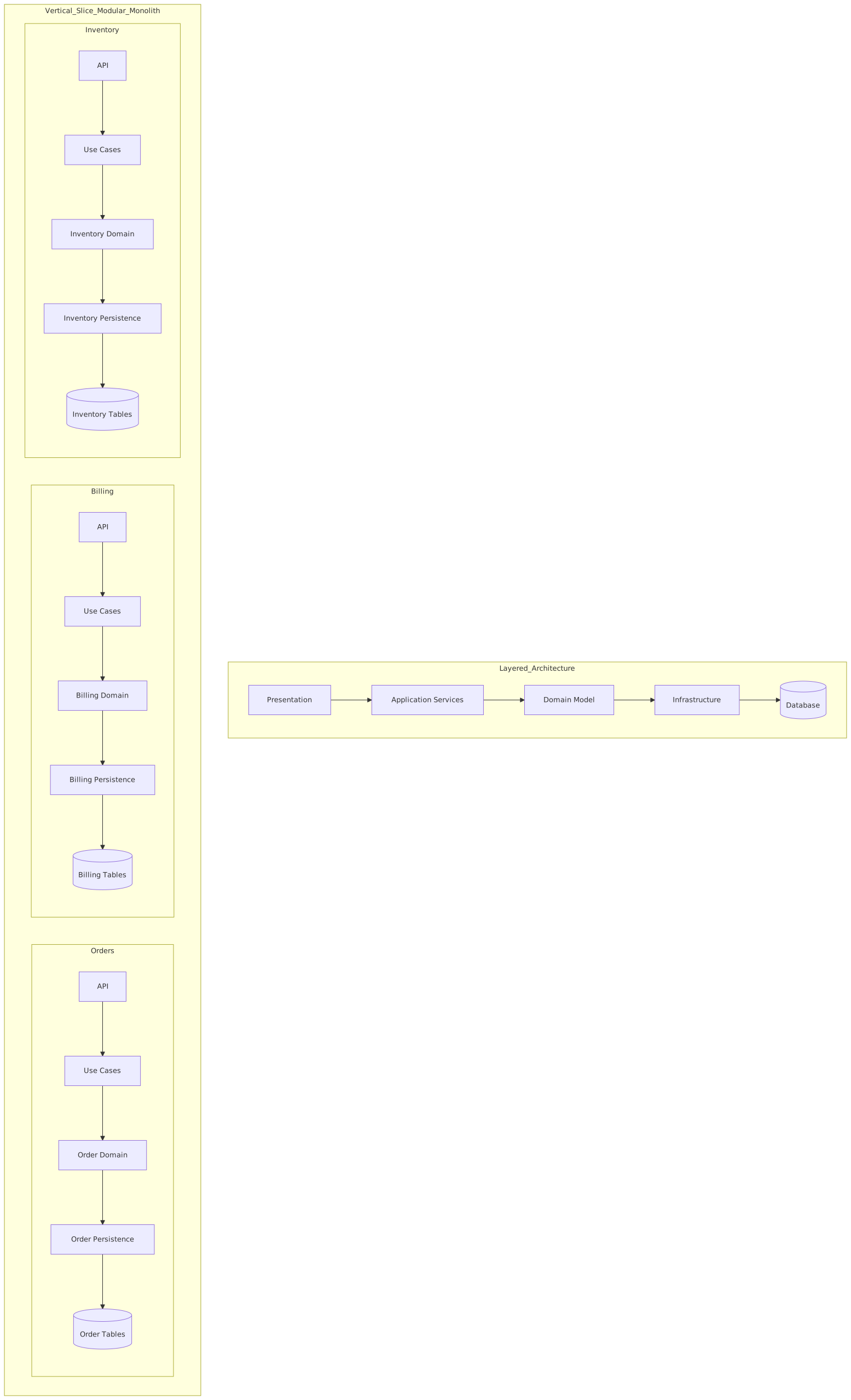
In the layered version, everything of the same technical type clusters together. In the slice version, everything needed for a business capability lives together.
That difference changes how teams think, how dependencies form, and how migrations unfold.
Architecture
Let us make this concrete.
Layered architecture in a modular monolith
The layered stack is familiar because it maps nicely to technical responsibilities.
- Presentation layer handles web/API/UI concerns
- Application layer coordinates use cases
- Domain layer holds business rules
- Infrastructure layer deals with persistence, messaging, external systems
There is nothing inherently wrong with this. In fact, inside a bounded context, it is often very good. The trouble begins when it becomes the primary system-wide organizing principle.
At enterprise scale, system-wide layers often drift toward these anti-patterns:
- a single domain model shared across unrelated subdomains
- repositories serving many business areas
- “service” classes as procedural god objects
- infrastructure concerns bleeding upward because everyone depends on the same persistence abstractions
- pseudo-modularity where package names imply boundaries but compile-time dependencies ignore them
The architecture looks neat in slides and untidy in Git.
Vertical slice architecture in a modular monolith
A vertical slice treats a business capability as the organizing unit. Each slice contains the code necessary to handle its own use cases end to end.
A slice might include:
- controllers or handlers
- commands and queries
- validators
- application services or use case coordinators
- aggregates, value objects, domain services
- repositories or data mappers
- integration adapters
- tests
This structure pairs naturally with domain-driven design because slices can align to bounded contexts or subdomains. Ubiquitous language stays closer to the code that enacts it. “Policy,” “endorsement,” “settlement,” “reservation,” “allocation,” “rebill”—these terms stop being spread thinly across horizontal layers.
In a vertical slice modular monolith, the key rule is not “never use layers.” It is “layers do not trump domain boundaries.”
Domain semantics matter
This is the piece architects routinely underplay.
Business systems are not just workflows. They are language machines. The architecture should protect meaning.
When an insurer talks about a “claim,” they may mean:
- the notice of loss
- the adjudication record
- the payment case
- the fraud investigation context
If the codebase has one giant ClaimService in the application layer and one generic ClaimRepository, then semantics have already been flattened. Future complexity becomes a naming game.
Vertical slices force a healthier question: which bounded context owns which meaning? That is proper DDD thinking. It prevents the modular monolith from becoming a semantic monolith.
Recommended dependency shape

A few important opinions are embedded here:
- Shared kernel should be small and rare.
Identity primitives, time abstractions, basic result types, maybe some cross-cutting observability helpers. Not business models.
- Cross-slice dependencies should be constrained.
Prefer published interfaces, domain events, or application-facing contracts over direct internal class references.
- Kafka belongs at the edge of a boundary, not at the center of your object model.
Use it when the integration demands decoupling or external consumers exist. Do not spray events around internally just because eventing feels modern.
Migration Strategy
Most enterprise teams do not get to rebuild. They get to migrate while the business keeps moving. That is why migration strategy matters more than pattern purity.
The safest path from a layered legacy monolith to a slice-oriented modular monolith is progressive strangler migration.
Not a big bang. Big bang rewrites are where architecture goes to become mythology.
Step 1: Identify bounded contexts and candidate slices
Start from business capabilities, not packages. Use event storming, domain mapping, production incident analysis, and change history.
Ask:
- which areas change together?
- where does vocabulary diverge?
- where are the handoffs and reconciliation problems?
- where do teams already have natural ownership?
Look for contexts like:
- Customer Onboarding
- Policy Administration
- Claims Intake
- Payments
- Pricing
- Fulfillment
Do not begin with technical layers. Begin with language and ownership.
Step 2: Stabilize the current monolith with seams
Before moving code, create seams:
- facade interfaces around unstable shared services
- anti-corruption translators around problematic models
- domain events or internal notifications for significant state changes
- package/module rules enforced in the build
This is where many migrations fail. Teams start relocating classes without first creating architectural boundaries. They move mess, not structure.
Step 3: Pull one business capability into a slice
Choose a slice with:
- high business value
- manageable dependency surface
- active change demand
- visible pain in the current architecture
Move use cases, domain policies, persistence logic, and tests into a cohesive module. Keep the monolith deployable as one unit.
A common technique is the branch by abstraction approach:
- old code delegates to new slice interfaces
- behavior is moved incrementally
- database schema remains initially shared if necessary
- read and write flows are switched gradually
Step 4: Introduce internal eventing carefully
As slices become more independent, some interactions should no longer be direct synchronous calls.
Examples:
- Order placed → reserve inventory
- Claim approved → initiate payment
- Customer onboarded → create billing account
Inside the modular monolith, this can start as in-process domain events with transactional outbox support where needed. If one day the interaction must cross service boundaries, the outbox can publish to Kafka.
This is the bridge between monolith modularization and selective microservice extraction.
Step 5: Reconcile data and semantics
Reconciliation is where architecture grows up.
When you carve slices out of a layered monolith, the old system often assumed one canonical model and one write path. Reality disagrees. Slices need their own view of truth.
That means dealing with:
- duplicated read models
- lag between emitted events and downstream projections
- idempotency
- corrective workflows
- replays
- business reconciliation reports
Do not treat reconciliation as an operational afterthought. In enterprise systems, it is part of the design.
If Billing and Orders stop sharing one transaction and communicate through events, there will be timing gaps and occasional mismatches. You need:
- correlation IDs
- replay-safe handlers
- dead-letter handling
- business-visible reconciliation jobs
- clear ownership of correction paths
Architects who talk about eventual consistency without talking about reconciliation are selling half a bridge.
Progressive strangler view

This path lets you improve structure now while preserving later options.
Enterprise Example
Consider a global insurance company modernizing its policy and claims platform.
The legacy system was a classic layered monolith:
- web controllers
- application services
- domain entities
- repositories
- one large relational schema
- shared service utilities for rating, document generation, payments, fraud checks
On diagrams, it looked disciplined. In delivery, it was chaos.
A change to “mid-term endorsement for commercial fleet policies with premium recalculation and broker notification” touched:
- policy service
- rating service
- customer service
- billing service
- notification service
- repository layer
- shared DTOs used by external integrations
Every release required broad regression testing. Teams collided constantly because the architecture made technical layers the unit of change, while the business worked in capabilities.
The company did not jump to microservices. That would have been reckless. Claims and policy workflows still had too many unknowns, and the operations team was already overstretched.
Instead, they built a modular monolith organized around bounded contexts:
- Policy Administration
- Pricing
- Billing
- Claims
- Party Management
- Documents
Inside each context, they used a selective layered structure. Policy Administration had its own commands, handlers, aggregates, repositories, and APIs. Billing had a different model of account state, intentionally not reused.
This was a crucial DDD move. “Policy” and “Billing Account” were related, but not the same thing. The old system had blurred them into a common customer-financial schema. The new slices preserved distinct semantics.
Cross-context interactions moved gradually:
- Policy endorsement emitted internal events
- Billing recalculated receivables via subscribed handlers
- document generation became asynchronous
- a transactional outbox published certain events to Kafka for downstream reporting and partner integrations
Not everything became asynchronous. Fraud checks stayed synchronous in claims intake for regulatory reasons. That was the right tradeoff.
What improved?
- teams could deliver within a bounded context with fewer collisions
- domain terms became clearer in code and conversation
- deployment stayed simple because it remained one application
- some contexts, particularly Documents and Pricing APIs, later became standalone services with much less pain
What did not improve automatically?
- database coupling remained a problem for a while
- reconciliation between Policy and Billing needed explicit operational workflows
- some engineers duplicated too much utility code before proper shared abstractions emerged
- reporting teams resisted context-specific schemas and wanted a single canonical model back
That last point is classic enterprise gravity. The old world always tries to reassemble itself.
Operational Considerations
A modular monolith is not just a code organization trick. It needs operational discipline.
Build-time governance
If slice boundaries are not enforced, they are fiction. Use:
- module dependency rules
- package visibility restrictions
- architecture tests
- CI checks for forbidden imports
- ADRs for boundary decisions
A modular monolith with no enforcement becomes a monolith with better folder names.
Observability
Even in one deployable unit, trace by slice:
- request flow by business capability
- latency per use case
- domain event publication and handling metrics
- failed reconciliation counts
- outbox lag
- dependency maps between modules
You want to know not only that the system is slow, but that Claims Settlement reconciliation is backing up after policy endorsement spikes.
That is enterprise observability. It speaks business.
Data ownership
A single database does not mean shared ownership of every table. Logical ownership matters even before physical separation.
Prefer:
- tables grouped by slice or schema where possible
- no direct cross-slice writes
- read access via views, APIs, projections, or published read models
- outbox tables owned per module if eventing is used
The day you want to extract a service, these constraints become the difference between surgery and amputation.
Kafka and microservices relevance
Kafka enters the picture when:
- other systems need to react to domain events
- bounded contexts are becoming independently deployable
- integration load or temporal decoupling matters
- replayability or audit streams are operationally valuable
Do not force Kafka into an internal modular monolith if simple in-process notifications will do. But do design your slices so that important state transitions can later be externalized through an outbox to Kafka.
Likewise, do not use a modular monolith as a moral stance against microservices. Use it as a staging ground for earned distribution. Some capabilities deserve extraction later. Most do not on day one.
Tradeoffs
Every architecture is a bargain with consequences.
Benefits of layered architecture
- consistent technical structure
- easier onboarding for teams trained in classic n-tier systems
- supports clear separation of concerns in simpler domains
- often works well for CRUD-heavy enterprise applications
- can reduce accidental duplication if the domain is stable and shared
Costs of layered architecture
- encourages horizontal coupling across business capabilities
- weakens bounded context integrity
- central layers become bottlenecks
- difficult to assign clean ownership to teams
- migration to service boundaries becomes harder because the business logic is smeared across layers
Benefits of vertical slice architecture
- aligns structure to business capabilities
- keeps domain logic, orchestration, and data access close together
- improves team autonomy inside a monolith
- creates better seams for future microservices extraction
- supports domain-driven design, especially bounded contexts and ubiquitous language
Costs of vertical slice architecture
- can introduce duplication
- may feel less uniform to developers expecting one global stack
- requires stronger architectural governance to avoid chaos
- cross-cutting concerns need deliberate handling
- reporting and enterprise data teams may resist context-specific models
The tradeoff is not elegance versus mess. It is uniformity versus domain fit.
And in enterprise systems, domain fit usually wins over time.
Failure Modes
A good pattern in bad hands becomes a slogan. These are the common failure modes.
1. Fake slices
Teams create folders named after business capabilities but still route everything through shared service and repository layers. The slices are decorative. The coupling remains.
2. Shared kernel obesity
A “common” module starts small and ends up containing:
- customer model
- money calculation
- workflow helpers
- event classes
- authorization rules
- reference data access
At that point, the common module is the real monolith inside the monolith.
3. Event theater
Teams introduce internal events, Kafka, and outbox patterns everywhere before they have stable boundaries. The result is complexity without autonomy. Use asynchronous messaging where it solves a real decoupling or integration problem.
4. No reconciliation plan
Data diverges between slices, an event is missed or retried twice, and nobody owns repair. Then operations invent spreadsheet workflows to patch the system. That is not resilience. It is surrender.
5. Premature microservice extraction
A slice looks neat, so leaders decide it should become a service immediately. But if transactions are still deeply coupled, operational maturity is low, and domain boundaries are unsettled, extraction simply exports confusion over HTTP.
When Not To Use
Vertical slices in a modular monolith are not always the right answer.
Do not force this style when:
The domain is genuinely simple
If the system is mostly forms over data with limited business rules, classic layering may be perfectly adequate. Not every internal application needs bounded contexts and domain events.
The team lacks architectural discipline
Vertical slices without dependency control become anarchy. If the organization cannot enforce boundaries, a simpler layered approach may degrade more slowly.
The product is a short-lived utility
If the application will be retired soon or has low strategic value, restructuring for slice-based modularity may not pay back.
Strong platform constraints dictate a layered model
Some commercial frameworks, low-code ecosystems, or enterprise reference architectures heavily constrain the structure. You may still carve out semantic modules, but the full slice model may fight the platform too much.
Cross-cutting optimization dominates
In rare cases—high-performance engines, deeply technical platforms, specialized processing systems—the primary forces are technical, not business-domain aligned. Then a capability-first decomposition may not be the best top-level structure.
And do not use a modular monolith at all if the organization truly needs independent deployment, scaling, and governance across sharply separated domains right now. In that case, some form of microservices may be justified. But be honest about the operational price. EA governance checklist
Related Patterns
This conversation sits in a wider pattern language.
- Domain-Driven Design: especially bounded contexts, ubiquitous language, aggregates, domain services, anti-corruption layers
- Hexagonal / Ports and Adapters: useful inside a slice to isolate domain logic from infrastructure
- CQRS: often helpful within slices where write models and read models differ significantly
- Transactional Outbox: key for reliable publication of events from a modular monolith to Kafka
- Strangler Fig Pattern: ideal for incremental migration from a layered legacy monolith
- Shared Kernel: use sparingly between closely aligned contexts
- Published Language: helpful when slices or services exchange stable business concepts
- Saga / Process Manager: relevant when workflows span slices or later cross microservices
- Anti-Corruption Layer: essential during migration from old shared models to context-specific models
A mature architecture uses these patterns as tools, not identity badges.
Summary
The real question in layered architecture vs vertical slice in modular monoliths is not which diagram looks cleaner. It is which structure keeps the software aligned with the business as complexity grows.
Layered architecture remains useful. It provides discipline, familiarity, and technical separation. But as a top-level organizing principle for a complex modular monolith, it often weakens domain boundaries and spreads behavior across horizontal layers.
Vertical slice architecture is usually the better default for serious enterprise domains. It aligns code to capabilities, protects semantics, improves ownership, and creates cleaner migration paths—both from legacy monoliths and toward selective microservices where justified.
The best practical design is often hybrid:
- vertical slices at the top
- layered discipline inside each slice
- DDD to define boundaries
- progressive strangler migration for adoption
- reconciliation designed explicitly
- Kafka used where integration or future distribution truly demands it
The memorable version is this:
A layered architecture organizes for plumbing. A vertical slice organizes for change.
And in enterprise systems, change is the only load that never stops.
Frequently Asked Questions
What is enterprise architecture?
Enterprise architecture aligns strategy, business processes, applications, and technology in a coherent model. It enables impact analysis, portfolio rationalisation, governance, and transformation planning across the organisation.
How does ArchiMate support architecture practice?
ArchiMate provides a standard language connecting strategy, business operations, applications, and technology. It enables traceability from strategic goals through capabilities and services to infrastructure — making architecture decisions explicit and reviewable.
What tools support enterprise architecture modeling?
The main tools are Sparx Enterprise Architect (ArchiMate, UML, BPMN, SysML), Archi (free, ArchiMate-only), and BiZZdesign. Sparx EA is the most feature-rich, supporting concurrent repositories, automation, scripting, and Jira integration.