⏱ 21 min read
Most architecture governance in banks is theater. ArchiMate for governance
There, I said it.
A lot of banks have architecture boards, standards catalogs, review gates, exception processes, policy documents, reference architectures, design authorities, and enough PowerPoint to heat a small city. And still—delivery teams keep building point-to-point integrations, IAM remains fragmented, Kafka turns into a distributed mess of mystery topics, cloud costs explode, and nobody can explain why a “strategic platform” now has six versions running in production.
That is not a governance problem in the abstract. It is a setup problem.
If governance slows delivery, gets bypassed, or only appears when something has already gone wrong, then it is not governance. It is bureaucracy with architectural branding. EA governance checklist
So let’s make this practical.
What architecture governance setup means in a bank
Architecture governance setup is the way a bank decides, enforces, and evolves technology choices so delivery teams can move without breaking security, regulation, resilience, or the operating model.
Simple version, early, because this is where many articles become vague:
Architecture governance in banking is the mechanism that answers five questions consistently:
- What decisions need control?
- Who makes which decisions?
- What standards are mandatory vs flexible?
- How are deviations approved?
- How do we know teams actually followed through?
That’s it.
Not a hundred-page framework. Not a monthly architecture review ritual. Not a giant repository nobody reads.
In banks, governance matters more because the consequences are larger. You are not just shipping a food delivery app. You are dealing with regulated data, fraud risk, operational resilience, identity trust, auditability, and systems that absolutely refuse to die quietly. Your architecture decisions have legal, financial, and reputational consequences.
But here is the contrarian part: because banking is complex, many banks over-govern exactly the wrong things.
They review every solution diagram and miss platform sprawl.
They force architects to present to boards and ignore runtime controls.
They create standards nobody can implement in a six-week sprint.
They obsess over “target state” and neglect migration paths.
Good governance is not more control. It is control in the right places.
The real purpose of architecture governance in a bank
Let’s get more precise.
A good governance setup in a bank should do four things:
- Reduce avoidable variation
- Protect the enterprise from high-impact technology risk
- Speed up delivery by making common decisions pre-approved
- Create traceability for auditors, regulators, and internal control functions
That third point gets missed all the time.
If your governance setup makes every team rediscover API standards, IAM patterns, Kafka topic ownership rules, cloud landing zone requirements, and data classification controls from scratch, then governance is failing. Architecture should remove decision load from teams, not add to it. architecture decision record template
The best governance model I’ve seen in banks works like road design. Teams can drive fast because the lanes, guardrails, signs, and speed limits are already there. The worst model works like a border checkpoint. Every movement requires approval. Everyone slows down. People start sneaking around.
Why banks struggle with governance setup
Banks have a few structural problems that make governance hard.
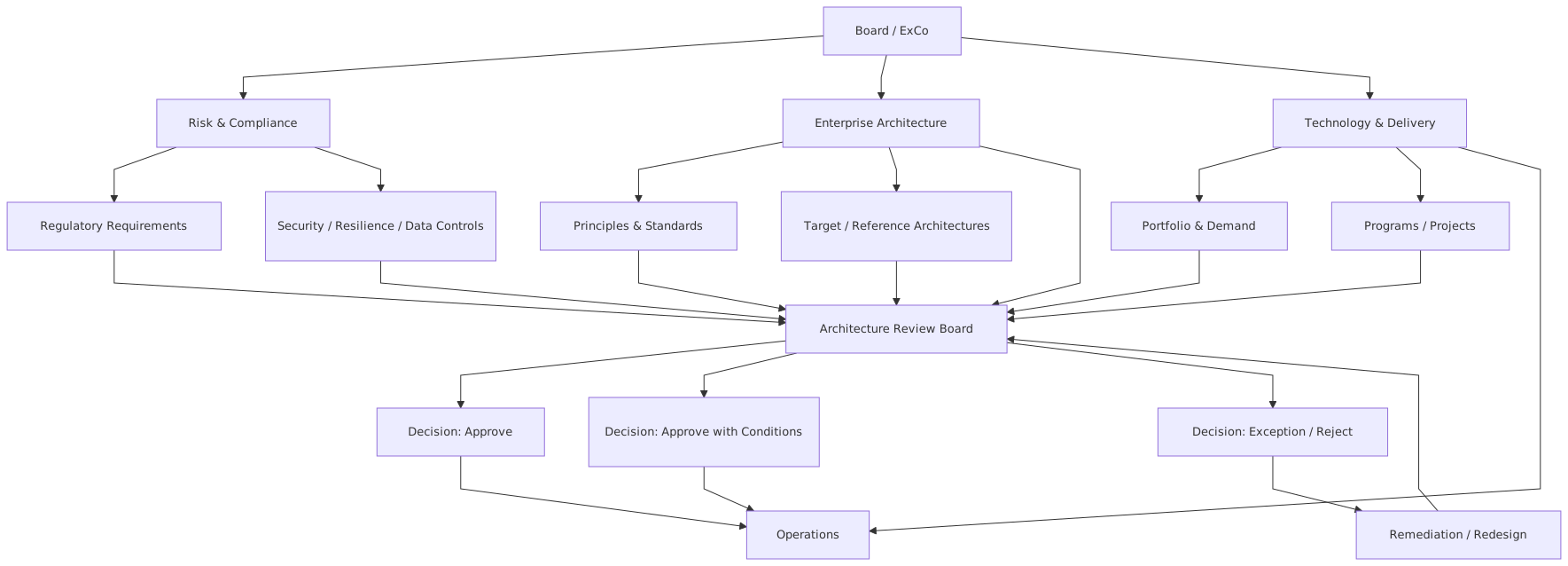
1. They confuse architecture governance with architecture review
A review board is not governance. It is one mechanism inside governance.
If your entire setup depends on architects catching bad decisions in slide decks, you are already too late. By the time a project presents a design, budget is committed, timelines are promised, vendors are selected, and politics are active. The review becomes symbolic.
Real governance starts earlier and lasts longer:
- before funding
- during design
- during implementation
- at deployment
- in production
2. They centralize too much
Banks love central control. Sometimes for good reasons. But a central architecture team approving every meaningful decision in a large bank is not governance. It is a delivery bottleneck pretending to be assurance.
The trick is to centralize standards and guardrails, but decentralize most implementation decisions.
3. They let “strategic” become vague
Every bank says it wants strategic platforms. But if “strategic” is not tied to funding, migration roadmaps, decommissioning, and mandatory adoption triggers, then it is just a label.
You do not have a strategic IAM platform because a slide says so.
You have one when old IAM services are being shut down and new workloads are blocked from bypassing it.
4. They ignore incentives
This is the one architects often dislike hearing.
Teams do not bypass governance because they are reckless. Usually they do it because the governed path is too slow, too unclear, too expensive, or too immature.
If using the approved Kafka platform takes three months and setting up a rogue messaging cluster takes two days, people will make “pragmatic” decisions. Then governance gets blamed after the fact.
Bad governance often starts with bad platform experience.
The minimum viable governance model for a bank
You do not need a giant framework to start. You need a model that is clear, enforceable, and connected to real delivery work.
Here is the practical baseline.
That’s the skeleton.
Now let’s go deeper into how to set this up in a bank that actually ships things.
Start with decision rights, not documents
Architects often start governance by writing principles and standards. Fine. But the real foundation is decision rights.
Who decides:
- whether a workload can run in public cloud?
- whether Kafka is the right integration pattern?
- whether IAM integration can use local authorization logic?
- whether a team can buy a SaaS product with customer data?
- whether a new API standard can be introduced?
- whether an exception is acceptable?
If you do not define this, governance turns political fast.
A practical banking model usually has four levels of decision-making:
1. Enterprise architecture decisions
These are cross-bank choices with enterprise impact:
- cloud strategy and landing zone model
- IAM control model
- Kafka/event platform standards
- canonical security patterns
- critical technology lifecycle standards
- resilience and data hosting guardrails
These should be made centrally and very deliberately.
2. Platform architecture decisions
These sit with platform owners and platform architects:
- how Kafka clusters are provisioned
- topic naming and ACL models
- IAM federation and token patterns
- cloud network segmentation and service onboarding
- observability and runtime controls
This is where governance becomes implementable.
3. Domain architecture decisions
These belong to business or product-aligned domains:
- service boundaries
- event ownership
- API decomposition
- data product ownership
- process orchestration choices within domain constraints
This should not need enterprise approval every time.
4. Solution-level decisions
These are local implementation choices:
- framework selection from approved stack
- detailed service interaction design
- schema evolution approach within standards
- local resiliency implementation
If enterprise architects are spending all day on these, something is broken.
My strong view: most banks have too many enterprise decisions and too few platform decisions. They centralize policy and neglect the machinery that makes policy usable.
Build standards that teams can actually consume
Standards in banks usually fail because they are written for committees, not delivery teams.

A useful standard answers:
- what is mandatory?
- what is recommended?
- what is forbidden?
- why?
- who owns it?
- how do I implement it?
- how do I request an exception?
If your IAM standard says “all applications must integrate with enterprise identity services using approved protocols” and stops there, that is not a standard. That is a vague wish.
A useful IAM standard says things like:
- Workforce authentication must use enterprise IdP with SAML or OIDC
- Customer-facing apps must use centralized CIAM capabilities
- Local credential stores are prohibited unless approved under exceptional offline use cases
- Authorization must use enterprise roles/claims model for regulated actions
- Privileged access must integrate with PAM controls
- Service-to-service authentication in cloud must use workload identity, not shared secrets where supported
- Exceptions require security architecture approval and a remediation date
Now people can work with it.
Same with Kafka. A real bank standard would define:
- when to use Kafka vs API vs batch
- topic ownership rules
- retention classes
- PII handling restrictions
- schema registration requirements
- event naming conventions
- consumer group expectations
- replay policy
- DR and resilience expectations
- managed platform onboarding path
Without those, Kafka becomes an integration free-for-all. And believe me, banks are very capable of turning Kafka into expensive point-to-point messaging with extra steps.
Governance should be risk-based, not universal
This is where many architecture teams get stubborn. They want every project reviewed because consistency matters.
No. Risk matters.
A mobile banking app introducing a new customer authentication flow? Yes, review that.
A team deploying another stateless service onto the approved cloud platform using standard IAM integration and approved Kafka patterns? That should mostly self-serve.
A practical review model in banking should classify work into categories such as:
- Standard implementation: fully aligned to approved patterns, no board needed
- Variant implementation: minor deviation within platform tolerances, lightweight review
- Material exception: non-standard design with manageable risk, formal approval needed
- Strategic divergence: introduces new enterprise capability or major deviation, senior governance required
This matters because governance capacity is finite. If architects spend time reviewing standard designs, they will miss genuinely risky moves.
Contrarian thought: many architecture boards create risk by being overloaded. They become slow, superficial, and performative. Better to review fewer things properly.
How this applies in real architecture work
Let’s leave theory.
In real bank architecture work, governance setup affects your calendar, your conversations, your escalation paths, and your design quality.
Example 1: Kafka event architecture for payments
A payments team wants to publish payment status events to Kafka so downstream fraud, notifications, and reconciliation services can subscribe.
Without governance:
- they create topics with vague names
- event schemas evolve without compatibility rules
- payloads include sensitive fields casually
- multiple teams publish semantically similar events
- nobody owns retention or replay policy
- operations get surprised by consumer lag and storage growth
With decent governance:
- enterprise standards define when event streaming is appropriate
- platform architecture defines provisioning, ACLs, schema registry, encryption, monitoring
- domain architects define event ownership and business semantics
- solution architects implement using pre-approved templates
- exceptions, like storing sensitive fields in events, require explicit sign-off
That is governance doing useful work. Not just approval. Shaping the design before it becomes expensive.
Example 2: IAM integration for internal and customer channels
A bank modernizes digital channels and internal operations tools.
Without governance:
- customer apps use one identity provider
- employee apps use three different login patterns
- admin portals have local authorization logic
- service accounts are hard-coded into scripts
- cloud apps manage secrets manually
- audit teams cannot trace access consistently
With proper governance:
- IAM decision rights are clear between enterprise security architecture, platform IAM team, and application teams
- authentication patterns are standardized by user type
- authorization model is linked to roles, entitlements, and critical action controls
- service identities in cloud use approved mechanisms
- privileged access is separated and controlled
- exception handling exists for legacy systems, but with migration dates
Again, this is not abstract. This changes implementation choices every week.
Example 3: Cloud onboarding for regulated workloads
A lending domain wants to deploy new services to public cloud.
Without governance:
- each team negotiates networking, logging, IAM, encryption, backup, and key management from scratch
- security reviews happen late
- cloud accounts are inconsistent
- controls are documented manually
- audit questions become painful
With a good setup:
- the cloud landing zone embodies non-negotiable controls
- architecture governance defines which workload classes can run in cloud and under what conditions
- solution teams inherit logging, IAM, network, and policy baselines
- review focuses on what is unique, not what is standard
This is the big idea: good governance should move controls into platforms wherever possible.
Architects who only write standards but never influence platform implementation are doing half the job.
Common mistakes architects make
Let’s be honest about our own profession.
1. Writing standards without adoption paths
Architects love target states. Banks need transition states.
If you define a new strategic IAM pattern but dozens of applications cannot realistically move for 24 months, then your governance needs phased compliance, compensating controls, and funding implications. Otherwise the standard is fantasy.
2. Mistaking attendance for influence
If 20 people attend an architecture board, that does not mean governance is strong. It may just mean nobody knows who owns the decision.
3. Reviewing designs too late
By the time a solution is “ready for architecture review,” most meaningful choices are already baked in. Good architects engage at capability planning, platform roadmaps, and early shaping. ArchiMate in TOGAF ADM
4. Being too abstract with delivery teams
Telling engineers to “follow enterprise principles” is lazy. Show them the approved patterns, starter templates, topic conventions, IAM integration examples, and cloud reference implementations.
5. Allowing exceptions to accumulate silently
In banks, exceptions are inevitable. Permanent exceptions are poison.
Every exception should have:
- an owner
- a reason
- a risk assessment
- a sunset date
- a remediation plan
Otherwise your exception register becomes your real architecture.
6. Ignoring operational evidence
A design can look compliant and still behave badly in production.
If your governance does not connect to runtime telemetry—Kafka topic growth, IAM policy drift, cloud misconfiguration, unencrypted storage, unsupported software versions—then you are governing diagrams, not systems.
7. Over-centralizing enterprise architecture
This one is personal. Too many enterprise architecture teams want to remain intellectually central to every decision. That is vanity, not governance.
The enterprise team should define the critical constraints and strategic direction. Platform and domain architects should carry much more of the day-to-day design authority.
A real enterprise example
Let me give you a composite but realistic example based on patterns seen across large banks.
The situation
A regional bank with operations across retail, corporate, and treasury had:
- three messaging technologies in active use, including a self-managed Kafka footprint and older MQ platforms
- four separate identity stacks across workforce and customer channels
- a growing public cloud estate in AWS and Azure
- architecture governance centered on a weekly review board
- over 200 “approved exceptions,” many older than three years
- frequent complaints that architecture delayed projects but did not prevent duplication
The review board was drowning. Every project came through it. Teams prepared decks optimized for approval rather than clarity. Standards existed, but they were broad and inconsistently interpreted. Kafka usage varied wildly. IAM integration was fragmented. Cloud controls were mostly policy-based, not platform-enforced.
What changed
The bank restructured governance around a few practical moves.
1. They split governance by decision type
Enterprise architecture kept authority over:
- strategic platforms
- cloud workload placement policy
- IAM control model
- integration principles
- technology lifecycle categories
Platform architecture teams got authority over:
- Kafka onboarding and operational standards
- IAM federation patterns and service identity design
- cloud landing zone controls
- observability and resilience baselines
Domain architects gained more freedom on:
- event design inside domains
- service decomposition
- data ownership and API boundaries
This single move reduced enterprise review load by more than half.
2. They created a standards taxonomy that meant something
Every standard was classified as:
- mandatory
- preferred
- tolerated
- sunset
- prohibited
That sounds simple, almost obvious. Yet many banks never force this clarity.
Now teams knew whether they had a choice.
3. They embedded controls into platforms
For cloud, the landing zone enforced baseline logging, identity federation, network controls, tagging, and encryption.
For Kafka, topic creation moved to a managed onboarding process with naming, ACL, schema, and retention controls built in.
For IAM, standard OIDC/SAML integration kits were provided, and service identity mechanisms were standardized for cloud-native workloads.
This reduced the number of architecture questions teams had to ask.
4. They changed the review model
Only high-risk or non-standard designs went to a formal board.
Everything else used lightweight pattern conformance checks and architect sign-off in the delivery workflow.
This was unpopular with some architects at first. They felt they were losing oversight. In reality, they were losing unnecessary meetings.
5. They cleaned the exception register aggressively
Old exceptions were reviewed in batches:
- close if no longer relevant
- convert to accepted tolerated state if truly unavoidable
- assign remediation plans where strategic alignment was still expected
This exposed a hard truth: some “temporary” exceptions were actually permanent business choices. Better to classify them honestly than pretend.
The result
Within 12 months:
- architecture review lead time dropped significantly
- cloud onboarding became faster and more consistent
- Kafka topic sprawl reduced because teams had clearer ownership and standards
- IAM integration quality improved, especially for new apps
- audit conversations became easier because design decisions and control evidence were more traceable
Did everything become perfect? Of course not.
Legacy remained difficult. Some business units still pushed for local exceptions. A few architects still wanted heavier central reviews. But the governance setup became operationally useful, which is the point.
What a practical governance operating model looks like
If I were setting this up in a bank today, I would keep the operating model blunt and disciplined.
Core governance forums
You do not need ten committees. You need a few with sharp scope:
- Enterprise Design Authority
For strategic technology decisions, major exceptions, and cross-domain conflicts.
- Platform Architecture Councils
Separate or combined forums for cloud, IAM, integration/Kafka, data, and security architecture where needed.
- Domain Architecture Reviews
Focused on business alignment, service boundaries, and adoption of enterprise/platform standards.
- Technology Lifecycle Board
Tracks products in tolerated, sunset, and prohibited states and drives migration pressure.
If your forums overlap heavily, simplify.
Core artifacts
Keep these few, and keep them alive:
- architecture principles
- standards catalog with lifecycle status
- reference architectures and implementation patterns
- architecture decision records
- exception register
- target-state and transition roadmaps
- review evidence and conformance records
If nobody updates them, they are dead artifacts. Kill them or fix ownership.
Core metrics
Banks often measure governance activity, not governance effectiveness. Wrong.
Measure things like:
- percentage of solutions using approved cloud landing zones
- percentage of apps integrated with strategic IAM patterns
- number of active exceptions by age and severity
- time to onboard to Kafka or cloud platforms
- percentage of reviews classified as standard vs exception
- technology sunset progress
- production control drift against architecture standards
These metrics tell you whether governance is shaping reality.
The hardest part: legacy and political honesty
Here is the uncomfortable truth.
In banks, governance setup fails less because of architecture immaturity and more because of political avoidance.
Nobody wants to say:
- this legacy platform will stay for five more years
- this strategic standard will not be universal
- this business unit will not fund migration
- this architecture exception is effectively permanent
- this “enterprise” platform is not good enough yet
But governance depends on telling the truth about these things.
A governance model built on fake universality collapses. Better to have a standard that says:
- mandatory for all new cloud-native workloads
- tolerated for existing systems until decommission
- prohibited for net-new procurement after a specific date
That is much more useful than pretending a 20-year-old core platform will suddenly align because a principle document says “API-first, cloud-native, event-driven.”
Architects need to be strategic, yes. But also realistic. Realism is not surrender. It is how transformation survives contact with a bank.
My recommended setup for banks, plainly stated
If you want a practical architecture governance setup for a bank, do this:
- Define a small number of enterprise-controlled decisions
Keep central authority for truly cross-bank, high-risk, high-cost choices.
- Push implementation governance into platforms
Cloud, Kafka, IAM, observability, and security controls should be built into platform services.
- Use risk-based reviews
Stop reviewing standard work like it is a constitutional event.
- Make standards executable
Teams need patterns, templates, onboarding flows, and examples.
- Manage exceptions like debt, not paperwork
Every exception should age visibly and hurt a little.
- Tie governance to lifecycle
If you cannot retire old tech, your standards are decorative.
- Measure adoption and drift
Governance without evidence is architecture by anecdote.
- Respect domain autonomy where appropriate
Enterprise architecture should not design every service boundary in the bank.
- Be honest about legacy
Transitional governance is still governance.
- Optimize for delivery through guardrails
Fast teams using safe defaults are the goal.
That is the model.
Not glamorous. Not framework-heavy. But it works.
Final thought
Architecture governance in banks should feel less like asking permission and more like operating within a well-run system.
If every project starts with fear of the architecture board, your setup is wrong.
If every team invents its own cloud controls, Kafka conventions, and IAM model, your setup is also wrong.
The sweet spot is disciplined freedom:
- central standards where the bank needs coherence
- platform guardrails where controls need enforcement
- local choice where teams need speed
- explicit exceptions where reality gets messy
That is what mature governance looks like.
And one more contrarian view before we end: the best sign of good architecture governance is not that architects are involved everywhere. It is that they no longer need to be involved in many routine decisions at all.
That usually scares architects. It should reassure the bank.
FAQ
1. What is the difference between architecture governance and architecture review in a bank?
Architecture review is one activity—usually assessing a design. Architecture governance is the full system of standards, decision rights, controls, exceptions, lifecycle management, and evidence. If you only have reviews, you do not have full governance.
2. How often should a bank run an architecture review board?
Only as often as needed for high-risk or non-standard decisions. Weekly boards are common, but they become ineffective if everything goes through them. Standard designs should use pre-approved patterns and lightweight checks instead.
3. Who should own Kafka and IAM standards in a bank?
Enterprise architecture should set the strategic direction and mandatory guardrails. But platform architecture teams should own the implementable standards and onboarding patterns. If ownership stays too abstract, adoption suffers.
4. How do you handle legacy systems that cannot meet new standards?
Use phased compliance. Classify legacy technology as tolerated or sunset, apply compensating controls, document exceptions with remediation plans, and stop pretending immediate full alignment is realistic. Governance must include transition states.
5. What are the first signs that architecture governance is failing?
Common signs are growing exception registers, long review lead times, duplicate platforms, inconsistent IAM patterns, Kafka topic sprawl, cloud control drift, and delivery teams bypassing architecture forums. If governance is routinely seen as something to get around, the setup needs redesign.
Frequently Asked Questions
What is architecture governance?
Architecture governance is the set of practices, processes, and standards that ensure architectural decisions are consistent, traceable, and aligned to organisational strategy. It includes architecture review boards (ARBs), modeling standards, lifecycle management, compliance checking, and exception handling.
How do you set up architecture governance in a large organisation?
Start with clear principles and a lightweight metamodel. Establish an Architecture Review Board with defined remit and cadence. Implement decision records (ADRs). Use a tool like Sparx EA to make governance evidence model-based rather than slide-based. Federate ownership — enterprise architects set standards, domain architects maintain their areas.
What is the role of ArchiMate in architecture governance?
ArchiMate supports governance by providing a standard language that makes architecture proposals comparable and reviewable. Governance decisions, principles, and compliance requirements can be modeled as Motivation layer elements and traced to the architectural choices they constrain — enabling reviews based on evidence, not opinion.