⏱ 19 min read
Architecture decision records are supposed to make the future less expensive. Too often, they do the opposite.
A team starts with good intentions. They document a handful of choices: use Kafka for event streaming, adopt a service mesh, split the monolith by bounded context, move customer identity to a shared platform. Six months later, nobody can answer a simple question: if we reverse one of these decisions, what else breaks? The ADR repository has become a museum of frozen opinions. Useful as artifacts, dangerous as a system.
This is the real problem. Decisions in enterprise architecture do not live alone. They form a web of dependency, constraint, timing, and consequence. A choice about identity leaks into security. A choice about event schema governance leaks into team topology. A choice about payment orchestration leaks into legal, reconciliation, and customer support workflows. The organization behaves as if decisions were independent because documents are independent. Reality is not so polite. EA governance checklist
So if you are building or modernizing an ADR system, you should stop treating decisions as pages and start treating them as a graph.
That shift sounds small. It is not. It changes how teams reason about architecture, how migration plans are sequenced, how risk is surfaced, and how governance becomes useful instead of ceremonial. A decent ADR system should not merely answer “what did we decide?” It should answer “what depends on this?”, “what conflicts with this?”, “what must land first?”, and “what domain assumptions does this lock in?” ArchiMate for governance
That is where architecture gets interesting.
Context
Most ADR practices begin life in markdown. A lightweight template, a repo, a folder called adr, and a team that wants better memory. For a while, this works. It is better than architecture living in slide decks and half-remembered conversations. But the markdown model reflects a narrow mental model: one file, one decision, one rationale.
Enterprises don’t operate that way.
Architecture decisions have lineage. They also have blast radius. A decision to standardize service communication on asynchronous events may depend on a prior decision to invest in observability, schema versioning, and platform support. A decision to carve out Order Management from a monolith may only make sense once product catalog semantics are stabilized and customer entitlement rules are separated from pricing logic.
In domain-driven design terms, decisions are not just technical. They are statements about the shape of the domain. They encode where a bounded context begins and ends, who owns a ubiquitous language, what integration style is tolerable, and which model is authoritative. Every architecture repository that ignores this ends up confusing implementation choices with domain commitments. That confusion is expensive.
The stronger your enterprise gets at platform engineering, event-driven architecture, and microservices, the more this matters. Complexity does not come from the number of systems. It comes from the number of interactions between decisions about those systems. microservices architecture diagrams
A dependency-aware ADR system gives you a way to model that complexity without pretending it does not exist.
Problem
Traditional ADR systems fail in four predictable ways.
First, they are static. They capture a decision at a point in time but do not maintain the network of implications around it. The decision says “adopt Kafka for domain event streaming.” Fine. But what about the dependent decision to establish event ownership? What about the consequence that downstream consumers now need idempotency? What about the eventual conflict with a low-latency request-response integration path needed by fraud screening? Static ADRs don’t answer these questions.
Second, they are semantically weak. They link documents with vague references like “see also ADR-14.” That is not dependency modeling. That is footnoting. Architects need richer relationship types: depends on, supersedes, conflicts with, enables, constrains, requires migration before, introduces reconciliation concern, owned by bounded context, and governed by policy.
Third, they flatten domain meaning. This is subtle but deadly. If a decision about “Customer” identity in sales is linked to “Customer” identity in support without acknowledging that these may be different domain concepts, the ADR system creates false coherence. Enterprises are littered with semantic collisions that wear the same noun. A dependency graph that ignores bounded context is just a better way to spread confusion.
Fourth, they do not help with migration. Most strategic architecture is not greenfield design. It is movement: from monolith to modular monolith, from synchronous to event-driven, from point-to-point integration to platform APIs, from nightly batch reconciliation to near-real-time ledger alignment. The useful question is not merely “should we adopt this target state?” but “what sequence of decisions gets us there with survivable risk?”
That last point is where many architecture programs collapse. They produce target architectures with elegant boxes and arrows, then discover the actual path is blocked by decision dependencies they never modeled.
Forces
Several forces shape the design of a dependency-aware ADR system.
1. Decisions are socio-technical
An ADR is never purely technical. A decision to standardize on Kafka is also a decision about platform team capability, operational maturity, consumer discipline, and support boundaries. If your ADR system only models technology components, it misses the organization that must carry the weight. event-driven architecture patterns
2. Domain semantics matter more than tool semantics
This is classic DDD territory. Decisions should be anchored in domain language, bounded contexts, and ownership. “Order accepted” in fulfillment is not necessarily the same event as “order created” in commerce. A dependency graph that treats both as interchangeable nodes invites downstream design errors.
3. Enterprises migrate in slices, not in leaps
The strangler fig remains one of the few metaphors in architecture that holds up in practice. You rarely replace core systems in one move. You wrap, route, replicate, reconcile, and gradually shift authority. Decision systems need to support progressive migration, interim states, and coexistence.
4. Governance must be lightweight or it dies
If every dependency requires committee approval, the graph will rot. Teams will bypass it. The system must be easy enough for teams to update continuously and strong enough to support governance where it matters.
5. Decision relationships change over time
A dependency that was mandatory in phase one may become obsolete after platform capabilities mature. A conflict between two choices may be resolved by a third decision. Architecture graphs are living structures. Versioning and historical traceability are not optional.
6. Failure is often caused by invisible coupling
Most architecture incidents in large estates are not because a single decision was wrong. They happen because the coupling between decisions was poorly understood. That is exactly the kind of coupling a graph can expose.
Solution
Treat the ADR system as a domain model of architectural decisions, not a document library.
That means each ADR becomes a first-class entity with typed relationships. The graph is the product. The markdown file, UI page, or generated report is just a view.
At minimum, a decision node should carry:
- identifier and status
- owning team and accountable architect
- bounded context
- affected capabilities
- rationale
- consequences
- assumptions
- risk classification
- migration phase
- review date
And the relationships should be explicit. Useful relationship types include:
- depends_on
- enables
- conflicts_with
- supersedes
- reconciles_with
- implements_policy_of
- blocks_migration_of
- owned_by_context
- consumes_event_from
- shares_semantic_term_with (a warning, not a positive link)
This matters because graph semantics let you ask better questions:
- Which accepted decisions are blocked by draft platform work?
- Which deprecated decisions still have active dependents?
- Which migration decisions affect finance reconciliation?
- Which contexts depend on Kafka but lack idempotency guidance?
- Which terms appear across bounded contexts with incompatible meaning?
Now we are in business.
A practical architecture for such a system usually has three layers:
- Authoring layer: where teams create and review ADRs, often in git-backed markdown or structured YAML.
- Graph model layer: where ADRs are parsed into nodes and edges with typed semantics.
- Query and visualization layer: where architects inspect dependency graphs, impact analysis, migration sequences, and governance views.
This is not overengineering. It is the smallest design that respects reality.
Architecture
The core design should align with DDD. The domain here is not “documents.” The domain is architecture decision management.
Bounded contexts usually emerge quickly:
- Decision Catalog: lifecycle of ADRs and metadata
- Dependency Analysis: graph relationships and impact queries
- Governance: policy rules, approvals, exceptions
- Migration Planning: sequencing, milestones, transitional states
- Visualization and Reporting: stakeholder-specific views
These are not just modules. They reflect different models and different users. Governance cares about controls and exceptions. Migration Planning cares about sequence and survivable transition. Dependency Analysis cares about graph traversal and semantic correctness.
Here is a conceptual view.
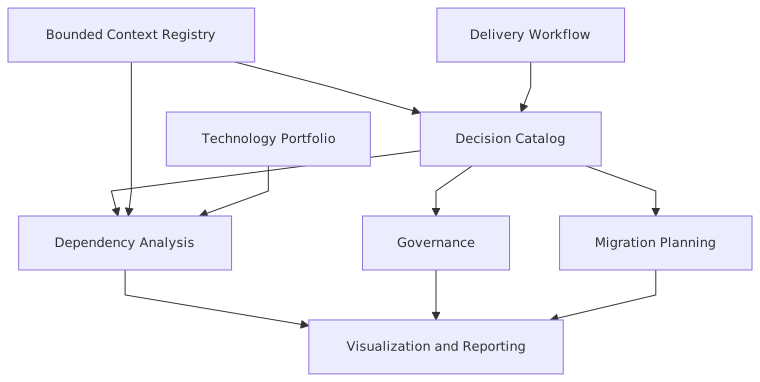
The Bounded Context Registry is worth calling out. Many enterprises do not have one, and they should. If decisions are not anchored to business capabilities and bounded contexts, technical linkages become detached from domain truth. That is how architecture governance turns into taxonomy theater.
Decision graph model
A dependency graph is not just an adjacency list. It needs meaningful edge semantics and state-aware analysis.
For example:
- A decision in Proposed state may inform another, but should not be treated as a hard dependency.
- A decision in Accepted state may block migration until implemented.
- A Deprecated decision may still be active in runtime, creating risk if successors are not fully adopted.
This suggests storing both design-time and runtime status. Enterprises often confuse them. “Accepted” does not mean “operational.” “Deprecated” does not mean “removed.” The gap between those states is where migration risk lives.
A useful model is to represent decisions, systems, domain concepts, and policies as separate node types. That allows richer traversals: a decision constrains a service, which emits an event, which is consumed by another bounded context, which introduces reconciliation obligations in finance.
That chain is the architecture.
Event-driven updates
If the organization already uses Kafka, there is a compelling pattern here: publish decision lifecycle events.
When an ADR changes state, update the graph asynchronously. When a bounded context registry changes ownership, recalculate semantic warnings. When a platform capability is introduced, identify decisions it enables or obsoletes.
This is one of the few places where event-driven architecture helps governance instead of merely decorating it. But be disciplined. You are not building a social network for ADRs. Use events because multiple consumers need timely updates: search indexing, compliance checks, migration dashboards, and dependency recalculation.
Migration Strategy
Most teams already have ADRs in markdown, wiki pages, or not at all. The migration path must be progressive. Big-bang replacement is exactly the kind of decision an ADR system should warn you against.
Start with a strangler approach.
Phase one: keep existing ADR authoring where it is. Add lightweight metadata headers that identify owner, bounded context, status, and explicit links. Parse those into a graph. Do not force every team into a new tool on day one.
Phase two: enrich relationship types. Replace vague “related” links with actual semantics. Add migration fields like target state, interim state, and dependency criticality.
Phase three: integrate with enterprise registries. Link ADRs to capabilities, systems, event streams, and platform products. This is where impact analysis becomes credible.
Phase four: add reconciliation views and operational state. For migration decisions involving dual writes, CDC, replicated read models, or financial data, track reconciliation dependencies explicitly. Architectural elegance ends where cash mismatches begin.
Phase five: use the graph to drive governance and change sequencing. By then, the system is no longer a passive repository. It becomes a planning instrument.
A migration roadmap might look like this:

The important thing is to preserve team autonomy while increasing semantic quality. If you begin with heavy central control, teams will comply just enough to pass review and no more. That creates a graph full of bureaucratic fiction.
Reconciliation during migration
This deserves explicit treatment because it is routinely underestimated.
A large share of architecture migration decisions create temporary inconsistency. During strangler migration, both old and new paths may process the same business facts. Orders may exist in both monolith and microservice stores. Customer profile updates may flow through APIs while legacy batch jobs still run nightly. Finance may reconcile transactions from a ledger that is no longer the sole system of record.
Your ADR system should model reconciliation as a first-class consequence, not an implementation footnote.
For example, a decision to emit domain events from the new Order service may depend on another decision establishing event idempotency, correlation IDs, and ledger reconciliation. Otherwise, the graph lies by omission. The migration is not just “extract service, publish events.” It is “extract service, maintain business integrity across a period of dual truth.”
That phrase—dual truth—is ugly. But it is honest.
Enterprise Example
Consider a global retailer modernizing its commerce platform.
The estate started with a monolithic order management system handling checkout, inventory allocation, payment capture, shipment orchestration, and returns. Over time, teams wanted to extract domains into microservices: Catalog, Pricing, Order, Payment, Fulfillment, and Customer Service. Kafka was selected as the event backbone. ADRs were created in several repos. Everyone felt mature.
Then things went sideways.
The Payment team adopted an event-first integration and published PaymentAuthorized. The Order team depended on this event to confirm orders. Meanwhile, the finance platform still treated the monolith’s settlement table as the source for reconciliation. A separate ADR allowed temporary dual write from the new Payment service back into the legacy schema. Another ADR introduced eventual consistency for inventory reservations. Yet another moved customer notifications to a separate service consuming Kafka events.
Individually, these were sensible decisions. Collectively, they formed a trap.
A failure in the dual-write bridge caused some payments to be authorized but not reflected in the legacy settlement table. Finance reports were incomplete. Customer notifications still fired because Kafka events were emitted. Support saw “paid” status in one system and “pending” in another. The issue was not a single bug. It was unmodeled decision dependency.
Had the ADR system represented the graph properly, architects would have seen:
- order confirmation depends on payment event integrity
- finance reconciliation depends on legacy settlement synchronization
- notification timing conflicts with incomplete reconciliation guarantees
- migration from legacy payment authority requires a cutover decision not yet accepted
- bounded contexts use “authorized” differently: payment authorization vs order approval
This is where DDD earns its keep. Shared words do not imply shared meaning. “Authorized” in finance and “authorized” in order handling were close enough to pass in meetings, but different enough to fail in production.
A graph view would have made this visible:
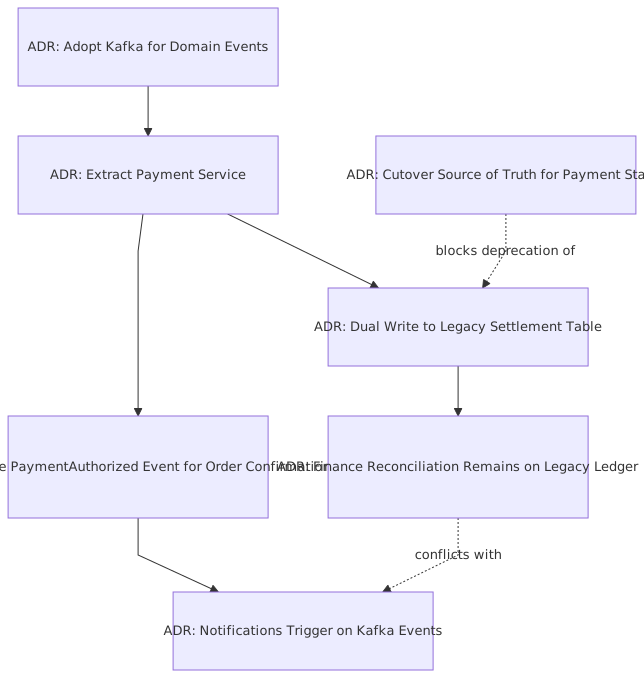
The point is not that diagrams save programs. They don’t. The point is that explicit dependency modeling makes hidden coupling discussable before it becomes expensive.
Operational Considerations
An ADR graph system is operational software. Treat it that way.
Data quality
Poor metadata is the fastest path to a useless graph. If teams cannot distinguish between depends on and related to, your analysis is noise. You need a small vocabulary, clear definitions, and automated checks.
Ownership
Every decision should have an owner. Better yet, a team owner and an accountable architect. Orphan decisions are architectural debt with a timestamp.
Review cadence
Accepted decisions should not become permanent by default. Add review dates. Some decisions age out because the context changed. Others should harden into standards. Time matters.
Integration with delivery workflows
Connect ADR changes to pull requests, system registries, and deployment metadata where possible. A decision that says a service will publish events should eventually link to actual topic ownership and schema artifacts. Without this, the system becomes a catalog of intentions.
Search and queryability
Graph systems live or die by the questions they can answer quickly. “Show all accepted decisions that block the retirement of the customer monolith.” “Show all migrations with unresolved reconciliation dependencies.” “Show decisions in the Pricing context that rely on Kafka exactly-once semantics.” These are practical enterprise questions, not vanity analytics.
Security and policy
Some decisions encode sensitive information: regulatory constraints, security posture, third-party risk. Access control matters. But do not use confidentiality as an excuse for fragmentation. Fragmented architecture memory is still memory loss.
Tradeoffs
Let’s be blunt: this approach costs more than storing markdown files in a repo.
You are adding metadata discipline, graph infrastructure, and semantic modeling overhead. Teams will need training. Architects will need to agree on relationship types. Governance may become visible in uncomfortable ways because hidden conflict is now easier to see.
That is the price.
The upside is substantial: better impact analysis, safer migration sequencing, improved architectural coherence, and a much more honest view of enterprise dependencies.
There are also tradeoffs in modeling depth.
If you model too little, the graph becomes decorative. If you model too much, the maintenance burden overwhelms teams. The sweet spot is not maximum detail. It is maximum usefulness per unit of effort.
Another tradeoff is centralization versus federation. A centrally managed ADR graph gives consistency. A federated model gives local ownership and better context fidelity. In most enterprises, the right answer is federated authoring with centrally defined semantics and validation.
And yes, there is a tradeoff in using Kafka or event-driven synchronization for ADR updates. You gain decoupling and near-real-time views, but you also introduce eventual consistency into a governance system. That is acceptable if consumers know what “current” means. Not acceptable if audit workflows require strict immediacy.
Failure Modes
The dangerous failure modes are not technical.
1. Relationship inflation
Teams create too many weak links. Everything is “related.” The graph becomes a hairball. If every node connects to everything else, you have learned nothing.
2. False semantic alignment
Different bounded contexts use the same term, and the ADR system treats them as equivalent. This is the silent killer. DDD should guard against it. If your graph does not respect context boundaries, it will amplify misunderstanding.
3. Governance theater
The system is populated to satisfy architecture review boards, not to help delivery. Records exist, but nobody trusts or uses them. This usually happens when the model is imposed top-down without operational value.
4. Stale migration state
The graph says a legacy dependency was removed, but production still relies on it. This is common in strangler migrations where transitional components linger. Distinguish design intent from runtime fact.
5. Missing reconciliation edges
This is especially painful in finance, inventory, and customer data domains. The system shows service extraction dependencies but omits the need for reconciliation between legacy and new sources. Everything looks cleaner than reality. Then month-end close arrives.
6. Tool-first implementation
Buying a graph visualization product does not solve this problem. If the underlying domain model is weak, you merely get prettier confusion.
When Not To Use
Not every environment needs a dependency-aware ADR graph.
If you are a small team with a modest codebase, short feedback loops, and mostly local decisions, a simple markdown ADR practice is probably enough. Do not build a graph because graphs are fashionable.
Likewise, if your architecture is stable, your migrations are minimal, and your domain boundaries are already well understood, the incremental value may be low. Some organizations need discipline more than tooling.
This approach is also a poor fit if the enterprise lacks even basic ownership clarity. If nobody knows which team owns customer identity, adding dependency modeling will not create alignment. It will document the absence of it.
And if leadership is looking for a governance weapon rather than a decision-support system, stop. This pattern only works when the goal is better reasoning, not centralized punishment.
Related Patterns
Several patterns sit naturally alongside dependency-aware ADR systems.
Architecture Decision Records
The foundation. Keep them lightweight in authoring, richer in structure than plain prose, and linked to consequences.
Bounded Context Mapping
Essential for semantic correctness. Decisions should attach to contexts, not float in an enterprise void.
Strangler Fig Migration
Critical for sequencing. Decision dependencies often mirror migration stages: wrap, extract, route, reconcile, retire.
Event Storming
Useful upstream when surfacing domain events and clarifying vocabulary before writing decisions. Good ADR graphs depend on good domain language.
Architecture Fitness Functions
Helpful for automating checks. If a decision mandates asynchronous integration or forbids direct database access, fitness functions can validate drift.
Knowledge Graphs
A technical enabler, not a goal. The graph model is useful because architecture dependencies are graph-shaped.
Outbox and CDC Patterns
Relevant where migration decisions depend on safe event publication and reconciliation. Particularly important in Kafka-backed modernization.
Summary
A mature ADR system should not be a filing cabinet. It should be a map of consequence.
The central idea is simple: architecture decisions form a dependency graph, and if you do not model that graph explicitly, you will eventually pay for it in migration mistakes, semantic drift, hidden coupling, and operational surprises.
The best implementation is grounded in domain-driven design. Decisions belong to bounded contexts. Terms need context-specific meaning. Migration states must account for transitional realities, especially reconciliation. Typed dependencies matter because “related” is not architecture.
Start small. Parse existing ADRs. Add structure. Introduce explicit dependencies. Anchor decisions to domain contexts and systems. Then use the graph to drive migration sequencing, governance, and impact analysis. Do it progressively, like a strangler migration, because even your architecture practice should respect evolutionary change.
A final opinion, because architecture deserves one: the enterprise does not suffer from lack of decisions. It suffers from lack of visible dependency between decisions. Once you make that dependency visible, the conversation changes. It becomes less about diagrams for approval and more about consequences you can actually manage.
That is the kind of architecture work worth doing.
Frequently Asked Questions
What is enterprise architecture?
Enterprise architecture aligns strategy, business processes, applications, and technology in a coherent model. It enables impact analysis, portfolio rationalisation, governance, and transformation planning across the organisation.
How does ArchiMate support architecture practice?
ArchiMate provides a standard language connecting strategy, business operations, applications, and technology. It enables traceability from strategic goals through capabilities and services to infrastructure — making architecture decisions explicit and reviewable.
What tools support enterprise architecture modeling?
The main tools are Sparx Enterprise Architect (ArchiMate, UML, BPMN, SysML), Archi (free, ArchiMate-only), and BiZZdesign. Sparx EA is the most feature-rich, supporting concurrent repositories, automation, scripting, and Jira integration.