⏱ 20 min read
Most deployment pipelines lie.
They claim to answer a simple question — is this service ready? — but what they really tell you is something much narrower: the code compiled, the unit tests passed, the container started, maybe a health endpoint returned 200 OK. That is not readiness. That is pulse detection. A pulse is useful, but nobody sane would discharge a patient from intensive care because the heart monitor still flickers.
In modern enterprises, especially those running microservices over Kafka-backed event flows, the distance between “process is alive” and “service is ready” is where outages breed. Teams deploy a new version, traffic is switched, and then the support channel lights up because the service can start but cannot serve. It is waiting on a schema migration. Its caches are cold. Its consumers lag behind. Its feature flags expect upstream data that has not yet arrived. Its domain invariants are technically uncompromised, yet the business capability is still unavailable.
That gap matters because the business does not buy containers, pods, or CPU. It buys outcomes. The order system must accept orders. The pricing service must calculate a valid price. The claims platform must reconcile downstream settlement events before finance notices a discrepancy. Readiness is therefore not an infrastructure fact. It is a domain statement.
That is the heart of service readiness gates in deployment pipelines: turning deployment from a technical ritual into a domain-aware admission process. A good readiness gate does not merely ask “did the service boot?” It asks “is this service safe to join the living system?”
This is an architectural concern, not a DevOps trick. And like most worthwhile architecture, it sits in the tension between elegance and scar tissue.
Context
Enterprises have spent the last decade decomposing systems into services, often with a combination of synchronous APIs, asynchronous messaging, and event streaming platforms such as Kafka. The intention was sound: reduce coupling, allow independent deployment, align software boundaries with business capabilities, and improve resilience. In practice, many organizations moved the coupling rather than removing it. event-driven architecture patterns
Instead of one monolith with obvious transactional boundaries, they now have twenty services with hidden semantic dependencies. The customer profile service technically deploys independently, but the onboarding journey still fails if identity verification events are not processed within tolerance. The product catalog can start fine, but until its search index catches up, the sales channel behaves as if inventory has disappeared. Payment authorization may be “up” while ledger posting is backlogged, creating a financial control problem long before a technical alert fires.
The deployment pipeline is usually the first place these contradictions surface. Teams want fast, automated releases. Platform teams want standardized controls. Risk and compliance functions want evidence that the change is safe. Operations wants fewer midnight surprises. Business stakeholders want confidence that a release will not break a revenue path three hops away.
Traditional pipeline gates address some of this: build quality, security scans, integration tests, environment promotion, and infrastructure health checks. Useful, necessary, but insufficient. They verify artifacts and environments more than they verify operational business capability.
This is why readiness gates matter. They are the explicit checks that determine whether a newly deployed service instance, version, or capability should be allowed to participate in production traffic or event consumption. In other words, they make readiness a first-class architectural decision.
And yes, this sounds obvious. It is not. Most systems still treat readiness as a liveness probe with better marketing.
Problem
The core problem is simple: deployment pipelines usually validate technical viability while production requires domain-operational readiness.
That mismatch creates several recurring pathologies:
- A service instance starts before all dependent resources are usable.
- A new version consumes Kafka events it cannot yet semantically interpret.
- Database migrations complete structurally but not functionally.
- A downstream service is reachable but not capable of honoring the business contract expected by the new release.
- Eventual consistency windows are ignored during cutover, causing duplicate work, gaps, or reconciliation debt.
- Canary releases are judged on HTTP error rates while silent business failures pass unnoticed.
A “healthy” deployment can therefore be profoundly unsafe.
This is especially dangerous in event-driven systems. In request-response systems, failure is often immediate and visible. In Kafka-based architectures, failure can be delayed, distributed, and subtle. A consumer may accept events but mis-handle a new field. An outbox publisher may run, but lag enough to violate domain timing assumptions. A service may process commands before its read model is rebuilt. The pipeline declares success; the business discovers drift three hours later during reconciliation.
The deeper issue is semantic. Readiness depends on the meaning of the service within its bounded context. If a shipping service is “ready” only when it can allocate carrier capacity, produce labels, and emit shipment-created events that downstream billing understands, then an endpoint check is theatrically inadequate.
A service is ready when it can uphold its obligations in the domain model. No earlier.
Forces
Architects designing readiness gates are balancing real forces, not textbook purity.
Speed versus assurance
Teams want rapid deployment. Every new gate introduces latency, complexity, and sometimes flakiness. But removing gates shifts risk into production, where the cost is higher and the blast radius wider.
Technical health versus domain correctness
Platform tooling makes infrastructure checks cheap. Domain checks are harder because they require business semantics, reference data, policy state, and cross-service assumptions. Yet domain correctness is what actually matters.
Local autonomy versus system coordination
Microservices promise independent deployment. Readiness gates often expose the uncomfortable truth that some changes still require choreography. Independence is bounded, not absolute.
Availability versus consistency
In event-driven systems, a service might be operational while still converging toward a consistent state. Gating too aggressively blocks throughput. Gating too loosely admits business errors. Architects must choose where inconsistency is acceptable and where it is not.
Generic platform controls versus bounded-context specificity
Platform teams prefer reusable gating frameworks. Domain teams need checks that reflect their context: customer eligibility, fraud rule activation, inventory snapshot freshness, settlement completeness. The architecture must support both.
False negatives versus false positives
A gate that blocks healthy releases becomes a tax on delivery. A gate that passes unhealthy ones is security theater for operations. Neither is acceptable.
These forces are why readiness gates should not be treated as a binary feature. They are a design discipline.
Solution
The practical solution is to model readiness as a layered set of gates, with each layer proving a different kind of fitness before the deployment advances or traffic is shifted.
At minimum, I recommend four layers:
- Technical readiness
The instance can start and operate at the infrastructure level: process alive, ports open, configuration loaded, secrets available, dependencies reachable within tolerance.
- Dependency readiness
The service can interact safely with required collaborators: database schema compatible, Kafka topics present, consumer groups stable, APIs reachable, reference data loaded, feature flag state valid.
- Domain readiness
The service can fulfill its business obligations: invariants enforceable, required projections current enough, policy engines synchronized, required upstream events processed, downstream contracts still honored.
- Release readiness
The new version can be admitted into live flow: canary metrics acceptable, semantic probes succeed, reconciliation tolerances acceptable, no incompatible consumers remain, rollback path intact.
This layered model matters because it avoids the common failure of treating readiness as a single probe. One probe collapses concerns that should remain separate. You want to know what kind of readiness has failed because the remediation differs. Broken secret injection is a platform issue. Stale fraud rules are a domain issue. Kafka lag after deployment may be a scaling or backpressure issue. A pipeline that cannot distinguish these will turn incident management into guesswork.
Here is a useful way to think about it:
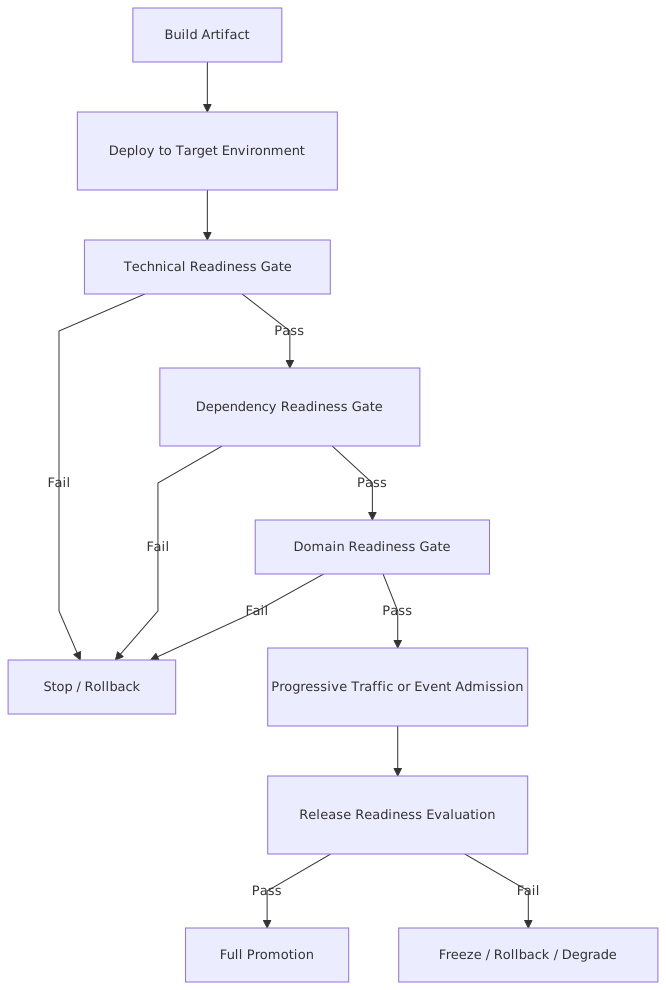
The point is not bureaucracy. The point is separating “can run” from “should run”.
Domain-driven design thinking
This is where domain-driven design earns its keep. Readiness gates should align to bounded contexts and domain responsibilities, not generic technical tiers alone.
If the service belongs to the Order Fulfillment bounded context, then readiness should be phrased in fulfillment language: allocation policy loaded, warehouse capacity snapshot fresh within SLA, shipment reservation topic healthy, downstream billing contract version supported.
If the service belongs to Customer Identity, readiness means something else entirely: sanctions list current, identity verification provider token valid, risk scoring model deployed, event replay complete to last durable offset.
The architecture gets cleaner when readiness is described using the ubiquitous language of the domain. Teams can then reason about risk in business terms, not just operational trivia.
A memorable rule: if the business owner cannot understand your readiness gate, you are probably gating the wrong thing.
Architecture
A robust readiness-gating architecture usually has five parts.
1. Probe providers inside each service
Each service exposes structured readiness evidence, not just a green/red status. This evidence should include:
- current software version
- schema compatibility state
- required dependency checks
- Kafka consumer lag and assignment state
- projection freshness or cache warmness
- domain-specific assertions
- feature flag state
- last successful reconciliation checkpoint
This is not the same as public health endpoints for load balancers. Treat it as deployment control telemetry.
2. A gate evaluation policy engine
The pipeline should not hardcode every check. It should invoke a policy layer that knows what gates apply to this service, in this environment, for this type of change.
For example:
- minor UI-only change: skip some domain gates
- event schema evolution: require compatibility and replay checks
- database migration: require dual-read or backward compatibility verification
- new consumer release: require downstream reconciliation thresholds
This policy engine can be implemented through CI/CD orchestration, a deployment controller, or a release management service. The important thing is explicit policy, not tribal memory.
3. Progressive admission controller
Readiness should determine not just whether code deploys, but how traffic or event flow is admitted.
For request/response services, this means:
- no traffic
- shadow traffic
- canary traffic
- partial production traffic
- full production traffic
For Kafka consumers, this means:
- deployed but not consuming
- consuming from a shadow topic
- consuming with rate limits
- consuming one partition subset or one consumer instance
- full participation in consumer group
This distinction matters. Event-driven systems often need admission control more than “startup checks”.
4. Reconciliation and observability loop
Architects often miss this. A service can pass all up-front gates and still behave incorrectly under real event flow. Therefore readiness must continue as post-admission observation, measured against business outcomes.
Examples:
- count of orders created versus payment-authorized events
- shipment-created events versus invoice-issued events
- account update commands versus audit ledger entries
- claims accepted versus settlement records posted
This is reconciliation: proving that the deployed service has not just stayed alive, but preserved domain integrity across asynchronous boundaries.
5. Rollback and degradation paths
A readiness gate without a credible rollback path is just optimism with YAML.
If the release fails domain or reconciliation checks after limited admission, the architecture should support:
- route traffic back to prior version
- pause Kafka consumption
- isolate bad consumers
- switch feature flags off
- drain requests
- replay from known offsets where safe
- trigger compensating actions where replay is unsafe
Here is a more detailed view:
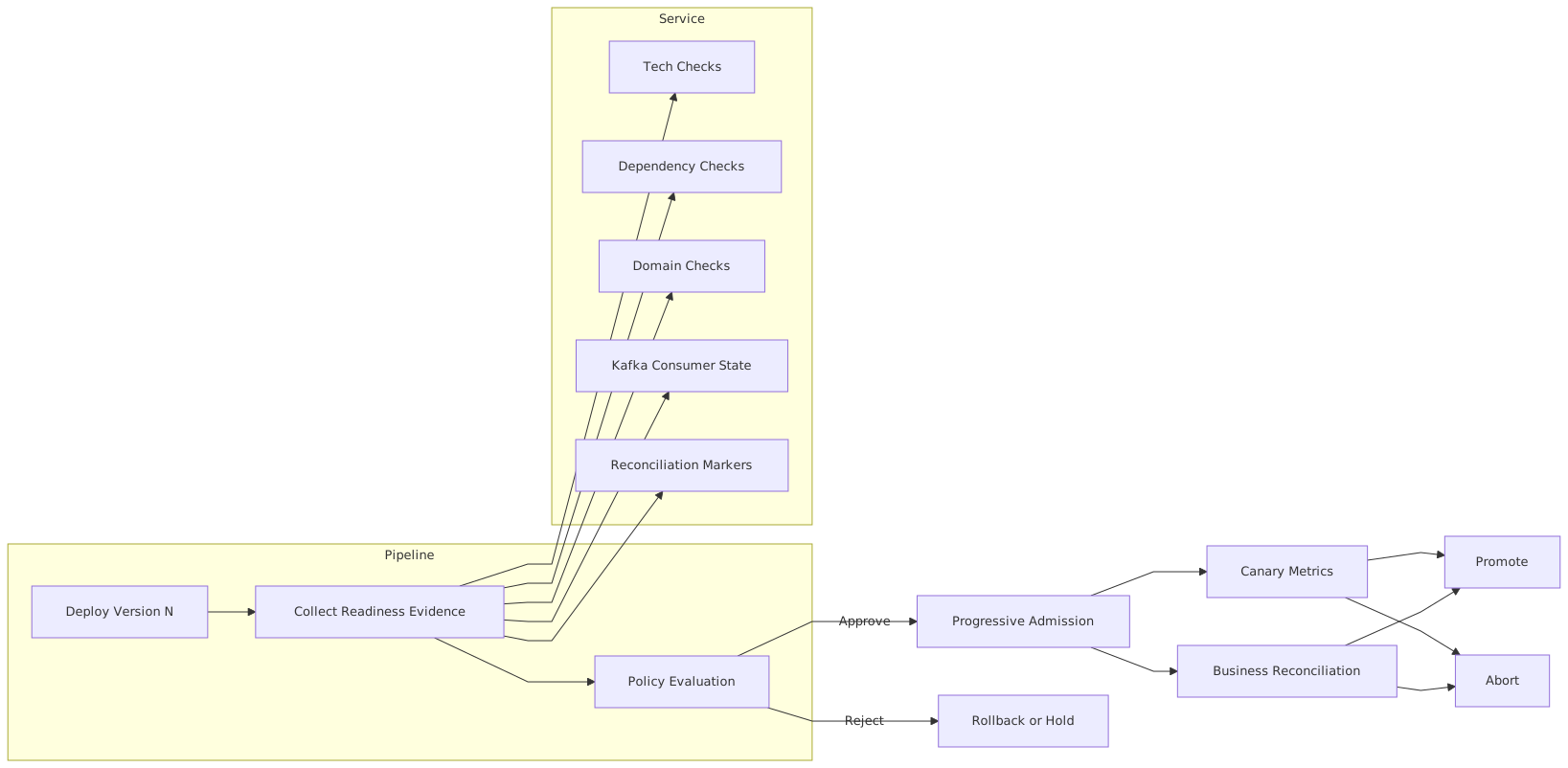
The cleanest architectures treat readiness as evidence-based governance, not a yes/no endpoint. EA governance checklist
Migration Strategy
You do not introduce sophisticated readiness gates into a large enterprise by decree. If you try, the teams will either revolt or fake compliance. Usually both.
This is a classic progressive strangler migration problem. The existing deployment model is already embedded in toolchains, runbooks, release calendars, and team habits. You need to evolve it incrementally.
Phase 1: distinguish liveness from readiness
The first move is embarrassingly basic and still frequently missing. Separate liveness checks, startup checks, and readiness checks. Do not overload one endpoint to serve all three. This gives teams a conceptual foothold.
Phase 2: add dependency-aware gates
Introduce checks for essential dependencies:
- schema compatibility
- secrets and config integrity
- API dependency viability
- Kafka topic and ACL verification
- consumer group stabilization
Keep these mostly technical, because they are easier to automate and less politically contentious.
Phase 3: add domain-specific assertions
Once teams trust the mechanism, move into business semantics. This is where bounded contexts become useful. Have each domain team define 3-5 assertions that genuinely indicate business readiness.
For example:
- Pricing: reference rate table loaded and current
- Orders: inventory snapshot freshness under threshold
- Payments: ledger writer available and idempotency store warm
- Customer: risk decision engine synchronized to approved rule version
Phase 4: progressive admission for traffic and event consumption
At this stage, alter deployment so that new service versions do not immediately receive full load. Introduce canaries, partition-limited consumers, or shadow reads. This is often where Kafka consumers need more thought than HTTP services.
Phase 5: reconciliation-based promotion
Promotion to full production should require not just system metrics but business reconciliation signals. If events in and outcomes out do not align within expected tolerances, the release should pause or roll back.
Phase 6: retire brittle release approvals
Only once the gates are trustworthy should you remove manual approvals that merely duplicate fear. Good automation replaces superstition.
A strangler approach might look like this:
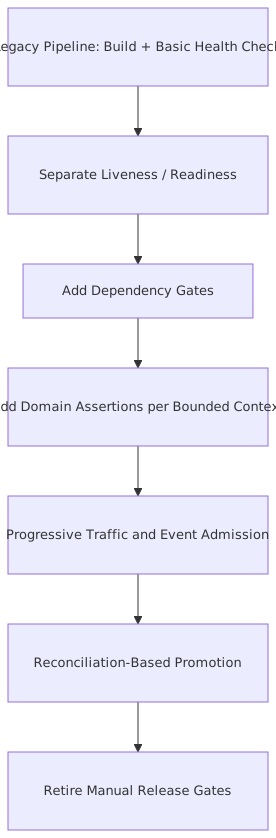
This migration is as much organizational as technical. Platform teams provide the mechanism; domain teams provide semantics; operations provides failure feedback; architecture provides the language and boundaries.
Backward compatibility first
During migration, prioritize backward-compatible release designs:
- schema evolution with additive changes
- tolerant readers
- dual writes only where unavoidable
- idempotent consumers
- feature flags around new semantics
- outbox pattern for event consistency
Why? Because readiness gates are not there to rescue reckless coupling. They work best when the underlying release design already respects compatibility. A bad change with a fancy gate is still a bad change.
Reconciliation during migration
When moving from weak gating to domain-aware gating, expect inconsistencies to surface that were always there but invisible. This is not the gate causing failures; it is the gate finally exposing them.
That is a good thing. Painful, but good.
Enterprise Example
Consider a global insurer modernizing its claims platform.
The platform had been split into microservices: microservices architecture diagrams
- Claim Intake
- Policy Validation
- Fraud Assessment
- Payment Authorization
- Ledger Posting
- Customer Notification
Kafka connected the backbone. A claim arrived, was validated, enriched, fraud-scored, approved, paid, posted to the ledger, and finally notified to the customer. Each service had health checks. Deployments were automated. On paper, it looked modern.
In practice, releases to Payment Authorization caused recurring incidents. The service deployed successfully, consumed claim-approved events, and returned valid payment decisions. Yet finance repeatedly found posting discrepancies later in the day. The culprit was not obvious.
The new release had introduced a change in settlement classification. The service itself was “healthy.” But Ledger Posting had not yet been updated to interpret the new classification, and its tolerant reader was not as tolerant as advertised. It accepted the event but defaulted a field, creating ledger entries that were technically processable and financially wrong. No HTTP error. No pod crash. No immediate alarm. Just silent accounting damage.
The insurer fixed this by introducing service readiness gates tied to domain semantics.
For Payment Authorization, readiness now required:
- settlement classification rules loaded for the target release
- downstream ledger consumer compatibility confirmed
- Kafka contract schema validated against approved version set
- canary event flow processed with reconciliation to expected ledger outputs
- claim-approved to ledger-posted ratio within tolerance during limited admission
They also changed admission behavior:
- deploy new version
- keep consumer paused
- validate dependency and domain gates
- allow one canary consumer instance on a subset of partitions
- reconcile payment and ledger events for fifteen minutes
- then scale into full consumer group
This slowed deployment by about twenty minutes. It eliminated a class of defects that previously took half a day to detect and two days to unwind.
That is a trade worth making.
The deeper lesson was domain-driven: the readiness of Payment Authorization was not complete until the financial meaning of its output could be safely absorbed by the Ledger Posting context. The software boundary did not erase the domain dependency. It merely made it easier to ignore.
Operational Considerations
A few operational realities separate useful readiness gates from expensive decoration.
Keep the signal small and explicit
Do not create a giant composite endpoint that returns 400 lines of nested JSON and requires a detective to interpret. Expose a concise readiness contract with named checks, reason codes, timestamps, and severity. Operators need clarity under pressure.
Time-box expensive checks
Some domain checks are slow: replay verification, cache warm-up, rule synchronization, projection rebuilds. The gate should handle timeouts, retries, and clear degraded states. Otherwise the pipeline becomes hostage to long-running startup rituals.
Version gate definitions
The readiness model itself evolves. A service version may require new checks. Store gate definitions as versioned policy artifacts. Treat them like code.
Distinguish hard gates from warning gates
Not everything should block release. Some conditions should warn, observe, and continue under controlled admission. The art is knowing which is which.
For example:
- missing secrets: hard fail
- unsupported schema version: hard fail
- cache warm-up incomplete but fallback path available: warning
- reconciliation drift above financial threshold: hard fail
- slightly elevated Kafka lag during canary: warning with watch
Measure gate quality
You should track:
- false-positive gate failures
- false-negative promotions leading to incidents
- mean deployment delay caused by gates
- incidents prevented or detected earlier
- classes of change most associated with failures
If you do not measure the gates, they will metastasize into ritual.
Avoid over-centralization
A central platform can provide the framework, but readiness semantics belong with the domain team. The people who understand claim settlement or order allocation should define the critical assertions. Platform teams should not invent business truth from afar.
Tradeoffs
Let us be blunt: readiness gates are not free.
They increase deployment complexity. They require services to expose richer internal state. They force teams to define semantics they may have avoided documenting. They surface hidden coupling and therefore trigger uncomfortable governance conversations. They can slow releases. ArchiMate for governance
Good.
Those are not necessarily defects. They are the price of honesty.
Still, there are real tradeoffs.
Benefits
- fewer unsafe promotions
- earlier detection of semantic incompatibilities
- safer canaries in event-driven systems
- better rollback decisions
- improved auditability and release confidence
- explicit domain knowledge in operational controls
Costs
- slower pipelines
- more instrumentation and policy code
- more sophisticated observability requirements
- possible gate brittleness
- cultural resistance from teams used to simplistic health checks
The architectural judgment lies in choosing where the added assurance is worth the friction. Core revenue flows, financial postings, customer identity, regulated decisioning — these are obvious candidates. A low-risk internal content rendering service may not deserve domain-heavy readiness gates.
This is why architecture remains a matter of taste informed by consequence.
Failure Modes
Readiness gates fail too. Usually in predictable ways.
1. Health-check theater
The organization renames /health to /readiness and congratulates itself. Nothing materially changes. The same shallow checks remain.
2. Gate sprawl
Every outage leads to “add another gate.” Soon the pipeline contains fifteen checks nobody trusts, half of them flaky, and engineers bypass them during urgent releases.
3. Domain ignorance in platform code
Platform teams build generic gates that say nothing meaningful about business capability. The mechanism works; the semantics do not.
4. Coupling hidden as readiness
A service requires half the estate to be “ready” before it can deploy. This is often a sign of poor bounded contexts or bad release design, not a need for more gates.
5. No rollback semantics for event systems
Teams can roll back stateless APIs but have no plan for Kafka consumer offsets, duplicate events, or compensating actions. The gate catches a problem after some messages were processed, and rollback makes it worse.
6. Reconciliation blind spot
The deployment passes all up-front checks but no post-admission reconciliation exists, so semantic drift remains invisible.
7. Permanently red gates
Checks depend on unstable external systems or stale test data. Teams stop believing the gates and eventually route around them.
A readiness gate should increase confidence. If it becomes a recurring source of noise, it will be bypassed in the first real emergency — precisely when you most need it.
When Not To Use
Not every service needs elaborate readiness gating.
Do not over-engineer this pattern for:
- trivial internal utilities with low blast radius
- stateless frontends where runtime readiness is dominated by infrastructure
- batch workloads not admitted into live interactive traffic
- early prototypes where architectural discovery matters more than operational precision
- tightly controlled monolith deployments where the monolith already guarantees atomic consistency inside one process
Also, do not use readiness gates as a substitute for good release engineering. If your schema changes are backward-incompatible, your consumers are not idempotent, and your contracts are unmanaged, the answer is not an ever-growing wall of gates. The answer is to fix the design.
A gate is a guardrail, not a miracle.
Related Patterns
Service readiness gates sit comfortably alongside several other patterns:
- Blue-green deployment: readiness gates determine when the green environment is genuinely promotable.
- Canary release: gates control progressive exposure based on both technical and domain evidence.
- Feature toggles: useful for decoupling code deployment from capability admission.
- Strangler fig migration: readiness gates help old and new paths coexist safely during transition.
- Outbox pattern: improves event publication consistency, making readiness and reconciliation more reliable.
- Saga orchestration/choreography: readiness should account for whether downstream steps can safely participate.
- Consumer-driven contracts: strong complement for dependency and semantic compatibility checks.
- Bulkheads and circuit breakers: runtime resilience mechanisms; readiness gates are pre-admission controls.
- Reconciliation jobs: essential in asynchronous systems to verify end-to-end correctness after release.
These patterns reinforce one another. None is sufficient alone.
Summary
A service is not ready because it is running. It is ready because it can safely participate in the domain.
That distinction sounds small. It is not. It is the difference between pipelines that certify software artifacts and pipelines that protect business capability.
The best readiness gates are layered. They start with technical reality, extend through dependency verification, and culminate in domain-aware assertions. In microservices and Kafka-based systems, they govern not just startup but progressive admission of traffic and event consumption. They do not stop at deployment; they continue through reconciliation, because eventual consistency is where hidden damage likes to hide.
From a domain-driven design perspective, readiness belongs inside bounded contexts and should be expressed in the ubiquitous language of the business. From a migration perspective, introduce it progressively, using a strangler approach: separate liveness from readiness, add dependency gates, add domain semantics, then introduce canary and reconciliation-based promotion. From an enterprise perspective, target the pattern where blast radius is high and semantics matter — payments, claims, ledgers, pricing, identity.
And always remember the uncomfortable truth: readiness gates expose coupling you already had. They do not create it.
That is why they are valuable.
Architecture should make risk visible before production does. Service readiness gates, done properly, are one of the rare deployment controls that actually tell the truth.
Frequently Asked Questions
What is enterprise architecture?
Enterprise architecture aligns strategy, business processes, applications, and technology in a coherent model. It enables impact analysis, portfolio rationalisation, governance, and transformation planning across the organisation.
How does ArchiMate support architecture practice?
ArchiMate provides a standard language connecting strategy, business operations, applications, and technology. It enables traceability from strategic goals through capabilities and services to infrastructure — making architecture decisions explicit and reviewable.
What tools support enterprise architecture modeling?
The main tools are Sparx Enterprise Architect (ArchiMate, UML, BPMN, SysML), Archi (free, ArchiMate-only), and BiZZdesign. Sparx EA is the most feature-rich, supporting concurrent repositories, automation, scripting, and Jira integration.