⏱ 5 min read
From Fragmentation to Coherence: Building Enterprise Architecture Capability in the French Railway Sector
When you enter the headquarters of a major French railway infrastructure organisation, you immediately feel the weight of responsibility.

Large operational maps display national rail corridors. Real-time dashboards show train movements across regions. Incident coordination rooms stand ready to respond to signalling failures, weather disruptions, infrastructure degradation, or cybersecurity alerts. Behind every screen lies a chain of systems. Behind every system lies a network. Behind every network lies physical infrastructure that keeps a nation moving.
Railways are not just transportation systems. They are living, breathing ecosystems of business processes, digital platforms, operational technology, safety protocols, and strategic programmes.
And in such ecosystems, complexity does not announce itself loudly. It accumulates silently.
It was in this environment that we delivered a large-scale enterprise architecture capability programme for one of France's national railway infrastructure operators. ArchiMate capability map example
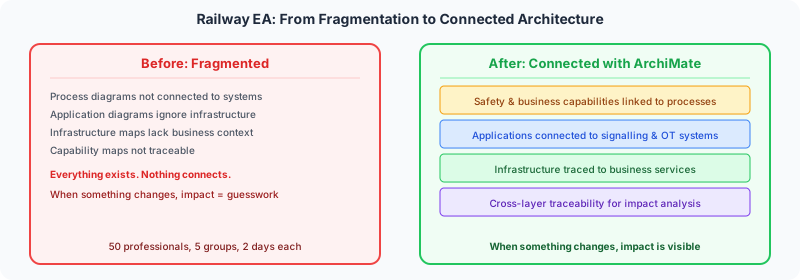
Fifty professionals. Five groups. Two intensive days per group.
But what we were building was not modelling skill.
We were building architectural coherence.
The Problem Nobody Sees Until It's Too Late
Large infrastructure organisations rarely suffer from lack of intelligence.
They suffer from fragmentation.
Different teams model in different ways. Transformation programmes create isolated views. Application landscapes grow organically. Infrastructure diagrams exist --- but rarely connect to business context. Data models live in separate streams.
Over time, the organisation develops:
- Process diagrams that are not connected to systems
- Application diagrams that ignore infrastructure dependencies
- Infrastructure maps that lack business context
- Capability maps that are not traceable to implementation
Everything exists.
But nothing connects.
In a railway environment, that fragmentation is dangerous.
Because when something changes --- a system upgrade, a supplier replacement, a cybersecurity vulnerability, a signalling modernisation initiative --- the real question is:
What else is affected?
Without connected architecture, the answer is guesswork.
Resetting the Foundation: What Architecture Means in a Railway Context
Enterprise architecture in a railway infrastructure organisation is not the same as enterprise architecture in a retail company. Sparx EA best practices
Railway architecture must account for:
- Safety-critical systems
- Regulatory compliance frameworks
- Long asset lifecycles (often 20--40 years)
- Heavy operational technology integration
- Multi-vendor ecosystems
- National infrastructure resilience obligations
- Public accountability
In such a context, architecture becomes:
- A risk management instrument
- A transformation alignment mechanism
- A governance backbone
- A communication bridge between engineering and IT
Architecture is not about documentation.
It is about operational stewardship.
The Core Breakthrough: Model vs Diagram
The most transformative idea introduced during the programme was simple:
The model is the truth. The diagram is a view.
Instead of drawing isolated diagrams, participants began thinking in terms of:
- Reusable elements
- Shared relationships
- Central repository integrity
- Traceable dependencies
A diagram can lie.
A connected model cannot.
Capability Mapping: Strategy Made Visible
We constructed a capability model aligned to strategic objectives such as:
- Digital rail operations
- Infrastructure resilience
- Predictive maintenance
- Cybersecurity hardening
- Cloud transformation
- Data-driven optimisation
Capabilities were then linked to:
- Business processes
- Applications
- Infrastructure
Strategic priorities became traceable to implementation.
Architecture moved from operational modelling to boardroom visibility.
OT/IT Convergence: The Hidden Complexity
Railway environments are deeply hybrid.
Operational Technology (OT) includes:
- Signalling systems
- Trackside monitoring
- Communication networks
- Safety-critical controllers
Information Technology (IT) includes:
- ERP systems
- Data platforms
- Integration hubs
- Reporting tools
Digital transformation is collapsing that separation.
Architecture provides the map of that convergence.
Impact Analysis: Architecture as Risk Radar
We built full traceability chains:
Strategy → Capability → Business process → Application → Infrastructure
We stress-tested the model with scenarios including:
- Legacy signalling replacement
- Cloud migration
- Vendor contract termination
- Security remediation
Architecture became predictive.
It allowed the organisation to simulate change before implementing it.
Governance at Scale: Preventing Model Decay
Training 50 professionals required governance foundations: EA governance checklist
- Repository domain segmentation
- Package ownership definitions
- Naming standards aligned to railway terminology
- Review and validation workflows
- Duplication prevention policies
Without governance, entropy wins. ArchiMate modeling standards
With governance, architecture becomes corporate memory.
Final Reflection: Architecture as Stewardship
Railway infrastructure is national infrastructure.
It demands:
- Transparency
- Resilience
- Strategic foresight
- Accountability
Enterprise architecture, when properly implemented, provides: free Sparx EA maturity assessment
- Systemic visibility
- Change simulation capability
- Cross-domain alignment
- Governance structure
- When architecture changes how people see complexity,
- It changes how they manage it.
- And in a national railway infrastructure organisation,
- That shift matters far beyond diagrams.
For expert guidance on enterprise architecture, explore our enterprise architecture consulting, architecture capability development, and Sparx EA consulting. Get in touch.
Frequently Asked Questions
What is a capability map in enterprise architecture?
A capability map is a structured view of what a business must be able to do — independent of how it is currently organised or which applications support it. Capabilities are grouped by domain and linked to strategic goals, helping architects prioritise investment and identify gaps.
How do capabilities relate to applications in ArchiMate?
In ArchiMate, Application Components realise Business Capabilities through Realisation relationships. This traceability shows which systems support which capabilities, enabling portfolio analysis, rationalisation decisions, and investment planning linked directly to business outcomes.
What is capability-based planning?
Capability-based planning is a strategic approach where investment decisions are driven by the capabilities the organisation needs to develop or improve, rather than by project requests. It aligns IT investment to business strategy by making the capability gap explicit and measurable.