⏱ 22 min read
Most enterprise architecture frameworks are over-respected and under-used.
That’s the uncomfortable truth.
Ask ten architects what framework they use and you’ll hear the same polished answers: TOGAF for structure, Zachman for taxonomy, ArchiMate for modeling, maybe SAFe for alignment. Then you sit in on real delivery work—an IAM rollout, a Kafka platform redesign, a cloud migration for a bank—and almost nobody is “doing the framework” in the way the certification books pretend. They’re borrowing pieces, improvising, translating between business and engineering, and trying not to drown in governance theater.
So let’s say it plainly: frameworks matter, but not in the way framework evangelists think they do.
A good architecture framework helps teams make better decisions repeatedly. A bad one becomes a vocabulary tax. The best architects I know use frameworks like scaffolding, not religion. They know when to apply structure, when to ignore it, and when a two-page decision paper beats a 60-slide capability map.
Simple answer first: what are architecture frameworks?
An architecture framework is just a structured way to describe, design, govern, and communicate enterprise architecture.
That’s the SEO-friendly version, and it’s true.
Frameworks typically help with some combination of:
- defining business, application, data, and technology architecture
- creating common artifacts and views
- standardizing decision-making
- aligning architecture with strategy
- governing change across complex organizations
Some frameworks are broad and process-heavy. Some are mostly classification systems. Some are modeling languages more than true frameworks. Some are useful only if your enterprise has enough maturity to benefit from them.
And that last point matters a lot. A framework that works in a global bank with regulated workloads, IAM sprawl, hundreds of APIs, and Kafka clusters across regions may be absurdly heavy for a mid-sized company trying to modernize one product line.
The real question is not “Which framework is best?”
It’s “Which framework gives this organization just enough structure to make better decisions without slowing delivery to a crawl?”
That’s a different conversation.
Why architects keep reaching for frameworks anyway
Because enterprise architecture is messy.
You’re trying to connect strategy, risk, funding, platforms, delivery constraints, regulatory obligations, security, and the brutal reality of legacy systems. In a bank, for example, you may be dealing with:
- 20+ years of core systems
- fragmented IAM across workforce, customer, and partner identities
- Kafka used as both integration backbone and event distribution layer
- cloud adoption under strict control frameworks
- product teams moving fast while risk and compliance move... less fast
Without some structure, architecture becomes personality-driven. Whoever talks loudest wins. Whatever tool is fashionable gets adopted. Every team invents its own standards. Nobody can explain dependencies. Costs drift. Security gaps multiply. Integration becomes accidental.
Frameworks exist because chaos is expensive.
But—and this is where I get opinionated—the industry often confuses having a framework with being architecturally competent. Those are not the same thing. A company can produce beautiful TOGAF artifacts and still make terrible platform decisions. I’ve seen it.
The major architecture frameworks worth comparing
There are dozens, but in real enterprise work the conversation usually centers around these:
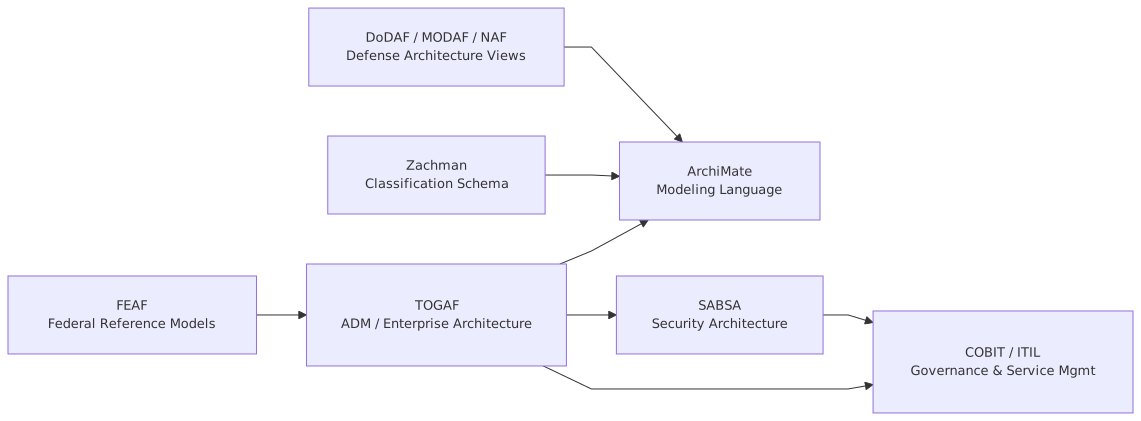
- TOGAF
- Zachman Framework
- ArchiMate
- FEAF
- SABSA
- SAFe (not an enterprise architecture framework in the classic sense, but it influences architecture heavily)
- Gartner-style enterprise architecture practices (more operating model than formal framework)
I’ll focus on the ones architects actually encounter in large organizations, and I’ll be blunt about where they help and where they become baggage.
Quick comparison table
Here’s the practical view, not the brochure view.
That table is already more useful than a lot of framework training.
TOGAF: still the default, still misunderstood
TOGAF remains the corporate default because it gives organizations something they crave: a recognizable process.
Its Architecture Development Method, or ADM, provides a repeatable cycle for moving from business vision through architecture definition, opportunities, migration planning, and governance. On paper, that’s exactly what enterprises need.
And to be fair, TOGAF does solve real problems: EA governance checklist
- it creates a shared vocabulary
- it helps architecture teams define scope and deliverables
- it supports governance discussions
- it gives large organizations a way to standardize architecture practice across domains
That’s the good part.
The bad part is what usually happens next: people mistake the framework for the work.
They start producing architecture artifacts because TOGAF implies they should exist, not because they help a decision. Capability maps appear. Principles get written. Baseline and target states are documented in painful detail. Repositories fill up. Delivery teams ignore most of it because it doesn’t answer the question in front of them. ArchiMate for governance
Where TOGAF works in real life
TOGAF works best when you use it selectively:
- business architecture to frame strategic change
- transition architectures for multi-year modernization
- governance checkpoints for high-risk decisions
- architecture principles tied to actual investment choices
For example, in a bank moving customer identity services to the cloud, TOGAF can help structure the transition:
- define the business drivers: digital onboarding, fraud reduction, regulatory compliance
- assess current IAM fragmentation across channels
- define target architecture: centralized identity platform, policy-based access, event-driven integration
- create migration roadmaps: phased application onboarding, token modernization, legacy retirement
- govern exceptions and sequencing
That’s useful.
What is not useful is forcing every team involved—mobile banking, fraud, branch systems, customer servicing, Kafka platform, cloud engineering—to wait for architecture perfection before building.
My opinion on TOGAF
TOGAF is not bad. It’s just too easy to misuse.
If your architecture team lacks judgment, TOGAF amplifies bureaucracy. If your team has judgment, TOGAF gives enough structure to work at enterprise scale. So the framework isn’t really the deciding factor. The architects are.
Contrarian thought: many organizations would get more value from using 20% of TOGAF properly than from “adopting TOGAF” fully.
Zachman: brilliant taxonomy, terrible crutch
Zachman gets praised a lot by architects who like intellectual structure, and I understand why. It’s elegant. It forces you to think about different perspectives and different interrogatives: what, how, where, who, when, why. It’s useful for checking whether you’re missing something.

But Zachman is a schema, not a method.
That distinction matters. A lot.
If TOGAF tells you roughly how to move through architecture work, Zachman tells you how to classify what you know. That makes it valuable for completeness and communication, but weak as a practical operating framework for delivery.
Where Zachman helps
Zachman is good when an enterprise has architecture artifacts scattered everywhere and no coherent way to organize them. It’s also good in regulated environments where different stakeholders need different views of the same architecture.
Say you’re reviewing a bank’s payments modernization initiative:
- executives care about why and outcomes
- operations care about who and where
- engineers care about how and what
- risk teams care about control points and timing
Zachman gives you a disciplined way to ask: do we have enough understanding across these dimensions, or are we only looking at the solution from one angle?
That’s useful.
Where Zachman frustrates real architects
It doesn’t tell you how to make trade-offs.
It doesn’t tell you how to govern migration.
It doesn’t tell you how to run architecture in an agile portfolio.
It doesn’t help much when a product team asks, “Can we use managed Kafka in cloud for this regulated event stream, and what controls do we need?”
In other words, Zachman helps organize thought. It doesn’t replace architecture leadership.
My opinion on Zachman
Use it as a mental model or artifact map. Don’t pretend it’s a complete enterprise architecture operating approach. A lot of architects over-romanticize it because it feels rigorous. It is rigorous. It’s just not sufficient.
ArchiMate: great language, abused daily
ArchiMate is not exactly a framework in the same sense as TOGAF, but it’s often paired with it, and for good reason. It gives architects a formal visual language to model business, application, data, and technology relationships.
When used well, ArchiMate is excellent. ArchiMate layers explained
It can show:
- how a business capability depends on applications
- how applications consume data and services
- where technology platforms support those applications
- how change initiatives affect the whole stack
This is incredibly helpful in enterprise settings where architecture communication is half the battle.
Real-world use case: Kafka and cloud in banking
Imagine a bank standardizing on Kafka as its event backbone. Different teams are publishing customer events, payment events, fraud alerts, and IAM-related security events. Some workloads remain on-prem. Some move to cloud. There are concerns about data residency, encryption, identity federation, topic ownership, and operational support boundaries.
A decent ArchiMate model can show:
- business processes generating or consuming events
- application services publishing to Kafka
- data objects and event domains
- technology nodes and cloud/on-prem deployment patterns
- IAM control points for service identities and access policies
That model helps everyone—from security to platform engineering to portfolio management—see the same system.
The problem
Most ArchiMate diagrams are terrible.
Too many symbols. Too many relationships. Too much ambition. Diagrams built for repository completeness rather than human comprehension. The result is architecture wallpaper: technically correct, practically unreadable.
That’s not ArchiMate’s fault. It’s an architect problem.
My opinion on ArchiMate
Use it sparingly and intentionally. One clear diagram that explains dependency and impact is worth more than twenty full-stack monstrosities. If your stakeholders need a legend and 30 minutes of coaching before they can read your model, you’ve already lost.
FEAF: better than people think, but context matters
The Federal Enterprise Architecture Framework, or FEAF, is mostly associated with government. Because of that, private-sector architects often dismiss it too quickly.
That’s a mistake.
FEAF is actually useful in environments where standardization, portfolio visibility, and cross-agency—or cross-division—coordination matter more than speed at the team level. Which sounds a lot like some large banks, insurers, and public infrastructure firms, frankly.
Where FEAF fits
If you have:
- many business units
- duplicated capabilities
- regulatory scrutiny
- long investment cycles
- pressure for portfolio rationalization
then FEAF-style thinking can be very practical.
It encourages disciplined views of performance, business, service, data, application, and infrastructure. That’s not glamorous, but it is often exactly what sprawling enterprises need.
Limitation
FEAF is not naturally lightweight. If your organization is already drowning in governance, FEAF won’t save you. It may make you feel organized while delivery gets slower.
My opinion on FEAF
It’s more relevant than its reputation suggests, especially in highly regulated sectors. But it needs strong tailoring. If you apply it mechanically, you’ll build an architecture bureaucracy with federal-level paperwork and none of the federal budget.
SABSA: the framework security architects should take more seriously
SABSA is one of those frameworks people mention respectfully and then fail to use enough. It’s a business-driven enterprise security architecture framework, and when you’re dealing with IAM, zero trust, cloud controls, and identity-centric risk, it becomes very powerful.
This is especially true in financial services.
Why SABSA matters in real architecture work
Security architecture often gets bolted on too late. Architects define target application and platform patterns first, then ask security to review. That sequence is backwards for many enterprise changes.
Take an IAM transformation in a bank:
- customer identity is fragmented across online banking, lending, and wealth systems
- workforce identity is managed separately
- privileged access is inconsistent
- cloud platforms use federated identity, but legacy apps still rely on local authorization models
- Kafka access is controlled differently in each environment
A SABSA approach helps trace from business attributes and risk drivers down to actual security services and controls:
- what business trust model do we need?
- what identity assurance levels are required?
- what access decisions must be centralized?
- what audit evidence is necessary?
- what security services should be shared across cloud and on-prem workloads?
That’s architecture, not just security review.
My opinion on SABSA
If your enterprise architecture team ignores SABSA in favor of generic “security principles,” they are probably under-architecting risk. Especially around IAM. And IAM is where a lot of enterprise architecture either becomes real or gets exposed as theater.
SAFe: not really an EA framework, but impossible to ignore
Purists will object, but SAFe shapes architecture in many enterprises whether we like it or not. If your organization runs Agile Release Trains, portfolio planning, and value streams under SAFe, the architecture function is already operating in that gravity field.
So yes, it belongs in the comparison.
What SAFe gets right
SAFe recognizes that architecture cannot live in a separate ivory tower forever. It tries to connect architecture with planning, roadmaps, enablers, and delivery cadence. That’s a real improvement over old-school architecture review boards that show up after everything important has already been decided.
What SAFe gets wrong
It often turns architecture into process choreography.
Architects get pulled into PI planning, capability decomposition, enabler wrangling, and alignment rituals. Sometimes that’s productive. Sometimes it’s a giant machine for creating the appearance of coordination while avoiding hard technical decisions.
Also, SAFe can encourage the fiction that all architectural work fits neatly into incremental planning horizons. It doesn’t. Some enterprise decisions—identity consolidation, cloud landing zone redesign, Kafka multi-region resilience, data sovereignty patterns—need long-range architecture thinking and non-trivial governance.
My opinion on SAFe
If your enterprise already runs SAFe, fight the urge to become a SAFe administrator with architecture in the background. Stay focused on actual system-level trade-offs. Architecture should support delivery, yes. It should not disappear into delivery mechanics.
Gartner-style EA: closer to reality than most formal frameworks
This is less a formal framework and more an operating philosophy. Gartner-influenced enterprise architecture tends to emphasize business outcomes, product/platform thinking, technology strategy, and pragmatic governance over doctrinal artifact production.
Honestly, this is how many good enterprise architecture teams already work.
They use:
- lightweight principles
- capability and value stream views
- roadmaps tied to investment
- technology standards linked to risk and cost
- decision records
- stakeholder-specific communication
In practice, these teams may borrow from TOGAF, model in ArchiMate, use security traceability from SABSA, and operate in a SAFe environment—all without pretending one framework explains everything. ArchiMate modeling guide
My opinion on this approach
This is usually the most mature posture. Not because it’s anti-framework, but because it treats frameworks as components of an architecture practice rather than the architecture practice itself.
That’s where most enterprises should land.
How this applies in real architecture work
Let’s get practical, because this is where articles often go soft.
In real enterprise architecture work, frameworks are useful in five situations:
1. Framing strategic change
If the bank wants to modernize customer onboarding and reduce fraud, a framework helps you connect business goals to capabilities, applications, data flows, IAM controls, and platform requirements.
Without structure, every team interprets the change differently.
2. Managing transition states
Target architecture is easy to draw. Transition architecture is the real job.
For example, moving from app-specific authentication to centralized IAM with cloud federation and policy-based access takes years. During that time, some apps remain legacy, some use modern OIDC flows, some still depend on LDAP-era assumptions. A framework helps sequence that without pretending the old world disappears overnight.
3. Governing shared platforms
Kafka is a good example. Enterprises love declaring Kafka a strategic platform. Then they fail to define domain ownership, topic standards, retention policies, schema governance, identity integration, network boundaries, resiliency patterns, and support models.
A framework won’t solve those decisions for you, but it gives a way to define them consistently and communicate them across teams.
4. Supporting regulatory and risk conversations
In banking, architecture is not just about technical elegance. You need explainability. Why was this cloud pattern chosen? How is access controlled? Where is customer data stored? What depends on this event stream? Which systems are in scope for resilience testing?
Frameworks help produce defensible architecture, not just clever architecture.
5. Preventing local optimization
Product teams naturally optimize for their own goals. That’s not evil, just normal. Enterprise architecture exists partly to stop ten good local decisions from becoming one bad enterprise outcome.
Frameworks help create enough shared structure to challenge local choices without killing team autonomy.
Common mistakes architects make with frameworks
This is where I see the same failures again and again.
Mistake 1: treating the framework as the outcome
No executive has ever funded “better TOGAF compliance” as a strategic goal. They fund modernization, resilience, cost reduction, risk reduction, speed, and growth. Frameworks serve those outcomes. They are not the outcome.
Mistake 2: over-modeling
Architects love completeness. Stakeholders love clarity. Those are not the same thing.
If your ArchiMate repository is beautiful but your cloud migration decisions are still unclear, you’re doing architecture cosplay.
Mistake 3: ignoring operating context
A framework that works in central architecture may fail in product engineering. A framework that works in government may overwhelm a digital business unit. Tailoring is not a nice-to-have. It’s the whole game.
Mistake 4: separating business architecture from technology architecture too much
This is an old enterprise architecture sin. Business architecture creates lofty capability maps. Technology architecture creates platform standards. Nobody joins the dots in a way delivery teams can act on.
In reality, the real value is in the connection.
Mistake 5: underestimating IAM
This deserves emphasis. Many enterprise transformations fail in the identity layer before they fail anywhere else. Cloud migrations, Kafka service-to-service access, zero trust, customer experience modernization, API security, privileged access—these all run through IAM.
Architects who treat IAM as a downstream security topic are making a category error.
Mistake 6: using one framework for everything
You don’t need one framework. You need a coherent architecture practice.
That may include:
- TOGAF for process and governance
- ArchiMate for modeling
- SABSA for security traceability
- SAFe alignment where relevant
- lightweight decision records for execution
That’s normal. In fact, it’s healthier than framework purity.
A real enterprise example: banking modernization with Kafka, IAM, and cloud
Let me give you a realistic composite example based on patterns I’ve seen repeatedly.
A regional bank wants to modernize its customer platform. It has:
- online banking and mobile apps on modern channels
- core banking and lending systems on older platforms
- multiple identity stores for customer and workforce users
- inconsistent authorization patterns
- point-to-point integrations between systems
- growing cloud adoption, but mostly for new workloads
- Kafka introduced by a few teams, but without enterprise standards
The business goals are clear:
- improve digital onboarding
- speed up product launches
- reduce fraud and operational risk
- support cloud-native delivery
- improve integration and event-driven responsiveness
How a framework-heavy team gets this wrong
They launch a massive architecture program.
- enterprise principles are rewritten
- capability maps are produced
- current-state inventories drag on
- target-state diagrams become too abstract
- governance forums multiply
- delivery teams keep building tactical integrations anyway
- IAM remains fragmented because it’s “phase two”
- Kafka becomes three different Kafka platforms in disguise
Eighteen months later, there is architecture everywhere and coherence nowhere.
How a pragmatic architecture team approaches it
They still use frameworks, but selectively.
Using TOGAF-like structure, they define the scope, stakeholders, transition states, and governance model.
Using ArchiMate, they create only a handful of models:
- customer onboarding business process
- IAM service interaction model
- event backbone and domain ownership model
- target cloud platform dependency view
Using SABSA principles, they define identity assurance, access control patterns, token strategy, service identity, and audit requirements.
Then they make a small number of high-leverage enterprise decisions:
- Customer IAM becomes a strategic shared service
Not every app owns identity anymore.
- Kafka is defined as an event backbone, not a generic integration dumping ground
Topic ownership, schema governance, and access controls are standardized.
- Cloud adoption follows platform guardrails
Identity federation, encryption, logging, and network controls are defined centrally.
- Legacy transition states are explicit
Some systems will stay on old auth models for a time, but compensating controls and migration deadlines are documented.
- Architecture governance is tied to real decision points
New systems, major changes, IAM exceptions, cross-domain data publishing, and cloud pattern deviations trigger review.
That is architecture work. It’s not glamorous. But it changes outcomes.
What improved
- onboarding times dropped because identity workflows were standardized
- Kafka became usable across domains because ownership and controls were clear
- cloud teams moved faster because security patterns were pre-defined
- audit discussions improved because architecture decisions were traceable
- product teams had more autonomy within guardrails, not less
That’s what a good framework-enabled architecture practice looks like.
So which architecture framework is best?
Here’s the real answer.
There is no universally best architecture framework. There is only the best fit for your enterprise’s maturity, complexity, risk profile, and operating model.
But if you want my opinionated ranking by practical usefulness in large enterprises:
- TOGAF as a tailored process toolbox
- ArchiMate as a modeling language
- SABSA for security and IAM-heavy domains
- Gartner-style pragmatic EA operating model
- Zachman as a classification aid
- FEAF where regulatory and portfolio standardization dominate
- SAFe as a contextual influence, not architecture truth
If forced to give blunt advice:
- Use TOGAF if you need enterprise-wide structure and governance.
- Use ArchiMate if you need visual coherence and traceability.
- Use SABSA if security, IAM, and risk are central.
- Use Zachman if you need to organize architecture knowledge.
- Use FEAF if you’re in highly structured public-sector-like environments.
- Tolerate SAFe if your delivery model requires it, but don’t let it define architecture quality.
And if your architecture team is spending more time defending framework choices than improving enterprise decisions, you already have the wrong approach.
Final thought
Frameworks don’t create architecture maturity. Good architects do.
A framework can help you scale consistency, explain decisions, govern risk, and connect strategy to implementation. But it can also become a hiding place for weak thinking. That happens all the time.
The strongest enterprise architects I know are not framework purists. They’re translators, simplifiers, and decision-makers. They know the framework language, sure. But they also know when to stop modeling and start leading.
That’s the difference.
If your bank is modernizing IAM, expanding Kafka, and moving into cloud under regulatory pressure, nobody really cares whether your artifact fits a textbook box. They care whether the target state is coherent, the transition is survivable, the controls are credible, and the teams can actually deliver.
Frameworks matter.
But judgment matters more.
FAQ
1. Is TOGAF still worth using in modern cloud-native enterprises?
Yes, but only if tailored aggressively. TOGAF still helps with governance, transition planning, and enterprise-wide coordination. What doesn’t work is applying it literally and expecting product teams to embrace heavy architecture processes. In cloud-native environments, use the structure, not the ceremony.
2. What’s the difference between TOGAF, Zachman, and ArchiMate?
TOGAF is mainly a process-oriented enterprise architecture framework. Zachman is a classification schema for organizing architectural perspectives and artifacts. ArchiMate is a modeling language for visualizing architecture across layers. They solve different problems, which is why many enterprises use all three in some combination. ArchiMate relationship types
3. Which framework is best for banking and other regulated industries?
Usually a mix. TOGAF is strong for broad enterprise structure, SABSA is excellent for security and IAM-heavy concerns, and ArchiMate helps communicate complex dependencies. In heavily regulated contexts, traceability matters as much as design quality, so frameworks that support governance and explainability tend to win.
4. How do architecture frameworks help with Kafka and event-driven architecture?
Frameworks help define ownership, standards, controls, and dependency views around Kafka. They won’t design your event model for you, but they can structure decisions about topic governance, schema management, service identity, access control, platform responsibilities, and migration sequencing across the enterprise.
5. What is the biggest mistake enterprise architects make with frameworks?
Confusing framework compliance with architectural effectiveness. A framework is useful only if it improves decisions, alignment, and outcomes. If it mainly produces artifacts, slows delivery, or creates governance noise, it’s being used badly—no matter how “industry standard” it looks.
1) Frameworks at a glance
2) Layer coverage and typical use
Frequently Asked Questions
What is enterprise architecture?
Enterprise architecture is a discipline that aligns an organisation's strategy, business processes, information systems, and technology. Using frameworks like TOGAF and modeling languages like ArchiMate, it provides a structured view of how the enterprise operates and how it needs to change.
How does ArchiMate support enterprise architecture practice?
ArchiMate provides a standard modeling language that connects strategy, business operations, applications, data, and technology in one coherent model. It enables traceability from strategic goals through business capabilities and application services to the technology platforms that support them.
What tools are used for enterprise architecture modeling?
The main tools are Sparx Enterprise Architect (ArchiMate, UML, BPMN, SysML), Archi (free, ArchiMate-only), and BiZZdesign Enterprise Studio. Sparx EA is the most feature-rich option, supporting concurrent repositories, automation, scripting, and integration with delivery tools like Jira and Azure DevOps.