⏱ 6 min read
Cloud-First vs Hybrid / On-Prem Reality
Why the "Everything to Cloud" Debate Is Still Unsettled in Europe
For more than a decade, cloud has been the dominant narrative in enterprise IT. enterprise cloud architecture patterns

Boardrooms approved it. CIOs mandated it. Vendors evangelized it.
With hyperscalers such as Amazon Web Services (AWS) and Microsoft Azure offering global infrastructure, elastic scalability, managed databases, AI platforms, and near-infinite compute, the conclusion seemed obvious:
Move everything to the cloud. hybrid cloud architecture
And yet --- especially inside EU institutions and financial services --- that conclusion is anything but universal.
Instead, the debate has matured.
It is no longer about whether cloud works. It clearly does. multi-cloud architecture strategy
The real question is: Does cloud-first make sense for every workload, under every regulatory condition, at every scale?
The All-In Cloud Vision
The appeal of cloud-first is powerful --- and rational. event-driven architecture
Hyperscalers operate at a scale few enterprises can match:
- Dozens of global regions
- Millions of servers
- Advanced security operations
- Continuous hardware refresh cycles
- Deep automation across the stack
For digital-native companies, cloud is not ideology. It is oxygen.
Provisioning infrastructure no longer takes months. It takes minutes. Scaling for peak demand becomes automatic. New services can be integrated through APIs instead of procurement cycles. integration architecture diagram
From a CFO perspective, cloud shifts capital expenditure to operational expenditure. Instead of investing heavily upfront in hardware that depreciates, organizations pay for what they use.
For innovation-heavy workloads --- AI experimentation, analytics, customer-facing digital platforms --- cloud is often the obvious choice.
Where the Story Becomes Complex: The European Context
In Europe, infrastructure decisions sit at the intersection of technology, law, and geopolitics.
Three themes consistently shape the cloud debate:
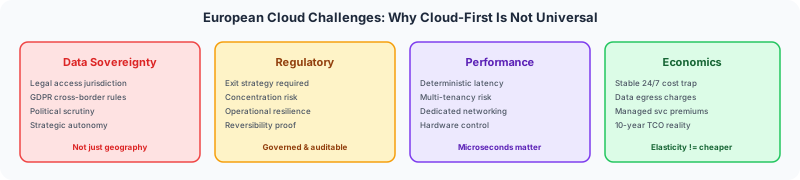
- Data sovereignty
- Regulatory constraints
- Strategic autonomy
These themes transform cloud from a purely technical matter into a governance issue.
Data Sovereignty: More Than a Location Pin
- At first glance, hyperscalers seem to address sovereignty concerns easily:
- "Your data stays in the EU region."
- But the conversation does not end with geography.
- Under GDPR and related frameworks, institutions must consider:
- Who can legally access the data?
- Under which jurisdiction does the provider operate?
- What happens in cross-border legal disputes?
Even if a server is physically located in Frankfurt or Paris, legal exposure may extend beyond physical borders.
For EU institutions and supervisory bodies, this is not theoretical. It is structural.
Cloud decisions must withstand not only technical audits --- but political and legal scrutiny.
Latency and Determinism: When Microseconds Matter
In financial services, performance is not merely about speed. It is about predictability.
High-frequency trading systems, real-time payments, and core transaction engines depend on:
- Deterministic latency
- Dedicated networking
- Tight hardware control
Public cloud environments, by design, introduce abstraction:
- Multi-tenancy
- Virtualization layers
- Shared network infrastructure
For most applications, this abstraction is acceptable.
For systems where microseconds influence financial exposure, it can be problematic.
This is why many institutions continue to maintain on-premise infrastructure for ultra-sensitive workloads.
Regulatory Pressure in Financial Services
Financial institutions operate under intense supervisory oversight.
Regulators increasingly ask difficult questions:
- What is your exit strategy from your cloud provider?
- How do you mitigate concentration risk?
- What happens if your hyperscaler experiences a prolonged outage?
- Can you demonstrate operational resilience independently?
If multiple systemically important banks rely on the same provider, an outage is no longer an IT incident --- it becomes a macroeconomic event.
Cloud is permitted --- but it must be governed, documented, and reversible.
Cost: Elasticity Is Not Always Cheaper
- Cloud optimizes for elasticity.
- When workloads fluctuate significantly, cloud is economically efficient.
- However, stable 24/7 systems tell a different story.
- Long-running core systems may accumulate:
- Continuous compute costs
- Storage expansion fees
- Data egress charges
- Managed service premiums
Over a ten-year horizon, total cost of ownership can rival --- or exceed --- on-premise investment.
Cloud changes the financial model. It does not eliminate infrastructure cost.
Hybrid Architecture: From Compromise to Strategy
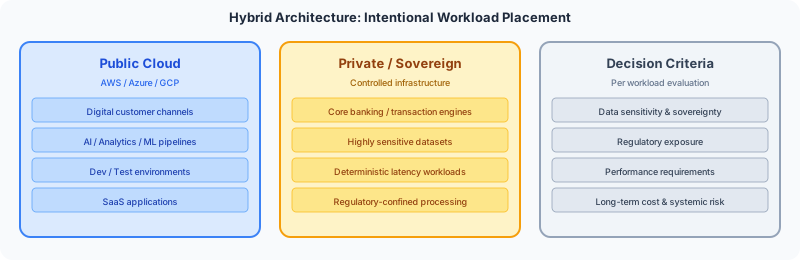
- Hybrid models are no longer transitional states. They are deliberate strategies.
- Hybrid does not mean hesitation.
- It means intentional placement.
- A typical institutional model now looks like this:
- Digital customer channels in public cloud
- AI and analytics in scalable cloud environments
- Dev/Test fully cloud-based
- Core banking engines on private or controlled infrastructure
- Highly sensitive datasets confined to sovereign or private environments
Each workload is evaluated according to:
- Sensitivity
- Regulatory exposure
- Performance requirement
- Cost predictability
- Strategic importance
This is not ideological. It is engineered governance.
Final Reflection
Cloud-first was an essential phase of digital transformation.
But maturity introduces nuance.
The real question today is not:
Cloud or on-prem?
It is:
- Which workload?
- Under which regulation?
- At what long-term cost?
- With what systemic risk?
- Under what geopolitical reality?
In EU institutions and financial services, infrastructure is no longer just engineering.
It is governance. It is economics. It is strategy.
And that is why the debate remains alive --- and necessary.
For expert guidance on enterprise architecture, explore our enterprise architecture consulting, architecture capability development, and Sparx EA consulting. Get in touch.
Frequently Asked Questions
How is ArchiMate used in cloud architecture?
ArchiMate models cloud architecture using the Technology layer — cloud platforms appear as Technology Services, virtual machines and containers as Technology Nodes, and networks as Communication Networks. The Application layer shows how workloads depend on cloud infrastructure, enabling migration impact analysis.
What is the difference between hybrid cloud and multi-cloud architecture?
Hybrid cloud combines private on-premises infrastructure with public cloud services, typically connected through dedicated networking. Multi-cloud uses services from multiple public cloud providers (AWS, Azure, GCP) to avoid vendor lock-in and optimise workload placement.
How do you model microservices in enterprise architecture?
Microservices are modeled in ArchiMate as Application Components in the Application layer, each exposing Application Services through interfaces. Dependencies between services are shown as Serving relationships, and deployment to containers or cloud platforms is modeled through Assignment to Technology Nodes.