⏱ 8 min read
Enterprise Architecture has evolved significantly over the past three decades. Once perceived as a documentation-heavy discipline focused on producing models and diagrams, it is now increasingly recognized as a strategic capability that shapes transformation, investment governance, and long-term competitiveness. Sparx EA best practices

Yet not all Enterprise Architecture functions are equal. In some organizations, EA operates as a reactive review function. In others, it acts as a strategic advisor influencing business direction, digital transformation, platform evolution, and operating model redesign. The difference between these realities is maturity.
An Enterprise Architecture Maturity Model (EAMM) provides a structured way to evaluate how effectively architecture is embedded within an organization — not merely as documentation, but as a leadership discipline. free Sparx EA maturity assessment
What Is Enterprise Architecture Maturity?
Maturity is not about how many diagrams exist. It is not about the number of certified architects. It is not about how detailed the repository appears. Maturity reflects how deeply architecture influences enterprise decisions.
At its core, Enterprise Architecture maturity answers one critical question: Does architecture shape the enterprise, or merely describe it?
A mature EA function influences strategy formulation, shapes investment decisions, guides portfolio prioritization, enables transformation coherence, reduces systemic complexity, and drives long-term structural integrity. An immature EA function reviews projects after decisions are made, focuses on technical compliance, produces documentation with limited strategic impact, and operates in isolation from business leadership.
Maturity therefore measures organizational capability, not artifact completeness.
Why Maturity Matters More Than Ever
Modern enterprises face unprecedented complexity: cloud adoption and multi-cloud architectures, API ecosystems and platform strategies, AI and data-driven transformation, regulatory pressure, cybersecurity threats, mergers and acquisitions, and globalized operations. enterprise cloud architecture patterns
Without architectural maturity, organizations experience technology sprawl, redundant platforms, inconsistent data models, vendor lock-in, escalating integration costs, and fragmented transformation initiatives. In environments undergoing rapid digital acceleration, architecture maturity is not optional — it becomes a structural risk mitigation capability.
The Five Evolutionary Levels
While models vary, most maturity frameworks describe five evolutionary levels. These should not be viewed as rigid categories but as patterns commonly observed across organizations.
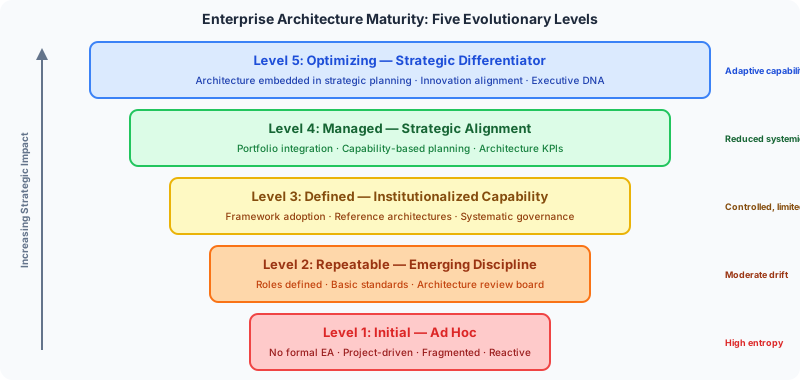
Level 1: Initial (Ad Hoc)
No formal EA function exists. Technology decisions are project-driven with limited standards and fragmented documentation. Architecture exists informally within projects or individual expertise, with no enterprise-wide perspective. This stage is common in startups, rapidly growing companies, and organizations with decentralized IT. The risk profile is high structural entropy.
Level 2: Repeatable (Emerging Discipline)
Architecture roles are formally defined, basic standards are introduced, and an architecture review board is established. Architecture begins to standardize decisions but remains largely IT-centric and reactive. Governance exists but is inconsistently enforced. Risk profile: moderate structural drift.
Level 3: Defined (Institutionalized Capability)
The organization adopts a formal framework such as TOGAF, documents architecture processes, defines reference architectures, and integrates architecture into the project lifecycle. Projects cannot proceed without architectural alignment, and governance becomes systematic. However, architecture may still operate parallel to strategy rather than influencing it. Risk profile: controlled but limited strategic impact.
Level 4: Managed (Strategic Alignment)
Architecture is integrated into portfolio management. Capability-based planning is introduced, roadmaps are tied to investment cycles, architecture KPIs are measured, and active executive engagement is in place. Architecture shifts from compliance to guidance, influencing budget allocation, platform selection, cloud strategy, data governance, and organizational design. Risk profile: reduced systemic risk with improved transformation coherence.
Level 5: Optimizing (Strategic Differentiator)
Architecture is embedded in strategic planning with a continuous improvement culture, data-driven governance, innovation alignment, and architecture as an enterprise leadership capability. At this level, architecture shapes mergers and acquisitions, drives ecosystem strategies, enables business model evolution, and supports platform-based operating models. Architecture becomes part of executive DNA. Risk profile: controlled complexity with adaptive capability.
Seven Dimensions of EA Maturity
Maturity is multi-dimensional. A comprehensive assessment must evaluate several domains simultaneously, not just governance or tooling in isolation.
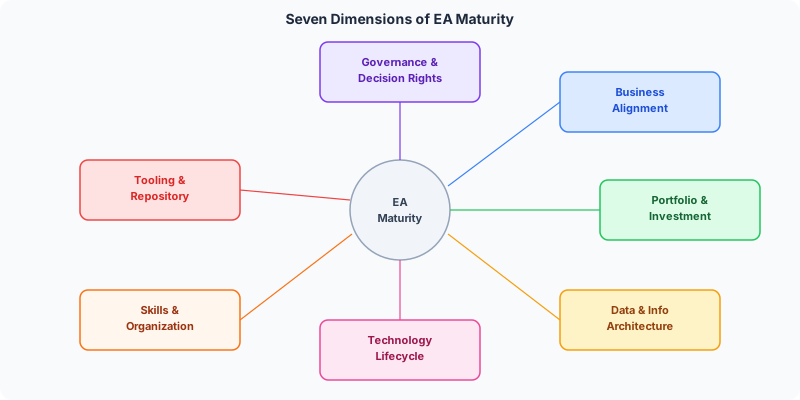
Governance and Decision Rights
Are architecture decisions authoritative? Is there executive sponsorship? Are exceptions formally managed? Mature organizations have clear escalation paths, transparent exception processes, and governance linked to risk management. Immature organizations rely on informal influence.
Business Alignment
Architecture maturity depends on business integration. In mature organizations, capability maps are used in strategy workshops, business leaders participate in architecture discussions, roadmaps align with corporate objectives, and architecture artifacts are referenced in board-level decisions. If architecture conversations occur only within IT, maturity remains limited. ArchiMate for governance
Portfolio and Investment Integration
A mature EA function connects roadmaps to funding decisions, influences capital allocation, aligns project prioritization with target architecture, and supports value realization tracking. Without portfolio integration, architecture remains advisory rather than decisive.
Data and Information Architecture
Modern enterprises are data-driven. Maturity indicators include an enterprise data model, data governance framework, master data ownership clarity, metadata management capability, and cross-system interoperability standards. Low data maturity creates systemic fragmentation.
Technology Lifecycle Management
High-maturity organizations maintain an approved technology catalog, enforce sunset policies, align with cloud strategy, standardize platforms, and track technical debt. Low maturity results in uncontrolled proliferation. hybrid cloud architecture
Skills and Organizational Capability
Architecture maturity depends on people. Consider defined architecture career paths, competency frameworks, cross-domain collaboration, soft skills development, and business literacy among architects. Technical excellence without communication capability limits impact.
Tooling and Repository Management
Tools enable traceability. Indicators include a centralized architecture repository in a tool like Sparx Enterprise Architect, traceability from strategy to implementation, impact analysis capability, and integration with portfolio and DevOps tools. Tools alone do not create maturity, but lack of tooling constrains scalability.
Cultural Dimensions of Maturity
Architecture maturity is deeply cultural. Common barriers include political resistance to governance, local optimization mindset, lack of executive sponsorship, short-term financial focus, and fear of transparency. High-maturity cultures demonstrate cross-functional collaboration, data-driven decision-making, respect for long-term structural integrity, and executive trust in architectural leadership.
Maturity cannot be forced purely through process. It must be socially embedded — which is why the combination of TOGAF governance with ArchiMate modeling is so effective: it provides both the organizational framework and the shared language that builds trust across stakeholders.
Conducting an EA Maturity Assessment
A realistic maturity assessment includes executive interviews, architecture team workshops, governance documentation review, portfolio and investment analysis, cultural assessment, KPI evaluation, gap analysis, target-state definition, and a phased improvement roadmap.
The objective is not to achieve Level 5 immediately. The objective is to align maturity with organizational complexity. Overengineering governance can be as harmful as under-governing. A startup does not need Level 5 maturity, but a multi-national bank undergoing digital transformation certainly needs Level 3 or higher.
Maturity and Digital Transformation
Digital transformation amplifies structural weaknesses. The same forces that enable rapid innovation — cloud, APIs, microservices, data platforms — also multiply complexity when ungoverned.
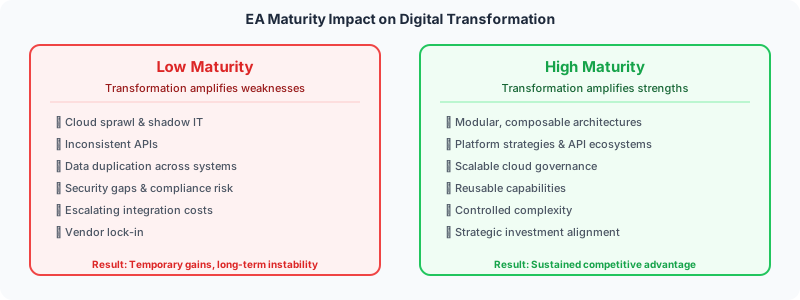
Transformation without architectural maturity often produces temporary gains and long-term instability. With maturity, organizations build modular architectures, scalable cloud governance, API ecosystems, and reusable capabilities that compound in value over time.
Executive Implications
For CIOs and executives, EA maturity directly influences investment transparency, risk management, speed of innovation, cost optimization, and organizational agility. Architecture maturity reflects leadership maturity. If architecture is treated as compliance, it will never become strategic. If architecture is integrated into planning cycles, it becomes transformative.
Roadmap to Higher Maturity
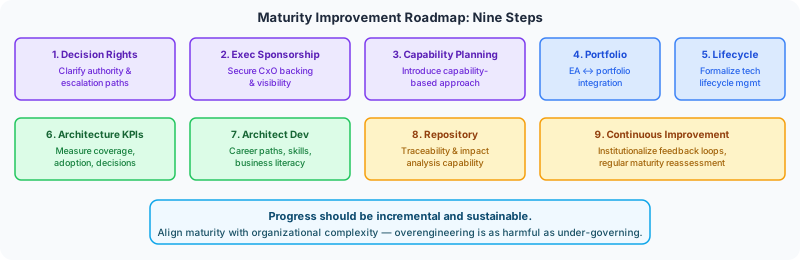
Progress should be incremental and sustainable. Starting with decision rights and executive sponsorship (steps 1-2) provides the organizational foundation. Introducing capability-based planning and portfolio integration (steps 3-4) connects architecture to investment decisions. Formalizing lifecycle management and KPIs (steps 5-6) makes architecture measurable. Investing in people and tooling (steps 7-8) builds long-term capacity. Institutionalizing continuous improvement (step 9) ensures maturity is maintained and evolved.
Conclusion
Enterprise Architecture Maturity Models are not scorecards. They are mirrors. They reveal whether architecture reacts or shapes, documents or guides, complies or leads, controls or enables.
In an era of accelerating technological disruption, architecture maturity becomes a strategic necessity. Organizations that invest in architectural capability do not simply manage complexity — they harness it. Maturity is not about perfection. It is about intentional evolution.
If your organization is ready to assess and improve its architecture maturity, we offer enterprise architecture consulting, enterprise architecture consulting, and ArchiMate modelling coaching to help you build a mature, strategically aligned EA function. Get in touch to start the conversation.
Frequently Asked Questions
What is enterprise architecture?
Enterprise architecture is a discipline that aligns an organisation's strategy, business operations, information systems, and technology infrastructure. It provides a structured framework for understanding how an enterprise works today, where it needs to go, and how to manage the transition.
How is ArchiMate used in enterprise architecture practice?
ArchiMate is used as the standard modeling language in enterprise architecture practice. It enables architects to create consistent, layered models covering business capabilities, application services, data flows, and technology infrastructure — all traceable from strategic goals to implementation.
What tools are used for enterprise architecture modeling?
Common enterprise architecture modeling tools include Sparx Enterprise Architect (Sparx EA), Archi, BiZZdesign Enterprise Studio, LeanIX, and Orbus iServer. Sparx EA is widely used for its ArchiMate, UML, BPMN and SysML support combined with powerful automation and scripting capabilities.