⏱ 5 min read
How to Implement EIRA in a Real European Commission Project
A Deep Technical Whitepaper for Practitioners
Executive Summary
The European Interoperability Reference Architecture (EIRA) is often cited in European Commission--funded IT initiatives, yet rarely implemented with architectural depth. Many projects reference EIRA in documentation but fail to integrate it structurally into capability design, governance models, semantic harmonisation, and technical realisation. ARB governance with Sparx EA
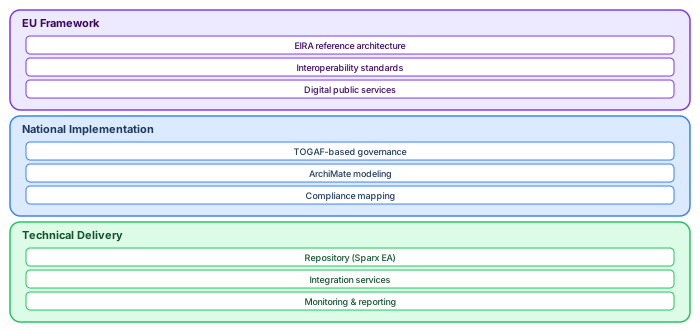
This whitepaper provides a practical, technically rigorous implementation approach for aligning a real European Commission project with EIRA in a defensible, traceable, and governance-ready manner. ArchiMate modeling standards
EIRA, as defined by the European Commission, is not a prescriptive solution framework. It is a structured reference architecture that supports interoperability across legal, organisational, semantic, and technical domains. Proper implementation requires architectural discipline across abstraction layers and lifecycle phases.
1. Understanding EIRA in Context
EIRA exists to operationalise interoperability principles across the European Union.
It serves three primary objectives:
- Promote reuse of architectural patterns and building blocks.
- Ensure cross-border compatibility of digital public services.
- Provide traceability between policy, services, and implementation.
EIRA is not:
- A mandatory software stack.
- A certification regime.
- A development methodology.
It is a reference architecture model aligned with the European Interoperability Framework (EIF).
2. Architectural Entry Point: Public Service First
Implementation begins at the highest abstraction level: public service delivery.
A Commission project must clearly define:
- The public service being delivered.
- The beneficiaries (citizens, businesses, authorities).
- The cross-border interactions.
- The operational mandate.
Deliverables include:
- Capability maps
- Stakeholder models
- High-level service decomposition
- Policy-to-service traceability
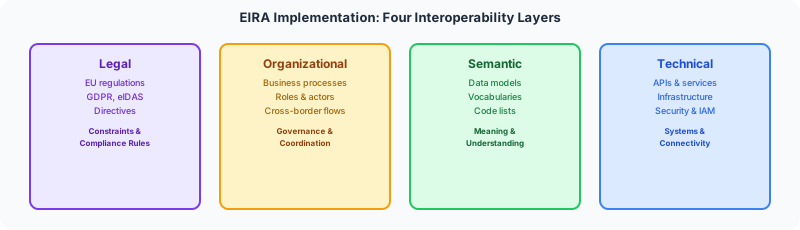
3. Operationalising the Four Interoperability Layers
3.1 Legal Interoperability
Legal interoperability ensures that data exchange and service delivery are legally grounded.
Implementation requirements:
- Explicit reference to the enabling Regulation or Decision.
- Defined lawful basis for data processing.
- Clear designation of data controllers and processors.
- Cross-border data transfer compliance.
- Defined liability and dispute resolution mechanisms.
3.2 Organisational Interoperability
Defines operational roles and governance structures. Sparx EA governance best practices
Implementation components:
- Operator model
- Hosting responsibility
- Service ownership
- Funding model
- Change governance
- Incident escalation paths
- Onboarding and offboarding procedures
3.3 Semantic Interoperability
Ensures shared meaning of exchanged data.
Implementation requires:
- Canonical data models
- Controlled vocabularies
- Code lists
- Version management framework
- Backward compatibility strategy
3.4 Technical Interoperability
Realises previous layers in operational systems.
Components include:
- API services
- Message brokers
- Identity providers
- Infrastructure services
- Monitoring and logging
- Network segmentation
- Encryption and security controls
4. ABB vs SBB Mapping
EIRA defines Architecture Building Blocks (ABBs). Projects define Solution Building Blocks (SBBs).
Implementation requires mapping SBB → ABB and documenting justification for deviations.
Example:
| SBB | ABB Category |
|---|---|
| Identity Provider | Authentication Service |
| API Gateway | Interoperability Service |
| Message Broker | Messaging Infrastructure Service |
| Data Store | Data Management Service |
| Monitoring Stack | Infrastructure Management Service |
5. Multi-Layer Architecture Modelling
Conceptual Architecture
Public services, capabilities, actors, high-level flows.
Logical Architecture
Application services, service interactions, logical security.
Technical Architecture
Infrastructure, deployment topology, security enforcement.
Traceability must exist across all layers.
6. Traceability as Core Design Principle
Policy → Capability → Service → Application → Infrastructure ArchiMate capability map example
Traceability enables:
- Audit defensibility
- Controlled evolution
- Governance efficiency
7. Reuse Strategy
Before implementing custom solutions, evaluate:
- Existing EU-wide services
- Common authentication mechanisms
- Established interoperability frameworks
If reuse is rejected, provide justification including risk and cost-benefit analysis.
8. Security as Cross-Cutting Concern
Security must include:
- Identity federation
- Authentication and authorisation
- Encryption
- Audit logging
- Incident response governance
9. Lifecycle and Evolution Management
Implementation should include:
- Version management strategy
- API lifecycle governance
- Schema evolution management
- Deprecation procedures
- Change approval workflows
10. Governance Deliverables Checklist
A mature EIRA-aligned project should produce:
- Public service model
- Capability map
- ABB/SBB mapping matrix
- Conceptual, logical and technical views
- Governance model
- Security architecture document
- Semantic governance framework
- SLA model
- Risk assessment
Conclusion
Implementing EIRA requires:
- Strategic clarity
- Multi-layer modelling
- Governance integration
- Semantic discipline
- Traceability
- Reuse awareness
- Lifecycle planning
When implemented properly, EIRA enables sustainable, cross-border, evolvable architecture.
For expert guidance on enterprise architecture, explore our enterprise architecture consulting, architecture capability development, and Sparx EA consulting. Get in touch.
Model quality as a continuous concern
Architecture models lose value when quality degrades. Five quality dimensions matter: completeness (do all significant elements exist in the model?), accuracy (does the model reflect current reality?), consistency (do naming conventions and relationship types follow standards?), currency (are tagged values and status fields up to date?), and clarity (can stakeholders understand the views without explanation?).
Automate quality measurement where possible. Scripts can check naming conventions, detect orphan elements, verify required tagged values, and identify elements not updated in the past 12 months. Human review covers what automation cannot: whether views answer their intended questions, whether the model reflects genuine architectural decisions or just documents what exists, and whether the model is actually used for decision-making rather than sitting in a repository nobody opens.
Frequently Asked Questions
What is enterprise architecture?
Enterprise architecture is a discipline that aligns an organisation's strategy, business operations, information systems, and technology infrastructure. It provides a structured framework for understanding how an enterprise works today, where it needs to go, and how to manage the transition.
How is ArchiMate used in enterprise architecture practice?
ArchiMate is used as the standard modeling language in enterprise architecture practice. It enables architects to create consistent, layered models covering business capabilities, application services, data flows, and technology infrastructure — all traceable from strategic goals to implementation.
What tools are used for enterprise architecture modeling?
Common enterprise architecture modeling tools include Sparx Enterprise Architect (Sparx EA), Archi, BiZZdesign Enterprise Studio, LeanIX, and Orbus iServer. Sparx EA is widely used for its ArchiMate, UML, BPMN and SysML support combined with powerful automation and scripting capabilities.