⏱ 19 min read
Organizations rarely fail because they lack smart people. They fail because smart people are arranged around the wrong seams.
That is the quiet tragedy inside many enterprises. They hire talented engineers, experienced product managers, capable architects, and still spend most of their energy moving work between queues, committees, and coordination rituals. The architecture diagram says “modern platform.” The operating model says “ticket-driven relay race.” And the teams—supposedly autonomous—are trapped in a maze of dependencies they did not design and cannot escape.
Feature-based team structures exist to break that maze.
This is not just an org chart preference. It is an architectural decision. Team topology shapes software topology. Conway’s Law is not a clever slogan to wheel out in workshops; it is a daily tax on every badly cut boundary. If your teams are aligned to layers, components, or technologies instead of business capabilities, you will almost certainly get software that mirrors those fractures: APIs that are coordination points instead of business contracts, Kafka topics that become accidental integration glue, and microservices that are too small to deliver value but too coupled to change safely. event-driven architecture patterns
A good team topology map does something deceptively simple. It draws the system around the flow of value. Not around backend versus frontend. Not around database versus middleware. Not around “the SAP team,” “the Java team,” or “the API team.” Around customer and business outcomes.
That sounds obvious. In enterprise architecture, obvious is where the hard work begins.
Context
Team Topologies gave the industry a better language for organizing software delivery: stream-aligned teams, platform teams, enabling teams, and complicated-subsystem teams. The model matters because it ties communication load, software boundaries, and cognitive load into one coherent frame.
But many organizations adopt the vocabulary without changing the underlying structure. They rename their delivery squads, keep the same approvals, preserve the same shared services bottlenecks, and wonder why lead times do not improve. It is lipstick on a dependency graph.
Feature-based team structures are the practical expression of stream alignment. A feature team owns a coherent slice of the product or business capability end to end. It can shape requirements, change UI, evolve services, publish events, update rules, and take responsibility for runtime behavior. It does not need six other teams to move a customer-facing change into production.
The phrase “feature” can be dangerously shallow, though. In serious enterprise settings, a feature is not a Jira artifact. It is usually a projection of domain semantics into a product experience. That means a feature-based structure only works when it is grounded in domain-driven design thinking.
This is where many transformations go wrong. They reorganize around customer journeys but ignore the business language, invariants, and decision boundaries underneath. The result looks agile on the surface yet remains tightly coupled in the core. Teams can deploy independently, but they cannot reason independently. That is worse than old-school centralization because it creates the illusion of autonomy.
So the real question is not “Should we use feature teams?” The real question is: what are the right feature seams, and do they map to bounded contexts that can sustain independent evolution?
Problem
Most enterprises inherit team structures from a different era.
One team owns the web front end. Another owns mobile. Another owns the order service. Another owns pricing logic. Another owns the customer database. Data engineering owns Kafka. Integration owns APIs. Infrastructure owns deployment templates. Security owns policy gates. Operations owns production access. Architecture owns standards. Nobody owns the customer outcome.
This creates a familiar pattern:
- changes take too long because every meaningful feature crosses multiple queues
- defects hide in handoffs because no single team carries full context
- prioritization becomes political because component teams serve many masters
- domain logic scatters across services, channels, and integration layers
- event streams become fragile because ownership of business events is unclear
- reconciliation work grows because asynchronous boundaries were introduced without domain discipline
Layer-based teams optimize local efficiency and destroy system flow.
The pain gets worse in microservice environments. Enterprises often split systems into dozens or hundreds of services, then leave teams aligned to technical specialties. The architecture promises decoupling. The organization guarantees coupling. A “simple” pricing change may involve a channel team, a pricing engine team, a customer offers team, a Kafka platform team, and a release management team. Each one is rational in isolation. Together they form a machine for slowing down learning.
There is also a semantic problem. When teams are not aligned to domain capabilities, core business concepts become unstable. “Order,” “customer,” “policy,” “eligibility,” “shipment,” “settlement”—these words mean different things in different services because nobody owns the language boundary. Integration then becomes a translation swamp. Reconciliation becomes permanent because systems are not disagreeing by accident; they are implementing different truths.
Forces
A good architecture article should not pretend there is one force at play. Enterprises live in competing pressures.
1. Flow versus specialization
Feature teams improve flow because they reduce handoffs. But they ask teams to be broader, not narrower. That means a team must be capable enough to own UI, APIs, event contracts, observability, and operational concerns inside its domain slice.
The tradeoff is real. Pure specialization can create local excellence. It can also create organizational gridlock.
2. Domain coherence versus platform consistency
A stream-aligned team should move fast without waiting on shared teams. But if every team invents its own CI/CD, telemetry, security model, and Kafka conventions, the organization creates chaos. That is why Team Topologies never argued for only feature teams. Platform capability is the counterweight.
3. Autonomy versus cognitive load
A team cannot own everything. The trick is not to maximize ownership; it is to keep ownership inside tolerable cognitive boundaries. A feature-based structure succeeds when the team’s scope is meaningful enough to deliver value but small enough to understand deeply.
4. Event-driven flexibility versus reconciliation cost
Kafka and event-driven microservices are often the right fit for feature teams because they let bounded contexts communicate through domain events rather than direct runtime coupling. But asynchronous models shift complexity into eventual consistency, idempotency, duplicate handling, reprocessing, and reconciliation. Architecture does not abolish work. It moves it.
5. Local optimization versus enterprise governance
Regulated industries need control. Financial services, healthcare, telecom, and public sector organizations cannot simply declare “you build it, you run it” and walk away. They need policy, lineage, auditability, and resilience. The answer is not to block feature teams. It is to encode governance into platforms and contracts rather than committees. EA governance checklist
Solution
The core idea is straightforward: organize delivery around business capabilities and customer outcomes, not technical components.
In Team Topologies terms, this usually means stream-aligned teams that own end-to-end slices of a value stream, supported by platform teams and sometimes enabling teams. In domain-driven design terms, those stream-aligned teams should align as closely as possible to bounded contexts or cohesive subdomains.
Feature-based does not mean “anything customer-visible.” It means the team can make meaningful business changes with minimal external coordination because the domain boundary is coherent.
A useful test is this: if a team changes a business rule, who else must be involved? If the answer is “several component teams,” then the topology is wrong. If the answer is “mainly our own team, with stable contracts to adjacent domains,” you are getting close.
A practical team topology map often looks like this:
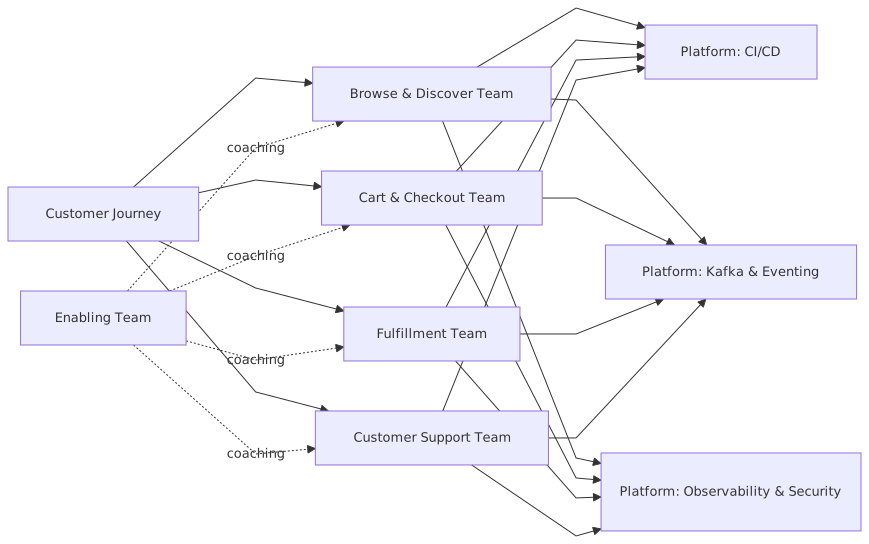
This diagram is simple, but the important thing is what it implies. The customer-facing and business-facing teams are primary. Platform exists to reduce friction. Enabling exists to accelerate capability. Shared services do not become approval towers.
Domain semantics first
This is where architecture earns its keep. Do not draw team boundaries from current systems. Draw them from domain language, business decisions, and change patterns.
If “Order Management” contains capture, pricing, fraud review, fulfillment orchestration, invoice generation, and returns, that is not one domain. It is a filing cabinet.
Good feature-based structures usually emerge from questions like:
- Which business concepts have their own lifecycle and invariants?
- Where are the natural seams in decision-making?
- Which changes tend to happen together?
- Which events are facts from one bounded context and inputs to another?
- Where is translation needed because semantics differ?
That last question matters enormously in enterprise systems. Translation is not a smell by itself. It is often the sign of a healthy boundary. Trouble starts when teams pretend semantics are universal and force one model everywhere. Shared canonical models are frequently the graveyard of autonomy.
Feature teams need product and runtime ownership
A feature team should not stop at coding. It should own business behavior in production: service levels, event quality, operational alerts, and reconciliation paths. If a Kafka consumer falls behind, if a compensation workflow fails, if a customer state diverges between systems, the owning team should see it, understand it, and fix it.
Otherwise, the topology is decorative.
Architecture
A feature-based architecture usually works best with a combination of:
- bounded contexts that encapsulate domain rules
- APIs for synchronous queries and commands where immediacy matters
- domain events over Kafka for asynchronous collaboration
- platform capabilities that standardize non-functional concerns
- explicit reconciliation patterns for eventual consistency
A representative architecture might look like this:
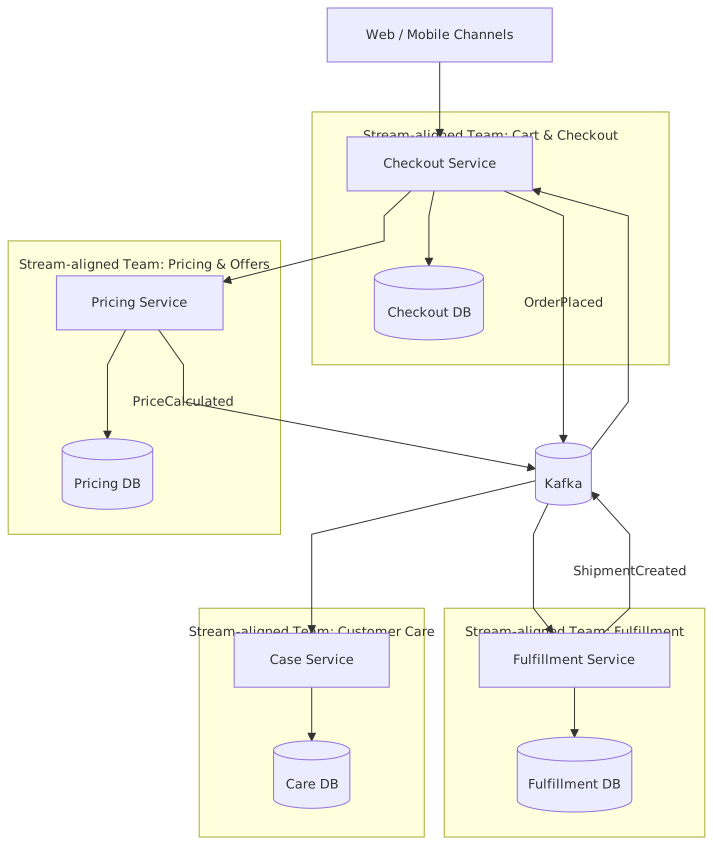
Notice what is absent: no central integration team in the middle of every interaction, no shared enterprise data layer as the mandatory point of truth, no component team that all changes must cross.
That does not mean anarchy. It means contracts are explicit.
APIs and events each have a place
One of the easiest mistakes in enterprise modernization is ideological architecture. Some teams use synchronous APIs for everything because they fear eventual consistency. Others use Kafka for everything because they want “loose coupling.” Both are simplistic.
Feature-based team structures work best when interaction style follows domain need:
- Use synchronous APIs when the caller needs an immediate answer and the dependency is part of the same business transaction from a user perspective.
- Use events when one domain is publishing a fact that others react to on their own timelines.
- Avoid turning Kafka into remote procedure call with more paperwork.
- Avoid chaining too many synchronous calls across team boundaries in customer-critical flows.
This is also where reconciliation enters the conversation. Once you have independent feature teams and event-driven integration, the enterprise must accept that consistency will often be achieved over time, not instantly. Therefore every critical cross-boundary process needs:
- a source-of-truth decision
- idempotent event handling
- replay capability
- dead-letter handling
- operational reconciliation views
- business-owned exception flows
Reconciliation is not a technical footnote. It is the price of autonomy in distributed systems.
Bounded contexts and team boundaries
The healthiest pattern is to map one stream-aligned team to one primary bounded context, or at least to a small number of tightly related contexts. If a team owns too many unrelated contexts, it becomes a mini-monolith. If several teams share one context, ownership becomes muddy and coordination rises again.
A team topology map should therefore include both interaction mode and semantic boundary. Something like this:

This is the picture many enterprises skip. They draw systems, not semantics. But semantics determine where the arguments happen.
Migration Strategy
No large enterprise gets from component teams to feature-based topology in one move. Trying usually causes panic, role confusion, duplicated work, and a lot of expensive “transformation theater.”
Use progressive strangler migration.
Start with one business area where delay is visibly caused by cross-team handoffs and the domain can be isolated enough to learn. Build a stream-aligned team around that capability. Give it the authority to own code, backlog, production signals, and key domain contracts. Then gradually pull dependencies into the team’s orbit while shrinking the old component-oriented pathways.
This is as much organizational migration as technical migration.
A practical sequence
- Map current demand and handoffs
Find where customer-impacting work crosses the most teams. These are usually the best candidates for redesign.
- Define target domain boundaries
Use domain event storming, capability mapping, and bounded context analysis. Do not start from service inventory alone.
- Create a pilot stream-aligned team
Give it a genuine business problem, not a sandbox.
- Stand up platform guardrails
CI/CD templates, observability, Kafka provisioning, security controls, runtime standards. This is what keeps autonomy from turning into entropy.
- Move ownership incrementally
Shift UI, API, service logic, event contracts, and support responsibilities gradually. Use anti-corruption layers where legacy semantics would otherwise leak in.
- Introduce reconciliation early
Especially if Kafka and asynchronous processes are involved. Build exception handling before scale exposes the cracks.
- Retire old coordination paths
If old approval boards and shared queues stay in place, teams will route around the new model.
Progressive strangler in practice
Suppose a retailer has a traditional “Order Management” monolith and separate component teams. The first move may be to carve out Checkout as a bounded context with its own team. That team still calls the monolith for some data, but it owns the customer-facing checkout flow, emits OrderPlaced events to Kafka, and maintains its own operational dashboard. Fulfillment and Customer Care subscribe downstream. Over time, the old order orchestration inside the monolith is reduced until the legacy core becomes an event source or record archive rather than the center of execution.
That is the strangler pattern applied to team structure and architecture together. One without the other is brittle.
Enterprise Example
Consider a global insurer modernizing claims processing.
The legacy environment had separate teams for portal UI, policy services, rules engine, document management, integration middleware, and batch reconciliation. A simple enhancement—say, introducing instant approval for low-value motor claims—required coordination across seven teams, multiple CAB windows, and a monthly release train. Everyone was busy. Nothing was fast.
The company reorganized around feature-aligned domains:
- Claims Intake Team
- Claims Decisioning Team
- Claims Payment Team
- Claims Case Management Team
- Platform Team
- Enablement Team for event-driven practices and observability
This was not just a rename. Each stream-aligned team owned a bounded context and a measurable business outcome. Claims Intake owned first notice of loss, intake validation, and claim submission events. Decisioning owned fraud signals, eligibility rules, and approval decisions. Payment owned settlement initiation and payment status. Case Management owned exception handling and agent workflows.
Kafka became the backbone for domain events:
ClaimSubmittedClaimDocumentsReceivedClaimApprovedPaymentInitiatedPaymentCompleted
But the important part was not Kafka itself. It was semantic ownership. The Decisioning team owned what “approved” meant. Payment did not reinterpret it. Case Management did not sneak in hidden business rules. Where translation was required—for example between policy administration and claims semantics—anti-corruption layers were made explicit.
Reconciliation was designed from day one. Why? Because payment confirmations could arrive late, duplicate claim documents were common, and partner systems occasionally published malformed messages. The teams built:
- idempotent consumers
- replayable event processing
- claim state comparison dashboards
- exception queues visible to business operations
- daily reconciliation reports for payments versus claim status
The result was not magic. It was cleaner responsibility. Lead time for targeted claims changes dropped from weeks to days. Failure diagnosis improved because ownership was clear. And the architecture became easier to evolve because team boundaries matched domain boundaries.
The hard part was cultural. Some central teams feared loss of control. Some stream-aligned teams initially underestimated runtime responsibility. A few early services were too fine-grained and had to be recombined. That is normal. Topology is designed, but it is also discovered.
Operational Considerations
A feature-based topology becomes credible only when operations match the model.
Observability by domain
Dashboards should show business flow, not just CPU and memory. A Checkout team needs to see checkout conversion, failed order submissions, lag on OrderPlaced consumers, compensation rates, and reconciliation mismatches. If monitoring is purely technical, domain failures hide in plain sight.
Event governance without bureaucracy
Kafka in large enterprises can become the Wild West or the Soviet Union. Neither helps. Teams need self-service topic provisioning, schema standards, retention defaults, access controls, and lineage visibility. They do not need a six-week request process to publish a domain event.
Ownership of support paths
If a feature team owns a capability, it should own the support path for issues in that capability, including collaboration with operations or customer service. Otherwise incidents will bounce between teams exactly as features used to.
Data products and reporting
Feature teams often own operational data within their context, but enterprise reporting cuts across domains. Be careful here. Do not recreate hidden coupling by forcing teams into a single transactional reporting schema. Use analytical pipelines, event streams, or data products designed for cross-domain consumption.
Reconciliation as an operational function
In event-driven enterprises, reconciliation is not just batch accounting. It is a first-class operational concern. Teams need tools to answer:
- What should have happened?
- What actually happened?
- What is missing?
- Can we safely replay?
- Which business records require manual intervention?
If you cannot answer those questions quickly, your event-driven architecture will eventually become an event-driven mystery.
Tradeoffs
Feature-based team structures are powerful, but they are not free.
You gain speed by paying for duplication.
Some capabilities will be implemented more than once, especially near the edges. This is acceptable if it reduces coordination and preserves domain clarity. Shared utility is cheaper than shared business logic.
You gain autonomy by paying for broader skills.
Teams need engineers who can work across more of the stack, or at least can operate effectively in cross-functional groups. That takes coaching and time.
You gain cleaner ownership by paying for harder boundary decisions.
The organization must confront semantics, not hide them. Bounded context decisions are often politically uncomfortable because they expose competing definitions of truth.
You gain loose coupling by paying with reconciliation complexity.
Kafka and asynchronous integration reduce runtime dependency but increase the need for compensation, replay, and exception handling.
You gain local flow by risking enterprise divergence.
Without a strong platform and architectural stewardship, teams can drift into incompatible standards, duplicated tooling, and operational inconsistency.
That is the essence of architecture: not choosing perfection, but choosing your problems deliberately.
Failure Modes
Most failed attempts at feature-based topology fail in recognizable ways.
1. Fake feature teams
The team is called “customer onboarding,” but it still depends on four component teams for every change. The org chart changed. The dependency graph did not.
2. Frontend-only feature ownership
The team owns user journeys but not business rules, data contracts, or runtime support. This creates a cosmetic alignment with no real autonomy.
3. Bounded contexts ignored
Teams are structured by journey maps without understanding domain semantics. Shared entities leak across services, and changes trigger endless coordination.
4. Platform as gatekeeper
Platform teams become mandatory intermediaries rather than internal product providers. Developers file tickets instead of using self-service capabilities.
5. Over-fragmented microservices
In an effort to align every tiny feature to a team, organizations create services too fine-grained to be viable. Communication overhead simply moves from code modules to network calls and topic sprawl.
6. No reconciliation design
Event-driven interactions are adopted without idempotency, replay, exception handling, or operational visibility. Everything looks decoupled until data diverges and no one can explain why.
7. Legacy governance remains untouched
CABs, release trains, architecture approval bottlenecks, and centralized production access continue unchanged. Teams are told to be autonomous inside a cage.
When Not To Use
Feature-based team structures are not a universal answer.
Do not use them aggressively when the system is very small and one or two teams can manage it more simply without formal topology distinctions. In small environments, over-structuring can be as harmful as under-structuring.
Do not force feature alignment where the dominant challenge is a genuinely complicated subsystem requiring deep specialist concentration—for example advanced optimization engines, real-time risk models, or highly specialized industrial control software. In those cases, a complicated-subsystem team may be the right primary unit, with clear interfaces to stream-aligned teams.
Do not split into feature teams if the platform foundations are absent and the organization is unwilling to invest in them. Without self-service delivery, observability, security automation, and data/event infrastructure, feature teams become dependency magnets.
Do not use feature teams as a management fad while retaining centralized decision rights over every meaningful change. That only adds confusion.
And do not use them where domain boundaries are still utterly opaque. If the organization cannot yet explain its own core semantics, do the domain work first. Otherwise you will create arbitrary lines and call them architecture.
Related Patterns
Several patterns sit naturally beside feature-based team structures.
Stream-aligned teams are the closest direct companion. Feature-based structures are often the practical manifestation of stream alignment.
Domain-driven design provides the language for finding the right boundaries: bounded contexts, context maps, ubiquitous language, core versus supporting domains.
Platform as a product is essential for sustainable autonomy. Shared capabilities should be consumed, not negotiated.
Strangler Fig migration is the safest route out of legacy component-oriented systems and monolith ownership models.
Anti-corruption layers matter whenever legacy or adjacent domains use different semantics.
Event-driven architecture and Kafka-based integration fit well when teams need decoupled collaboration, provided reconciliation is designed properly.
Team APIs are worth mentioning too. Teams should expose not just technical interfaces but clear ways of working, service expectations, and ownership boundaries.
Summary
Feature-based team structures are not a fashionable reorg. They are a deliberate way of aligning teams to the shape of value and the semantics of the business.
Done well, they reduce handoffs, clarify ownership, improve flow, and produce software that changes where the business actually changes. They work best when grounded in domain-driven design, supported by strong platform capabilities, and paired with a realistic migration strategy such as progressive strangler. Kafka and microservices can help, but only when event ownership, eventual consistency, and reconciliation are treated as first-class architectural concerns. microservices architecture diagrams
Done badly, feature teams become little more than a new label over old dependencies. The software remains coupled, the domain remains muddy, and coordination remains the true system of record.
That is the central lesson. Teams are architecture. Not metaphorically. Literally.
If you want a better team topology map, start by finding the real business seams. Then give teams the authority—and the burden—to own them end to end. The map will only be honest when the boundaries carry meaning.
Frequently Asked Questions
What is enterprise architecture?
Enterprise architecture aligns strategy, business processes, applications, and technology in a coherent model. It enables impact analysis, portfolio rationalisation, governance, and transformation planning across the organisation.
How does ArchiMate support architecture practice?
ArchiMate provides a standard language connecting strategy, business operations, applications, and technology. It enables traceability from strategic goals through capabilities and services to infrastructure — making architecture decisions explicit and reviewable.
What tools support enterprise architecture modeling?
The main tools are Sparx Enterprise Architect (ArchiMate, UML, BPMN, SysML), Archi (free, ArchiMate-only), and BiZZdesign. Sparx EA is the most feature-rich, supporting concurrent repositories, automation, scripting, and Jira integration.