⏱ 6 min read
Recommended Reading
Executive summary
API-first organizations function on contract discipline. The same governance logic that applies to Kafka event contracts applies to APIs: ownership boundaries, compatibility/versioning rules, and decision traceability. This blueprint reuses ADR discipline and TOGAF governance hooks (board/compliance review) to keep API-first architecture coherent at scale. ArchiMate in TOGAF ADM
- Domain boundaries and platform enablement
- Evidence workflows: reviews, baselines, audits (tool-dependent)
- ADR practice.
- TOGAF compliance review.
- TOGAF architecture board.
API-first architecture layers
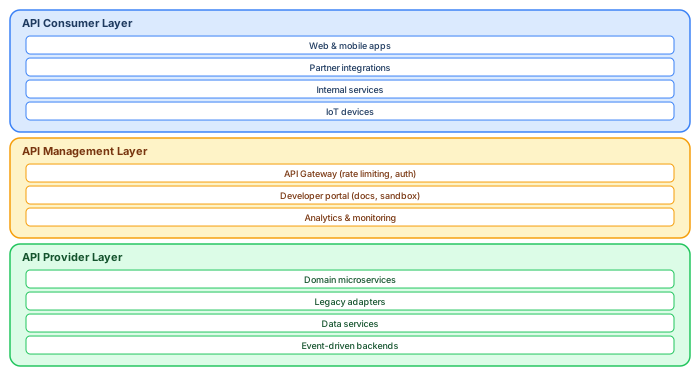
API-first organizations treat APIs as products — designed, versioned, documented, and governed like any other product the organization offers. Enterprise architecture in this context focuses on the API lifecycle, the platform that supports it, and the governance that ensures quality and consistency. free Sparx EA maturity assessment
API Consumer Layer: Web and mobile applications, partner integrations, internal services, and IoT devices all consume APIs. The enterprise architecture models these as external Business Actors or Application Components with Serving relationships from the APIs they consume. Understanding the consumer landscape is essential for impact analysis — changing an API affects every consumer.
API Management Layer: The API gateway handles cross-cutting concerns: rate limiting, authentication (OAuth 2.0, API keys), request routing, and protocol translation. The developer portal provides documentation, sandbox environments, and API key management. Analytics track usage patterns, error rates, and latency. Model these as shared Application Services that serve all API providers.
API Provider Layer: Domain microservices implement the business logic behind APIs. Legacy adapters expose older systems through modern API contracts. Data services provide query access to domain data. Event-driven backends handle asynchronous operations triggered by API calls. Each provider owns its API contract (OpenAPI specification), its versioning strategy, and its SLA.
API governance in the EA model
Model each API as an Application Service in ArchiMate. Tag with API_Version, Status (Active / Deprecated / Sunset), Owner_Team, Consumer_Count, and SLA_Tier. Build an API Portfolio view showing all APIs colored by status. Build an API Dependency view showing which consumers depend on which APIs. These views enable the architecture board to govern API lifecycle: when to deprecate, when to sunset, and when breaking changes require a new major version.
The API lifecycle in enterprise architecture

In API-first organizations, the API lifecycle is the central governance process. Every API passes through five stages, each with architecture touchpoints. integration architecture diagram
Design (schema-first): The API contract (OpenAPI specification) is designed before any implementation code is written. The specification defines endpoints, request/response schemas, authentication requirements, error codes, and pagination strategy. Architecture reviews the design for standards compliance: consistent naming conventions, proper HTTP verb usage, standard error format, and alignment with the organization's API design guidelines.
Review (standards check): An automated linter validates the OpenAPI specification against organizational standards. Common checks: all endpoints require authentication, all responses include standard error schema, collection endpoints support pagination, field names use camelCase. Manual review is reserved for design decisions that automated checks cannot catch: is this API at the right level of abstraction? Does it duplicate an existing API? Does it expose internal implementation details?
Implement (code + tests): The implementation matches the reviewed specification exactly. Contract testing (tools like Pact or Schemathesis) verifies that the implementation conforms to the OpenAPI spec. Integration tests verify behavior against the specification's examples. The architecture team does not review implementation code — they trust the contract testing to enforce conformance.
Publish (portal + docs): The API is published to the developer portal with documentation generated from the OpenAPI specification. Interactive documentation (Swagger UI or Redocly) lets consumers try the API in a sandbox environment. The API is registered in the architecture repository as an Application Service element with tagged values: version, status, owner, consumer count, and SLA tier.
Operate (monitor + evolve): The API is monitored for availability, latency, error rates, and usage patterns. Deprecation follows a strict process: announce deprecation 6 months before sunset, provide a migration guide to the replacement API, monitor consumer migration progress, and only sunset when all consumers have migrated or accepted the risk.
API versioning strategy
API versioning is the most contentious design decision in API-first organizations. The enterprise architecture team should mandate a single versioning strategy across the organization — mixed strategies create confusion for consumers. Sparx EA best practices
URL versioning (/v1/customers, /v2/customers) is the simplest to understand and implement. Breaking changes get a new major version. Non-breaking changes (new optional fields, new endpoints) are added to the current version. This is the most common strategy and the easiest for consumers to understand.
Header versioning (Accept: application/vnd.company.v2+json) keeps URLs clean but is harder for consumers to discover and test. Better suited for APIs with sophisticated consumers (internal microservices) than public APIs.
Whichever strategy is chosen, enforce it through the API linter and architecture contract. Track all active API versions in the architecture repository. Build an "API Version Sunset" view showing which versions are active, deprecated, and sunset, with timeline for each — the CTO needs this view to manage the organization's API surface area. modeling integration architecture with ArchiMate
API portfolio management
As the API portfolio grows, management becomes a governance concern. The architecture repository should maintain an API catalog as a first-class artifact, with views that enable portfolio-level decisions.
API Portfolio Health view: All APIs colored by lifecycle status — Active (green), Deprecated (amber), Sunset (red), Draft (blue). This view answers "how many APIs are we maintaining, and how many should be retired?"
API Dependency graph: Which APIs call which other APIs. This reveals cascading dependencies that create fragility — if API A depends on API B depends on API C, a failure in C cascades through B to A. Identify and break long dependency chains by introducing caching, circuit breakers, or event-driven alternatives for non-critical paths.
API Consumer distribution: For each API, how many consumers and from which teams. APIs with zero consumers should be sunset. APIs with 50+ consumers need careful change management — any breaking change has massive coordination cost.
If you’d like hands-on training tailored to your team — Sparx Enterprise Architect, BPMN, SysML, Apache Kafka or the Archi tool — or modelling coaching in ArchiMate and TOGAF-aligned governance, you can reach us via our contact page.
Frequently Asked Questions
What is enterprise architecture?
Enterprise architecture is a discipline that aligns an organisation's strategy, business operations, information systems, and technology infrastructure. It provides a structured framework for understanding how an enterprise works today, where it needs to go, and how to manage the transition.
How is ArchiMate used in enterprise architecture practice?
ArchiMate is used as the standard modeling language in enterprise architecture practice. It enables architects to create consistent, layered models covering business capabilities, application services, data flows, and technology infrastructure — all traceable from strategic goals to implementation.
What tools are used for enterprise architecture modeling?
Common enterprise architecture modeling tools include Sparx Enterprise Architect (Sparx EA), Archi, BiZZdesign Enterprise Studio, LeanIX, and Orbus iServer. Sparx EA is widely used for its ArchiMate, UML, BPMN and SysML support combined with powerful automation and scripting capabilities.