⏱ 5 min read
Enterprise Architecture Operating Model Template
A Board-Level White Paper with Application to the Pharmaceutical Sector
Executive Summary
The pharmaceutical industry operates in one of the most complex, regulated, and innovation-intensive environments in the global economy. Organizations must simultaneously accelerate drug discovery, maintain regulatory compliance across jurisdictions, manage global supply chains, integrate acquisitions, and adopt emerging digital technologies such as artificial intelligence, advanced analytics, and real-world evidence platforms.
In this environment, Enterprise Architecture (EA) cannot function as a documentation exercise or a technical review checkpoint. It must operate as a strategic management capability. Sparx EA best practices
An Enterprise Architecture Operating Model institutionalizes architecture as a decision-enabling, value-delivering function embedded across business and technology domains. It defines governance structures, decision rights, integration into portfolio and delivery processes, regulatory alignment, performance measurement, and continuous improvement mechanisms. free Sparx EA maturity assessment
This white paper provides a comprehensive, board-ready template for establishing or transforming an EA Operating Model within pharmaceutical enterprises.
1. Strategic Context
Pharmaceutical enterprises face structural pressures:
- Increasing regulatory scrutiny (FDA, EMA, PMDA, MHRA)
- Long R&D cycles with high attrition rates
- Globalized clinical trials
- Data-intensive pharmacovigilance
- Serialization and supply chain transparency mandates
- Patent cliffs and generics competition
- Rapid adoption of AI-driven drug discovery
- Growing interoperability requirements
Without institutionalized architecture:
- Systems proliferate
- Compliance risk increases
- Redundancy inflates cost
- Digital initiatives fragment
The EA Operating Model transforms architecture from advisory documentation into a strategic enterprise capability.
2. Definition: Enterprise Architecture Operating Model
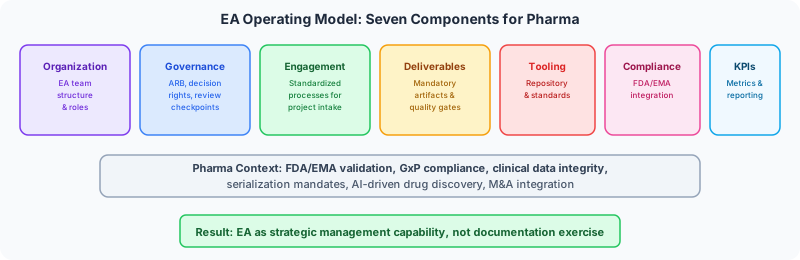
An Enterprise Architecture Operating Model defines:
- Organizational structure of the EA function
- Governance bodies and decision authorities
- Standardized engagement processes
- Mandatory deliverables and quality controls
- Tooling and repository standards
- Compliance integration mechanisms
- Performance metrics and reporting
It formalizes architecture as a core enterprise management discipline.
3. Governance Framework
3.1 Architecture Review Board (ARB)
Responsible for:
- Enterprise-wide architectural decisions
- Major technology investment alignment
- Exception approvals
3.2 Domain Architecture Councils
- R&D Architecture Board
- Manufacturing Architecture Board
- Commercial Architecture Board
- Data Governance Council
Clear decision rights prevent architectural dilution and ensure accountability.
4. Organizational Model
Best practice in pharmaceutical enterprises is a hybrid model:
- Central Enterprise Architecture Office
- Embedded Domain Architects across R&D, Manufacturing, and Commercial
Key roles include:
- Chief Enterprise Architect
- Business Architect
- Data Architect
- Application Architect
- Technology Architect
- Security Architect
- Compliance/Validation Architect
5. Integration with Strategy and Portfolio
Architecture must influence capital allocation and transformation priorities. integration architecture diagram
Governance gates include: architecture decision records
- Business case validation
- Solution design approval
- Pre-go-live compliance verification
- Post-implementation review
6. Regulatory Alignment
In pharmaceutical enterprises, compliance is non-negotiable.
Architecture must embed:
- 21 CFR Part 11 compliance
- EU Annex 11 controls
- GAMP 5 validation alignment
- ALCOA+ data integrity principles
- Audit trail and traceability standards
Compliance must be designed into systems, not retrofitted.
7. Technology and Cloud Strategy
Modern pharmaceutical organizations operate hybrid environments.
Architecture must define:
- Cloud adoption standards
- Data sovereignty controls
- Cybersecurity reference architecture
- Integration and API standards
- High-performance computing for R&D
8. KPIs and Performance Measurement
Board-level reporting should include:
- \% IT spend aligned to target architecture
- Technology standardization ratio
- Reduction in redundant systems
- Regulatory audit findings linked to architecture
- Cloud maturity progression
9. Continuous Improvement
EA maturity evolves from:
- Informal reviews
- Structured governance
- Portfolio integration
- Strategic transformation enablement
- Enterprise innovation leadership
Annual maturity assessments are recommended.
Conclusion
Enterprise Architecture without an operating model remains theoretical. With a defined operating model, it becomes a strategic governance instrument. ArchiMate modeling standards
For pharmaceutical enterprises, the EA Operating Model:
- Reduces compliance risk
- Optimizes capital allocation
- Enables digital acceleration
- Improves regulatory readiness
- Strengthens global operational alignment
Architecture becomes not an IT function, but a strategic enterprise capability.
For expert guidance on enterprise architecture, explore our enterprise architecture consulting, architecture capability development, and Sparx EA consulting. Get in touch.
Model quality as a continuous concern
Architecture models lose value when quality degrades. Five quality dimensions matter: completeness (do all significant elements exist in the model?), accuracy (does the model reflect current reality?), consistency (do naming conventions and relationship types follow standards?), currency (are tagged values and status fields up to date?), and clarity (can stakeholders understand the views without explanation?).
Automate quality measurement where possible. Scripts can check naming conventions, detect orphan elements, verify required tagged values, and identify elements not updated in the past 12 months. Human review covers what automation cannot: whether views answer their intended questions, whether the model reflects genuine architectural decisions or just documents what exists, and whether the model is actually used for decision-making rather than sitting in a repository nobody opens.
Frequently Asked Questions
What is enterprise architecture?
Enterprise architecture is a discipline that aligns an organisation's strategy, business operations, information systems, and technology infrastructure. It provides a structured framework for understanding how an enterprise works today, where it needs to go, and how to manage the transition.
How is ArchiMate used in enterprise architecture practice?
ArchiMate is used as the standard modeling language in enterprise architecture practice. It enables architects to create consistent, layered models covering business capabilities, application services, data flows, and technology infrastructure — all traceable from strategic goals to implementation.
What tools are used for enterprise architecture modeling?
Common enterprise architecture modeling tools include Sparx Enterprise Architect (Sparx EA), Archi, BiZZdesign Enterprise Studio, LeanIX, and Orbus iServer. Sparx EA is widely used for its ArchiMate, UML, BPMN and SysML support combined with powerful automation and scripting capabilities.