⏱ 21 min read
Most SaaS architecture arguments start in the wrong place. They start with infrastructure. Shared database or dedicated database? Shared cluster or per-tenant cluster? Kubernetes namespace or account boundary? Those are important questions, but they are not the first questions.
The first question is simpler and more dangerous: what are you isolating, really?
If your answer is “tenant data,” you are only halfway there. In serious enterprise systems, isolation is not just about data. It is about blast radius, noisy neighbors, legal boundary, change cadence, operational privilege, encryption scope, billing semantics, support workflows, integration contracts, and sometimes plain old political reality. A bank’s “tenant” is not the same animal as a startup customer in a project management tool. The word is overloaded. Architecture suffers when language gets sloppy.
This is where domain-driven design earns its keep. Before drawing boxes, you need to understand what a tenant means in the domain. Is it a billing account? A legal entity? A workspace? A deployment unit? A security perimeter? Often it is several at once, and that is where the trouble begins. Teams casually say “tenant” when they really mean “organization,” “subscription,” “region,” or “customer environment.” Then they design a platform where one boundary is expected to carry the weight of five.
That never ends well.
In practice, multi-tenant isolation is a negotiation among competing forces. Efficiency wants sharing. Risk wants separation. Sales wants flexibility. Operations wants standardization. Compliance wants evidence. Product wants one codebase. Customers want to feel special without paying for it. And somewhere in the middle sits the architect, trying to stop the platform from becoming either a fragile commune or a fleet of expensive snowflakes.
The useful way to think about this is not as a binary choice between shared and isolated. It is a spectrum of tenant boxes. Some boxes are mostly logical: rows partitioned by tenant ID, shared services, shared queues, shared caches. Some are harder boundaries: separate schemas, separate databases, separate Kafka topics, separate encryption keys, separate clusters, separate cloud accounts, separate control planes. The art is deciding which boxes deserve to be isolated and which can be safely shared.
A good SaaS platform usually lands on a hybrid model. Not because architects love nuance, but because reality insists on it.
Context
Multi-tenancy became the default because it is economically sensible. Shared infrastructure improves utilization, lowers cost, simplifies release management, and makes it easier to evolve a product. You want one platform, one deployment pipeline, one operational story. For many SaaS products, that is not just desirable; it is the business model.
But as products mature, the customer base changes. Early customers tolerate shared everything. Larger enterprises do not. They ask for data residency, customer-managed keys, private connectivity, dedicated throughput, separate backups, premium support, and contractual guarantees around isolation. Regulated industries go further: they want evidence of separation, not just assurances.
At that point, the architecture meets its first adult problem. The model that was elegant at 50 tenants starts groaning at 5,000, and may become politically or legally unacceptable at 50 strategic enterprise customers. The platform has to support multiple isolation postures without collapsing under its own complexity.
That is why “shared vs isolated” is the wrong framing. The real design challenge is how to build a platform that can place tenants into different isolation boxes, and move them between those boxes over time, without rewriting the product every quarter.
Problem
The core problem is this:
How do you provide appropriate isolation for different tenant needs while preserving enough sharing to keep the platform operable, evolvable, and profitable?
This breaks into a set of hard subproblems:
- How do you model tenant identity in the domain?
- Where do you enforce tenant boundaries: UI, API, service, database, event stream, network, runtime?
- How do you prevent cross-tenant data leakage?
- How do you manage noisy-neighbor effects?
- How do you evolve from a shared model to more isolated models without a flag day migration?
- How do you reconcile state when tenants move between environments?
- How do you avoid building a bespoke platform for every large customer?
There is also a subtle but important problem: tenant isolation is not uniform across capabilities. Billing may be shared. Search may be semi-isolated. Audit logs may require hard separation. Reporting might need cross-tenant aggregation for the provider, while primary business data must never cross legal boundaries. The architecture therefore has to support mixed isolation strategies by bounded context, not one global policy.
That is a DDD problem as much as a platform problem.
Forces
Several forces pull in opposite directions.
1. Cost efficiency vs hard isolation
Shared infrastructure wins on cost and utilization. CPU, memory, storage, queue consumers, and operational labor are all used more efficiently. But shared infrastructure creates shared fate. A bad query, runaway batch process, cache stampede, or hot partition can hurt innocent tenants.
Dedicated environments reduce blast radius, but they bring idle capacity, more operational objects, more deployments, more patching, more monitoring targets, and more opportunities for drift.
2. Product uniformity vs customer-specific promises
Product teams want one platform with standard behavior. Sales and enterprise success teams want to promise dedicated environments, custom release windows, region-specific hosting, and premium throughput. Every new promise adds another branch in the operational state machine.
This is how SaaS platforms quietly become hosting companies.
3. Domain semantics vs technical convenience
A simplistic tenant model is technically convenient: every row carries tenant_id, every query filters by it, every service extracts it from the token. But the domain often refuses to stay simple. Parent companies own subsidiaries. Users work across organizations. Data sharing exists between tenants through partner relationships. Some workflows are provider-operated and cross tenant boundaries legitimately. Compliance and analytics teams need provider-level views.
The domain model must explicitly handle these semantics. Otherwise, cross-tenant behavior emerges as exceptions and backdoors.
4. Throughput scaling vs data locality
Some tenants are tiny; some are whales. Shared systems struggle when tenant traffic distribution is highly skewed. A handful of very large tenants can dominate partitions, queue lag, cache churn, and reporting workloads. Isolated systems help contain that, but then you lose some economies of scale and create data movement complexity.
5. Autonomy vs operational coherence
Microservices and Kafka can help isolate workloads and ownership, but they also multiply places where tenant boundaries can be violated. Once data is copied into events, search indexes, caches, and read models, isolation must be enforced consistently across the whole landscape. A single missed filter in a downstream consumer can become an incident.
6. Migration safety vs speed
Moving tenants from shared to isolated boxes sounds straightforward until you remember the customer is live. Orders are being placed. Events are in flight. Webhooks are firing. Search indexes are updating. Batch jobs are running. “Move tenant” is not a schema script. It is a distributed systems operation.
Solution
My recommendation is blunt:
Design multi-tenancy as a first-class platform capability, but apply isolation selectively by bounded context and tenant tier.
Do not hardwire the whole product into one shared model or one dedicated model. Build a platform with explicit isolation tiers and clear movement paths between them.
A practical isolation taxonomy looks like this:
- Logical isolation
- Shared application services
- Shared databases or schemas
- Row-level partitioning by tenant
- Shared Kafka clusters and topics, with tenant-aware keys and ACL patterns
- Best for small and medium tenants with standard requirements
- Segmented isolation
- Shared control plane
- Separate schemas, databases, or topic namespaces per tenant segment
- Dedicated compute pools for premium segments
- Stronger workload isolation without full environment duplication
- Best for premium tiers and moderate regulatory needs
- Dedicated tenant boxes
- Shared control plane, isolated data plane
- Separate database instances, dedicated service runtime, isolated topic namespace, tenant-specific keys and backup policies
- Sometimes separate cloud accounts or subscriptions
- Best for strategic, regulated, or high-volume tenants
- Fully isolated environments
- Separate deployment stacks, potentially separate CI/CD lanes, network boundaries, and operational access models
- Useful when legal, contractual, or air-gap-like requirements demand it
- Rarely desirable unless truly necessary
The critical architectural move is to separate the control plane from the data plane.
The control plane knows what tenants exist, what isolation tier they belong to, what policies apply, where they are hosted, what keys they use, and how traffic should be routed. The data plane runs the actual business workloads.
That split gives you leverage. It allows one product to operate multiple tenant boxes. It also creates a foundation for migration. If tenant placement is metadata-driven and routing-aware, moving a tenant becomes a controlled platform operation rather than an application rewrite.
Here is a simplified view.
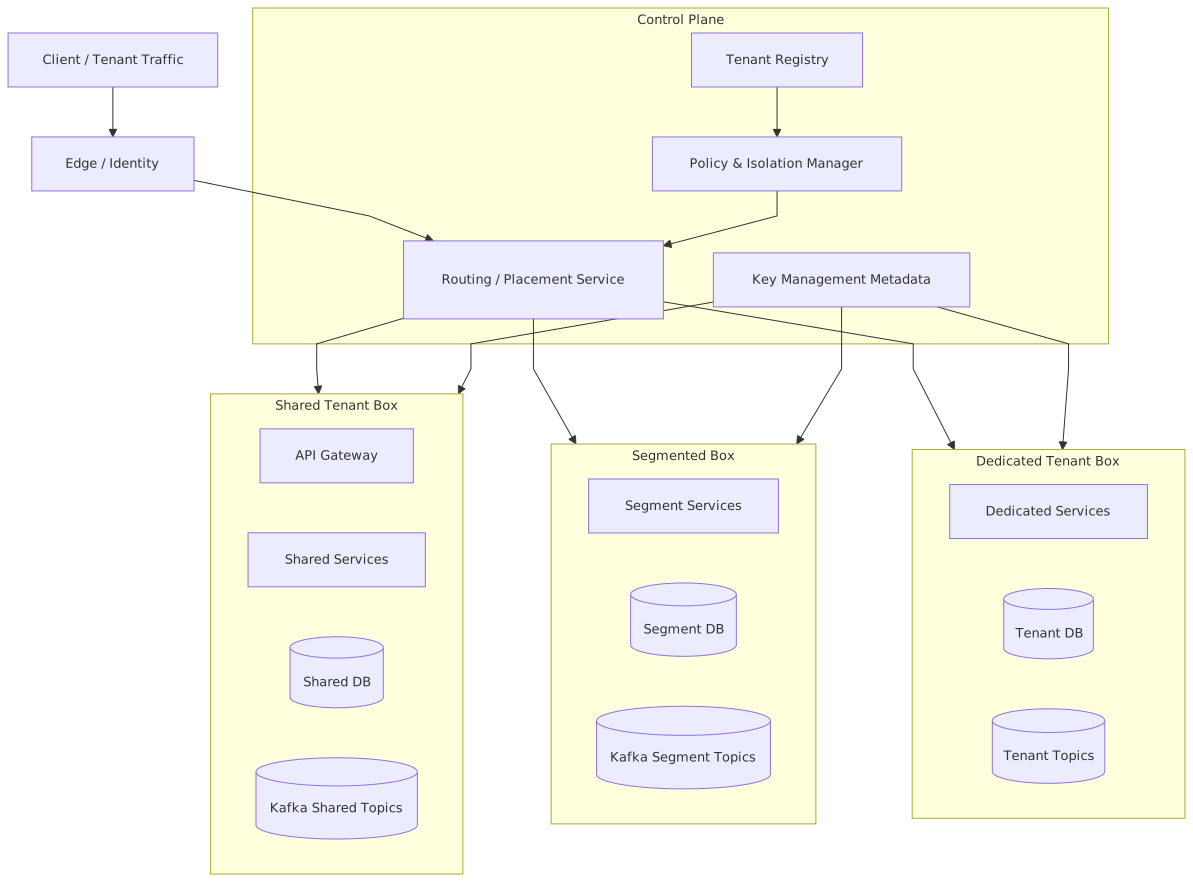
This is not just a deployment pattern. It is a product strategy. It lets you sell different isolation guarantees without inventing a new software company each time.
Architecture
A sound architecture for multi-tenant isolation has a few non-negotiables.
Tenant identity as a domain concept
Tenant identity must be explicit in the ubiquitous language. Not buried in middleware. Not implied by a JWT claim and forgotten.
You need a domain model that distinguishes at least:
- tenant
- organization or account
- workspace or subscription
- legal entity
- region or residency boundary
- isolation tier
- environment placement
In many enterprises, a customer account maps to multiple operational tenants. That is normal. A global enterprise may require separate tenants by geography, subsidiary, or data sensitivity. Treating “customer” and “tenant” as synonyms leads to ugly exceptions later.
DDD helps here because bounded contexts often need different interpretations. In the billing context, the customer account is primary. In identity and access, organization and user affiliation matter. In data protection, legal entity and residency may dominate. In runtime placement, the deployment tenant matters most.
Do not force one model to do every job.
Isolation enforcement at multiple layers
One line of defense is not enough. Good platforms use layered isolation:
- identity claims
- API authorization
- service-level tenant context propagation
- database-level partition controls
- topic naming and ACLs in Kafka
- cache key scoping
- object storage prefixing or bucket isolation
- encryption key policy
- observability dimensions and access control
The reason is simple: failures happen at seams. If tenant isolation exists only in application code, one bad query can leak data. If it exists only in the database, events or caches may still mix tenant state. Defense in depth is not fashionable architecture poetry. It is survival.
Shared control plane, variable data plane
The cleanest enterprise approach is one control plane managing multiple data-plane topologies. The control plane owns onboarding, tenant metadata, policy decisions, placement, migration state, feature flags, and routing rules.
The data plane can then vary:
- fully shared for standard tenants
- dedicated data stores for heavy or regulated tenants
- isolated runtimes for high-risk workloads
- mixed placement by bounded context
For example, a tenant may use shared identity, shared notification services, and shared billing, but have isolated order processing and audit storage. That is perfectly reasonable if the domain and risk profile justify it.
Kafka and event-driven isolation
Kafka helps when used with discipline. It can decouple services, support replay, and simplify migration through dual-write or bridge patterns. But it can also become the place where tenant leakage goes to scale.
There are several viable patterns:
- shared topics with tenant ID in key and payload
- topic-per-segment
- topic namespace per dedicated tenant
- cluster-per-regulated domain in extreme cases
My preference is pragmatic:
- use shared topics for ordinary low-risk event flows at scale
- use namespace or topic isolation for premium or dedicated boxes
- reserve separate clusters for exceptional regulatory or operational reasons
Events must carry tenant context as immutable metadata. Consumers must treat tenant identity as part of message validity, not optional decoration.
Data and state reconciliation
Any architecture that supports tenant movement needs reconciliation as a built-in capability. Once data is replicated between shared and isolated boxes, drift becomes possible.
You need to know:
- what was copied
- what changed during the move window
- what events were replayed
- what side effects already happened
- what remains unmatched
Reconciliation is not glamorous, but it is the difference between a migration and a public apology.
A robust model includes:
- immutable migration IDs
- per-aggregate version tracking
- event offsets or checkpoints
- idempotent consumers
- audit records comparing source and target counts, hashes, or semantic invariants
- compensating workflows for missed side effects
This matters particularly in microservices landscapes. Data is rarely in one place. You are reconciling databases, topics, indexes, caches, and integration outputs. microservices architecture diagrams
Here is a useful conceptual model.
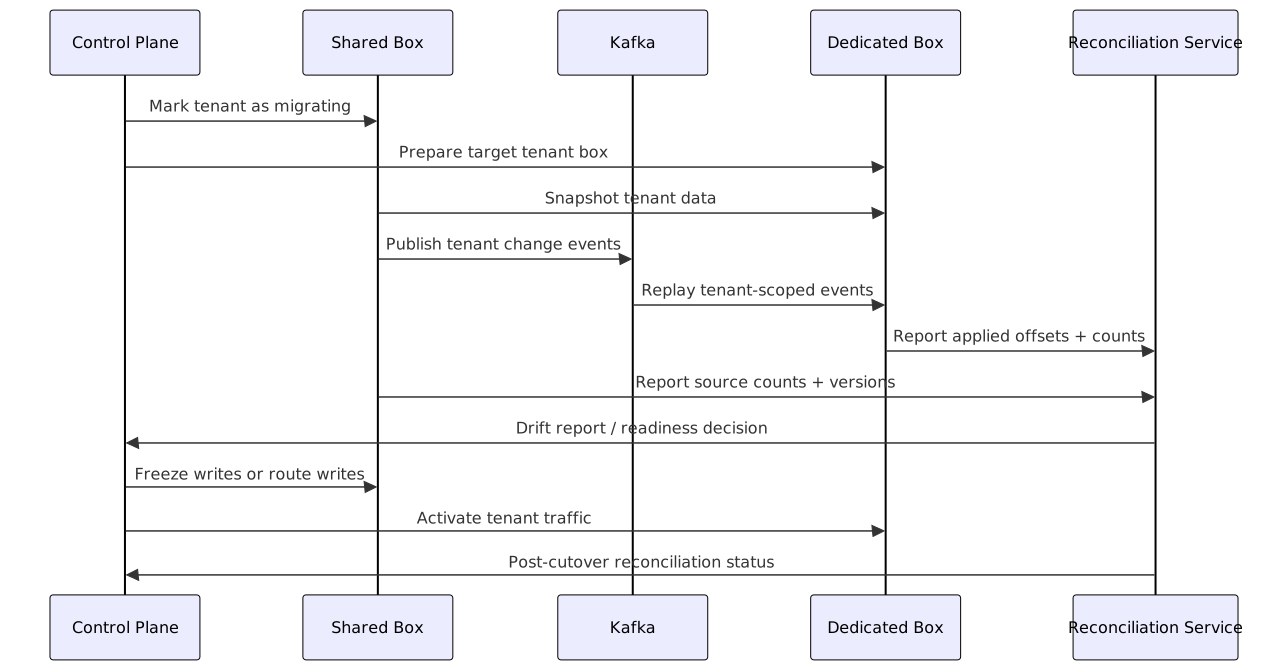
The important point is this: reconciliation should be designed before migration, not after the first discrepancy.
Migration Strategy
Most platforms do not get to design this from scratch. They start shared, then discover that not all tenants belong in the same box.
This is where the progressive strangler pattern earns its reputation. You do not replace the world. You carve out the tenant placement capability gradually.
A sensible migration path looks like this.
Stage 1: Make tenant context explicit everywhere
If tenant identity is not consistently propagated, stop and fix that first. Every API, service call, event, log, and write path must carry tenant context explicitly and verifiably.
Without this, you cannot migrate safely because you cannot even observe the system correctly.
Stage 2: Introduce a tenant registry and placement service
Create a source of truth that records:
- tenant identity
- isolation tier
- hosting location
- region
- encryption policy
- migration status
- feature compatibility
This is the start of the control plane. Existing services still run as before, but placement decisions now come from metadata instead of assumptions.
Stage 3: Decouple ingress from storage location
Introduce routing so that service requests can be directed to shared or isolated boxes transparently. At first, all tenants may still route to the shared box. That is fine. The point is to create indirection.
This is the moment where teams complain about complexity. They are right. It is additional complexity. It is also the complexity that buys future optionality.
Stage 4: Strangle one bounded context at a time
Do not migrate the whole platform in one wave. Pick one bounded context with a strong business reason—say document storage, reporting, order management, or audit logs—and make it placement-aware.
Contexts differ in migration difficulty. Stateless APIs are easy. Reporting stores are manageable. Transactional domains with many side effects are harder. Identity is often nastier than people expect. Billing is nastier than people admit.
Stage 5: Use snapshot + change replay
For live tenants, the proven approach is:
- snapshot tenant state from the source
- replay tenant-scoped changes from Kafka or CDC stream
- compare source and target using reconciliation rules
- cut over when lag and drift are acceptable
This is less dramatic than a big-bang migration and far safer.
Stage 6: Cut over per capability, not necessarily per tenant in one instant
A tenant may move in phases. Search first. Then documents. Then transactional core. Then reporting. There is no virtue in pretending migration must be monolithic.
Just be honest in your domain contracts about where the source of truth lives during each phase.
Stage 7: Retire shared dependencies carefully
After migration, shared components still contain old assumptions. Background jobs, support tooling, reporting extracts, and admin consoles are often the last places to be tenant-safe. They are also common leak paths. Retire or refactor them deliberately.
Here is a strangler-style migration view.

This is not glamorous work. It is carpentry. But enterprise architecture is mostly carpentry with better slideware.
Enterprise Example
Consider a global B2B procurement SaaS provider serving mid-market firms and a handful of multinational manufacturers. In the early years, the platform used a classic shared model:
- one application tier
- one primary relational database
- tenant ID on all major tables
- shared Kafka topics for domain events
- one reporting warehouse
- one deployment cadence for everyone
It worked well until three things happened.
First, several large manufacturers demanded regional data residency and stricter audit isolation. Second, one tenant’s month-end batch processing started hammering shared database resources and increasing latency for everyone else. Third, the sales team promised “dedicated environments” to close a strategic account, without appreciating what that implied.
The platform team could have forked the product into a hosted enterprise edition. That is the road to sorrow. Instead, they introduced a control plane with a tenant registry, policy engine, and placement service. They redefined the domain model so that a customer account could map to multiple operational tenants by region. Procurement workflows remained a shared product capability, but audit, document storage, and analytics became placement-aware bounded contexts.
The new shape looked like this:
- identity and billing remained shared
- order and invoice processing moved to segmented data stores for premium tenants
- audit logs and document repositories used dedicated storage and keys for regulated tenants
- Kafka topics remained shared for low-risk events, but premium tenants received namespace-isolated topics for operationally sensitive streams
- the reporting warehouse ingested from both shared and isolated sources with strict provider-side access controls
Migration used snapshot and event replay. For each strategic tenant, the team copied procurement documents and transactional state into a dedicated box, replayed tenant-scoped Kafka events, and ran reconciliation comparing order counts, invoice totals, document hashes, and audit sequence continuity. Only after those checks passed did they switch routing. event-driven architecture patterns
The business result was worth the architectural effort:
- premium isolation became a sellable service tier
- noisy-neighbor incidents dropped sharply
- regulated customers passed audits more easily
- the provider retained one product roadmap and one control plane
The cost also became visible:
- observability became more complex
- support tooling had to understand tenant placement
- deployment automation had to manage more targets
- some cross-tenant analytics became slower and more governed
That is a fair trade. Complexity moved from accidental to intentional.
Operational Considerations
Isolation strategies succeed or fail in operations, not diagrams.
Observability
Every log, metric, trace, and alert should be tenant-aware—but not in a way that leaks tenant-sensitive data to everyone. This means carefully designed dimensions and role-based access to operational data.
At scale, cardinality becomes a problem. You cannot naively add tenant ID as a metric label everywhere and expect your monitoring bill not to explode. Use aggregation wisely: tier, segment, workload class, and top-tenant exception dashboards often work better than universal per-tenant labels.
Capacity and noisy-neighbor management
Shared boxes need explicit workload governance: EA governance checklist
- rate limits
- queue quotas
- concurrency controls
- tenant-aware scheduling
- query guards
- batch windows
If you do not have these, “shared” really means “first one to abuse it wins.”
Security and keys
Encryption policy is often where logical isolation starts to feel inadequate. Per-tenant keys provide stronger separation and cleaner compliance narratives, but they also multiply lifecycle management. Rotation, revocation, backup access, and restore workflows all get harder.
Use per-tenant keys where the business value is real. Do not reach for them as decoration.
Backup and restore
A shared database with row-level tenancy is efficient until a single tenant asks for point-in-time restore without affecting anyone else. Suddenly the economics change. Tenant-level backup and restore requirements often push you toward schema, database, or storage isolation faster than application concerns do.
Support and administration
Provider-side admin tools are classic sources of cross-tenant leakage. If support can search across all tenant data casually, your technical isolation story has holes even if your database diagrams look noble.
Admin capabilities must be audited, least-privilege, and context-bound. The provider is part of the threat model.
Tradeoffs
There is no perfect model. Only managed compromise.
Shared tenant boxes offer:
- lower cost
- simpler releases
- better pooled utilization
- easier aggregate analytics
- faster product iteration
But they suffer from:
- larger blast radius
- harder compliance narratives
- trickier tenant-level restore
- noisy neighbors
- greater risk of cross-tenant leakage if controls are weak
Dedicated tenant boxes offer:
- stronger isolation
- clearer compliance posture
- independent scaling
- easier custom maintenance windows
- cleaner tenant-specific backup and key policies
But they cost you:
- more infrastructure
- more deployment targets
- more automation burden
- more support complexity
- more drift risk
- temptation toward customer-specific customization
The middle ground—segmented isolation—is often the most useful and the least admired. It lacks the ideological purity of either extreme, which is usually a sign it belongs in enterprise architecture.
Failure Modes
Architects should be judged not just by the happy path but by whether they can describe how the design fails.
1. Tenant confusion in the domain model
You modeled tenant, customer, workspace, and legal entity as one thing. Then one enterprise customer needs multiple residency zones and shared users across subsidiaries. The system responds with hacks. Authorization rules become folklore. Incidents follow.
2. Isolation at only one layer
You filter by tenant in SQL, but your cache keys are global. Or your events omit tenant metadata. Or your search index doesn’t enforce scope. One missed seam is enough to create a breach.
3. The dedicated environment snowflake trap
You start offering dedicated boxes, then allow version skew, custom integrations, custom patch windows, and manual ops exceptions. Soon every strategic tenant is a pet, not cattle. Costs soar. Release confidence dies.
4. Migration without reconciliation
Teams snapshot and replay data, cut over, and trust that all is well. It isn’t. Webhooks duplicate. Search indexes lag. Reporting totals drift. Someone notices during quarter close. This is a very expensive way to learn to respect reconciliation.
5. Kafka topic design that ignores tenant skew
One large tenant dominates a shared partition strategy, consumer lag grows, and smaller tenants suffer. Shared eventing only works when partitioning and quotas acknowledge reality.
6. Control plane immaturity
If the tenant registry, routing metadata, or policy engine is wrong, the platform may send traffic to the wrong box. Centralized placement is powerful. It is also a concentrated point of failure. Treat the control plane as production-critical.
When Not To Use
There are cases where elaborate multi-tenant isolation machinery is the wrong answer.
Do not use a sophisticated hybrid isolation platform if:
- you have a small product with modest growth and no meaningful enterprise isolation demands
- your domain has extremely low tenant count and very high contractual separation from day one
- your customers are governments, defense, or ultra-regulated institutions that effectively require dedicated environments always
- your team cannot support the operational automation required for multiple tenant boxes
- your product economics cannot sustain premium isolation options
Sometimes the honest answer is simpler:
- either run a straightforward shared SaaS
- or run dedicated customer environments as a managed service
The hybrid model pays off when you have meaningful tenant diversity and a real need to move up the isolation ladder over time.
Related Patterns
Several patterns sit close to this problem.
Bounded Context
Use different isolation strategies per context. Billing, identity, audit, and transactional core do not need identical topology.
Control Plane / Data Plane
Essential for managing placement, policy, and migration without entangling runtime business logic.
Strangler Fig
The right migration approach when evolving from fully shared to hybrid isolation. Replace assumptions incrementally.
Event-Carried State Transfer
Useful for migration, read model propagation, and reconciliation, especially with Kafka.
Anti-Corruption Layer
Important when legacy shared systems and new dedicated boxes interpret tenant semantics differently.
Cell-Based Architecture
A good fit when the platform grows large enough that segmented tenant boxes become repeatable cells rather than ad hoc environments.
Bulkhead
Particularly relevant for noisy-neighbor containment in shared systems.
Summary
Multi-tenant isolation is not a database choice. It is a domain and platform design problem disguised as an infrastructure debate.
The right question is not whether your SaaS is shared or isolated. The right question is: which tenant boxes need to be isolated, for which bounded contexts, for which tenants, and how will you move tenants between them safely?
If you begin with domain semantics, make tenant placement explicit, separate control plane from data plane, enforce isolation in layers, and build reconciliation into migration from the start, you can support a sensible spectrum of tenant needs without splitting your product into chaos.
Shared boxes are efficient. Dedicated boxes are reassuring. Hybrid isolation is where most serious SaaS platforms eventually land.
That is not indecision. It is architecture growing up.
Frequently Asked Questions
What is enterprise architecture?
Enterprise architecture aligns strategy, business processes, applications, and technology in a coherent model. It enables impact analysis, portfolio rationalisation, governance, and transformation planning across the organisation.
How does ArchiMate support architecture practice?
ArchiMate provides a standard language connecting strategy, business operations, applications, and technology. It enables traceability from strategic goals through capabilities and services to infrastructure — making architecture decisions explicit and reviewable.
What tools support enterprise architecture modeling?
The main tools are Sparx Enterprise Architect (ArchiMate, UML, BPMN, SysML), Archi (free, ArchiMate-only), and BiZZdesign. Sparx EA is the most feature-rich, supporting concurrent repositories, automation, scripting, and Jira integration.