⏱ 43 min read
Energy Sector Enterprise Architecture Blueprint Sparx EA best practices
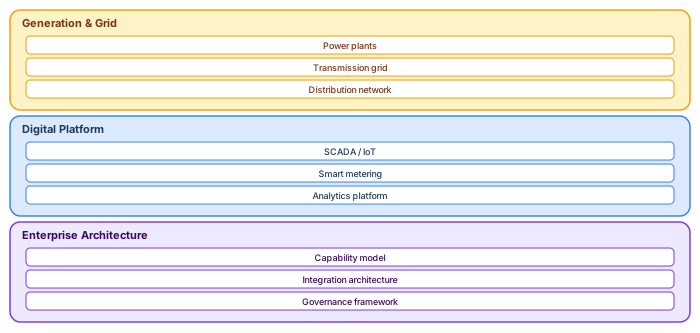
(Transmission System Operator / Energy Utility Perspective)
1. Executive Summary
1.1 Purpose of This Blueprint
The energy sector is undergoing one of the most profound transformations in its history. Decarbonization, decentralization, digitalization, and geopolitical volatility are reshaping how electricity is generated, transmitted, traded, and consumed. In this environment, incremental optimization is no longer sufficient. What is required is structural coherence — a deliberate alignment between strategy, operations, technology, and governance.
This Enterprise Architecture Blueprint provides that coherence. free Sparx EA maturity assessment
Its purpose is to translate strategic ambition into a structured architectural vision that guides decision-making across the enterprise. It establishes a shared language between business leaders, operational teams, architects, and technologists. It clarifies what the organization is becoming, how its capabilities must evolve, and which architectural foundations are required to support that evolution.
This document is not an IT plan. It is an enterprise instrument. It connects grid reliability, market operations, asset stewardship, customer engagement, regulatory obligations, cybersecurity, and sustainability objectives into one integrated architectural perspective.
It defines both the direction of travel and the guardrails that ensure disciplined execution.
1.2 Scope of the Blueprint
The blueprint spans the full enterprise architecture landscape and aligns with TOGAF principles and lifecycle phases. It addresses: TOGAF roadmap template
- Business Architecture — capabilities, value streams, organizational model, and target operating model.
- Data & Information Architecture — governance, ownership, real-time operational data, analytical platforms, and AI enablement.
- Application Architecture — system landscape rationalization, integration patterns, modularization, and digital platforms.
- Technology Architecture — hybrid infrastructure, IT/OT convergence, resilience, and cybersecurity.
The scope explicitly includes both Information Technology (IT) and Operational Technology (OT). In the energy sector, grid control systems, asset telemetry, and market platforms are mission-critical and inseparable from enterprise systems. Architectural decisions must therefore respect safety, latency, regulatory, and resilience constraints that go beyond typical corporate IT environments.
This blueprint focuses on the medium- to long-term target state (three to five years), while also defining transition architectures that enable controlled evolution from the current landscape.
1.3 Strategic Context
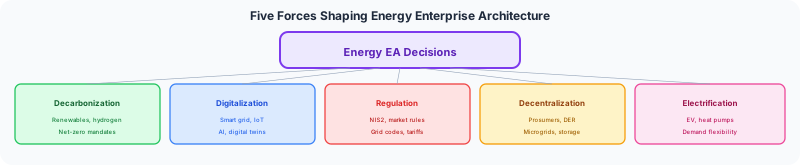
Energy utilities today operate within a delicate equilibrium:
- Increasing penetration of intermittent renewables
- Electrification of transport and heating
- Rapid growth of distributed energy resources
- Heightened cybersecurity risks
- Expanding regulatory oversight
- Rising customer expectations for transparency and digital interaction
At the same time, infrastructure investments are capital-intensive, asset lifecycles extend over decades, and operational stability is non-negotiable. Reliability remains paramount.
The enterprise must therefore balance innovation with prudence. It must modernize without compromising safety. It must digitize without fragmenting its architecture. It must accelerate while maintaining grid stability and regulatory compliance.
Enterprise Architecture provides the discipline to achieve this balance.
1.4 Target State Vision
The envisioned future state is characterized by:
- A capability-driven operating model aligned with strategic objectives
- A data-centric architecture enabling real-time visibility and advanced analytics
- Modular, API-driven application ecosystems
- Event-driven integration supporting flexibility markets and distributed assets
- Hybrid infrastructure optimized for critical workloads and digital innovation
- Converged IT/OT governance ensuring security and operational integrity
- Architecture governance embedded in investment and delivery processes
In this future state, architecture is not a documentation exercise — it is an operational capability. It informs portfolio prioritization, guides solution design, and reduces systemic risk.
1.5 Transformation Themes
The transformation journey is structured around several architectural themes:
- Grid Digitalization — enhanced observability, automation, and predictive operations.
- Data as a Strategic Asset — enterprise-wide governance and advanced analytics enablement.
- Platformization — reusable digital platforms instead of siloed solutions.
- Resilience & Cybersecurity by Design — zero-trust principles and segmented architectures.
- IT/OT Convergence — structured integration between enterprise systems and operational networks.
- Sustainable Architecture — energy-efficient infrastructure and ESG-aligned reporting capabilities.
Each theme is reflected throughout this blueprint and will be translated into architectural building blocks, roadmaps, and governance mechanisms in subsequent sections.
1.6 A Living Architectural Instrument
This blueprint is not static. It establishes a baseline, defines a target, and frames the transformation path — but it is intended to evolve as regulatory, technological, and market conditions change.
Enterprise Architecture must be continuous. It must monitor signals, assess impact, and adapt the architectural landscape without losing structural integrity.
This document therefore serves both as a strategic compass and as a governance foundation — ensuring that as the energy ecosystem transforms, the enterprise evolves deliberately, coherently, and securely.
2. Architecture Governance & Methodology
Enterprise Architecture only delivers value when it is embedded in decision-making. In a capital-intensive, safety-critical energy environment, architecture must not remain theoretical. It must guide investments, shape programs, and influence operational risk management.
This section defines how architecture is governed, how it aligns with TOGAF principles, and how it becomes a disciplined capability rather than a documentation exercise.
2.1 Adoption of the TOGAF Framework
The architecture practice is structured in alignment with TOGAF, adapted pragmatically to the realities of the energy sector.
The Architecture Development Method (ADM) is not followed mechanically; instead, it is institutionalized as a lifecycle:
- Preliminary & Vision → Strategy translation and principle definition
- Business, Data, Application, Technology Architecture → Target-state design
- Opportunities & Solutions → Portfolio alignment and initiative shaping
- Migration Planning → Transition architectures and phased roadmaps
- Implementation Governance → Design authority and compliance oversight
- Change Management → Continuous evolution
In practice, architecture operates as a continuous loop — synchronizing corporate strategy cycles, regulatory changes, infrastructure programs, and digital initiatives.
The organization adopts capability-based planning and architecture building blocks (ABBs) and solution building blocks (SBBs) to maintain traceability from strategic intent to implementation.
2.2 Architecture Principles
Architecture principles provide stable guardrails for decision-making across projects and domains. They prevent fragmentation and reduce long-term systemic risk.
Key categories include:
Business Principles
- Business capabilities drive technology investments
- Regulatory compliance is non-negotiable
- Safety and reliability take precedence over optimization
Data Principles
- Data is an enterprise asset
- Single authoritative sources for master data
- Real-time visibility for operational critical domains
Application Principles
- Modular, loosely coupled systems
- API-first and event-driven integration
- Buy before build (unless differentiation requires otherwise)
Technology Principles
- Hybrid infrastructure strategy
- Security by design
- Observability and resilience as architectural defaults
These principles are reviewed periodically but remain intentionally stable to ensure architectural continuity.
2.3 Architecture Governance Model

Architecture governance is structured across three levels:
1. Strategic Architecture
Defines enterprise-wide target states, standards, and principles. Aligned with executive leadership and investment committees.
2. Domain Architecture
Business, Data, Application, and Technology domains own standards, patterns, and reference models. Ensures consistency within functional areas (e.g., grid operations, market systems, corporate IT).
3. Solution Architecture
Operates at program and project level. Ensures alignment with enterprise standards while adapting to delivery constraints.
Architecture governance is integrated into portfolio management and funding processes. No major investment proceeds without architectural assessment.
2.4 Architecture Review Board (ARB)
The Architecture Review Board formalizes governance and enforces accountability.
Its responsibilities include:
- Reviewing major solution designs
- Validating compliance with principles and standards
- Managing architectural exceptions
- Assessing technical debt implications
- Ensuring cybersecurity and resilience alignment
The ARB operates transparently, with documented decisions and Architecture Decision Records (ADRs). Exceptions are time-bound and risk-assessed rather than informally tolerated.
2.5 Architecture Repository & Tooling
The architecture repository serves as the institutional memory of the enterprise.
It contains:
- Capability models
- Value streams
- Domain models
- Application landscapes
- Integration patterns
- Technology reference models
- Roadmaps and transition architectures
- Architecture Decision Records
Models are maintained using standardized notations (e.g., ArchiMate for cross-domain views, BPMN for processes, UML where appropriate).
The repository is not static documentation; it is actively maintained and linked to portfolio planning and project governance processes.
2.6 Compliance, Risk & Regulatory Oversight
Energy utilities operate under strict regulatory and security frameworks. Architecture governance therefore integrates:
- Critical infrastructure protection requirements
- Cybersecurity directives
- Data protection regulations
- Operational risk frameworks
- Grid reliability obligations
Architecture reviews explicitly evaluate:
- Network segmentation and IT/OT separation
- Identity and access controls
- Data sovereignty
- Resilience and disaster recovery
- Safety impacts
Regulatory constraints are treated as architectural requirements, not as post-design validations.
2.7 Continuous Architecture & Change Management
The energy landscape evolves rapidly — flexibility markets, distributed energy resources, hydrogen integration, and digital grid automation introduce new architectural demands.
To respond effectively, architecture governance includes:
- Periodic target state reassessment
- Technology radar reviews
- Regulatory impact analysis
- Controlled experimentation frameworks
- Innovation governance pathways
Architecture is therefore positioned as a living capability — balancing stability and adaptability.
2.8 Integration with Investment & Portfolio Management
Architecture governance is embedded in financial governance.
Every major initiative must demonstrate:
- Alignment with target architecture
- Contribution to capability uplift
- Reduction of technical debt or risk exposure
- Clear transition-state positioning
This ensures that transformation investments incrementally move the enterprise toward its defined future state, rather than creating isolated modernization islands.
Closing Perspective
Architecture governance is not about control for its own sake. It exists to protect systemic integrity in a mission-critical environment.
In an energy utility, fragmentation introduces risk — operational, financial, and reputational. Governance ensures that as the organization innovates and scales, it does so deliberately, coherently, and securely.
3. Business Architecture (TOGAF Phase B)
Business Architecture defines what the enterprise does, why it does it, and how value is created and sustained in a rapidly transforming energy ecosystem.
In a utility context, this domain is foundational. Technology does not define the enterprise — capabilities do. Systems, data platforms, and infrastructure exist to enable reliable grid operations, efficient markets, asset stewardship, regulatory compliance, and long-term sustainability.
This section articulates the capability model, value streams, and target operating model that guide all downstream architectural domains.
3.1 Business Context & Industry Model
The energy sector operates within a tightly interdependent ecosystem composed of:
- Generation assets (conventional and renewable)
- Transmission and distribution networks
- Market operators and balancing mechanisms
- Large industrial consumers and distributed prosumers
- Regulators and cross-border coordination bodies
The enterprise must ensure:
- Continuous grid stability
- Real-time balancing of supply and demand
- Integration of intermittent renewables
- Transparent and compliant market operations
- Secure and resilient infrastructure
The operating environment is characterized by:
- Increasing electrification (transport, heating, industry)
- Distributed energy resources and storage
- Flexibility markets and demand response mechanisms
- Cross-border energy exchanges
- Heightened cybersecurity threats
- ESG and decarbonization targets
Business Architecture must therefore support operational excellence, regulatory discipline, and adaptive innovation simultaneously.
3.2 Enterprise Capability Model
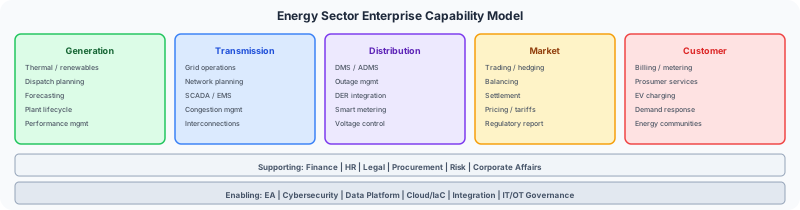
The enterprise capability model defines what the organization must be able to do — independent of current systems or organizational structures.
Capabilities are stable constructs that outlive projects and technologies. They form the backbone of investment prioritization and transformation planning.
Core Operational Capabilities
- Grid Planning & Expansion
- Network Operations & Control
- System Balancing & Congestion Management
- Asset Lifecycle Management
- Outage & Incident Management
- Infrastructure Maintenance & Field Operations
Market & Commercial Capabilities
- Market Operations & Settlement
- Capacity & Flexibility Management
- Customer / Prosumer Management
- Contract & Tariff Management
- Billing & Financial Settlement
Regulatory & Governance Capabilities
- Regulatory Reporting
- Compliance Management
- Risk & Control Management
- ESG & Sustainability Reporting
Corporate & Enabling Capabilities
- Financial Management
- Procurement & Supply Chain
- Human Capital Management
- IT & Digital Services
- Cybersecurity & Resilience Management
Each capability is assessed across maturity dimensions:
- Process standardization
- Automation level
- Data quality
- System support
- Risk exposure
This maturity assessment informs prioritization and investment sequencing.
3.3 Value Streams

Value streams describe how capabilities interact to deliver measurable outcomes.
In the energy utility context, key value streams include:
1. Plan & Invest in Infrastructure
From long-term demand forecasting to capital project execution and asset commissioning.
2. Connect Asset to Grid
From connection request through technical assessment, approval, installation, and activation.
3. Operate & Balance the Network
Real-time monitoring, dispatch, congestion management, and balancing interventions.
4. Maintain & Renew Assets
Preventive maintenance, predictive analytics, field execution, and asset retirement.
5. Manage Market Transactions
Market clearing, nomination, scheduling, imbalance settlement, and financial reconciliation.
Each value stream crosses organizational silos and depends on integrated data and systems.
Business Architecture ensures these streams are optimized end-to-end rather than locally optimized within departments.
3.4 Target Operating Model
The Target Operating Model (TOM) translates capabilities into organizational design and governance structures.
- Key characteristics of the target model include:
- Capability-Based Organization
- Ownership of capabilities rather than purely functional silos.
- Clear Process Ownership
- End-to-end accountability for value streams.
- Digital-by-Default Processes
- Automation embedded in planning, operations, and reporting.
- IT/OT Collaboration
- Structured governance between enterprise IT and operational control domains.
- Risk-Integrated Decision-Making
Operational risk and cybersecurity considered in business decisions, not treated as afterthoughts.
The TOM ensures that strategic ambitions — such as increased renewable integration or advanced analytics — are operationally realizable.

3.5 Business Process Architecture
Business processes operationalize capabilities and value streams.
The process architecture defines:
- Core operational processes (real-time and batch)
- Supporting and enabling processes
- Governance and control processes
Special attention is given to:
- Real-time operational processes (grid control, dispatch)
- High-criticality processes (incident response, outage management)
- Regulatory reporting processes with strict timelines
- Cross-border coordination processes
Process standardization reduces operational risk and enhances automation potential.

3.6 Capability Maturity & Gap Analysis
Business Architecture is not only descriptive; it is diagnostic.
Each major capability is evaluated against:
- Strategic importance
- Current maturity
- Risk exposure
- Digital enablement level
- Data readiness
Gaps between current and target maturity define transformation initiatives.
For example:
- Low data maturity in asset lifecycle management may justify predictive maintenance programs.
- Fragmented market systems may trigger platform consolidation.
- Manual regulatory reporting may require structured data governance investments.

3.7 Business Architecture as a Transformation Anchor
Business Architecture anchors all other domains.
- Data Architecture supports capability intelligence.
- Application Architecture enables process automation.
- Technology Architecture ensures resilience and scalability.
Without a clear capability model and value stream orientation, digital transformation risks becoming technology-led rather than business-led.
In a mission-critical energy enterprise, that risk is unacceptable.
Business Architecture therefore acts as the strategic backbone — ensuring that transformation investments systematically strengthen the enterprise’s ability to operate reliably, comply rigorously, and innovate responsibly.
4. Information & Data Architecture (TOGAF Phase C – Data)
In a modern energy enterprise, data is not a by-product of operations — it is an operational asset. Grid stability depends on telemetry. Market efficiency depends on accurate settlement data. Regulatory compliance depends on traceable, auditable information flows. Advanced analytics and AI depend on trustworthy, well-governed datasets.
Information & Data Architecture defines how data is structured, governed, secured, and leveraged across the enterprise.
This domain is foundational for digital grid operations, predictive maintenance, flexibility markets, and enterprise transparency.
4.1 Data Strategy
The enterprise adopts a data-as-a-strategic-asset philosophy built on the following principles:
- Data ownership is explicit and accountable.
- Authoritative sources are clearly defined.
- Data is discoverable, governed, and secured by design.
- Operational and analytical use cases are architected deliberately.
- Data quality is measured and managed continuously.
The data strategy supports both real-time operational decision-making and long-term strategic analytics.
4.2 Core Data Domains

The enterprise data landscape is structured into logical domains to ensure clarity of ownership and governance.
1. Grid & Topology Data
- Network models
- Substation configurations
- Transmission and distribution mappings
- Interconnection structures
Highly sensitive and operationally critical. Latency and accuracy are paramount.
2. Asset Data
- Asset inventory
- Technical specifications
- Maintenance history
- Lifecycle and depreciation information
Supports predictive maintenance and capital planning.
3. Operational & Telemetry Data
- SCADA measurements
- Real-time system state
- Event logs
- Fault and outage signals
Characterized by high velocity and strict availability requirements.
4. Market Data
- Bids and offers
- Capacity allocations
- Imbalance positions
- Settlement records
Must be accurate, auditable, and regulatory compliant.
5. Customer & Prosumer Data
- Connection details
- Consumption patterns
- Contract information
- Billing and financial transactions
Subject to strict privacy and data protection controls.
6. Corporate & Financial Data
- General ledger
- Procurement
- HR data
- Risk management information
Supports governance, reporting, and investment management.
4.3 Data Governance Framework
Data governance is structured around four pillars:
1. Ownership & Stewardship
Each data domain has:
- Executive Data Owner
- Domain Data Steward
- Technical Custodian
Accountabilities are formalized and embedded in governance processes.
2. Data Quality Management
- Defined quality dimensions (accuracy, completeness, timeliness, consistency)
- Automated validation where possible
- Data quality KPIs integrated into operational dashboards
3. Metadata & Lineage
- Centralized data catalog
- Business glossary
- End-to-end lineage tracking for regulatory reporting
Traceability is especially critical in market settlement and regulatory disclosures.
4. Access & Security
- Role-based access control
- Attribute-based access where required
- Segregation between IT and OT domains
- Encryption and key management standards

4.4 Master Data Management (MDM)
To reduce fragmentation and reconciliation risk, the enterprise defines authoritative sources for:
- Assets
- Network topology
- Market participants
- Customers
- Financial entities
MDM ensures:
- Consistency across systems
- Reduced manual reconciliation
- Reliable regulatory reporting
- Improved analytics quality
Golden records are defined per domain, with synchronization mechanisms designed to avoid tight coupling.
4.5 Real-Time vs. Analytical Data Architecture
Energy utilities operate across two fundamentally different data paradigms:
Operational (Real-Time) Data
- Millisecond-level telemetry
- High availability requirements
- Strict segmentation (IT/OT boundary)
- Deterministic performance constraints
Analytical Data
- Aggregated historical data
- Forecasting and modeling
- AI/ML enablement
- Regulatory reporting
The architecture separates these workloads logically and physically where necessary, while enabling controlled data exchange through secure integration mechanisms.

4.6 Data Platform Architecture
The target data platform consists of layered capabilities:
- Ingestion Layer
- Event-driven pipelines
- Batch ingestion
- Streaming frameworks
- Storage Layer
- Operational data stores
- Data lake / lakehouse architecture
- Structured warehouses for regulatory reporting
- Processing & Transformation Layer
- Real-time stream processing
- ETL/ELT pipelines
- Data enrichment and harmonization
- Consumption Layer
- BI & dashboards
- Advanced analytics
- AI/ML models
- API-based data exposure
Architectural patterns prioritize scalability, auditability, and security.
4.7 Data Security & Sovereignty
Given the critical nature of infrastructure data:
- Sensitive operational data remains within controlled environments.
- Cross-border data flows respect regulatory constraints.
- Segmentation between operational control systems and enterprise IT is enforced.
- Data classification models guide encryption and retention policies.
Cybersecurity is embedded into data architecture rather than appended afterward.
4.8 Advanced Analytics & AI Enablement
The data architecture enables:
- Load forecasting
- Renewable production forecasting
- Predictive asset maintenance
- Congestion prediction
- Market optimization modeling
- ESG performance analytics
AI initiatives are governed through:
- Model validation processes
- Data quality thresholds
- Explainability requirements
- Risk impact assessments
Operational AI use cases undergo stricter validation due to grid reliability implications.
4.9 Data Architecture as a Risk Mitigation Mechanism
In an energy enterprise, poor data quality can translate into:
- Grid instability
- Financial imbalance exposure
- Regulatory penalties
- Cybersecurity vulnerabilities
Information & Data Architecture therefore serves not only innovation goals but also systemic risk reduction.
It ensures that as digitalization accelerates, the enterprise remains reliable, compliant, and analytically empowered.
5. Application Architecture (TOGAF Phase C – Application)
Application Architecture defines how business capabilities are realized through systems, platforms, and digital services. In an energy enterprise, the application landscape is typically heterogeneous — combining decades-old operational systems with modern digital platforms and cloud-native services. enterprise cloud architecture patterns
The objective of this architecture domain is not merely system modernization. It is to establish a coherent, modular, resilient application ecosystem that supports operational stability while enabling controlled innovation.
5.1 Current Application Landscape Overview

The enterprise application landscape can be broadly categorized into five domains:
1. Operational Control Systems
- SCADA systems
- Energy Management Systems (EMS)
- Distribution Management Systems (DMS)
- Substation automation platforms
These systems are mission-critical, real-time, and safety-sensitive.
2. Asset & Field Systems
- Enterprise Asset Management (EAM)
- Work management systems
- Mobile field service applications
- Geographic Information Systems (GIS)
These support infrastructure planning, maintenance, and asset lifecycle optimization.
3. Market & Commercial Systems
- Market clearing platforms
- Settlement systems
- Capacity and flexibility management tools
- Customer and contract management systems
These systems must ensure financial accuracy and regulatory traceability.
4. Corporate Systems
- ERP platforms
- Financial management systems
- Procurement and supply chain
- Human Capital Management
These provide enterprise backbone services.
5. Digital & Analytical Platforms
- Data platforms
- Reporting and BI tools
- Advanced analytics and AI platforms
- API gateways and integration services
The current state often reflects organic growth: overlapping systems, legacy dependencies, manual reconciliation processes, and fragmented integrations.
5.2 Target Application Architecture Principles
The target application architecture is shaped by the following design objectives:
Modularity
Applications are decomposed into clearly defined domains aligned with business capabilities.
Loose Coupling
Integration through APIs and events rather than direct database dependencies.
Platform Orientation
Shared digital platforms provide reusable services instead of duplicative point solutions.
Buy Before Build
Commercial solutions are preferred unless differentiation requires custom development.
Cloud-Appropriate Deployment hybrid cloud architecture
Workloads are deployed based on criticality, latency, and regulatory requirements — not ideology.
5.3 Domain-Aligned Application Architecture
The target model organizes applications by domain ownership:
Grid & Operations Domain
- Operational control systems remain isolated and resilient.
- Edge computing capabilities support substation automation.
- Secure integration bridges enable controlled data exchange with enterprise systems.
Asset Management Domain
- Unified EAM platform with standardized asset master data.
- Integration with predictive analytics models.
- Mobile-enabled field operations.
Market Domain
- Modular market systems with standardized interfaces.
- Event-driven settlement processes.
- Auditability embedded by design.
Corporate Domain
- Consolidated ERP backbone.
- Standardized financial and procurement processes.
- Harmonized master data integration.
Digital Services Domain
- API management platform.
- Identity and access management integration.
- Customer and prosumer digital portals.
5.4 Integration Architecture

Integration is often the most fragile element in legacy-heavy utilities. The target architecture emphasizes:
API-First Design
- Standardized RESTful interfaces
- Versioned contracts
- Governance over API lifecycle
Event-Driven Architecture
- Message brokers for asynchronous communication
- Real-time event streaming for telemetry and market signals
- Decoupled publish/subscribe patterns
Controlled Data Synchronization
- Avoidance of tight database-level coupling
- Master data propagation via governed mechanisms
IT/OT Integration Controls
- Segmented network boundaries
- Secure gateways
- Strict protocol management
The integration layer becomes a strategic asset rather than an accumulation of ad-hoc connectors.
5.5 Legacy Modernization Strategy
Given long asset and system lifecycles, immediate replacement is rarely feasible. The modernization strategy includes:
- Encapsulation of legacy systems via APIs
- Progressive modular replacement
- Strangler-pattern migrations
- Decommissioning roadmap aligned with business value
Modernization decisions are risk-based, not trend-driven. Systems supporting grid control require rigorous validation before change.
5.6 Non-Functional Requirements
Application Architecture is defined as much by non-functional requirements as by functionality.
Key cross-cutting requirements include:
- High availability and fault tolerance
- Cybersecurity hardening
- Performance and latency guarantees
- Observability and monitoring
- Disaster recovery capabilities
- Regulatory auditability
Each application domain inherits baseline security and resilience standards defined at the enterprise level.
5.7 Application Portfolio Governance
Application sprawl introduces cost and risk. Governance mechanisms include:
- Portfolio rationalization reviews
- Technical debt assessments
- Standard technology stacks
- Decommissioning targets
- Vendor risk evaluations
Every new system must demonstrate:
- Capability alignment
- Architectural compliance
- Clear lifecycle management plan
5.8 Application Architecture as a Transformation Enabler
A coherent application landscape enables:
- Faster integration of renewable assets
- Real-time congestion management
- Efficient settlement and financial reconciliation
- Predictive asset optimization
- Digital customer interaction
- Data-driven regulatory reporting
Without architectural discipline, digital initiatives risk creating further silos. With a structured, domain-aligned, modular approach, the enterprise builds a scalable and resilient digital foundation.
6. Technology Architecture (TOGAF Phase D)
Technology Architecture defines the infrastructure foundations that enable business capabilities and application services to operate securely, reliably, and at scale.
In an energy enterprise, technology is not merely an enabler of efficiency — it is a pillar of operational safety and systemic resilience. Infrastructure decisions influence grid stability, cybersecurity posture, regulatory compliance, and disaster recovery readiness.
This section defines the hybrid infrastructure model, IT/OT convergence strategy, cybersecurity baseline, and resilience architecture.
6.1 Infrastructure Strategy
The enterprise adopts a hybrid infrastructure model, guided by workload criticality, latency sensitivity, regulatory constraints, and data sovereignty requirements.
Private Infrastructure (On-Premise / Dedicated Environments)
Reserved for:
- Real-time operational control systems
- Critical telemetry processing
- Sensitive infrastructure data
- High-assurance cybersecurity zones
Characteristics:
- Deterministic performance
- Strict network segmentation
- Hardened physical and logical security
- Redundant power and connectivity
Public / Cloud Infrastructure
Leveraged for:
- Analytical workloads
- Digital services
- Customer-facing platforms
- Elastic compute demands
- AI and data science environments
Characteristics:
- Scalability
- Managed services acceleration
- Rapid experimentation capability
- Cost elasticity
Deployment decisions are principle-driven — critical workloads are not migrated without rigorous impact assessment.

6.2 IT / OT Convergence Model
Operational Technology (OT) and Information Technology (IT) have historically evolved independently. However, modern digital grid operations require controlled convergence.
The target model establishes:
- Clear segmentation between operational control networks and enterprise IT
- Secure, monitored gateways for data exchange
- Protocol mediation layers where necessary
- Zero-trust principles across both domains
Convergence is governed carefully — integration improves visibility and analytics, but isolation protects operational stability.
6.3 Network Architecture
The network architecture is designed around layered security and operational resilience:
- Segmented security zones
- Micro-segmentation for sensitive workloads
- Encrypted communication channels
- Redundant connectivity for critical sites
- Edge computing nodes at substations
Operational sites are architected to withstand communication interruptions while preserving local control capabilities.
Network design reflects the reality that energy infrastructure is classified as critical national infrastructure.
6.4 Cybersecurity Architecture

Cybersecurity is embedded into the architecture rather than layered on top.
The baseline approach includes:
Zero-Trust Principles
- Continuous authentication
- Least-privilege access
- Context-aware authorization
Identity & Access Management
- Centralized identity governance
- Privileged Access Management (PAM)
- Multi-factor authentication
- Strong segregation of duties
Security Monitoring & Response
- Centralized logging
- Security Operations Center (SOC) integration
- Real-time anomaly detection
- Incident response playbooks
OT-Specific Protections
- Intrusion detection for industrial protocols
- Strict change management for control systems
- Vendor access governance
Security controls are risk-based and aligned with regulatory requirements for critical infrastructure.
6.5 Resilience & High Availability
Operational continuity is paramount. Technology Architecture therefore incorporates:
- Active-active or active-passive redundancy
- Multi-site failover capabilities
- Automated backup and recovery mechanisms
- Disaster Recovery (DR) sites geographically separated
- Defined Recovery Time Objectives (RTO) and Recovery Point Objectives (RPO)
Business Continuity Planning (BCP) is integrated with architectural design. Critical processes are mapped to infrastructure dependencies to avoid hidden single points of failure.
Resilience is not confined to data centers — it extends to substations, control rooms, and communication links.
6.6 Platform Engineering & Standardization
To reduce fragmentation and operational complexity, the enterprise defines standardized platform services:
- Container orchestration platforms
- CI/CD pipelines
- Infrastructure-as-Code frameworks
- Observability stacks (monitoring, tracing, logging)
- API gateway platforms
Standardization improves:
- Deployment consistency
- Security posture
- Operational transparency
- Developer productivity
Technology diversity is controlled to prevent ecosystem sprawl.
6.7 Observability & Operational Monitoring
Modern infrastructure requires real-time visibility into:
- Application performance
- Network health
- System capacity
- Security events
- Operational telemetry
Unified observability platforms enable proactive incident detection and predictive capacity planning.
Operational dashboards integrate IT and OT signals to provide a complete operational view.
6.8 Sustainability & Green IT
Technology decisions increasingly incorporate environmental impact considerations:
- Energy-efficient data center design
- Cloud provider sustainability benchmarks
- Hardware lifecycle optimization
- Intelligent workload placement
Sustainable infrastructure aligns with broader decarbonization commitments and ESG reporting requirements.
6.9 Technology Architecture as a Stability Anchor
In a critical energy enterprise, instability at the infrastructure layer can cascade into operational and financial disruption.
Technology Architecture therefore serves as:
- A reliability foundation
- A cybersecurity shield
- A scalability enabler
- A risk mitigation mechanism
It ensures that digital innovation does not compromise operational integrity — and that modernization proceeds within clearly defined safety and resilience guardrails.
7. Cross-Cutting Architecture Domains
While Business, Data, Application, and Technology Architectures define structural layers, certain capabilities cut horizontally across all domains. These cross-cutting architectural concerns ensure coherence, security, operational transparency, and sustainable evolution.
They are not standalone systems; they are enterprise-wide enablers embedded in every initiative and architectural decision.
7.1 Integration Architecture
Integration is the connective tissue of the enterprise. In a utility environment — where operational control systems, market platforms, asset management tools, and financial systems must interact — unmanaged integration quickly becomes systemic risk.
The integration architecture is based on:
- API-first principles
- Event-driven communication
- Loose coupling between systems
- Canonical data models where appropriate
- Version-controlled interface governance
Integration services are treated as reusable enterprise platforms rather than project-level artifacts.
Key design objectives:
- Minimize point-to-point connections
- Avoid database-level dependencies
- Enable scalability and substitution
- Maintain observability across message flows
Integration governance ensures that system interactions remain transparent, auditable, and secure.
7.2 Identity & Access Management (IAM)
Identity is foundational in a critical infrastructure environment.
The IAM architecture supports:
- Centralized identity lifecycle management
- Role-based and attribute-based access control
- Privileged Access Management (PAM)
- Federated identity for partners and market participants
- Strong authentication (MFA)
Identity governance extends to:
- Operational control environments
- Field service personnel
- Third-party vendors
- Cross-border coordination bodies
Access is continuously monitored and periodically reviewed. Segregation of duties is enforced to reduce fraud and operational risk.
IAM is not a technical feature — it is a governance mechanism embedded into enterprise operations.

7.3 DevSecOps & Delivery Architecture
Digital acceleration requires disciplined delivery practices.
The enterprise adopts a DevSecOps model characterized by:
- Automated build and deployment pipelines
- Infrastructure as Code
- Security scanning embedded in CI/CD
- Automated compliance validation
- Version-controlled configuration management
Security and compliance controls are integrated into the delivery lifecycle rather than treated as post-development gates.
Operational systems follow stricter change management protocols, especially in IT/OT convergence zones.
The goal is controlled agility — faster delivery without compromising reliability or safety.
7.4 Observability & Monitoring
Enterprise-wide observability enables proactive management of:
- Application performance
- Infrastructure health
- Integration flows
- Security events
- Data quality metrics
Monitoring is unified where feasible, but logically segmented where required by regulatory or safety constraints.
Observability supports:
- Incident response
- Root cause analysis
- Capacity planning
- Performance optimization
- SLA compliance
In a grid context, early anomaly detection can prevent operational escalation.

7.5 Enterprise Risk & Control Architecture
Risk management is embedded in architecture design.
The cross-cutting risk framework includes:
- Operational risk controls
- Cybersecurity risk modeling
- Data privacy impact assessments
- Third-party risk governance
- Audit traceability mechanisms
Architectural designs must explicitly document:
- Risk assumptions
- Mitigation mechanisms
- Failure scenarios
- Control checkpoints
Architecture thus becomes a proactive risk governance tool.
7.6 Digital Twin & Advanced Simulation

Modern energy enterprises increasingly rely on simulation capabilities:
- Grid state modeling
- Asset performance simulation
- Capacity forecasting
- Congestion prediction
- Infrastructure investment modeling
The Digital Twin strategy integrates:
- Real-time telemetry
- Historical asset data
- Predictive models
- Scenario simulation engines
These capabilities support more informed investment and operational decisions while improving resilience planning.
7.7 Sustainability & ESG Architecture

Sustainability objectives extend beyond reporting — they influence architecture choices.
Cross-cutting ESG architecture enables:
- Automated carbon accounting
- Infrastructure energy efficiency measurement
- Renewable integration analytics
- Transparent sustainability reporting
Architectural decisions consider:
- Energy efficiency of workloads
- Hardware lifecycle impacts
- Data center sustainability benchmarks
Sustainability becomes measurable, not aspirational.
7.8 Standards & Reference Models
Cross-cutting standards ensure consistency across domains:
- Technology reference models
- Security baselines
- Data classification standards
- API design standards
- Modeling conventions (e.g., ArchiMate, BPMN)
Standards are centrally governed but periodically reviewed to avoid rigidity.
They create coherence while allowing controlled evolution.
7.9 Cross-Cutting Architecture as Structural Integrity
These domains provide structural integrity across the enterprise.
Without them:
- Integration becomes fragile
- Identity becomes inconsistent
- Security becomes reactive
- Monitoring becomes fragmented
- Risk becomes opaque
With them, the enterprise operates as a coordinated system rather than a collection of independent solutions.
Cross-cutting architecture ensures that as the organization scales, modernizes, and integrates new energy paradigms, it does so with stability, transparency, and disciplined governance.
8. Opportunities & Solutions (TOGAF Phase E)
With the baseline and target architectures defined, the focus shifts from structure to action. This phase translates architectural intent into concrete initiatives, solution patterns, and prioritized transformation opportunities.
In an energy enterprise, transformation must be deliberate. Investments are capital-intensive, operational stability is non-negotiable, and regulatory obligations constrain experimentation. Therefore, Opportunities & Solutions are evaluated not only for innovation value, but also for systemic impact and risk exposure.
This section defines how gaps are identified, how solution building blocks are structured, and how transformation initiatives are shaped.
8.1 Baseline vs. Target Gap Analysis
Gap analysis evaluates the distance between:
- Current capability maturity and target maturity
- Existing system landscape and modular target architecture
- Current data governance state and desired data discipline
- Current infrastructure resilience and target reliability posture
Gaps typically fall into several categories:
Capability Gaps
- Manual processes limiting scalability
- Insufficient predictive maintenance capability
- Fragmented market settlement processes
Data Gaps
- Inconsistent master data
- Lack of end-to-end data lineage
- Limited real-time analytics
Application Gaps
- Redundant systems
- Tight coupling between legacy applications
- Limited API exposure
Technology Gaps
- Single points of failure
- Inconsistent security controls
- Limited observability
Each gap is evaluated along three dimensions:
- Strategic importance
- Risk exposure
- Complexity of remediation
8.2 Architecture Building Blocks (ABBs)
Architecture Building Blocks define reusable conceptual components aligned with the target state.
Examples include:
- Enterprise API Platform
- Event Streaming Backbone
- Master Data Hub
- Identity & Access Management Platform
- Hybrid Cloud Landing Zone
- Observability Platform
- Digital Twin Framework
ABBs represent architectural intent independent of specific vendors or technologies. They provide stable reference components that guide solution design.
8.3 Solution Building Blocks (SBBs)
Solution Building Blocks are concrete implementations of ABBs within projects.
For example:
- Deployment of an API gateway platform
- Implementation of a unified EAM system
- Introduction of a centralized data catalog
- Establishment of a secure OT data bridge
- Rollout of CI/CD automation toolchain
Each SBB must demonstrate:
- Alignment with defined ABBs
- Compliance with architecture principles
- Integration into the long-term roadmap
SBBs are assessed not only for functional delivery, but for architectural contribution.
8.4 Transformation Themes & Initiative Clusters

Transformation initiatives are grouped into coherent themes to avoid fragmented execution.
Typical initiative clusters include:
Grid Digitalization
- Advanced telemetry expansion
- Predictive maintenance analytics
- Substation automation upgrades
Data & Analytics Enablement
- Enterprise data governance rollout
- Real-time streaming platform deployment
- Advanced forecasting models
Application Modernization
- Legacy encapsulation and API exposure
- Market platform consolidation
- ERP harmonization
Cybersecurity & Resilience Strengthening
- Zero-trust implementation
- Network segmentation enhancements
- Centralized security monitoring
Platform Standardization
- Container orchestration adoption
- Infrastructure-as-Code rollout
- Observability unification
These clusters create structured transformation waves rather than isolated projects.
8.5 Prioritization Framework
Prioritization is based on a balanced evaluation of:
- Regulatory urgency
- Risk reduction potential
- Strategic differentiation
- Operational efficiency gains
- Investment cost and complexity
Quick wins are identified where high impact meets manageable complexity. Structural transformations are sequenced carefully to avoid operational disruption.
In a critical infrastructure context, stability takes precedence over speed.
8.6 Transition Architectures

Large-scale transformation cannot occur in a single step. Transition architectures define intermediate states that are:
- Operationally stable
- Security-compliant
- Financially manageable
Each transition state specifies:
- Systems to be introduced
- Systems to be decommissioned
- Temporary integration patterns
- Risk mitigation measures
Transition architecture ensures that the journey toward the target state does not introduce instability.
8.7 Investment Alignment & Portfolio Integration
Architecture must influence capital allocation.
Each initiative is linked to:
- Capability uplift objectives
- Risk mitigation goals
- Architectural debt reduction
- Regulatory compliance requirements
Portfolio governance integrates architectural scoring into funding decisions. This prevents isolated investments that deviate from the enterprise direction.
Architecture thus becomes a decision-support instrument at executive level.
8.8 Risk Considerations in Solution Design
Every proposed solution undergoes structured risk assessment, including:
- Operational disruption risk
- Cybersecurity exposure
- Vendor lock-in risk
- Data privacy impact
- Long-term maintainability
Solutions are evaluated for sustainability over multi-decade infrastructure lifecycles.
Innovation is encouraged — but always within disciplined architectural guardrails.
8.9 From Architecture to Execution
Opportunities & Solutions mark the transition from blueprint to delivery.
This phase ensures that:
- Architecture is actionable
- Investment is structured
- Risk is transparent
- Transformation is sequenced
In a mission-critical energy enterprise, the difference between ambition and execution lies in disciplined orchestration.
The blueprint now transitions to structured migration planning — where strategic intent becomes time-bound, sequenced transformation.
9. Migration Planning (TOGAF Phase F)
If Opportunities & Solutions define what must change, Migration Planning defines how and when change will occur.
In an energy enterprise, migration is not simply a technical exercise. It is an orchestration challenge across operational continuity, regulatory compliance, cybersecurity integrity, financial discipline, and organizational readiness.
Transformation must proceed without jeopardizing grid stability, market integrity, or safety. Migration Planning therefore structures change into controlled, sequenced transition states.
9.1 Transformation Roadmap (3–5 Year Horizon)

The transformation roadmap defines the staged evolution from baseline to target architecture over a multi-year horizon.
The roadmap is structured into:
- Foundational initiatives (platform, governance, security baseline)
- Capability uplift programs (asset management, market modernization, data governance)
- Infrastructure modernization waves
- Decommissioning milestones
Roadmap characteristics:
- Time-phased and dependency-aware
- Aligned with capital investment cycles
- Coordinated with regulatory timelines
- Structured around measurable capability improvements
The roadmap avoids over-concentration of risk by distributing major change initiatives over time.
9.2 Transition Architectures
Each major phase of transformation defines a formal transition architecture.
A transition architecture includes:
- Interim system landscape
- Temporary integration patterns
- Coexistence models (legacy + new systems)
- Risk mitigation controls
- Performance and resilience safeguards
For example:
- API encapsulation of legacy systems before replacement
- Parallel run strategies for market settlement systems
- Controlled data synchronization during MDM rollout
Transition states are designed explicitly — not allowed to emerge organically.
9.3 Work Package Sequencing & Dependencies
Transformation initiatives are decomposed into structured work packages.
Sequencing considers:
- Technical dependencies
- Resource constraints
- Operational risk windows
- Regulatory reporting cycles
- Outage scheduling constraints
Critical systems are migrated during controlled windows with rollback capabilities.
Dependency mapping ensures that foundational capabilities — such as identity management or integration platforms — are deployed before dependent solutions.
9.4 Risk & Impact Management
Migration introduces risk. Risk must be explicit, not assumed.
Each migration initiative includes:
- Operational impact assessment
- Cybersecurity impact analysis
- Business continuity validation
- Vendor dependency evaluation
- Stakeholder readiness review
High-risk migrations require:
- Simulation testing
- Failover drills
- Phased rollout
- Monitoring intensification during transition
Operational control systems are subject to stricter change governance than enterprise IT domains.
9.5 Decommissioning Strategy
Modernization is incomplete without disciplined decommissioning.
The decommissioning strategy defines:
- Sunset criteria for legacy systems
- Data archival policies
- Regulatory retention requirements
- Technical debt reduction targets
Uncontrolled coexistence of old and new systems introduces cost and risk. Decommissioning is therefore planned as deliberately as deployment.
9.6 Financial & Investment Alignment
Migration planning is aligned with financial governance:
- Capital expenditure phasing
- Operational cost implications
- Total cost of ownership projections
- Vendor contract alignment
Architecture supports executive decision-making by clarifying:
- Long-term savings from rationalization
- Risk reduction impact
- Investment-to-capability traceability
Financial discipline reinforces architectural discipline.
9.7 Organizational Readiness & Change Enablement
Technology migration must be accompanied by organizational alignment.
This includes:
- Capability-based role adjustments
- Training for new systems
- Updated operational procedures
- Governance model adjustments
- Communication to market participants and regulators
Operational staff, market teams, and field engineers must be prepared before new systems are activated.
Architecture transformation is therefore socio-technical — not purely technological.
9.8 Governance During Migration
During migration phases:
- Architecture compliance reviews intensify
- Design authority oversight increases
- Exception handling is tightly managed
- Monitoring and observability are heightened
Architectural integrity must be preserved even under delivery pressure.
9.9 Migration as Risk-Controlled Evolution
Migration Planning ensures that transformation is:
- Sequenced rather than abrupt
- Risk-managed rather than reactive
- Transparent rather than fragmented
- Measurable rather than ambiguous
In a critical energy enterprise, transformation is not about speed alone. It is about disciplined evolution.
The next section formalizes how implementation is governed and how architectural integrity is preserved during delivery.
10. Implementation Governance (TOGAF Phase G)
Defining a target architecture and migration roadmap is only meaningful if implementation remains aligned with architectural intent. Implementation Governance ensures that delivery activities — across programs, projects, vendors, and operational teams — preserve architectural integrity.
In a mission-critical energy environment, deviation from architectural standards is not a minor inefficiency. It can introduce operational fragility, cybersecurity exposure, financial misalignment, and long-term technical debt.
Implementation Governance bridges architecture and execution.
10.1 Architecture Compliance Framework
All major initiatives are subject to structured architecture compliance assessments at defined control points:
- Concept approval
- High-level design review
- Detailed solution design review
- Pre-deployment validation
- Post-implementation verification
Compliance reviews assess:
- Alignment with enterprise architecture principles
- Conformity with reference models and standards
- Integration consistency
- Security baseline adherence
- Data governance alignment
- Resilience and availability design
Non-compliance is formally documented, risk-assessed, and either remediated or approved as a time-bound exception.
Architecture governance is transparent, documented, and traceable.
10.2 Design Authority Model

A Design Authority structure formalizes accountability for architectural decisions.
Enterprise Architecture Authority
- Maintains target-state coherence
- Approves cross-domain design patterns
- Resolves escalated architectural conflicts
Domain Architecture Leads
- Own standards within business, data, application, or technology domains
- Provide guidance to solution architects
- Validate domain-level compliance
Solution Architects
- Translate enterprise standards into project-level designs
- Ensure delivery teams understand architectural constraints
This layered authority model balances centralized coherence with domain expertise.
10.3 Architecture Decision Records (ADRs)
Every significant architectural decision is documented through structured Architecture Decision Records.
ADRs include:
- Context
- Decision statement
- Alternatives considered
- Risk implications
- Consequences and trade-offs
ADRs create institutional memory and reduce repetitive debates. They also support auditability and regulatory transparency where required.
10.4 Vendor & Third-Party Governance
Energy enterprises depend on specialized vendors for control systems, infrastructure, and digital platforms.
Implementation governance therefore extends to:
- Architectural compliance clauses in contracts
- Security requirements embedded in procurement
- Vendor access control and monitoring
- Technical roadmap alignment with enterprise direction
Vendor solutions must integrate into the architecture — not define it unilaterally.
10.5 Security & Regulatory Validation
Before deployment, systems undergo structured validation to ensure:
- Compliance with cybersecurity standards
- Data protection alignment
- Network segmentation adherence
- Operational resilience verification
In high-criticality domains, additional measures include:
- Penetration testing
- Failover simulations
- Disaster recovery validation
- Operational impact assessments
Implementation governance ensures that regulatory compliance is embedded at delivery time — not retrofitted.
10.6 Monitoring Architectural Drift
Over time, incremental changes can gradually erode architectural coherence. To prevent architectural drift:
- Periodic landscape reviews are conducted
- Technical debt indicators are monitored
- Redundant systems are identified and rationalized
- Integration sprawl is tracked
Metrics may include:
- Number of non-standard integrations
- Percentage of systems aligned with target platforms
- Application redundancy ratios
- Infrastructure standardization coverage
Architecture health becomes measurable.
10.7 Continuous Feedback into Architecture
Implementation Governance is not unidirectional.
Lessons learned from delivery feed back into:
- Updated architecture standards
- Revised reference models
- Refined principles
- Adjusted roadmaps
Architecture evolves based on empirical evidence, not theoretical design alone.
10.8 Balancing Control and Agility
Implementation Governance must avoid becoming bureaucratic. The objective is disciplined agility.
Controls are risk-based:
- Critical grid systems require stricter validation cycles.
- Low-risk analytical platforms may follow accelerated review paths.
This proportional approach preserves innovation capacity while protecting operational stability.
10.9 Governance as Structural Safeguard
Implementation Governance ensures that:
- Investments reinforce the target state
- Technical debt is consciously managed
- Cybersecurity posture remains consistent
- Regulatory obligations are respected
- Operational integrity is preserved
Without governance, architecture fragments under delivery pressure. With disciplined oversight, architecture becomes a durable foundation for long-term evolution.
11. Architecture Change Management (TOGAF Phase H)
Architecture is not static. In the energy sector, change is constant — regulatory frameworks evolve, renewable penetration increases, cybersecurity threats intensify, new market mechanisms emerge, and technological capabilities advance.
Architecture Change Management ensures that the enterprise adapts deliberately rather than reactively. It institutionalizes continuous evaluation and structured evolution of the architectural landscape.
This phase transforms Enterprise Architecture from a one-time blueprint into a living governance capability.
11.1 Continuous Architecture Lifecycle
The enterprise adopts a continuous architecture model built around recurring cycles:
- Strategic review alignment (annual or bi-annual)
- Regulatory impact assessment
- Technology radar evaluation
- Capability maturity reassessment
- Architecture compliance feedback loop
Rather than waiting for major transformation programs, architecture adjustments are introduced incrementally and systematically.
This reduces disruption and avoids large-scale corrective overhauls.
11.2 Change Triggers
Architectural review may be triggered by several events:
Regulatory Changes
- New cybersecurity directives
- Market structure adjustments
- Reporting requirements
- Data sovereignty regulations
Market & Industry Shifts
- Growth in distributed energy resources
- Introduction of flexibility markets
- Electrification acceleration
- Cross-border coordination reforms
Technological Evolution
- Cloud platform advancements
- Emerging AI capabilities
- Industrial IoT innovation
- Cybersecurity threat evolution
Internal Drivers
- Major system incidents
- Audit findings
- Capability maturity gaps
- Technical debt accumulation
All triggers are formally assessed for architectural impact.
11.3 Architecture Impact Assessment
When change is triggered, a structured impact assessment is conducted:
- Which business capabilities are affected?
- Which data domains require modification?
- Which applications must evolve?
- Does infrastructure require scaling or redesign?
- What are the cybersecurity implications?
- Are regulatory validations required?
Impact assessments prevent localized changes from generating systemic inconsistencies.
11.4 Innovation Governance Framework
Innovation is essential, but uncontrolled experimentation in critical infrastructure environments can introduce risk.
The enterprise therefore defines controlled innovation pathways:
- Sandboxed experimentation environments
- Isolated proof-of-concept platforms
- Security-reviewed pilot programs
- Controlled production rollouts
Emerging technologies such as:
- AI-driven forecasting
- Digital twin expansion
- Advanced automation
- Edge intelligence
Are evaluated through structured architectural checkpoints before operational adoption.
Innovation is encouraged — but disciplined.
11.5 Technology Radar & Standards Evolution

A formal technology radar process evaluates:
- Maturity of emerging technologies
- Vendor ecosystem stability
- Long-term supportability
- Interoperability with existing platforms
- Cybersecurity posture
Standards are periodically reviewed to ensure relevance. However, change is introduced cautiously to avoid destabilizing the technology stack.
Architectural stability and adaptability are balanced deliberately.
11.6 Managing Technical Debt
Technical debt is inevitable but must be consciously managed.
Architecture Change Management includes:
- Periodic technical debt assessments
- Sunset planning for outdated technologies
- Vendor lifecycle monitoring
- Consolidation opportunities
Debt is categorized as:
- Strategic (temporary and justified)
- Structural (requiring remediation)
- Risk-inducing (requiring priority intervention)
This transparency prevents hidden fragility from accumulating.
11.7 Regulatory & Audit Alignment
Change Management integrates with:
- Internal audit cycles
- External regulatory reviews
- Cybersecurity audits
- ESG reporting requirements
Architecture documentation and decision records support audit traceability and compliance transparency.
In a regulated energy context, adaptability must remain auditable.
11.8 Organizational Learning & Capability Development
Architecture evolution requires human capability evolution.
Change Management includes:
- Architecture competency development
- Domain training programs
- Cross-functional collaboration forums
- Lessons-learned integration from major programs
Architecture is sustained not only by documentation but by people who understand and apply it.
11.9 Architecture as a Strategic Compass
Architecture Change Management ensures that:
- The enterprise remains aligned with its strategic objectives
- Innovation does not undermine resilience
- Compliance does not stifle modernization
- Growth does not create fragmentation
In a dynamic energy ecosystem, architecture becomes the strategic compass — enabling the enterprise to evolve confidently without sacrificing stability.
12. Risk & Regulatory Architecture
In the energy sector, risk is not abstract. It is operational, financial, reputational, and societal. Grid instability, market miscalculations, cybersecurity breaches, or regulatory non-compliance can have immediate and far-reaching consequences.
Risk & Regulatory Architecture ensures that governance, compliance, resilience, and control mechanisms are structurally embedded into the enterprise architecture — not treated as external overlays.
This domain formalizes how risk is identified, mitigated, monitored, and governed across business and technology layers.
12.1 Regulatory Architecture Framework

Energy enterprises operate within a dense regulatory landscape covering:
- Market transparency
- Grid reliability standards
- Data protection
- Cybersecurity directives
- Environmental and ESG obligations
The architecture therefore incorporates:
- Structured regulatory requirement mapping to capabilities
- Traceable links between regulation and system implementation
- Automated reporting enablement where feasible
- Version-controlled compliance documentation
Regulatory requirements are translated into architectural constraints and design principles.
Compliance is proactive — not reactive.
12.2 Operational Risk Architecture
Operational risk is inherent in real-time grid operations and asset management.
Risk architecture addresses:
- Grid imbalance scenarios
- Equipment failure impacts
- Network congestion events
- Control system downtime
- Communication failures
Controls include:
- Redundancy design
- Automated failover mechanisms
- Incident response workflows
- Predictive maintenance analytics
- Continuous monitoring and anomaly detection
Risk mitigation is engineered directly into application and infrastructure layers.

12.3 Cybersecurity Risk Architecture
Cybersecurity in critical infrastructure environments requires layered defense.
The risk architecture incorporates:
- Threat modeling frameworks
- Attack surface reduction strategies
- Network segmentation controls
- Zero-trust implementation
- Privileged access governance
- Security operations integration
Risk assessments are periodic and scenario-based, including:
- Ransomware simulations
- Insider threat analysis
- Third-party compromise scenarios
- Supply chain risk evaluation
Cybersecurity is continuously reassessed against evolving threat intelligence.
12.4 Data Privacy & Protection
Customer and market participant data require structured privacy governance.
The architecture enforces:
- Data minimization principles
- Role-based and attribute-based access
- Encryption at rest and in transit
- Data retention and deletion policies
- Privacy impact assessments
Audit trails are preserved to ensure transparency and accountability.
Privacy compliance is designed into systems from inception.
12.5 ESG & Sustainability Reporting Architecture
Environmental and sustainability commitments are increasingly regulated and scrutinized.
The architecture enables:
- Automated carbon accounting
- Renewable integration tracking
- Energy efficiency metrics
- Infrastructure sustainability reporting
- Transparent ESG dashboards
Data traceability ensures that reported metrics are defensible and auditable.
Sustainability is operationalized through measurable architecture components.
12.6 Third-Party & Supply Chain Risk
Energy enterprises rely on specialized vendors for equipment, software, and operational services.
Risk governance includes:
- Vendor security assessments
- Access governance and monitoring
- Contractual compliance clauses
- Dependency mapping
- Lifecycle and supportability reviews
Third-party integration points are carefully controlled to prevent systemic exposure.
12.7 Business Continuity & Crisis Architecture
Crisis readiness is structurally embedded in architecture design.
This includes:
- Disaster recovery environments
- Geographical redundancy
- Crisis communication protocols
- Emergency governance escalation paths
- Regular resilience testing and simulation exercises
Business Continuity Planning (BCP) is aligned with architectural dependencies to ensure recoverability under extreme scenarios.
12.8 Integrated Risk Governance Model
Risk management is not siloed.
An integrated governance model connects:
- Enterprise Risk Management (ERM)
- Architecture Governance
- Cybersecurity Operations
- Regulatory Compliance
- Internal Audit
Risk dashboards provide consolidated visibility into:
- Control effectiveness
- Compliance status
- Security posture
- Technical debt exposure
- Operational resilience metrics
Architecture thus becomes a measurable risk control instrument.
12.9 Risk & Regulation as Structural Discipline
In a critical energy enterprise, architecture must withstand:
- Technical stress
- Regulatory scrutiny
- Market volatility
- Cyber threats
- Infrastructure aging
Risk & Regulatory Architecture ensures that the enterprise evolves confidently within a disciplined, compliant, and resilient framework.
It anchors transformation in responsibility.
For expert guidance on energy sector enterprise architecture, explore our enterprise architecture consulting, architecture capability development, and Sparx EA consulting. Get in touch.
Frequently Asked Questions
What is TOGAF used for?
TOGAF (The Open Group Architecture Framework) is used to structure and manage enterprise architecture programmes. It provides the Architecture Development Method (ADM) for creating architecture, a content framework for deliverables, and an enterprise continuum for reuse.
How does ArchiMate relate to TOGAF?
ArchiMate and TOGAF are complementary. TOGAF provides the process framework (ADM phases, governance, deliverables) while ArchiMate provides the notation for creating the architecture content. Many organisations use TOGAF as their EA method and ArchiMate as the modeling language within each ADM phase.
What is the TOGAF Architecture Development Method (ADM)?
The ADM is a step-by-step process for developing enterprise architecture. It consists of a Preliminary phase and phases A through H: Architecture Vision, Business Architecture, Information Systems Architecture, Technology Architecture, Opportunities and Solutions, Migration Planning, Implementation Governance, and Architecture Change Management.