⏱ 21 min read
Most data architecture problems do not begin with technology. They begin with impatience.
A sales leader wants today’s pipeline by region. Finance wants revenue reconciled to the ledger. Operations wants every order visible the moment it lands. Product wants clickstream analysis next to subscription churn. And somewhere in the middle, an overloaded production database becomes the accidental center of gravity for everything. It starts life as a faithful transactional system. Then reporting arrives. Then dashboards. Then ad hoc SQL. Then a nightly export nobody trusts. Before long, the operational path and the analytical path are no longer two different concerns. They are one tangled knot.
That knot is expensive.
The core distinction between OLTP and OLAP is not simply “writes versus reads” or “normalized versus denormalized.” Those are implementation echoes. The real distinction is that they serve different truths at different tempos. Operational systems exist to execute the business correctly, one transaction at a time. Analytical systems exist to understand the business, across time, in aggregates, trends, segments, and correlations. One guards state transitions. The other hunts meaning.
Treating them as the same thing is how enterprises end up with fragile reporting, blocked transactions, arguments about whose numbers are correct, and architecture diagrams that lie by omission.
A healthy data architecture acknowledges that operational and analytical paths are distinct, coupled by business meaning rather than by convenience, and evolved with discipline rather than copied in panic. In practice, that means separating the path that runs the business from the path that observes and explains it—while building a reliable bridge between the two.
This article is about that bridge.
Context
Every enterprise eventually discovers that “data” is not one workload. It is several very different workloads forced to share infrastructure, vocabulary, and politics.
The operational side of the house is the OLTP flow: order capture, account updates, inventory reservations, payments, claims, policy changes, shipment confirmations. These systems are concerned with short, atomic interactions. They care about consistency of the current business state. They are usually aligned with bounded contexts: Orders, Billing, Customer, Inventory, Claims, Payments. Their language is transactional because the business itself is transactional.
The analytical side is the OLAP flow: trend reporting, profitability analysis, customer segmentation, forecasting, anomaly detection, executive dashboards, machine learning features, compliance evidence. These systems care less about a single transaction than about thousands or millions of them over time. They need history, dimensions, broad scans, and flexibility in shaping questions. Their model is not the same as the operational one because the question is not the same.
That distinction sounds obvious. Yet many organizations still build as if a transactional database can be a warehouse with enough indexes, or as if a data lake can somehow become the system of record by sheer force of executive enthusiasm.
It cannot.
Domain-driven design helps here because it forces a useful question: what does this model mean, and to whom? A customer in the CRM bounded context may not be the same thing as a customer in Billing, Identity, or Support. An order in the checkout service is not the same artifact as a booked order in Finance. Operational models preserve local consistency and behavior. Analytical models intentionally cut across those boundaries to support decision-making. If you blur those semantics, the architecture will compile but the enterprise will disagree with itself.
And disagreement at scale is what people call “data quality issues.”
Problem
The classic failure pattern looks familiar.
An enterprise launches a set of transactional applications, often around a central ERP or a growing set of microservices. Reporting starts small: a few read replicas, a BI tool pointed at production, some scheduled extracts. Business demand grows. Queries become more expensive. Joins creep across service boundaries. A “temporary” integration database appears. A data lake is introduced with no common semantics. Kafka is added for real-time needs, but events are poorly governed and downstream consumers reverse-engineer meaning from payloads. The warehouse team builds conformed dimensions while product teams continue changing source schemas at will. Executives compare numbers across dashboards and discover that “revenue” has three definitions and five timestamps.
At that point, the issue is no longer performance. It is epistemology. What is the business fact? When did it become true? Which system is authoritative? What happened if one system published an event and another rolled back? What is the difference between “order placed,” “order accepted,” “order fulfilled,” and “order recognized as revenue”?
The deeper problem is that OLTP and OLAP flows have been connected physically but not semantically.
A mature architecture must answer all of the following:
- How do transactional systems publish changes without being destabilized by analytics?
- How do analytical platforms consume operational facts without misreading business intent?
- How do teams handle latency, late arrivals, corrections, deletions, and replay?
- How are bounded contexts respected operationally while still enabling enterprise-wide analysis?
- How do we reconcile numbers when different paths process data at different times and levels of granularity?
Without clear answers, every integration becomes a one-off. Every metric becomes political. Every “real-time dashboard” becomes a source of institutional mistrust.
Forces
This is where architecture gets interesting, because the forces pull in different directions.
Transaction integrity versus analytical freedom
Operational systems need fast, predictable transactions. They are optimized for contention, referential rules, and the current state of business entities. Analytical systems need broad scans, historical retention, denormalized structures, and flexible query plans. Trying to optimize one engine for both workloads usually optimizes for neither.
Local domain autonomy versus enterprise consistency
Microservices and bounded contexts encourage teams to model their own language well. That is good design. But executives and analysts need cross-domain views: customer lifetime value, order-to-cash, claims ratio, supply chain delay, fraud exposure. This creates tension between local truth and enterprise truth.
DDD gives a practical answer: don’t force one canonical operational model for the whole company. Instead, maintain explicit mappings and derived analytical models. Canonical data models in the wrong place become bureaucratic fiction.
Freshness versus correctness
The business often asks for “real-time analytics” when what it really needs is “timely enough with clear semantics.” Streaming data can reduce latency, but speed without reconciliation is theater. If the dashboard updates in three seconds but diverges from Finance by morning, trust evaporates.
Event-driven flow versus batch certainty
Kafka, CDC pipelines, and event streaming are powerful for decoupling operational producers from analytical consumers. But streams introduce their own realities: duplicates, out-of-order events, schema evolution, replay costs, poison messages, and temporal ambiguity. Batch is slower, but often easier to reason about. Good architecture is usually hybrid.
Simplicity versus future-proofing
A separate warehouse or lakehouse sounds like the obvious answer. It often is. But it introduces pipelines, governance, metadata, lineage, and new operational burdens. Not every organization needs a grand data platform on day one. Some need a read replica and a disciplined reporting boundary. Architecture should solve the next five years, not cosplay the next twenty. EA governance checklist
Solution
The solution is to establish two intentional paths:
- Operational path for executing business transactions.
- Analytical path for consuming business facts, history, and events for reporting, analysis, and machine-scale insight.
These paths should be connected through explicit integration mechanisms—typically change data capture, domain events, or both—rather than by letting analysts or downstream systems reach into transactional stores directly.
A useful rule of thumb is this:
Operational systems own behavior. Analytical systems own hindsight.
The operational path should remain aligned to domain behavior. Services or transactional applications own invariants, validation, and state transitions inside bounded contexts. Their databases are not general-purpose enterprise assets; they are implementation details wrapped around domain capabilities.
The analytical path should receive business facts in a way that preserves meaning and temporal order as much as practical. Those facts may land first in Kafka, object storage, or a raw zone, then be transformed into curated models such as star schemas, wide analytical tables, or dimensional marts. event-driven architecture patterns
This is not just about data movement. It is about semantic contracts.
There are two common integration styles:
1. Change Data Capture
CDC observes changes in OLTP databases and emits inserts, updates, and deletes downstream. It is attractive because it is non-invasive and can be added to existing systems. For legacy modernization, CDC is often the practical first move.
Its weakness is equally obvious: database changes are not business intent. A row update can be technically precise and semantically vague. CDC tells you that an order status changed from PENDING to APPROVED; it does not tell you why, under which policy, or whether that means “recognized sale” in the accounting context.
CDC is excellent plumbing. It is a poor ubiquitous language.
2. Domain Events
Domain events express business meaning: OrderPlaced, PaymentCaptured, ShipmentDelivered, PolicyBound, ClaimRejected. They are far better for downstream analytics and integration because they name the business fact explicitly.
Their challenge is governance. If teams publish events casually, they become versioned rumors. Good events require ownership, schema discipline, and clarity on whether they represent notifications, immutable facts, or commands in disguise. ArchiMate for governance
In practice, strong enterprises often use both: CDC to bootstrap and backfill, domain events to carry intent, and a reconciliation process to ensure the analytical path remains faithful to operational reality.
Architecture
A sensible architecture separates concerns without pretending the worlds are independent.
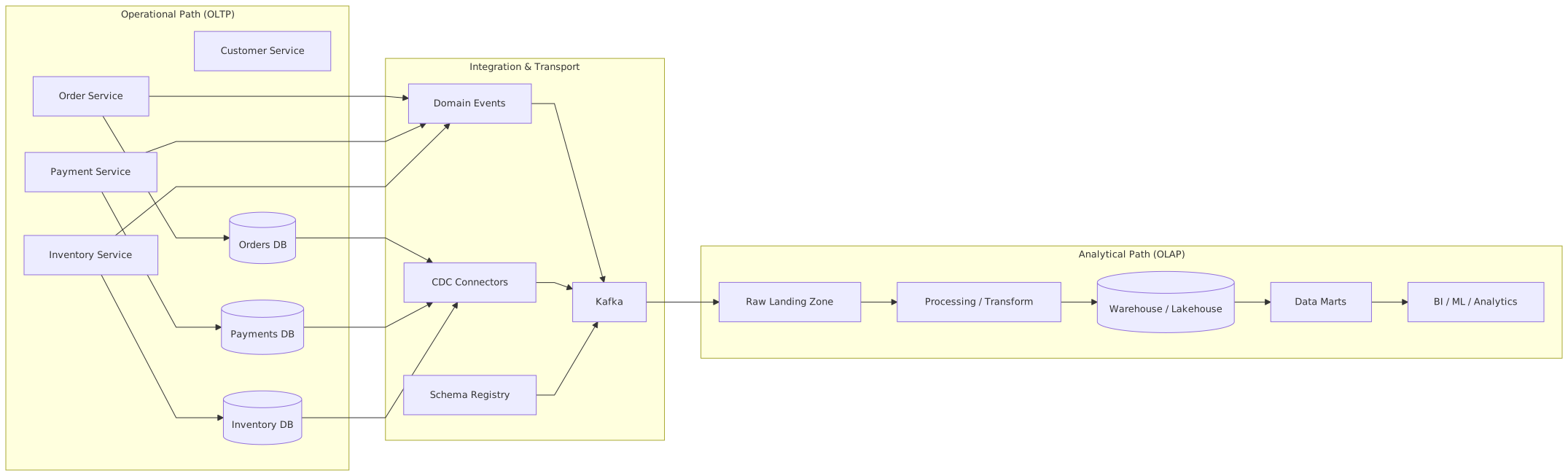
A few points matter here.
First, the operational stores remain optimized for transaction processing. They are not burdened with broad analytical joins, expensive aggregates, or end-user reporting. If a read replica is used, it should still be considered part of the operational estate, not a substitute for an analytical platform.
Second, Kafka or another event backbone is not the architecture by itself. It is a transport fabric. Enterprises often mistake movement for design. The architecture only becomes coherent when producers publish well-defined business facts and consumers understand lineage, versioning, and replay behavior.
Third, the analytical path is layered on purpose:
- Raw landing preserves source fidelity.
- Processed/curated layers standardize and enrich.
- Warehouse/lakehouse models support enterprise analysis.
- Data marts tailor output to business domains such as Finance, Sales, Risk, Supply Chain.
Those layers are not bureaucracy. They are where semantics are stabilized.
Domain semantics in the analytical path
This is where DDD earns its keep.
An analytical platform should not flatten all domains into a fake universal truth on day one. Instead, it should preserve source context, then create derived views that are explicit about their meaning. For example:
customer_idin Identity may identify a person.account_idin Billing may identify a legal payer.party_idin CRM may identify a business relationship.- A “customer dimension” in analytics may deliberately combine these under clearly governed survivorship rules.
That is not inconsistency. It is honest modeling.
A common anti-pattern is forcing every upstream team to conform to one enterprise-wide customer schema before any analytics can proceed. This slows delivery and usually fails because the business itself contains multiple valid notions of customer. Better to use bounded contexts operationally and conformed dimensions analytically, with lineage and policy visible.
Temporal modeling
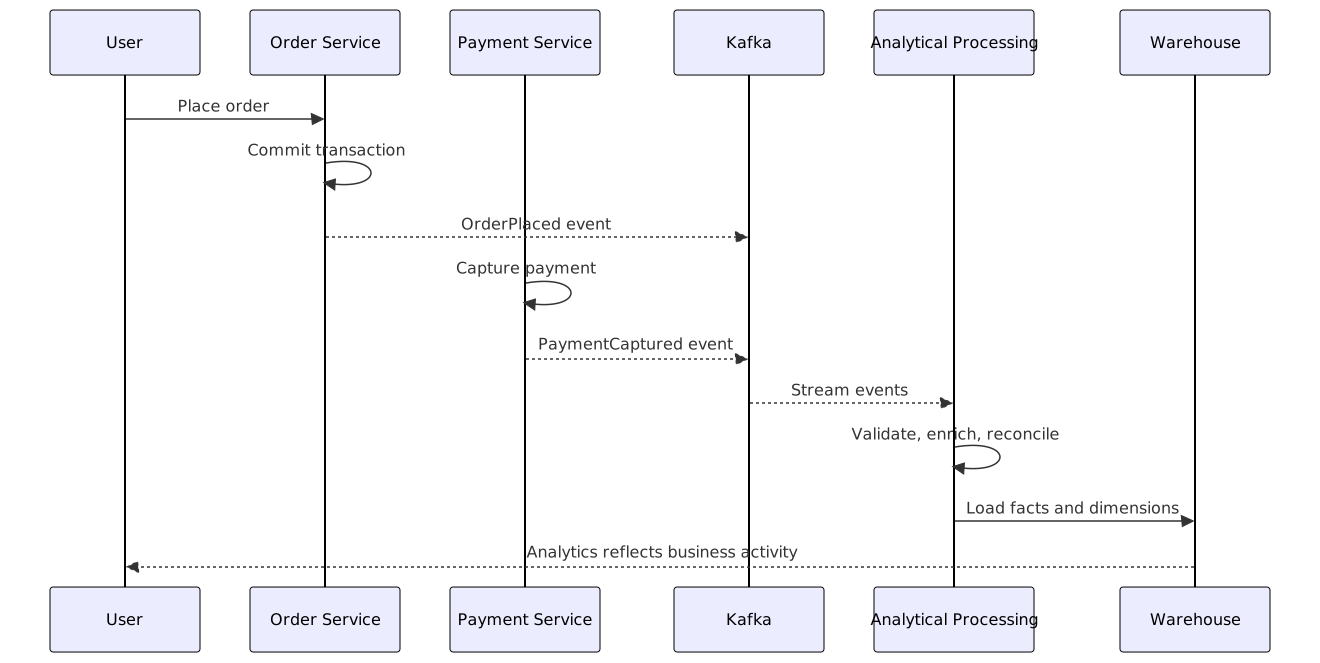
Operational systems care mostly about now. Analytics often cares about then, before, during, and after. This means the analytical path must handle:
- event time versus processing time
- late-arriving facts
- slowly changing dimensions
- corrections and reversals
- bitemporal or audit-friendly history where regulation demands it
Without time-aware modeling, analytical truth becomes a snapshot illusion.
Migration Strategy
No large enterprise gets to redesign this cleanly. They inherit ERP tables, integration hubs, brittle ETL, reporting against production, and dozens of undocumented extracts. So the migration strategy matters as much as the target architecture.
The right pattern is usually a progressive strangler migration.
Start by identifying the highest-friction reporting dependencies on operational systems. These are often nightly reports that hammer transactional databases, executive dashboards with poor trust, or cross-domain extracts maintained by hand. Then introduce an analytical path beside the current landscape rather than replacing everything at once.
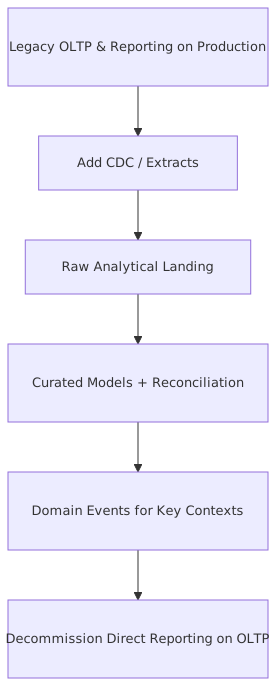
A practical migration sequence looks like this:
Step 1: Separate analytical consumption from transactional stores
Create a raw ingestion path from key operational systems using CDC, events, or scheduled extraction where necessary. The first win is not elegance. It is reducing reporting pressure on OLTP platforms.
Step 2: Model a few business facts properly
Pick high-value facts such as orders, payments, shipments, claims, or invoices. Define them with business owners. Clarify event timestamps, lifecycle states, correction rules, and authoritative sources.
This step often reveals that existing reports are comparing incompatible states. Good. Better to expose semantic conflict than preserve false confidence.
Step 3: Build reconciliation as a first-class capability
Reconciliation is not a patch for bad architecture; it is a necessary discipline when separate paths process data asynchronously. Daily and intraday controls should compare analytical aggregates against operational systems of record using agreed tolerance and exception handling.
If reconciliation is left until the end, the warehouse becomes a polished argument nobody can settle.
Step 4: Introduce domain events where semantics matter most
Once teams understand the analytical demand, move from raw CDC dependence toward more meaningful event contracts in the most important bounded contexts. Keep CDC where legacy systems cannot produce events cleanly.
Step 5: Strangle direct reporting dependencies
Redirect BI tools, ad hoc users, and downstream feeds away from OLTP systems toward curated analytical models. Remove old access paths deliberately. If you leave production reporting “just in case,” people will keep using it forever.
Step 6: Rationalize and govern
Only after value is visible should the enterprise invest in broader governance: schema registries, metadata catalogs, data product ownership, SLA definitions, quality controls, lineage tooling.
Architecture should earn its platform.
Reconciliation in plain language
Reconciliation is how you avoid the oldest trap in enterprise data: two systems both claiming to be right.
You need at least three levels:
- Record-level reconciliation for critical transactions
- Aggregate reconciliation for daily or hourly business totals
- Semantic reconciliation where business definitions differ and must be mapped explicitly
For example, “booked revenue” in the sales dashboard may not equal “recognized revenue” in Finance, and that is acceptable if the distinction is named, governed, and consistently implemented. It is disastrous if both are labeled simply “revenue.”
Enterprise Example
Consider a global retailer modernizing order-to-cash across e-commerce, stores, and marketplace partners.
The estate is typical. Orders originate from a commerce platform, payments flow through separate gateways, inventory is managed regionally, and finance closes on an ERP. The business wants near-real-time visibility into sales, fulfillment delays, cancellations, returns, and margin by channel. Historically, analysts queried replicas of the commerce database and joined extracts from payment and ERP feeds overnight. The result was predictable: slow queries, incompatible definitions of order status, and endless reconciliation meetings.
The retailer adopted a two-path architecture.
Operationally, order capture, payment authorization, inventory reservation, shipment, and return initiation were managed in separate bounded contexts. Each service owned its own store and lifecycle rules. The architecture resisted the temptation to invent a single operational “Order Master” for every concern. That would have looked tidy and aged badly.
For the analytical path, the team introduced Kafka for event transport and CDC for older systems that could not emit business events. The commerce service published OrderPlaced, OrderCancelled, and OrderLineAdjusted. Payments published PaymentAuthorized, PaymentCaptured, and RefundIssued. The ERP remained CDC-fed. A lakehouse stored raw events and snapshots, then transformed them into conformed facts for sales, returns, and payment settlement.
This worked, but not because Kafka saved them. The hard work was semantic.
They discovered at least four “order dates” in use:
- checkout submitted time
- fraud-cleared time
- fulfillment acceptance time
- financial booking time
Different functions had each chosen one and called it “order date.” Once the architecture made these timestamps explicit, reporting became more honest and more useful. Sales could track demand at checkout time. Operations could track fulfillment acceptance. Finance could close on booked timestamps. The argument shifted from “whose number is right?” to “which business question are we answering?”
Reconciliation was built into daily controls. Sales totals by channel from the analytical platform were checked against operational order counts and ERP postings. Discrepancies above threshold opened investigation workflows automatically. Returns and late payment settlements caused expected divergence windows, which were documented rather than hand-waved.
The strangler aspect mattered too. For months, legacy dashboards remained, but each was replaced domain by domain. Production reporting access was eventually removed for all but operational support teams. Query load on OLTP stores dropped sharply. More importantly, the executive team stopped carrying screenshots from rival systems into review meetings.
That is what success looks like in enterprise data architecture. Not elegance. Reduced argument. enterprise architecture with ArchiMate
Operational Considerations
Architects often focus on the target model and neglect the plumbing. The plumbing bites back.
Schema evolution
Events and source tables change. They always do. If there is no schema versioning strategy, downstream consumers become archaeologists. Use explicit contracts, compatibility rules, and deprecation windows. A schema registry is not glamorous, but it saves careers.
Idempotency and duplicates
Streams duplicate. Replays happen. Connectors fail and retry. Analytical loads must be idempotent or support deterministic merge logic. If your fact tables cannot tolerate duplicate delivery, your design is unfinished.
Ordering and partitioning
Kafka preserves order only within partitions. If a business process requires strict sequencing for an entity, partitioning strategy matters. Even then, late and out-of-order events will still occur. Design for correction, not fantasy.
Data quality controls
Quality checks should be layered:
- technical validity in ingestion
- structural conformity in processing
- business rule validation in curated zones
- reconciled control totals at consumption boundaries
Security and compliance
The analytical path often concentrates sensitive data. PII, payment data, health data, and regulated records should be classified and handled with policy-based access, masking, retention controls, and auditability. Too many firms secure production tightly and treat the warehouse like a communal shed.
SLAs and expectations
Not every metric needs to be real-time. Define freshness tiers:
- sub-minute for operational monitoring
- near-real-time for customer experience views
- hourly for management oversight
- daily for finance and governance
Architecture improves when promises are explicit.
Tradeoffs
There is no free architecture here. Only visible tradeoffs and hidden ones.
Separating OLTP and OLAP paths improves performance isolation, analytical flexibility, and semantic clarity. It also introduces more moving parts: pipelines, transport layers, transformation logic, metadata, quality controls, and support overhead.
CDC accelerates migration and reduces source changes. But it leaks physical persistence details into the analytical path and can obscure business meaning.
Domain events carry rich semantics and support decoupled integration. But they require disciplined product thinking from engineering teams, and many organizations are not culturally ready for that level of ownership.
A warehouse offers strong structure and trusted reporting. A lakehouse offers scale, flexibility, and support for mixed analytical patterns. The right choice depends less on fashion than on workload mix, talent, governance maturity, and ecosystem.
Microservices can make operational domains clearer. They can also multiply semantic fragmentation if each team publishes events with casual naming and no enterprise coordination. Distributed architecture does not absolve you from enterprise language. It makes language more important.
And perhaps the biggest tradeoff of all: the more accurate and explicit your semantics become, the more business disagreement you surface. That can feel like architecture causing conflict. In truth, it is architecture revealing it.
Failure Modes
These systems usually fail in predictable ways.
1. Reporting directly on OLTP forever
The organization says the warehouse is strategic but keeps key dashboards tied to production “for now.” That “for now” becomes permanent. Performance suffers, semantics stay fragmented, and no one finishes the migration.
2. Mistaking event transport for domain design
A Kafka topic named customer-updates containing mutable blobs is not event-driven architecture. It is just a queue with ambition.
3. Building a canonical enterprise model too early
This is the graveyard of many data programs. If you try to force all domains into one universal schema before delivering any value, you produce delay disguised as rigor.
4. Ignoring reconciliation
The analytical platform goes live without control totals, exception management, or authoritative source rules. Mismatches appear. Trust collapses. Users return to spreadsheets and direct database access.
5. Treating the analytical path as operational
People start using warehouse tables to drive transactions because they are “cleaner” or “easier to query.” This creates delayed decisions, stale writes, and compliance risk. The observing system starts impersonating the acting system.
6. No ownership for business facts
If nobody owns the definition of OrderPlaced, NetSales, ActiveCustomer, or ClaimClosed, architecture cannot save you. Data platforms do not generate meaning. People do.
When Not To Use
A separated operational and analytical path is usually the right destination for a large enterprise. But not always, and not immediately.
Do not over-engineer this pattern if you have:
- a small application with modest reporting needs
- one operational database and a handful of well-bounded read queries
- low concurrency and no meaningful historical analytics demand
- limited team maturity for operating streaming and data platform components
In such cases, a read replica, a reporting database, or simple batch extraction may be enough. Not every company needs Kafka, a lakehouse, and six medallion layers to count invoices.
Also be cautious when the main problem is not architecture but domain chaos. If the business cannot agree on lifecycle states, ownership, or definitions, building a sophisticated dual-path data architecture will automate confusion very efficiently.
Finally, do not use the analytical path as a substitute for fixing bad operational design. If services do not own their invariants, events are ambiguous, and source systems are full of silent side effects, the warehouse will become a museum of transactional dysfunction.
Related Patterns
Several patterns sit naturally beside this approach.
- CQRS: useful when read and write models differ significantly inside a domain, though it is not a synonym for enterprise analytics.
- Event Sourcing: powerful for audit-heavy domains, but often too invasive as a universal strategy.
- Data Mesh: helpful if interpreted as federated ownership with interoperable governance; harmful if interpreted as “everyone publishes whatever they like.”
- Lambda/Kappa style streaming architectures: relevant for real-time analytics, though often overcomplicated when simpler hybrid batch-stream models suffice.
- Medallion architecture: a practical layering model for raw, cleansed, and curated data in lakehouse environments.
- Strangler Fig Pattern: essential for progressive migration from legacy reporting and tightly coupled data access.
These are tools, not religions.
Summary
The operational path and the analytical path should be close enough to share business meaning and far enough apart to avoid harming each other.
That is the heart of the matter.
OLTP systems exist to carry the business safely through each transaction. OLAP systems exist to make sense of the business across time and across domains. They deserve different models, different optimizations, and different operational disciplines. The bridge between them should be built with explicit semantics, not accidental SQL access. Use CDC when you need pragmatic extraction. Use domain events when you need business intent. Use reconciliation because separate paths create timing and semantic gaps that must be governed, not wished away.
Domain-driven design is not an optional sophistication here. It is the thing that keeps the architecture honest. Bounded contexts explain why operational models differ. Analytical models then become deliberate cross-domain interpretations rather than confused copies. That is how you avoid the false promise of a single canonical truth while still delivering trusted enterprise reporting.
Migrate progressively. Strangle direct reporting on production. Build a raw path, then curated facts, then reconciled business views. Expect tradeoffs. Expect failure modes. Expect uncomfortable conversations about definitions. Good architecture does not eliminate those conversations. It gives them a place to happen before they become outages, audit findings, or executive theater.
In the end, this is less about OLTP versus OLAP than about respecting the shape of reality.
The system that runs the business should not also be forced to explain the business under every possible lens. And the system that explains the business should never be allowed to pretend it is the one in charge.
That distinction is not technical trivia.
It is architectural adulthood.
Frequently Asked Questions
What is enterprise architecture?
Enterprise architecture aligns strategy, business processes, applications, and technology in a coherent model. It enables impact analysis, portfolio rationalisation, governance, and transformation planning across the organisation.
How does ArchiMate support architecture practice?
ArchiMate provides a standard language connecting strategy, business operations, applications, and technology. It enables traceability from strategic goals through capabilities and services to infrastructure — making architecture decisions explicit and reviewable.
What tools support enterprise architecture modeling?
The main tools are Sparx Enterprise Architect (ArchiMate, UML, BPMN, SysML), Archi (free, ArchiMate-only), and BiZZdesign. Sparx EA is the most feature-rich, supporting concurrent repositories, automation, scripting, and Jira integration.