⏱ 6 min read
Enterprise Architecture Governance Framework with Compliance and ARB Setup Guide
A Deep-Dive Whitepaper for Regulated and Digital-First Enterprises
Executive Summary
In modern enterprises---particularly those operating in regulated industries such as financial services, public sector, utilities, healthcare, and critical infrastructure---Enterprise Architecture (EA) can no longer function as a documentation discipline. It must operate as a governance engine. Sparx EA best practices

An Enterprise Architecture Governance Framework, tightly integrated with compliance controls and supported by a formal Architecture Review Board (ARB), ensures that:
- Technology investments align with business strategy
- Regulatory obligations are embedded in solution design
- Risk exposure is reduced proactively
- Architectural coherence is maintained
- Innovation is enabled safely
This whitepaper provides a structured, implementation-ready framework for:
- Designing an EA governance model
- Integrating regulatory and compliance controls
- Establishing and operationalizing an ARB
- Defining decision rights and escalation models
- Managing architectural exceptions
- Measuring governance effectiveness
- Evolving toward automated, continuous governance
1. The Strategic Imperative for EA Governance
1.1 The Problem Enterprises Face
Organizations today operate under:
- Accelerated digital transformation
- Cloud adoption and multi-cloud complexity
- Cybersecurity threats
- Increasing regulatory scrutiny
- Pressure to reduce cost and technical debt
Without structured architecture governance:
- Projects select technologies inconsistently
- Security controls are applied unevenly
- Data protection obligations are misunderstood
- Integration patterns diverge
- Technical debt accumulates silently
- Regulatory non-compliance risks increase
EA governance provides the mechanism to prevent architectural entropy.
2. Enterprise Architecture Governance Model
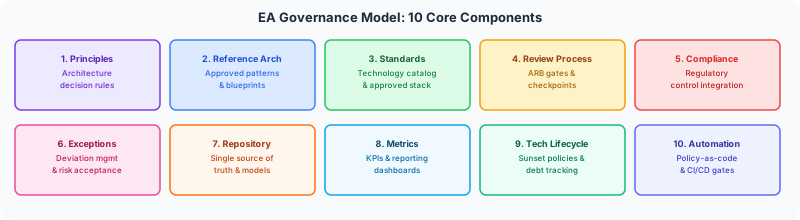
2.1 Core Components
- Architecture Principles
- Reference Architectures
- Standards Catalog
- Architecture Review Process
- Compliance Control Integration
- Exception Management
- Architecture Repository
- Metrics and Reporting
- Technology Lifecycle Management
- Automation & Policy-as-Code
3. Architecture Review Board (ARB) Setup Guide
3.1 Purpose
The Architecture Review Board (ARB) is the formal governance body that:
- Approves or rejects solution architectures
- Enforces compliance and risk alignment
- Controls technology sprawl
- Manages exceptions
- Ensures architectural consistency
3.2 ARB Charter Elements
Mandate: Ensure alignment with enterprise architecture and regulatory standards.
Authority: Decisions are binding unless escalated to CIO.
Scope: - Projects above budget threshold - New technology adoption - Cloud migrations - Regulatory-impacting changes
Decision Types: - Approved - Approved with Conditions - Rework Required - Rejected
4. Compliance Integration Model
Compliance must be embedded---not appended.
Key Domains
- Data protection
- Operational resilience
- Audit requirements
- Industry-specific regulation
- Cloud governance
- Cybersecurity frameworks
Compliance must map directly to architecture controls.
5. Exception & Waiver Management
When Exceptions Are Allowed
- Legacy constraints
- Regulatory urgency
- Vendor limitations
- Strategic innovation
Process
- Formal request
- Risk analysis
- Compensating controls
- Expiry date
- Registered in architecture debt log
- Periodic review
6. Governance Metrics & KPIs
Architecture KPIs
- \% compliant at first review
- Review turnaround time
- Number of exceptions
- Standard reuse rate
- Technical debt index
Risk KPIs
- Audit findings
- Security incidents
- Compliance breaches
- DR test success rate
7. Governance Maturity Model
Level 1 -- Ad Hoc Level 2 -- Structured Level 3 -- Standardized Level 4 -- Integrated Level 5 -- Automated
Conclusion
A well-designed Enterprise Architecture Governance Framework with Compliance and ARB Setup provides: free Sparx EA maturity assessment
- Strategic alignment
- Risk mitigation
- Regulatory assurance
- Cost control
- Technology coherence
- Faster innovation
Governance becomes a competitive advantage when implemented correctly.
For expert guidance on enterprise architecture, explore our enterprise architecture consulting, architecture capability development, and Sparx EA consulting. Get in touch.
Governance that accelerates rather than blocks
Architecture governance adds value when it prevents costly mistakes — duplicate technology purchases, incompatible integration patterns, non-compliant data handling. It destroys value when it becomes a bottleneck that slows delivery without proportional risk reduction. The difference is speed and proportionality. integration architecture diagram
Implement tiered governance: low-risk changes (adding an optional field to an API, deploying a patch, updating documentation) are auto-approved through automated checks. Medium-risk changes (new service deployment, technology adoption within approved categories, non-breaking API changes) get 48-hour review by the assigned architect. High-risk changes (new technology category, breaking API changes affecting multiple consumers, cross-domain data access) get full Architecture Review Board discussion at the next scheduled meeting. modeling integration architecture with ArchiMate
Measure governance effectiveness quarterly: review turnaround time (target: under 48 hours for medium-risk), bypass rate (teams making changes without review — indicates governance is too slow), and decision quality (percentage of decisions that hold versus require reversal within 6 months).
Building sustainable architecture practices
Architecture practices succeed when they deliver visible value to stakeholders — not when they produce comprehensive documentation. The most impactful architecture deliverables answer specific questions that business and IT leaders ask repeatedly: "What applications support this business capability?" "What is affected if we change this system?" "Where are our technology risks concentrated?" "How does this initiative connect to our strategic goals?"
Each of these questions maps to a specific ArchiMate viewpoint, a specific repository query, and a specific governance process. The capability map answers the first question. The traceability matrix answers the second. The technology portfolio view answers the third. The motivation model answers the fourth. When architects can produce these answers in minutes rather than weeks, the architecture practice proves its value — and earns the organizational trust needed to expand its scope. ArchiMate layers explained
Start with one question that matters to your most important stakeholder. Build the view that answers it. Demonstrate the answer. Then expand to the next question. This incremental approach builds a useful, governed architecture repository faster than any comprehensive top-down initiative.
Frequently Asked Questions
What is architecture governance in enterprise architecture?
Architecture governance is the set of practices, processes, and standards that ensure architecture decisions are consistent, traceable, and aligned to organisational strategy. It typically includes an Architecture Review Board (ARB), architecture principles, modeling standards, and compliance checking.
How does ArchiMate support architecture governance?
ArchiMate supports governance by providing a standard language that makes architecture proposals comparable and reviewable. Governance decisions, architecture principles, and compliance requirements can be modeled as Motivation layer elements and traced to the architectural elements they constrain.
What are architecture principles and how are they modeled?
Architecture principles are fundamental rules that guide architecture decisions. In ArchiMate, they are modeled in the Motivation layer as Principle elements, often linked to Goals and Drivers that justify them, and connected via Influence relationships to the constraints they impose on design decisions.