⏱ 19 min read
Enterprise architecture has a bad habit of becoming a museum of boxes. Teams spend months drawing landscapes nobody uses, polishing target states that age faster than milk, and debating whether a system belongs in the application layer or the technology layer while the business is busy acquiring a competitor, launching a new product, or trying to survive a margin squeeze.
Business capability mapping matters because it drags architecture back to the only conversation worth having: what the enterprise must be able to do, regardless of who does it, how it is automated, or which org chart happens to be fashionable this quarter.
That distinction sounds simple. It is not. Most enterprises confuse capabilities with processes, departments, platforms, products, and sometimes ambitions. “Customer onboarding” is called a capability in one deck, a process in the next, and a value stream in the third. “Risk management” gets split by every function that touches it. “Pricing” turns into an application discussion before anyone agrees what pricing means in the business. The result is predictable: architecture maps become either too vague to guide investment or too tangled to support change.
A good capability map does something more practical. It gives you a stable semantic backbone. Processes change. Systems get replaced. Reporting lines come and go. Capabilities are the enduring verbs of the enterprise. They describe what the business needs to be able to perform to execute its model. If you do this well, capability mapping becomes the bridge between strategy, operating model, domain boundaries, application portfolios, data ownership, and migration planning.
That is why capability maps deserve more respect than they usually get. They are not decoration for PowerPoint. They are navigational charts for change.
Context
In enterprise architecture, we often need a stable reference model. Something that survives reorgs, outsourcing, platform modernization, and the annual relabeling exercise where “digital transformation” becomes “business reinvention” and then “AI-enabled operating model.” Capability maps are one of the few tools that can survive all three.
A business capability describes what an enterprise does at a level that is meaningful to business and technology leaders alike. It is not a workflow. It is not a team. It is not a product. It is not a single application. It is an ability.
For example, a bank may have capabilities such as Customer Management, Credit Decisioning, Payments Processing, Fraud Detection, Collections, Treasury Management, and Regulatory Reporting. Each of these can be decomposed into lower-level capabilities. Credit Decisioning may include Application Intake, Identity Verification, Bureau Data Acquisition, Risk Scoring, Offer Generation, and Policy Adjudication.
This decomposition matters. The top levels help executive planning. The lower levels help architects reason about bounded contexts, systems, APIs, ownership, and investment. A capability hierarchy diagram is useful precisely because it allows both abstraction and specificity without collapsing into process spaghetti.
Done properly, capability mapping becomes a pivot between several architectural concerns:
- strategy to execution alignment
- application portfolio rationalization
- domain-driven design and bounded context identification
- data ownership and stewardship
- operating model design
- modernization and migration sequencing
- outsourcing and sourcing decisions
- resilience and risk analysis
That is a lot of leverage from a deceptively simple artifact.
Problem
Most enterprises do not suffer from a lack of architecture artifacts. They suffer from too many diagrams built on unstable concepts.
Here is the usual pattern. One group models business processes. Another catalogs applications. Another builds data domains. A transformation office defines value streams. A platform team maps APIs. None of them share a common semantic anchor. So they end up with overlapping taxonomies and mismatched boundaries. Everyone is right in their own frame. The enterprise is wrong in aggregate.
Capability mapping is often introduced as the cure, but many implementations fail for familiar reasons:
- capabilities are named as processes: “manage complaint workflow”
- capabilities mirror org units: “marketing operations”
- capability levels are inconsistent
- maps are too generic to be useful: “finance,” “HR,” “IT”
- there is no tie to systems, data, or investment decisions
- every stakeholder uses different definitions
- the exercise stops at the poster and never informs migration
That last point is fatal. If capability mapping does not influence funding, accountability, platform strategy, or modernization decisions, it is theater. Beautiful theater, perhaps, but still theater.
The real challenge is not drawing a capability map. The real challenge is making it semantically coherent enough to connect strategy to operating reality.
Forces
Several forces make capability mapping both necessary and difficult.
First, enterprises need stability amid change. Org structures are volatile. Mergers, cost programs, platform shifts, and regulatory interventions constantly reshape operations. Capabilities offer a more durable planning surface than teams or systems.
Second, business language is messy. Different functions use the same words to mean different things, or different words to mean the same thing. “Customer” may mean legal entity, account holder, policyholder, prospect, tenant, or patient depending on context. Capability maps expose these collisions, which is useful but politically inconvenient.
Third, modernization rarely happens on a blank sheet. Legacy platforms hold critical rules, historical data, reconciliation logic, and exception handling accumulated over decades. So capability mapping must support migration reasoning, not just target-state fantasy.
Fourth, distributed architectures raise the cost of bad boundaries. In monoliths, conceptual confusion is painful. In microservices, it becomes operationally expensive. If your capability boundaries are wrong, your APIs thrash, your Kafka topics become integration gossip channels, and your teams spend their lives reconciling each other’s side effects. event-driven architecture patterns
Fifth, executive stakeholders want simplicity while delivery teams need precision. A capability model must satisfy both. Too abstract, and it is ignored. Too detailed, and it becomes unreadable.
This is why capability mapping is an architectural act, not a cataloging exercise. It requires judgment. And judgment means tradeoffs.
Solution
The useful approach is to treat business capability mapping as a layered semantic model of enterprise abilities, with direct links to domains, systems, information ownership, and change investment.
Start with a few principles.
1. Name capabilities as stable business abilities
Use verb-noun or noun phrases that describe enduring business abilities, not specific workflows or organizational constructs. “Credit Decisioning” is better than “Loan Underwriting Team Operations.” “Customer Identity Management” is better than “KYC Workflow.”
A good test is this: if the enterprise outsourced the work, automated it, or reorganized the department, would the capability still exist? If yes, you are probably modeling a capability.
2. Build a hierarchy, not a flat list
A capability hierarchy diagram matters because capabilities operate at different levels of granularity. Enterprise executives need broad domains. Architects and portfolio managers need enough decomposition to assign ownership and identify dependencies.
Here is a simplified example.

This is not just a decomposition device. It helps expose where enterprise attention belongs. Some capabilities are strategic differentiators. Others are commodity. Some are fragmented across systems. Others are centralizing anchors. The hierarchy gives you a way to discuss these differences without disappearing into implementation details too early.
3. Connect capabilities to domain semantics
This is where domain-driven design earns its keep.
Capabilities tell you what the business must do. Domains and bounded contexts tell you where meanings must remain coherent. They are related but not identical. One capability may involve multiple bounded contexts. One bounded context may support multiple related capabilities. The job of architecture is not to force a one-to-one mapping where it does not belong. The job is to understand the semantic seams.
Take “Customer Management.” In many enterprises, that label hides multiple meanings:
- party and identity resolution
- commercial relationship management
- service entitlements
- legal and compliance status
- consent and preference management
Trying to make one giant Customer service own all of this is a classic enterprise mistake. It creates semantic overreach. The model becomes either vague or tyrannical. Better to identify bounded contexts such as Party, Identity Verification, Customer Profile, Contract Relationship, and Consent, each with explicit language and ownership.
Capability mapping becomes useful when it reveals these distinctions instead of flattening them.
4. Use capabilities to anchor investment and modernization
Every major application, platform, data store, or vendor should map to the capabilities it supports. That sounds obvious, yet many portfolios are still managed by system age, spend, or vendor category rather than business contribution.
Once systems are mapped to capabilities, several useful questions become answerable:
- Which capabilities are overserved by too many overlapping applications?
- Which strategic capabilities are underinvested?
- Which capabilities are hostage to brittle legacy platforms?
- Which capabilities have fragmented data ownership?
- Which modernization moves unlock multiple adjacent capabilities?
At that point, capability mapping stops being a taxonomy exercise and becomes an investment instrument.
Architecture
A practical enterprise architecture uses capability maps as the top organizing layer, then links them downward into bounded contexts, services, events, and systems of record.
A simple pattern looks like this:

This sequence matters. Too many organizations start from applications and work upward. That guarantees architecture by archaeology. You merely inherit the sins of the current estate. Starting with capabilities and domain semantics gives you a chance to shape boundaries intentionally.
Capability-to-domain mapping
A capability map gives structure; domain modeling gives meaning.
Suppose you are in insurance. “Claims Management” is a capability. But domain analysis might reveal distinct bounded contexts:
- First Notice of Loss
- Coverage Validation
- Claims Adjudication
- Reserve Management
- Payment Authorization
- Recovery and Subrogation
- Fraud Investigation
That decomposition is not just an intellectual exercise. It affects event design, service boundaries, data ownership, and team topology. If Coverage Validation and Claims Adjudication use different policy interpretations or lifecycle rules, they should not be smashed into one context merely because they both sit under Claims Management.
This is where experienced architects earn their salary. They know the map is not the territory. Capabilities provide the stable planning surface; bounded contexts provide the operational semantics.
Capability heatmaps and strategic posture
A common and worthwhile technique is to apply heatmaps to capabilities:
- strategic importance
- business pain
- technical debt
- regulatory exposure
- automation maturity
- data quality risk
Heatmaps turn the capability map into a decision device. They help prioritize migration, funding, and organizational attention. The key is to avoid fake precision. A three-color view discussed honestly is more useful than a seven-dimension scoring spreadsheet nobody trusts.
Microservices and Kafka, where relevant
Capabilities often inform service decomposition, but they should not directly dictate microservice counts. A capability is often too broad for a single service and too coarse for operational design. microservices architecture diagrams
The better move is this: use the capability map to locate candidate business domains, then use bounded contexts to define service and event boundaries.
Kafka becomes relevant when capabilities interact through business events that matter independently of request-response flows. For example:
- Order Accepted
- Payment Authorized
- Inventory Reserved
- Shipment Dispatched
- Customer Consent Updated
But Kafka is not a substitute for clear domain ownership. Without clear semantics, teams publish events with ambiguous meanings, incompatible schemas, and hidden coupling. The event backbone becomes a polite way to distribute confusion at scale.
A robust architecture makes event ownership explicit:
- which bounded context emits the event
- what business fact it represents
- what level of finality it has
- how consumers should handle versioning and late arrival
- what reconciliation process exists when downstream projections diverge
If you remember only one thing: asynchronous architecture does not remove coupling; it changes its shape.
Migration Strategy
Capability mapping becomes truly valuable during migration, especially in enterprises trying to modernize without stopping the business. This is where progressive strangler migration fits naturally.
Most enterprises cannot replace a core platform in one move. The safer path is to peel capabilities away incrementally, placing new domain-aligned services around the legacy estate and gradually shifting responsibility outward.
A capability map helps decide the order.
You do not start with whatever is easiest technically. You start with a capability slice that is:
- meaningful to the business
- semantically coherent
- low enough in dependency complexity to isolate
- high enough in value to justify the effort
- capable of coexistence with the legacy platform
That last point matters. Coexistence is the real migration architecture.
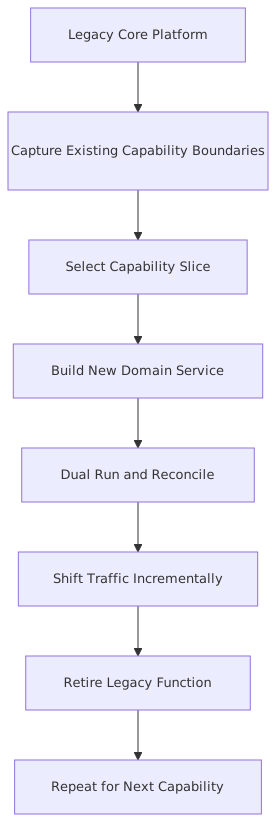
Progressive strangler migration in practice
Suppose a telecom provider wants to modernize order management. The monolithic CRM and order platform handles customer profile, product catalog, pricing, order capture, fulfillment orchestration, and billing triggers in one giant mass.
A sensible strangler path might look like this:
- separate Product Catalog as a standalone capability and service
- externalize Pricing rules next
- introduce a new Order Capture channel layer
- create an Order Orchestration service around legacy fulfillment
- gradually replace downstream fulfillment and billing integration
This sequence is not arbitrary. Catalog and pricing often offer high business leverage and cleaner domain seams than fulfillment. Order orchestration can then sit as an anti-corruption layer between new and old worlds.
Reconciliation is not optional
Every migration plan looks elegant until reality arrives carrying duplicate records, timing mismatches, stale caches, and inconsistent state transitions.
Reconciliation deserves first-class design attention. During migration, you often run legacy and new services in parallel. They will disagree. The question is not whether discrepancies happen, but how you detect, classify, and resolve them.
Key reconciliation patterns include:
- record-level comparison between legacy and target outputs
- event replay to rebuild projections
- discrepancy queues with operational triage
- golden-source rules by capability and lifecycle stage
- tolerance thresholds for acceptable divergence
- audit trails for regulatory review
For example, during payments modernization, authorization decisions may remain in the legacy host while posting moves to a new ledger service. Reconciliation then compares authorized, captured, settled, and posted amounts across systems. If that sounds operationally tedious, good. It is. Migration success often depends more on boring reconciliation discipline than on glamorous target architecture diagrams.
Enterprise Example
Consider a global insurer formed through multiple acquisitions. It has separate policy administration systems by product line and region, three customer masters, a claims platform that varies by market, and scattered compliance tooling. Leadership wants “a unified digital platform,” which is executive shorthand for “please make this mess easier to change.”
The first instinct in many firms is to launch a core platform replacement. That is the expensive mistake. It assumes uniformity where there is semantic divergence.
A better approach starts with capability mapping.
At level one, the insurer identifies:
- Distribution Management
- Customer Management
- Policy Management
- Underwriting
- Billing
- Claims Management
- Reinsurance
- Finance and Reporting
- Risk and Compliance
Then, through domain analysis, it decomposes Claims Management and Customer Management more carefully. It discovers:
- “customer” means party, policyholder, claimant, broker, and beneficiary in different contexts
- first notice of loss is operationally distinct from adjudication
- fraud signals need event access across claims, billing, and customer changes
- regulatory reporting depends on consistent claims event history, not merely database extracts
This leads to a modernization plan focused on capabilities with both business pain and strong semantic seams.
Phase 1:
- establish Party and Consent bounded contexts
- create a claims event backbone on Kafka
- externalize First Notice of Loss from regional claims systems
- build canonical event contracts for claim registration and status progression
Phase 2:
- introduce Fraud Signal Aggregation consuming claims, billing, and customer change events
- standardize Coverage Validation APIs behind anti-corruption layers
- implement reconciliation services comparing regional claims states to the enterprise event model
Phase 3:
- progressively replace claims adjudication workflows market by market
- centralize regulatory reporting from event-sourced claims history
- retire duplicate reporting extracts from legacy platforms
Notice what did not happen. They did not create one giant “Customer 360” service and demand that every product line conform immediately. They respected domain semantics. They used capabilities to identify investment areas and bounded contexts to define implementation boundaries.
The result was not architectural purity. It was something better: reduced integration drag, improved reporting accuracy, and a modernization path that could survive coexistence.
That is what enterprise architecture is for.
Operational Considerations
Capability maps are strategic artifacts, but they only pay off when connected to operational mechanisms.
Ownership
Every material capability needs accountable ownership, but not necessarily a single all-powerful team. Ownership should be explicit at multiple levels:
- business owner for outcomes and investment priority
- architecture owner for domain coherence
- product or platform owner for implementation responsibility
- data owner for authoritative records and quality rules
Without this, capability maps become laminated ambiguity.
Metrics
Capabilities need measures beyond system uptime. Useful measures include:
- cycle time
- straight-through processing rate
- exception rate
- cost to serve
- data quality defects
- regulatory findings
- change lead time
- service dependency count
These metrics reveal whether a capability is merely present or actually healthy.
Data semantics and stewardship
Capabilities often fail because data ownership remains muddled. A map should identify where authoritative facts are created and how they propagate. This is especially important in event-driven environments. If multiple services can assert different versions of the same business fact, your architecture has already started lying.
Governance, but not the ceremonial kind
Capability governance should focus on:
- naming and decomposition consistency
- linkage to investment and platform decisions
- semantic boundary review for new services
- exception handling when local optimization cuts across enterprise domains
It should not become a monthly review where architects admire color-coded posters. Governance should be lightweight, opinionated, and tied to delivery decisions. EA governance checklist
Tradeoffs
Capability mapping is useful precisely because it simplifies. But simplification always hides something.
One tradeoff is stability versus specificity. Capabilities are intentionally more stable than processes, but that stability can blur important operational variation. If you stay at too high a level, you miss the distinctions that matter for design and migration.
Another is enterprise coherence versus local autonomy. A common capability model helps align strategy, but if over-centralized it can become a political weapon. Teams end up forced into abstract enterprise taxonomies that ignore real domain nuance.
Another is strategic planning versus implementation fidelity. Capabilities are excellent for portfolio and modernization planning, but they do not replace process models, event models, or application architecture. Use them as a backbone, not as a universal answer.
And there is an uncomfortable truth: capability maps can create false confidence. Executives may feel clarity because the map looks orderly, while the underlying semantics remain unresolved. A neat taxonomy is not the same as a sound architecture.
Failure Modes
Capability mapping fails in very predictable ways.
Capability equals org chart
The map mirrors departments. “Sales Ops,” “Regional Claims Team,” “Finance Shared Services.” This guarantees instability because the artifact changes every time the org does.
Capability equals process flow
The map becomes a sequence of steps rather than a set of enduring abilities. This confuses value streams with capabilities and leads to awkward decomposition.
Generic consulting wallpaper
The enterprise adopts a standard industry reference map and stops thinking. Reference models are useful as prompts, not as truth. Real businesses differentiate in the edges, exceptions, and language.
No domain semantics
The map stays at a conceptual level and never resolves meaning. Then teams build services around broad labels like Customer, Order, or Product, and spend years untangling overlapping responsibilities.
No reconciliation planning
Migration proceeds with dual writes and optimistic assumptions. Discrepancies pile up. Trust collapses. The business blames “the new platform,” when the real problem was a missing operational reconciliation design.
Tool-driven decomposition
A repository tool or portfolio platform defines the model shape. Architecture follows the form fields. This is a subtle but common way to produce dead artifacts.
When Not To Use
Capability mapping is not mandatory for every situation.
Do not lead with a full capability mapping exercise when:
- the enterprise problem is local and tactical
- a single product team is improving one bounded workflow with little cross-enterprise impact
- there is no appetite to connect the model to investment or governance decisions
- the domain is still too immature for stable capability language
- the organization mainly needs process redesign rather than strategic decomposition
In a startup or a small digital product business, a heavy enterprise capability map can be unnecessary ceremony. Product areas, domain boundaries, and customer journeys may be enough. Capability mapping shines when scale, complexity, portfolio sprawl, or merger-driven heterogeneity create the need for a stable enterprise lens.
In other words, do not use a map when you need a sketch.
Related Patterns
Capability mapping works best alongside a few other patterns.
Domain-Driven Design
This is the natural companion. Capabilities identify enterprise abilities; bounded contexts protect semantic integrity. One gives breadth, the other depth.
Value Streams
Value streams show how value flows across capabilities. They are dynamic where capability maps are relatively static. You need both.
Application Portfolio Rationalization
Capabilities help reveal redundant systems and modernization candidates. This is where architecture meets budgeting.
Strangler Fig Pattern
An essential migration pattern for incrementally replacing legacy systems by capability slices.
Anti-Corruption Layer
Critical during coexistence. It protects new domain models from legacy semantics while migration is in progress.
Event-Driven Architecture
Useful when capability interactions depend on important business events. Especially valuable with Kafka, but only when domain ownership and event semantics are explicit.
Master Data and Data Product Design
Capability maps inform where authoritative data should live and how stewardship should be assigned.
Summary
Business capability mapping is one of the few enterprise architecture techniques that can genuinely earn its place. Not because it is fashionable, and not because executives like tidy grids, but because it gives the enterprise a stable way to talk about what must endure while everything else changes.
The trick is to treat capability maps as semantic scaffolding, not decorative inventory. Name capabilities as enduring business abilities. Build a hierarchy that supports both strategy and implementation. Connect capabilities to domain-driven design and bounded contexts. Use them to drive investment, portfolio rationalization, and migration sequencing. And when modernizing, embrace progressive strangler migration with explicit reconciliation rather than pretending replacement is a single clean cut.
A capability map should help answer hard questions: what matters, what is broken, where meaning diverges, what to modernize first, and how to change without losing control. If it cannot answer those questions, it is just another enterprise wallpaper pattern.
Good architecture is not the art of drawing the future. It is the craft of giving change somewhere solid to stand. Business capability mapping, done properly, is one of those solid places.
Frequently Asked Questions
What is enterprise architecture?
Enterprise architecture aligns strategy, business processes, applications, and technology in a coherent model. It enables impact analysis, portfolio rationalisation, governance, and transformation planning across the organisation.
How does ArchiMate support architecture practice?
ArchiMate provides a standard language connecting strategy, business operations, applications, and technology. It enables traceability from strategic goals through capabilities and services to infrastructure — making architecture decisions explicit and reviewable.
What tools support enterprise architecture modeling?
The main tools are Sparx Enterprise Architect (ArchiMate, UML, BPMN, SysML), Archi (free, ArchiMate-only), and BiZZdesign. Sparx EA is the most feature-rich, supporting concurrent repositories, automation, scripting, and Jira integration.