⏱ 20 min read
Zero Trust changed the conversation, but it didn’t simplify the system. It made the real shape of the system visible.
For years, enterprises built security like medieval cities: strong outer walls, guarded gates, a moat if the budget was generous. Once you got through the perimeter, the world became friendlier than it should have been. Applications trusted networks. Services trusted IP ranges. People trusted VPNs as if tunneling into the datacenter somehow made intent legitimate.
That model is dead, even if many organizations haven’t updated the diagrams yet.
In a Zero Trust architecture, every request arrives as a question mark. Identity matters. Device posture matters. Context matters. And authorization can no longer be treated as an afterthought buried inside application code or scattered across API gateways in a pile of brittle rules. The edge has become a policy battlefield.
But here is the uncomfortable truth: pushing authorization to the edge is not the same as solving authorization. It is merely choosing where the first decision gets made.
That distinction matters. A lot.
Edge authorization is attractive because it promises speed, consistency, and control. Put a policy decision point in front of services, stop bad requests early, centralize governance, and reduce duplication. On paper, it looks clean. In production, it collides with domain semantics, event timing, stale caches, regulatory boundaries, and one of the oldest truths in enterprise architecture: the closer a rule is to the business, the more likely it is to change in ways your platform team did not predict.
So the question is not “should we do edge auth?” The better question is “which authorization decisions belong at the edge, which belong in the domain, and how do we migrate there without breaking the estate?”
That is the heart of this article.
We will look at edge authorization patterns inside Zero Trust architecture, with the bias of someone who has watched large enterprises over-centralize too early, under-govern too long, and then spend years reconciling the mess. We will cover the forces at play, concrete architecture options, migration strategy using a progressive strangler approach, Kafka and microservices considerations, reconciliation for eventual consistency, operational concerns, tradeoffs, failure modes, and—equally important—when not to use these patterns at all. event-driven architecture patterns
Context
Zero Trust is often reduced to slogans: never trust, always verify. Fine slogan. In practice, enterprises need something more mechanical.
A request reaches an edge component: API gateway, service mesh ingress, global application delivery platform, identity-aware proxy, or workload access proxy. The edge authenticates the caller, evaluates coarse and sometimes fine-grained policy, and decides whether the request should proceed. That decision may rely on identity claims, device state, network context, tenant boundaries, entitlements, geographic restrictions, and resource attributes.
At the same time, the services behind that edge still contain business rules. A bank transfer service knows whether a user can approve a transfer over a threshold. A claims system knows whether a regional adjuster may access a case based on product line and jurisdiction. A manufacturing platform knows whether a supplier can see inventory only for facilities covered by contract. Those are not merely security rules. They are domain rules wearing security clothes.
This is where many Zero Trust implementations wobble. They confuse infrastructure authorization with domain authorization.
Infrastructure authorization answers questions like:
- Is this principal authenticated?
- Is the token valid?
- Does the device meet posture requirements?
- Is this API callable by this client type?
- Does the request satisfy coarse-grained scope policy?
Domain authorization answers different questions:
- Can this claims adjuster approve this payout for this policy in this state?
- Can this manager view salary data for employees outside her cost center during a restructuring period?
- Can this trading algorithm place an order in a restricted market window for this portfolio?
The first category fits naturally at the edge. The second often does not.
Good architecture separates these concerns without pretending they can be fully isolated. That means we need patterns, not doctrine.
Problem
Enterprises usually arrive at edge authorization for one of three reasons.
First, they are modernizing a sprawl of APIs and microservices and want a consistent Zero Trust enforcement point. microservices architecture diagrams
Second, they have suffered an audit failure or breach and discovered that authorization logic is duplicated, inconsistent, and impossible to explain with confidence.
Third, they are pursuing platform consolidation: one identity plane, one policy engine, one gateway layer, one way of controlling access across web, mobile, partner, and machine-to-machine traffic.
All three are legitimate. All three can go badly wrong.
The most common anti-pattern is simple: move all authorization to the edge because centralization feels safer. It rarely is. What actually happens is that teams encode business semantics in policy files far away from the bounded contexts that own the meaning. Now the policy engine needs data from ten systems, half of it eventually consistent, and every new feature becomes a negotiation between domain teams and a central security platform group. Latency rises. ownership blurs. Incidents multiply.
The opposite anti-pattern is just as dangerous: keep everything inside services and use the edge only for token validation. That preserves domain purity but leaves the estate with inconsistent controls, no shared policy posture, weak auditability, and too many opportunities for accidental exposure.
The hard part is deciding where the seam belongs.
Forces
Several forces shape the design. They pull in different directions.
1. Coarse-grained versus fine-grained decisions
The edge is excellent for coarse-grained controls: who may call which API, from which channel, under what posture, with which scopes. It is much less reliable for nuanced decisions tied to domain state.
A useful rule of thumb: if the authorization rule depends on the meaning of a business aggregate, be suspicious of pushing it entirely to the edge.
2. Latency and availability
Edge authorization sits on the hot path. Every external request pays for that decision. If your policy engine must fetch entitlements from three downstream systems and resource state from two more, you have built a distributed transaction disguised as an access check. That is not architecture. That is a hostage situation.
3. Consistency of policy data
Zero Trust encourages richer context, but richer context means more data dependencies. Entitlements, org hierarchy, tenant mapping, device health, consent, contract terms, data classification, resource ownership. Some of that can be cached. Some of it changes constantly. Some of it is mastered in systems that were never built to serve online policy evaluation.
This is where Kafka and event-driven architecture become relevant. If the edge needs policy data, the platform should prefer replicated, event-fed authorization views rather than synchronous fan-out across core systems.
4. Explainability and audit
Enterprises need to answer awkward questions after the fact: why was access allowed, denied, or partially masked? Which policy version applied? What claims were used? Which resource attributes were stale? Can we reconstruct the decision path?
Edge authorization must produce evidence, not just decisions.
5. Domain ownership
Authorization is never just a security concern. It is often one of the purest expressions of domain policy. If the fraud domain says “step-up verification is required for payout changes above this risk score,” that belongs with the fraud and payments domains, even if parts of enforcement are delegated to the edge.
Domain-driven design matters here because language matters. “Account owner,” “delegate,” “beneficial owner,” “broker of record,” “regional controller”—these are not generic roles. They are domain concepts. Flatten them into a universal RBAC model too early and you will spend years compensating for the loss of meaning.
6. Multi-channel consistency
The enterprise wants the same decision whether the caller is a browser user, a mobile app, a partner integration, or an internal batch process. The policy model must survive across channels without forcing every channel into the lowest common denominator.
Solution
The practical solution is a layered authorization model. Not one giant decision point. Not total decentralization either.
I recommend thinking in three layers:
- Edge policy enforcement for identity, coarse-grained access, contextual access, and early rejection.
- Domain authorization services or in-service policy for business-semantic decisions.
- Data-level controls for field filtering, masking, row-level access, and post-decision enforcement where necessary.
The edge should answer: should this request enter the estate at all, and under what trust constraints?
The domain should answer: is this actor allowed to perform this business action on this business resource right now?
Data controls should answer: even if action is permitted, what subset of information may be revealed or modified?
That split is not ideological. It is operationally sane.
A mature implementation usually includes these elements:
- Identity provider issuing tokens with stable identity claims
- API gateway or identity-aware proxy as policy enforcement point
- Central policy decision service for coarse-grained and contextual rules
- Authorization data projection fed by events, often via Kafka
- Domain-owned authorization components for fine-grained business rules
- Consistent decision logging and policy observability
Here is the baseline pattern.
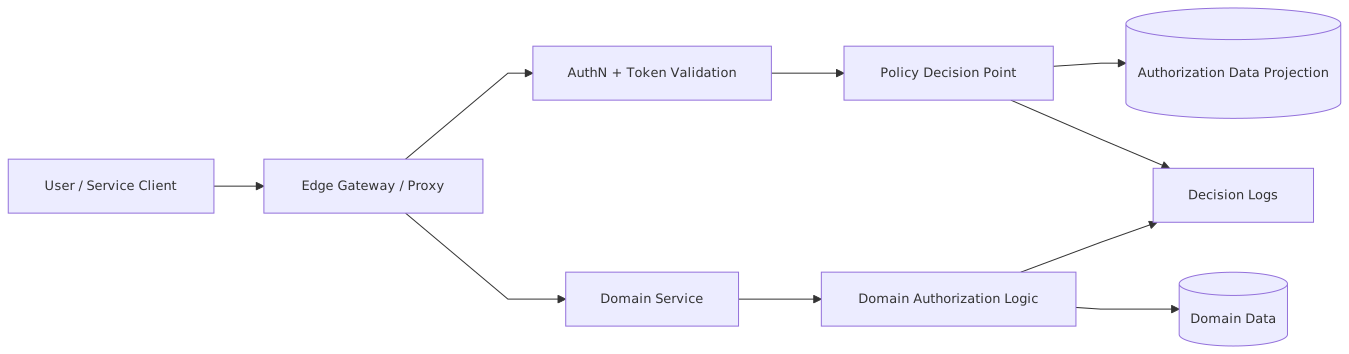
The key is what does not happen: the edge does not become the sole owner of all business authorization.
Domain semantics discussion
This is where many architecture articles become bland. They talk about policies without talking about meaning. But authorization is soaked in meaning.
Suppose you run a global insurance company. A user may have the title “claims manager.” That sounds like a role. It is not enough. Their access may depend on line of business, jurisdiction, catastrophe event assignment, policy lifecycle state, litigation hold, and delegated authority threshold. Some of these are organizational facts. Some are transactional facts. Some are temporary, event-driven facts.
If you model all of that as static roles in the edge, you are lying to the system.
Domain-driven design gives us a better lens. Treat “authority to approve catastrophe payout under delegated threshold in region X” as a domain concept. It may be represented through permissions, attributes, or policy rules, but it belongs to a bounded context with clear ownership. The edge can enforce a projection of that authority. The domain still owns the truth.
That distinction makes migration and governance dramatically easier. EA governance checklist
Architecture
A workable enterprise architecture often separates policy into two broad categories.
Edge-suitable policies
These are strong candidates for enforcement at the edge:
- Authentication and token validity
- Device posture and network trust checks
- Tenant isolation at API boundary
- API/product access by client application
- Scope-based authorization
- Geographic restrictions
- Time-window and rate-class rules
- Step-up authentication triggers
- Contractual access for partners
- Basic ABAC using stable claims and replicated attributes
Domain-suitable policies
These should usually remain in the domain, even if the edge assists:
- Approval thresholds tied to aggregate state
- Access based on workflow stage
- Dynamic ownership or delegation
- Separation of duties within a transaction
- Entitlements based on live business state
- Data visibility depending on legal hold or case sensitivity
- Conditional mutation rights based on invariants
A common pattern is to create an authorization projection. Instead of asking live domain systems for every edge decision, upstream systems publish events—user entitlement changes, org structure changes, contract updates, resource classification changes, tenant membership changes—to Kafka. A projection service builds query-optimized views for policy evaluation.
That projection is not the source of truth. It is a read model for fast decisions.
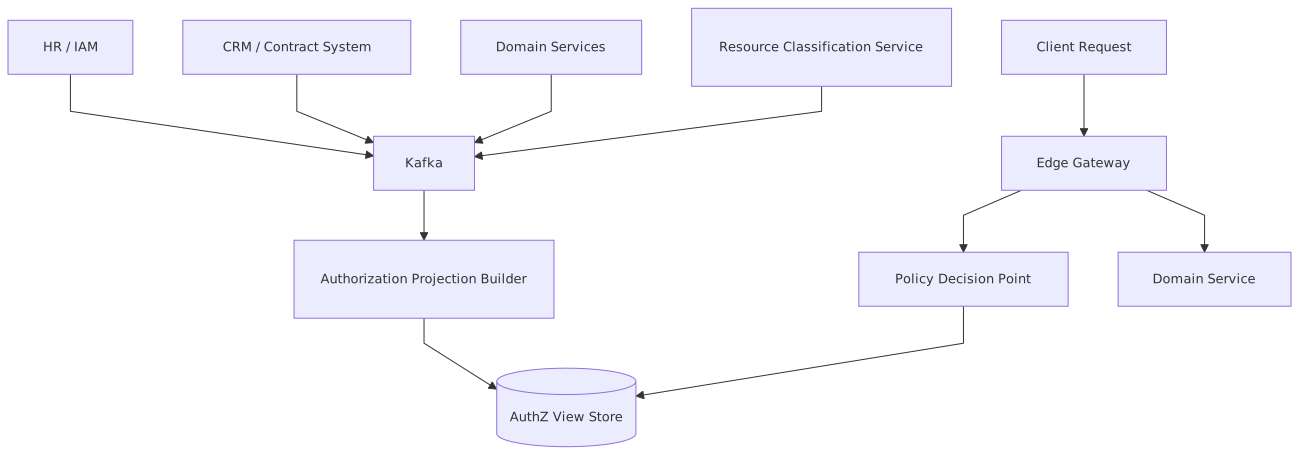
This is CQRS thinking applied to authorization. It works well because policy evaluation is read-heavy, latency-sensitive, and often structurally different from the transactional models where the data originates.
But event-fed projections create a new question: what about reconciliation?
Reconciliation discussion
Eventually consistent authorization data is perfectly acceptable—until it isn’t.
If a user loses access because they left the company, the edge should not wait fifteen minutes for a leisurely synchronization. If a regulator asks why a partner could still access customer records after contract termination, “Kafka lag” is not a convincing answer.
So systems need explicit reconciliation strategies:
- Fast-path revocation for high-risk access changes, propagated synchronously or through priority channels
- Periodic reconciliation jobs that compare source-of-truth entitlements with authorization projections
- Decision TTLs and cache invalidation for sensitive attributes
- Compensating controls such as short-lived tokens and continuous re-authentication
- Policy drift detection between central policy models and domain-owned rules
A mature architecture treats reconciliation as a first-class capability, not a housekeeping task delegated to operations.
Migration Strategy
No serious enterprise starts greenfield here. You inherit API gateways with hand-written rules, services with if-statements full of role checks, brittle LDAP groups, and dozens of applications convinced they are special. Some are.
This is why the migration must be progressive and strangler-style.
Start by mapping current authorization decisions into categories:
- Edge-worthy and easy to centralize
- Domain-owned and should stay local
- Ambiguous, requiring decomposition
- Dead or redundant rules that can be retired
Then build a target operating model around incremental interception, not sudden replacement.
Phase 1: Standardize authentication and coarse edge checks
Move token validation, client authentication, coarse API access, and basic tenant controls to the edge. Keep domain logic where it is.
Phase 2: Externalize repeatable cross-cutting policies
Policies repeated across services—geographic restrictions, partner contract validation, device posture requirements, common scopes—move to the policy decision point.
Phase 3: Introduce authorization projections
Publish entitlement and resource events to Kafka. Build a query model for the edge so the gateway and PDP stop calling source systems directly.
Phase 4: Refactor services to explicit domain authorization boundaries
Replace scattered authorization checks inside service methods with clearer domain authorization components. This often reveals hidden policy duplication and inconsistent semantics.
Phase 5: Strangle legacy policy stores
Retire gateway scripts, app-server interceptors, static ACL tables, and legacy group mappings only after policy parity and decision logging prove the new path is stable.
Here is the migration picture.
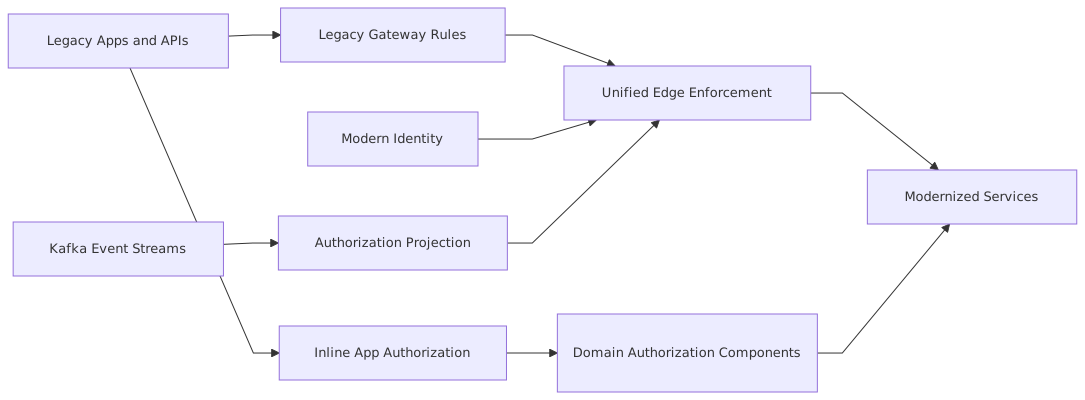
A progressive strangler migration works because it respects two realities: authorization is safety-critical, and legacy systems encode more business knowledge than the documentation admits.
Do not migrate by translating old rules one-for-one into a shiny new engine. First understand what those rules mean. Some are workaround fossils from systems that no longer exist. Some are silently protecting critical segregation-of-duties controls. Some are wrong but relied upon. Migration is not policy copy-and-paste. It is policy archaeology.
Enterprise Example
Consider a multinational bank modernizing its corporate payments platform.
The bank had:
- customer-facing web and mobile channels
- internal operations tools
- partner APIs for ERP integrations
- over 120 microservices
- a mix of regional entitlements and product-specific approval rules
- legacy entitlements stored across IAM, mainframe account systems, and workflow engines
The initial platform strategy was aggressive centralization. The architecture team proposed putting all authorization into the API gateway and a central policy engine. It looked elegant. It failed in pilot.
Why? Because payment approval semantics were not generic. A user’s ability to initiate, approve, release, or repair a payment depended on:
- legal entity and account mandate
- amount thresholds
- currency
- payment type
- dual-approval state
- time-of-day cutoffs
- regional compliance status
- temporary delegation
- fraud risk flags
The gateway team tried to consume all this context at the edge. Latency spiked. Policy definitions became unreadable. Every release required coordination across security, payments, and channel teams. Worse, when a payment’s workflow state changed between evaluation and execution, decisions became inconsistent.
The bank corrected course.
They kept the edge responsible for:
- user and client authentication
- token and certificate validation
- tenant and channel isolation
- device and session risk checks
- coarse permissions such as “payments:initiate” or “payments:approve”
- partner API product access
They moved fine-grained payment authorization into a domain authorization service owned by the payments bounded context. Kafka streams from account mandates, entitlement changes, delegation events, and fraud signals fed an authorization projection used by both the edge and the payments domain.
The edge answered: may this actor access the payments API and attempt approval operations under current trust conditions?
The payments domain answered: may this actor approve this payment, for this account, at this amount, at this workflow state, under current dual-control constraints?
That split reduced edge complexity dramatically. It also made audit stronger because the bank could show two distinct decisions: access admission and business authorization. Regulators liked that. So did the incident teams.
The migration took eighteen months. They ran dual decisions for a period, logging both old and new outcomes. Reconciliation jobs flagged policy mismatches daily. They found dozens of hidden exceptions in regional systems. That is the thing about authorization modernization: it does not just improve architecture. It exposes organizational truth.
Operational Considerations
Architecture drawings are polite fiction unless operations can keep them alive.
Policy lifecycle management
Policies need versioning, promotion workflows, testing, rollback, and ownership. A central repository helps, but ownership should align with domains. Platform teams own the policy framework and common controls. Domain teams own business semantics.
Treat policies like code, but do not stop at that slogan. Add:
- unit tests for policy logic
- golden decision sets
- shadow evaluation in production
- canary rollout by tenant or channel
- policy diff explainability
Decision logging and observability
You need more than access logs. Capture:
- principal identity
- client application
- token claims used
- resource and action
- policy version
- data snapshot or attribute version used
- decision result
- reason codes
- latency
- fallback path if any
Without this, post-incident analysis turns into folklore.
Caching strategy
Caching is unavoidable. The edge needs speed. But every cache is a promise that stale data is acceptable for some period.
Be explicit about which attributes can be cached and for how long. Differentiate between:
- stable identity attributes
- entitlements with medium churn
- revocation-sensitive controls
- resource attributes tied to workflow state
Do not use one TTL for all of them. That is laziness disguised as simplicity.
Resilience and degraded modes
What happens when the policy engine is unavailable? Or Kafka lag grows? Or the authorization projection store is stale?
You need predefined degraded modes:
- fail closed for high-risk operations
- fail open only for carefully classified low-risk read operations
- permit with step-up verification
- serve decisions from signed cached policies for a bounded interval
- route to domain revalidation for sensitive actions
If these decisions are improvised during an outage, the outage has already won.
Tradeoffs
There is no free lunch here. Only different kinds of pain.
Centralized edge authorization advantages
- Consistent enforcement
- Early rejection reduces downstream load
- Better governance and visibility
- Cleaner Zero Trust posture
- Easier cross-channel policy alignment
Centralized edge authorization costs
- Risk of over-centralizing domain logic
- Increased dependency on replicated authorization data
- Hot-path latency concerns
- Platform team bottlenecks
- Harder local experimentation for domains
Domain-local authorization advantages
- Preserves business semantics
- Closer to source-of-truth data
- Easier for domain teams to evolve
- Better fit for stateful, contextual rules
Domain-local authorization costs
- Inconsistent patterns across services
- Weaker enterprise visibility
- Duplicated implementation effort
- More difficult external governance and audit
The right answer is usually hybrid. That sounds boring. It is not. Hybrid done well is disciplined partitioning. Hybrid done badly is chaos with diagrams.
Failure Modes
This is where architecture earns its keep.
1. Stale entitlements at the edge
A user is revoked, but the projection or cache is stale. They retain access longer than acceptable.
Mitigation: short-lived tokens, revocation channels, prioritized event propagation, mandatory revalidation for critical operations.
2. Policy split-brain
The edge allows a request that the domain denies, or vice versa. Users see inconsistency. Support tickets explode.
Mitigation: clear policy boundary, shared vocabulary, shadow mode comparison, reason-code instrumentation.
3. Semantic erosion
Generic roles and scopes replace nuanced domain concepts. Over time, authorization becomes technically consistent but business-incorrect.
Mitigation: bounded context ownership, ubiquitous language in policy models, regular domain review.
4. Policy dependency explosion
The policy engine starts calling many systems synchronously. Latency and failure propagation follow.
Mitigation: projection-based reads, strict dependency limits for hot-path evaluation, precomputed attributes.
5. Audit without explanation
You know the decision outcome but cannot explain why it happened.
Mitigation: structured decision traces and immutable policy versioning.
6. Overuse of ABAC
Attribute-based access control is seductive. It promises flexibility. In practice, poorly governed attributes become a junk drawer. Everyone adds a new attribute; nobody curates semantics.
Mitigation: explicit attribute taxonomy, ownership, lifecycle rules, and retirement discipline.
When Not To Use
Edge authorization is not universal medicine.
Do not push decisions to the edge when:
- the rules depend heavily on live transactional state that changes within the request workflow
- the domain semantics are volatile and not yet stable
- the service is internal-only with low exposure and the overhead outweighs the benefit
- latency budgets are extremely tight and the edge adds material delay
- the organization lacks governance maturity and will centralize without understanding semantics
- event replication cannot meet revocation or compliance requirements
Also, do not build a central policy platform just because the vendor demo looked impressive. A policy engine can become the new ESB: strategically justified, tactically abused, and eventually blamed for problems it did not create.
Sometimes the right move is modesty: edge authentication, coarse gateway controls, and strong domain authorization inside a bounded context. That is still Zero Trust if trust is continuously evaluated where it matters.
Related Patterns
Several related patterns commonly appear alongside edge authorization.
Policy Enforcement Point / Policy Decision Point
The old split still matters. Keep enforcement near traffic. Keep decisions in a service that can be governed and evolved. But do not let that separation hide ownership.
Backend for Frontend
A BFF can carry channel-specific authorization shaping while leaving core business authorization in downstream domains.
Sidecar or service mesh authorization
Useful for east-west traffic and workload identity, but not a replacement for domain authorization. Mesh policy is usually excellent for service-to-service controls and poor at rich business semantics.
CQRS authorization projections
As discussed, this is often the practical answer for low-latency policy reads from replicated data.
Strangler Fig migration
Essential for modernizing legacy auth without a big-bang rewrite. Introduce new edge checks around old systems, then progressively reroute and retire.
Token exchange and delegated access
Important in partner and machine-to-machine scenarios where downstream services need constrained delegation rather than simple pass-through identity.
Summary
Edge authorization in Zero Trust architecture is valuable, but only when treated with restraint.
Put simply: the edge should be a sharp bouncer, not the entire legal system.
Use the edge to validate identity, enforce coarse access, apply contextual controls, and reject bad traffic early. Use domain-owned authorization for decisions rooted in business semantics and live aggregate state. Feed the edge with event-driven authorization projections where low-latency reads are needed, and invest in reconciliation because eventual consistency without reconciliation is just delayed confusion.
If you are migrating from legacy estates, do it progressively. Strangle old policy paths. Run shadow decisions. Reconcile constantly. Expect to discover hidden semantics buried in code and process. That discovery is not a side effect. It is the work.
The best enterprise architectures are not the ones with the most centralized control. They are the ones that place decisions where meaning, speed, and accountability line up.
And in authorization, meaning is everything.
Frequently Asked Questions
What is enterprise architecture?
Enterprise architecture aligns strategy, business processes, applications, and technology in a coherent model. It enables impact analysis, portfolio rationalisation, governance, and transformation planning across the organisation.
How does ArchiMate support architecture practice?
ArchiMate provides a standard language connecting strategy, business operations, applications, and technology. It enables traceability from strategic goals through capabilities and services to infrastructure — making architecture decisions explicit and reviewable.
What tools support enterprise architecture modeling?
The main tools are Sparx Enterprise Architect (ArchiMate, UML, BPMN, SysML), Archi (free, ArchiMate-only), and BiZZdesign. Sparx EA is the most feature-rich, supporting concurrent repositories, automation, scripting, and Jira integration.