⏱ 19 min read
Feature Toggles as Architectural Control in Continuous Delivery | toggle evaluation tree and rollout waves
Continuous delivery is often sold as a conveyor belt. Code goes in one end, value comes out the other. It’s a nice picture. It’s also a lie, or at least a dangerous half-truth.
Real enterprise delivery looks less like a conveyor belt and more like air traffic control. Multiple systems are landing and taking off at once. Some are old and noisy. Some are brand new and overconfident. Some are carrying revenue, regulatory obligations, and customer trust. In that world, feature toggles are not just a developer convenience. They are an architectural control surface.
That distinction matters.
Most teams first meet feature toggles as a tactical trick: hide unfinished code, merge early, deploy safely. Useful, certainly. But at scale, in a portfolio of services, channels, domains, and release trains, toggles become something else entirely. They become a way to decouple deployment from exposure, shape operational risk, coordinate domain transitions, and manage migration in the open rather than in the dead of night. A toggle is not merely an if-statement with a UI. Used properly, it is policy encoded close to behavior.
And used badly, it is a distributed mess of accidental complexity, hidden branching logic, stale configuration, and customer outcomes nobody can explain after the fact.
This is the central architectural question: when does a feature toggle remain a local coding technique, and when does it become part of the architecture? My answer is blunt. The moment a toggle changes business behavior across bounded contexts, user cohorts, or runtime environments, it is architecture. It deserves design, ownership, semantics, governance, and a retirement plan. EA governance checklist
Context
Continuous delivery changed one thing more than any tooling brochure admits: it collapsed the distance between change and consequence.
In the old release model, architecture often hid behind the ceremony of a release weekend. Integration happened in batches. Risk was concentrated. Coordination was explicit because it had to be. Continuous delivery inverts that. Change happens all the time, often invisibly. That is better for throughput, but harsher on architecture. The system needs ways to release behavior gradually, verify outcomes continuously, and retreat without rebuilding the world.
Feature toggles emerged as one answer. They let a team ship code that is not yet universally active. They let operators turn on behavior by cohort, region, tenant, channel, or transaction class. They let product and engineering separate “is it deployed?” from “is it live?” That sounds procedural. It is actually structural.
In domain-driven design terms, toggles matter because they influence the ubiquitous language of release and behavior. “Enabled for gold-tier customers.” “Active only for broker-assisted quotes.” “Disabled for cross-border settlements.” These are not technical details. These are business semantics. Once toggles express domain distinctions, they sit inside the domain model whether engineers like it or not.
That is why naive toggle use causes trouble in enterprises. Teams think they are managing flags. In reality, they are managing conditional business policy across services, events, and customer journeys.
Problem
The practical problem is easy to state and hard to solve.
We want to deploy continuously without exposing unfinished or risky behavior to everyone at once. We want to test in production, but responsibly. We want to migrate old capabilities to new services without stopping the business. We want rollback without rollback. We want to reconcile data and outcomes while two realities coexist.
That is a lot to ask from an if.
In a monolith, the problem is manageable. Toggle evaluation is local. State is mostly coherent. Rollout can often be reasoned about in one place. In a microservice estate, especially one using Kafka or similar event streaming, toggles ripple. A customer-facing toggle might affect API behavior, event publication, downstream projections, fraud scoring, billing, and analytics. If one service evaluates a toggle differently from another, the enterprise creates contradictory truths. A loan appears approved in one context and pending in another. A policy is quoted using the new rating model but invoiced using the old one. Those are not bugs in the abstract. They are operational incidents with domain consequences.
The architecture challenge is therefore not “how do we implement feature flags?” It is “how do we govern controlled divergence in business behavior across a distributed system?”
That is a much more serious question.
Forces
Several forces pull in opposite directions.
First, speed versus consistency. Teams want independent deployment and local control. The enterprise wants coherent customer outcomes. The faster teams move, the easier it is for toggle semantics to drift.
Second, safety versus simplicity. Progressive delivery reduces blast radius, but every toggle introduces alternate execution paths. The code becomes a branching tree. The operational model becomes harder to reason about. You gain control at the cost of clarity.
Third, local autonomy versus domain integrity. In a healthy DDD landscape, bounded contexts own their own models. Good. But rollout policies often cut across contexts: a customer cohort, a geography, a regulatory segment. Someone must define how those concepts map consistently across services.
Fourth, migration pressure versus runtime stability. During strangler migrations, toggles are seductive. Route some traffic to the new capability, keep the old path alive, compare outputs, and ramp up. This is sensible. It also means the architecture is temporarily bi-modal, carrying duplicate logic, duplicate data flows, and reconciliation needs.
Fifth, operational responsiveness versus auditability. If toggles can be changed live, operators can mitigate incidents quickly. They can also accidentally create undocumented production changes. In regulated environments, “someone flipped a flag” is not an acceptable post-incident explanation.
The important thing is not to eliminate these tensions. You can’t. The job is to design a system where the tensions are visible and managed deliberately.
Solution
The architectural solution is to treat feature toggles as governed runtime policy with explicit domain semantics, not ad hoc conditional logic.
That means a few things.
A toggle should have a type. Release toggle, experiment toggle, operational kill switch, migration toggle, entitlement toggle. These are not interchangeable. A release toggle hides incomplete work. An operational toggle protects the platform under load. A migration toggle routes behavior between legacy and target implementations. An entitlement toggle expresses a business rule. If a team stores all of these in one generic mechanism without distinction, they create policy soup.
A toggle should also have a bounded scope and owner. Which context defines it? Which team is accountable for its semantics? What services may evaluate it? What is its expected lifespan? The most dangerous toggles are the immortal ones: “temporary” switches that become permanent hidden architecture.
And a toggle should be evaluated through a consistent decision model. Not every service should improvise its own rollout logic. Enterprises need a toggle evaluation tree: a predictable order of decisions that separates hard safety checks from cohort targeting and experimentation.
A simple pattern looks like this:
- Global safety gates
- Domain eligibility checks
- Tenant or customer entitlements
- Rollout cohort assignment
- Experiment allocation
- Fallback behavior
That order matters. You don’t want experiment logic overriding a regulatory exclusion. You don’t want a tenant entitlement applied after random cohort assignment. Architecture is often just disciplined ordering.
Here is a representative evaluation tree.
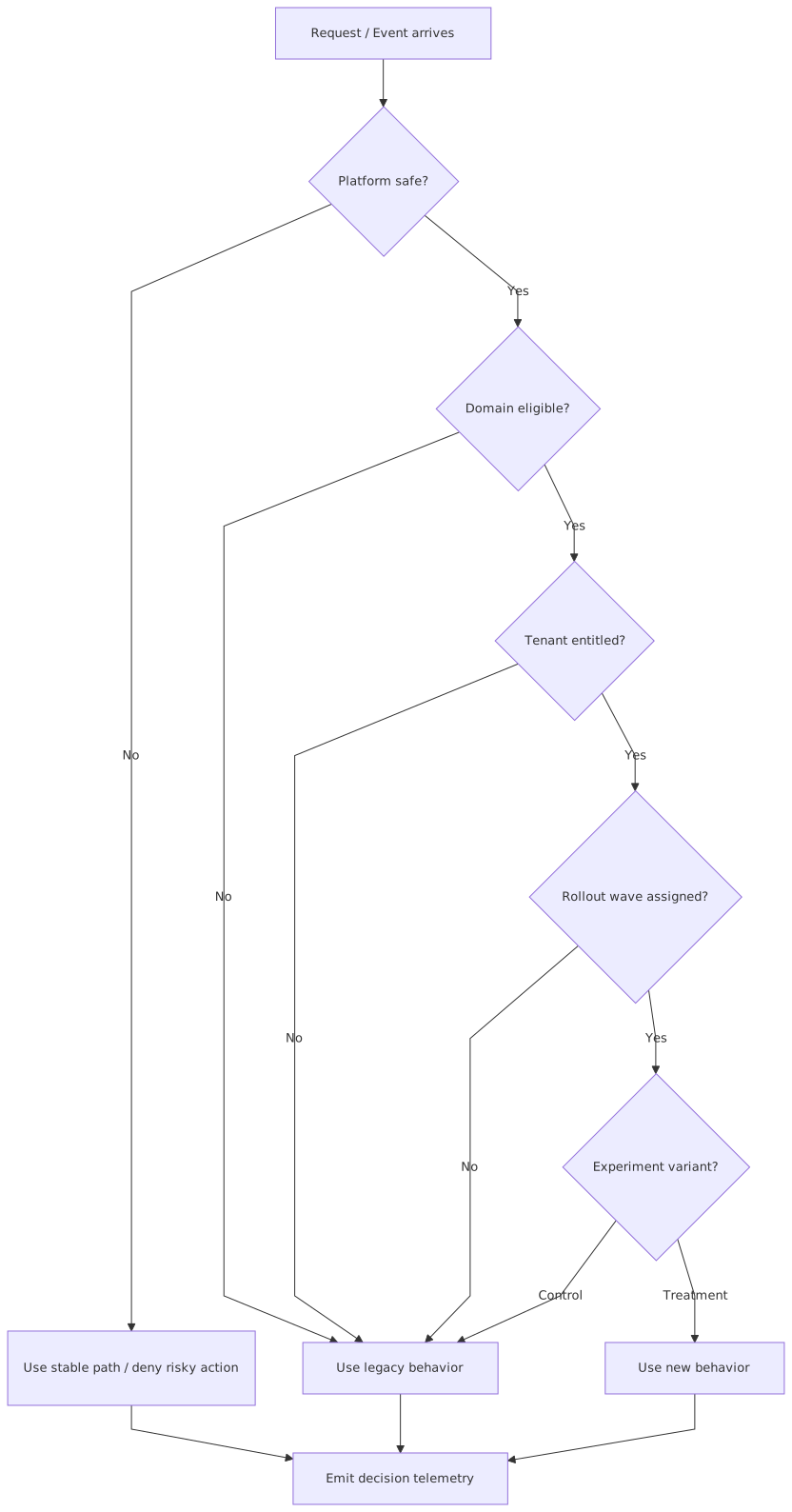
Notice what this is doing. It is not merely deciding whether a button appears. It is controlling which business behavior is valid for this request, this tenant, this operational moment. That is architecture.
Architecture
The architecture of a mature toggle platform usually has four parts.
First, the control plane. This is where toggle definitions live: metadata, ownership, environment, targeting rules, expiry dates, audit history. It is the place where policy is authored. In a large enterprise, this is often centralized because governance, security, and audit matter.
Second, the evaluation plane. This decides toggle outcomes at runtime. There are tradeoffs here. Centralized remote evaluation gives consistency and live control, but adds latency and dependency risk. Local SDK evaluation gives speed and resilience, but risks stale rules and fragmented semantics. For high-throughput transactional systems, the winning pattern is often centrally managed rules with local cached evaluation, backed by strict schema and telemetry.
Third, the telemetry plane. Every significant toggle decision should be observable. Which toggle, which rule matched, which cohort, which variant, which request attributes mattered. If outcomes change and you cannot reconstruct toggle state at the time, your production system is partly unknowable.
Fourth, the lifecycle plane. Toggles need creation standards, naming conventions, review, expiry, and removal. The deletion path is not administrative cleanup. It is part of the architecture. A toggle without an expiry plan is deferred complexity with interest.
In event-driven systems, there is another design choice: evaluate once and propagate the decision, or evaluate independently in each service.
My bias is strong here. If the decision has domain significance, evaluate once close to the initiating interaction and propagate the decision context with the command or event. Do not let six downstream services independently decide whether “new pricing model enabled” using slightly different attributes or stale config. That is how enterprises create reconciliation teams.
For Kafka-based architectures, this often means attaching a decision envelope to the event: toggle version, evaluated outcome, cohort id, maybe rationale category. Downstream consumers may still apply local safety checks, but the business-routing decision is treated as part of the fact stream.
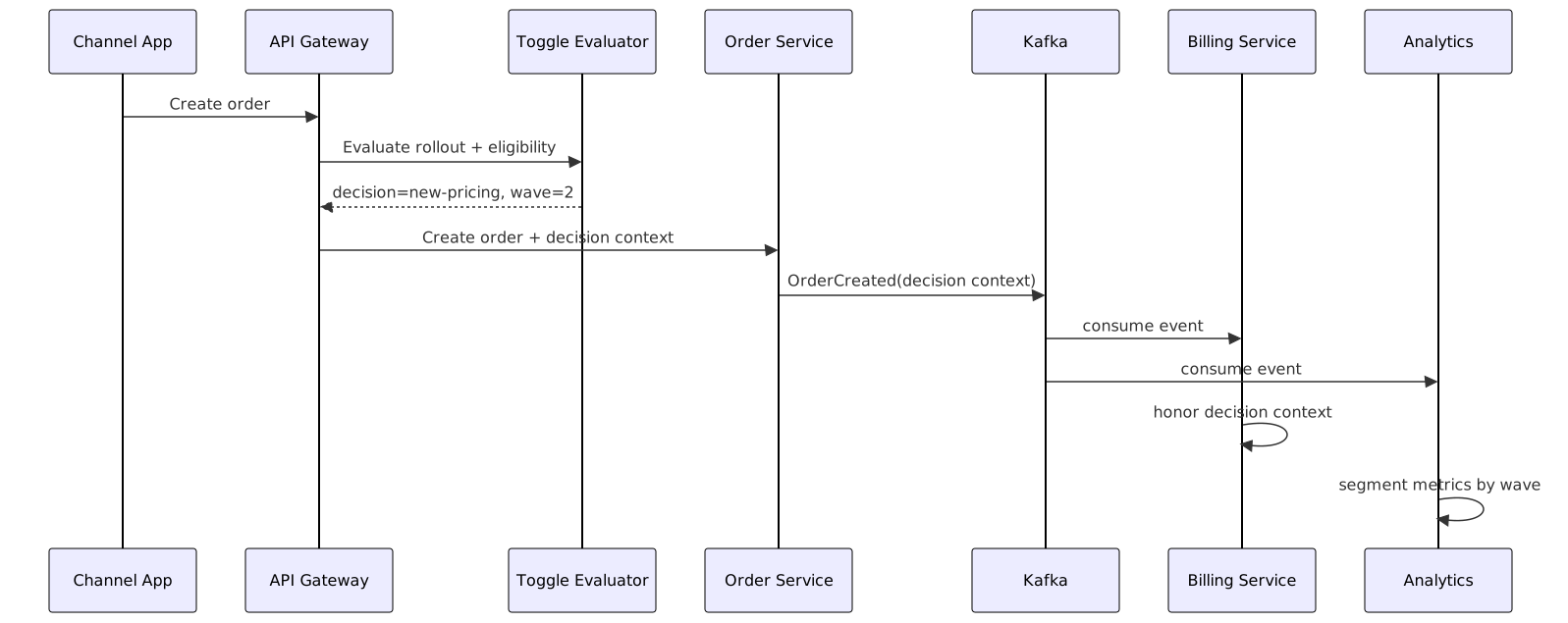
This avoids a common failure mode: the order service prices with the new engine, billing consumes the event later and independently evaluates the old toggle state, and finance wonders why invoice totals do not match checkout totals.
There is a DDD angle here worth emphasizing. Toggle evaluation belongs where the semantics are understood. A release toggle for an internal UI widget can be local. A migration toggle that chooses between legacy underwriting and new underwriting is not a UI concern. It belongs close to the domain service or process manager orchestrating that business decision. Domain semantics should drive toggle placement.
Migration Strategy
Feature toggles become truly valuable during migration. Not because they make migration easy. Nothing does. They make migration survivable.
In a progressive strangler migration, the enterprise gradually moves capabilities from a legacy system to a new one while both remain active. Toggles act as routing controls across the seam. They decide which requests go to the old capability, which to the new one, and when to compare both.
The sensible migration pattern usually moves through stages:
- Dark launch — deploy the new capability but do not expose it.
- Shadow execution — run the new path alongside the old, without customer impact.
- Compare and reconcile — inspect output differences, data drifts, timing behaviors.
- Canary rollout — route a small cohort to the new path.
- Wave expansion — increase cohorts gradually by tenant, region, or transaction class.
- Default switch — make the new path standard.
- Legacy retirement — remove toggle and decommission old path.
This is where migration reasoning matters. A toggle is not enough by itself. You also need reconciliation.
Reconciliation is the work enterprises underestimate because it is unglamorous. While legacy and target paths coexist, outputs will differ. Sometimes because the new model is wrong. Sometimes because the old one is. Sometimes because both are “correct” under different assumptions. You need explicit comparison rules. Which fields must match exactly? Which are acceptable within tolerance? Which downstream side effects are authoritative? If you cannot answer that, your migration is operating on hope.
A useful migration architecture includes a reconciliation service or at least a well-defined comparison process. For example, in a Kafka-driven estate, the legacy underwriting result and the new underwriting result can both be emitted with a shared correlation id, then compared asynchronously. Significant deviations trigger review before wider rollout. event-driven architecture patterns

This pattern is not free. Shadow execution consumes capacity. Diff analysis creates operational overhead. But this is the cost of changing a running business safely.
One more opinionated point: rollout waves should align with domain boundaries, not just percentages. “Enable for 5% of traffic” sounds scientific but can be dangerously arbitrary. Better to start with a low-risk tenant group, a region with supportive operations, a product line with simpler rules, or internal users. Domain-aware waves tell you something. Random percentages often just produce noise.
Enterprise Example
Consider a large insurer replacing a monolithic rating engine with a set of microservices: quote intake, risk enrichment, pricing, discount rules, and policy issuance. The old mainframe-based engine still prices all policies. The new platform is event-driven, uses Kafka for workflow integration, and must support continuous delivery because product changes happen weekly. microservices architecture diagrams
The first instinct in many firms is to build the new services, cut over by product line, and hope for a clean switch. That is fantasy. Insurance pricing is one of those domains where hidden dependencies lurk in endorsements, renewals, broker channels, and regional regulation. A hard cutover invites chaos.
Instead, the insurer uses migration toggles as architectural routing controls.
At quote submission, the quote orchestration service evaluates a domain-aware rollout policy:
- Is this product line in scope?
- Is the state or region approved?
- Is this broker channel included?
- Is this tenant or subsidiary entitled to the new path?
- Is the quote in the current rollout wave?
If yes, the orchestration service calls the new pricing service. If in shadow mode, it also invokes the legacy engine asynchronously and emits both results for reconciliation. The decision context is attached to the quote events on Kafka so downstream issuance, commission, and analytics services know which pricing path produced the result.
This matters because pricing is not isolated. The commission service calculates broker compensation differently depending on discount structures. The analytics platform needs to segment conversion and loss ratio data by rollout wave. The customer support desktop needs to display which pricing path was used when a broker disputes a quote. The toggle is therefore not just a deployment aid. It is part of the enterprise operating model.
What did they learn?
First, semantics beat plumbing. The successful rollout policies were expressed in domain language: product family, broker class, renewal vs new business, admitted state. Early attempts to target by technical identifiers were brittle and incomprehensible outside engineering.
Second, reconciliation found business misunderstandings, not just coding defects. In one region, the new service handled a discount stack in the “correct” documented order, while the legacy engine followed a decades-old operational exception. The migration exposed a tacit business rule the documentation had forgotten. This is common. Legacy systems are often archives of institutional memory.
Third, independent toggle evaluation downstream caused trouble. One analytics consumer re-evaluated rollout state based on current configuration rather than the original quote decision. Historical reporting drifted as waves expanded. They fixed it by treating decision context as immutable event metadata.
Fourth, some toggles had to become first-class domain policy. A tenant-specific discount entitlement started life as a release toggle and ended as a proper business capability owned by the product domain. That transition was healthy. If a “toggle” represents enduring business meaning, stop pretending it is temporary.
Operational Considerations
Operationally, feature toggles need more discipline than most teams expect.
Caching and availability. Runtime evaluation should degrade gracefully. If the toggle service is unreachable, what happens? Fail-open for a cosmetic UI experiment is tolerable. Fail-open for a fraud bypass or risky payment path is reckless. Every important toggle should define failure behavior explicitly.
Audit and change control. In enterprises, toggle changes are production changes. They need audit trails: who changed what, when, why, and with what approval. This is especially important for financial services, healthcare, and regulated utilities.
Telemetry. You need correlation between toggle decisions and business outcomes. Latency, error rates, conversion, abandonment, claims leakage, fraud rates, support calls. Otherwise rollout waves are theatre.
Testing. Toggle-heavy systems need combinatorial restraint. You cannot test every possible flag combination. The answer is to model allowed states and prohibit invalid combinations by design. This is another reason to classify toggle types. Not every flag should interact with every other flag.
Security. A toggle can expose behavior before controls are ready. Treat toggle administration as privileged access. Attackers do not care whether the vulnerability was “only behind a feature flag.”
Retirement. Every toggle should carry an expiry date or review date. Teams should track toggle debt like any other technical debt, except this debt has runtime consequences.
Tradeoffs
Feature toggles buy flexibility by introducing branching. That is the core tradeoff, and there is no escaping it.
They let teams deploy independently, stage exposure, run experiments, and manage migration risk. They also make code paths multiply, observability harder, and business logic less obvious.
A centralized toggle platform improves governance and consistency but can become a bottleneck, both organizationally and technically. A decentralized model empowers teams but often produces semantic drift. The sweet spot is usually centralized standards with federated ownership. ArchiMate for governance
Evaluating once and propagating decisions improves consistency, especially in event-driven systems, but reduces downstream autonomy. Independent evaluation preserves local control but invites divergence. For high-value domain decisions, consistency usually wins.
Rollout waves reduce blast radius but prolong the period of dual behavior. That means more reconciliation, more support complexity, and more analytical segmentation. Safety is not free.
And there is the hidden tradeoff many leaders miss: toggles can mask architectural indecision. Teams postpone hard design work by adding one more switch. Sometimes that is prudent. Sometimes it is cowardice in YAML form.
Failure Modes
The classic failure mode is toggle sprawl. Hundreds of flags, unclear ownership, overlapping targeting rules, stale code paths, and no reliable inventory. At that point, the enterprise has built a shadow architecture no one can describe.
Another failure mode is semantic ambiguity. A flag named newPricingEnabled sounds harmless until one service interprets it as “call the new pricing API,” another as “display the new premium breakdown,” and a third as “use new discount logic.” Same words, different realities. This is why toggle names need explicit business meaning and bounded scope.
Then there is inconsistent evaluation. Service A uses customer region from the profile service. Service B uses billing country from the invoice context. Both think they are evaluating “regional rollout.” They are not. Customers get contradictory experiences.
Stale configuration is another common one. Local caches improve resilience, but if propagation is weak or versions are unmanaged, one part of the estate can operate on old toggle rules for hours. In financial or regulated workflows, that can become a reportable incident.
Migration-specific failure modes are nastier. Shadow execution without disciplined reconciliation creates false confidence. Teams see “mostly matching” outcomes and proceed, only to discover edge-case financial discrepancies after broad rollout. Another is side-effect duplication: both legacy and new paths accidentally emit billable events. Dual-write and dual-process architectures are unforgiving.
Finally, there is social failure. If toggles let product, operations, and engineering change business behavior without shared understanding, the organization fragments. Architecture is partly about code, yes. It is also about making sure the left hand knows what the right hand just enabled for wave three in Germany.
When Not To Use
Feature toggles are not a universal answer.
Do not use them for long-lived business configuration masquerading as release control. If a rule is permanent domain policy—customer tiering, contractual entitlement, regulatory segmentation—model it properly in the domain. A toggle platform may host the policy technically, but the concept belongs to the business model, not release machinery.
Do not use toggles to avoid versioning when public contracts change incompatibly. If an API or event schema changes materially, pretending you can hide the difference behind flags often leads to consumer confusion and prolonged dual support. Sometimes versioning is the adult decision.
Do not use them where deterministic behavior is legally required and runtime drift is unacceptable unless the governance is truly strong. In some core accounting, settlement, or compliance flows, “we can switch it live” is not a virtue.
And do not use them to patch over poor modularity. If turning on one feature requires flags across twelve unrelated services, the problem may be the decomposition, not the rollout mechanics.
Related Patterns
Feature toggles sit near several related patterns, and it helps to separate them.
Strangler Fig Pattern. Toggles are often the routing mechanism inside a strangler migration. The pattern is larger than the toggle: it includes seams, interception, coexistence, and retirement.
Branch by Abstraction. This is the code-level companion. You insert an abstraction, implement old and new behaviors behind it, and use toggles to choose between them. Very effective for internal refactoring.
Canary Release and Blue-Green Deployment. These are deployment strategies. Toggles can complement them, but they are not the same thing. Blue-green swaps environments. Toggles control behavior within an environment.
Saga and Process Manager. In distributed domains, rollout decisions may need to persist across long-running workflows. A saga should not re-decide core behavior halfway through because the flag changed.
Policy Decision Point / Policy Enforcement Point. In security and access control architecture, this split is familiar. It is a useful mental model for enterprise toggle design too: define policy centrally, enforce it close to behavior.
Summary
Feature toggles are one of those tools that start small and end up governing more of the enterprise than anyone intended.
Used casually, they are little more than conditional branches with a dashboard. Used architecturally, they become a control system for continuous delivery: separating deployment from release, enabling progressive strangler migration, supporting reconciliation, and shaping rollout waves in business terms rather than technical guesswork.
The key is to stop thinking of toggles as incidental code constructs and start treating them as runtime policy with domain semantics. Give them types. Give them owners. Put them in the right bounded contexts. Evaluate them consistently. Propagate important decisions through events. Instrument them. Reconcile during migration. Retire them aggressively.
Above all, remember this: every toggle creates two worlds. Architecture is the discipline of making sure the business can survive while both exist.
Frequently Asked Questions
What is enterprise architecture?
Enterprise architecture aligns strategy, business processes, applications, and technology in a coherent model. It enables impact analysis, portfolio rationalisation, governance, and transformation planning across the organisation.
How does ArchiMate support architecture practice?
ArchiMate provides a standard language connecting strategy, business operations, applications, and technology. It enables traceability from strategic goals through capabilities and services to infrastructure — making architecture decisions explicit and reviewable.
What tools support enterprise architecture modeling?
The main tools are Sparx Enterprise Architect (ArchiMate, UML, BPMN, SysML), Archi (free, ArchiMate-only), and BiZZdesign. Sparx EA is the most feature-rich, supporting concurrent repositories, automation, scripting, and Jira integration.