⏱ 20 min read
Most architecture governance is either too weak to matter or so heavy it becomes a corporate tax on delivery. ArchiMate for governance
That’s the uncomfortable truth.
In a lot of enterprises, “governance” means one of two things: a slide deck review nobody respects, or a bureaucracy machine that slows teams down until they route around it. Neither is architecture. Neither improves outcomes. And neither deserves the name governance. EA governance checklist
Real architecture governance is not about drawing boxes, policing standards, or forcing every team through the same committee ritual. It is about making sure important technology decisions are made deliberately, with the right level of control, and with consequences visible before the enterprise pays for them in outages, security failures, or runaway complexity.
That’s the simple explanation.
If you want the SEO version in one line: architecture governance is the way an organization makes, reviews, enforces, and evolves architecture decisions so that delivery teams can move fast without creating systemic risk.
That’s it. That’s the core.
But in real enterprise work, it gets more complicated quickly. Because governance sits in the uncomfortable middle between strategy and delivery, between standards and autonomy, between architects who want coherence and engineers who just want to ship. If you do it badly, teams hate you. If you don’t do it at all, the enterprise slowly turns into a pile of incompatible systems, duplicated capabilities, fragile integrations, and security exceptions held together by PowerPoint optimism.
So let’s talk about what architecture governance actually is, how it works in real organizations, where architects get it wrong, and what good looks like when you’re dealing with banking systems, Kafka platforms, IAM sprawl, and cloud adoption at enterprise scale. architecture decision record template
What architecture governance actually means
Architecture governance is the set of practices, decision rights, controls, and feedback loops used to guide technology decisions across an organization.
Not just approve them. Guide them.
That distinction matters.
A lot of architecture teams think governance means gatekeeping. It doesn’t. Governance is broader than an approval board. It includes:
- decision principles
- architecture standards
- review processes
- exception handling
- accountability for outcomes
- measurement of compliance and fitness
- escalation paths for risk
- continuous evolution of standards
Good governance answers questions like:
- Who can choose a technology?
- Which decisions are local to a team, and which are enterprise-wide?
- When does a team need architectural review?
- What standards are mandatory versus recommended?
- How do we handle exceptions?
- How do we know if the architecture is getting better or worse over time?
That’s governance.
And no, it should not mean every team needs permission to create a REST API or deploy a container.
The real point is this: governance exists because some technology decisions create enterprise-wide consequences that local teams cannot see.
A product team may think choosing a new identity provider is a local optimization. It isn’t. It impacts IAM integration, audit controls, user lifecycle management, privileged access, support models, and probably regulatory obligations. A team may think spinning up a separate Kafka cluster is faster. Maybe. But now you have platform duplication, fragmented event contracts, inconsistent security posture, and operational complexity that will outlive the project sponsor. enterprise architecture guide
Governance is the mechanism that says: some decisions are not just your decision.
That sounds unfashionable. Fine. Enterprise architecture is not a popularity contest. enterprise architecture consulting
Why architecture governance exists in the first place
If enterprises were small, simple, and staffed only by disciplined teams with perfect judgment, we wouldn’t need governance.
But enterprises are none of those things.
They are messy systems made of:
- old applications that still matter
- new platforms introduced too quickly
- acquisition baggage
- duplicated data
- conflicting incentives
- compliance requirements
- budget politics
- teams optimizing locally
- executives chasing speed and control at the same time
So governance exists to manage four things:
That last one is the hardest.
Because the mature position is not “centralize everything” and it’s not “let every team choose.” Both are lazy answers. The real job is deciding which decisions need central control and which should stay with delivery teams.
For example:
- Choosing the enterprise IAM platform? Central decision.
- Naming your internal microservice? Team decision.
- Defining Kafka topic retention and encryption standards? Central policy.
- Modeling your service’s internal domain objects? Team decision.
- Selecting one of three approved cloud database patterns? Team decision within guardrails.
- Introducing an entirely new observability stack? Not a team decision.
That’s the shape of governance in practice.
Governance is not architecture review boards. That’s only one tool
Let me be blunt: many architecture review boards are a symptom of weak governance, not strong governance.
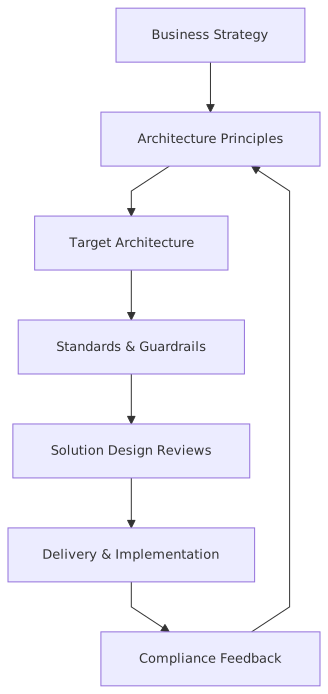
If every meaningful decision has to be dragged into a committee, your architecture operating model is already broken.
Review boards have a role. Sometimes. They are useful for:
- high-risk initiatives
- major platform choices
- cross-domain integration decisions
- exception approvals
- legacy modernization with significant enterprise impact
But if the board is reviewing everything, one of two things is true:
- your standards are too vague to guide teams without meetings, or
- your architects don’t trust teams, so they replaced governance with supervision
Neither scales.
Strong governance should reduce the number of decisions needing escalation. It should push clarity forward into principles, standards, reference architectures, reusable patterns, platform products, and automated controls.
This is one of my stronger opinions: the best governance is often invisible to delivery teams because it is embedded in the engineering path.
Examples:
- cloud landing zones enforcing network and security baselines
- IAM integration patterns built into application onboarding
- Kafka provisioning templates with policy defaults
- CI/CD checks for approved images, secrets handling, tagging, and encryption
- reference architectures for internet-facing APIs in banking
- standard event schemas and topic naming conventions
That is governance with teeth. Not a monthly meeting where architects ask teams to “take comments offline.”
The core components of architecture governance
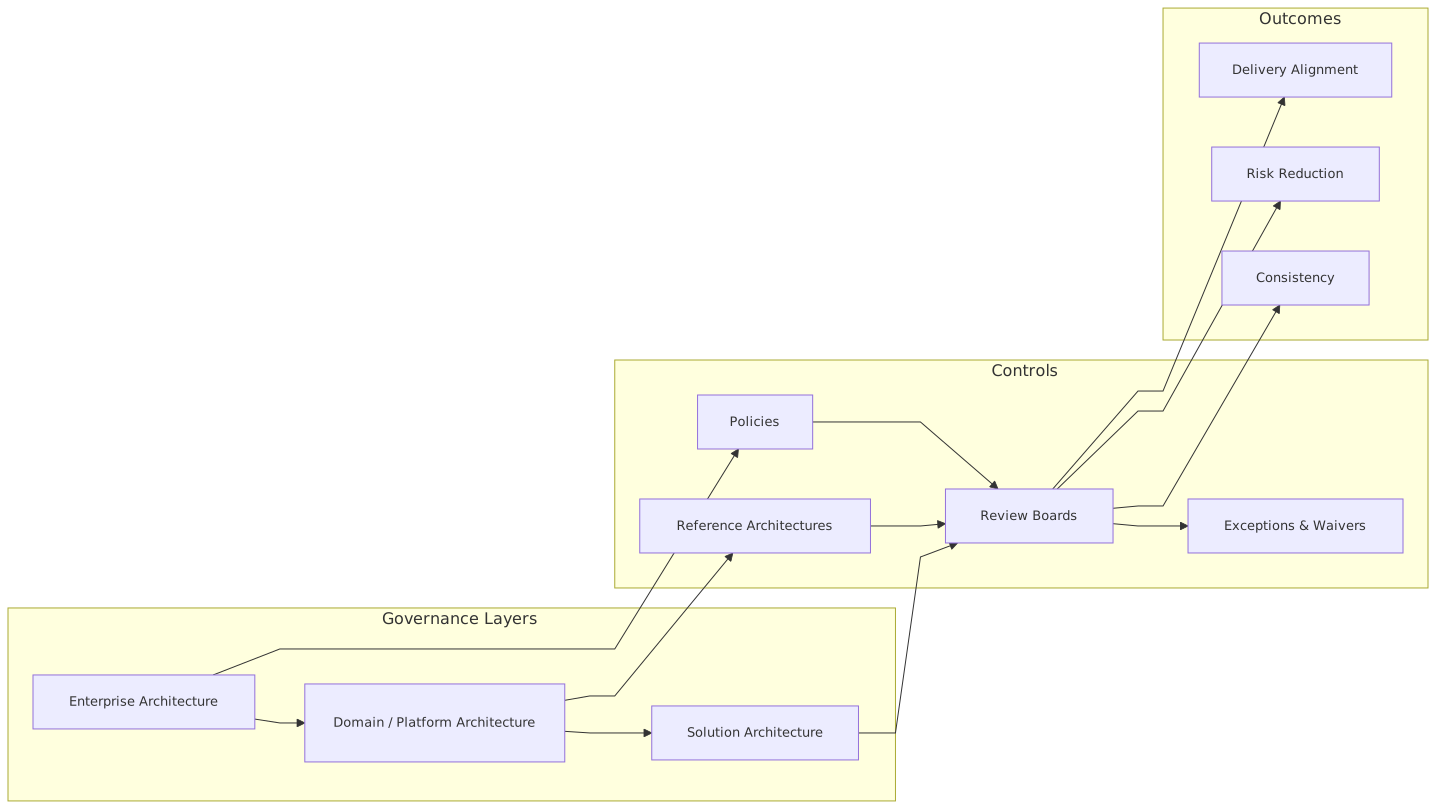
In real enterprise work, architecture governance usually rests on six components.
1. Principles
These are the high-level rules that shape decisions.
Good principles are few, clear, and testable in practice. Not slogans.
Bad principle: “Leverage modern technologies to drive innovation.”
Good principle: “Customer-facing workloads must use centralized IAM for authentication and authorization unless a formally approved exception exists.”
See the difference? One is decorative. The other changes decisions.
Typical enterprise principles might include:
- cloud-first, but not cloud-random
- buy before build for commodity capabilities
- event-driven integration for business domain events
- zero trust access for internal and external users
- data ownership remains with the system of record
- resilience requirements must match business criticality
If your principles can’t be used to settle an argument, they are not principles.
2. Standards and guardrails
These are the practical interpretations of principles.
Examples:
- all customer identity flows must integrate with the enterprise IAM stack
- production Kafka topics require defined ownership, retention, classification, and schema strategy
- regulated banking workloads must use approved cloud regions and key management controls
- APIs exposed externally must go through the standard gateway pattern
- privileged access must use approved PAM controls and federated identity
Standards should distinguish:
- mandatory
- recommended
- deprecated
- prohibited
If you don’t classify standards this way, teams will treat all of them as optional, or all of them as equally painful.
3. Decision rights
This is where many architecture functions fail. They talk about standards but never clarify who gets to decide what.
You need explicit decision ownership:
- enterprise architects define enterprise-wide patterns and cross-domain standards
- platform teams own implementation patterns and paved roads
- domain or solution architects shape solution decisions within those constraints
- engineering teams make local design choices inside guardrails
- risk, security, and compliance functions co-own certain categories of control
Without decision rights, governance becomes theater.
4. Review and exception process
Exceptions are not governance failure. They are governance reality.
A mature enterprise has a way to say:
- here is the standard
- here is why this case is different
- here is the risk
- here is the mitigation
- here is the expiry date
- here is who approved it
The expiry date matters. Otherwise exceptions become permanent architecture by accident.
5. Measurement
If you can’t measure architecture adherence and drift, governance is just opinion.
Useful metrics include:
- percentage of applications integrated with enterprise IAM
- number of cloud deployments outside approved landing zones
- Kafka topics without registered ownership or schema controls
- exception count by domain and age
- technology stack diversity by capability
- critical systems aligned to target resilience patterns
- unsupported products still in production
Governance should produce observable signals, not just decisions.
6. Evolution
Standards must change. If they don’t, governance becomes fossilized.
A standard that made sense three years ago may now be the wrong pattern. Architects who confuse consistency with permanence do a lot of damage. Governance has to evolve with platform maturity, vendor shifts, regulation, and lessons from delivery.
How this applies in real architecture work
This is where people get disappointed. Because architecture governance sounds elegant in a framework diagram, but in practice it shows up in awkward, political, operational moments.
Real architecture work is not “define target state and govern compliance.” It is more like:
- a product team wants to onboard a new SaaS vendor that has its own identity model
- an integration team wants a new Kafka cluster because the shared platform is too slow to provision
- a cloud migration program wants to lift-and-shift a fragile banking application without redesign
- a security team wants tighter IAM controls, while operations wants fewer moving parts
- a line of business wants an urgent exception because a regulatory deadline is looming
Governance is the mechanism for handling those moments without improvising every time.
Example: banking application modernization in cloud
Let’s say a bank is modernizing a customer servicing platform.
The target architecture says:
- applications should run in approved cloud landing zones
- authentication should use centralized IAM with MFA and federation
- event-driven integration should use the enterprise Kafka platform
- customer data must follow classification and encryption controls
- internet-facing APIs must use the standard gateway and WAF pattern
Now the delivery team says:
- the legacy app can’t support modern IAM integration without significant rewrite
- the Kafka platform onboarding process takes six weeks
- the cloud landing zone has network restrictions that break a third-party dependency
- the target API gateway adds latency and cost
This is where weak architects become process clerks. They just repeat the standard and block progress.
Strong architects do something else:
- identify which constraints are real enterprise controls and which are accidental friction
- separate valid exceptions from convenience requests
- work with platform teams to remove unnecessary barriers
- define transitional patterns where needed
- document risk, mitigation, and sunset plan for deviations
For example:
- a temporary IAM bridge pattern is approved for the legacy app, with a deadline for full federation
- Kafka onboarding is streamlined through pre-approved templates for low-risk use cases
- the landing zone team adjusts network policy to support a controlled integration pattern
- the API gateway requirement remains mandatory because the external threat model justifies it
That is governance doing real work. Not saying yes to everything, not saying no to everything. Shaping better decisions under delivery pressure.
A real enterprise example: Kafka governance in a bank
Here’s a pattern I’ve seen in large financial organizations.
A bank decides to expand event-driven architecture across retail banking, payments, fraud, and customer servicing. Kafka becomes the strategic backbone for asynchronous integration and near-real-time processing.
On paper, this is a good move.
Then reality hits.
Different teams start creating:
- inconsistent topic naming
- duplicate business events
- no clear data ownership
- retention settings based on guesswork
- weak access controls
- no schema discipline
- direct point-to-point misuse hidden inside an event platform
- multiple clusters created by different infrastructure groups
Within 18 months, the “enterprise event backbone” is drifting toward a distributed mess.
This is where architecture governance matters.
The governance response should not be “all Kafka decisions go to the architecture board.” Too slow. Too late.
It should look more like this:
Governance controls for Kafka
- define enterprise event categories: domain events, integration events, technical events
- assign ownership for each topic and schema
- establish naming, retention, partitioning, encryption, and access standards
- require schema strategy for regulated or shared data
- define when teams can create topics autonomously and when review is required
- standardize cluster provisioning through a platform team
- ban unmanaged clusters except by approved exception
- monitor topic sprawl, orphaned topics, and access policy violations
- align event governance with data governance and security classification
What architects often miss
The mistake is treating Kafka as just infrastructure. It isn’t. In a bank, Kafka becomes part of the enterprise information architecture, integration architecture, security architecture, and operational risk posture. integration architecture guide
If governance only covers the cluster and not the event model, you’ll get technical compliance with architectural chaos.
And yes, there is a contrarian point here: many organizations adopt event-driven architecture before they are mature enough to govern events. They think Kafka will create decoupling automatically. It won’t. It often creates a faster, harder-to-see form of coupling unless governance is clear.
IAM governance: the area where “team autonomy” often goes too far
Identity and access management is one of the best examples of why architecture governance exists.
Every application team thinks identity is a detail until it becomes a breach, an audit finding, or a customer support nightmare.
In enterprise reality, IAM governance should cover:
- authentication patterns
- authorization models
- federation standards
- service identities
- privileged access
- user lifecycle integration
- logging and traceability
- customer identity versus workforce identity separation
And yet, teams still try to do things like:
- store their own local users “temporarily”
- bypass enterprise federation because it is “complex”
- implement custom role models with no mapping to enterprise controls
- create machine credentials manually
- use shared technical accounts in production
This is exactly where architects need a spine.
Not every standard is negotiable. In banking especially, IAM is not a style preference. It is control architecture.
That said, governance often fails here for another reason: the central IAM platform is painful to use. Slow onboarding, poor documentation, rigid patterns, weak developer support. Then architects act surprised when teams go around it.
That is not just a delivery failure. It is a governance failure.
A useful rule: if teams keep bypassing a standard, don’t just blame the teams. Investigate whether the governed path is actually usable.
Good governance requires both control and service quality.
Cloud governance is architecture governance, whether people admit it or not
Cloud governance gets treated as a separate discipline sometimes. Fine, organizationally that may make sense. But conceptually, cloud governance is architecture governance with stronger automation.
In cloud environments, governance should not depend mainly on manual reviews. The scale is too high and the pace is too fast.
What good looks like:
- approved landing zones with network, logging, identity, and policy baselines
- standard deployment patterns for common workload types
- policy-as-code for encryption, tagging, region usage, and public exposure
- reference patterns for regulated workloads
- cost guardrails tied to architecture choices
- exception workflows integrated into platform processes
This is one of the biggest shifts in modern architecture work. Governance moves from static documents to executable controls.
Architects who haven’t adapted to this still produce standards nobody reads while engineering teams build the real governance in Terraform, Kubernetes policies, CI/CD gates, and cloud platform templates.
Harsh but true.
If architecture governance is not influencing the platform engineering model, it is probably not influencing reality.
Common mistakes architects make
Let’s be honest about our own profession for a minute. Architects create a lot of governance problems themselves.
1. Confusing governance with approval
If your only move is “submit for architecture approval,” you are not governing architecture. You are creating a queue.
2. Writing standards that are too abstract
Teams cannot implement “favor loosely coupled services aligned to business capabilities.” They can implement “publish customer domain events to the shared Kafka platform using approved schema and classification controls.”
Specificity matters.
3. Governing too late
Reviewing architecture after delivery has started is mostly theater. The important decisions are already embedded in backlog, contracts, environments, and code.
4. Ignoring platform usability
A standard nobody can consume at delivery speed is not a standard. It is a workaround generator.
5. Treating exceptions as rebellion
Sometimes the standard is wrong for the use case. Sometimes the enterprise is in transition. Sometimes the platform isn’t ready. Mature architects can handle nuance without collapsing into inconsistency.
6. Failing to define decision rights
When nobody knows who decides, politics decides.
7. Trying to govern everything equally
Not all decisions matter equally. Governance should focus on high-impact, high-risk, high-reuse concerns. If you govern every technical choice, teams stop listening.
8. Separating governance from outcomes
If governance does not reduce incidents, improve interoperability, strengthen security, or lower duplication, then what exactly is it doing?
A practical governance model that actually works
Here’s a model I’ve seen work better than the classic architecture-police approach.
The key is that governance should be distributed, not centralized in one committee.
Enterprise architecture sets direction.
Platform teams operationalize it.
Solution and domain architects apply it.
Engineering works within it.
Risk and security shape the control boundaries.
Governance forums deal with the difficult edge cases.
That’s a healthier model than pretending a monthly board can govern a modern enterprise.
Contrarian view: too much governance is often a symptom of weak architecture
Here’s the contrarian thought that experienced people usually recognize immediately: if you need constant heavy governance, your architecture may be too complicated, your standards too unclear, or your platforms too immature.
Strong architecture reduces the need for intervention.
When patterns are clear, platforms are usable, and decision rights are understood, governance becomes lighter because teams can operate safely without escalation.
So when executives ask, “How do we tighten governance?” the better question is often:
- which decisions are generating repeated risk?
- where are teams forced to improvise?
- what standards are unclear or unrealistic?
- what platform capabilities are missing?
- what should be automated instead of reviewed?
More governance is not automatically better governance.
In fact, mature enterprises often have fewer meetings and stronger control than immature ones, because the controls are built into delivery.
What good architecture governance feels like
This is a strange but useful test.
Bad governance feels like:
- waiting
- guessing what the architects want
- producing slides for approval
- arguing over wording
- discovering mandatory standards late
- collecting exceptions forever
- hearing “it depends” when a decision is needed
Good governance feels like:
- knowing the boundaries early
- using standard patterns by default
- escalating only genuinely hard decisions
- getting quick answers when a cross-enterprise risk appears
- seeing exceptions tracked and retired
- having architecture involved before the wrong thing is expensive
If teams experience governance mainly as friction, something is wrong.
If the enterprise experiences no friction at all, something is also wrong.
The sweet spot is purposeful constraint.
That phrase matters. Enterprises need constraint. Especially banks. Especially in IAM. Especially in cloud security. Especially with Kafka and data movement. The issue is not whether constraint exists. The issue is whether it is targeted, justified, and operationally usable.
Final thought
Architecture governance is not about stopping teams from building. It is about stopping the enterprise from building itself into a corner.
That corner usually looks familiar:
- too many platforms
- inconsistent IAM
- cloud estates with policy drift
- Kafka environments full of unmanaged topics and unclear ownership
- duplicated capabilities across business units
- exceptions nobody retired
- “temporary” solutions celebrating their fifth birthday
Governance is the discipline that says architecture decisions have enterprise consequences, and those consequences deserve structure, accountability, and follow-through.
Done badly, governance becomes bureaucracy.
Done well, it becomes one of the few mechanisms that lets a large organization scale delivery without scaling chaos.
And if I had to reduce it to one practical rule, it would be this:
govern the decisions that create systemic risk, automate the controls you can, and leave teams alone on the rest.
That is usually the difference between architecture that helps and architecture that gets ignored.
FAQ
1. What is architecture governance in simple terms?
Architecture governance is how an organization controls and guides important technology decisions so teams can deliver quickly without causing security, integration, compliance, or operational problems across the enterprise.
2. Is architecture governance the same as an architecture review board?
No. A review board is only one governance mechanism. Real governance also includes principles, standards, decision rights, exception processes, metrics, and automated controls built into platforms and delivery pipelines.
3. Why is architecture governance important in banking?
Banking environments have high regulatory pressure, complex integration landscapes, sensitive data, and strict resilience expectations. Without governance, teams create inconsistent IAM models, risky cloud deployments, uncontrolled Kafka usage, and fragmented architectures that become audit and operational problems.
4. What are the most common architecture governance mistakes?
The big ones are over-centralizing decisions, writing vague standards, governing too late, ignoring developer experience, failing to track exceptions, and treating governance as documentation instead of an operating model.
5. How do you make architecture governance less bureaucratic?
Focus governance on high-risk and cross-enterprise decisions, define clear standards, automate controls in cloud and platform tooling, provide paved-road patterns, and use review forums only for cases that genuinely need escalation.
Frequently Asked Questions
What is architecture governance?
Architecture governance is the set of practices, processes, and standards that ensure architectural decisions are consistent, traceable, and aligned to organisational strategy. It includes architecture review boards (ARBs), modeling standards, lifecycle management, compliance checking, and exception handling.
How do you set up architecture governance in a large organisation?
Start with clear principles and a lightweight metamodel. Establish an Architecture Review Board with defined remit and cadence. Implement decision records (ADRs). Use a tool like Sparx EA to make governance evidence model-based rather than slide-based. Federate ownership — enterprise architects set standards, domain architects maintain their areas.
What is the role of ArchiMate in architecture governance?
ArchiMate supports governance by providing a standard language that makes architecture proposals comparable and reviewable. Governance decisions, principles, and compliance requirements can be modeled as Motivation layer elements and traced to the architectural choices they constrain — enabling reviews based on evidence, not opinion.